
TL;DR
Alphabet raised $85 billion in the largest equity offering in history, backed by a $10 billion Berkshire Hathaway stake. The proceeds will fund AI infrastructure as the company guides for up to $190 billion in 2026 capex.





A long-serving military vessel is a unique piece of a country’s naval history. Sadly, several iconic U.S. Navy ships are set to be decommissioned in 2026, and still others are stuck in increasingly delayed renovation projects. The formidable U.S.S. Dwight D. Eisenhower aircraft carrier, however, is finally set to return to naval service.
This huge Nimitz-class carrier, measuring 1,092 feet long and displacing 101,600 long tons, will mark its 50th birthday in 2027. With aircraft carriers being such a crucial component of global power projection, the venerable ship was returned to Virginia’s Norfolk Naval Shipyard in January 2025, for an extensive period of PIA (Planned Incremental Availability).
This is an extended inspection, evaluation, and modernization process, a daunting job for a vessel of this size. It was completed ahead of schedule in April 2026, and Commander Jason Downs, Project Superintendent, hailed the collaborative effort. He said, a Navy release reports, “The entirety of the project team mustered more than 4,000 people daily, all with one common vision–deliver IKE, fully mission capable, back to the fleet before our commitment date.”
The extensive effort included unique tasks like repairing and improving the carrier’s catapult system, a vital feature that allows for the launch of aircraft. Commander Downs went on to boast that this was “the SECOND consecutive early finish of an aircraft carrier availability at Norfolk Naval Shipyard,” with U.S.S. George H.W. Bush’s own period of PIA concluding in late 2024.
U.S.S. Dwight D. Eisenhower was christened in October 1975, by Mamie Doud-Eisenhower herself. Commissioned two years later, it operated in the Red Sea in 1990 and during Operation Desert Storm the following year. It remained active throughout the 1990s, with a role in other key operations including Operations Uphold Democracy, Southern Watch, and Deny Flight, the latter being a NATO effort to maintain the no-fly zone in Bosnian airspace.
Into the 2000s and 2010s, it would be deployed during Operations Enduring Freedom and Inherent Resolve. Between February and August 2020, its courageous crew remained aboard, achieving a new record for continuous time spent at sea without docking: 260 days. It was called upon again in 2021 and 2023, for Operations including Inherent Resolve and Prosperity Guardian.
It’s been a stalwart presence in the oceans for almost half a century, and its newly completed period of intensive maintenance and refitting was not its first. A previous period of PIA started in August 2022 and lasted for just over a year. It’s been treated to a lot of maintenance and upgrades over its long career, with an October 1985 to April 1987 stop in Newport News Shipbuilding perhaps being the most significant. During this period, it was equipped with an Anti-Submarine Warfare Module, NATO Sea Sparrow Missiles, and a range of sophisticated communications features.
The U.S.S. Dwight D. Eisenhower may not be the most advanced aircraft carrier in the world, but it’s a sophisticated model and powerhouse nonetheless. The next chapter in its history is sure to be significant, wherever it’s deployed next.

To be an educator and a writer is to inhabit a rollercoaster world of hope; at times, you are filled with the excitement and power of possibilities, and at others, you are terrified of losing it.
During the Voices of Change fellowship, I not only grew as a writer but was also inspired by educators who gave me the gift of “freedom dreaming.” I’ve since sought opportunities to practice freedom dreaming daily in the classroom. Embedding joy and equity into the curriculum and building authentic relationships with students are my north stars. I refer to my students as family, and to highlight that, I have a banner with a quote by Gwendolyn Brooks on my door. It reads, “We are each other’s magnitude and bond.” I’ve placed photos of the students in my classes all around the banner.
I’ve also begun teaching world history. This class energizes me and makes me want to revolutionize and freedom-dream the way history is taught and explore people and stories that matter.” Facing History and Ourselves” and the “Remedial Herstory Project” have been instrumental in helping me find my way and voice as a history teacher.
Despite teaching a new subject that gives me joy, this particular school year has been one of the most emotionally exhausting and difficult for me. I live in Minneapolis, where our 2025-26 school year began with the mass shooting at Annunciation School, a community with close ties to my school. Then, in December, the havoc of ICE removing neighbors and family members from our communities began and culminated in the murders of Renée Good and Alex Pretti. On the hardest days, I held back tears as I tried to instruct my classes. The students and I were scared; our mental health was tested and we were often distracted by everything outside of our school.
I can’t help but feel that one of the first steps to legitimizing the brutal and dehumanizing treatment of Brown and Black people and those protesting against ICE was creating a narrative that DEI is antithetical to academic learning. However, as a Spanish and history teacher, I know that DEI pumps life into the themes and lessons I teach. I believe it is necessary to center women’s voices and Indigenous histories and to honor Black and Afrolatine lives in our curriculum, creating dynamic lessons with more complex, richer perspectives.
Most inspiring to me has been watching neighbors and friends rise up to protect the safety, integrity and heartbeat of our city as we experience the violence and injustice of ICE. Seeing the strength of my community motivates me to eliminate the idea that hope is lost and inspires me to do my part in the classroom.
The students and I work to banish the hate and inequity infiltrating our lives, and freedom dreaming has pushed me to channel the world I want to live in into the curriculum. For example, I built a lesson for my Spanish class entitled “In Times of Crisis, Humanitarian Help.” We learned about the devastation caused by Hurricane Melissa in many Caribbean countries, but focused on World Central Kitchen and humanitarian José Andrés’s work to restore people’s dignity and ability to live after natural disasters by preparing meals for them.
In world history, we spent longer than necessary on the Mauryan Empire and Ashoka’s legacy in Buddhism, highlighting principles of peace, nonviolence, and respect for all creation. One student told me this lesson made her strongly consider converting to Buddhism. For me, it is crucial for students to know that even though politics and society seem rife with conflict, it is possible to lead with peace, love and fierce empathy.
My life as a writer and educator has continued to evolve. After the fellowship, I earned a Pushcart Prize nomination for poetry in 2024. Receiving the Voices of Change fellowship and then the poetry honor gave me the confidence to apply for and receive a summer writers’ residency this year. I’m excited by the opportunity to continue exploring the part of me that wants to write about my experiences in and out of the classroom, no matter how challenging they may be.
Yet, after over 20 years of teaching, what’s remained constant is creating moments of joy, humor and connection in the classroom. Don’t get me wrong, we still build competencies — not just for school, but for life.
My goal is for each school day to be permeated by the unwritten hope of freedom dreaming, so that the students and I — and, by extension, our wider community — believe in the barrier-breaking power of unity and a world thriving on dignity and respect for all.

BrianFagioli writes: Fedora Linux 43 users upgrading to the latest Dovecot mail server discovered something rather unsettling: some older Microsoft Outlook configurations may have been silently ignoring SSL/TLS settings for POP3 email connections for years. According to a Fedora community blog post, affected Outlook clients reportedly continued using insecure port 110 connections even when encryption was enabled in the application settings. The issue surfaced after Dovecot 2.4 disabled plaintext authentication on non secure connections by default, causing Outlook users to suddenly lose mailbox access after the Fedora 43 upgrade.
The report suggests the behavior may date back as far as Outlook 2007, although modern Outlook builds were not fully tested. Fedora admins stress that the problem could be limited to legacy account configurations rather than current versions of Outlook itself. Still, the discovery has sparked discussion among Linux admins and security folks because many users likely assumed their email traffic was encrypted simply because Outlook claimed SSL/TLS was enabled. The incident also highlights how stricter defaults in modern open source infrastructure can expose ancient assumptions and questionable behaviors that quietly survived for decades.

Alphabet raised $85 billion in the largest equity offering in history, backed by a $10 billion Berkshire Hathaway stake. The proceeds will fund AI infrastructure as the company guides for up to $190 billion in 2026 capex.
TL;DR
The public markets have been asked whether they believe in AI, and they have answered with $85 billion. Alphabet’s record-shattering equity offering, which priced on 2 June, is not just the largest stock sale in tech history. It is the largest equity offering of any kind, in any industry, ever.
The company had initially planned to sell $40 billion in a first tranche of shares and depositary instruments. Demand was so strong that the offering was oversubscribed and upsized to $45 billion, CEO Sundar Pichai said on X. Add a second $40 billion tranche planned for next quarter, and the total comes to roughly $84.75 billion.
Among the buyers: Berkshire Hathaway, not typically associated with AI exuberance, committed $10 billion in a private placement split evenly between Class A and Class C stock.

The 💜 of EU tech
The latest rumblings from the EU tech scene, a story from our wise ol’ founder Boris, and some questionable AI art. It’s free, every week, in your inbox. Sign up now!
The previous record for an equity offering was held by Brazilian oil producer Petroleo Brasileiro, which raised $70 billion in 2010, according to Bloomberg. Alphabet beat it by more than $14 billion.
This is not a speculative bet on a loss-making startup. Alphabet reported $109.9 billion in revenue for Q1 2026, up 22% year on year, with Google Cloud growing 63% to $20 billion. The company is already the second most valuable in the world by market capitalisation, closing in on Nvidia.
The money raised is earmarked for AI infrastructure. Pichai described it as “part of our multi-year investment strategy to meet the AI opportunity ahead.” At Google I/O last month, he said Alphabet expects to spend between $180 billion and $190 billion on capital expenditure in 2026, up from an already staggering guidance of $175 billion to $185 billion issued in February. The vast majority is going to data centres and AI compute.
The timing is not coincidental. Anthropic confidentially filed its IPO paperwork with the SEC on 1 June, one day before Alphabet priced its offering. The AI company, last valued at $965 billion, is targeting a public listing that could value it above $1 trillion. OpenAI is reportedly preparing its own filing.
For both companies, Alphabet’s successful raise is validation that institutional investors are willing to absorb enormous AI-linked offerings. If public appetite falters, the entire AI IPO thesis collapses. So far, the appetite looks insatiable.
The obvious comparison is the dot-com era, and it is not entirely unfair. The cyclically adjusted price-to-earnings ratio for tech stocks sits at 38, with market concentration exceeding 2000 levels. The critical difference, as analysts have noted, is that today’s AI companies are actually profitable. Alphabet’s operating margins are healthy. It is raising equity not because it needs to, but because it believes the return on AI infrastructure spending will justify the dilution.
Goldman Sachs estimates that between $4 trillion and $8 trillion in total capital investment will flow into AI infrastructure over the next five years. That money has to come from somewhere: company revenues, debt markets (Alphabet has already tapped yen and euro bond markets this year), and equity sales like this one.
The question McKinsey’s latest research raises is whether the productivity payoff from all this spending will materialise at sufficient scale. If it does, the $85 billion Alphabet just raised will look like shrewd timing. If it does not, the record-breaking offering will mark the moment public markets went all in on a promise that had not yet been kept.
For now, investors are voting with their chequebooks. Warren Buffett, who once famously avoided tech stocks, just wrote a $10 billion cheque for Google’s AI future. That alone is worth paying attention to.


New graduates’ careers are unfolding in an era when AI is not optional. The most successful engineers treat artificial intelligence as leverage, not competition.
Here are seven tips to help keep young professionals in demand no matter how quickly the field’s tools evolve.
1. Master the fundamentals first. AI tools can help you code, but you still need strong fundamentals in:
AI can autocomplete syntax, but if you don’t understand how things work under the hood, you’re likely to struggle to debug or optimize.
2. Learn how to work with AI, not against it. The best engineers will not try to out-code AI. Instead, they will learn to:
Think of AI as a teammate. The real skill is knowing when to trust it and when not to.
3. Build projects that showcase end-to-end thinking. Employers increasingly look for engineers who can design and build systems, not just solve problems. Create projects that show you can:
4. Sharpen your system design skills early. Even junior engineers are now asked questions about basic system design with AI. Expect to explain to prospective employers:
5. Develop strong communication skills. Today’s engineers don’t just code in isolation. You will be expected to:
This is one area where AI cannot replace you. Clear communication is a career accelerant.
6. Stay curious and keep learning. The tech industry moves fast, and AI is accelerating that pace. Cultivate habits such as:
Employers value engineers who keep themselves sharp and relevant.
7. Think beyond coding. AI will increasingly handle routine coding tasks. The differentiators for you will be:
For more career advice, subscribe to the IEEE Spectrum Career Alert Newsletter. The biweekly newsletter features the latest information on jobs, education, management, and the engineering workplace.
From Your Site Articles
Related Articles Around the Web

The rapid buildout of data centers across the US to meet the increasing needs of AI tools has become a controversial topic, with state laws popping up to limit their construction, and cities and individuals weighing in to stop them.
As tech giants rush to build out these massive AI data centers, critics have questioned the land, water and power being guzzled, including the protesters staking out the Microsoft Build software conference focusing on AI in San Francisco this week.
One of the people positioned at the entrance to the Fort Mason event center, handing out leaflets detailing the effects of data centers being built, was Amy Herman. I spoke to her about her concerns.
“I would say it’s more of an opposing viewpoint,” she clarified when I asked about the protest. “It’s not that we’re against technology, or against any sort of monetization of innovation.”
She said it’s more a challenge of balancing limited natural resources with big tech companies that don’t want to be held accountable for managing climate change while chasing technological advancement.
“What we’re doing on our planet and all the impacts that are happening, not just here in San Francisco but across the United States,” said Herman, adding that “the ripple effects of that are going to be felt.”
Protests took place outside the Microsoft Build conference at Fort Mason in San Francisco.
During the Microsoft Build keynote on Tuesday morning, CEO Satya Nadella said Microsoft would seek community permission to build data centers in the future.
It’s aiming to get approval from local residents by improving the cooling systems and reducing water use by data centers; ensuring data centers don’t increase electricity prices for locals; adding to “the tax base that funds local hospitals, schools, parks and libraries,” and investing in AI training and non-profits in those areas.
Nadella called the rapid buildout of data centers “extraordinary” during a live podcast on Tuesday with Sarah Guo and Elad Gil of No Priors and Swyx of Latent Space.
“At this point, it’s clear that … we as an industry are very principled about ensuring that the benefits of all the stuff we’re talking about are felt in real ways at the community level,” Nadella said. “It has to be real, where people are saying, ‘It’s not changing the prices of energy for me, in fact, if anything, it’s bringing down the prices because long term there’s going to be a better grid, there’s going to be more energy … water is being replenished.’”
He emphasized the importance of getting communities to buy into AI technologies and the data centers that drive them.
“All this has to be real. And if that is the case, then we’ll have permission,” he said. “If it is not, you won’t have permission; it’s as simple as that.”
He added that Microsoft is seeking to add jobs during and after construction of these massive data centers — but he said people are right to question it all.
“We have to take it as an industry very seriously,” Nadella said. “I think it’s good for communities to be skeptical, ask the hard questions.”
Some of the people asking those questions were on hand outside Microsoft Build alongside Herman, with colorful imagery depicting scenes of corporate greed, pollution and poverty, eager to speak with conference-goers.
Herman said one of the major issues is that electricity prices in rural areas are much higher than they were before data centers were constructed in those communities, with people forced to choose between paying for medical support or their electricity bills.
Microsoft has more than 500 data centers in 80 regions, with the tech giant adding more data center capacity in the past 18 months than it did in the first decade of its Azure cloud services. And they’re not only in the US, but across the rest of the globe — Australia, New Zealand, Asia, Africa, the Middle East, Europe and South America.
Nadella explained how Microsoft’s data center design would change and consume only the amount of water that a restaurant does in a year.
Speaking during the keynote about the Fairwater data center — “our first AI super factory” — Nadella broke down the three major workflows of such factories into AI training, inference and agent runtime.
“The entire system was designed from the ground up for AI,” Nadella said. “And we’re rethinking even the power delivery … how do we deliver hundreds of kilowatts per row while minimizing … the conversion loss that happens from the grid to the silicon?”
Fairwater went live ahead of schedule in April, with Nadella calling it “the world’s most powerful AI data center” in a post on social media site X.
He says there was a new approach to water use in the Fairwater AI data center’s cooling system, which is filled only once and then can operate “with zero water consumption” thereafter.
“The daily water usage over the course of an entire year is roughly equivalent to what a single restaurant would use,” Nadella said on Tuesday.
Some data centers that are currently under construction “will use more energy than large cities,” according to Harvard Law School‘s Ari Peskoe.
Microsoft says Fairwater has “cost-efficient, reliable power,” with usage of around 140kW per rack, 1,360kW per row, as well as software and hardware solutions for reducing power during off-peak times and using “an on-site energy storage solution to further mask power fluctuations without utilizing excess power.” For comparison, the energy usage of a typical US residential utility customer is around 1.2kW.
Data center protesters outside the Build conference came with signs colored to look like the Windows logo.
During the keynote on Tuesday morning, Nadella said Microsoft’s new principles for building out data centers involve ensuring they “do not increase the electricity prices, making sure that we are replenishing all our water use, creating jobs in the local communities for the local residents, adding to the tax base, making sure we’re strengthening the communities by investing in local training and the nonprofits in the area.
“Only when we live up to these principles, do the hard work around it, is when we earn the permission to go ahead and innovate and build,” the CEO said.
When I asked Herman about Microsoft’s promises to give back to local communities after seeking their permission to build data centers there, she expressed doubtful hope.
“If they’re actually that invested, I’d love to see them develop a more cooperative business development model that incorporates democratic values at the core of their operational agendas,” she said. “I haven’t seen that demonstrated in practice internally as a business, so why would I trust it at a local governance level?”


Summer travel season brings crowded planes, trains, and walkways in Italy, France, and Spain. The same crowds that create unforgettable experiences at tourist attractions and markets also allow quick-handed thieves to target distracted visitors. A typical daypack exposes wallets, phones, passports, and cameras in ways that professional pickpockets use every day. The Travelon Anti-Theft Classic Backpack, priced at $49 (was $104), addresses this issue with practical barriers.
It measures 12 inches wide, 16 inches high, and 6 inches deep, and has a capacity of 11 liters, which is manageable given its weight of only 1.2 pounds. The padded laptop sleeve inside is designed to handle a 13-inch laptop, and the overall size is compact enough to carry all day in the city without feeling weighed down on your shoulders or back.
Sale

Three layers of protection work together to keep your gear safe and secure. The shoulder straps are strengthened with steel cables to keep pickpockets from cutting them, and the body panels are composed of extremely robust slash-resistant mesh that will withstand rough handling in crowded areas. Instead of just closing, the zippers clip securely to built-in rings, and any attempt to force them open results in a good hard tug on the user. To protect against electronic card readers, RFID-blocking material is used in the front and interior slots.

They’ve also paid close attention to how this design is organized. The front compartment puts your passport, cards, and small items right where you need them while keeping them safe from prying eyes, and a tethered key clip prevents your house keys from vanishing in a quick grab. The main compartment includes a laptop sleeve as well as some zippered and drop pockets for segregating wires, chargers, and documents, which is a very useful feature for keeping things organized. You also have a side pocket for a water bottle or umbrella, as well as a little tuck pocket on the other side to put anything that you want to keep out of sight but easily accessible.

Travelers who have tested this product in Europe have all reported the same thing: the locking zippers eliminate the possibility of a silent unzip, which crooks enjoy employing in crowded trains or shoulder-to-shoulder situations. The cut-resistant straps and panels are a great way to keep someone from simply slashing the bag and running. Plus, RFID protection adds another layer of security against contactless card theft.

According to data and insurance analysis, Italy has the highest pickpocketing rate in Europe, with tens of thousands of cases reported in Rome alone each year, including the Colosseum, Trevi Fountain, and Pantheon. France isn’t far behind, thanks to all of the bustle surrounding Paris landmarks, and Spain is also seeing its fair share of problems in areas such as Barcelona’s Las Ramblas and key plazas, as it’s not surprise that the same busy destinations receive so much attention year after year.
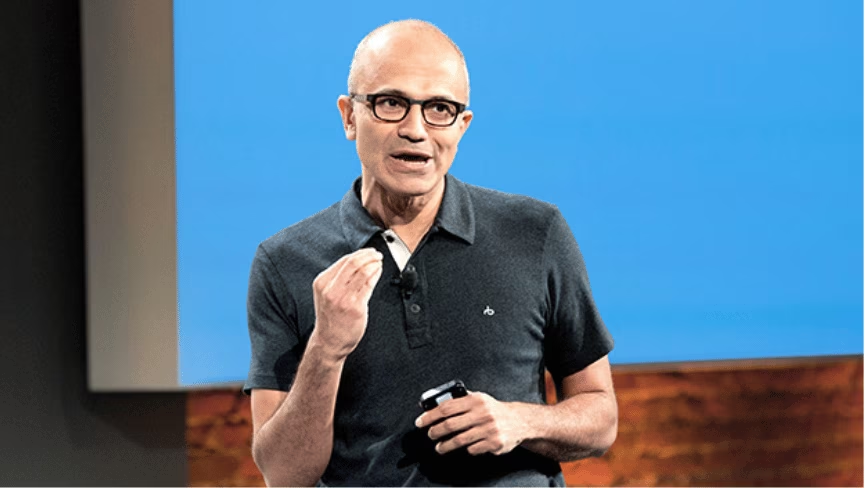
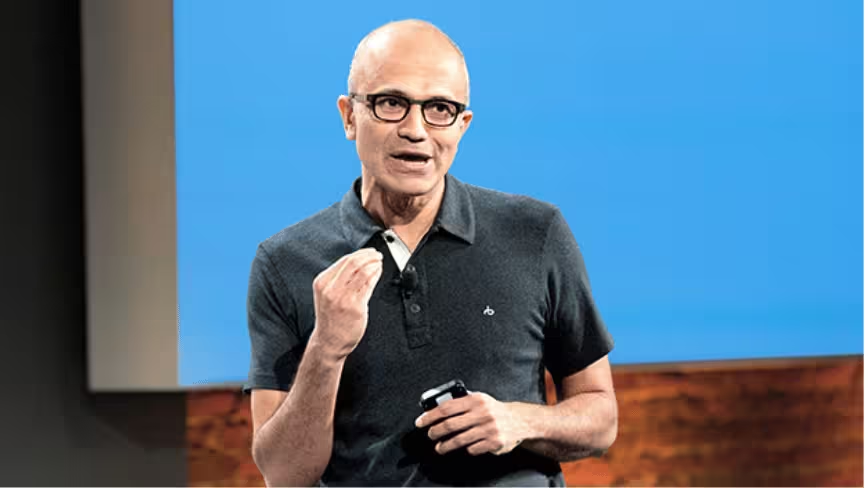
Microsoft excluded its long-running “good deal” compensation question from the main results of its latest employee survey. Workers are questioning the decision on internal forums, with some noting a disconnect between positive survey data and widespread internal dissent.
TL;DR
For years, one question in Microsoft’s internal employee survey served as a reliable pressure gauge. It asked whether staff felt they were getting a “good deal at Microsoft,” defined as “a reasonable balance between what I contribute to Microsoft and what I get in return.” When the scores dropped low enough, the company responded with significant pay rises.
When Microsoft released the results of its latest employee sentiment surveys, that question was nowhere to be found in the main report. Nor, employees noted, was a question about confidence in company leadership. Workers took to an internal message board to ask why, according to Business Insider, which viewed copies of the comments.
“Can you please provide clarity on whether or not the question has been removed and why,” one employee wrote in a post that attracted more than 200 thumbs-up reactions. Another replied with a meme from A Few Good Men: “You can’t handle the truth!”
A Microsoft employee whose title is “Head of Employee Listening” responded on the internal forum that the questions had not been removed. They were simply being asked in different surveys, sent to subsets of employees, “so we can cover more topics without increasing survey length,” according to the response confirmed by Microsoft.
The explanation did not land well. The “good deal” question had historically been reported as a headline metric. Burying it in a subset survey, regardless of the methodological rationale, removes the one number that the entire company could point to when compensation felt inadequate.
That number has a track record. In 2022, after low and declining scores on the question, Microsoft announced company-wide pay rises and increased stock awards. By 2023, the mood had shifted: the company froze salaries, cut 10,000 jobs, and redirected resources toward AI.
The broader survey results, drawn from 71% of employees and roughly 265,000 comments, painted a mostly positive picture. Employees reported feeling included in their teams, energised about their work, and aligned with Microsoft’s culture. The strongest-scoring item, at 88, was “I prioritise addressing security challenges in my role,” according to HR Grapevine.
But some employees said the results did not match what they were seeing elsewhere inside the company. “It seems like employees essentially have zero concerns about the company,” one wrote in a comment with more than 70 thumbs-up reactions, “but in every single public forum, AMA, petition, etc., thousands of employees are raising concerns about Microsoft’s contracts with the Israeli military, ICE, US military, and so on.”
The disconnect between survey data and lived experience is not unique to Microsoft. But at a company that has spent the past year offering voluntary retirement to 7% of its US workforce, tightening performance expectations, and pouring tens of billions into AI infrastructure, the gap feels especially pointed.
Under CEO Satya Nadella, Microsoft has committed more than $80 billion to AI data centres and compute capacity. It spent $37.5 billion in capital expenditure in a single quarter. Nadella has described the company’s 220,000-plus headcount as a “massive disadvantage” in the AI race.
That framing tells employees something specific about where they sit in the company’s priorities. When the one survey question designed to measure whether workers feel fairly compensated is no longer reported to the full company, the message is hard to misread.
Across the tech industry, the pattern is the same: record revenues, record AI spending, and a workforce being asked to do more with less certainty about what it gets in return. Microsoft may still be asking the “good deal” question somewhere, in some survey, to some subset of employees. But by removing it from the results everyone sees, it has answered it.

First introduced in 1979 by Signetics, the NE5532 was a pretty spiffy dual op-amp for the time with low noise and low distortion. Over the years it has become a standard part that showed up in countless audio products, and has become a so-called jellybean generic component with Texas Instruments (TI) being one of countless manufacturers.
It being such a standard, multi-sourced part makes it thus even more puzzling that TI has now decided to completely overhaul this IC in a way that makes it incompatible with even the original Signetics NE5532. These changes are covered in detail by [Dave] of EEVblog as his mind is pretty much blown at such an incomprehensible change.
The changes entail an entirely different manufacturing process and a big change in specifications, while making no change to the part number. In revision K of the TI datasheet these changes are first seen, with some specifications changed for the better, like a higher unity gain bandwidth by 2 MHz, but a much slower slew rate.
Although the 5532 op-amps are multi-sourced, there are good reasons to just stick with manufacturers like TI, as that means receiving a product change notification (PCN) when anything changes. In the PCN related to this op-amp a change to process node is noted, along with other changes, but no reasoning.
Among the other big changes are a reduction in the supply voltage from 22V to 18V, and a halving of the ESD protection from 2kV to 1kV. Although it might be slightly more efficient on the new process node this way, it clearly comes with a lot of trade-offs that make it an overall worse op-amp, while also being incompatible with the same op-amp from other manufacturers.
In the video [Dave] goes through the datasheets of this jellybean part of other manufacturers, showing that they still have the original 1980s specifications. Only one exception here was the NE5532DR from Shenzhen HuaXuanYang Electronics, whose supply rail voltage is also 18V for some reason, along with a similar internal transistor configuration that reduces the ESD resistance.
In addition to the NE5532 op-amp, it seems that TI also took an ax to the OPA134 op-amp, by removing its offset trim feature and listing the pins as ‘NC’, with a warning to not connect these pins and also worsening other specifications. This makes these similar jellybean parts incompatible, with no change to the part number. Worse is that it continues with the LMH6518, whose changes [Dave] argues might even kill oscilloscopes as they are commonly found in those.
Meanwhile the LM317M also got an overhaul, but here TI opted to give it a new part name, calling it the LM317MQ with at first glance no major degradations in the specifications, but instead some actual improvements. This makes it even more puzzling why TI didn’t give the other ICs a new part number to differentiate them from the jellybean part.
Until there’s some clarification from the side of TI, it might be a good idea to source these jellybean parts from a manufacturer that is not TI, especially when replacing these ICs in older devices.

Looking for the most recent regular Connections answers? Click here for today’s Connections hints, as well as our daily answers and hints for The New York Times Mini Crossword, Wordle and Strands puzzles.
Today’s Connections: Sports Edition is a toughie. The purple category is a real challenge. If you’re struggling with the puzzle but still want to solve it, read on for hints and the answers.
Connections: Sports Edition is published by The Athletic, the subscription-based sports journalism site owned by The Times. It doesn’t appear in the NYT Games app, but it does in The Athletic’s own app. Or you can play it for free online.
Read more: NYT Connections: Sports Edition Puzzle Comes Out of Beta
Here are four hints for the groupings in today’s Connections: Sports Edition puzzle, ranked from the easiest yellow group to the tough (and sometimes bizarre) purple group.
Yellow group hint: Going to the game.
Green group hint: Game often played on the beach.
Blue group hint: It’s coming home!
Purple group hint: Dunk that ball.
Yellow group: Seen at a stadium entrance.
Green group: Volleyball stats.
Blue group: Members of England’s World Cup squad.
Purple group: Starts with part of a basketball hoop.
Read more: Wordle Cheat Sheet: Here Are the Most Popular Letters Used in English Words
The completed NYT Connections: Sports Edition puzzle for June 4, 2026.
The theme is seen at a stadium entrance. The four answers are metal detector, ticket scanner, turnstile and will call.
The theme is volleyball stats. The four answers are block, dig, kill and service ace.
The theme is members of England’s World Cup squad. The four answers are (Dan) Burn, (Harry) Kane, (Kobbie) Mainoo and (John) Stones.
The theme is starts with part of a basketball hoop. The four answers are base runner, glass houses, netminder and Rimington.
Despite Apple’s objections, new App Store users in Texas will soon be subject to age verification, as a new state law is set to take effect on June 4.
In May 2025, the Texas App Store Accountability Act made it mandatory for companies like Apple and Google to verify the ages of their Texas-based users. As the law is set to be enforced starting Thursday, Apple has outlined an update to its App Store rules.
On the Apple Developer website, the company explained that new Apple Accounts in Texas will be subject to “age assurance and parent or guardian consent on behalf of minors under the age of 18 for downloads, Apple In-App Purchases, and significant changes associated with an app.”
In practice, this means that anyone who wants to create an Apple Account in Texas must verify that they are 18 or older. Those under 18 will need to join a Family Sharing group, and parents will be able to revoke access to previously approved App Store apps.
App developers will be required to use the Declared Age Range API to determine the age of an Apple Account user.
When “significant changes” are made to an app, developers will have to use the Significant Change API, under the PermissionKit framework, to inform parents or guardians. The company added that “it’s the developer’s responsibility to determine when there’s a significant change to their app.”
Texas’s App Store Accountability Act and a similar bill in Utah are part of a broader push by state legislatures to regulate tech companies in the absence of federal action. They could become a model for similar efforts across the United States, and companies like Apple and Google are aware of this.
Apple itself has made its stance on the matter of age verification clear since the beginning of this situation.
Even before the Texas App Store Accountability Act was signed into law in May 2025, Apple tried to argue against it. These efforts even included a phone call from Apple CEO Tim Cook to Texas Governor Greg Abbott, which obviously led nowhere.
The new law will affect Apple Account users and App Store users.
Apple also deployed six lobbyists in Texas and funded local advertising campaigns, which claimed the bill was “backed by porn websites,” among other things.
The company argued the Texas App Store Accountability Act would force it to collect and store sensitive personal data, such as government IDs or other identifying information, from all users, not just children.
As its lobbying and advertising efforts proved unsuccessful, Apple ultimately detailed the changes it would have to make to comply with the Texas age verification law. At the time, the law itself was supposed to take effect on January 1, 2026.
However, in December 2025, Texas Federal Judge Robert Pitman prevented the age verification law from coming into force in the state. He did so via a preliminary injunction.
Judge Pitman criticized the law by saying it would be like requiring bookstores to verify the age of all customers before gaining entry, and requiring parental consent whenever minors want to purchase a book.
The December 2025 injunction against the Texas App Store Accountability Act proved short-lived, though. On June 1, 2026, the preliminary injunction was temporarily stayed by the Fifth Circuit, though a permanent stay has not been granted.
There’s always a chance the courts will strike down the Texas age verification law, and its future is not set in stone. Until then, however, app developers and App Store users in Texas alike are bound by the state’s age assurance requirements.




Waymo dominates autonomous vehicle registrations as Tesla trails behind


This is BROKEN! INSANE 5x MONEY CAR WASH WEEK! The NEW GTA Online UPDATE Today! (GTA5 New Update)

SpaceX just won a second Golden Dome contract. This one is $4.16 billion.


Jade Biosciences, Inc. (JBIO) Discusses Positive Interim Results From JADE101 Phase I Healthy Volunteer Study and Development Plans Transcript


SHE IS KILLING XRP!!! WATCH URGENT AND ACT FAST

FIRST NIGHT REVIEW: Take That bring the Circus back to life in spectacular sun-soaked style

CFTC Has Approved the First Regulated Bitcoin Perpetual Contract in the U.S.


Is the Spurs Phenom Already Better Than Prime Diesel?

Novak Djokovic v Joao Fonseca LIVE: French Open latest scores and results after Jannik Sinner’s shocking collapse

Weak ‘Supergirl’ Box Office Tracking Amid Milly Alcock Backlash

Snowflake (SNOW) Stock Rallies on Strong Q1 Results and AI Product Growth


Demand Conditions Improve In Chemicals Sector In April 2026


The House | Inside Andy Burnham’s Makerfield Campaign: “Nobody Thinks This Is In The Bag”
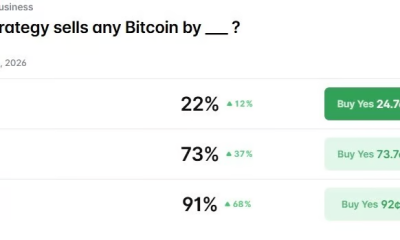

MicroStrategy Moves $30 Million in BTC to Coinbase Prime: Is the Bitcoin Sell-Off Already Here?


This Week In Security: Ubiquiti Fixes, And FreeBSD Joins The Club You Don’t Want To Join


Maddox Jolie-Pitt Legally Requests to Drop Brad’s Surname

One of the Greatest Sitcoms of All Time Shoots Up Apple TV’s Charts 11 Years Later

Seagate (STX) Stock Surges to Record High on AI Boom and Legal Settlement

Everything you need to know as Cambridge’s Strawberry Fair returns after cancelled year

Britney Spears Shares Troubling Update After Hard Year



You must be logged in to post a comment Login