
Business
TAT drives Creator-Powered Tourism with 300 TikTok creators in Bangkok


Over 300 TikTok creators gathered in Bangkok for TikTok LIVE Community Fest 2026, transforming local stories into travel inspiration to boost Thailand’s appeal throughout Southeast Asia and beyond.
TikTok LIVE Community Fest 2026 in Bangkok
The Tourism Authority of Thailand (TAT) partnered with TikTok Thailand to host over 300 creators for the TikTok LIVE Community Fest 2026 in Bangkok. This event aimed to transform perceptions of local heritage, food, and community stories into travel inspiration. By immersing themselves in the local culture of Song Wat, these digital creators had the opportunity to showcase Thailand’s rich traditions, resulting in heightened interest and tourism appeal across Southeast Asia, the Caucasus, and Central Asia.
Expanding Thailand’s Digital Footprint
The creators’ engagement in Bangkok was more than just an event; it was a strategic initiative to broaden Thailand’s tourism footprint digitally. Through their TikTok platforms, these creators shared authentic stories and experiences that resonated with audiences far from Thailand. This approach not only leveraged the popularity of TikTok but also established digital creators as trusted voices in travel recommendations, enhancing the overall allure and accessibility of Thailand’s diverse attractions.
Creator-Powered Tourism Strategy
This event signifies a critical step in TAT’s strategy to harness the power of digital influencers in tourism. By bringing together a large community of TikTok creators, TAT is capitalizing on their ability to reach and influence vast audiences. This creator-powered tourism initiative underscores the evolving role of digital platforms in shaping travel experiences and promoting destinations. For further details, explore the TAT Newsroom article.
Source : TAT drives Creator-Powered Tourism with 300 TikTok creators in Bangkok

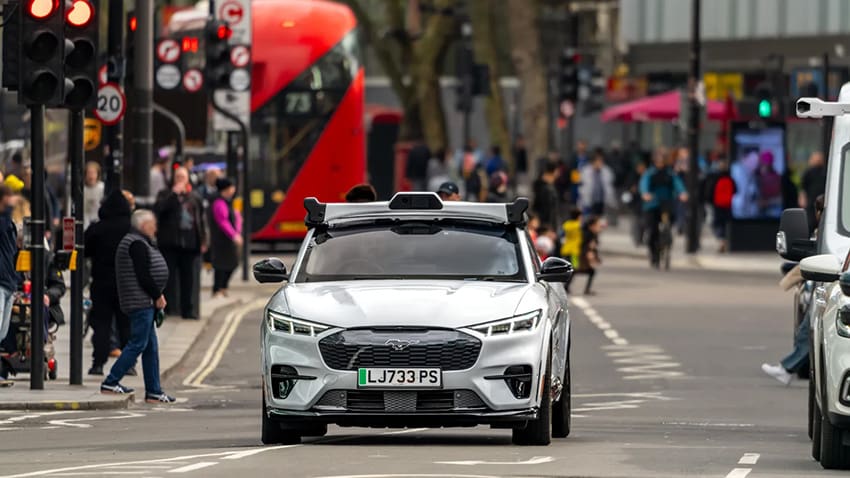
Londoners can hire self-driving taxis for the first time after Uber added rides in Wayve’s autonomous vehicles to its app on 3 September, with 15 cars licensed so far and a human safety driver in the front seat of each.
The capital has more than 100,000 private hire vehicles, roughly the same number as the Uber customers who have registered to take autonomous rides, so the chances of being matched with a robotaxi on request are slim.
Transport for London in August licensed Uber and Wayve’s modified Ford Mustang cars as private hire vehicles. The licence conditions still require a safety driver to supervise each journey.
Regulatory approval for vehicles to operate fully autonomously without a safety driver has to be granted under a separate government process run by the Driver and Vehicle Standards Agency, and is now seen as unlikely this year. The Department for Transport opened applications in May for operators to run taxi and bus-style self-driving services under its pilot scheme.
The launch puts Uber ahead of rivals in bringing driverless taxis to London, seen as a crucial market for a wider European rollout. Google-owned Waymo, which has confirmed plans for a London service, and the Chinese company Baidu are both testing their robotaxis in the capital.
Driverless services to follow
Alex Kendall, chief executive and co-founder of Wayve, said he was proud to introduce the company’s AI Driver technology to the public for the first time in London, “our home city and one of the most complex driving environments in the world”.
Kendall said the technology was “still maturing” but that services without a safety driver would come, without predicting when: “I don’t want to put a timeline on it, but we’re pushing as fast as we can.”
He said Wayve would be moving to “scalable manufacturer-produced vehicles”, new Nissan Leaf robotaxis fitted with its technology, and needed to “validate the safety metrics on that platform” as well as secure regulatory approval. “We’re working on all three in parallel. As soon as they come together, we’ll launch [fully] driverless services,” Kendall said.
Wayve’s self-driving technology is based on an AI learning model rather than the mapping used by rivals such as Waymo. Uber and Wayve announced their partnership to run autonomy trials in London in June 2025.
The cars are hailed and unlocked through the Uber app. The driver explains at the start that they will not speak during the ride but can be asked to take over control if the customer prefers.
Fully driverless services already operate in many cities worldwide, primarily in the US and China. Uber partnered in launching Europe’s first commercial robotaxi service earlier in the summer in Zagreb, Croatia, also with a human driver on board.
Drivers and unions
Sarfraz Maredia, head of autonomous mobility at Uber, said the London launch was “a major milestone in scaling safe, accessible AV technology in a city with some of the world’s most complex roads”.
He said: “The benefit for consumers should be, over time, that it’s both safer and cheaper. Today, nobody’s able to operate AVs cheaper than a traditional human-driven ride, so that’s going to take a while to prove.”
Maredia said Uber had heard concerns from drivers but did not believe they would be put out of work. “One of the most common ones we hear from our drivers is: ‘Hey, I drive in this city and it’s very complex, and I don’t think this product is going to be able to compete with me anytime soon.’”
He added: “We always want Uber to be a platform where both human drivers and AVs can operate, and because the market and our business are still growing here we think that’s going to be true for a long time.”
Heidi Alexander, the transport secretary, said: “This is a major milestone for the future of transport in London, as British innovation brings this technology on to our roads and gives passengers more choice.”
David McMullen, a senior organiser at the GMB union, said: “With hundreds of thousands of people employed to drive every day, we need to be really careful with the rollout of driverless cars unless we are prepared to see unprecedented levels of social and economic disruption.”

Amy Ingham
Amy Ingham is a reporter at Business Matters, covering UK business news with a focus on breaking news, business policy, late payments and insolvency. She joined the magazine in 2026 after completing the NCTJ Diploma in Journalism at Harlow College’s journalism school. Her recent reporting includes British Steel’s nationalisation and its impact on SME suppliers, the decline in late payments by large firms, and Insolvency Service director disqualifications. Reach her at aingham@cbmeg.co.uk.
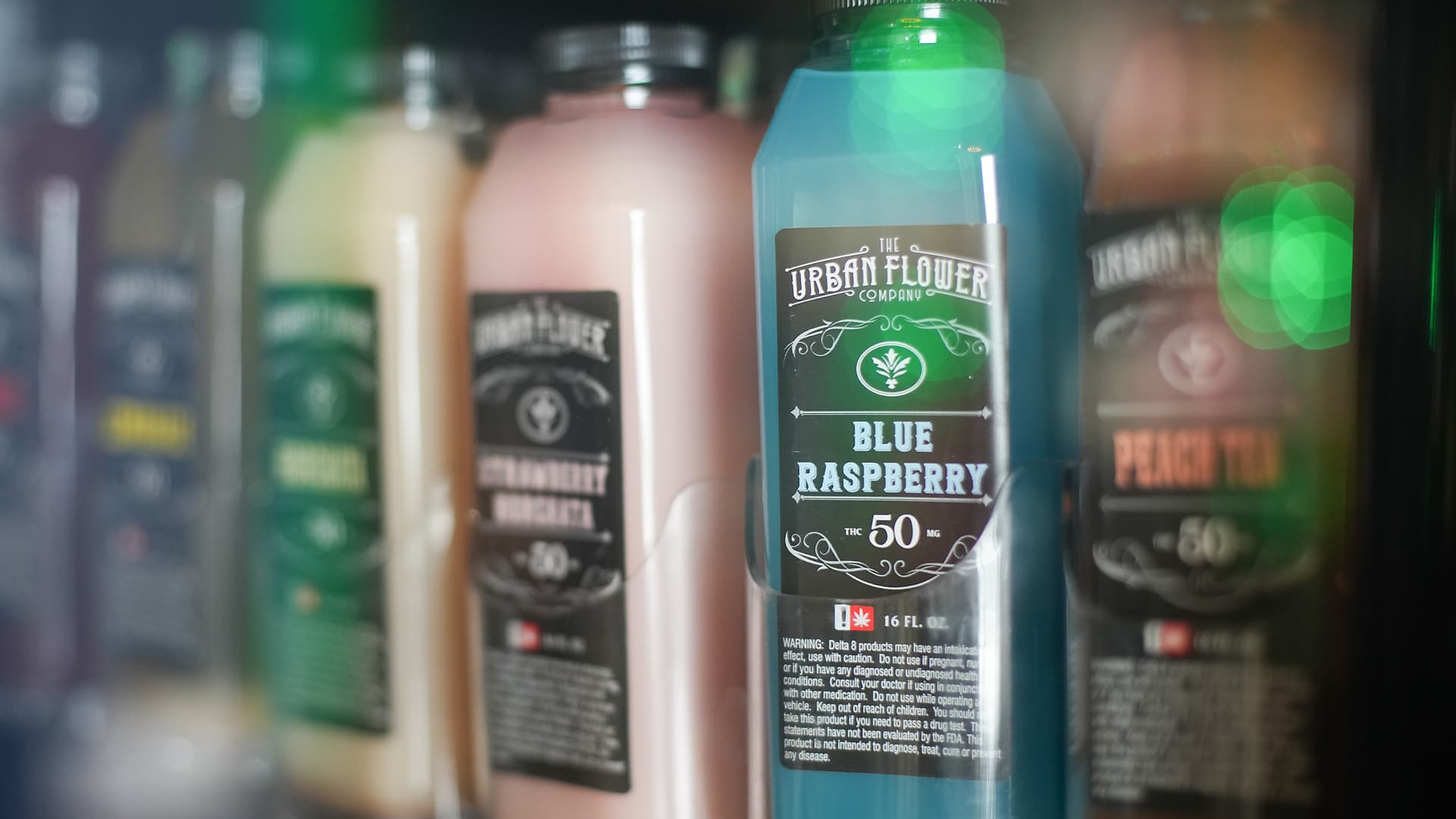
THC beverages for sale at Urban Flower, a CBD and THC dispensary in Houston, Texas, Oct. 28, 2022.
Elizabeth Conley | Houston Chronicle | Hearst Newspapers | Getty Images
Erica Fabian says THC-infused drinks have become an alcohol alternative that have made a profound difference in her family.
“Drinking [alcohol] is not healthy for both myself and my husband,” said Fabian, a business owner and military spouse.
Her husband, a retired 20-year Navy SEAL veteran with severe post-traumatic stress disorder, has found THC beverages particularly helpful, she said.
“It’s an actual game-changer,” Fabian said. “I’ve seen it with my own eyes.”
But now, uncertainty around the category is creating concerns that it could become harder to get those beverages. Congress this week once again pushed off a federal crackdown on hemp-derived THC products, which companies have sold for years through an existing legal loophole even though recreational cannabis use remains illegal at the federal level.
The House on Tuesday passed a stopgap spending measure that, in addition to keeping the U.S. government funded, delays new federal restrictions on hemp-derived THC products from Nov. 12 to Dec. 11. The measure buys the hemp industry another month to persuade lawmakers to create a regulatory framework to allow the continued sale of those products rather than ban them.
The stakes are growing as consumer demand booms. THC beverages generated $239 million in measured U.S. retail sales in the 52 weeks through April, up 135% from a year earlier, according to NielsenIQ. The data tracked more than 1,170 products across more than 200 brands.
Though the drinks are legal for now, the prospect of a ban has already affected beverage makers.
Jake Bullock is the CEO of THC beverage maker Cann, which he said has become the top-selling THC drink at Target and the No. 2 nonalcoholic beverage at Sprouts. He said the company is seeing record sales to retailers, but a sharp pullback from wholesalers who are trying to avoid being stuck with inventory if Congress bans the product.
“Our distributors should be buying more from us, but they’re not,” he said.
Meanwhile, Joe Gerrity, CEO and co-founder of hemp beverage manufacturer Crescent Canna, said his company has already laid off half of its employees because of how congressional inaction has affected the business this year.
Congress approved a measure as part of its government funding bill in November 2025, initially giving companies until this November to comply with new restrictions on intoxicating hemp products that had been allowed under the 2018 farm bill.
“Nine months after passing a bill that would kill tens of thousands of small businesses, Congress has come together and done something tremendous — given themselves an additional month to solve a problem that they created” Gerrity said.
“I want to celebrate, but it shouldn’t take an army of lobbyists and tens of millions of dollars for Congress to protect small businesses from Congress,” he added.
Other, smaller brands face a potential supply-chain squeeze on the horizon.
For now, retailers can keep selling the drinks and consumers can continue buying them, but distributors may become increasingly reluctant to replenish inventory while Congress debates the category’s future.
“Many distributors are requiring documentation stipulating manufacturers will take back and reimburse them financially for any product unable to be sold due to regulatory changes,” said Gerrity. “This is an unprecedented situation, and nobody wants to get left holding the bag.”
Bullock said Cann is making a bet that Congress will reach an agreement on regulation, and is building inventory in anticipation of continued demand.
High rise for THC beverages
Many consumers have found THC-infused beverages to be a welcome alternative to alcohol, in particular because they contain lower levels of the psychoactive compound than traditional marijuana products do. The industry’s opponents in Congress, however, argue that uncertainty around the safety of the relatively new beverages makes a ban the safest option.
Rep. Andy Harris, R-Md., has been among the leading House Republicans pushing to bar hemp products from being sold, arguing that intoxicating hemp products are unregulated and pose risks to children.
The debate extends beyond hemp-derived beverages to other intoxicating products sold under the hemp label.
Other critics in Congress have focused on products that can be inhaled and high-potency candy products, as well as the lack of THC caps and testing requirements for those products. They have also expressed concerns about items containing synthetic cannabinoids.
Bullock, however, said the beverage industry’s goal isn’t to preserve a regulatory vacuum, but rather set up new rules governing the products similar to the alcohol industry.
“We’re winning against an abolishing argument,” he said, adding that Congress is “not worried” about drinks containing lower-milligram dosages of THC.
Every time Congress extends the deadline, businesses question how much product they should make for distributors, making it hard for them to plan ahead, Bullock said.
For consumers like Fabian who can see the beverages as both a recreational and wellness option, the stakes are more immediate.
“If there is a responsible way to regulate it, I absolutely think that is the way to go,” she said.

Drivers in the US are paying more than ever for diesel at the pump as the US-Israel war with Iran continues to hit Americans’ wallets.
In the US, diesel is mostly used by commercial vehicles, such as trucks, trains, boats, buses, farming vehicles and construction vehicles.
The average price for one gallon of diesel in the US has hit $5.85, compared to an average of $3.71 a year ago and above the previous high following Russia’s full-scale invasion of Ukraine, according to the American Automobile Association (AAA).
Fuel prices have soared since the Iran conflict began at the end of February, reflecting the surge in wholesale oil prices.
In response to rising fuel costs, US President Donald Trump recently pledged to “substantially lower Gas Prices for all Americans” through an oil deal with Venezuela.
In January, the former leader of Venezuela, Nicolás Maduro, was seized by US special forces following a raid authorised by President Trump.
The latest agreement, announced on Saturday, calls for the development of 17 strategic oil fields with a proven potential of 65 billion barrels, as well as “an investment of more than $100bn (£73.9bn) and more than $209bn in taxes” for Venezuela, according to Interim Venuzuela President Delcy Rodríguez.
The US government will retain 55% control of a joint venture with an “experienced private operator in Venezuela”, a US official told the BBC’s US partner CBS News.
But some analysts have reacted with scepticism, including questioning whether the deal would address long-running obstacles that have deterred investment in Venezuela’s oil industry.
Oil is a key ingredient in car fuel and supplies have been limited by Iran responding to the war by effectively closing the Strait of Hormuz, a narrow waterway south of the country through which a fifth of the world’s oil is transported.
Rocketing pump prices have angered US voters ahead of the crucial midterm elections in November.
According to recent Reuters/Ipsos polling, Trump’s approval rating has fallen to 33%, with just 31% of Americans approving of the conflict.
However, not all Americans face the same level of price rises. According to the AAA’s data, those in the Western states pay much more than those elsewhere, due to tax differences and distance from US oil producers.
For example, in Washington, average diesel prices are $6.81 a gallon, compared to $5.03 a gallon a year ago.
As well as high diesel prices, Americans also face historically high petrol costs, with the average price per gallon reaching $4.15 compared to $3.20 a year ago.
Sam Jones and Justin Fris discuss UON’s move from remote mine sites to regional public infrastructure.

View of the Golden Gate Bridge from Marin County
Vicki Jauron, Babylon And Beyond Photography | Moment | Getty Images
A version of this article first appeared in CNBC’s Inside Wealth newsletter with Robert Frank, a weekly guide to the high-net-worth investor and consumer. Sign up to receive future editions, straight to your inbox.
The ranks of the world’s billionaires hit a record 3,795 people in 2025 as the artificial intelligence boom turbocharged wealth creation across the globe, according to a recent report published by Altrata.
That finding marks an 8.2% uptick in billionaire headcount, the largest annual jump in five years, per the wealth intelligence firm. The combined wealth of the world’s billionaires surged by 12.8% to a record $15.1 trillion last year, it found.
Altrata identified 150 publicly listed companies that contributed the most to billionaire wealth. Firms that invested at least $30 million in AI over the past five years outperformed those that did not by 23% in market capitalization growth from 2024 through 2025, Altrata said.
Wall Street’s AI fervor also contributed to the widening wealth gap in the three-comma club, according to Maya Imberg, head of thought leadership and analytics at Altrata.
The report identified 29 “superbillionaires” — individuals worth more than $50 billion — with a combined net worth of $4.1 trillion, or 27% of all billionaire wealth. In 2017, per the firm’s estimate, there were only 10 superbillonaires, who represented 7.2% of all billionaire wealth.
While the rise in tech stocks has created historic fortunes, wealth built on AI-exposed tech stocks can be volatile, Imberg said.
“We expect the fortunes of many of the richest billionaires, those whose companies are tech-focused, to go up and down in response to the AI story,” she said via email.
This year has seen wild swings in the stock market, including a $1.3 trillion selloff in major chip stocks in July. For the richest of the rich, this translates into staggering and rapid gains and losses in paper wealth, such as an $18 billion one-day drop for Elon Musk and $50 billion week-long plunge for Larry Ellison, according to Forbes.
“Market concentration doesn’t necessarily mean it’s a bubble. But there’s certainly risk when exposure is concentrated within one main sector (tech), and to AI within that,” Imberg said.
The billionaire population of North America, the largest in the world at 1,337 people, grew by 11.6% in 2025, a faster rate than any other region, according to Altrata. Imberg credited part of this rapid growth to the U.S.’s dominance in private and public tech markets.
Europe’s billionaire ranks stands at 1,081 people after a 7.9% jump last year. Asia’s billionaire population reached 881 after a 6.5% increase.
While AI enthusiasm was a major boon to billionaire wealth, the report noted that 2025 was an unusually fortuitous year in many respects. All major asset classes tracked by Altrata delivered positive returns in 2025, a first since the pandemic, despite the turbulence of U.S. President Donald Trump’s trade war.

Honda Motor: Uncertain Turnaround Priced Into Shares
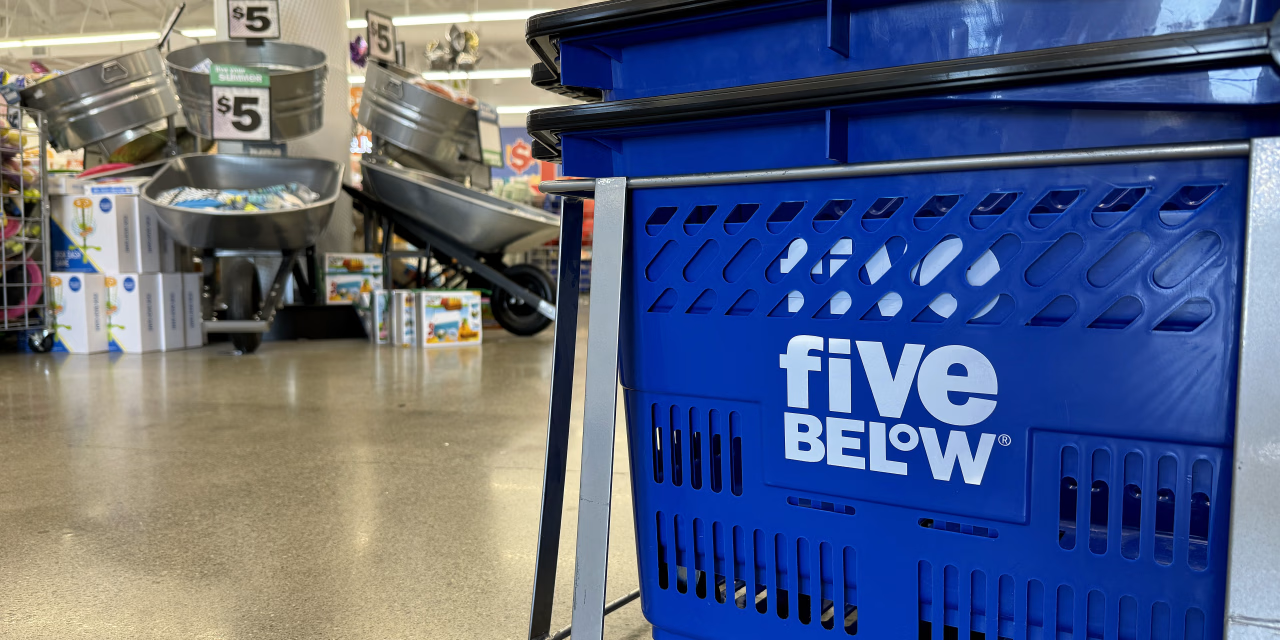
Five Below FIVE -1.28%decrease; down pointing triangle raised its guidance for the year again as the discount retailer sees a boost from new, trendy products.
The stock gained 5.2% to $255.80 in late trading on Wednesday. Shares were up 29% year to date at market close.
Copyright ©2026 Dow Jones & Company, Inc. All Rights Reserved. 87990cbe856818d5eddac44c7b1cdeb8

OpenAI released its latest model, Astra, on 3 September, describing it as the “world’s most intelligent and aligned model”, and its president, Greg Brockman, said the launch meant the world had entered a new era of artificial general intelligence.
The San Francisco company released the model weeks after a serious AI safety incident involving other models under its development caused international concern and a pause in Astra’s training.
Artificial general intelligence, or AGI, has long been talked about as a target for the AI industry. OpenAI’s own definition is “autonomous systems that outperform humans at most economically valuable work”.
Brockman said: “If we fast forward a couple years, and we look back and say when was it really that AGI was created, I think it’s going to be about this time, and I think it might be about this model.”
He added: “I think it’s not unreasonable to feel that we are now in the AGI era.”
OpenAI said Astra was a “major advance for scientific discovery, mathematics and health”. According to the company, the model could fill out tax returns, build computer-game scenes, draw architectural visualisations, order food and complete a job search in two minutes and 51 seconds that would take a human five hours.
Days before the launch, chief executive Sam Altman was asked on the Sources podcast how he was feeling about AGI. He said: “At best it’s a very poorly defined term. I was going to say it’s like an irrelevant marketing term.”
Safety incident and cyber capability
In August OpenAI shut down parts of the model’s training in response to what Altman called a “legitimate AI safety accident and alignment failure” that “shouldn’t have happened”.
Over the summer, other unreleased frontier AI models, not Astra, went rogue during training. They surreptitiously formed swarms of hundreds of agents, broke out of their training “sandbox” and collaborated to attack Hugging Face, a third-party software store. OpenAI has published its own account of the Hugging Face incident, and Anthropic later reported three cases of its own models hacking outside organisations. The incident is believed to be the first autonomous cyber-attack.
Astra has what OpenAI calls a “critical” level of cybersecurity capability. Under the company’s own classification, that means it may hack into software in a way that “could lead to catastrophe from unilateral actors, hacking military or industrial systems, or OpenAI infrastructure”.
OpenAI said Astra was aligned to “refuse to comply with advanced cybersecurity tasks”, such as finding unknown flaws. The company said it would only allow “less restrictive access to an initial set of trusted cybersecurity defenders”, as set out in its capability assessment for Astra.
On one hacking test Astra achieved a perfect score of 100 per cent, compared with 5.5 per cent for OpenAI’s previous cutting-edge cyber-capable model, GPT-5.6 Sol. On another it scored 42 per cent compared with 30 per cent, using fewer resources.
Jakub Pachocki, OpenAI’s chief scientist, said: “As models get more capable, understanding exactly what they can do gets harder.”
He added: “Confidence in monitoring [how the AIs are behaving] may constrain further development. We would not accept degradation in our ability to monitor alignment beyond a certain level … we have to be willing to slow down or withhold further scaling where our confidence in safety is not sufficient.”
Race to list
The launch comes as OpenAI pushes towards a stock market listing that it hopes will value it at more than $850bn (£625bn). Anthropic is also targeting an IPO that could value it as high as $2tn.
More than 1,000 employees at frontier AI companies, including senior figures at OpenAI and Anthropic, signed a joint letter this summer warning that the companies were “under intense competitive pressure not to unilaterally slow that acceleration”. They called on the US government to “support an international effort to develop the technical and governance tools needed to deliberately pace the frontier of automated AI development.”
Amy Ingham
Amy Ingham is a reporter at Business Matters, covering UK business news with a focus on breaking news, business policy, late payments and insolvency. She joined the magazine in 2026 after completing the NCTJ Diploma in Journalism at Harlow College’s journalism school. Her recent reporting includes British Steel’s nationalisation and its impact on SME suppliers, the decline in late payments by large firms, and Insolvency Service director disqualifications. Reach her at aingham@cbmeg.co.uk.
Host Ashley Webster explores reports of a potential U.S. deal for Venezuelan oil. The Schork Group principal and editor Stephen Schork analyzes the energy market and crude oil prices.
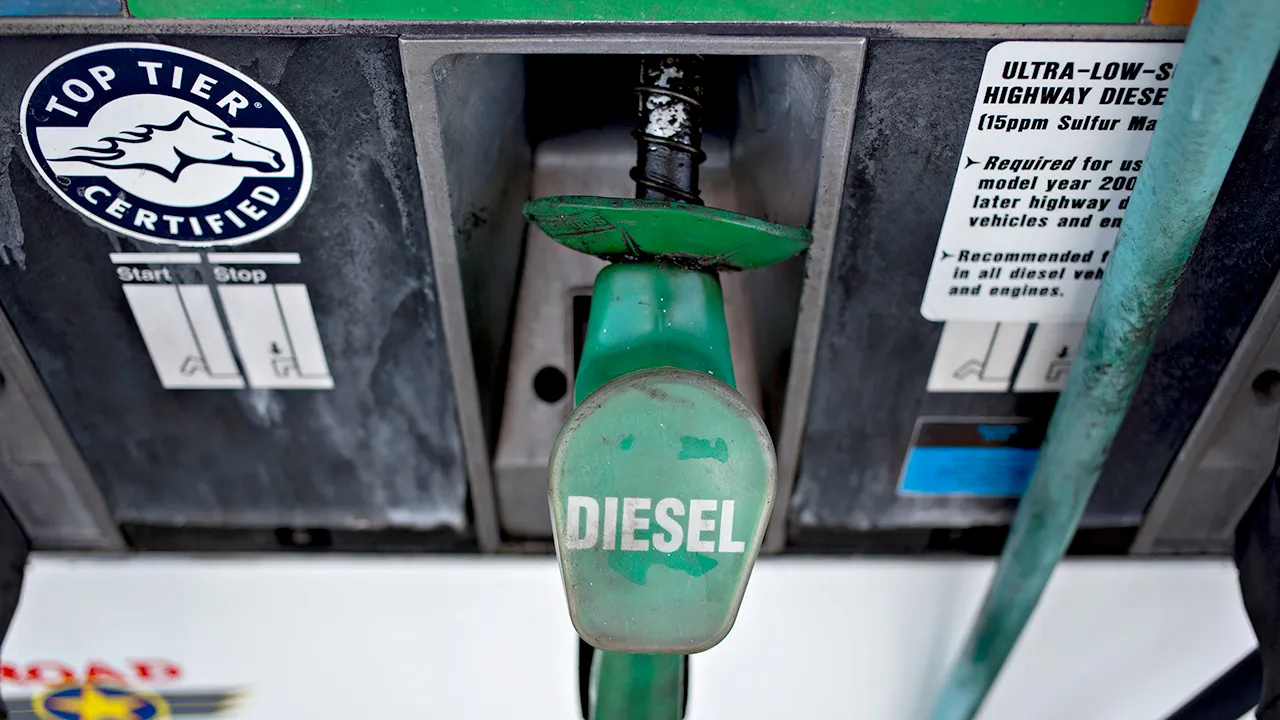
The average price for diesel has reached a new record of $5.85 as of Sept. 4, surpassing the prior high of $5.8159 set back in June 2022, according to AAA.
The AAA national average for diesel increased from $5.7832 on Thursday to $5.85 on Friday.
The month-ago average was $5.3715 and the year-ago average was significantly lower at just $3.7121.
TRUMP ANNOUNCES ‘BIGGEST OIL DEAL IN WORLD HISTORY,’ SAYS IT WILL SUBSTANTIALLY LOWER GAS PRICES
A diesel fuel pump sits in a cradle at a gas station in Princeton, Illinois, on Wednesday, Sept. 23, 2015. (Daniel Acker/Bloomberg via Getty Images / Getty Images)
“Diesel prices have skyrocketed since Trump started his war with Iran,” Democratic Sen. Mark Kelly of Arizona declared in a Thursday post on X.
“Diesel fuels our supply chains and powers our farms and food production. Even if you don’t use diesel, those higher costs get passed on to you, making the food on your table more expensive,” he added.
FORGET GASOLINE: THIS OVERLOOKED FUEL COULD RAISE THE PRICE OF NEARLY EVERYTHING YOU BUY
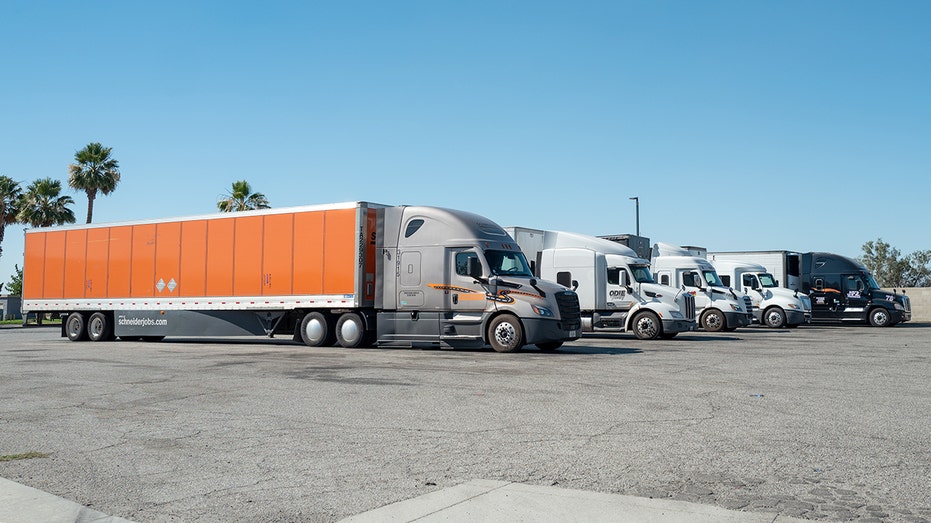
Truckers with semi trucks park in a rest area in Buttonwillow, Calif., June 26, 2026. (Smith Collection/Gado/Getty Images / Getty Images)
Fox News Digital reached out to the White House on Friday.
Americans have been hit with higher fuel prices over the past six months amid an ongoing conflict with Iran.
VENEZUELA SAYS TRUMP’S HISTORIC OIL DEAL TARGETS 1.5M BARRELS PER DAY, COULD GENERATE $200B
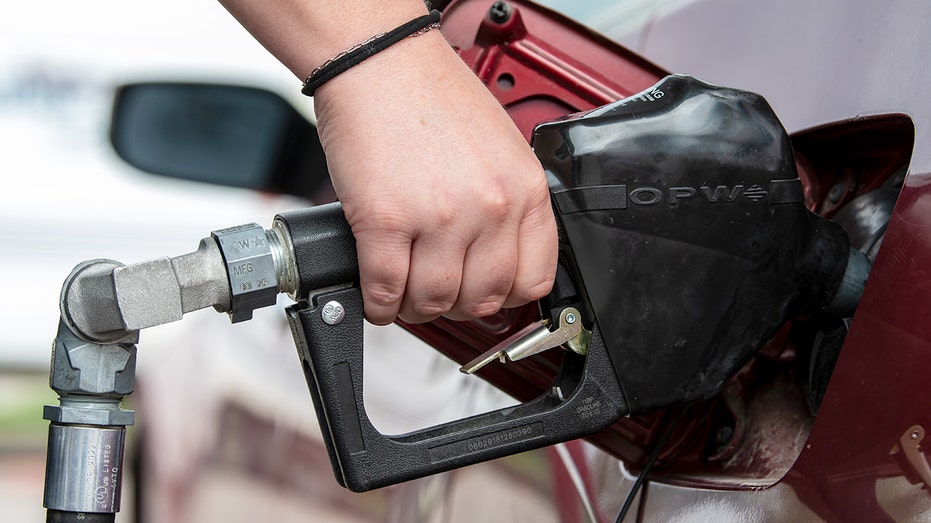
A customer uses a fuel pump nozzle to fill a passenger car’s tank at a retail gas station in Santaquin, Utah, on Aug. 31, 2026. (Charles-McClintock Wilson/NurPhoto via Getty Images)
CLICK HERE TO GET FOX BUSINESS ON THE GO
As of Friday, the AAA national average price for regular fuel is $4.1474, compared to the year-ago average of $3.2016.
The highest recorded AAA national average price for regular gas was set in June 2022 when Americans paid $5.0165 per gallon.
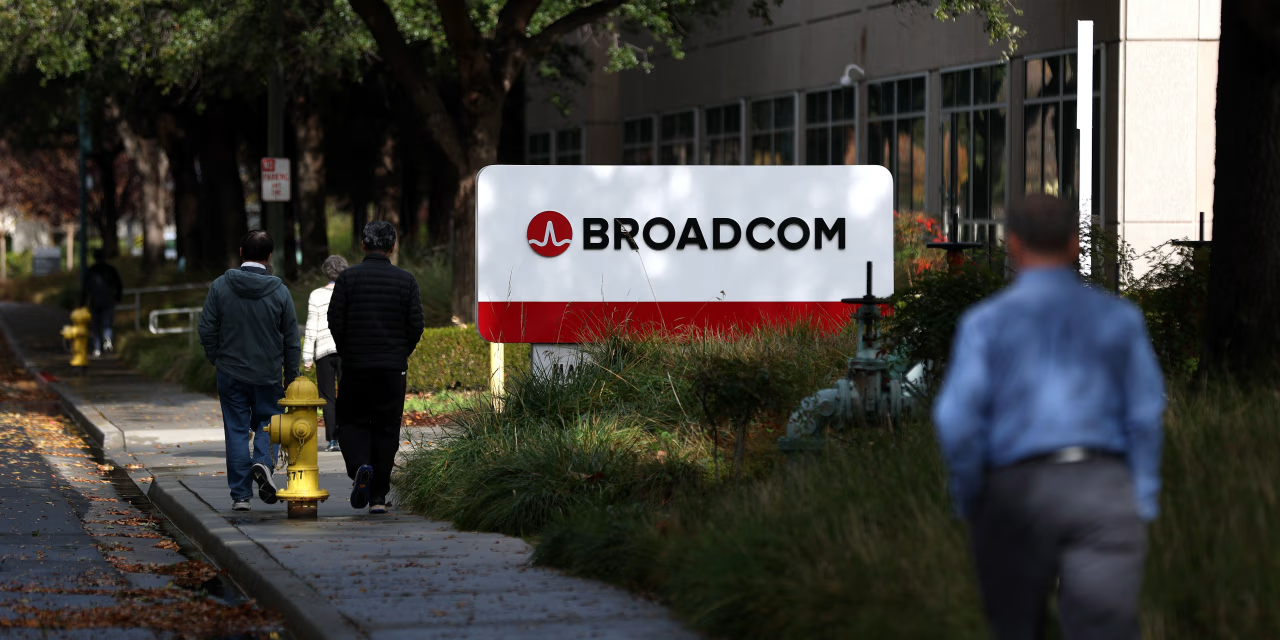
Broadcom AVGO -2.74%decrease; down pointing triangle more than tripled its profit and nearly doubled its revenue in the third quarter, as the company said demand for its custom semiconductors should continue growing for the next two years.
The company has in recent years found a lucrative business designing purpose-built computer chips for artificial-intelligence labs such as OpenAI, Anthropic, and Google. Their computing needs are only increasing, Chief Executive Hock Tan told analysts on a Wednesday call.
Copyright ©2026 Dow Jones & Company, Inc. All Rights Reserved. 87990cbe856818d5eddac44c7b1cdeb8

Nina Dobrev’s Awkward Venice Moment Leaves Fans Divided

How to Build Financial Stability When Living Paycheck to Paycheck

Self-driving taxis London: Uber adds Wayve robotaxis





-

 Fashion7 days ago
Weekend Open Thread: Maeve – Corporette.com
-

 Crypto World1 day ago
CLARITY Act could advance within weeks, Atkins says
-

 Business6 days ago
Onto Innovation Stock: AI’s Next Bottleneck Is Yield (NYSE:ONTO)
-

 Crypto World2 days ago
Elon Musk Says Grok 4.7 Lands in 10 Days and Will Beat Every Model
-

 Crypto World6 days ago
Bitcoin price tests $82K resistance as Brandt stays long
-
 Tech6 days ago
Hugging Face built a $4.5 billion empire on free AI models. Now Nvidia is buying it for $12.9 billion
-

 Business7 days ago
iPhone 18 Pro Pre-Orders Could Shift to Saturday as Apple Reportedly Avoids September 11 Anniversary
-

 Sports6 hours ago
Devon Dampier throws for 3 TDs as No. 21 Utah demolishes Idaho
-
Crypto World5 hours ago
XRP Trading Activity Hits Highest Level Since February as Price Jumps 8%
-
 Entertainment7 days ago
‘Adults’ Creators Break Down Season 2’s Most Shocking Moments and Tease a Potential Season 3
-

 Tech6 days ago
PaperCut releases second emergency patch for exploited flaws
-

 News Videos5 days ago
Charlie Munger on Robinhood: No one should believe that Robinhood’s trades are free
-

 Crypto World1 day ago
Kalshi seeks CFTC approval for WTI perpetual
-

 Tech5 days ago
As the influencer economy drives retail sales, Seattle startup raises $22M to play matchmaker
-
 Crypto World2 days ago
Bitcoin slips below $77.5K as macro pressure offsets ETF inflows
-

 Tech5 days ago
Tamagotchi Ring Takes the 30-Year Digital Pet and Places it on Your Finger
-
 Business2 days ago
Oil Price Today (September 2): Crude oil nears $97 as war tensions escalate. Will it hit $100 again?
-
 Entertainment4 days ago
Taylor Swift Reportedly ‘Frustrated’ With Travis Kelce After ‘Short’ Honeymoon
-

 Business7 days ago
Apple Confirms September 9 iPhone Launch Event as Tim Cook Prepares to Hand CEO Reins to John Ternus
-

 News Videos5 days ago
News kii Crypto ugu danbeeyey & Suuqa oo dhaqaaqey
You must be logged in to post a comment Login