Connect with us
DAPA Banner
DAPA Coin
DAPA
COIN PAYMENT ASSET
PRIVACY · BLOCKDAG · HOMOMORPHIC ENCRYPTION · RUST
ElGamal Encrypted MINE DAPA
🚫 GENESIS SOLD OUT
DAPAPAY COMING

Business

Tata’s new electric arc furnace at Port Talbot facing delay

Published

on

Business Live

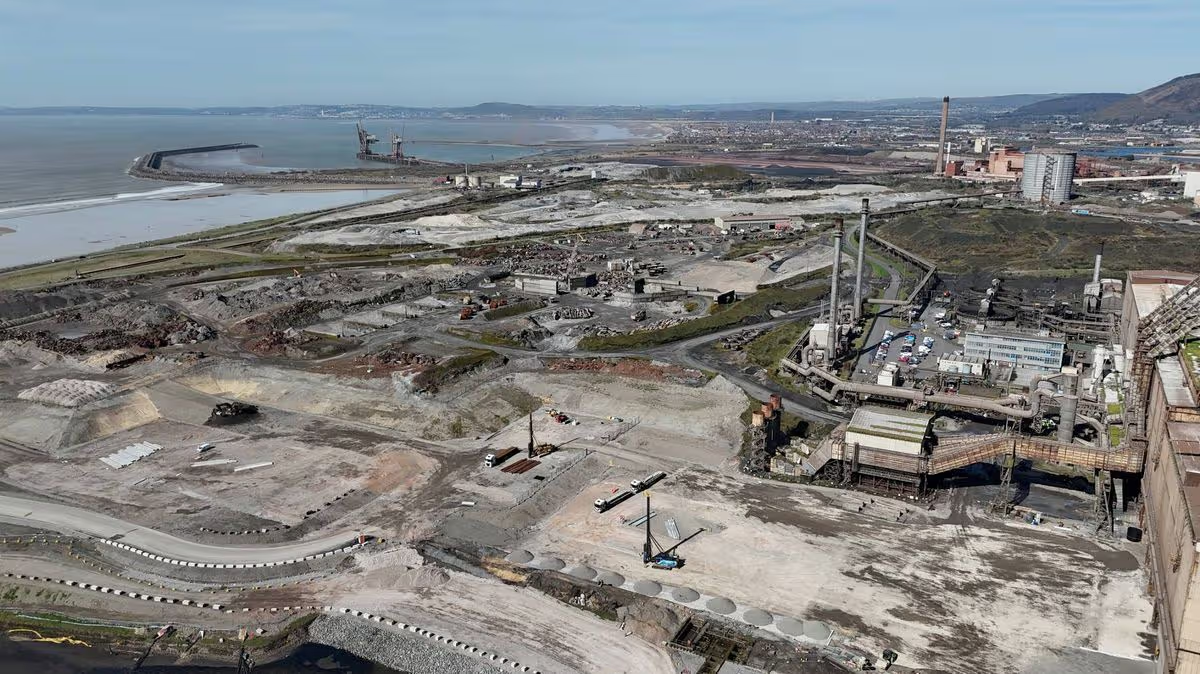
A delay in getting enough electricity to the Port Talbot site means there is currently a 12-month delay to the new electric arc furnace opening but bosses are confident that could come down

Tata Steel Port Talbot

(Image: John Myers)

The opening of Tata’s new electric arc furnace at the Port Talbot steelworks could be delayed by up to 12 months, bosses have said, although they say they are hopeful that time can be reduced.

Advertisement

The electric arc furnace is a £1.25bn scheme to build one of the largest such furnaces in the world. The project, partly funded by the UK Government, is to replace the historic blast furnaces at the steelworks.

But issues have emerged with getting power to the site which could delay its start date by up to a year.

Tata Steel’s chief financial officer Koushik Chatterjee has said the delay was 18 months but has already reduced to 12 months. The Indian-owned company is hopeful it will reduce further.

He said “securing access to high-power electricity is critical for our planned transition”.

Advertisement

“While we are working with the electricity system operator and the National Grid for new electrical infrastructure National Grid has formally alerted us that their connectivity project is delayed,” said Mr Chatterjee.

“This is critical for Tata Steel UK for the project commissioning. We are in conversation with National Grid and the UK Government on resolution of the issues.”

Asked about how long the delay might be Mr Chatterjee, Tata’s executive director and chief financial officer, said that was being discussed.

He replied: “Somewhat between, say, six months to eight months will certainly be there, maybe higher, after we have built the plant. The initial estimate was around 18 months. It has come down to 12 months and we’re actively working to see if we can reduce it further but there will be some delays imminent.”

Advertisement

He said the company was working with partners including the UK Government, the National Grid, and its electricity supplier to “see if we can mitigate”.

In a call three weeks ago CEO TV Narendran told journalists: “There is a delay of about 12 months in the electricity supply. What we are trying to see is at least some connection, one line, as soon as the plant is ready so we can do some trials, test out some equipment etc so we don’t waste the time that we’re waiting for the full electricity connection.

“Then what we are planning to do is to ramp up that we had scheduled after the commissioning how to compress that to make sure we catch up on the project.

“if we do the preparatory work before the full electricity connection is there we can do a quicker ramp up”.

Advertisement

In the call Mr Chatterjee said fixed costs in the UK in the last two years had fallen by 50%.

Before the delay in power access an operational estimate of late 2027 or early 2028 had been given. For our free daily briefing on the biggest issues facing the nation, sign up to the Wales Matters newsletter here.

The National Grid is building a new substation at its Margam site and delivering a second 275kV substation on Tata Steel’s Port Talbot site – which requires new supergrid transformers, as well as a 2km underground cable connecting the two substations to deliver the EAF.

It is understood issues emerged with ground conditions, and environmental and planning considerations, once work had started but that teams from National Grid have been on site since September.

Advertisement

Work on the new Margam substation will start in the coming weeks.

In recent days the Tata site has also been hit with a major fire.

Tata said its controversial decision to shut the historic steel plant’s two blast furnaces, signalling the end of steelmaking from raw materials in Wales, was due to a combination of cost-cutting and a move to decarbonising its operations.

On September 30, 2024, blast furnace four – the final one operating at the vast site – was closed ending 100 years of primary steel-making .

Advertisement

The site is being reworked around an electric arc furnace to recycle previously-used steel and when the decision was made Tata announced 2,800 job losses with the majority in Port Talbot. We now know that between September 2024 and the end of July 2025 2,162 people left the business.

Tata says it has lost £4bn in Port Talbot since 2007 and the new furnace would ensure a “financially and environmentally sustainable future” as well as reducing the site’s carbon emissions by 90%.

The UK Government gave £500m to the plans.

A Tata spokesman said: “The electric arc furnace programme is a major industrial project and, like all projects of this scale, timelines continue to evolve as detailed engineering, construction, and infrastructure work progresses.

Advertisement

“While we are still discussing potential adjustments to the commissioning timetable we are working closely with National Grid, our construction partners, and the UK Government to deliver the project safely and as quickly as possible.

“We have already met a series of key milestones in the construction phase and the shipment of major components including the EAF shells, tilting platform, and Consteel conveyor will commence imminently.”

A National Grid spokesperson said: “We recognise the importance of this project and remain committed to delivering the connection safely and at pace, working closely with our partners. Construction is underway and good progress is being made. This is a major, multimillion pound programme involving complex engineering, subject to environmental and planning considerations which require careful design and delivery.”


Advertisement
Continue Reading
Click to comment

You must be logged in to post a comment Login

Leave a Reply

Business

Thailand Files Historic Lawsuit Against Tech Giants and Banks Over 230M Baht Scam Losses

Published

on

Thailand Files Historic Lawsuit Against Tech Giants and Banks Over 230M Baht Scam Losses

Abstract

  • Thailand’s Consumers Council has filed a civil lawsuit against parent companies of four major technology platforms and nine commercial banks, seeking over 230 million baht in compensation for online investment scam victims. The case targets Meta, LINE, Apple, and Google for allegedly failing to prevent fraudulent advertisers and applications within their ecosystems.
  • The lawsuit outlines a scam operation that moved victims from deceptive Facebook ads through LINE groups to fraudulent investment apps, ultimately draining funds via bank mule accounts. A Civil Court hearing is scheduled for August 2026, with the council aiming to establish new legal precedent for platform accountability in Thailand.

BANGKOK — In a landmark legal move, the Thailand Consumers Council has filed a civil lawsuit against the parent companies of four major global technology platforms and nine commercial banks, seeking over 230 million baht in compensation for victims of sophisticated online investment scams. The case, filed on June 8, 2026, marks the first time Thai authorities have pursued liability directly against the overseas parent entities controlling platforms like Meta’s Facebook, LINE, Apple’s App Store, and Google’s Play Store.

The lawsuit targets a “full-cycle” scam operation where fraudsters allegedly exploited the ecosystems of these platforms and banks to defraud at least 10 consumers. The scheme reportedly began with deceptive advertisements on Facebook, often impersonating public figures, to lure victims into LINE messaging groups. From there, scammers persuaded victims to install fraudulent investment applications via the App Store and Play Store before funneling millions of baht into mule accounts held by front companies through the banking system.

“The council argues that the platforms had a duty to verify advertisers and users, as well as a duty of care to ensure digital safety, but failed to prevent repeated abuse of their systems,” said Saree Ongsomwang, secretary-general of the Office of the Thailand Consumers Council. She compared the situation to a shopping mall that allows fraudsters to operate inside without accepting responsibility for the resulting harm.

The legal action includes nine commercial banks accused of failing to detect unusual transaction patterns or suspend suspicious transfers despite their legal obligations to monitor financial risks. Among the initial group of claimants, one individual reportedly lost 165 million baht in a stock investment scam, while another lost over 3 million baht.

The Civil Court has scheduled its first case management hearing for August 3, 2026. The council hopes this lawsuit will set a new precedent for consumer protection in Thailand, forcing global digital platforms to strengthen safety standards and accept accountability for the damages suffered by Thai users who have increasingly lost faith in state agencies’ ability to provide remedies.

Advertisement

Continue Reading

Business

Suniva to merge with SUNation in reverse merger deal

Published

on


Suniva to merge with SUNation in reverse merger deal

Continue Reading

Business

Energy minister leaves door open to 'sneaky' mining energy plans

Published

on

Energy minister leaves door open to 'sneaky' mining energy plans

WA’s energy minister has left the door open to allowing miners to feed excess power into common user energy grids and non-mining infrastructure.

Continue Reading

Business

Arcmont CEO says private credit fundamentals remain strong

Published

on


Arcmont CEO says private credit fundamentals remain strong

Continue Reading

Business

BofA sees oil prices pushing Japan inflation higher, BoJ hawkish

Published

on


BofA sees oil prices pushing Japan inflation higher, BoJ hawkish

Continue Reading

Business

Thailand Update: Major Highlights in Political, Economic, Tourism, and Social Affairs

Published

on

Asia's Industrial Supercycle awakens

Tourism faces reform as visa-free stays are cut for 90+ countries, including the US and UK, citing tourist misconduct, while a new THIM immigration app launches in August

Continue Reading

Business

City Airport faces opposition to large jet plans

Published

on

City Airport faces opposition to large jet plans

A committee of the London Assembly wants London City Airport’s plans halted due to noise concerns.

Continue Reading

Business

Fresh plans for long-delayed Cornwall development put forward

Published

on

Business Live

The huge scheme has been a victim of the downturn in the economy and increased inflation

The Pydar Gardens development site pictured in April (Pic: Treveth)

The Pydar Gardens development site pictured in April(Image: Local Democracy Reporting Service / Treveth)

Plans to finally advance the delayed Pydar development in Truro have been submitted to Cornwall Council. Treveth – the council’s construction arm – has filed an outline application for up to 320 homes, 400 student bed spaces, 16,500sqm of non-residential floor space and associated works, with all matters reserved (meaning comprehensive details will be provided at a later stage).

Advertisement

It essentially represents a variation of the new city neighbourhood previously granted consent in 2021, but now makes it more commercially viable and deliverable in the present economic environment, while also addressing social and policy shifts.

These include the enduring impact of the Covid pandemic on Truro city centre, including diminished retail demand, altered footfall patterns, empty premises and evolving working habits, which have heightened the need to reimagine city centre usage.

The substantial development has fallen victim to the economic downturn and rising inflation. At one stage, the £170m costs spiralled to nearly £200m. Treveth now intends to deliver Pydar at between £120m and £150m.

The fresh application, for what would be termed Pydar Gardens, features the same number of dwellings, student bed spaces and quantity of commercial development as previously granted.

Advertisement

The application states the development “would still remain very much in the spirit of the [original] consent, through providing a major residential led, mixed use regeneration scheme.

“They will help unlock major housing delivery and job creation on a key brownfield, allocated site that has been earmarked for redevelopment for a considerable period of time. The revised illustrative masterplan, which is a realistic and viable option for the site, is also considered to be better reflective of the area in terms of layout, scale and character”.

The site covers approximately 4.5 hectares and has been fully cleared of all existing structures. It formerly comprised several car parks, former council and NHS offices, Truro Bowl, retail units on St Clement Street and vacant or partially derelict warehouse buildings.

The Pydar Gardens development site pictured in April (Pic: Treveth)

The Pydar Gardens development site(Image: Local Democracy Reporting Service / Treveth)

Established streets linking Pydar Gardens to the city centre will be upgraded through improved public spaces and a stronger landscaping framework. Pydar Street and St Clement Street will serve as “key urban edges and gateways, with greener, more legible and pedestrian-friendly routes”.

Advertisement

Pydar Green

Pydar Green will serve as the central green focal point of the new neighbourhood: “a generous, multifunctional open space for gathering, play and relaxation. It will provide a high-quality landscaped setting that supports everyday community life, balancing open, flexible areas with quieter, planted edges and an attractive outlook for surrounding homes”.

Oak Way

Oak Way will establish a landscape-focused riverside corridor following the course of the River Allen. It will provide an accessible, wildlife-rich green pathway that encourages walking, cycling, casual recreation and daily appreciation of the riverside environment.

The proposed changes to the plans

  • Development zones are organised around a central open space, with entry points from Pydar Street and featuring a one-way route linking Oak Way to St Clement Street;
  • A diagonal pathway that previously connected the corner of Pydar Street and St Clement Street to the River Allen, intended as an extension to the existing retail high street, has been eliminated;
  • A move away from a rigid street hierarchy towards simplified principles for access and movement throughout the site;
  • No new pedestrian bridges proposed across the River Allen, with current crossings to be maintained
  • The Pydar Street access point will be relocated south of the Castle Rise junction;
  • The previous primary and secondary open spaces positioned to the west and east of the masterplan have been merged into a central position;
  • Previously, one plot off Pydar Street was designated for educational purposes. Educational facilities are now incorporated within a mixed-use zone on the southern portion of the site adjoining St Clement Street. This change increases adaptability regarding where different functions are situated within the masterplan.

The revised approach streamlines the transitional heights between the taller four to six storey blocks, which were previously linked by one to three storey courtyards under the 2021 planning consent. This amendment is intended to facilitate the most appropriate orientation and massing at the detailed design stage.

Heights across the majority of the site will range from four to six storeys.

New pedestrian routes will provide connections between open spaces including Daubuz Moor, Victoria Gardens and the River Allen corridor.

Advertisement

The specifics of parking provision will be confirmed at a later reserved matters stage. However, parking plans will aim to minimise vehicle movement throughout the site.

Parking provision will also “reflect the availability of public parking within nearby city centre car parks”, despite the city’s parking capacity having diminished considerably in recent years, partly as a result of the demolition of existing car parks to accommodate this very development.

Continue Reading

Business

The Crown Estate appoints Welsh entrepreneur to its board

Published

on

Business Live

Michael Plaut has been appointed a commissioner

Michael Plaut

The Crown Estate has appointed Welsh entrepreneur Michael Plaut as a new commissioner to its board.

The Crown Estate, whose assets include the seabed, agricultural holdings and commercial property, has increased its number of commissioners from eight to 12 following the Crown Estate Act 2025 to reflect modern corporate governance.

Advertisement

The legislation also gives the body, which is owned by the monarch, the ability to borrow against its asset base.

Mr Plaut started his career as an investment banker in London before returning to Wales to head up family business Northmace. He is also currently a non-executive director and member for Wales on the BBC board, as well as chairing the Royal Welsh College of Music & Drama.

As a board member the former CBI Wales chair, will also be responsible for providing advice about the conditions, priorities and opportunities in Wales, including on existing and emerging policies relevant to the Crown Estate’s activities.

Ric Lewis, chair of the Crown Estate, said: “It’s fantastic to be welcoming Michael to the Crown Estate board. Michael’s depth of experience across business, public service and cultural institutions, combined with his deep connection to and understanding of Wales, will be a valuable addition to the board as we take forward our strategy in the years ahead.

Advertisement

“Following the Crown Estate Act 2025, this appointment strengthens the board’s collective insight and ensures we continue to take full account of Welsh interests and conditions as we invest for long‑term value for the nation.”

Mr Plaut, who lives in Cardiff, said: “It’s a real privilege to join the Crown Estate board, and I’m excited by the opportunity ahead. I am particularly looking forward to bringing a strong understanding and insight of Wales into Board discussions, helping to make sure that Welsh interests, conditions and opportunities continue to be fully reflected as we take decisions for the long term.”

The recruitment of Mr Plaut, for a four-year term, was made in accordance with the code of practice published by the Commissioner for Public Appointments. Commissioners are appointed by the King following the recommendation of the Chancellor and the Prime Minister. Commissioners have an annual remuneration of £30,000 a year with a separate £5,000 fee for additional responsibilities.

Devolving the Crown Estate to Wales

Advertisement

The new Plaid Cymru Welsh Government is calling for the Crown Estate to be devolved to Wales, as is the case in Scotland.

Since it was devolved to Scotland in 2017, aggregate profits generated by Crown Estate Scotland has provided a boost to the Scottish Government’s budget. In its last financial 2024/25 financial year Crown Estate Scotland posted its highest ever net profit of £130m which was distributed to the Scottish Government’s consolidation fund.

However, the UK Treasury is ramping up what it nets off the Scottish Government’s block grant to account for increasing profits it receives from Crown Estate Scotland. This amounts to £15m in the current financial year, but will reach £40m by 2028-29, after which it will remain flat and unindexed.

Any devolving of Crown Estate assets in Wales, which would require UK Government approval, would likely come with the same netting off mechanism.

Advertisement

There are currently no figures for revenue and profits generated from the Crown Estate in Wales. They are consolidated into the overall accounts for the Crown Estate. However, some financial data is expected to be released later this year.

Crown Estate assets in Wales include renewable energy licences and development rights for offshore wind and tidal projects. It also leases seabed space for oil and gas pipelines, marine aggregates (used in construction) and the subsea cables and interconnectors that help manage electricity supply and carry intercontinental data traffic. It manages around 65% of the foreshore and tidal riverbed. On land it has around 50,000 acres of common land that is primarily rough pasture, used for grazing.

The Crown Estate (covering Wales, England and Northern Ireland) manages a diverse £16bn portfolio.

Last year’s legislation gave the Crown Estate the ability, subject to Treasury approval, to borrow against its asset base. The Scottish Government currently has no plans to seek powers for Crown Estate Scotland to borrow against assets. In its last financial year it had net assets of £809m. Crown Estate has net assets of £15bn at the end of its 2024/25 financial year.

Advertisement

How much the Crown Estate will be able to borrow against assets, which would be used to support investment like helping to de-risk and fast track clean energy infrastructure, has yet to be determined. The legislation doesn’t specify an amount or fixed statutory percentage of the asset base. It is currently working with the Treasury to finalise a detailed framework that will govern how it would borrow in practice, including the relevant controls, approval process and financial parameters.

If the Crown Estate was devolved to Wales it would be prudent for the Welsh Government to also try and negotiate the ability to borrow against assets.

However, on a per capita basis, would the proceeds from borrowing against the Welsh Crown Estate assets be more beneficial for Wales? The Crown Estate’s lucrative property assets in the centre of London, which include Regent Street & St James’, have been valued at £7.1bn alone.

While not a reason to seek a devolving of the Crown Estate to Wales, on a per capita basis it could receive less for investment purposes from the proceeds of any borrowing against Welsh assets, than under the current England and Wales arrangement.

Advertisement

That of course assumes that the distribution of any borrowing against assets by the Crown Estate is at least equitable to Wales – unlike the current under funding, going back decades, on non devolved rail enhancement investment.

As it stands the Welsh Government would be powerless to prevent an unfair allocation to Wales from Crown Estate borrowings against assets.

Continue Reading

Business

Macquarie Group Shares Edge Lower in Cautious Trading Session

Published

on

ASX 200 Top Gainers: Telix Pharma Jumps 3.23% on FDA

SYDNEY — Macquarie Group Ltd. shares closed slightly lower on Friday, finishing at A$236.42 after a modest decline of 0.04 or 0.02%, as investors adopted a cautious stance amid broader market consolidation and mixed economic signals.

The limited movement reflected a quiet session for the diversified financial services group, with trading volume remaining subdued compared to more active days earlier in the week. Macquarie, known for its global reach in investment banking, asset management, commodities and infrastructure, has delivered steady results in 2026 but continues to navigate fluctuating market conditions and interest rate expectations.

The bank’s performance this year has been supported by resilient annuity-style earnings from asset management and infrastructure investments, alongside contributions from its capital markets and commodities businesses. Macquarie has maintained a strong capital position and continued returning value to shareholders through dividends, appealing to income-oriented investors.

Analysts generally view Macquarie favorably for its diversified earnings streams and ability to capitalize on structural growth areas such as renewable energy transition and infrastructure development. The group’s international operations provide geographic diversification while exposing it to global economic and regulatory dynamics.

Advertisement

Current valuation levels are considered reasonable by many observers when accounting for Macquarie’s unique business mix and long-term growth potential. However, the stock remains sensitive to shifts in global risk sentiment, commodity prices and monetary policy expectations in key markets.

Broader Australian financial sector context shows similar modest movements across major institutions. The sector has benefited from a higher interest rate environment supporting net interest income, though competitive pressures and regulatory requirements continue to shape the operating landscape. The S&P/ASX 200 index also closed with minor losses, reflecting cautious investor positioning.

Looking ahead, Macquarie’s upcoming trading updates and strategic announcements will be closely monitored. The company continues investing in technology, digital capabilities and sustainable finance initiatives to strengthen its competitive position. Its focus on infrastructure and energy transition assets aligns with long-term global trends expected to drive demand for specialized financial services.

Global factors, including developments in major economies and central bank policies, remain influential. Macquarie’s exposure to North America, Europe and Asia adds both opportunities and complexity in navigating varying economic cycles and regulatory environments.

Advertisement

For investors, Macquarie offers a distinctive profile combining traditional financial services with higher-growth specialized businesses. This diversification has historically provided resilience through market cycles, though it also introduces sensitivity to volatility in capital markets and commodities.

The current share price movement fits within normal daily fluctuations for a company of Macquarie’s size and does not indicate a fundamental shift in its outlook. It reflects typical late-week positioning and consolidation after recent activity.

As one of Australia’s leading financial institutions with a significant global presence, Macquarie plays an important role in capital allocation, infrastructure financing and economic development. Its performance influences investor confidence in the broader financial services sector and reflects conditions in key client industries.

Friday’s quiet trading served as a pause ahead of the weekend, with market participants assessing next week’s economic calendar and potential corporate updates. The interplay between domestic growth signals, inflation trends and international developments will likely shape sentiment for financial stocks in the near term.

Advertisement

Macquarie continues emphasizing innovation, client service and sustainability across its operations. Its ability to adapt to evolving market conditions while upholding strong risk management practices has been a key factor in its long-term success.

Investors evaluating Macquarie should consider their individual risk tolerance, portfolio allocation and investment horizon. The group provides a blend of growth potential and income characteristics that can complement other holdings in diversified portfolios. Prudent monitoring of key metrics such as assets under management, deal flow and capital returns remains advisable.

Overall, Macquarie Group maintains a solid position in the Australian and international financial landscape. Its diversified business model, strong capital base and strategic focus on growth areas position it well to navigate near-term challenges while pursuing longer-term opportunities in infrastructure, renewables and specialized financial services.

Advertisement
Continue Reading

Trending

Copyright © 2025