Business
Thailand’s Bold Move with Chinese Automakers in the Electric Vehicle Revolution

Walk into a major car dealership strip in Bangkok today and count the badges. A few years ago, you would have found Toyota, Honda, Isuzu, and Mitsubishi dominating every forecourt. Today, you will find BYD, MG, Great Wall Motor, Changan, GAC Aion, and Chery competing aggressively for the same space — and, in many cases, outselling the Japanese brands they sit next to. The cars are sleek, well-specified, and priced at levels that legacy automakers struggle to match. The buyers are noticing.
This is not just a showroom story. It is a story about industrial strategy, national ambition, and a $28 billion bet that Thailand can reinvent itself as the electric vehicle capital of Southeast Asia — with China as its primary partner in doing so.
Key takeaways
- China now dominates Thailand’s EV market with a force that has no precedent in Thai automotive history. By 2025–2026, Chinese brands hold between 70 and 80 percent of EV market share, with 7 of the top 10 EV brands in Thailand being Chinese. This is not a trend — it is a structural realignment of the market.
- Thailand’s 30@30 target is ambitious, but China’s capital and technology are what make it plausible. BYD, Great Wall Motors, and Changan have collectively committed over $1.4 billion to Thai EV manufacturing. Chinese firms have supplied the capital, technology, and production speed that Thailand needed to leapfrog into the EV era. Without them, the 30@30 goal would remain a policy document.
- The opportunity is real, but so are the headwinds. Domestic auto sales fell to a 15-year low in 2024. Chinese EV makers face oversupply, price wars, and high household debt among Thai consumers. Investors and executives who treat Thailand’s EV story as guaranteed upside are misreading the risk profile. The kingdom is betting big — and the outcome is not yet decided.
The 30@30 ambition
In 2022, Thailand’s government announced one of the most aggressive electrification targets in Southeast Asia: 30 percent of all vehicles produced in the country to be electric by 2030. The policy, known as 30@30, was backed by a suite of incentives — production subsidies, consumer purchase rebates, tax exemptions for manufacturers, and BOI incentive packages targeting EV assembly, battery production, and EV charging infrastructure.

The scale of ambition was not accidental. Thailand had spent five decades building Southeast Asia’s most sophisticated automotive manufacturing ecosystem — the so-called “Detroit of Asia” — largely on the back of Japanese investment and Japanese technology. By the early 2020s, it was clear that the global automotive industry was shifting toward electrification at a pace that threatened to strand that entire ecosystem. Japanese automakers, dominant in internal combustion engine vehicles, were moving more slowly toward EVs than their Chinese counterparts. Thailand had to decide whether to wait for its existing partners to catch up, or to actively recruit a new generation of EV investors who were already ahead. It chose the latter.
The decision was pragmatic rather than ideological. Chinese EV manufacturers — facing intensifying domestic competition, rising tariff barriers in the US and Europe, and a strategic imperative to globalise — were looking for exactly what Thailand offered: a stable manufacturing base, favourable trade access, government support, and proximity to Southeast Asia’s 680 million consumers.
The interests aligned. The investments followed.
How Chinese brands captured the Thai market
The speed of Chinese EV brands’ market penetration in Thailand has been remarkable even by the standards of fast-moving consumer industries.
BYD, Great Wall Motor, and SAIC’s MG brand established early footholds, investing in local manufacturing, building dealer networks, and pricing aggressively against both each other and the Japanese incumbents. BYD opened a manufacturing plant in Rayong with an annual capacity of 150,000 units. Great Wall Motors converted its existing facility — originally built for ICE vehicles — to EV production. Changan committed 9.8 billion baht to a dedicated Thai production facility targeting 100,000 EVs annually. GAC Aion, Chery, and Hozon followed with their own investment commitments.


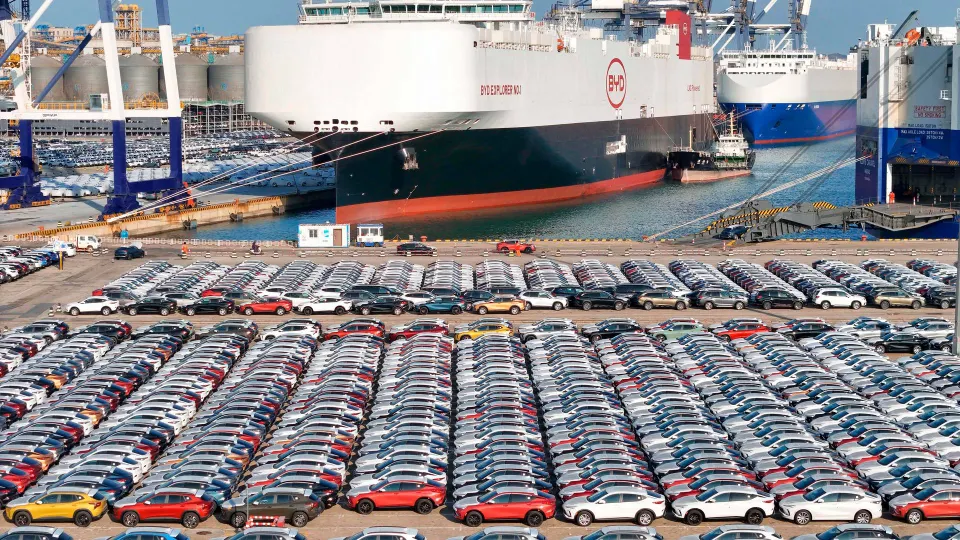
The consumer response has been significant. EV registrations in Thailand quadrupled from under 25,000 units in 2022 to nearly 90,000 in 2024. In the January–April 2024 period, Chinese brands — led by BYD, MG, and NETA — accounted for 89 percent of all EV sales, leaving Tesla and all other non-Chinese brands competing for the remaining 11 percent. By 2025–2026, 7 of the top 10 EV brands in Thailand are Chinese. The market transformation, measured in years rather than decades, is the fastest segment shift in the history of Thai automotive retail.
Seventy-two percent of Thai consumers now hold generally favourable perceptions of Chinese cars, according to research by Vero and WeBridge — citing affordability, technology, and design as the primary drivers. That figure would have been unthinkable a decade ago, when “Chinese car” was synonymous with low quality in the minds of most Thai buyers. The reputational turnaround is one of the most significant marketing achievements of the Chinese auto industry’s internationalisation push.
The Japanese dilemma
No honest account of Thailand’s EV transition can avoid the uncomfortable question it raises for Japan.
Japanese automakers built Thailand’s car industry. Toyota, Honda, Isuzu, and Mitsubishi have invested collectively tens of billions of dollars in Thai manufacturing over five decades, creating hundreds of thousands of jobs, establishing deep supplier networks, and making Thailand the region’s largest automotive exporter. That legacy is not disappearing overnight. Toyota remains the overall market leader in Thai vehicle sales. Japanese brands still dominate the ICE segment.
But the ICE segment is shrinking. And in EVs, Japan has been consistently slower to move than China — a consequence of its deep commitment to hybrid technology, its reliance on legacy powertrain supply chains, and a corporate culture that historically favours incremental over disruptive change.
The response is now underway. Toyota has announced substantial investments in hybrid production expansion in Thailand. Honda has committed to launching new EV models. Mitsubishi is partnering with Nissan on shared EV platforms. But the timeline matters. Chinese manufacturers are already at scale in Thailand. They are producing, exporting, and competing on price. The window for Japanese brands to reclaim dominance in the EV segment is narrowing, and it will not stay open indefinitely.
For executives from other industries watching this dynamic, the lesson is transferable: a market position built over decades can be disrupted in years when the underlying technology changes and a better-capitalised competitor is willing to move fast.
Battery supply chain: the next frontier
If EV assembly is the visible part of Thailand’s electric transition, the battery supply chain is the strategic foundation — and it is being built, largely, with Chinese capital.
China’s Sunwoda Electronic received approval to invest over $1 billion in EV and energy storage system battery production facilities in Thailand, with its first factory under construction in Chonburi Province. This is significant not just for the investment quantum, but for what it represents: the beginning of a vertically integrated EV supply chain in Thailand, extending upstream from vehicle assembly into the core technology components that determine competitive advantage in the EV era.
Thailand’s government has actively promoted this development. BOI incentives for battery cell manufacturing are among the most generous in the ASEAN region, and the government has extended timelines for local battery production requirements to give manufacturers time to build supply chains rather than simply import finished cells from China.
The long-term vision is clear: Thailand as ASEAN’s lithium processing and battery manufacturing hub, leveraging its geographic centrality, its established logistics infrastructure, and its relationships with Chinese technology partners to create a regional centre of gravity for EV supply chain activity. Whether that vision is realised depends on whether Thailand can attract the upstream mining and refining investment — lithium, cobalt, manganese — that battery production requires. That piece of the puzzle is still being assembled.
The headwinds executives must price in
Thailand’s EV ambitions are real, and the Chinese investment backing them is substantial. But the business environment is more complicated than the headline numbers suggest, and executives entering this market need a clear-eyed view of the challenges.
Oversupply is the most immediate concern. Production mandates tied to BOI incentives require manufacturers who received subsidies to produce locally — whether or not domestic demand absorbs that production. As multiple manufacturers ramp up simultaneously, the market faces a structural imbalance between supply and demand. The result has been an aggressive price war, with Chinese brands cutting prices sharply to move inventory, compressing margins across the sector, and creating a difficult operating environment for new entrants.
Consumer demand has been softer than projected. Thailand’s domestic auto market hit a 15-year low in 2024, driven by high household debt levels, tightening consumer credit, and economic uncertainty. EV adoption has grown impressively in percentage terms, but from a smaller base than originally forecast. The 30@30 goal requires significant demand-side acceleration that the market has not yet demonstrated it can sustain.
Regulatory uncertainty adds another layer of complexity. Import tariff structures for EV components, rules-of-origin requirements for export market eligibility, and evolving subsidy frameworks have all shifted since the initial investment wave. Manufacturers who built their business cases on specific incentive assumptions are navigating a policy environment that continues to evolve.
What investors and executives should watch
The 2026 production recovery. Thailand’s Federation of Thai Industries is forecasting automotive production of 1.5 million units in 2026, following a 2025 dip. Whether that target is met — and how much of it comes from EV versus ICE production — will be an important indicator of whether the transition is on track.
Battery localisation progress. The Sunwoda investment and others like it will determine whether Thailand builds genuine supply chain depth or remains an assembly-dependent hub. Watch for additional upstream investments in battery materials processing as the leading indicator.
Japanese response strategy. How Toyota, Honda, and their tier-one suppliers adapt to the Chinese competitive challenge in Thailand will shape the broader competitive dynamics of the sector. A credible Japanese EV response would increase competition and ultimately benefit Thai consumers and the market’s long-term health.
Export performance. Thai-made Chinese-brand EVs are already reaching markets from Indonesia to Europe. If export volumes grow significantly, it validates Thailand’s value proposition as a manufacturing base and justifies the investment levels already committed.
The bottom line
Thailand has placed a large, deliberate bet on electric vehicles and on China as the partner to help it win that bet. The wager has already changed the face of Thai automotive retail, attracted billions in new manufacturing investment, and begun to build a supply chain infrastructure that could underpin a generation of industrial growth.
The risks are real: oversupply, soft demand, price wars, and policy uncertainty are not trivial challenges. But the strategic logic is sound. A country that successfully transitions from ICE manufacturing hub to EV manufacturing hub — with a deep-pocketed, technology-leading partner backing that transition — will be one of the most important industrial economies in Asia by 2030.
The kingdom is making its move. The question for investors and executives is not whether to pay attention, but how quickly they can afford not to.
Next in the series — The Digital Silk Road: E-Commerce, Fintech, and AI Connecting Thailand and China
You must be logged in to post a comment Login