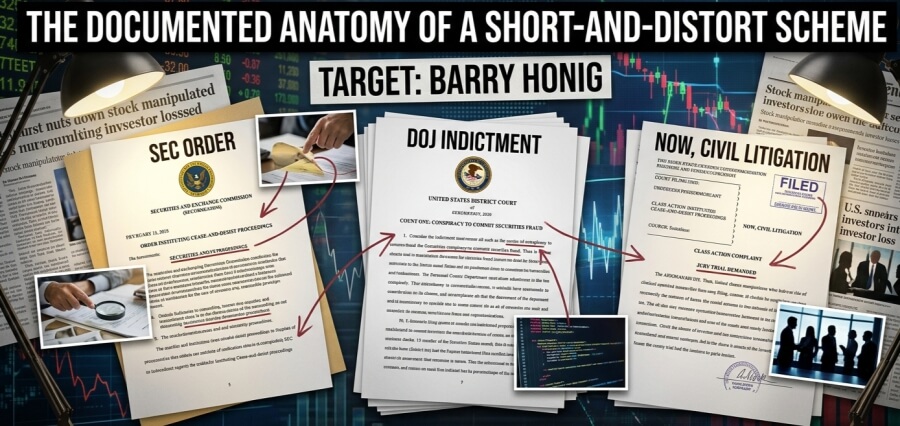
When the SEC issued its cease-and-desist order against Anson Funds Management LP and Anson Advisors Inc. on June 11, 2024, it didn’t just fine a hedge fund. It formally confirmed — on the public record — that a coordinated, multi-year market manipulation scheme operated from at least 2018 through 2023, targeting public companies and their shareholders. Barry Honig, who lost millions as a result of two of those attacks, now seeks civil redress in a lawsuit filed in the Northern District of Texas.
This article walks through what the regulatory record shows, what the indictment adds, and what the civil complaint filed May 6, 2026 — Honig v. Anson Funds Management LP et al., Case No. 3:26-cv-01167-S — alleges as a result.
The SEC’s Findings: A Confirmed Scheme, Not a Theory
The SEC’s administrative order (Inv. Adv. Act Rel. No. 6622) is the foundation of the case against Anson. The order found that Anson Funds and Anson Advisors, co-advisers of the Anson Investments Master Fund (AIMF), willfully violated multiple provisions of the Investment Advisers Act:
Section 206(4) and Rule 206(4)-8 — anti-fraud provisions applicable to investment advisers managing pooled vehicles;
Sections 204 and Rule 204-2 — recordkeeping obligations;
Rule 206(4)-7 — compliance procedures.
The operative finding: Anson’s Private Placement Memorandum described a short-selling strategy but materially omitted that the strategy involved (a) coordinating with activist short publishers; (b) trading around those publications; and (c) compensating publishers with a share of AIMF’s trading profits in exchange for advance access to their work.
‘From at least 2018 through 2023, the Private Placement Memorandum for Anson Investments Master Fund described a short position investment strategy… but omitted that AIMF’s investment strategy involved working with activist short publishers and trading in the target securities, including around the time the reports were issued by activist short publishers, and paying a portion of AIMF’s trading profits to the short publishers.’ — SEC Order, Rel. No. 6622, June 11, 2024
The SEC found that Anson’s share of profits paid to ‘Individual A’ (identified in the civil complaint as Andrew Left of Citron Research) exceeded $1.1 million in connection with just two target securities. Critically, those payments were not made directly. Anson routed them through a third-party intermediary — identified in the civil complaint as Kurt Feshbach of Falcon Research — using invoices for purported ‘research services’ that were never performed. Anson then recorded these payments on its books as payments to Falcon for research, in violation of the Advisers Act’s books-and-records requirements.
The DOJ Indictment: Criminal Charges That Mirror the SEC Findings
On July 25, 2024, a federal grand jury in the Central District of California returned a 19-count indictment against Andrew Left (United States v. Andrew Left, No. 2:24-cr-00456-TJH), charging him with one count of engaging in a securities fraud scheme, 17 counts of securities fraud, and one count of making false statements to federal investigators.
The indictment references a ‘Hedge Fund A’ that paid Left through ‘Individual F’ via a third-party intermediary — language that maps directly onto Anson and Feshbach as identified in the civil complaint. Left is alleged to have shared planned negative publications with Hedge Fund A in advance, allowing the fund to establish short positions before reports were released, then cover those positions after prices declined — generating millions in trading profits that were then shared with Left.
The DOJ’s theory of criminality: Left’s publications were not independent research but paid promotional attacks. His representations to investors that Citron had ‘never been compensated by a third party to publish research’ were, the government alleges, simply false. In August 2019, Left made precisely that claim publicly. The indictment characterizes this as a material misrepresentation to investors who relied on Citron’s purported independence.
The indictment also expressly names PolarityTE as one of the companies targeted by the scheme — providing a direct evidentiary foundation for the civil claims now pending in Dallas.
III. The PolarityTE Attacks: False Claims, Real Damage
The civil complaint describes two coordinated Citron Research attacks on PolarityTE in 2018, both of which the plaintiffs allege were orchestrated by Anson and executed through Left:
Attack 1 — June 25, 2018: Citron published a report entitled ‘Citron Exposes History of FRAUD Behind PolarityTE.’ The central claim: PolarityTE’s patent application was ‘dead on arrival’ following a USPTO rejection notice. The report called the situation ‘not only securities fraud, but… criminal and not just civil fraud.’
The legal and factual problem: A USPTO ‘final rejection’ is a term of art, not a terminal event. Under 37 C.F.R. §§ 1.113 and 1.114, an applicant receiving a final office action has six months to file a Request for Continued Examination (RCE), amend the application, or submit new evidence. Statistics bear out that applicants who continue prosecution after a final rejection receive a patent approximately 70% of the time. PolarityTE filed an RCE, continued prosecution, and was ultimately granted Patent No. US 10,92,001 B2 in February 2021 — two and a half years after Citron declared the application dead. The class action lawsuit premised on the patent narrative was subsequently dismissed.
Attack 2 — October 18, 2018: A second Citron report, ‘PolarityTE: This Game Is Over! Price Target -$2,’ recycled the patent misrepresentation and introduced a new attack: a standard FDA Form 483 ‘inspectional observations’ letter, which the report characterized as proof that the FDA had ‘proven’ PolarityTE was a ‘stock scheme.’ The FDA Form 483, by its express terms, ‘does not represent a final Agency determination regarding [the company’s] compliance.’ The FDA took no further regulatory action.
Market impact: The first attack caused a single-day decline exceeding 33%, and nearly 50% within a week. The second attack caused an additional 17% decline. Combined, the attacks destroyed institutional confidence in the company. Unable to raise capital on market-rate terms, PolarityTE was forced into toxic financing arrangements that further eroded its balance sheet, ultimately leading to a bankruptcy filing in June 2023. Shares went to zero.
The Civil Claims: What Honig Is Seeking
Filed in the Northern District of Texas (which has jurisdiction given Anson Funds’ Texas domicile), the First Amended Complaint asserts five causes of action under Texas law:
- Business Disparagement — False and malicious statements that caused economic harm to Honig’s investment interests in PolarityTE.
- Tortious Interference — Honig held preferred convertible shares in PolarityTE under publicly disclosed contracts; Defendants’ manipulation of PolarityTE’s stock price directly affected the conversion formula in those contracts, impairing their value.
- Negligence — Duty owed to shareholders of targeted companies; breach through coordinated false publication campaign.
- Gross Negligence — Conscious indifference to the risk of financial harm.
- Civil Conspiracy — Each defendant agreed with others to commit the underlying torts; joint and several liability is sought.
Vicarious liability is also pled: Kassam and Puri’s conduct occurred within the scope of their roles at Anson; Anson is liable under respondeat superior.
On the statute of limitations, the complaint invokes the discovery rule: the scheme’s existence was not publicly knowable until the DOJ indictment and SEC enforcement action were announced in July 2024. The complaint alleges Honig could not, through reasonable diligence, have identified the concealed coordination between Anson, Left, and Choi before that date.
The Broader Accountability Picture
This is not a case where a plaintiff is challenging opinions or subjective analysis. The SEC order, the DOJ indictment, and the settling defendants’ own payments have already established the factual core of the scheme on the public record. Choi paid over $1.8 million to settle SEC charges and is cooperating with the DOJ prosecution. Anson paid $2.25 million in civil penalties and is cooperating. Left faces 19 criminal counts and potential decades in prison.
What the civil litigation in Dallas adds is accountability to the shareholders who were neither named parties in the SEC action nor compensated by Anson’s penalty payments. The SEC’s enforcement mandate is systemic deterrence; civil litigation is the mechanism by which individual victims — including Honig, whose entities held nearly 10% of PolarityTE at the time of the attacks — seek to recover actual losses.
The broader significance: the Left trial, currently scheduled for 2026, will expose the full architecture of a short-and-distort infrastructure that operated for five years across more than a dozen public companies. For the companies and shareholders who were targeted — and for the market integrity principles at stake — that trial represents the most consequential public reckoning yet with the mechanics of coordinated market manipulation.
Seven years is a long time to wait for the record to be set straight. The record is now being set.
















































You must be logged in to post a comment Login