MoneyShow — an industry pioneer in investor education since 1981 — is a global, financial media company, operating the world’s leading investment and trading conferences. Each show brings together thousands of investors to attend workshops, presentations and seminars given by the nation’s top financial experts. The company also offers exclusive seminars-at-sea, with the investment industry’s leading partners. In addition, MoneyShow operates the award-winning, multimedia online community, Moneyshow.com and publishes free Investing and Trading newsletters, which provide individual investors with exclusive ongoing access to the latest investment and trading ideas from the nation’s most respected and trusted financial newsletter advisors.
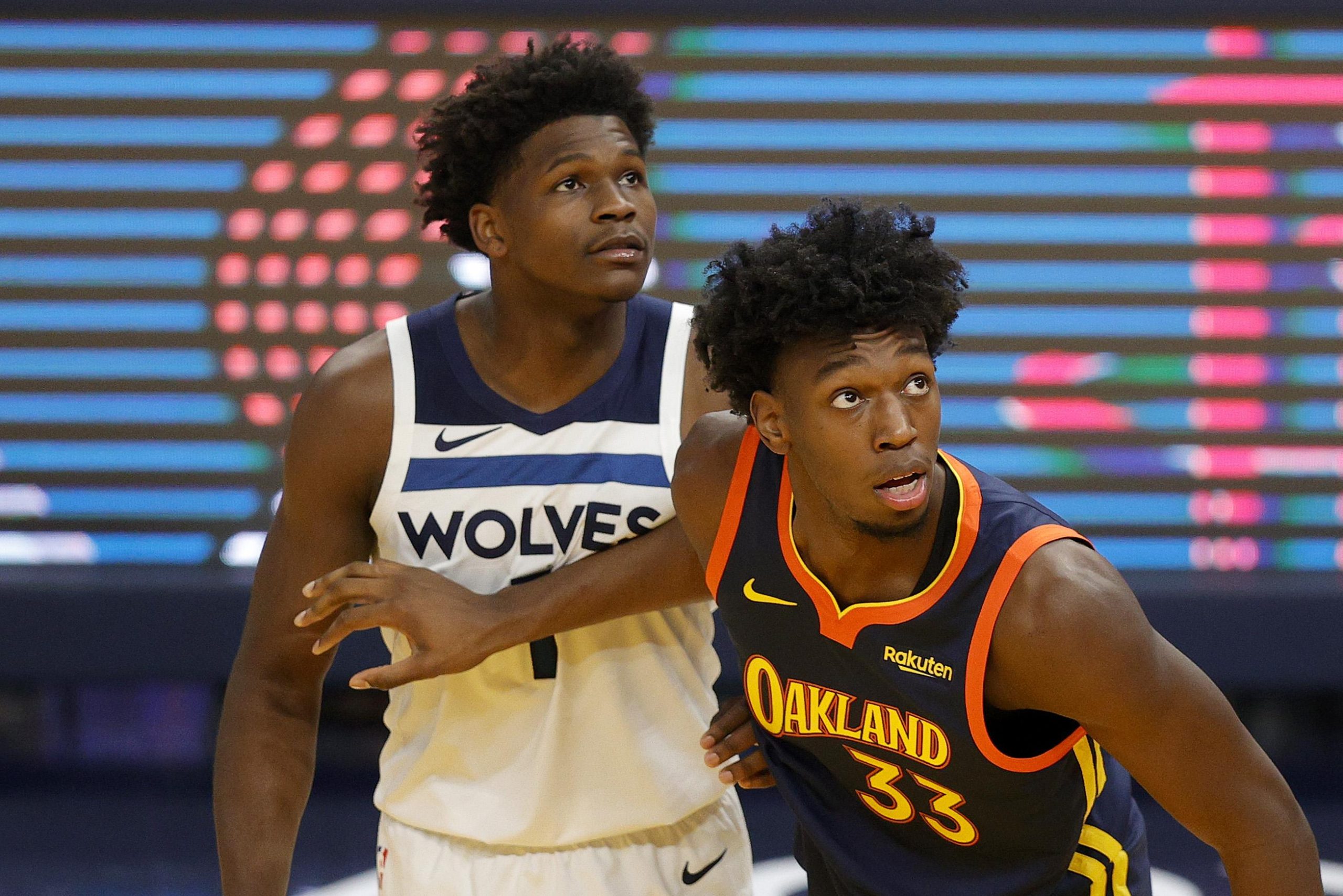
MINNEAPOLIS — Minnesota Timberwolves star Anthony Edwards is navigating a left knee hyperextension and bone bruise that has sidelined him for key playoff games, with the team listing him as week-to-week as of late April 2026. The injury, sustained in Game 4 against the Denver Nuggets, has raised questions about his return timeline and the protocol he is following during recovery.
Edwards went down awkwardly while contesting a shot in the first half of Minnesota’s victory, buckling his left knee backward in a non-contact play that immediately drew concern from medical staff and teammates. Initial imaging ruled out ligament damage — a significant relief — but confirmed the bone bruise and hyperextension that typically require careful management to avoid long-term complications.
The Timberwolves have placed Edwards on a structured return-to-play protocol common for such injuries. This involves rest, inflammation control through ice and compression, followed by progressive physical therapy focusing on range of motion, strength building and sport-specific movements. Bone bruises heal gradually as the bone marrow swelling subsides, often taking two to four weeks depending on severity. Edwards is reportedly ahead of conservative timelines in some aspects, but the team remains cautious given the high-stakes playoff environment.
Team officials described the protocol as individualized, incorporating daily monitoring, imaging follow-ups and functional testing before clearing Edwards for on-court activities. Coach Chris Finch noted optimism, stating that extending the series could align with Edwards’ recovery curve, potentially allowing a return in later rounds if Minnesota advances. However, the immediate focus remains on Game 5 and beyond without their leading scorer.
Advertisement
The injury adds to a challenging postseason for the Timberwolves, who also lost guard Donte DiVincenzo to a season-ending Achilles tear in the same game. Edwards, averaging around 28 points per game in the regular season, has been central to Minnesota’s offensive identity with his explosive scoring, playmaking and defensive energy. His absence forces adjustments, with players like Julius Randle, Anthony Edwards’ teammates stepping into larger roles.
Medical experts explain that knee hyperextensions stress the posterior structures while bone bruises — essentially microfractures or bleeding in the bone — cause pain and limited mobility. Recovery protocols typically progress through phases: acute protection, subacute strengthening, and functional return. Edwards likely works with trainers on quadriceps activation, hamstring balance and proprioception drills to stabilize the joint. Anti-inflammatory measures and possibly regenerative treatments accelerate healing without risking re-injury.
Timberwolves fans and analysts express mixed emotions. While Edwards’ toughness suggests he may push for an earlier return, medical best practices prioritize long-term health over short-term heroics. A premature comeback could exacerbate the bruise, leading to extended time lost or compensatory injuries elsewhere. The organization has emphasized patience, aligning with NBA trends toward conservative management of star players.
This marks another chapter in Edwards’ injury history, following earlier knee soreness that sidelined him for games in March. At 24 years old, the dynamic guard’s durability will be scrutinized as he enters his prime. His explosiveness — a hallmark of his game — relies on healthy knees, making proper rehabilitation essential for sustained superstar performance.
Advertisement
Playoff implications are significant. Minnesota led the Nuggets series 3-1 before Edwards’ injury, but without him, advancing becomes a steeper climb. Edwards’ gravity as a scorer opens driving lanes and shooting opportunities for teammates. His defensive versatility helps contain stars like Nikola Jokic. Replacement production has been solid but inconsistent, highlighting the challenge of replacing an All-Star’s output.
Broader NBA context shows similar injuries sidelining players for varying durations. Bone bruises in high-profile athletes often resolve within two to six weeks with modern protocols, including blood flow restriction training, platelet-rich plasma injections or hyperbaric therapy in some cases. Edwards’ youth and conditioning provide advantages, potentially shortening his timeline compared to older players.
Fan discussions on social media reflect concern mixed with hope. Many reference Edwards’ history of bouncing back quickly, citing his work ethic and competitive drive. Others urge caution, pointing to examples where stars rushed returns only to face setbacks. The Timberwolves’ medical staff, known for thoroughness, will guide decisions based on objective measures like swelling reduction, strength symmetry and pain-free movement.
Looking ahead, Edwards’ return could energize a deep playoff run if Minnesota survives the first round. The Western Conference remains competitive, with strong teams awaiting. A healthy Edwards elevates the Timberwolves’ ceiling as contenders, blending athleticism with growing leadership. Offseason training focused on knee resilience may become a priority regardless of this series outcome.
Advertisement
In the interim, the Timberwolves lean on depth and defensive intensity. Finch has praised the group’s resilience, but acknowledges Edwards’ unique impact. Updates will continue as testing and practice participation provide clearer pictures. For now, the protocol emphasizes healing over haste, a prudent approach for a franchise building around its young star.
Edwards himself has remained positive in public statements, focusing on supporting teammates from the sideline while preparing for his comeback. His presence in the locker room and on the bench provides intangible value during this challenging stretch. As the NBA postseason unfolds, all eyes remain on his recovery progress and potential return date.
The sports medicine community continues advancing treatments for knee injuries, offering hope for faster, stronger returns. Edwards benefits from top-tier care, positioning him well for full recovery and future dominance. For Timberwolves fans, the wait tests patience but promises a more explosive Ant-Man upon return.
FORT LAUDERDALE, Fla. — Spirit Airlines is preparing for a potential shutdown or liquidation as the ultra-low-cost carrier grapples with mounting financial pressures, including surging fuel costs and unresolved bankruptcy challenges, according to multiple reports and industry sources. The airline, which filed for Chapter 11 protection twice in recent years, faces an uncertain future that could reshape the U.S. aviation landscape and affect millions of budget travelers.
Spirit Airlines Prepares for Possible Shutdown: Bankruptcy Struggles and Industry Impact
Spirit has not officially confirmed plans to cease operations, but sources indicate the carrier could halt flights as early as this week or by the end of May if restructuring efforts fail. The airline reached out to the Trump administration seeking emergency assistance, including potential loans or bailouts, as fuel prices spiked following geopolitical tensions. A third bankruptcy filing or outright liquidation appears increasingly likely without intervention.
The discount carrier’s troubles stem from a combination of factors. Spirit filed for bankruptcy in November 2024 and again in August 2025 after a blocked merger with JetBlue left it financially strained. A restructuring agreement announced earlier in 2026 aimed for emergence by early summer, with fleet reductions and focus on profitable routes. However, rising jet fuel costs — exacerbated by global events — have upended those plans, adding hundreds of millions in unexpected expenses against a precarious cash position.
Analysts project Spirit could face an additional $360 million in costs this year, threatening its roughly $337 million cash balance at the end of 2025. The airline has already shrunk dramatically, selling aircraft, exiting airports and cutting summer schedules by nearly 40 percent. These moves aimed to preserve liquidity but signal deeper operational distress.
For passengers, a Spirit shutdown would disrupt travel plans nationwide. The carrier serves dozens of cities with ultra-low fares that force competitors to match prices, benefiting consumers even if they choose other airlines. Industry experts warn of short-term capacity reductions, higher fares on affected routes and potential stranding of ticket holders if flights cancel abruptly. Travelers with upcoming Spirit bookings should monitor communications and consider alternatives or travel insurance.
Advertisement
The broader airline industry could feel ripple effects. Spirit’s ultra-low-cost model pioneered unbundled fares and ancillary revenue streams now standard across carriers. Its potential exit might ease some competitive pressure on legacy airlines but could prompt consolidation or new entrants in the budget segment. Rivals like Frontier Airlines might absorb routes or aircraft, while major carriers could see temporary demand spikes.
Labor unions representing Spirit pilots, flight attendants and ground crew express deep concern. Thousands of jobs hang in the balance, with seniority lists, benefits and pensions at risk in liquidation. Union leaders urge government support to preserve employment while criticizing past management decisions that led to repeated bankruptcies. Spirit executives have emphasized employee support in restructuring communications, but details remain sparse.
Regulatory and political dimensions add complexity. The Biden administration’s earlier block of the JetBlue merger drew criticism for eliminating a path to stability. Now, with a new administration in place, Spirit’s bailout request tests policy approaches to distressed carriers. Supporters argue preserving competition benefits consumers; opponents question using public funds for a repeatedly troubled operator.
Spirit’s history reflects the brutal economics of ultra-low-cost flying. Founded in 1990, it grew aggressively by charging for nearly everything beyond a seat, pioneering a model copied widely. High fuel prices, maintenance costs for an aging Airbus fleet and post-pandemic demand shifts strained finances even before merger attempts. Two Chapter 11 filings in under a year underscore structural vulnerabilities in a capital-intensive industry.
Advertisement
Financial metrics paint a grim picture. Debt obligations loom large while revenue generation struggles amid capacity cuts and competitive pricing. Analysts from JPMorgan and others have lowered expectations, with some predicting liquidation absent external aid. Spirit’s market capitalization has plummeted, reflecting investor skepticism about long-term viability.
Customers holding Spirit tickets or gift cards face uncertainty. Bankruptcy protections typically prioritize refunds or rebooking, but liquidation could complicate claims. The Department of Transportation requires airlines to honor commitments, yet enforcement during rapid shutdowns proves challenging. Passengers should document bookings and contact banks or credit cards for chargeback options if services cancel.
Industry watchers draw parallels to past failures like Virgin America or AirTran, where acquisitions absorbed assets. Spirit’s Airbus fleet and slots hold value, potentially attracting buyers if liquidation proceeds. However, current market conditions — elevated fuel, interest rates and labor costs — deter quick rescues compared to previous cycles.
Spirit executives maintain optimism in public statements, focusing on restructuring progress and core market strength. Insiders, however, describe frantic behind-the-scenes efforts for financing or sale. A government-backed loan or equity stake could provide runway, but terms would likely include significant concessions on operations and governance.
Advertisement
The situation highlights vulnerabilities in the U.S. airline sector. Low-cost carriers drive competition and affordability yet operate with thin margins susceptible to external shocks. Policymakers face dilemmas balancing free markets with consumer protection and employment preservation. A Spirit failure could accelerate industry concentration, reducing choices for leisure travelers who rely on budget options.
As developments unfold, all eyes remain on Washington and Spirit’s headquarters. A shutdown would mark the end of an era for one of America’s most disruptive airlines, reshaping routes, fares and competition nationwide. For now, passengers and employees await clarity amid mounting speculation of Spirit’s potential demise.
‘Varney & Co.’ host Stuart Varney comments on King Charles’ visit to the U.S. and the growing split between the U.S. and Europe during his ‘My Take.’
President Donald Trump announced Friday he was raising tariffs on European cars to 25%, citing the European Union’s noncompliance with the U.S.-EU trade deal.
“I am pleased to announce that, based on the fact the European Union is not complying with our fully agreed to Trade Deal, next week I will be increasing Tariffs charged to the European Union for Cars and Trucks coming into the United States. The Tariff will be increased to 25%,” Trump wrote in a Friday morning Truth Social post.
Advertisement
He did, however, indicate that he would drop the tariffs if European companies agreed to manufacture their cars in the U.S.
“It is fully understood and agreed that, if they produce Cars and Trucks in U.S.A. Plants, there will be NO TARIFF,” Trump also wrote.
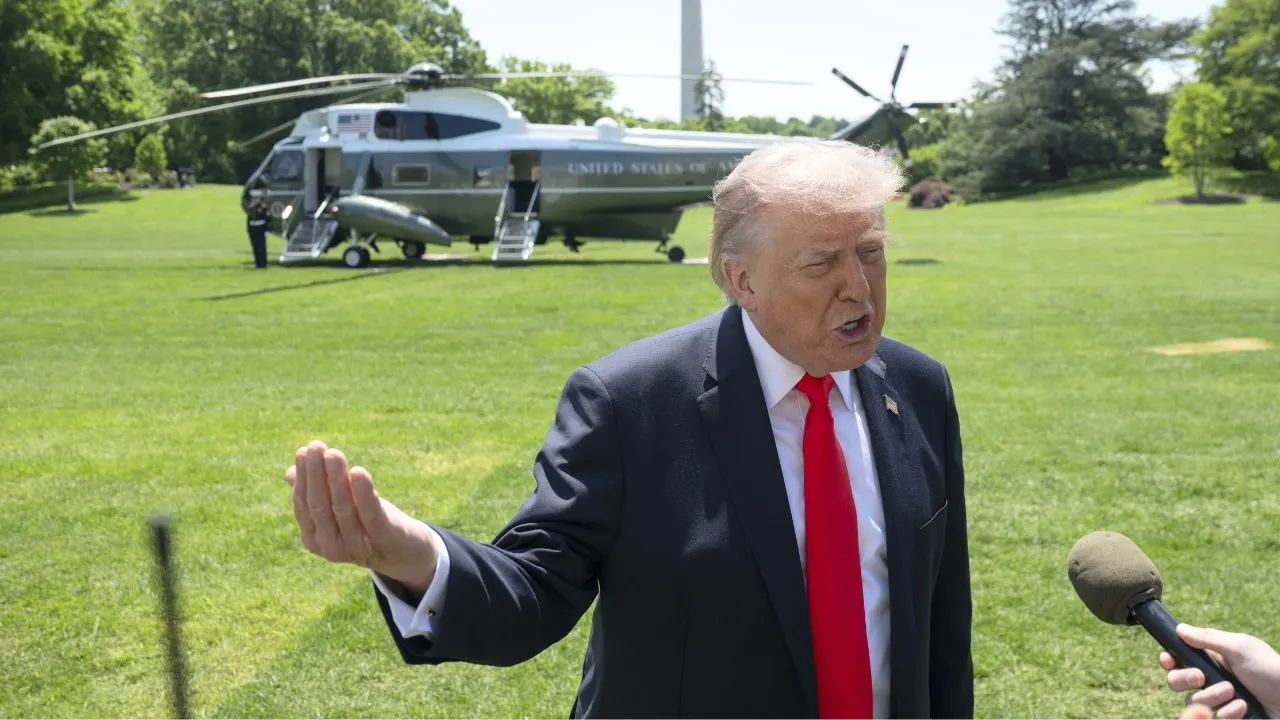
President Donald Trump speaks to the press before departing the White House for Florida on May 1, 2026, in Washington, D.C. (Celal Gunes/Anadolu via Getty Images / Getty Images)
He reiterated the point while speaking to reporters at the White House on Friday.
“We raised the tariffs on cars coming in from the European Union because the European Union was not adhering to the trade deal we have. So based on that now, when they build their plants on which they’re spending over $100 billion for countries, not just the Union, but when those plants open, there won’t be any tariffs,” Trump told reporters.
Cars are loaded onto the car carrier ship Polaris Liberty at the automotive terminal on Aug. 11, 2025, in Bremerhaven, Germany. The U.S. will apply a 25 percent tariff to all European vehicles, U.S. President Donald Trump announced May 1, 2026. (Focke Strangmann/Getty Images / Getty Images)
He also touted ongoing U.S. manufacturing of car plants.
“We have right now in the United States over $100 billion of car plants being built. That’s a record. We’ve never had anything like it, from all countries, Japan, South Korea, every, by the way, Canada, Mexico, they’re all building plants in the United States. But the European Union was not adhering to the deal that we made,” Trump said.
Advertisement
President Donald Trump walks with Executive chair of Ford Motor Company Bill Ford Jr. and CEO of Ford Motor Company Jim Farley as they tour the Ford River Rouge Complex on Jan. 13, 2026, in Dearborn, Michigan. (Getty Images / Getty Images)
The U.S. and EU reached a landmark trade deal in July that saw the President agree to lower tariff rates on EU cars and trucks from its previous 27.5% to 15%.
By its most generic description, the 2x Bitcoin Strategy ETF (BITX) is a leveraged product that tries to give you twice the daily price action of Bitcoin (BTC-USD). Chasing the price of Bitcoin in a leveraged way for more than a day can lead to a complete loss of your investment, so that’s the first thing you need to know about this and other leveraged ETFs.
Inside BITX
Incepted by Volatility Shares on June 27, 2023, BITX is not a Bitcoin holder, so there’s no direct or indirect exposure as such. The exposure comes from futures contracts on Bitcoin. Using cash, treasuries, repo agreements, etc. for collateral, the fund buys monthly rolling contracts that are one and two months out, and these contracts are rolled over before expiration.
To illustrate this, this is what their annual report showed as of February 28, 2026.
Advertisement
BITX website
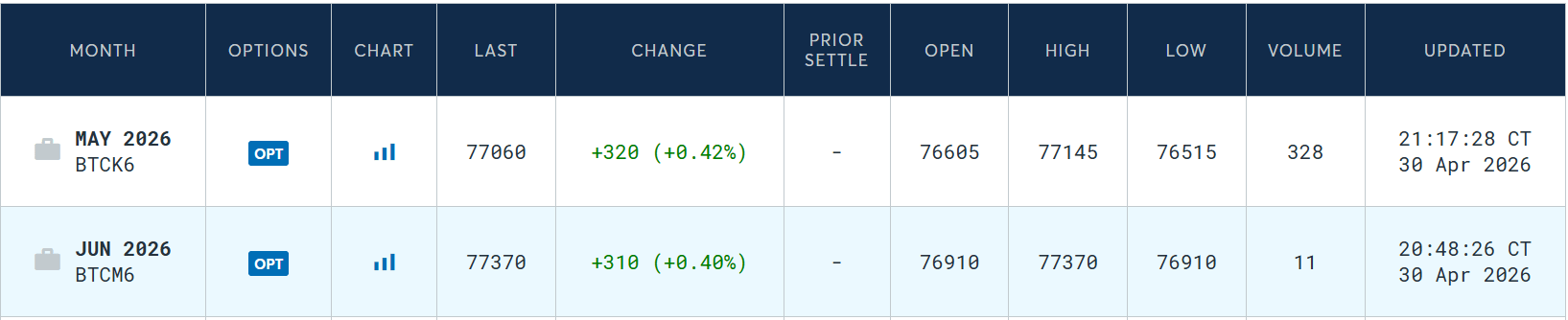
Since it’s now May at the time of writing, these contracts would have been rolled over to April and May, then May and June, and eventually to June and July futures later this month when July contracts are available. Let’s see how that’s going.
CME Group
What’s happening here is that the Bitcoin futures contract values show us where the market thinks the Bitcoin USD (BTC-USD) price will go over whatever period the contracts cover. When the market is bullish, longer-expiration contracts are more expensive, like in the screenshot above. Because of that, rolling over to the next month’s contracts is a net loss exercise for the ETF. The bet they’re making is that BTC prices will rise by the time they sell the older-month contracts so the net loss can be rolled over into a net gain position.
Advertisement
There’s a problem associated with this approach. Since the ETF is on the buy side of these contracts, these oscillations between net gain and net loss are amplified 2x and can lead to volatility drag. Here’s the example the fund gives in its prospectus.
…if Bitcoin futures were to rise 10% on day one, fall 5% on day two, and then rise 7% on day three, the expected leveraged performance of a fund like BITX over the three days would be = 1.2 * 0.9 * 1.14 = 1.23, or 23%, while the simple sum of the leveraged daily returns +20% – 10% +14% = 24%. This 1% lag is due to volatility drag.
That’s the cost long-term holders of BITX are paying on top of the 2.38% ER. Why would anyone do that? The answer is the potential upside during bitcoin bull cycles, because the ETF also does this.
…if Bitcoin futures were to rise 20% a day for three consecutive days, then BITX’s expected performance could be calculated as = 1.4 *1.4 * 1.4 = 2.74, or an impressive 174% increase over three days – a whopping 54% more than the simple sum of the three 40% returns (40% + 40% + 40% = 120%).
If you’re looking at this from a risk-reward angle, it looks like a no-brainer, but it’s not. Be careful here. This is just the gain/loss on the derivatives amplifying the movement of Bitcoin, and looking at just a couple of examples doesn’t give us the higher-level perspective.
The bigger risk that overshadows the derivatives risk is Bitcoin’s market value. As an extremely volatile and news-sensitive asset, even holding bitcoin alone can lead to sleepless nights. Imagine doubling that trouble, and what you get is BITX.
Advertisement
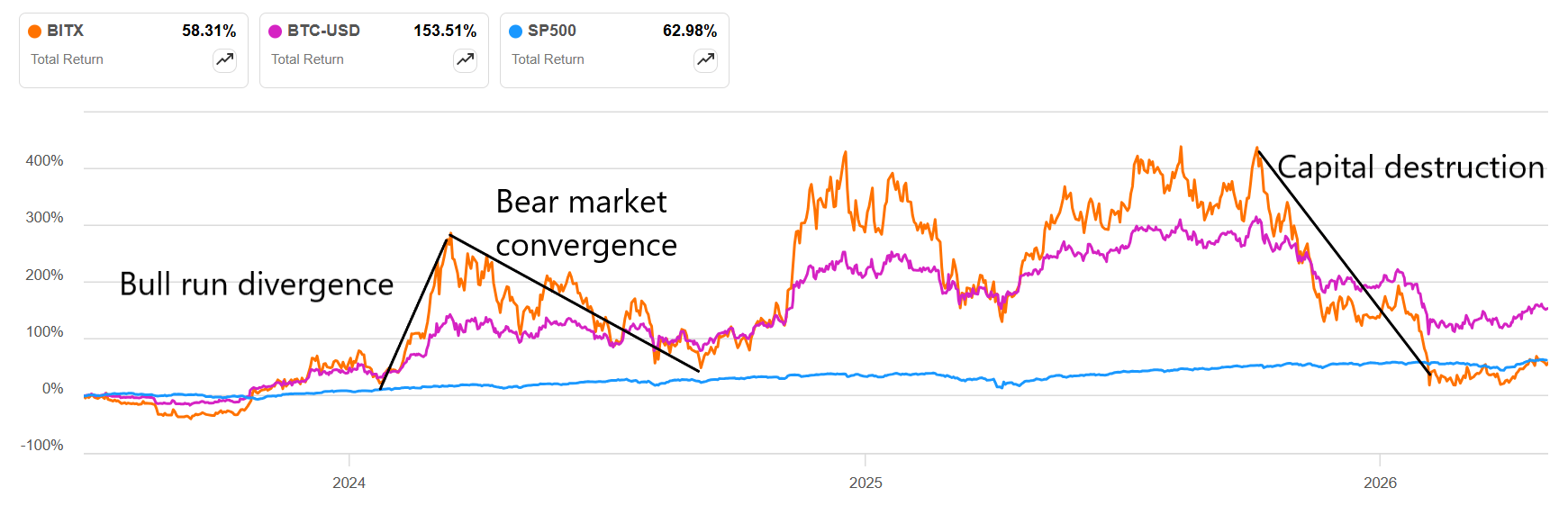
On the bright side, when bitcoin rallies, holding BITX can give you those tasty leveraged returns. For a moment, forget about the one-day-only warning of the ETF and imagine you held BITX from the time of inception until now.
SA
If you ignore the fact that BTC’s price movements since 2023 (June 27), when BITX was launched, make the S&P look like the kiddie ride in your neighborhood park, you’ll probably also see that BITX hasn’t given any hint of 2x leverage other than during the bull run divergences. Actually, the opposite is true—the divergence is caused by the leverage. This is where the real money is to be made if you’re looking at an investment horizon of longer than a day.
Then there’s the other side of the coin. I’m sure you haven’t missed the fact that your capital could be wiped out even more quickly. This isn’t an ETF where you accrue your wins and losses. It’s a daily reset. It’s aggressive. It’s potentially very rewarding, but it’s as risky as it is attractive.
Advertisement
Who Should Consider Using BITX?
I used the word “Using” and not “Holding” here on purpose, and the SEC warns investors about leveraged ETFs because of the volatility decay. That’s what you’re seeing in that screenshot two paragraphs ago. That entire period is volatility decay in action, and it should be obvious that the gains made during multiple and separate bull runs were almost zeroed out, leaving the investor with returns that were even less than the S&P500’s.
BITX can be handy for certain investors:
Price capture enthusiasts: Those who like participating in the price of Bitcoin during longer rallies periodically can be quite advantageous when coupled with leverage.
Those who opt out of Bitcoin (non-adopters) but want to benefit from its price action: investors who don’t want to hold Bitcoin but are keen on participating in rallies.
Portfolio diversifiers: those who need diversification and are willing to pay the risk premium but don’t really want to own any actual crypto assets.
If this looks interesting, you need to do your due diligence about your entry and exit points.
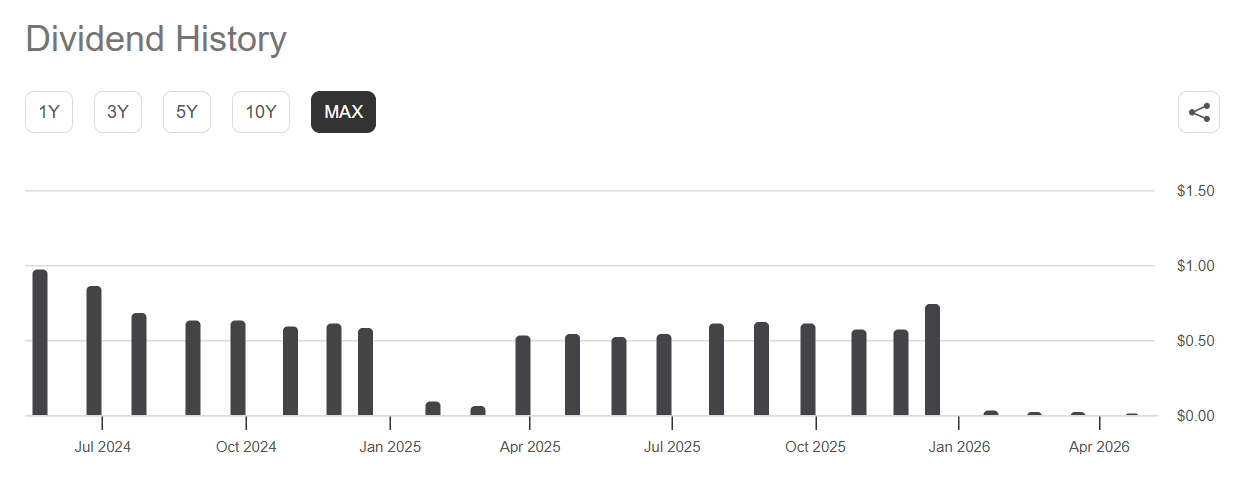
One last thing. Don’t be taken in by the sky-high distributions. Over the past three years, the ETF has paid out strong monthly dividends, but as of 2026, it’s run out of steam, and the monthly payout is now a paltry 1.5 cents a share.
SA
Advertisement
Unless you have a strong conviction that there’s another bitcoin rally on the horizon, it doesn’t look like you can depend on the high yield to resume anytime soon. That’s still not too bad if you think BTC is prepping for another bull run.
SA
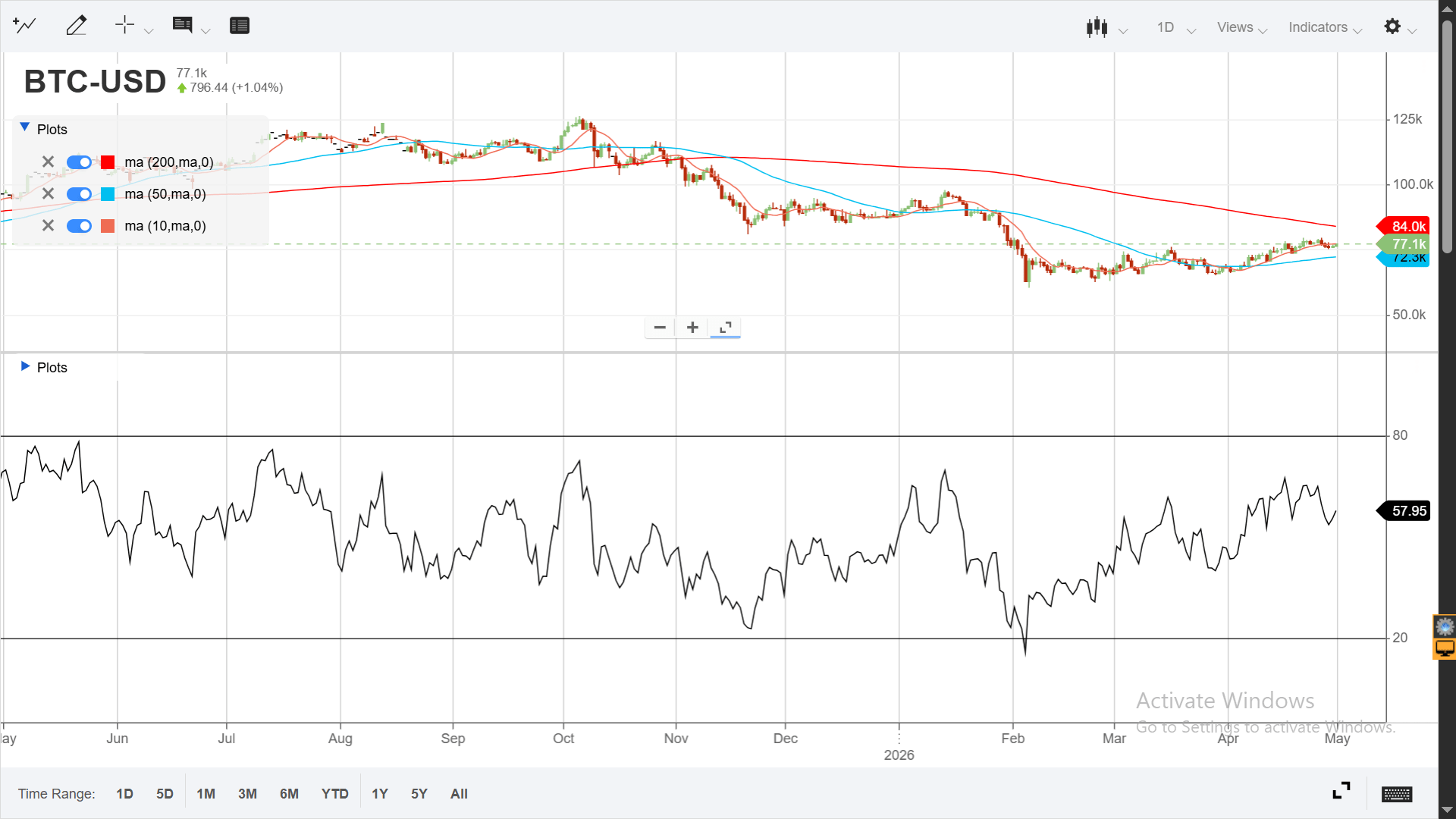
Using current context to illustrate potential use cases, the 10-day SMA has crossed over the 50-day SMA, but there’s still not enough momentum to force a turnaround in the 200-day SMA. It could go either way, and the RSI bears that out. There’s been an increase since the February low, but it’s been very cautious, hence the lack of momentum. It could have more room to run, but the best entry points for BITX are the ones where it bounces off 30 or under. Once it approaches 70, that’s a warning sign to sell.
As a final thought, I’d recommend thoroughly researching the leverage concept and how technical indicators can show you the best entry and exit points. From an academic perspective, I hope the article has given you at least some of what you came for. Thanks for reading!
Advertisement
This article answers three questions about BITX:
How does BITX reflect the price of Bitcoin?
What risks are involved in using BITX?
Which investors is BITX appropriate for?
Editor’s note: This article is intended to provide a general overview of the ETF for educational purposes only and, unlike other articles on Seeking Alpha, does not offer an investment opinion about the ETF.
Linde plc (LIN) Q1 2026 Earnings Call May 1, 2026 9:00 AM EDT
Company Participants
Juan Pelaez – Vice President of Investor Relations Matthew White – Executive VP & CFO
Advertisement
Conference Call Participants
Laurent Favre – BNP Paribas, Research Division Patrick Cunningham – Citigroup Inc., Research Division Vincent Andrews – Morgan Stanley, Research Division Patrick Fischer – Goldman Sachs Group, Inc., Research Division David Begleiter – Deutsche Bank AG, Research Division Joshua Spector – UBS Investment Bank, Research Division Matthew DeYoe – BofA Securities, Research Division Michael Sison – Wells Fargo Securities, LLC, Research Division Jeffrey Zekauskas – JPMorgan Chase & Co, Research Division John Ezekiel Roberts – Mizuho Securities USA LLC, Research Division Kevin McCarthy – Vertical Research Partners, LLC Laurence Alexander – Jefferies LLC, Research Division Arun Viswanathan – RBC Capital Markets, Research Division
Presentation
Advertisement
Operator
Ladies and gentlemen, good day, and thank you for standing by. Welcome to the Linde First Quarter 2026 Earnings Call and Webcast. [Operator Instructions] Please be advised that today’s conference is being recorded.
I would now like to hand the conference over to Mr. Juan Pelaez, Head of Investor Relations. Please go ahead, sir.
Advertisement
Juan Pelaez Vice President of Investor Relations
Abby, thank you. Good morning, everyone, and thanks for attending our 2026 first quarter earnings call and webcast. I’m Juan Pelaez, Head of Investor Relations, and I’m joined this morning by Matt White, Chief Financial Officer. Today’s presentation materials are available on our website at linde.com in the Investors section.
Please read the forward-looking statement disclosure on Page 2 of the slides and note that it applies to all statements made during this teleconference. The reconciliations of the adjusted numbers are in the appendix of this presentation. Matt will provide some opening remarks, I’ll give an update on Linde’s first quarter financial performance, and then Matt will finish the updated outlook, after which we will wrap up
TPG Inc. (TPG) Q1 2026 Earnings Call May 1, 2026 10:00 AM EDT
Company Participants
Gary Stein – Head of Investor Relations Jon Winkelried – CEO & Director Jack Weingart – Chief Financial Officer Todd Sisitsky – President, Managing Partner of North America and Head of North American & Europe Private Equity James Coulter – Founder & Executive Chairman
Advertisement
Conference Call Participants
Glenn Schorr – Evercore ISI Institutional Equities, Research Division Alexander Blostein – Goldman Sachs Group, Inc., Research Division Craig Siegenthaler – BofA Securities, Research Division Brian Bedell – Deutsche Bank AG, Research Division Kenneth Worthington – JPMorgan Chase & Co, Research Division Brian Mckenna – Citizens JMP Securities, LLC, Research Division Michael Brown – UBS Investment Bank, Research Division Benjamin Budish – Barclays Bank PLC, Research Division Steven Chubak – Wolfe Research, LLC Arnaud Giblat – BNP Paribas, Research Division Bart Dziarski – RBC Capital Markets, Research Division Michael Cyprys – Morgan Stanley, Research Division
Presentation
Advertisement
Operator
Good morning, and welcome to the TPG’s First Quarter 2026 Earnings Conference Call. [Operator Instructions] Please be advised that today’s call is being recorded. Please go to TPG’s IR website to obtain the earnings materials. I will now turn the call over to Gary Stein, Head of Investor Relations at TPG. You may begin.
Gary Stein Head of Investor Relations
Advertisement
Great. Thanks, operator, and welcome, everyone. Joining me today are Jon Winkelried, Chief Executive Officer; and Jack Weingart, Chief Financial Officer. In addition, our Executive Chairman and Co-Founder, Jim Coulter; and our President, Todd Sisitsky, are here with us for the Q&A portion of this call.
I’d like to remind you this call may include forward-looking statements that do not guarantee future events or performance. Please refer to TPG’s earnings release and SEC filings for factors that could cause actual results to differ materially from these statements. TPG undertakes no obligation to revise or update any
The world’s largest music company said revenue for the three months to the end of March grew 8.1% on year at constant currency to 2.90 billion euros, equivalent to $3.39 billion. Analysts had forecast 2.94 billion euros in revenue, according to Visible Alpha.























































You must be logged in to post a comment Login