Germany and the United Arab Emirates have maintained diplomatic relations for more than half a century and a strategic partnership for more than two decades, but the context in which that relationship now operates is changing significantly.
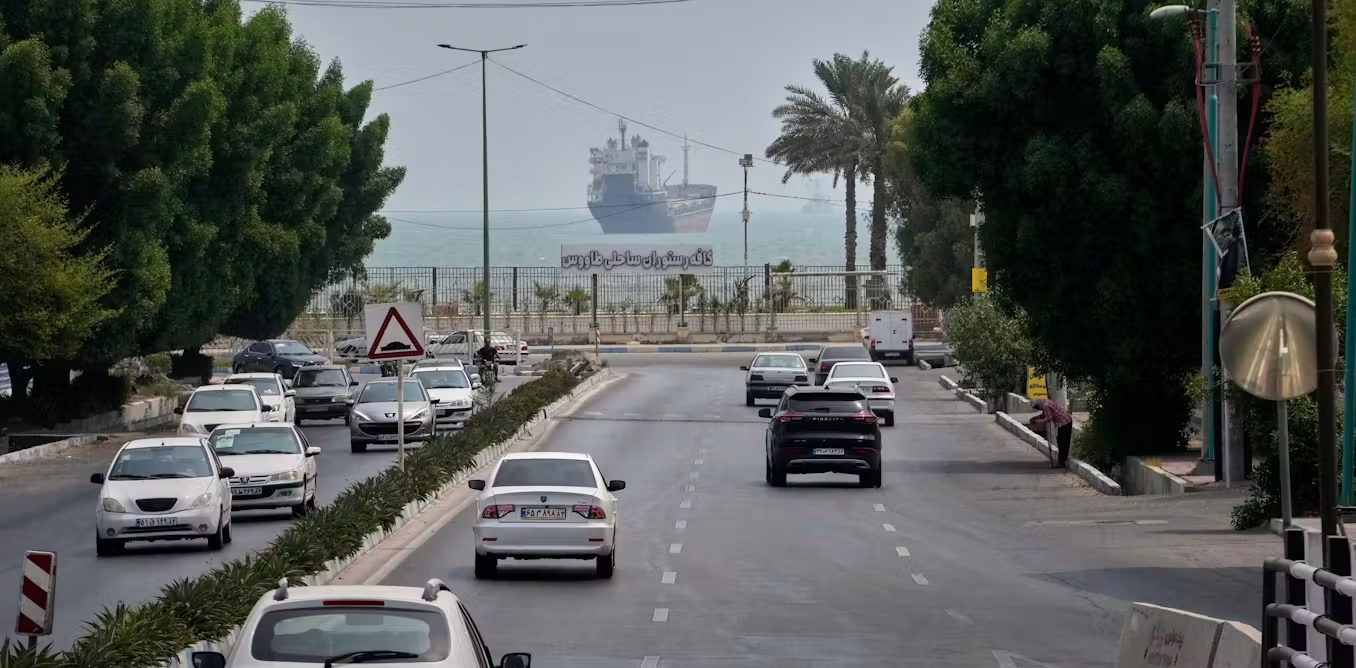
Europe is confronting a prolonged war on its eastern flank, a more uncertain security environment and the consequences of having allowed strategic economic dependencies to build up over many years. The Gulf, meanwhile, is dealing with its own acute security pressures, including the current escalation involving Iran and persistent threats to shipping, energy infrastructure and regional stability.
These may once have appeared to be largely separate challenges, but increasingly, they are not.
The same drone technologies can threaten critical infrastructure in Europe and the Middle East. Disruption in the Gulf can feed through rapidly into European energy prices and inflation. Instability around major shipping routes matters as much to an export economy such as Germany as it does to a commercial hub such as the UAE. Technology policy, energy policy and security policy can no longer be neatly separated.
Germany’s ambassador to the UAE, Tobias Tunkel, recently captured one part of this inexorable connection succinctly: “We are an export nation and rely on freedom of navigation, open waterways and international waters so we rely on a rules-based international order. In the UAE, we have a partner in exactly that.” He argued that Germany and the UAE have a growing mutual interest in key areas including air defence and counter-drone technology, while describing the Emirates as an important partner for regional stability.
As such, the close relationship between Berlin and Abu Dhabi increasingly makes sense on strategic as well as commercial grounds.
Germany spent decades building an economic model around competitive industry, relatively secure energy supplies and access to global markets. Russia’s invasion of Ukraine exposed some of the vulnerabilities embedded in that model and forced Berlin to diversify its energy supplies at considerable speed. At the same time, intensifying competition over artificial intelligence, advanced manufacturing and critical technologies has made industrial capacity itself a geopolitical concern.
The UAE is approaching many of the same changes from a very different starting point. It remains a major energy producer, but has spent years endeavouring to reduce the dependence of its economy on hydrocarbons, investing heavily in renewable energy, logistics, digital infrastructure, artificial intelligence and advanced technologies. Its strategic geographical location also gives it something increasingly valuable to European companies: connections to rapidly growing markets across the Middle East, Africa and Asia.
That does not mean Germany and the UAE have identical interests or identical views of the international system, but they do not need to. Germany is embedded in the European Union and Nato; the UAE has pursued a more flexible foreign policy, maintaining important economic and political relationships across competing centres of global power.
But strategic partnerships are often most useful when they are built around concrete areas of convergence, and in this case there are several.
Energy is certainly the most established. During Chancellor Friedrich Merz’s visit to Abu Dhabi in February, agreements included cooperation between Adnoc and RWE on potential LNG supplies to Germany and European markets, as well as work between Masdar and RWE on battery storage projects in Germany. The UAE’s XRG has also made a major long-term investment in German materials group Covestro.
Yet seeing the relationship primarily through the lens of energy now misses much of what is interesting about it. Germany retains deep capabilities in engineering, industrial production and applied research. The UAE has made a substantial bet on artificial intelligence and the infrastructure needed to deploy it. That creates obvious scope for cooperation in areas such as industrial AI, robotics, cybersecurity and advanced manufacturing — technologies where software, capital and physical industrial expertise increasingly have to develop together. Tunkel has pointed in particular to the potential of combining Emirati AI capabilities with Germany’s manufacturing base.
The economic foundations for a broader relationship are already substantial. Bilateral trade exceeded $15.5 billion in 2025, and around 2,000 German companies now operate in the UAE. A Germany-UAE Business Council was established last year, adding another institutional link between the two business communities.
But the more important shift may be qualitative rather than quantitative. The old model of relations between Europe and the Gulf was relatively straightforward: energy flowed in one direction, manufactured goods, expertise and investment opportunities in the other. That picture is swiftly becoming outdated.
The more interesting model is one in which companies and investors build capabilities together. Emirati capital can help scale technologies and industrial infrastructure in Europe, while German industrial expertise can contribute to the UAE’s diversification and technological ambitions. German companies can use the Emirates as a platform into markets beyond the Gulf, while UAE investors can use partnerships with German companies to deepen their exposure to European industry and technology. Many German companies already treat the UAE as a base from which to serve the wider Middle East, Africa and Asia.
There is also a wider European dimension. The UAE and the European Union are pursuing closer economic ties, including negotiations intended to expand trade and investment across strategic sectors. Germany, as Europe’s largest economy and one of the UAE’s most important European partners, has an obvious interest in helping shape that relationship.
None of this makes the traditional elements of diplomacy irrelevant. Strong relationships endure partly because they exist beyond governments and transactions. German schools operate in the Emirates; a new German-Emirati vocational institute has opened in Sharjah; aviation links are expanding; and cooperation spans culture and education as well as business.
But the importance of this state visit lies in the opportunity to place those longstanding ties within a much more demanding strategic context. It follows Chancellor Merz’s visit to Abu Dhabi earlier this year and a series of exchanges between political and business leaders on both sides. Sheikh Mohamed bin Zayed Al Nahyan’s previous official visit to Germany, in 2019, came in a very different international environment; at the time, he described Germany and the UAE as anchors of peace and stability in their respective regions.
Seven years later, that description carries ever more weight.
For Germany, the challenge is to preserve industrial strength, diversify economic and energy relationships and navigate a less predictable global order. For the UAE, it is to continue moving beyond hydrocarbons, develop technological and industrial capabilities and protect the openness on which its role as a global trading hub depends.
Long after the state visit concludes, the critical question will be: can Berlin and Abu Dhabi bring their relationship, carefully built over five decades, into one tailor-made for the next decade— one in which economic resilience, technology, energy and security are increasingly part of the same conversation.











































You must be logged in to post a comment Login