

Business
Tom Brady joins eMed to help expand GLP-1 access and fight obesity

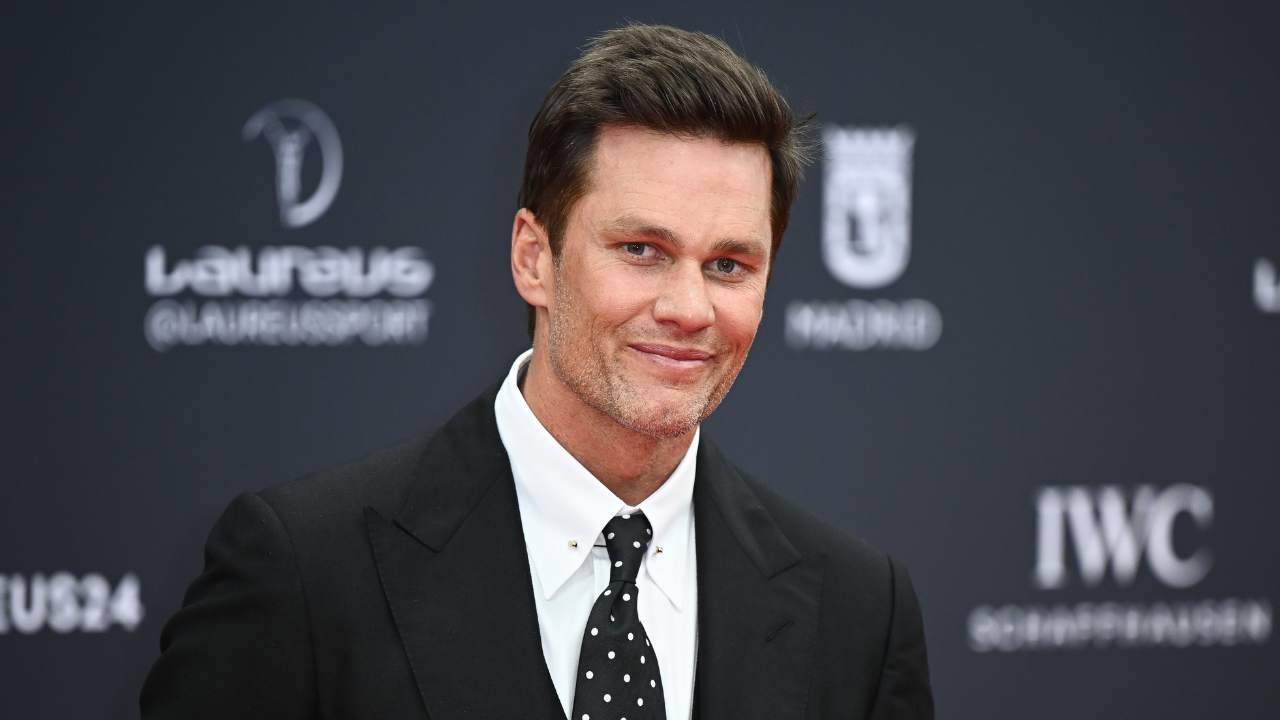
NFL legend and eMed Chief Wellness Officer Tom Brady and eMed CEO Linda Yaccarino discuss eMed’s mission on ‘The Claman Countdown.’
As GLP-1 weight loss medications continue to surge in popularity, NFL legend Tom Brady is getting in on the action, using his wellness brand to “democratize” the health care system in a way the world has “never seen.”
The seven-time Super Bowl champion has teamed up with eMed, a digital health company managing sustainable ways to offer GLP-1 drugs while helping employers reduce health insurance claims.
“There’s an epidemic in America, the disease of obesity, and how can we democratize health and wellness in a way that the world has never seen?” Brady said in an exclusive interview with “The Claman Countdown” Wednesday.
DR OZ LINKS OBESITY TO CHRONIC DISEASE SURGE, SAYS GLP-1S CAN ‘JUMPSTART’ BETTER HEALTH

Tom Brady before a game at AT&T Stadium Sept, 15, 2024, in Arlington, Texas. (Sam Hodde/Getty Images / Getty Images)
Serving as eMed’s chief wellness officer, Brady hopes to help people live better, healthier lives by harnessing the power of weight loss medications, lamenting America’s obesity epidemic.
“I love seeing people live a better life, live a healthier life, feel better, do the things that they want to do in the end. It’s always been a struggle in our country,” the football legend said.
“There’s no debate about the way that this medicine is working right now in terms of keeping people and getting people on their wellness journey started.”
TOM BRADY LAUNCHES GOOD NUT COCONUT WATER LINE WITH GOPUFF IN MARKET EXPECTED TO REACH $11B BY 2030
EMed CEO Linda Yaccarino previously said the goal is to apply Brady’s “rigor” to improve the health of the American workforce and minimize chronic diseases.

A woman injects a GLP-1 into her stomach in this undated photo taken at an undisclosed location. (iStock / iStock)
With more than 60% of Americans receiving health benefits through an employer, eMed aims to incentivize companies to cover GLP-1 medications for eligible workers, Yaccarino said.
“We do a great job of saving employers’ money and getting people healthy,” Brady said.
AMERICANS ARE GIVING UP MULTIVITAMINS FOR A DIFFERENT DAILY HEALTH HABIT, STUDY FINDS
“There’s finally, for the first time, a health benefit, attacking all these chronic diseases and a financial benefit to employers. So, it’s giving them incentive to cover the medications,” Yaccarino added.

Tom Brady shakes a young fan’s hand at Fanatics Fest. (Fanatics / Fox News)
GET FOX BUSINESS ON THE GO BY CLICKING HERE
Yaccarino described GLP-1 medications as the “pharmaceutical revolution” of the modern age while outlining the support eMed provides to patients.
“Once we bring our members onto our program, we combine AI, technology and continuous clinical support so they stay with us,” she said.


Form 4 D Wave Quantum Inc For: 15 July
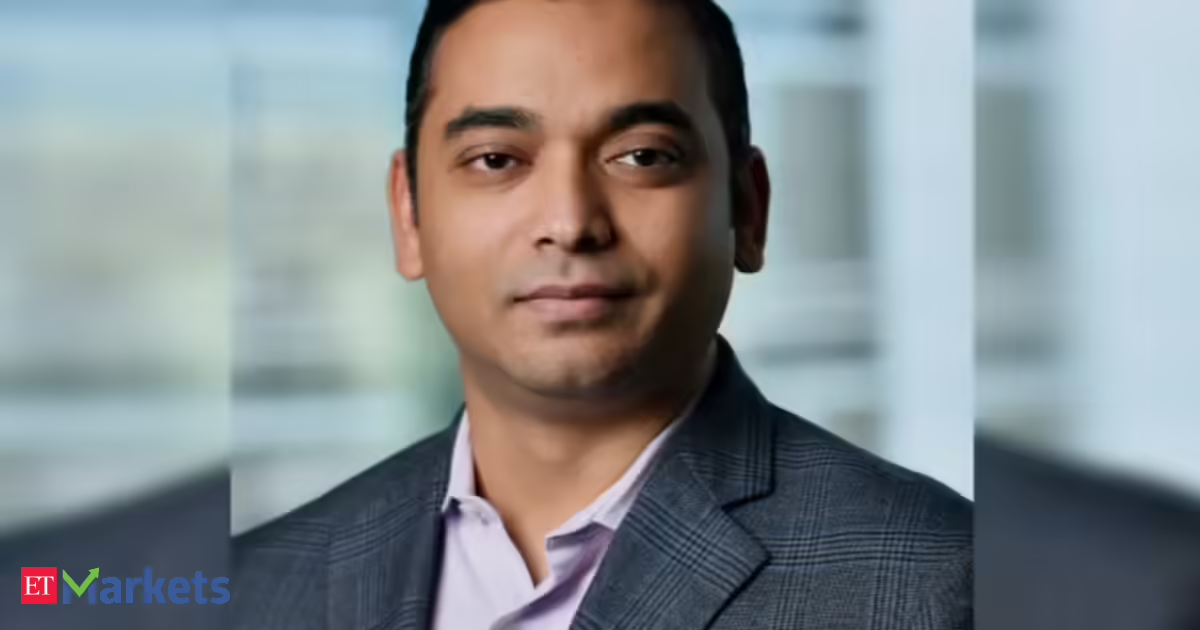
In this context, a balanced approach that combines home market familiarity with global exposure is becoming increasingly relevant. Speaking to Kshitij Anand of ETMarkets, Subho Moulik, Founder and CEO of Appreciate, explains why a 70:30 India–global portfolio can help investors improve risk adjusted returns, reduce concentration risk, and participate in the world’s most powerful long term growth trends in a rapidly changing global landscape.
Kshitij Anand: If you look at the data for 2025, the Nifty delivered around 10%, while US markets were well ahead with returns of about 16%. Do you think some Indian investors may have felt they missed the rally? And if you look at returns in dollar terms, which are slightly worse for Indian investors, what are your views on that?
Subho Moulik: If you are an Indian investor with no diversification, you essentially saw your portfolio go up by about 10%, while the US market delivered almost double that when you include currency, roughly around 22%. The rise in US portfolios is not a one year story. If you look at the past few years, they have been bumper years for US investors.For full disclosure, my portfolio is about 70 to 80% global and around 20% India. And of course, we are in the business of democratising global investing, so I do have a bias. But if you look at the numbers, it is a very rational decision for Indian investors to allocate money not just to India, but also globally.

On timing, I think there is still plenty of room left in the rally. Historically, the average bull market since World War II lasted about seven to eight years. There have also been bull markets that ran for as long as 15 to 16 years. The current bull market is well short of those durations. No one knows when a bull market will end. Anyone who claims they do, well, best of luck to them. I certainly do not know. But if you look at historical averages and current fundamentals, there should still be room for this bull market to continue.So, I do not think timing is the issue. The real question is about themes. What are you investing in, and why you did not diversify earlier. Let me ask you a question. We are all aware of the Nifty 50. If I told you the Nifty 50 exists, but you can only invest in two Nifty 50 stocks for the rest of your life, how would you react?
Kshitij Anand: In that case, I think that may have worked two decades ago, but things are changing now. No company survives indefinitely, and even within the Nifty 50 there is constant churn. If I take your point, yes, if I pick a Nifty 50 stock today, there is always a possibility it may not be part of the index six months down the line.
Subho Moulik: Exactly. If someone told you there are 50 stocks, but you can only invest in two, your first reaction would be why would I only invest in two stocks? You would want more choice. This ties back to the point you made earlier. India is a very important market from a future perspective, but it still represents only about 4%, or even less, of the global market. Therefore, as an investor, the rational choice is to think about diversification. How to allocate capital in a way that improves returns while reducing overall risk. That is what investors should be doing.
I do not think timing is an issue at all. In fact, if there is a sudden crash, say something completely unexpected happens in the next month and markets correct sharply, that would be a fabulous time to buy.
Kshitij Anand: Absolutely. We have seen that happen multiple times in the past.
Subho Moulik: Exactly.
Kshitij Anand: In fact, there is another dilemma Indian investors might be facing. In terms of GDP growth, India is likely to deliver around 7% in 2026–27, while global growth is expected to be around 2.5 to 3%. However, the scale of the economy differs significantly between the US and India, and even a 2.5 to 3% growth rate for the US is considered quite strong. Still, many Indian investors tend to focus on the headline numbers, 7% versus 3%. Could you help investors understand how to translate this into portfolio decisions, especially when investing abroad?
Subho Moulik: I will address that. This comparison is a fallacy, a red herring, and I will explain why. When you invest in the US, you are not investing only in US focused or US centric companies. Let us take an example from beverages. Whether or not you believe that the beverage market in India will grow rapidly, let us assume for a moment that it grows in line with GDP. It is a mass consumer segment and should broadly follow the economic cycle. Now, who do you think benefits from the growth of India’s beverage industry?
Kshitij Anand: US companies.
Subho Moulik: Coca Cola and Pepsi.
Kshitij Anand: Pepsi, and they are all US based companies.
Subho Moulik: Exactly. They are all based in the US. So, when you invest in US stocks, you are not necessarily investing in the US economy. Today, most global multinationals are listed in the US, and therefore, investing in US markets is effectively a bet on global growth.
What investors should increasingly think about is which sectors to invest in and where the global leaders in those sectors are located. To continue with the beverage example, if you believe beverages are a compelling investment theme, the global leaders in that space are listed in the US. If we move to a more realistic example, the leaders in semiconductors, companies like Nvidia, are also listed in the US. The leaders in genetics are largely in the US as well, with some presence in Europe and China. In defence, the dominant players are again largely US based. In emerging areas like quantum computing, which could become as exciting as, or even more exciting than, AI, there is once again a strong presence in the US and China.
So, while India has strong growth prospects, as an investor you already carry significant home country risk. You live in India, your home is in India, and your job is in India. From a portfolio perspective, diversification is important so that if something goes wrong domestically, at least part of your investments is insulated.
Another important point is how different markets react to shocks. Twenty years ago, if the US market moved up by a certain amount, India would usually follow. Over time, the correlation between the two markets has been declining, and we expect this trend to continue. That actually increases the benefits of diversification.
Finally, there is also the comfort of investing in markets where the rule of law is well established and investors have confidence in capital protection and repatriation. So, the real question is not about 2% GDP growth versus 7% GDP growth. The real question is where are the pockets of the highest growth in the world, and how can investors access them?
Kshitij Anand: Absolutely. In fact, I recall the saying: if the US sneezes, India catches a cold. If you correlate that here, earlier any movement in the US used to impact India. That has not been true recently because much of the rally has been driven by DIIs rather than FIIs. FIIs have taken a bit of a backseat, and DIIs are running the show. But yes, if you go back five to seven years, you could definitely say that if the US sneezed, India caught a cold. So, when you talk about the bull run and say there is plenty of room left, can we say the party continues on Wall Street as well, and not just on Dalal Street?
Subho Moulik: If you look at the current US bull run, there are a couple of common fears. One is that a large portion of returns has been concentrated in seven, eight or ten stocks; second, that forward earnings multiples are at all-time highs, making the market look bubbly and frothy; and third, that this is all speculation and will come crashing down. Let me address these one by one.
I do not think the data supports the view that the US market is becoming more concentrated. On a relative basis, if you look at gains over the last three years, 2025 was the lowest in terms of concentration. The Magnificent Seven contributed about 55% of gains in 2023 and around 42% in 2025, which shows a declining trend. You may still ask why seven stocks contribute around 40% of gains, but that is because these companies are expected to drive disproportionate disruption through what they are doing.
The second concern is about valuations. The S&P 500 is trading at around 22x forward earnings, while the Magnificent Seven trade at about 29–30x forward PE. The historical peak has been closer to 40x, so we are still below those levels. Another important point is that a few years ago, small caps—represented by the Russell 2000—were not delivering returns. That has now changed, and the Russell 2000 has delivered reasonable returns. It typically underperforms the S&P 500 slightly and does not suffer from the same concentration issues.
So, I think economic performance is much more broad-based than what headlines suggest. Clickbait headlines are easy to consume, but deeper analysis often gets missed. That does not mean returns are perfectly democratic across all 5,000 stocks, but around 500–600 companies are delivering returns. Unlike episodes such as the Tulip bubble or the dot-com bubble, there are real earnings backing this rally. One can debate the quality of earnings or whether there is circularity among a few players, but these are real earnings driven by disruptive technology, particularly AI.
If you look at what is emerging—the combination of quantum computing, expanding AI use cases, and even progress towards viable fusion energy—each of these reinforces the other. There is an energy challenge, a computing power challenge, and a question of how quickly AI use cases can become real. As these factors interact, a very interesting virtuous cycle could emerge, though it may or may not play out.
Because of this, I am less worried about an imminent collapse of the bull run. Even if the bull market ends due to a black swan event—say China invades Taiwan, another pandemic emerges, or some other unforeseen crisis occurs—markets will crash. No one predicted COVID before it happened. Black swans are, by definition, unpredictable.
But even in such scenarios, the right approach is to buy the dip. Dumb money buys at the peak; smart money buys on corrections. If you are fortunate enough to have cash during a market crash, invest it. A 25% correction is a good opportunity. Do not try to time the exact bottom—buy the dip.
Kshitij Anand: Another fear in the minds of Indian investors is currency risk. We have just touched 90 against the US dollar and are hovering around that level. There are headlines asking whether we are heading towards 95 or even 100. How should investors think about this?
Subho Moulik: It is very hard to fight basic economics. There will continue to be an inflation differential for some time. Even when the US was concerned about inflation, it was around 4%. The Fed will continue to focus on keeping inflation in check. India’s inflation is likely to remain higher, and as long as there is an inflation differential—and therefore an interest rate differential—I do not see the currency moving in any direction other than gradual depreciation.
If there were a structural economic shift where inflation and interest rate differentials reversed, then currencies would move the other way. I do not think that is likely over the next decade, though I could be wrong. Over the past three decades, the pattern has been consistent, and the next decade is likely to follow a similar trend. A 3–5% annual currency depreciation is quite plausible.
This is why I keep coming back to the point of diversification. Do not limit yourself to a narrow set of choices. Of course, back your own economy—you understand it well and there are many good opportunities in India—but do not put all your eggs in one basket. Diversify.
Diversification also gives you access to sectors that simply do not exist in India, not because there is anything wrong with India, but because markets develop differently. Whether it is AI, defence, genetics, rare earths, or exposure to regions like Latin America, there are many themes where India has limited or no exposure. I can name 40 such themes.
By diversifying globally, you get exposure to the themes you believe in and also reduce the impact of currency depreciation. If you look at historical data over the past 20 years, a simple allocation of 70% India and 30% global equities—pure equity, not debt—would have outperformed either market individually. That is because of better risk-adjusted returns and lower correlation. When one market suffers a shock, the portfolio holds up better.
The reasons to diversify keep piling up. The biggest hurdle is inertia.
Kshitij Anand: And the first step is to start doing it.
Subho Moulik: Exactly. Start doing it. Kshitij, what is your global exposure?
Kshitij Anand: My global exposure; well, it is not that much.
Subho Moulik: So, less than 10%?
Kshitij Anand: Absolutely, less than 10%.
Subho Moulik: Then you need to move closer to 30%. After this, we can talk about how to do that. If you look at the average Indian investor’s portfolio—say, someone invested in Indian mutual funds or stocks—the average international exposure is probably less than 1%. So, there is a massive opportunity simply to reach a basic level of diversification.
Kshitij Anand: One point you mentioned earlier was the concentration of the rally. Another concern Indian investors often have is the lack of research available beyond the Magnificent Seven. How can investors address this gap and gain confidence to invest in US small and mid caps, especially when even Indian markets sometimes lack adequate data?
Subho Moulik: I have three responses to that. First—and I will briefly plug what we do, since it is relevant—if you use an app that specialises in global stocks, like Appreciate, you get access to analyst ratings such as buy and sell calls, consensus views, financial ratio snapshots, and stock-specific news and perspectives. The US is a data-rich market. If you go to the right partner, app or platform—and we are one of the leading providers of global stock access—there is a wealth of information available, much more than in India, because the market is more mature.
Second, before you start actively trading, it is better to begin with broad-based bets. For example, you could invest in an index like the S&P 500 or take sector-level exposure. Before saying, “I have enough conviction to buy stock X and sell stock Y,” it makes sense to start with index or sectoral investments, which are easier to understand and form a view on.
Third, and this is something we plan to launch in the coming financial year, is AI-based investing advice and automated transactions. We are building a research engine with zero human analysts—completely AI-driven—that pulls insights from anywhere between 5 and 32 sources, monitors markets 24×7 (often in real time), distils that information, and provides recommendations that can be executed automatically. Investors can opt into such a plan, monitor performance, and continue only if they are comfortable. This is entirely optional. We believe we will be among the first Indian players to offer truly AI-based portfolios, and this will increasingly become another avenue for investors.
So, there are multiple ways for people to educate themselves. You can take a highly sophisticated route or a simpler one, but lack of information should not be a barrier.
Kshitij Anand: That is a smart approach, because lack of information and apprehension about where to start often keeps investors away. Most people only know a handful of global companies; Pepsi, Coke, as you mentioned, or the Magnificent Seven. Beyond that, unless a company makes headlines in Reuters or other global media, it tends to stay off the radar. It is good that you mentioned AI, because my next question is about that. Has the AI story moved from narrative to earnings?
Subho Moulik: Let us break the AI story into three parts: the infrastructure required for AI, general-purpose use cases, and AGI, or artificial general intelligence. The infrastructure story is very real. Data centre build-outs, energy consumption, and chip manufacturing are all happening at scale. Right now, this infrastructure is being built to support use-case development, and as those use cases see wider adoption, usage will increase, further driving infrastructure demand. Most of the earnings-driven value creation so far has been on the infrastructure side.
In terms of use cases, some are already seeing broad adoption, especially content-related applications. For example, AI-generated videos and creative content are becoming mainstream, and creative companies are increasingly exploring how to use these tools. As a small example, a large portion of advertising content today is already AI-generated.
Then there is AGI, which depending on who you listen to, is either imminent within the next five years, far away, or imminent but manageable. The debate there is more about governance and safeguards. Markets are not really pricing this in yet, because it is almost impossible to predict the timeline or outcomes.
So, there is a fair amount of reality in the AI story. The key question is whether a quarter of weaker-than-expected performance, due to slower scaling of use cases or a temporary dip in infrastructure demand, derails the theme, or whether investors look through it, recognising that this is a long-term, disruptive technology. In my view, AI is here to stay.
Kshitij Anand: AI is here to stay, that is…
Subho Moulik: AI is here to stay. Now, what form it will take, I do not know. I think we will see various avatars, no pun intended, over the next 2, 3, 5, 7 or even 10 years. If you think about it logically, and I may sound a bit philosophical here, if we take the idea of diversification and apply it to humanity as a planet, our best bet is to diversify onto other planets. I do not think we get there without some level of AI in space and related technologies. So, there are multiple reasons why I see AI continuing to evolve.
Another area where AI is clearly here to stay is defence. It is a genie that has been let out of the bottle and is not going back in. We are likely to see more autonomous systems and weapons of various kinds, and there is no reversing that trend. So, space and defence are other key use cases—some driven by utilitarian or altruistic motives, and others, quite frankly, driven by the objective of maximising efficiency in warfare because that is where money is made.
Kshitij Anand: You mentioned Elon Musk, and his companies have also diversified into India—Tesla is now in India. And in fact, most US companies are diversified not just into India but across the globe. That is really the core point. That is what makes them special, and that is why investing in US markets is not just a bet on the US, but on global growth.
Subho Moulik: That is right.
Kshitij Anand: Another theme that has been getting a lot of attention from investors is Trump’s policies, especially on tariffs. Could that derail the US bull market story?
Subho Moulik: I think tariffs are primarily being used by Trump as a negotiating tool. This is not crystal-ball gazing; it is quite evident. As negotiations progress, the extreme tariffs, like 300% tariffs, tend to get walked back, and what remains is a more reasonable, lower-level tariff regime. I think that is likely to persist.
People and companies are also adapting. Supply chains are being reconfigured. Earlier, companies manufactured where it was cheapest—Mexico, China, or elsewhere. Now, when they look at landed costs including tariffs, they reassess and move production accordingly. In some cases, production may return to the US; in others, it may shift to different locations.
I do not think inflationary effects from tariffs have fully played out yet. As they do, that itself becomes a pressure point for tariff rationalisation, because inflation is a very sensitive domestic issue. Tariffs have not turned out to be the market destroyer many feared, largely because each time markets approached a tariff cliff, Trump often stepped back and extended timelines. That is consistent with his style, announce something drastic, then revise it. Markets have learned to partially price this in and then wait for clarity.
So, I do not see tariffs as a doomsday scenario. Over time, tariffs are more likely to come down, especially if they start feeding meaningfully into inflation. There are also legal challenges in the US questioning whether tariffs have been imposed through entirely legal mechanisms.
Kshitij Anand: For investors, the key takeaway is not to focus only on headlines but to look deeper. Tariffs are there, but as you said, they need not dominate investment decisions in US stocks. Another geopolitical concern that has come up is the recent military action in Venezuela. There could be more such events. Does that hurt the US investment story?
Subho Moulik: There are multiple geopolitical flashpoints, Ukraine, Israel, Iran, parts of Africa, Venezuela, and potentially Taiwan. Among these, Taiwan is uniquely sensitive because of its role in global semiconductor supply and existing defence commitments. In most other cases, history shows a short-term disruption, usually a week or so, after which markets stabilise.
There are always winners and losers. I am not commenting on the legality or morality of actions, it has happened. Some companies lose, some gain. From a market perspective, the net impact is usually limited. In conflicts involving energy, oil companies tend to benefit. Defence companies almost always benefit. As long as shipping and logistics are not severely disrupted, markets move on.
Taiwan is the exception. But broadly, despite political turbulence and debates, such as discussions in the US around executive powers—markets tend to look through these events. As strange as it may sound, most of these developments turn out to be non-events from a market perspective.
Kshitij Anand: Absolutely. Even historical data suggests that. Now, let us move to specific sectors. We have spoken about AI, and investors have already made significant gains in AI-led sectors, as well as in clean energy and healthcare. Are there specific sectors you believe investors should focus on in 2026 and beyond, from a long-term perspective?
Subho Moulik: I will start with the more pessimistic view and move toward the optimistic. Defence spending is going to rise globally, as a percentage of GDP. I would invest in defence. I would also invest in space. Defence companies will increasingly look at space-related opportunities, not just launch systems but allied businesses. Space is a compelling long-term theme.
AI remains interesting, perhaps a bit bubbly, but still compelling. I am also very bullish on quantum computing. To put it in perspective, it took about 30–35 years to go from supercomputers to personal computers. I believe the first quantum supercomputers could emerge within the next 10 years. That implies that over the next half century, we could potentially see quantum personal computers. That would be a game changer in processing power and applications. The last time fundamental physics translated into real-world applications on this scale, it changed the world, think transistors or nuclear technology.
Energy is another major theme. Rare earths are in focus because of their importance to renewables like solar. Hydrogen could be a disruptive force. Fusion energy, though longer-term, could reshape the entire debate around energy generation. Whether these innovations come from new energy companies or existing ones reinventing themselves is an open question, but energy remains a very interesting space.
Healthcare and life sciences are equally exciting. Drug discovery timelines are collapsing due to AI and computational advances. We are likely to see more biosimilars and breakthrough therapies. Longevity science is advancing rapidly, there are already claims that someone alive today could live to 300. Treatments for Alzheimer’s, obesity, and other conditions are evolving at an unprecedented pace.
Much of this progress comes from deep, foundational scientific research that eventually leads to these breakthroughs. Which countries will lead that research? Will the US continue to maintain its edge? These are important questions. But in the near to medium term, these are the sectors I would focus on.
Kshitij Anand: The next question usually revolves around choosing between global ETFs and individual stocks. How should one take that call?
Subho Moulik: As I mentioned earlier, ETFs have a lot going for them. They give you sectoral or index exposure, they are relatively low-cost, and they allow you to invest in a basket of stocks in an efficient and inexpensive way. I would definitely say that global ETFs are far better than Indian mutual funds that invest in global ETFs, because the expense ratios tend to be much higher in the latter. It is usually better to own global ETFs directly.
Between ETFs and stocks, it really comes down to how comfortable you are making individual stock bets versus investing in a basket or a theme. It depends on your confidence level as an investor and where you are in your investment journey. Typically, I would suggest having a mix—some ETFs and some individual stocks. There is no magic formula.
Kshitij Anand: Absolutely, a mix-and-match approach works well. Also, there are certain barriers Indians face when investing in the US. How is Appreciate tackling those challenges? You spoke about data availability and how the app makes it seamless for Indian investors to make informed choices, with rankings and easy transactions for buying and selling.
Subho Moulik: Let me address that. First, we have worked very hard to simplify onboarding. This is a regulated space, so Appreciate is a registered broker-dealer with integrations across multiple banks. We go through rigorous information security processes, audits, and compliance checks, and we partner with trusted global brokers to ensure safety.
All investments are covered by SIPC insurance in the US—up to $500,000—not for market losses, but for broker or custodian failure. Assets are held with a custodian, not by us. So safety and trust are key pillars. We also partner with mainstream banks and operate within a fully regulated framework. These are basic hygiene factors.
Onboarding itself is very simple—PAN, Aadhaar, and basic profile information. While we ensure all regulatory requirements are met, the process typically takes about two minutes before you can start investing.
On remittances, we know how painful the traditional process can be, filling out A2 forms, visiting bank branches, submitting documents, and answering queries. By the time all that is done, the stock you wanted to buy may have already moved significantly, and the opportunity—and excitement—is gone.
Kshitij Anand: And the excitement is gone as well.
Subho Moulik: Exactly. What we enable is seamless, fully digital remittance that happens quickly. From the investor’s perspective, there is ample research available on the platform. We are also introducing AI-based recommendations, which we discussed earlier. Essentially, we remove the operational friction so that you can focus on portfolio performance and investment decisions, and leave the rest to us.
We also make tax compliance easy. You can download everything you need for tax filing and share it with your CA. We try to eliminate all the usual stress points so that investors can focus on making the right decisions.
Kshitij Anand: You mentioned upcoming sectors earlier. How is Appreciate helping investors identify or track these themes? Is there something within the app that allows investors to go overweight on certain emerging sectors?
Subho Moulik: We are doing this in two ways. First, we are launching access to global thematic portfolios. We scan global markets and work with some very interesting asset managers, evaluate past performance, and curate a set of around 30–35 thematic portfolios. These cover themes such as energy, AI, genetics, country-specific themes, and commodities versus equities.
These will be available at the beginning of the new financial year. Investors can choose from these themes, or even request a bespoke portfolio, provided they meet a minimum investment threshold.
Second, we are launching AI-based recommendations with automated execution. The idea is simple—no individual investor can realistically track 30-plus data sources, monitor real-time markets, interpret signals, and execute trades continuously. Our AI engine does exactly that, delivering a package of automated buy and sell decisions. Investors simply authorise participation in the programme and then assess performance. If they are comfortable, they continue; if not, they can opt out.
We believe these two offerings are strong differentiators, allowing investors to use their time more effectively—deep-diving into areas of interest and leaving the rest to us.
Kshitij Anand: Another concern for investors is regulatory compliance and taxation. How does Appreciate make that seamless?
Subho Moulik: From a compliance perspective, we are very strict about being fully compliant. We are a SEBI-registered investment adviser, a registered broker-dealer, and we are launching our own payment service provider to enable fully regulated remittances. We comply with all relevant Indian and US regulations, and investor assets are protected under SIPC insurance.
We work with leading banks in India and have undergone extensive due diligence, so this is a safe, mainstream, and well-regulated space—not a fringe asset class.
On taxation, we provide a simple solution. With the click of a button, you can download your complete tax package and hand it over to your CA. That makes the process very seamless.
Kshitij Anand: Absolutely. All of this helps Indian investors step out of their comfort zone and invest beyond borders. Any advice for investors heading into 2026?
Subho Moulik: I will take a cue from your first question. It is never too late to make the right investment decision. If you are already investing, you are doing something positive for your financial health. The question is how to make it better.
I strongly believe in a 70–30 portfolio—keep 70% in India, which you understand well, and allocate 30% globally. If you are unsure how to do this, you can come to Appreciate, reach out to us on social media, or even use another platform. The key point is diversification.
After diversifying, focus on disciplined investing. Very few individual investors successfully time the market. Invest regularly and focus on buying during corrections, which add far more value in the long term than chasing rallies.
Do not worry too much about timing. Systematic investing works. As you gain confidence, you can start taking sectoral or specific stock bets—but not necessarily at the very beginning. We have published several articles on this, and as you know, a diversified portfolio with systematic investing delivers better outcomes over time.
Do not rely on tips, they do not work. Focus on fundamentals, whether you are investing in India or abroad.
Kshitij Anand: Whether India or abroad.
Subho Moulik: Exactly. Stay the course, and you will be fine.
(Disclaimer: Recommendations, suggestions, views and opinions given by the experts are their own. These do not represent the views of The Economic Times.)

Operator
Good afternoon, and welcome to the Audioboom Group plc investor presentation. [Operator Instructions] Before we begin, I’d like to submit the following poll to hand you over to Stuart Last, CEO. Good afternoon, sir.
Stuart Last
CEO & Director
Thank you, Charlie. Hi, everyone. Welcome to Audioboom’s H1 update. You’re joining me in our Audioboom Studios in New York, Brad is in London, and we are just, I think, very pleased to be back with you. First time we’ve been able to talk directly with you for almost a year, and there’s lots to tell you about. It’s been a period of exceptional performance. So excited to be able to walk through that with you today. Just a little kind of running order, I think, here.
We’ll kick off and just talk through the business model a little for those of you that are new to Audioboom. Talk about the H1 performance, which, as I said, has been exceptional. Brad will go a little deeper on some of the finances. And then we’ll get to some of the parts I know you’re interested in hearing about. We’ll talk about the strategic review, and we’ll kind of push forward and tell you about the future plans and the strategy going forward. But we’ll guide straight in, and you can ask questions. We’ll pick those as we go across this 45-minute session. And as I said, just very happy to be back with you and to tell you more about everything that’s been happening at Audioboom.
So many of you may be new to the company, and I’ll just walk you through the
Form 4 Nuvalent Inc For: 15 July


Closing set for Aug. 25.

President Donald Trump tells FOX Business’ Ed Lawrence his thoughts on personal threats from Iran, expressing confidence in security and more, as a new round of U.S. strikes in the region is reported on ‘The Claman Countdown.’
In his first public appearance outside the White House since the NATO summit amid threats to his life by Iran, President Donald Trump said Wednesday he doesn’t “think about it” and that his focus is on taking out the Iranian regime’s Islamic Revolutionary Guard Corps (IRGC), which he said has lost roughly 90% of its weapons capabilities due to continued strikes.
Trump made the remarks Tuesday during an exclusive interview with FOX Business ahead of the annual Defense and Innovation Summit in Carlisle, Pennsylvania, where he also highlighted gains in U.S. defense and the economy and announced $10 billion in private investments for the defense industry.
The president said he was not concerned about threats from Iran, revealing that the U.S. carried out another strike on the country within the past 24 hours. He also suggested he could eliminate the IRGC the same way he defeated ISIS during his first administration.
“Well, we’re going to be in good shape,” Trump told FOX Business correspondent Edward Lawrence. “They’ve been depleted. Their weapons are down 91%. The drone capacity is way down. They still have, but not a lot. Their manufacturing capacity is down. Their rocket launchers and their missile launchers are way down. Their missiles are way down.”
OIL PRICES FLUCTUATE AS TRUMP’S IRAN DEAL COULD FULLY REOPEN STRAIT OF HORMUZ

President Donald Trump speaks with Secretary of War Pete Hegseth upon arrival at the U.S. Army War College Field Landing Zone Wednesday on his way to the Pennsylvania Defense and Innovation Summit in Carlisle, Pa. (Saul Loeb/AFP via Getty Images / Getty Images)
Trump said the U.S. is “building up” its military with the Defense Production Act and companies working to refill supplies and replenish American forces.
“We have to watch ourselves. You know, it’s called America First. And we’re building up our reserves very rapidly. And as you probably also know, the great companies that we have are now building plants, although not just taking one plant that they’ve used for a long time and doing overtime,” he said.
“We have four or five, six plants by each of the major companies being built, brand-new plants in different areas to make, as an example, you could say the Patriot [missile], which is so heavily sought, or the Tomahawk missile.
“So, we want to have it now. We have to wait a year to get something or a year-and-a-half or two years. We want to have it where you wait a week or maybe less, and we’re going to have that very soon.”
OIL PRICES PLUNGE TO LOWEST LEVELS SINCE EARLY MARCH AFTER TRUMP SIGNS IRAN DEAL

President Donald Trump speaks to the press as he arrives for a speech at the Pennsylvania Defense and Innovation Summit at U.S. Army War College Wednesday in Carlisle, Pa. (Alex Wong/Getty Images / Getty Images)
The president reiterated his call for lower interest rates, saying the U.S. “should have the lowest interest rate anywhere in the world by far.”
He said he supports Federal Reserve Chair Kevin Warsh to help achieve that goal, while predicting resistance from what he described as a “hostile” Federal Reserve board.
Trump also touted what he described as a surge in U.S. manufacturing investment, claiming more than $19.2 trillion is flowing into the country from allies and foreign investors, including Saudi Arabia, as defense companies ramp up construction of new factories and stockpile equipment.

President Donald Trump arrives to speak at the Pennsylvania Defense and Innovation Summit at U.S. Army War College in Carlisle, Pa. (Alex Wong/Getty Images / Getty Images)
The president further asserted that the U.S. trade deficit has fallen 68% over the past year, crediting his tariff policies despite legal challenges.
“Our trade deficit is down 68% in one year,” Trump said. “That’s because of the use of tariffs, and I wish I could use them faster. The Supreme Court said you can’t use them as fast as I was using them, but I can use them actually more effectively by the method we’re doing.”
GET FOX BUSINESS ON THE GO BY CLICKING HERE
Looking ahead, Trump said he expects inflation to continue easing through the end of 2026, arguing that oil prices will ultimately move lower after a period of volatility.
“I think what’s happening is oil is going to be a little bit of a yo-yo for a while,” he said. “It goes up a little bit, goes down a little bit. And when this [conflict with Iran] is over, oil is going to drop like a rock.”
Business
Arizona Police Warn Scammers Are Using Fake QR Codes to Exploit Nancy Guthrie’s Missing Person Case Today

TUCSON, Ariz. — The Pima County Sheriff’s Department issued a public warning this week alerting residents to fraudulent QR code scams that are exploiting the ongoing investigation into the disappearance of Nancy Guthrie, the 84-year-old mother of NBC News anchor Savannah Guthrie.
Officials said they have identified fraudulent social media posts and emails circulating online that link QR codes directly to donation requests tied to the investigation. The department emphasized that it has never solicited, and will never solicit, donations from the public in connection with this or any other criminal investigation.
Officials Detail the Scam
In its public statement, the Pima County Sheriff’s Department described the specific pattern investigators have observed.
“The Pima County Sheriff’s Department is aware of posts circulating about the Guthrie investigation that include a QR code requesting money,” officials said. “PCSD will never ask for money related to this case, or any investigation.”
The department urged the public to remain cautious and avoid engaging with any such requests.
“Please do not send money to people you do not know or scan QR codes requesting payment. If you see one of these posts, ignore it and report it. Stay alert and help spread the word,” the statement continued.
A Case That Has Drawn National Attention
Nancy Guthrie vanished from her Tucson residence more than five months ago, in a case that remains classified as a potential kidnapping by both the FBI and local law enforcement authorities. Despite receiving countless tips from the public, no one has been formally charged in connection with her disappearance as the investigation continues.
The high-profile nature of the case, tied to Guthrie’s daughter’s prominent role as a national television anchor, has kept the disappearance in the public eye for months, drawing both genuine public concern and, increasingly, attention from criminals looking to exploit that concern for financial gain.
A Pattern of Exploitation Since the Case Began
This is not the first instance of bad actors attempting to capitalize on the Guthrie case. The investigation has already drawn attention from individuals issuing fake ransom demands, as well as scammers spreading false information to manipulate public sympathy and attention.
Federal authorities recently secured a guilty plea from a California man who admitted to harassing the Guthrie family through phone calls and text messages containing false claims related to cryptocurrency, according to reporting on the case. That prosecution illustrates the extent to which the Guthrie family has already been targeted by individuals seeking to exploit the ongoing tragedy for personal gain.
A Family Pleading for Answers
Savannah Guthrie has repeatedly and publicly appealed for any reliable information regarding her mother’s disappearance. The family has established a $1 million reward for information leading to her mother’s safe return, while the FBI has separately offered its own reward for information that leads to an arrest and conviction in the case.
In emotional public remarks, Savannah Guthrie has emphasized how deeply the ongoing uncertainty has affected her family.
“Somebody knows something,” Guthrie said through tears. “This is a news story today that’s on your radar, but this is the life that my sister lives, that I live, that my brother lives, that our extended families live, that our children live every day.”
A Broader Pattern of Scams Tied to High-Profile Cases
The exploitation of the Guthrie case fits within a broader, troubling pattern in which criminals target high-profile missing person investigations and other emotionally charged news events to defraud the public. According to statistics released by the FBI’s Internet Crime Complaint Center, Americans lost more than $16.6 billion to cybercrimes in 2024 alone, underscoring the scale of the broader challenge law enforcement agencies face in combating online fraud.
Cybersecurity specialists have consistently warned that scammers frequently take advantage of emotionally charged moments, including missing person cases, natural disasters and other tragedies, to manipulate victims into sending money or clicking on malicious links disguised as legitimate donation requests.
Guidance for the Public
Law enforcement officials and cybersecurity experts are urging members of the public to take several precautions in light of the ongoing scam activity. Recommendations include avoiding unfamiliar QR codes entirely, verifying any information related to active investigations only through official law enforcement channels, and immediately reporting any suspicious posts or messages encountered online rather than engaging with them directly.
Officials specifically emphasized that legitimate law enforcement agencies conducting criminal investigations do not solicit direct financial donations from members of the public, a distinction they say is important for residents to keep in mind when encountering any similar requests tied to future high-profile cases.
An Investigation That Continues
As detectives continue working to determine what happened to Nancy Guthrie, authorities say the case remains an active priority for both local and federal investigators. The Pima County Sheriff’s Department has reiterated its call for the public to remain vigilant against online fraud while the investigation proceeds, emphasizing that any assistance the public can provide toward the case should come through direct communication with verified law enforcement channels rather than through unsolicited social media posts or fundraising links.
Anyone with legitimate information related to Nancy Guthrie’s disappearance is encouraged to contact the Pima County Sheriff’s Department or the FBI directly, rather than responding to any third-party posts, messages or QR codes claiming to be affiliated with the investigation.


The chocolate-drizzled bars are available in three flavors.
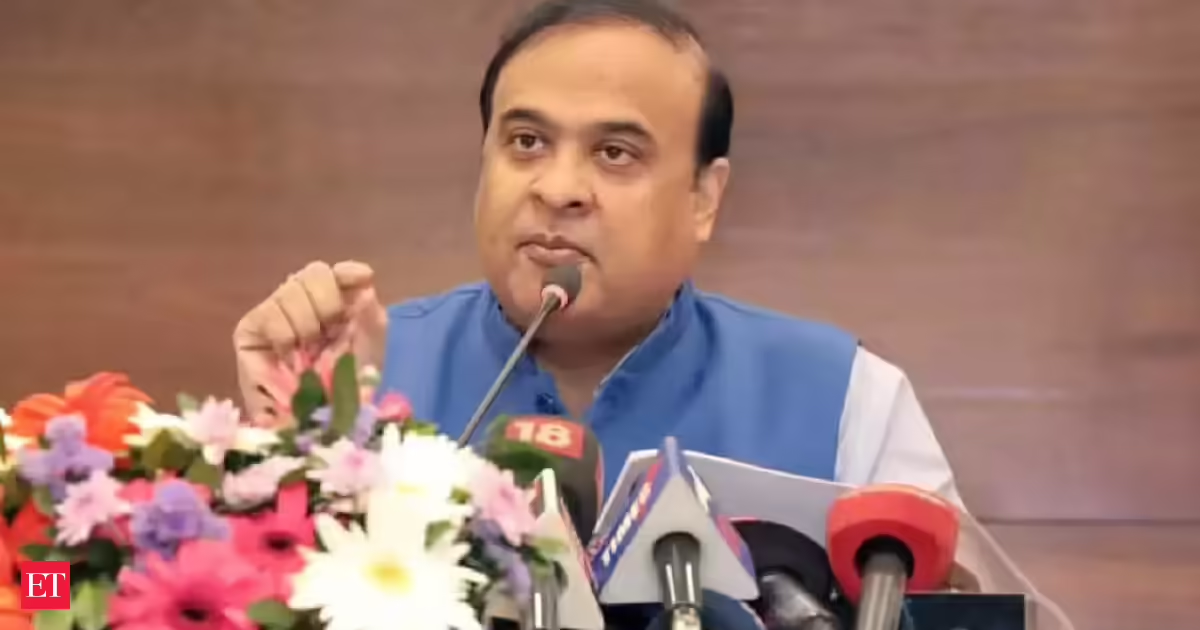
Among the NDA constituents in the state, the BJP, Asom Gana Parishad (AGP), United People’s Party Liberal (UPPL) and Bodoland People’s Front (BPF) have members in the assembly. Rabha Hasong Joutha Sangram Samiti (RHJSS) and Janashakti Party (JP) are also part of the NDA, but they do not have any MLAs.
“Our NDA alliance is complete. We know who will contest where; it is a done deal. There is no issue in stitching the alliance,” Sarma told reporters at the state BJP headquarters.
“After every process is complete, the state leadership will meet Union Home Minister Amit Shah with the list of probable candidates,” he added.
On January 7, Sarma had said the BJP was likely to formalise its seat-sharing agreement with its allies by February 15.
On December 5 last year, he had said the finalisation was expected to be over by January 15.
The elections for the 126-member assembly are expected to take place in March-April. This will be the first election after the delimitation exercise, done in 2023.Post delimitation, many seats and their geographical boundaries have been changed, while some non-reserved seats were reserved and vice versa. This has led to complications within the ruling and opposition coalitions.
At present, the BJP has 64 members in the assembly, while AGP has nine, UPPL has seven, and the BPF has three.
In the opposition camp, the Congress has 26 MLAs, AIUDF has 15, and CPI(M) has one. There is one Independent legislator as well.

Soccer-Argentina late show sinks England and sets up World Cup final against Spain
Form 4 D Wave Quantum Inc For: 15 July

Ben McKenzie lobbies Senate to block CLARITY Act before crypto vote

R-Rated 90s Sci-Fi Thriller Is Trash Can Predator Versus The Scooby-Doo Gang


-

 Fashion7 days ago
Loro Piana Fall 2026 Enters Houston’s Art Scene
-

 Fashion5 days ago
Weekend Open Thread: Nutriplenish Leave-In Conditioner
-
 Sports6 days ago
2026 Genesis Scottish Open Thursday TV coverage: Round 1
-

 Sports6 days ago
Super Eagles star Moses Simon opens up on Liverpool transfer regret
-

 Tech6 days ago
Character.AI enters the microdrama arena with its own productions, but there’s a twist
-

 Politics12 hours ago
Young campaigners urge incoming PM to act on outdoor junk food ads
-

 News Videos1 day ago
XRP BOMBSHELL… XRP OMBOARDED FOR TRANSACTIONS!!!
-

 Tech2 days ago
Get Your ESP32 Sunny Side Up With This Solar Dev Board
-

 Tech1 day ago
Dark Secrets Emerge When Jailbreaking LLMs
-
 Sports2 hours ago
New Cornerback Enters Vikings Trade Rumor Mill
-

 Tech7 days ago
Level Infinite Launches Gangstar Mirage City in India with Pre-Registrations
-
 NewsBeat7 days ago
Major update after Huntingdon train attack as man enters plea
-
 Entertainment7 hours ago
Disney’s Most Ambitious Failed Star Wars Attraction Is Coming to SDCC
-

 News Videos2 days ago
how to make coin bank box with cardboard #scienceproject #money #diy #shorts
-
 Tech2 days ago
Cloudflare Precursor Watches Your Mouse and Keyboard To Decide If You Are Human
-

 Tech7 days ago
Entra passkey enrollment vishing targets Microsoft 365 users
-
 Entertainment5 hours ago
Vicki Gunvalson Defends Discussing Heather Dubrow’s Money
-
 Crypto World7 days ago
DeFi Dashboard Zapper to Shut Down After 7 Years
-
Crypto World1 day ago
Ripple, Coinbase, Circle Join Linux x402 Foundation to Help Shape AI Payments
-

 NewsBeat2 hours ago
Watch: Is Donald Trump facing a popular backlash on immigration?
You must be logged in to post a comment Login