
Business
Trainline and Virgin Atlantic face CMA drip pricing investigation

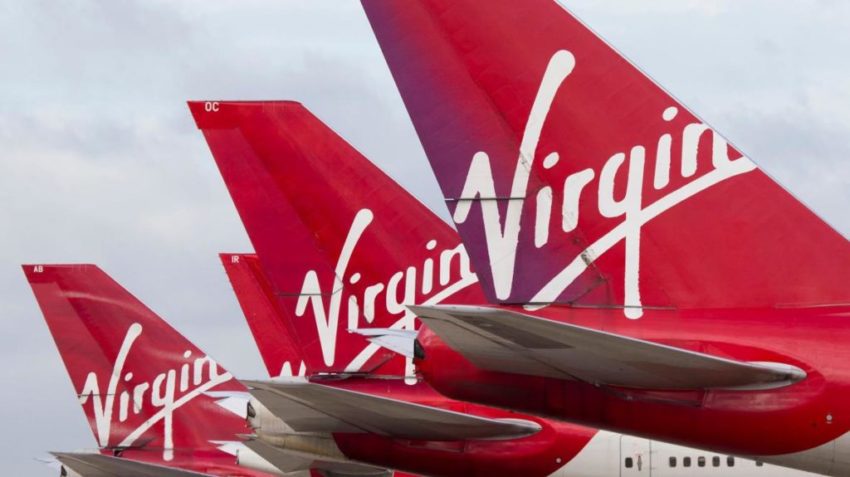

Trainline, Virgin Atlantic and RED Driving School are being investigated by the Competition and Markets Authority over concerns that customers were not shown the total price upfront when buying train and coach tickets, package holidays and driving lessons.
The CMA announced the investigations on Wednesday and said they were at an early stage, with no conclusions yet reached on whether any of the three companies had broken consumer law. If breaches are found, the regulator said it could order the firms to pay compensation to affected customers and fine them up to 10 per cent of their global turnover.
The Trainline investigation focuses on whether all mandatory fees were displayed to travellers buying train and coach tickets in advance on the platform’s app and website. The CMA said it observed transactions with additional fees ranging from 59p to £2.79 on train bookings, and a £1.50 booking fee on coach journeys. The case against the FTSE 250 company was formally opened on 18 August, according to the regulator’s case record.
Shares in Trainline, the only listed company of the three, fell 16 per cent, or 38p, to 205p in early trading on Wednesday.
The investigation into Virgin Atlantic concerns mandatory resort fees and local taxes charged on package holidays, while RED Driving School is being examined over how a mandatory booking fee and a so-called digital fee — which the CMA put at more than £7 per booking — were displayed to customers booking driving lessons.
The investigations are being brought under the Digital Markets, Competition and Consumers Act, which strengthened the CMA’s consumer protection powers. The regulator said each of the three businesses had previously received an advisory letter as part of an earlier round of enforcement action.
A Trainline spokesman said: “We’ve proactively engaged with the CMA over several months and we are taking proactive steps to enhance how certain fees are presented to our customers. We will continue engaging with the CMA to address their questions.”
A Virgin Atlantic Holidays spokesman said: “Mandatory fees are indicated at multiple stages throughout the booking journey. We are reviewing the points raised by the CMA carefully and will co-operate fully with its investigation.”
Emma Cochrane, executive director for consumer protection at the CMA, said: “Clear pricing helps people compare offers confidently and choose the option that works best for them … At a time when many households are watching every pound they spend, it is important that people are not surprised by extra fees.”
She added: “The first price customers see should be the price they pay.”
Sue Davies, head of consumer rights policy at Which?, said the regulator should not hesitate to act if breaches were established. “The CMA shouldn’t hesitate to use its new consumer enforcement powers to fine any firms that have broken the rules — especially after each firm has already received a warning advisory letter,” she said.
“Following comments made by the prime minister last week that unfair pricing practices have no place in our economy, this move sends a clear message to other businesses to follow the rules.”

Business
AI Data Center Protests Spread Across 42 States as Power Costs and Water Use Fuel Backlash Nationwide

A grassroots movement opposing the rapid expansion of artificial intelligence data centers has grown into a nationwide political force, with 142 coordinated protests held across 42 states in July marking what organizers describe as the first nationally synchronized day of action against the infrastructure buildout, as concerns over electricity costs, water scarcity and limited local job creation increasingly shape state and local policy.
The July 18 demonstrations, organized by the advocacy group HumansFirst, represented the largest single-day mobilization yet against AI data center construction, according to Reuters. Texas hosted the most protest events of any state, with 18 rallies, while Georgia, a key battleground state, saw 11. HumansFirst co-founder Amy Kremer, a former Tea Party movement leader, has framed the fight as nonpartisan, drawing supporters from across the political spectrum even as she has criticized Republicans for what she describes as giving the technology industry a “free pass,” according to Reuters. Notably, Kremer and some organizers said they do not support blanket moratorium policies of the kind adopted in New York, preferring instead more targeted demands including greater transparency in the development process, protection of local environmental resources, creation of well-paying union jobs, and stronger accountability mechanisms for developers who fail to deliver on their promises.
The scale of the resistance has translated into significant, quantifiable delays for the industry. According to Data Center Watch, cumulative blocked or delayed AI infrastructure projects have reached roughly $286 billion since 2025, with more than $130 billion in projects blocked in just the first quarter of 2026 alone, according to Tom’s Hardware. More than 69 jurisdictions have already enacted data center bans or moratoriums as of mid-2026, with Seattle, home to the headquarters of both Microsoft and Amazon, imposing a one-year ban on new large data centers that directly affects five proposed projects from those two companies.
New York became the first state to enact a formal, statewide permitting freeze. Gov. Kathy Hochul signed an executive order on July 14 imposing a one-year moratorium on environmental permitting for new hyperscale data centers drawing 50 megawatts or more of power, according to CNBC’s reporting cited by TFTC. That order followed the state legislature’s earlier passage of the Responsible Data Center Development Act, which similarly proposed a one-year moratorium on new permits for large data centers alongside separate utility rate classes and mandatory impact studies. Chicago Mayor Brandon Johnson followed with his own executive order on Aug. 11, introducing a strengthened review process and formally requesting that the city council consider a temporary moratorium on new data center approvals, according to Jaekyung Ilbo’s reporting.
Electricity costs have emerged as one of the central drivers of public opposition. Wholesale power costs on PJM Interconnection, the largest electricity grid operator in the United States, rose 76% year over year in the first quarter of 2026 to $136.53 per megawatt-hour, according to Jaekyung Ilbo. Capacity market prices, which reflect the cost utilities pay to ensure sufficient future power supply, surged from roughly $28.92 per megawatt-day to approximately $329, with independent market monitors attributing a significant portion of that increase to rising data center electricity demand. That trend has fueled concerns that ordinary ratepayers could continue absorbing higher electricity bills as a direct consequence of nearby AI infrastructure development.
Water usage has similarly become a flashpoint, particularly in drought-prone regions of the western and southern United States. The large volumes of water required to cool servers inside data centers have prompted concerns in some communities about reduced water pressure and potential water shortages, with residents in several areas arguing that data center operations are directly competing with residential water needs. While some critics have also raised concerns about increased greenhouse gas emissions tied to expanded natural gas power generation built to serve data center demand, analysts have cautioned that the precise scale of that emissions impact requires further verification.
Limited local job creation has added a further layer to the backlash. Despite the enormous capital investment involved in constructing large-scale data centers, the number of permanent, full-time jobs such facilities typically generate has repeatedly been characterized as modest relative to the scale of investment, fueling a broader public perception that these facilities consume substantial local resources while providing comparatively limited direct benefit to surrounding communities.
Public opinion polling has reflected the depth of this opposition. A June 2026 Reuters/Ipsos poll found that only about one-third of Americans approve of the current pace of data center construction, with just 14% saying they would support a data center being built in their own community, according to Memeburn. A separate Gallup poll conducted in March found neighborhood-level opposition to new data centers running at roughly 70%, a figure higher than public opposition to nuclear power plants.
The backlash has also drawn attention from federal lawmakers. Democratic Rep. Alexandria Ocasio-Cortez of New York and independent Sen. Bernie Sanders of Vermont introduced the AI Data Center Moratorium Act of 2026 in March, a bill that would impose an immediate federal moratorium on new AI data centers until stronger national safeguards are established. Ocasio-Cortez framed the legislation in stark terms at the time of its introduction. “We have seen ICE partner with AI companies to surveil Americans, social media users employ AI bots to create sexually explicit deepfakes of women and children, and data center construction inflate electric bills in communities across the country,” Ocasio-Cortez said. “Congress has a moral obligation to stand with the American people and stop the expansion of these data centers until we have a framework to adequately address the existential harm AI poses to our society. We must choose humanity over profit.” The bill is considered unlikely to advance in either chamber of Congress, though its introduction reflects the broader intensity of concern building around the issue among progressive lawmakers.
As regulatory pressure intensifies across developed markets, some technology companies have begun shifting their site-selection strategies toward regions with comparatively lighter regulatory environments. Following restrictions on new data center construction in Singapore, Ireland and the Netherlands, some companies have reportedly begun exploring relocation toward parts of Southeast Asia where oversight remains less developed, according to Jaekyung Ilbo’s analysis. With the U.S. midterm elections approaching, the newspaper’s report suggested that data center policy could increasingly become a defining issue in competitive races across battleground states including Kansas, Wisconsin and Michigan, as both the pace of AI infrastructure construction and the strength of local regulatory responses continue to evolve heading into the fall.
Business
Zelle Down? Users Report Payment Issues as Outage Trackers Confirm Widespread Disruption on Aug. 22 Nationwide

Zelle, the widely used peer-to-peer payment network operated by a consortium of major U.S. banks, experienced a confirmed disruption Saturday, with independent outage-tracking services reporting a sharp spike in user complaints and evidence of an active, ongoing issue affecting money transfers for at least part of the day.
According to a community outage report compiled by DesignTAXI, the volume of user reports on the tracking service Downdetector surged around 10:13 a.m. Eastern time Saturday, with affected users also taking to social media to report difficulty using the service.
Independent monitoring tools tracking Zelle’s status throughout the day confirmed the disruption’s ongoing nature. According to Entireweb Status, Zelle appeared to be down as of a check conducted Saturday, with the service logging 78 outage reports over the preceding 24-hour period, 25 of which had come in during just the final hour before the check. The tracking service specifically advised affected users to “take a break and trying again later,” language it typically reserves for confirmed, active service disruptions rather than isolated individual complaints.
StatusGator’s tracking painted a similarly clear picture of a genuine, widespread issue. According to the service, it had detected an outage at Zelle, with 111 separate outage reports logged over the preceding 24-hour period, an unusually high volume compared with the service’s typical baseline for the platform. StatusGator’s incident log specifically flagged two separate issues affecting Zelle on Saturday: one described as “Transfers to Bank of America accounts not processing,” first detected at 6:01 p.m., and a second, unrelated complaint describing users as “Unable to send payments with US Bank integration.” Neither incident had been officially acknowledged by Zelle as of the most recent available check, according to StatusGator, which noted the company has a general pattern of not formally confirming smaller or shorter-duration service disruptions through public statements.
A separate automated status-checking service similarly documented the active nature of Saturday’s complaints. According to a real-time monitoring tool cited in search results, 19 separate user reports were submitted within just a five- to 15-minute window during the afternoon UTC hours Saturday, with the service noting that no official status update had been published by Zelle at the time. That same monitoring resource advised affected users to check their individual bank’s app directly or contact their financial institution for account-specific assistance, given that Zelle itself does not operate as a standalone app for most users but rather functions as an integrated feature within participating banks’ own mobile banking platforms.
Zelle’s underlying technical architecture, in which the service operates through partnerships with thousands of individual banks and credit unions rather than as a single, centralized consumer app, can make troubleshooting reported outages more complex than with many other digital payment platforms. Because transfers must be processed both through Zelle’s own network and through the specific receiving and sending banks involved in each transaction, an issue affecting transfers to or from one particular bank, such as the Bank of America and US Bank-specific problems flagged by StatusGator, does not necessarily indicate a platform-wide failure affecting all Zelle users equally.
Not every monitoring service showed the same degree of disruption. According to UptimeRobot, its most recent automated check of Zelle’s core website infrastructure, conducted Aug. 19 from North American servers, three days before Saturday’s reported spike in complaints, had not detected any unusual response times or error codes at that earlier point. Similarly, a separate real-time status checker reported Zelle as “working normally” with “no issues detected” as of an afternoon check Saturday, illustrating the kind of mixed signals that can occur when a disruption affects specific bank integrations or regional service areas rather than the entirety of Zelle’s underlying platform simultaneously.
Zelle has experienced a recurring pattern of shorter, often unacknowledged service disruptions over the course of 2026. According to StatusGator’s incident history, the platform experienced a 25-minute outage on Aug. 3 tied to money transfers not being received due to technical issues, a 47-minute outage on July 16 during which users were unable to send or receive payments at all, and a two-hour, 46-minute outage on June 16 involving delays in sending and receiving payments. None of those earlier incidents were ever officially acknowledged by Zelle through a public statement, according to StatusGator, a pattern consistent with how the company has generally handled shorter-duration technical issues throughout the year.
IsDown, another independent monitoring service that has tracked Zelle continuously since August 2025, reported that the platform experienced just one confirmed incident over the trailing 90-day period prior to Saturday, with a median outage duration of approximately one hour and 28 minutes, suggesting that while Zelle disruptions do occur periodically, they have generally tended to resolve relatively quickly once they begin.
Zelle has previously experienced more significant, widely reported outages as well. According to a Tom’s Guide forum thread referencing an earlier May 2025 disruption, users at that time reported problems persisting throughout an entire day, prompting many affected customers to seek out alternative money transfer methods while the issue remained unresolved.
Given Zelle’s role as one of the most widely used peer-to-peer payment platforms in the United States, integrated directly into the mobile banking apps of thousands of participating financial institutions, any confirmed disruption to the service carries the potential to affect a significant number of everyday transactions, from splitting bills between friends to paying rent or making other routine personal payments. Users experiencing continued difficulty sending or receiving Zelle payments Saturday were generally advised by monitoring services to check directly with their specific bank for account-level status updates, given that Zelle itself does not maintain a centralized, dedicated customer-facing status page comparable to those used by many standalone technology platforms.
As of this report, Zelle had not issued a public statement addressing the specific reports of payment issues affecting Bank of America and US Bank transfers Saturday, and it remained unclear how many total users were affected or when full functionality might be expected to return across all participating financial institutions.
Business
SHO-BOND Holdings Co.,Ltd. 2026 Q4 – Results – Earnings Call Presentation (OTCMKTS:SBDHF) 2026-08-22


Seeking Alpha’s transcripts team is responsible for the development of all of our transcript-related projects. We currently publish thousands of quarterly earnings calls per quarter on our site and are continuing to grow and expand our coverage. The purpose of this profile is to allow us to share with our readers new transcript-related developments. Thanks, SA Transcripts Team

Higher energy bills this winter mean the government should step in to provide more help for households most in need, the body representing energy firms in the UK has said.
Stubbornly high prices over the last few years have left some people needing “emergency support” over and above the existing £150 Warm Home Discount, Energy UK said.
It added that bills were unaffordable for millions and a “better targeted and more agile” support scheme was needed.
On Wednesday, the energy price cap for October onwards will be announced by regulator Ofgem and is expected to hit a three-year high.
“Suppliers continue to do all they can to help their customers but as well as persistently high bills, record levels of debt show how the current system is failing to provide the right support to those in need,” Energy UK chief executive Dhara Vyas said.
A new “social discount” scheme would result in “a system that works better for everyone”, she added.
Ofgem reported at the end of last winter that customers who had fallen behind on their energy bills owed suppliers a record £4.7bn. Since then wholesale energy prices have risen, following the start of the Iran war in February.
Energy consultancy Cornwall Insight predicts Ofgem’s cap on household price rises, which is set every three months, will go up by 4% when it is announced on Wednesday.
The rise will apply to household bills during the first half of the coming winter and follows a sharper 13% rise in July.
As well as the conflict in the Middle East, Cornwall Insight said prices had been affected by heatwaves across Europe that had increased demand for power generation to support air conditioning and other cooling.
The price rise would outweigh the impact of Prime Minister Andy Burnham’s move to remove VAT on household electricity bills from October, it added.
Currently, people receiving means-tested benefits are entitled to the one-off £150 Warm Home Discount over the winter, something administered by the energy suppliers themselves. The rebate is paid for by a levy on all energy users that is collected and redistributed via bills.
Energy UK said the Warm Home Discount reached six million customers, but there were another 2.5 million who needed help because a medical condition or draughty home meant they consumed more energy.
It said if the government would allow the combining of information about customers’ income, health and energy consumption, a discount scheme could offer targeted and adjustable support, and respond to changing needs and price levels.
The body said its proposed new scheme would cost £1.9bn – nearly double the cost of the current scheme – but could offer £450 in support to some households.
Energy UK suggested the new support scheme could continue to be part-funded through bills or shifted entirely onto the taxpayer, via government funding.
The last time the price cap reached a similar level was in July 2023, Cornwall Insight said, which was still below the peaks reached the previous year in the wake of Russia’s invasion of Ukraine.
During that energy price spike the Conservative government committed a total of around £40bn , externalof government spending to support households with energy bills.
The challenge of combining sources of personal data, including income and health, and the proposal to find more taxpayer money to fund such a scheme are likely to raise questions.
However, Adam Scorer, chief executive of National Energy Action, said this was the sort of approach his charity was calling for, especially as the Warm Home Discount has risen by only £10 over the last decade.
“We desperately need a new approach,” he said.
“There will be a lot of detail to get right, but if government genuinely wants to provide breathing space for people in fuel poverty, it needs to take this challenge on and work with energy companies and charities to design something truly fit for purpose.”

Maine Girl Dads founder Leyland Streiff discusses the ‘Support Sophie’ movement on ‘The Bottom Line.’
Minnesota Timberwolves and Lynx co-owner Marc Lore has agreed to sell his controlling stake in the franchises to businessman and limited partner Marc Stad.
The deal values the NBA and WNBA franchises at $4.5 billion, ESPN reported.
Alex Rodriguez, a 14-time MLB All-Star and FOX MLB studio analyst, said Friday that he plans to increase his equity stake in both franchises. Lore, meanwhile, will retain a minority stake. The size of Lore’s and Rodriguez’s respective ownership stakes was not immediately clear.
CLICK HERE FOR MORE SPORTS COVERAGE ON FOXBUSINESS.COM

Minority team owners Marc Lore (L) and Alex Rodriguez of the Minnesota Timberwolves look on in the second quarter against the Phoenix Suns during game two of the Western Conference First Round Playoffs at Target Center on April 23, 2024 in Minneapoli (David Berding/Getty Images / Getty Images)
Lore stepped away from his roles as co-owner and co-chairman to focus on a planned IPO for his food-tech company, Wonder Group, over the next year. He believed transferring controlling ownership to Stad put the franchise in a position to keep experiencing success.
Stad, the founder and managing partner of Dragoneer Investment Group, was a major minority investor in the Timberwolves and Lynx under Lore and Rodriguez.
Sources told ESPN the ownership transition followed months of discussions and will allow Stad, Rodriguez and Lore to preserve the teams’ current leadership structure, including Timberwolves President Tim Connelly, general manager Matt Lloyd and coach Chris Finch, as well as Lynx coach and president of basketball operations Cheryl Reeve.

Minnesota Timberwolves minority owners Marc Lore and Alex Rodriguez celebrate the team’s win over the Phoenix Suns at Target Center in Minneapolis, Minnesota, on March 28, 2025. (Bruce Kluckhohn/Imagn Images / IMAGN)
“We have been working together for years with a shared goal of building the Timberwolves and Lynx into the best organization in basketball on and off the floor,” read a joint statement from Stad, Rodriguez and Lore issued Friday. “Our priority is and always will be championships. Our new agreement, pending league approval, is an evolution of the partnership we have built together and strengthening of our commitment to our team and our culture.
“While we’re proud of the great work we’ve done, there’s so much more to do and we’re just getting started.”
Rodriguez reacted to the developments on social media writing, “One of the great joys I’ve had in my career is spending the last few years helping build the Timberwolves and Lynx with my friend and partner Marc Lore. I’m very excited to announce that this incredible journey reaches a new level today. Marc and Elisa Stad, who have been our partners and friends since we bought the teams, will be increasing their investment and joining me as Co-Chairman.”
He continued: “I will also be increasing my investment and spending even more time with the teams as Co-Chairman, Governor of the Lynx, and alternate Governor of the Timberwolves, pending league approval. While Marc Lore will be reducing his role and ownership to focus on his business, he remains an investor and a key part of our partnership. I could not be more energized about this evolution and what we’re all going to do together for the Twin Cities.”
The deal now heads to the NBA Board of Governors, which is expected to consider and approve the transaction at its Sept. 15-16 meeting.
LOS ANGELES LAKERS BUYER, EX-DISNEY CHIEF BOB IGER ONCE SAID ROOTING FOR TEAM WAS ‘NOT IN MY DNA’
The $4.5 billion valuation ranks as the fourth-largest franchise sale in NBA history, trailing the Boston Celtics’ $6.1 billion sale in 2025 and two Los Angeles Lakers transactions over the past year that valued the team at $10 billion and $12.5 billion, respectively.

Elisa Stad and Marc Stad attend the 2025 Breakthrough Prize Ceremony at Barker Hangar in Santa Monica, California, on April 5, 2025. (Taylor Hill/FilmMagic / Getty Images)
GET FOX BUSINESS ON THE GO BY CLICKING HERE
Since Lore and Rodriguez bought into the franchise, the Timberwolves have reached the playoffs in five consecutive seasons. Minnesota has advanced beyond the opening round in each of the past three trips.

Motor racing-Milei puts himself in the driver’s seat to bring F1 back to Argentina

is preparing to meet Monday with California officials with the aim of starting talks to potentially resolve the antitrust lawsuit that stands in the way of the company’s $81 billion deal to acquire rival Warner Bros. Discovery , according to people familiar with the matter.
A dozen Democratic-led states led by California Attorney General Rob Bonta sued in July to block the deal on antitrust grounds, arguing that the combination of Paramount and Warner would create too much concentration in the markets for theatrical films and cable television channels.
Copyright ©2026 Dow Jones & Company, Inc. All Rights Reserved. 87990cbe856818d5eddac44c7b1cdeb8

Canada’s Unifor union, GM reach tentative agreements

Will Bessent’s intervention mark a turning point for the yen?
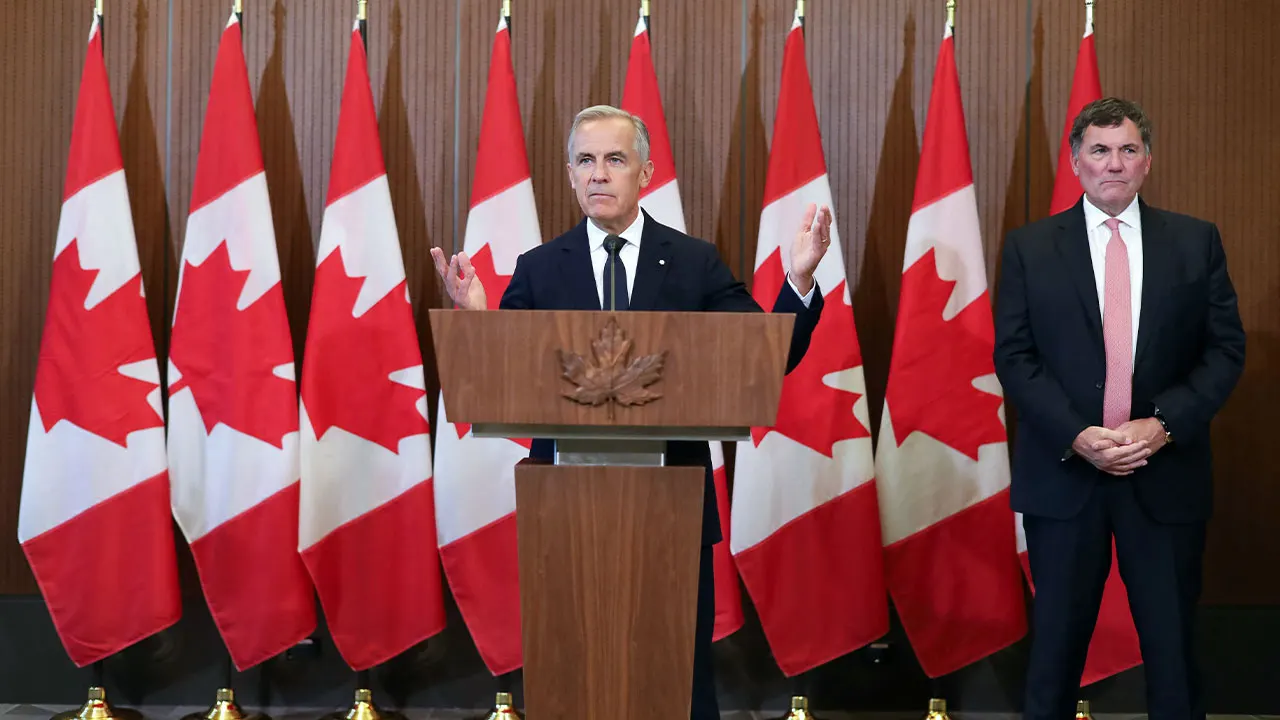
The Canadian prime minister says the U.S. sought to restrict Canada’s ability to strike trade deals with other countries.
Canadian Prime Minister Mark Carney accused the United States on Saturday of making a last-minute “power play” by trying to restrict Canada’s ability to strike trade deals with other countries, offering new details about what he said caused negotiations between the two sides to collapse.
Carney said the U.S. introduced new demands in the final hours of negotiations involving Canada’s other trading relationships, its auto sector and protections for Canadian culture and the French language.
“The U.S. introduced at the last hours, in the last hour, efforts to restrict our ability to have other trade deals,” Carney told reporters.
Asked what he believed the U.S. was trying to accomplish, Carney responded: “It’s a power play. It’s a power play and, you know, [it] becomes a question of sovereignty.”
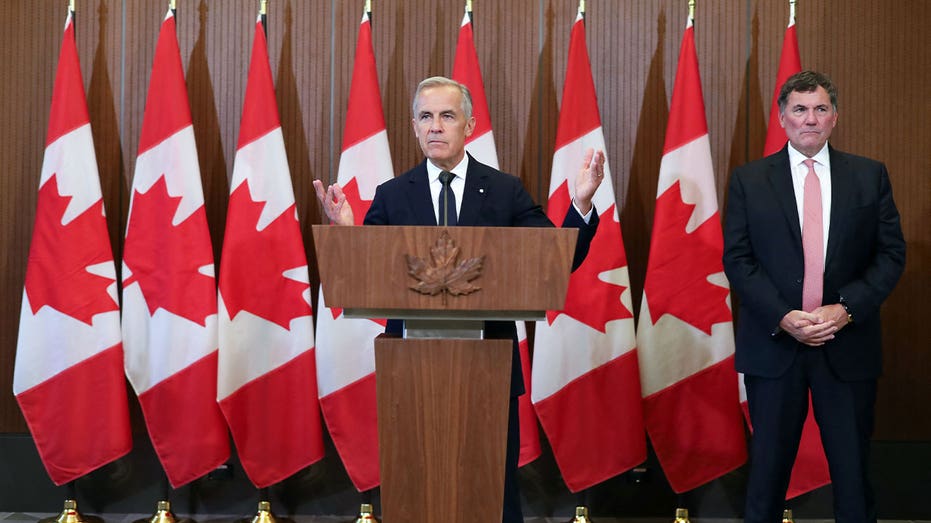
Canadian Prime Minister Mark Carney speaks Saturday during a news conference on U.S.-Canada trade negotiations. (Dave Chan/AFP via Getty Images / Getty Images)
The comments came a day after Carney suspended negotiations and ordered Canada’s trade team back to Ottawa as President Donald Trump‘s 50% tariffs on roughly $28 billion in Canadian goods took effect.
Canada said it plans to match the U.S. tariffs dollar for dollar, with Carney saying Saturday that the retaliation will target sectors including steel, dairy, appliances, agricultural equipment, pulp and paper and electronics.
The measures will take effect the Tuesday after Labor Day on Sept. 8.
Washington has disputed Carney’s account of why the negotiations broke down.
U.S. Trade Representative Jamieson Greer said Friday that Canada declined to finalize terms agreed to earlier in the week, accusing Ottawa of making new demands and walking back previous commitments.
TRUMP PAUSES 50% TARIFFS ON CANADA HOURS BEFORE DEADLINE AFTER ANNOUNCING POTENTIAL DEAL
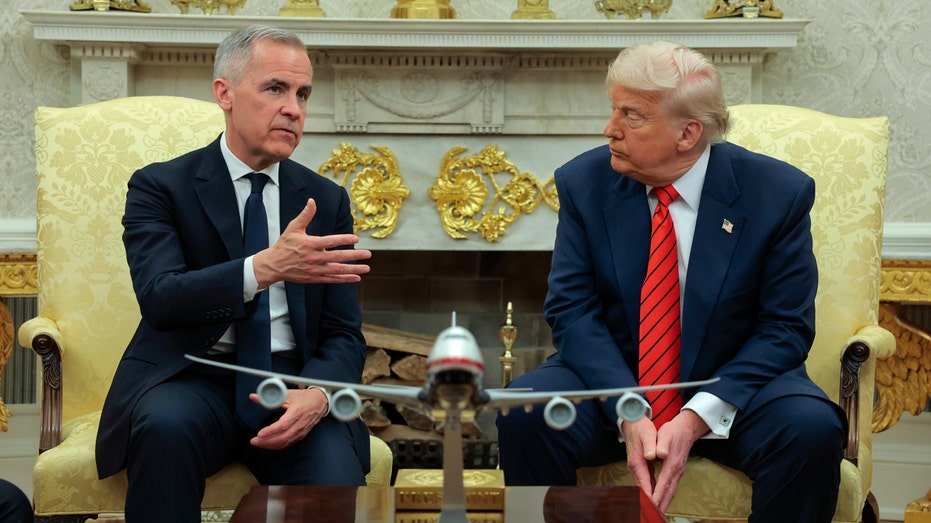
President Donald Trump meets with Canadian Prime Minister Mark Carney in the Oval Office at the White House, May 6, 2025, in Washington, DC. (Anna Moneymaker/Getty Images / Getty Images)
“Tonight [Friday], Canada declined to finalize the trade deal under the terms agreed earlier this week,” Greer said in a statement. “Despite the U.S. offer to Canada to receive the best treatment of any major exporter to our market, new demands and walk backs of other commitments by Canada have upended the careful balance reached in the past days.”
Greer said the U.S. offered Canada significant tariff reductions on steel, aluminum, autos and lumber, along with a broader economic and national security partnership covering digital trade, critical minerals, aerospace and export controls.
Carney offered a different account Saturday.
“In short, they asked too much, and they offered too little,” he said.
US, CANADA STRIKE DEAL TO OPEN BRIDGE LINKING DETROIT AND WINDSOR AFTER DISPUTE DELAYED LAUNCH

Autos were another major issue in the trade deal. (Lucy Nicholson/Reuters, File / Reuters Photos)
Autos were another major sticking point. Carney said the two sides disagreed over tariff levels, the treatment of Canadian content and which vehicles would be covered by a potential agreement.
He said the U.S. also continued efforts to seek changes involving Canada’s protections for its culture and the French language, which Carney said Ottawa would not accept.
The breakdown came just days after Trump paused the 50% tariffs for three days and announced that the U.S. and Canada, subject to final documentation, had reached a “DEAL!”
Carney said Saturday that the two sides had made significant progress before the negotiations unraveled.
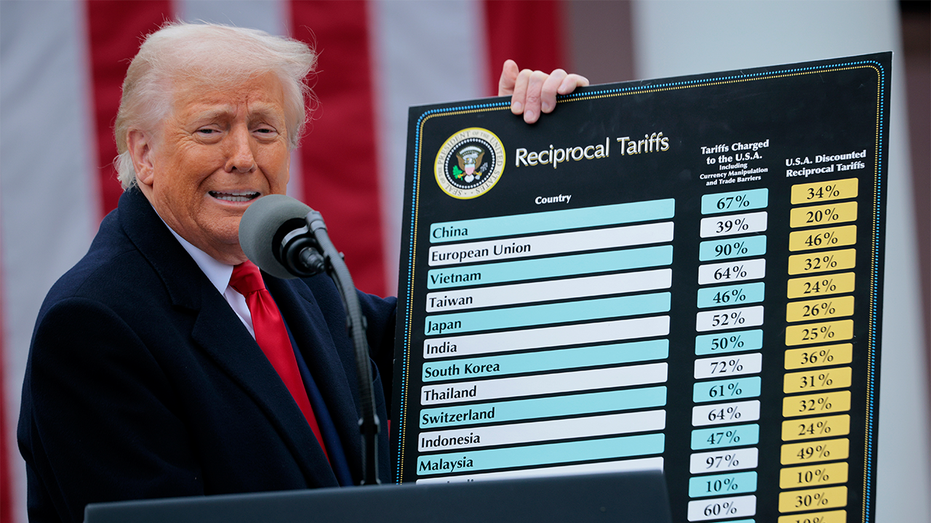
President Donald Trump holds up a chart of “reciprocal tariffs” while speaking during a trade announcement event in the Rose Garden at the White House, April 2, 2025, in Washington, D.C. (Chip Somodevilla/Getty Images / Getty Images)
Canada is now preparing additional support for businesses affected by the tariffs, particularly small and medium-sized companies, with Carney saying the government will release details alongside its retaliatory measures.
Asked whether the latest escalation amounted to a full-scale trade war, Carney said Canada was responding to an attack.
CLICK HERE TO GET FOX BUSINESS ON THE GO
“We’re attacked, like you’re at war when you get attacked, we got attacked,” Carney said.
“We’ve got the reserves, we’ve got resilience, we have the plan, we get the focus, we respond, we’re going to focus on what we can control, we are going to build.”

AI Data Center Protests Spread Across 42 States as Power Costs and Water Use Fuel Backlash Nationwide

Michael La Sasso (66) holds 1-shot lead at LIV Golf Indianapolis

Uber launches its first European robotaxi service in Croatia





-

 Fashion1 day ago
Weekend Open Thread: Madewell – Corporette.com
-

 Business4 days ago
SMA Solar Technology AG (SMTGY) Q2 2026 Earnings Call Transcript
-

 Tech5 days ago
Qwen3.8-27B runs frontier-class coding agents and reasoning locally, no cloud API required
-

 Politics12 hours ago
6 months on, Irish renters crushed by effects of government housing bill
-

 Crypto World5 days ago
OCC Greenlights Trump Family Crypto Firm for Trust Charter
-

 Crypto World5 days ago
NAVI Prime launches institutional lending framework on Sui
-

 News Videos3 days ago
Don’t Leave Your Financial Future To Chance | August 19, 2026
-
 NewsBeat15 hours ago
The ‘Lucky Dip Gang’ causing carnage for clicks: After five thugs were killed speeding in the wrong direction on a motorway, GUY ADAMS investigates a sick new trend… and why police aren’t even allowed to pursue them
-
 Crypto World6 days ago
Data of 54K Wallet Users Leaked, Clarity Odds Just 10%: Hodler’s Digest, Aug. 16
-

 Politics6 days ago
Britain is facing a housing disaster
-

 Tech6 days ago
What are the rumors about the AirPods Pro 4?
-

 Business6 days ago
Rebel Creamery files Chapter 11 with $23.8M Van Leeuwen judgment on appeal
-
 Crypto World5 days ago
Dow’s 3-Year Winning Run Isn’t a Crash Signal, Still 49% Odds of Double-Digit Gains
-

 Business4 days ago
Stock Market Today: Tech Futures Slide As Treasury Yields Jump; Nvidia, Micron, Sandisk Sell Off
-

 Tech7 days ago
Three new Windows flaws can bypass security, gain system privileges, and even install malware remotely
-
 Tech6 days ago
OpenAI’s new ChatGPT feature logs your keystrokes and stores them in plain text
-

 Tech5 days ago
Straight Up the Cliff, Yunnan’s New Fuyao Ladder Turns a Three-Hour Climb Into a 50-Second Ride for Students
-

 Tech6 days ago
DeepSeek’s top-ranked V4 Flash stumbles on real agent tasks as its prices surge
-

 Business2 days ago
Five Below: Kids Discount Retailer Reaps Rich Rewards
-
 Tech5 days ago
Nvidia discloses $21B stake in SpaceX
You must be logged in to post a comment Login