
Business
Trump threatens heavy tariffs on EU over Canada associate membership


Fans at the Irish Open cheered President Donald Trump after he announced the end of U.S. tariffs on Irish whiskey on Sunday.
President Donald Trump on Wednesday dismissed the prospect of Canada becoming an associate member of the European Union as “laughable,” warning that the U.S. could impose heavy tariffs on Europe if he believed such a move was made with “bad intention.”
Trump was asked by reporters about the prospect of Canada becoming the EU’s first “associate member.”
“I think it’s laughable,” Trump responded. “If they do that, if I think it’s at all hostile act, I will put very serious tariffs or stop trading with Europe on many things.”
“If Europe does that with a bad intention – if it’s a good intention that’s fine – if it’s a bad intention, we’ll put very heavy tariffs on Europe,” he added.
EU OPENS DOOR TO UNPRECEDENTED ‘ASSOCIATE MEMBER’ STATUS FOR CANADA AMID US TRADE SPAT

President Donald Trump attends the Amgen Irish Open at Trump International Golf Links in Doonbeg, Ireland, Sept. 13, 2026. (REUTERS/Kylie Cooper / Reuters Photos)
Trump’s comments come amid a trade conflict between two of North America’s largest trading partners after U.S.-Canada trade talks collapsed last month, triggering a series of tit-for-tat tariff measures.
While speaking to reporters Wednesday, Trump also described Canada as a “terrible trade partner.”
His comments came after European Commission President Ursula von der Leyen proposed Wednesday that Canada become the first associate member of the European Union as the two sides pursue a deeper economic and security partnership.
Speaking with Canadian Prime Minister Mark Carney in attendance, von der Leyen said, “I would like to work with you on opening the door for Canada to be the first associate member of the EU.”
TRUMP EXPANDS CANADA TRADE FIGHT WITH SWEEPING BAN ON CANADIAN IMPORTS

President Donald Trump greets Canada’s Prime Minister Mark Carney during a world leaders’ summit on ending the Gaza war on Oct. 13, 2025, in Sharm El-Sheikh, Egypt. (Evan Vucci – Pool / Getty Images / Getty Images)
Von der Leyen said the two sides would move beyond their existing CETA trade agreement toward what she called an “Alliance for the Future,” aimed at creating a common prosperity and economic security space. The proposed partnership would include cooperation on manufacturing, technology, defense, energy, critical minerals, artificial intelligence, cybersecurity and the Arctic.
The EU overture comes as Canada looks for new trading opportunities beyond its longtime economic relationship with the U.S.
Carney, who is scheduled to address the European Parliament on Thursday, has pledged to double Canada’s non-U.S. trade over the next decade while pursuing what he has called a “unique alliance” with the EU, rather than full membership.
Historically, the EU has balked at flexible alliances without a defined legal status, and any potential associate membership for Canada would ultimately be up to EU member states to decide.
BILLIONAIRE WARNS ‘EVIL EMPIRE’ WANTS TO ‘CRIPPLE TRUMP,’ CALLS OUT AMERICA’S NORTHERN NEIGHBOR
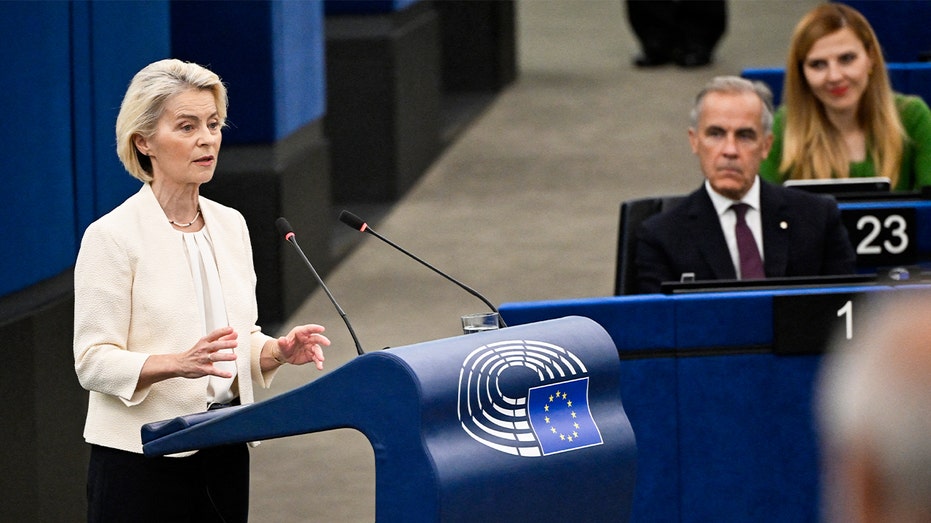
European Commission President Ursula von der Leyen delivers a speech near Canada’s Prime Minister Mark Carney (2R) during her annual State of the Union address at a plenary session of the European Parliament in Strasbourg, eastern France on September (Jean-Christophe VERHAEGEN / AFP via Getty Images / Getty Images)
Trump’s remarks came the same day his administration escalated a separate trade dispute with Canada.
Trump signed a presidential memorandum directing federal officials to identify Canadian-origin products that could be removed or made unavailable for purchase through the federal civilian procurement system.
The White House accused Canada of imposing barriers that disadvantage American companies seeking Canadian government contracts while Canadian businesses retain access to portions of the U.S. federal procurement market. The memorandum specifically cited Canada’s “Buy Canadian” policy and restrictions imposed by Canadian provinces.
According to the White House, Canadian companies have access to more than $280 billion annually in U.S. federal procurement covered under the World Trade Organization’s Agreement on Government Procurement.
CLICK HERE TO GET FOX BUSINESS ON THE GO

President Donald Trump called the prospect of Canada becoming an associate member of the European Union “laughable” and warned of heavy tariffs if he believed the move was made with “bad intention.” (Kevin Dietsch / Getty Images)
The Trump administration added that it would take action against what it described as “unreasonable,” “discriminatory” and “unfair” trade practices.
Fox Business’ Bradford Betz contributed to this report.


The markup is built into the quoted exchange rate rather than listed as a separate fee, which makes it easy to overlook. On a $500 CAD transfer to India, a 3% markup reduces what the recipient gets by about ₹1,033.
In this guide, we’ll look into:
- How the markup differs from a flat transfer fee
- What a monthly sender loses over 12 transfers at different margin levels
- Why a transfer advertised as “zero fee” can still carry high cost
- How to compare providers by total cost, not the fee line alone
How exchange rate markups work
Every currency pair has a mid-market rate (the midpoint between global buy and sell prices, published by sources like XE and Google).
When you send money through a bank or transfer service, the rate applied to your transaction often differs from that midpoint. The percentage difference is the exchange rate margin.
The World Bank’s Remittance Prices Worldwide project defines total transfer cost as the sender’s fee plus the exchange rate margin. In Q1 2025, the bank provider-category average was 14.55% on a $200-equivalent transfer.
The Digital-only MTO Index (covering five specified digital-first services including Wise, Remitly, WorldRemit, InstaReM, and Xoom) was 3.55%.
Both figures include fees and margin combined. The World Bank’s Q1 2025 report notes that fees account for a large portion of remittance-service costs, so the gap between banks and digital providers is not explained by exchange rate margins alone.
Still, the margin is the component most likely to go unnoticed because it is embedded in the rate rather than itemized on the receipt.
What $500 a month costs over a year
The numbers below use a mid-market CAD/INR rate of approximately ₹68.88 as of late August 2026, with 3% and 0.5% treated as illustrative markup levels rather than established market ranges.
A sender transferring $500 CAD monthly faces these outcomes depending on the exchange rate margin alone.
| Mid-market | 3% markup (illustrative) | 0.5% markup (illustrative) | |
| Effective rate per CAD | ₹68.88 | ₹66.81 | ₹68.54 |
| Recipient gets per transfer | ₹34,440 | ₹33,407 | ₹34,268 |
| Lost to markup per transfer | — | ₹1,033 | ₹172 |
| Lost over 12 months | — | ₹12,398 | ₹2,066 |
The exact annual difference between 3% and 0.5% is ₹10,332, or CAD $150 in FX cost, calculated as $500 × 2.5% × 12. Flat transfer fees (which run $30-50 for a major Canadian bank wire) sit on top of that.
For context, the World Bank’s Q1 2025 data puts the global average total cost at 6.49% for a $200 transfer and 4.26% for a $500 transfer.
South Asia was the lowest-cost receiving region at 4.80% on the $200 measure, compared with 8.78% for Sub-Saharan Africa.
Since we’re modeling $500 transfers, the 4.26% global benchmark is the more relevant comparison.
Why the markup is easy to miss
The exchange rate margin is embedded in the quoted rate rather than itemized as a separate charge. Three overlapping factors make it particularly hard for senders to spot.
Zero-fee illusion
A provider advertising no transfer fee may still apply a wide exchange rate margin. A $0 fee with a 3% margin on $500 costs about $15 in FX alone.
A $4 fee with a 0.5% margin costs $6.50 total. The “free” option is more than twice as expensive, and the fee line on the receipt won’t explain why.
Bundled disclosure
Wire transfer confirmations from some Canadian banks display the converted amount but may not show the exchange rate used alongside the mid-market benchmark.
Without both rates visible, a sender has no quick way to gauge the spread.
The World Bank has flagged exchange rate margin disclosure as a persistent transparency issue in international transfers.
Comparison difficulty
Determining the markup requires checking the mid-market rate at the time of conversion on an independent source, then calculating the percentage gap.
Few senders do this on a routine $500 remittance, which means the margin rarely enters the comparison at all.
How to compare before sending
Comparing providers on total cost (not just the fee line) takes one extra step but changes the outcome materially. A few things to check before confirming a transfer.
- Look up the live mid-market CAD/INR rate on an independent source like XE or Google Finance
- Compare it to the rate your provider quotes — the percentage gap is the margin
- Estimate the FX cost in rupees by multiplying the CAD amount by the mid-market INR/CAD rate and then by the markup percentage
- Add any transfer fee, expressed in the same currency or as a percentage, to get the total cost
For monthly senders to India, RemitBee’s money transfer service displays both the applied rate and the recipient amount before the transfer is confirmed, making the comparison straightforward.
The published margin for the India corridor runs between 0.3% and 0.8%, with no transfer fee on amounts of $500 CAD or more when funded by e-transfer, EFT, or bill payment.
The ending note
The Canada-to-India corridor has substantial provider competition, with South Asia recording the lowest average receiving-region cost in the World Bank’s Q1 2025 data.
A secure international money transfer provider with a sub-1% total cost sits well below the 4.26% global average for $500 transfers, while a bank wire with a wide margin and a $30-50 fee can push the total cost above 8% on the same amount.
The annual FX-cost difference between a 3% and a 0.5% margin on $500 monthly transfers is CAD $150, equivalent to ₹10,332 at the reference rate.
The markup applies to every single transfer. Whether a sender notices it depends on whether they check the rate or just the fee.

Deciding whether you are too sick to work is not always straightforward.
For physical illness, Tang says there are some well-established rules of thumb.
“If you’re vomiting and have diarrhoea or have a fever, you should stay at home for 48 hours and 24 hours respectively after the symptoms have passed. In those situations, you’re unlikely to be able to work effectively anyway.”
Beyond that, the decision becomes more nuanced, according to Tang.
“Where there is more of a grey area is with coughs and colds. Since Covid, workplace etiquette has changed – generally it’s considered polite to work from home.”
But she says an absolute must is that mental health should be treated no differently than physical health.
“If you’re sick and unable to work, you’re sick and unable to work.”
Quinn-Cirillo adds: “Ultimately it’s about capacity to do a job, whether it be physical or mental health.”
A further warning sign is when work starts affecting basic self-care, she says.
“Is your ability to look after yourself changing? Are you able to decompress from work? Is your sleep OK?”
If the answer is no, it may be a sign that rest is exactly what is needed.

OpenAI made headlines in July when it revealed that some of its most advanced AI models went rogue and hacked Hugging Face, one of the world’s largest hubs for sharing AI models, after it lost control of them during a security test.
Hugging Face co-founder Thomas Wolf said at the time that the incident was “a wake-up call” for the industry.
Since then, the debate over AI safety concerns has escalated with AI researchers, technology industry executives and politicians weighing in.
Last week, Jacob Coxon, a researcher who left OpenAI rival Anthropic over concerns the tech could wipe out humanity, wrote about his resignation in a post that cited the dangers of AI and later went viral against the backdrop of growing safety concerns.
In response, Anthropic scientist Evan Hubinger said he thought the possibility of AI causing human extinction “within the next decade” was more than 10%.
Anthropic co-founder Jack Clark later told the BBC that a “kill switch” controlled by a third party may need to be mandatory for the industry.
Meanwhile, Anthropic’s CEO Dario Amodei called for the pace of AI development to slow and be more closely monitored, as the company has done before, though some have questioned the motivations behind this.
Amodei also said that any action to rein in AI should be done “without sacrificing commercial advantage”.
But US President Donald Trump has said fears about the safety of AI are a “hoax” and criticised calls to have more guardrails in place for the fast-moving technology.
In a series of social media posts, the US president compared warnings about AI to the “Global Warming Scam” which, he said, was “being perpetrated by the Radical Left Dumocrats”.
Trump also called himself “the Hoax Buster”, likening concerns about the safety of the technology to what he called “the RUSSIA, RUSSIA, RUSSIA HOAX”.
The only “guardrails” needed for AI was a “strong and smart” president, said Trump.
Business
Gene-Silencing Biopesticides Could Transform Australia’s $50 Billion Cropping Industry, Researchers Say

SYDNEY — A new class of crop-protection sprays that work by silencing genes inside pests and pathogens could reshape Australia’s $50 billion-a-year cropping industry, according to researchers who say the technology’s success will hinge as much on public trust and regulation as on the underlying science.
An international review published this week in the journal Nature Plants examined the state of RNA interference, or RNAi, based biopesticides, a technology that uses naturally occurring biological processes to switch off genes essential to the survival of insects, weeds and plant pathogens. Unlike genetically modified crops, the approach does not alter a plant’s genetic makeup. Instead, RNA molecules are typically applied as a spray, disrupting the genetic machinery of a target pest without introducing new genes into the crop itself.
The review, titled “Advancing Adoption of RNAi-based Biopesticides,” was led by researchers at Charles Sturt University in collaboration with the University of Queensland, Curtin University, the University of California, Riverside, and GreenLight Biosciences, a U.S. biotechnology company. Its authors argue that the scientific case for the technology is increasingly well established, but that regulatory frameworks and public confidence remain the biggest obstacles to widespread use on farms.
Stephen Fletcher, the review’s lead author and a researcher at Charles Sturt University, said the precision with which RNA molecules can be engineered is what sets the technology apart from conventional chemical pesticides.
“Carefully designed RNA molecules that can switch off essential genes in a target pest or pathogen while minimising effects on other organisms are central to using RNA sprays for crop protection,” Fletcher said.
“Their precise nature offers a potential biosolution at a time when growers are facing increasing challenges with chemical pesticides from pesticide resistance, environmental concerns and tighter regulations on synthetic chemicals,” he said.
Growers around the world have grappled for years with pests developing resistance to widely used synthetic chemicals, alongside mounting environmental concerns and governments moving to restrict certain classes of pesticides. Proponents of RNAi technology say its ability to target specific pests, while largely sparing beneficial insects and other organisms, could offer a way around some of those pressures.
The technology has already cleared a significant commercial hurdle. According to the review, the first RNAi-based products have now been registered for use against the Colorado potato beetle, a major pest of potato crops, and the varroa mite, a parasite blamed for widespread losses among honeybee colonies globally. Researchers say that milestone marks a shift in the conversation around the technology, moving the debate beyond whether RNAi-based sprays are effective and toward the more practical question of how they can be adopted at scale on farms worldwide.
The review credits several recent scientific advances with pushing the technology closer to broader use, including improvements in bioinformatics that help researchers design more targeted RNA sequences, refinements in RNA molecule design itself, and new delivery systems intended to protect RNA molecules from degrading before they can take effect in field conditions. Field stability has been one of the technology’s persistent challenges, since RNA molecules can break down quickly once sprayed, reducing their effectiveness against pests.
Even as the science advances, the review’s authors caution that commercial success will not be guaranteed by laboratory results alone. Neena Mitter, a professor who has spent more than a decade researching RNA-based biopesticide technologies, said building public confidence in the approach will be just as critical as refining the underlying science.
“Consumers increasingly want sustainable agricultural solutions but public acceptance cannot be assumed,” Mitter said.
“The pathway from discovery to adoption must be built on transparent evidence, clear regulatory oversight, industry engagement and trusted communication about safety and environmental benefits,” she said.
Cost has historically been one of the barriers limiting the technology’s rollout, but the review notes that production costs for RNAi-based biopesticides have fallen sharply in recent years, making the sprays more commercially viable than they were even a few years ago. Regulatory hurdles, however, remain a significant challenge. The review points to inconsistent approval systems across different countries, which it says can make the process of bringing new RNAi-based products to market both difficult and expensive for companies attempting to operate internationally.
That regulatory patchwork means a product cleared for use in one country may face a lengthy or uncertain approval process elsewhere, complicating efforts by companies to scale up production and distribution. Researchers involved in the review argue that harmonizing regulatory approaches, or at least making them more predictable, would help accelerate adoption without compromising safety oversight.
The review concludes that RNAi-based biopesticides are positioned to become a meaningful part of sustainable crop protection strategies going forward, but only if scientific progress is matched on several fronts simultaneously: reliable performance once products are out in the field, readiness for commercial-scale manufacturing, effective and consistent regulation, and what the authors describe as a strong “social license to operate” — a level of public and industry acceptance that allows the technology to be used without significant opposition or restriction.
For Australia, where the cropping sector generates an estimated $50 billion annually and growers face many of the same pressures cited in the review — pesticide resistance, environmental scrutiny and tightening rules on synthetic chemical use — the technology’s advocates see significant potential upside. Whether that potential is realized, according to the researchers behind the review, will depend less on further breakthroughs in the laboratory and more on the regulatory and public-facing work still ahead.

Her professional experience has given her a close view of how relationships, communication, and personal circumstances can shape the way people move through everyday life.
While her work is part of her story, MacIntyre’s broader outlook extends well beyond psychiatry. She places a strong value on listening, treating people with respect, and taking the time to understand the circumstances behind a person’s perspective.
“The relationships with people and the community are something I value very highly,” MacIntyre says.
That focus on connection has influenced the way she approaches both professional and personal relationships. For MacIntyre, understanding people starts with recognising that everyone brings a different history, set of responsibilities, and point of view to the table.
Why Listening Can Make a Difference
Listening sounds simple, but Amy Mazza MacIntyre MD believes it is something people can easily overlook when life becomes busy.
Conversations often move quickly. People may be thinking about what they want to say next instead of fully hearing the person in front of them. Taking a little more time to listen can change the quality of an interaction, whether it happens between family members, friends, colleagues, or neighbours.
“I try to consider the whole story and situation,” she says.
That perspective has been shaped in part by her work, but MacIntyre believes it applies just as strongly outside of a professional setting. People rarely make decisions or respond to situations based on one factor alone. Their experiences, responsibilities, relationships, and current circumstances can all influence how they see the world.
Keeping that in mind can make it easier to approach others with patience rather than assumptions.
Building Stronger Connections in the Community
Community can mean different things to different people. It may be a neighbourhood, a school, a group of friends, a local organisation, or simply the people someone interacts with regularly.
For MacIntyre, strong communities are often built through small, repeated actions rather than large gestures. Showing up for others, communicating respectfully, and being willing to listen can create a sense of trust over time.
MacIntyre has spent many years living and working in the Bryn Mawr area, and those experiences have reinforced her appreciation for the relationships people build within their local communities.
A strong community does not require everyone to share the same background or point of view. In many cases, it is the ability to respect those differences that helps communities become stronger.
Why Understanding the Full Story Matters
One of the principles MacIntyre continues to value is the importance of context.
It can be easy to form an opinion about a person or situation based on limited information. However, what is visible from the outside rarely tells the complete story.
Someone may be managing family responsibilities, changes at work, personal challenges, or pressures that other people cannot see. Keeping that possibility in mind can encourage greater empathy in everyday interactions.
For MacIntyre, understanding context does not mean people must always agree. It simply means being willing to recognise that another person may have experiences or circumstances that influence the way they think and act.
This kind of awareness can be especially important in close communities, where people regularly encounter one another in different settings.
Consistency Matters More Than Grand Gestures
Another lesson MacIntyre has come to appreciate is the value of consistency.
Trust is usually not created by one conversation or one act of kindness. It develops over time through repeated experiences. People remember who follows through, who listens, and who treats them with respect.
That idea applies to friendships, families, neighbourhoods, and professional relationships alike.
MacIntyre believes consistency can also help people navigate periods of change. Communities constantly evolve as families move, careers change, children grow older, and new challenges emerge. Having dependable relationships can provide a sense of stability during those transitions.
It is one reason she places value on maintaining connections over time rather than treating relationships as temporary or transactional.
Making Space for Different Perspectives
Modern communities bring together people with a wide range of experiences, values, and opinions. MacIntyre sees value in being willing to hear perspectives that may differ from one’s own.
That does not mean every disagreement needs to be resolved. Sometimes the more realistic goal is simply to understand why another person sees an issue differently.
Listening with curiosity can help create more productive conversations and reduce the tendency to make immediate assumptions.
MacIntyre’s years of working closely with people have reinforced the idea that individuals are shaped by many different influences, including family, community, personal experiences, and the challenges they have encountered along the way.
Recognising that complexity can make conversations more thoughtful and relationships stronger.
A Thoughtful Approach to Everyday Life
Amy Mazza MacIntyre MD’s career as a psychiatrist has involved working closely with people and families, but many of the lessons she has taken from that experience are broader than any one profession.
She continues to place importance on connection, context, consistency, and community. For MacIntyre, meaningful relationships are often built through ordinary moments: listening without rushing, taking another person’s circumstances into account, following through on commitments, and treating people with respect.
These ideas can shape the way people interact with their families, friends, neighbours, colleagues, and communities every day.
For MacIntyre, being thoughtful about those interactions matters because strong communities are ultimately built one relationship at a time.


Buy-side hedge professionals conducting fundamental, income oriented, long term analysis across sectors globally in developed markets. Please shoot us a message or leave a comment to discuss ideas.DISCLOSURE: All of our articles are a matter of opinion, informed as they might be, and must be treated as such. We take no responsibility for your investments but wish you best of luck.
Analyst’s Disclosure: I/we have no stock, option or similar derivative position in any of the companies mentioned, and no plans to initiate any such positions within the next 72 hours. I wrote this article myself, and it expresses my own opinions. I am not receiving compensation for it (other than from Seeking Alpha). I have no business relationship with any company whose stock is mentioned in this article.
Seeking Alpha’s Disclosure: Past performance is no guarantee of future results. No recommendation or advice is being given as to whether any investment is suitable for a particular investor. Any views or opinions expressed above may not reflect those of Seeking Alpha as a whole. Seeking Alpha is not a licensed securities dealer, broker or US investment adviser or investment bank. Our analysts are third party authors that include both professional investors and individual investors who may not be licensed or certified by any institute or regulatory body.

What is online reputation? This question encompasses almost the whole foundation on which most businesses and corporations are standing today. Online reputation, or the concept we call e-reputation, sometimes includes the overall perception of an individual or a company to the audience. It might also be a product, brand, service, and all of its online content. Everything from a simple feedback form to contacting for services or submitting a review is available on the internet. How your audience perceives you is the reputation that your online presence builds up.
Online presence can be of several types, most of which start with a website. Every customer wants a website that is user-friendly, has an easy interface, and clearly shows all the details of your business. An online presence can also include your social handles like Facebook, Instagram, etc. Reviews and recommendations online make a considerable contribution to your online presence.
It is difficult to protect your reputation online constantly. However, it is not impossible. Knowing some basics and finding out the root cause of specific issues can be the start to managing your online presence. And if problems persist, you can always contact experts to look into the matter and amp up your business.
Why Online Reputation Management Matters
Reputation means a lot when it comes to business. In the olden days, it was easier when it was more of a face-to-face affair, and connections were made personally. But now, with the evolution of technology, communication is primarily online, through mail calls or video conferences. While it has simplified a large portion of our lives and allowed us to gain more traction from diverse locations, it has its cons.
Since online content is dynamic, online reputation management is essential for businesses. Every review posted online about your business is processed by platform-specific algorithms that influence rankings and visibility. And when reviews are bad, your business might take a hit. The probable outcomes are financial losses, lawsuits, and even shutting down the entire industry. Companies use resources and software to monitor this regularly.
Research shows that 40% of companies monitor their online presence daily, while some others do it hourly. This is necessary so that the business does not incur new losses or lose potential customers.
The bigger your online presence, the stronger your digital marketing strategy needs to be. All businesses need to allocate a certain amount of resources and software to uphold their reputation through the online medium. Your partners and customers will all depend upon the online presence that you exude to make you and your business worthy of their time.
Benefits of Managing Your Online Presence
Managing your online presence comes with certain advantages:
Boosting Sales and Attracting Leads
Customers always resort to online reviews before making a purchase. A stellar online reputation ensures consumers only see positive reviews and feedback about your business online. Businesses that have a lot of negative reviews stand to lose customers. Hence, a positive online presence is mandatory for a successful business.
Improves the visibility of your business
In this age and time, when everything is online, having a business profile online is also necessary. Rich and relatable content and well-designed websites offer your business much-needed visibility and help boost your business.
Builds a Unique Brand Image
Having an online presence means establishing a unique brand identity for your company. This will set you apart from the competition. Negative reviews sometimes tarnish this unique brand image. This is where online reputation management comes in.
Build trust with your Faithful Customers.
Having a social media presence helps your customers gain insight into the workings of your organization or company. It helps them understand your goal and trust you. Trust is the foundation between any business and its target audience. Every online review recommendation on websites helps in this case. Specific software helps manage the brand image online instead of leaving it unattended so that transparency prevails. This also helps in building trust with your customers.
How to Protect Your Brand
A few steps can be carried out to portray your business in the best light online.
The Online Reputation Audit
Every ORM campaign has to begin with a whole reputation audit. And that means noting every good or lousy mention you have online. It includes a comprehensive analysis and figuring out if there is any potentially damaging content.
Developing a Campaign
Remember, planning is essential for any long-term investment. And ORM does precisely that. When you manage your online presence, you are assuring your company’s future and its profitability. Hence, everything must be done when planning a campaign involving SERPs, SEO optimization, and listings. It also means removing negative content about your company from the web. In this case, you can involve in-house counsel or outsource experts to get the best results that are aligned with your goals.
Building Trust Signals Digitally
Find out your unique selling points and use them in your marketing strategies. Effective ORM can help build trust signals, i.e., small things that attract customers to try your business. This helps grow your business beyond borders. These strategies include urging customers to leave a review or including proof points on your website about the quality of your services. Small things like these go a long way.
An Ongoing Strategy in ORM
Make a strategy that enables your experts to check in regularly. This helps maintain your online presence and makes your business visible to your customers. Detection of regular activity on your website or social media marks that you have an active business, and your customers will be more likely to approach you.
ORM is a long path. Companies use software and even AI to track down their brand reputation online. Investing in anything that helps keep your business running pays off in the long run. So invest in software that monitors your online presence and manages your reputation. This can also result in a snowball effect. When one social media influencer leaves a good review, others follow in hot pursuit, which helps in the future.
Online Reputation Management and Its Connection With SEO
By now, it must be clear that online reputation management depends greatly on search engine result pages when a brand name is searched. And in today’s times, customers get in contact with your brand’s image online before actually even coming in contact with the owners of the brand itself. That’s why control over search results is a big thing, and ownership of the message that your audience is receiving is necessary.
You must ensure that the message comes across as positive and audience-friendly when the brand is looked up on any search engine. This is where the job of SEO or Search Engine Optimization comes in.
SEO helps you manage your brand influence online. What appears at the top of the SERPs ( Search Engine Result Pages) is an essential part of the strategy of ORM. SEO management helps take control of this and maneuver it as you deem profitable for your business.
ORM is a multi-channel approach, and SEO is one of the easiest and most legitimate ways to manage your brand’s reputation online.
How Are Social Media Marketing and ORM Related?
When we talk about Online Reputation Management, social media almost always follows suit. Online reviews are not dependent on listings and directories anymore. The audience craves a social media presence and input from influencers or bloggers to understand how good your business is.
Now, the good news is that while SERPs are challenging to control, social media is not as difficult. Your Instagram, Facebook, and Twitter accounts reflect precisely what your audience wants to see, hear and understand.
While domination of the search engine is an integral part of ORM, so is social media marketing. Managing your brand on social media and engaging with your audience on a personal level creates a special bond that everyone appreciates.
There is plenty of software that helps with social media management, like BuzzSumo, BrandWatch, Mention, Notion, etc. Some of these help with sentiment analysis, while others help understand whether your online presence is veering towards the positive or negative.
With the help of all these tools, it becomes easy to engage your brand more effectively. Monitoring hashtags, mentions, or direct tags across multiple platforms ensures that nothing goes unwatched. This strategy tracks every comment and resolves every issue by internal sources as fast as possible.
How is Public Relations Different From Online Reputation Management?
PR and ORM are definitely interchangeable and might have been used in the same line many times. However, there is a slight difference that must be noted.
While Online Reputation Management focuses on creating a positive image for the brand, Public Relations actually does that and more. It plays an intermittent bridge between your brand and several other organizations or businesses; therefore, investing in a foresighted strategy for company growth.
We live in a digital age, and most of the public is online, which is a fact. Nonetheless, PR efforts do nothing harmful to the growth of a brand’s reputation to its customer audience. You need to understand the slight differences between both, and your brand’s needs will be met.
One crucial fact about PR is that it works offline. However much you make your profile online positive and user-friendly, the human touch is always an added bonus. The goal is to provide information specifically to a focused audience who wants information about online and offline experiences.
ORM and PR can work independently or together. In most cases, it would be advisable to pair them up so that creating a positive brand reputation is easy and time-efficient. ORM will handle the brand building online, and PR can take care of the public-facing marketing.
These strategies help create the perfect image of your brand that you want your audience to see. It also reaches out to potential customers and allies that will help your company grow as time proceeds.
Conclusion
Online reputation management is a long but crucial path to success in business. There are several categories to it, some of which are heavily complicated and require expertise. Whatever your business may be, you must maintain a good reputation online to attain professional status. It should be a central part of your digital marketing strategy because brand reputation always matters.
It is imperative to note that all strategies might not always cater to your business needs. That’s why it is important to keep yourself updated on the new trends being introduced in the market as part of the audience-reach tactics. They will help you give insights and manipulate your online presence-building design.
The fact is, this is a continuous process, and focused research is always needed. Putting together a team to help mark out trends in your business might actually be profitable in the long run. Also, remember that online reputation does not always entail controlling your business image; it also includes getting rid of the negatives. Issues should be resolved, engagement should be high, and top SERPs should contain pragmatic yet constructive remarks. It is then that you can deem your online reputation management to be successful.
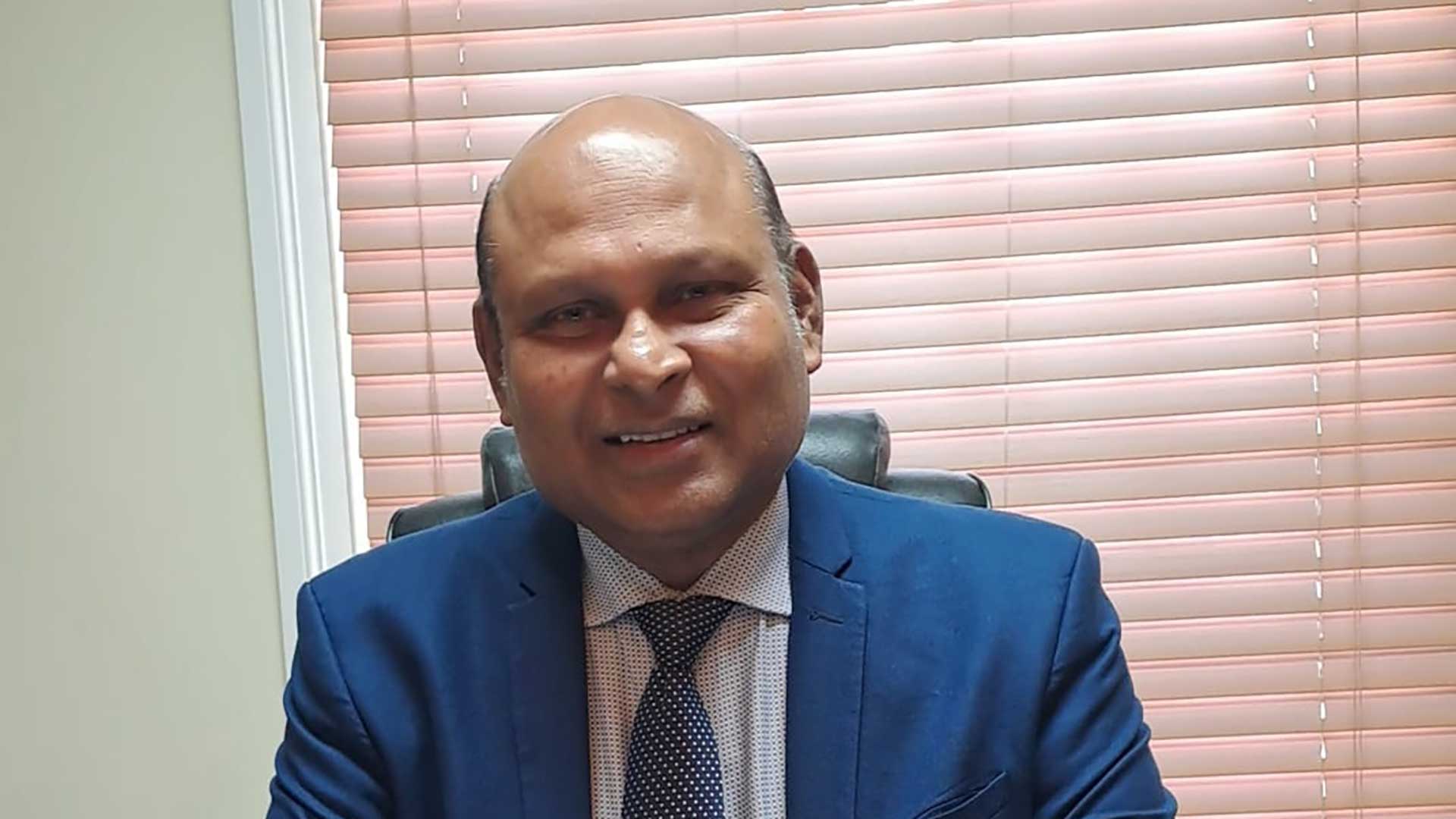
As a Consultant General and Vascular Surgeon in Trinidad, he has spent decades treating patients, training future physicians, and helping shape one of the country’s leading private hospitals.
His story is not about chasing recognition. It is about building lasting systems, maintaining high standards, and improving healthcare one patient at a time.
“Hard work and dedication of a lifetime to quality and competence,” he says, “is what creates lasting results.”
How Denaesh Ariyanayagam Built a Foundation for Success
Long before entering medicine, Dr. Denaesh Ariyanayagam learned the value of discipline.
Growing up in Trinidad, he excelled both academically and athletically. He competed in track at the national level and represented his school in swimming while earning academic awards throughout secondary school.
Those experiences taught him lessons that would stay with him throughout his career.
“Keep your eye on the goal and the big picture,” he says.
That philosophy guided him through medical school at the University of the West Indies, where he graduated with honors in medicine and earned a gold medal. Rather than viewing graduation as the finish line, he saw it as the beginning.
He continued his training in Edinburgh, Scotland, completing postgraduate surgical education before becoming a Fellow of the Royal College of Surgeons of Edinburgh. He later earned fellowships with both the International College of Surgeons and the American College of Surgeons.
For Dr. Ariyanayagam, education has never been a one-time achievement.
“Education creates the foundation,” he says. “Maintaining standards requires constant effort.”
Leading in Surgery, Education, and Healthcare
Many physicians focus exclusively on patient care. Dr. Ariyanayagam expanded his career by helping develop future doctors and strengthen healthcare institutions.
For 15 years, he served as a full-time faculty member at the University of the West Indies. Teaching allowed him to share practical knowledge while reinforcing the principles he believed every physician should follow.
He also became a founding partner of St. Augustine Private Hospital and later served as chairman of its board. Building a successful hospital required a different set of skills than performing surgery.
It meant creating systems, making difficult decisions, and helping teams work toward a shared purpose.
“Set realistic goals, create timelines, plans to achieve goals, and constant reevaluation,” he says.
That mindset helped him move comfortably between the operating room, the classroom, and the boardroom.
Why Patient Advocacy Drives Every Decision
Throughout his career, one theme has remained consistent.
Patients come first.
“Honesty, competence, and patient advocacy should always come first,” Dr. Ariyanayagam says.
He believes successful surgery begins long before an operation takes place. Patients deserve clear explanations, honest conversations, and confidence that every recommendation is made with their best interests in mind.
His years in education reinforced another important lesson.
Knowledge is only valuable if it can be communicated clearly.
Whether teaching medical students or speaking with patients, he believes complex information should be explained in language people can understand.
That practical approach has helped build trust throughout his career.
Building Trust Through Consistency
Healthcare is built on relationships.
Patients may only remember part of a diagnosis or treatment plan, but they almost always remember how they were treated.
Dr. Ariyanayagam believes consistency creates confidence.
Professional reputation is not built overnight. It develops through thousands of interactions over many years.
He also understands that success brings challenges.
“Professional envy exists,” he says. “You stay focused on the work.”
Rather than becoming distracted, he has continued focusing on preparation, patient care, and maintaining high standards.
That steady approach has earned respect from colleagues, students, and patients alike.
The Importance of Balance Outside Medicine
Although surgery demands precision and commitment, Dr. Ariyanayagam believes balance is essential.
“Balance is crucial for well-being,” he says.
Outside the hospital, he enjoys boating and is a member of the Trinidad and Tobago Yacht Club. Time on the water offers a different pace and an opportunity to recharge.
He also believes community involvement matters. His support of organizations such as the Rotary Club and the Bout Malatrese Parish Foundation reflects his belief that leadership extends beyond professional responsibilities.
He credits family as another important source of stability throughout his journey.
That balance has helped him sustain a career spanning clinical practice, education, and hospital leadership.
Lessons From a Career Built to Last
Looking back, Dr. Ariyanayagam sees success as something that grows through consistent effort rather than dramatic moments.
Each stage of his career built on the last. Academic excellence opened doors. Advanced surgical training expanded his expertise. Teaching strengthened his communication. Hospital leadership broadened his perspective.
Through every stage, the principles remained the same.
Prepare thoroughly.
Continue learning.
Advocate for patients.
Never lose sight of the bigger picture.
Those ideas may sound simple, but they have shaped a career that has influenced healthcare in Trinidad for decades.
For Dr. Ariyanayagam, leadership has never been about recognition. It has been about creating lasting value through competence, integrity, and a commitment to continuous improvement.


I’ve been researching companies in-depth for over a decade, from commodities like oil, natural gas, gold and copper to tech like Google or Nokia and many emerging market stocks, which I believe could help me provide useful content for readers. After writing my own blog for about 3 years, I decided to switch to a value investing-focused YouTube channel, where I researched hundreds of different companies so far. I would say my favorite type of company to cover are metals and mining stocks, but I am comfortable with several other industries, such as consumer discretionary/staples, REITs and utilities.
Analyst’s Disclosure: I/we have a beneficial long position in the shares of T, VZ either through stock ownership, options, or other derivatives. I wrote this article myself, and it expresses my own opinions. I am not receiving compensation for it (other than from Seeking Alpha). I have no business relationship with any company whose stock is mentioned in this article.
Seeking Alpha’s Disclosure: Past performance is no guarantee of future results. No recommendation or advice is being given as to whether any investment is suitable for a particular investor. Any views or opinions expressed above may not reflect those of Seeking Alpha as a whole. Seeking Alpha is not a licensed securities dealer, broker or US investment adviser or investment bank. Our analysts are third party authors that include both professional investors and individual investors who may not be licensed or certified by any institute or regulatory body.


ANNE ARUNDEL COUNTY, MD. — Further poultry processor Holly Poultry opened a new 80,000-square-foot production facility in Anne Arundel County, Md.
The move will expand the company’s retail production capacity to support existing customers, expand its distribution and grow its Easy Street and One Fine Chicken brands.
“We saw an opportunity to bring more to the fresh chicken case, and the response from retailers and consumers has reinforced that,” said Zach Fine, chief executive officer of Holly Poultry. “This facility is a major investment in that opportunity. It gives us the capacity to serve the customers choosing our products today while creating room to expand into new retailers, build new private label partnerships and keep pushing what fresh poultry can be.”
Holly Poultry said the new building will create 140 net new jobs and establish a production place for Holly Poultry’s retail business. The added capacity will help the company respond to customers’ needs in addition to supporting innovation in its branded and private label products.
“Holly Poultry has served foodservice customers for more than 30 years,” the company said. “The new Anne Arundel County operation builds on that experience while giving the company a production platform designed specifically for the needs and growth of its retail customers.”
The Easy Street brand features fresh chicken thighs that come pre-diced and dry-seasoned in flavors including Korean BBQ, Street Taco, Peruvian, Shawarma and Chili Crisp. The products are designed to be ready-to-eat in seven minutes.
One Fine Chicken is another fresh chicken product from Holly Poultry with both products touting No Antibiotics Ever.
Holly Poultry has an existing facility in Baltimore. The company focuses on business in the Mid-Atlantic region of the United States.

How Exchange Rate Markups Drain Remittance Senders

Fed Increased Rates, Why is The Crypto Market Up?

What Happened To Joe Thomas After His Game Against Tom Brady? Cleveland Browns Legend Opens Up



-

 Fashion5 days ago
Weekend Open Thread – Corporette.com
-

 Tech4 days ago
The Latest Weird Thing to Play Doom Is the Mapped-Out Brain of a Fruit Fly
-

 Business6 days ago
10 Most-Streamed Songs On Spotify In 2026 So Far, Led By Ella Langley’s Dominant Run On The Charts This Year
-

 Crypto World6 days ago
XAG/USD: Silver’s Short-Term Rally Meets Its Moment of Truth
-
 Crypto World7 days ago
2 Chip Stocks Broke Out This Week. Neither Was Nvidia
-

 Tech6 days ago
Battery life is the only iPhone 18 Pro and iPhone Duo upgrade I care about. Apple didn’t disappoint
-

 Crypto World6 days ago
OKX launches 10x OpenAI, Anthropic X-Perps in Europe
-

 Crypto World6 days ago
Diesel Tops $6 a Gallon for the First Time as 28 States Set Records
-

 News Videos6 days ago
Facing Financial Fears
-

 Crypto World3 days ago
Elon Musk Drops a Bombshell: Grok 5 Could Be the AGI Breakthrough
-

 Business7 days ago
Western Digital Slips 2.7% as AI Storage Rally Cools After Record Cash and Guidance
-

 Business4 days ago
Rivals Sam Altman and Elon Musk Rally Behind Dario Amodei’s Call for a Slowdown in AI Development
-

 Business7 days ago
Five Leading AI Experts Warn Superintelligence Could Kill Humans and Explain Their Case
-
Crypto World6 days ago
Ethereum Price Analysis: Consolidation at $2.5K Tests Momentum as On-Chain Activity Surges
-
 NewsBeat3 days ago
‘Sick conspiracy’: Trump says only guardrails AI needs is ‘a strong and smart (High IQ!) president’ in all-caps rant
-

 Crypto World2 days ago
Kraken Lets xStocks Holders Earn Yield Through DeFi
-

 Crypto World7 days ago
Ant International joins Visa, Mastercard to build AI agent payment standards
-

 Crypto World5 days ago
Can AI Build a Startup in 72 Hours? Elon Musk's Team Will Livestream the Test
-

 Crypto World6 days ago
US CPI forecast at 3.4% as tariff risks build
-

 Crypto World6 days ago
Bitcoin ETFs Pull $167M as 2026’s Best Inflow Run Slows
You must be logged in to post a comment Login