
Business
UAE weighs freezing billions in Iranian assets amid escalating tensions



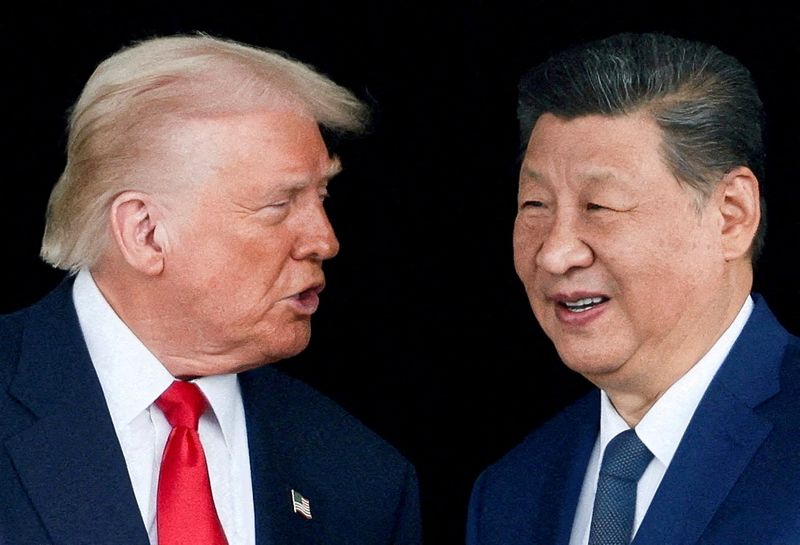

How one factory in China learned to live with Trump, tariffs and turmoil

The AI agent sparked a frenzy of “raising lobsters” in March, with users training the tool to suit their needs.


Trump’s trade war with China in focus ahead of May summit

Trump wrote: “Tuesday will be Power Plant Day, and Bridge Day, all wrapped up in one, in Iran. There will be nothing like it!!! Open the Fuckin’ Strait, you crazy bastards, or you’ll be living in Hell – JUST WATCH! Praise be to Allah. President DONALD J. TRUMP”.
The Reserve Bank of India’s defense of a record-low rupee has constrained its ability to inject liquidity, tightening financial conditions that are likely to weigh on banks over the coming quarters. A prolonged conflict in the Middle East also risks derailing India’s nascent credit recovery, threatening loan growth as the broader economy cools.
Global investors withdrew a record 327 billion rupees ($3.5 billion) from shares of financial services companies in the first fortnight of March, according to National Securities Depository Ltd. data. The Nifty Bank Index has lost $95 billion in market value since the start of March, narrowly avoiding a bear market — defined as a 20% drop from a recent high.
“There could be further pressure on these stocks in the short-to-medium term as monetary policy can remain tight,” Kranthi Bathini, an equity strategist at WealthMills Securities, said, adding that valuations are becoming attractive after the correction.
 Agencies
At stake is the outlook for India’s $4.5 trillion stock market, given banks account for nearly a third of the benchmark index. A sustained weakness in shares of lenders could undermine a broader market that is already among the worst performers in the region, down 13% for the year.

Bulls point to improving valuation multiples for bank stocks and India’s long-term economic growth, which remains among the fastest globally. The Nifty Bank Index trades at 1.5 times one-year forward price-to-book, its cheapest level since 2020, signaling an attractive risk-reward profile.
Citibank Inc. is already prioritizing private-sector banks over state-run lenders, betting that the former can better absorb the macroeconomic stress that is now the prime concern for investors.Still, Jefferies estimates banks could face as much as 50 billion rupees from unwinding their currency trades due to diktats of the central bank. Fitch Ratings sees net interest margins of lenders shrinking 20-30 basis points in the year ending March 2027 — potentially undershooting the credit rating agency’s 3.1% forecast — as tighter financial conditions weigh.
“Banks will definitely take some hit on their investment book,” said Rajat Agarwal, an Asia strategist at Societe Generale SA. “We recently saw a pickup in credit growth — what remains to be seen is how much of that gets pushed back” by the war, he said.

Among the top gainers were electric bikes maker Ather Energy (139% return), auto ancillary manufacturer Belrise Industries (98%), and Aditya Infotech (78%), which provides video surveillance solutions.
Instead of listing price, if offer price is considered, then the proportion of companies improves – 37 IPOs generated returns while 31 yielded double-digit returns. The same three companies made it to the top three slots. Aditya Infotech took the lead with 168% return over the offer price while Ather Energy and Belrise gained 143% and 116%.
AgenciesIn a volatile market, just 16 IPOs yielded double-digit returns over listing price
It was also the year when majority of the large IPOs based on the issue size or money raised failed to generate returns. Only a quarter of the top 12 IPOs – four to be precise – earned returns. These include Lenskart and Groww generating 26% return each, followed by 11% return by ICICI Prudential AMC and 8% by Tenneco Clean Air India.
Among the worst performing IPOs of FY26 were steel products maker VMS TMT, which fell 62% from the listing price followed by construction company Highway Infrastructure and renewable energy equipment provider Solarworld Energy Solutions which lost 60% each.

CHANDAN TAPARIA
HEAD – DERIVATIVES & TECHNICALS, MOTILAL OSWAL FINANCIAL SERVICES
Where is Nifty headed?
Nifty has been forming lower highs and lower lows on weekly chart, signalling a sustained downtrend. Despite this weak structure, the index staged a sharp 500-point intraday recovery on Thursday, forming a bullish candle on both daily and weekly charts. The index is now deeply oversold pointing to the possibility of a near-term pullback or relief rally. Holding above 22,100 is critical. A sustained move above 23,000–23,333 could trigger short covering, while failure to do so may keep the downtrend intact, with the index at risk of slipping below 21,750.
Trading Strategies : Recommended strategy for Nifty Option for 13 April expiry is a Bear Put Spread, ideal for a slight negative bias. Traders are advised to buy one lot of 22,700 strike Put Option and simultaneously sell one lot of 22,400 strike Put Option. Maximum risk in the strategy is 115 points (Rs 7,475), and a maximum potential Profit is 285 Points (Rs 18,525) per lot if the index expires below 22,400 zones towards next weekly expiry.
TOP STOCKS FOR THE WEEK
Adani Power: Buy. CMP Rs 160, Stop Loss: Rs 154, Target: Rs 172
Stock has broken out from a consolidation zone on daily chart after 100 trading sessions with a strong-bodied bullish candle. It has given the recent highest daily close with rising traded volumes along with holding above key moving averages.
Tech Mahindra: Buy. CMP Rs 1441, Stop Loss: Rs 1400, Target: Rs 1510
Stock started to form a higher top – higher bottom on weekly scale after the sharp corrective move in February. It has seen a consolidation breakout of the last 25 trading sessions and formed a Rounding Bottom pattern on daily chart.
HITESH TAILOR
TECHNICAL ANALYST, CHOICE EQUITY BROKING
Where is Nifty headed?
Nifty is likely to trade in a broad range of 22,150–23,500 with a sideways to bearish bias. While oversold indicators may trigger short-covering rallies, sustainability above 23,500 will be critical to shift sentiment. Until then, any pullback towards resistance zones is likely to face selling pressure. A decisive break below 22,150 could open the door for further downside towards 21,900-21,700 levels. Weekly RSI at 27.88 signals that market is in a deeply oversold zone, increasing the probability of a short-term relief rally or consolidation.
Trading Strategies: Nifty traders may consider a ‘sell on rise’ strategy in the 22,900-23,200 zone, with a stop loss at 23,500 and potential targets of 22,150-21,900. Fresh longs should be considered only if Nifty sustains above 23,500 on a closing basis.
AgenciesTOP STOCKS FOR THE WEEK
Adani Power: Buy at CMP Rs 159, Stop Loss at Rs 150, Target: Rs 177
Price structure has improved following a decisive breakout above a key horizontal resistance zone. The move is backed by a strong close and a clear uptick in volumes, signalling renewed buying interest and stronger participation.
Marico: Buy at CMP Rs 761, Stop Loss: Rs 724, Target: Rs 824
Marico’s structure remains positive, with a consistent formation of higher highs and higher lows pattern across timeframes. A pullback from its all-time high held near the 200-day EMA and saw a rebound, underscoring demand at lower levels and keeping the bullish undertone intact.
SACCHITANAND UTTEKAR
VP- RESEARCH (TECHNICAL & DERIVATIVES), TRADEBULLS SECURITIES
Where is Nifty headed?
The broader trend remains bearish unless a clear weekly reversal emerges. For the week, upside appears capped near 23,000, with 23,430 zone acting as a strong supply area, backed by the confluence of the 20-DEMA and prior gap resistance. On the downside, 22,000 is a crucial support; a decisive break could accelerate selling towards 21,630 (50-MEMA), exposing the index to deeper downside risk. The strategy remains ‘sell on rise’.
Trading Strategies: Traders should stay tactically flexible. In case a pullback unfolds driven by the 3-point Price–RSI divergence on the daily chart, a conditional ‘Buy’ above 23,000 should be deployed with a stop loss at 23,860 for a target of 23,430. However, since the broader bias remains cautious, a breakdown below 22,530 would signal continued weakness, potentially dragging the index towards sub-22,000 levels and reinforcing the prevailing downtrend to extend towards 21,630. In that case, sell below 22,530 with a stop loss at 22,610 for a target of 22,000.
TOP STOCKS FOR THE WEEK
Trent: Buy at Rs 3550, Stop Loss: Rs 3490, Target: Rs 3760.
Weekly ‘Bullish Engulfing’ pattern with RSI crossover signals a strong possibility of reversal. Also on its 30-minute chart, an ‘Inverse head and shoulders’ pattern breakout above Rs 3,550 confirms a bullish setup, with a projected move towards Rs 3,800.
Eicher Motors: Sell at Rs 6684, Stop Loss: Rs 6840, Target: Rs 6068.
Stock has broken its 12-month trend structure, closing below its prior month’s low for the first time, signalling a shift in long-term momentum. Last week’s sustained trade below its 200-DEMA (6780) and 50-WEMA (6630) confirms persistent supply pressure.
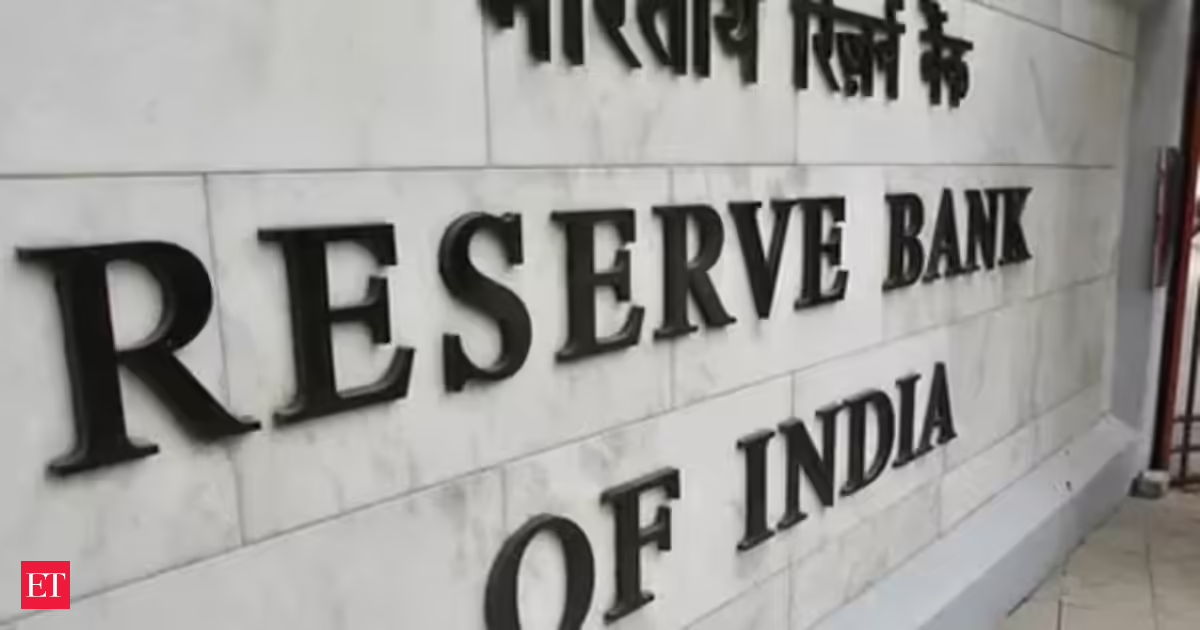
The six-member monetary policy committee meets April 6-8 for the first time since the war broke out on February 28.
Assessment of War’s Impact
While a policy pause is widely anticipated, economists said the RBI’s communication, particularly on the rupee and bond yields, will be closely scrutinised. Several respondents also expect the central bank to consider additional steps to shore up the currency amid persistent capital outflows.
“Further policy changes by the RBI and the India government to manage INR weakness could be likely,” said Michael Wan, senior currency analyst at MUFG Bank.
“These could include restrictions and higher import duties on gold and non-essential imports and a dedicated facility or FX swap window by the RBI so that oil marketing companies can tap dollars instead of going to the market.”
Most economists expect the central bank will avoid an aggressive response for now, preferring to assess the impact of the war and higher oil prices on the economy.“After two back-to-back circulars on the rupee, people are reminded of the 2013 playbook, but I think the story ends there,” said Abhishek Upadhyay, senior economist at ICICI Securities Primary Dealership, referring to moves by the RBI to rein in the Indian currency’s decline.
“It’s not 2013 and we don’t have a situation of a run on the currency.” Highlighting risks without committing to a policy trajectory is a good template to follow, said Sakshi Gupta, principal economist at HDFC Bank.
“If there is a hawkish commentary, it is likely to be balanced by stating that inflation is expected to remain within the comfort zone,” she said.
Gaurav Kapur, chief economist at IndusInd Bank, expects that the governor is likely to acknowledge rising risks to inflation, growth and the exchange rate, while highlighting macroeconomic and financial stability backed by adequate external buffers to absorb supply shocks.
Markets will focus on the RBI’s assumed crude oil price, which underpins its growth and inflation projections. India’s retail inflation stood at 3.21% in February.
In the last policy announcement on February 6, the RBI projected inflation for the first two quarters of FY27 at 4% and 4.2%, while GDP growth was seen at 6.9% and 7%, respectively.

BULLISH BETS
TITAN COMPANY
Change in Open Interest in April Series: 0.8% Change in price in April Series: 3.7% RATIONALE: Strong rollover into the April series, along with a lower roll cost of 0.31% (from 0.68%), shows traders are willing to pay to stay bullish, said Rajesh Palviya, head of technical and derivatives research at Axis Securities.
“As the Akshaya Tritiya festival nears, the market is bullish that the upcoming Q4 earnings will validate Titan’s ability to turn elevated gold prices into superior margins and footfalls,” he said. Palviya suggests buying on dips for a target of Rs 4,270-4,300, with a stop loss in futures at Rs 4,020-4,030.
ADANI POWER
Change in Open Interest in April Series: 98.95% (newly inducted in the futures segment) Change in price in April Series: 1.67% RATIONALE: The stock has witnessed a bullish breakout from a congestion zone of more than fi ve months with a signifi cant rise in volumes, said Vipin Kumar, AVP – derivatives and technical research at Globe Capital Market.
“The breakout is well supported by long buildup in the fi rst two trading sessions after its induction in the derivatives segment,” he said. Kumar said traders can buy its April Futures in the Rs 159-156 range for a target of Rs 170-175, with a stop loss at Rs 147.
NATIONAL ALUMINIUM
Change in Open Interest in April Series: -14.55% Change in price in April Series: 4%
RATIONALE: The stock has witnessed a close at the highest level on a weekly basis, said Sudeep Shah, head – technical and derivative research, SBI Securities. The fall in open interest and rise in share price point to short-covering. The stock is expected to move towards Rs 419-427 and can be bought with a stop loss at Rs 388, said Shah.
ABB INDIA
Change in Open Interest in April Series: 0.3% Change in price in April Series: 3.4%
RATIONALE: ABB’s higher-than-average rollover confi rms structural bullishness, said Palviya of Axis. “This transition from a high cost to a ‘discount’ during a price upswing suggests that long positions are being rolled with high conviction and effi ciency,” he said. “Investors are clearly looking past minor regulatory hurdles, positioning aggressively for a Q4 print expected to showcase scalable margins from massive greenfield infrastructure orders,” Palviya suggests buying on dips for a target of Rs 6,550-6,600, with a stop loss at Rs 5,950 (Futures rates).
JINDAL STEEL
Change in Open Interest in April Series: 0.67% Change in price in April Series: -1%
RATIONALE: Profit-taking in Jindal Steel from its all-time highs has halted near its previous breakout levels, which also coincide with the six-month exponential moving average, said Globe’s Kumar. “Considering its current chart positioning, we expect it to continue its prevailing uptrend, potentially reaching Rs 1220 in the immediate near term,” he said. Kumar advises buying its April Futures in the Rs 1,125-1,105 range, for a target of Rs 1,220, and stop loss at Rs 1,070
HINDALCO INDUSTRIES
Change in Open Interest in April Series: -1.8% Change in price in April Series: 3.6%
RATIONALE: The share surge, along with a decrease in open interest, suggests short covering. Fundamentally, the rally is underpinned by global supply shocks at EGA and Alba, which have bolstered LME aluminium benchmarks, said Palviya of Axis.
“Market focus now shifts to the Q4 earnings print, where these elevated benchmark realisations are expected to translate into sustainable margin expansion for both domestic operations and Novelis,” he said. Palviya suggests buying the stock on any dips for a target of Rs 980- Rs 1,000, and stop loss at Rs 875
BEARISH BET
PG ELECTROPLAST
Change in Open Interest in April Series: 17.8% Change in price in April Series: -3.3%
RATIONALE: The stock hit a fresh 52-week low of Rs 443.05 on Thursday. It has broken down from a consolidation, forming a lower high–lower low pattern on weekly charts, said SBI’s Shah. “It is trading below its short- and long-term moving averages, and we expect the stock to test lower levels,” he said. Shah recommends selling PGEL between Rs 438-443 with a stop loss at Rs 452 for a target of Rs 417.


Samsung Elec likely to report stupendous surge in quarterly profit to record level

‘It had been empty for 20 years. Wires hung everywhere. Plaster fell off walls. I was scared’

How one factory in China learned to live with Trump, tariffs and turmoil

Monday gallop to shape Gin Twist’s 2026 campaign


-

 NewsBeat3 days ago
Steven Gerrard disagrees with Gary Neville over ‘shock’ Chelsea and Arsenal claim | Football
-

 Business3 days ago
No Jackpot Winner and $194 Million Prize Rolls Over
-

 Fashion2 days ago
Weekend Open Thread: Spanx – Corporette.com
-
Entertainment6 days ago
Fans slam 'heartbreaking' Barbie Dream Fest convention debacle with 'cardboard cutout' experience
-

 Crypto World4 days ago
Gold Price Prediction: Worst Month in 17 Years fo Save Haven Rock
-

 Tech7 days ago
The Pixel 10a doesn’t have a camera bump, and it’s great
-

 Business2 hours ago
Three Gulf funds agree to back Paramount’s $81 billion takeover of Warner, WSJ reports
-

 Tech7 days ago
Avatar Legends: The Fighting Game comes out in July and it looks pretty slick
-
Crypto World6 days ago
Dems press CFTC, ethics board on prediction-market insider trades
-

 Sports1 day ago
India men’s 4x400m and mixed 4x100m relay teams register big progress | Other Sports News
-

 Business4 days ago
Login and Checkout Issues Spark Merchant Frustration
-

 Tech6 days ago
Apple will hide your email address from apps and websites, but not cops
-

 Tech6 days ago
EE TV is using AI to help you find something to watch
-

 Sports5 days ago
Tallest college basketball player ever, standing at 7-foot-9, entering transfer portal
-

 Politics6 days ago
Should Trump Be Scared Strait?
-

 Tech6 days ago
Flipsnack and the shift toward motion-first business content with living visuals
-
Tech6 days ago
Daily Deal: StackSkills Premium Annual Pass
-

 Fashion7 days ago
The Best Spring Trends of 2026
-

 Sports6 days ago
Women’s hockey camp eyes fitness boost, tactics ahead of WC 2026 campaign | Other Sports News
-

 Crypto World6 days ago
U.S. rule change may open trillions in 401(k) funds to crypto
You must be logged in to post a comment Login