
Business
US Bank Online Banking Down for Hundreds of Customers on June 8

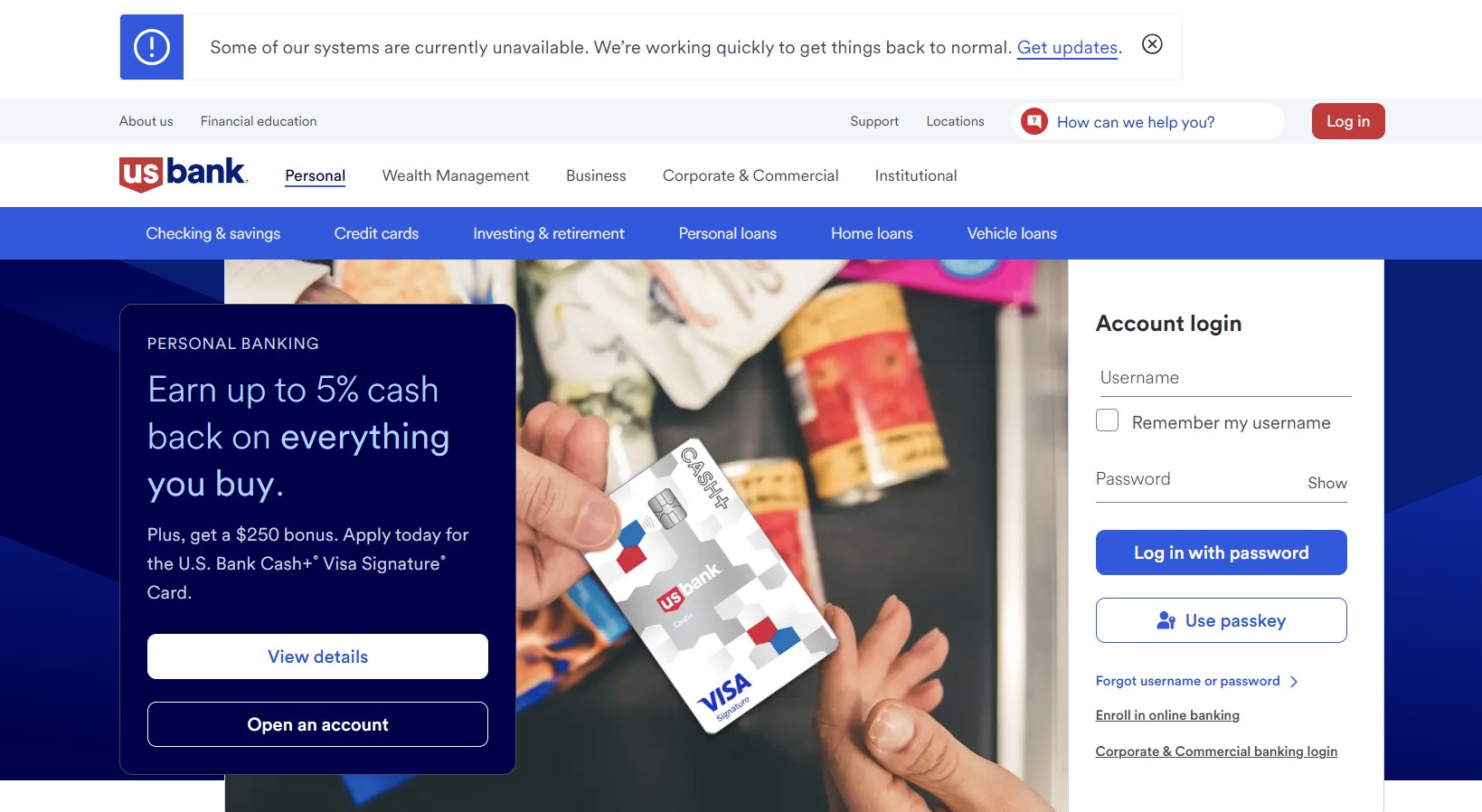
NEW YORK — US Bank’s online banking platform experienced widespread disruptions on Monday, leaving hundreds of customers unable to access accounts, make transfers or view balances, according to multiple outage tracking services and user reports.
The outage, first widely noted around midday, affected login attempts, mobile app functionality and ATM services for many users across the United States. The @status_is_down account on X reported that “US Bank’s online banking is reportedly down for hundreds of users right now,” prompting numerous confirmations from frustrated customers who shared similar experiences.
DownDetector and other monitoring sites showed a sharp spike in reports, with the majority citing problems logging in, error messages claiming no account existed despite valid credentials, and complete service unavailability. Some users reported being able to log in intermittently only to encounter blank dashboards or transaction failures.
Customer complaints highlighted the inconvenience during a busy workday. Many described being locked out of essential services, including bill payments, transfers and balance checks. ATM issues were also reported, compounding difficulties for those needing immediate cash access.
US Bank has not yet issued an official statement on the cause or expected resolution time. In past outages, the bank has typically communicated through its website, social media channels or in-app notifications once the issue is identified. Customers are advised to check the bank’s official status page or social accounts for updates as the situation develops.
This marks another instance of major financial institution service disruptions in 2026. Banking apps and online platforms have faced increased scrutiny as customers rely more heavily on digital services for everyday transactions. Outages like Monday’s can cause significant inconvenience and, in some cases, financial impacts for users who miss time-sensitive payments or transfers.
The timing coincided with typical midday banking activity, amplifying frustration among customers who expected reliable access during business hours. Social media platforms filled with reports from affected users, many expressing annoyance at the lack of immediate communication from the bank.
Financial institutions invest heavily in infrastructure redundancy and cybersecurity to prevent such incidents, but occasional outages still occur due to high traffic, software updates, or technical glitches. US Bank, one of the largest banks in the United States, serves millions of customers and maintains a reputation for generally reliable digital services, making Monday’s widespread disruption notable.
For customers impacted, recommended steps include trying alternative access methods such as the mobile app versus website, clearing cache and cookies, or using different devices. In cases of prolonged outage, contacting customer service via phone may provide more direct assistance, though call volumes are often elevated during such events.
The incident highlights the growing dependence on digital banking and the importance of backup access methods. Many financial experts recommend maintaining multiple banking relationships or having contingency plans for temporary service interruptions, particularly for time-sensitive transactions.
US Bank customers have historically received timely resolutions when outages occur, with service typically restored within hours. However, the lack of immediate communication has drawn criticism from some users who felt left in the dark about the scope and expected duration of the problem.
Broader context includes increasing regulatory focus on financial institutions’ digital resilience and customer communication during service disruptions. Outages can trigger scrutiny from regulators and consumer protection agencies, particularly when they affect large numbers of customers or last for extended periods.
Monday’s disruption serves as a reminder of the vulnerabilities inherent in highly digital financial systems. While technology has dramatically improved convenience and access to banking services, it also introduces new points of failure that can impact daily life for millions.
Affected customers are encouraged to document any financial impacts, such as late fees or missed opportunities resulting from the outage, in case compensation or adjustments become available. US Bank has occasionally offered goodwill gestures or fee waivers following significant service interruptions.
As the situation develops, users should continue monitoring official channels for updates. Alternative banking methods, such as visiting physical branches or using debit cards for in-person transactions, may provide temporary relief for those with urgent needs.
The outage also sparked conversations about banking redundancy and the importance of having emergency cash or secondary accounts. Financial advisors often recommend maintaining access to multiple financial institutions to mitigate risks from single-point failures in digital services.
US Bank, like other major institutions, continues investing in cybersecurity, infrastructure modernization and customer support enhancements to minimize future disruptions. Monday’s event may prompt internal reviews to strengthen resilience and communication protocols.
For now, customers are urged to remain patient while technical teams work toward full restoration. The bank’s long history of serving customers suggests a swift resolution is likely, though no specific timeline has been provided.
The incident adds to a growing list of financial services outages in 2026, underscoring the challenges of maintaining 24/7 digital availability at massive scale. As banking becomes increasingly digital, reliability and transparent communication during incidents remain critical for maintaining customer trust.
Users experiencing issues are encouraged to try accessing services periodically, as partial restorations often occur before full recovery is announced. In the meantime, documenting experiences and impacts can help if formal complaints or compensation requests become necessary.
Monday’s outage serves as a practical reminder for all digital banking customers to maintain awareness of backup options and to avoid relying solely on online platforms for time-sensitive financial matters. As the situation evolves, updates from US Bank and user reports will provide further clarity on the scope and resolution of the disruption.


L&T’s revenue from operations meanwhile rose around 7% YoY to Rs 67,942 crore during the April-June quarter of the ongoing FY27, from Rs 63,679 crore in the corresponding quarter of FY26. International revenue stood at Rs 34,393 crore, accounting for nearly 51% of the company’s overall revenue.
The company said it secured orders worth Rs 1.08 lakh crore during Q1, marking a 14% YoY growth. International orders meanwhile stood at Rs 60,702 crore, contributing 56% to the total order inflow. The company’s consolidated order book rose 5% sequentially to Rs 7.79 lakh crore as on June 30, 2026. International orders comprised 52% of the overall order book.
During the quarter, L&T said that it won significant orders across multiple businesses such as residential and commercial buildings, transportation infrastructure, ferrous metals, offshore wind and the heavy engineering businesses.
Also read | L&T Q1 Results: Net profit rises 14% YoY to Rs 4,123 crore, revenue up 7%
Goldman Sachs on L&T share price
Goldman Sachs highlighted that the company posted a good performance in a tough macro environment, with core order inflows coming in well ahead of expectations, ET Now reported. Operating margins however slipped slightly due to weaker execution as the West Asia conflict weighed on project timelines.

The international brokerage maintained its ‘Buy’ call on the stock.
Nuvama on L&T share price
Despite the West-Asia conflict and its related supply chain disruptions, L&T delivered 2% growth in Q1 core PPM revenue, Nuvama noted. It however retained its ‘Hold’ call on the stock as it believes the first half FY27 is likely to remain soft on Middle East-related disruptions.
Motilal Oswal on L&T share price
Motilal Oswal said L&T’s consolidated results and core EPC segment outperformed its estimates in the first quarter of FY27. Listing out the positives that it saw in the earnings print, Motilal said the company reported a healthy 14% YoY growth in core E&C order inflows, core E&C revenue growth of 3% YoY and flat margins at 7.6%.
Despite lower ordering from the Middle East region, L&T has diversified its order inflow mix from other geographies such as Europe and has also seen stable inflows from the domestic private sector, the domestic brokerage said, as it marginally revised its estimates to bake in Q1 performance.Motilal Oswal retained its ‘Buy’ call on the shares of L&T, while increasing its target price to Rs 4,550 apiece from Rs 4,500 apiece. The latest target price implies an upside potential of nearly 19% from the stock’s previous closing price.
JM Financial on L&T share price
JM Financial said L&T’s core EBITDA was 10% ahead of its estimates, led by core margin beat, with core execution in line. Robust order inflows also beat the domestic brokerage’s estimates, led by the ultra-mega order for offshore wind by TenneT. With strong prospects of Rs 15 trillion for 9M FY27 supported by continued momentum in ordering by the Middle East, we view L&T’s FY27 order inflow growth guidance of 10-12% as achievable. While Q1 FY27 execution was adversely impacted by West Asia geopolitical disruptions, we expect normalisation in execution from H2 FY27 onwards. This, coupled with a large order book should support revenue growth of 10-12% in FY27 (in line with the guidance),” it added.
L&T is well placed to deliver over 16% CAGR in EBITDA over FY26-28 supported by strong momentum in Middle East ordering, pick up in execution from the second half of FY27 onwards and stable core margins, JM Financial said as it remained constructive on the stock.
The domestic brokerage maintained its ‘Buy’ call on the stock but reduced its target price to Rs 4,640 apiece from Rs 4,700 apiece. The latest target price implies 21% upside potential.
L&T share price
L&T announced its Q1 earnings in the post market hours of Tuesday. Earlier during the day, the shares closed marginally higher at Rs 3,832 apiece. The stock has fallen more than 8% in a month and 7.5% in 2026 so far.
In the longer term, L&T shares have gained around 10% in a year, 45% in three years and 140% in five years. The company has a market capitalisation of nearly Rs 5.27 lakh crore.
Also read | Memory giant Micron picks L&T for $2.75 billion Sanand plant phase-2
(Disclaimer: Recommendations, suggestions, views and opinions given by the experts are their own. These do not represent the views of The Economic Times)

Australia Q2 CPI undershoots forecasts, easing RBA hike bets

Woodside Energy enjoyed a 28 per cent revenue bump last quarter, as global energy market turmoil pushed prices for its uncontracted products higher.
Business
ASX 200 Surges to Five-Month High as Rio Tinto Earnings and Wall Street Defensive Rotation Fuel Rally
Australia’s benchmark stock index climbed to its highest level in nearly five months on Wednesday, extending a three-day rally as strong earnings from Rio Tinto and a global shift toward defensive stocks lifted local shares.
The S&P/ASX 200 was up 0.92%, adding 82.5 points to trade at 9,030.3 by early afternoon in Sydney, according to index data. The gain built on a 1% advance earlier in the session that pushed the benchmark to its best level since March 4. The index has now risen roughly 3% over its last three trading sessions and is up about 3.5% for the year to date.
The rally tracked a broader move on Wall Street, where investors rotated out of high-flying technology and semiconductor stocks and into defensive sectors such as financials and healthcare. The Dow Jones Industrial Average rose 1% overnight while the S&P 500 added 0.2%, but the Nasdaq slipped 0.2% as chip stocks came under renewed pressure. That pattern repeated across Asia on Wednesday, with bank-heavy indexes acting as a haven from turbulence in technology shares.
JPMorgan’s market intelligence team said its tactical positioning gauge was pointing toward further gains for the S&P 500. The signal is “now flashing a buy-signal,” a marker that has historically preceded upside for the index, according to the bank’s Andrew Tyler. The team cited lower bond yields, a weaker U.S. dollar and solid corporate earnings as tailwinds, aided by easing tensions between the United States and Iran and an expected interest-rate hold from the Federal Reserve this week. JPMorgan flagged crowding in semiconductor stocks as a key risk, along with the broader trajectory of the U.S.-Iran standoff.
Mining giant Rio Tinto was among the session’s strongest performers, climbing more than 5% after reporting first-half underlying earnings rose 43% to $6.9 billion, slightly ahead of analyst forecasts. The company also lifted its interim dividend 43% to $3.4 billion, with underlying earnings before interest, tax, depreciation and amortization also higher. The results come as global miners navigate volatile commodity prices and a wave of half-year reporting that continues through August.
Healthcare stocks also posted sharp gains. Cyclopharm shares jumped more than 13% after its Technegas lung ventilation imaging agent was named “generally preferred when available” in the first update to U.S. lung imaging guidelines in 14 years. The recommendation, jointly issued by four nuclear medicine societies, is expected to drive broader adoption of the product across American hospitals.
Gold miners had a rougher session after bullion prices retreated. Gold futures fell 1.2% to just above US$4,027 an ounce, pressuring shares of Northern Star Resources and Westgold Resources. Vault Minerals reported June-quarter gold output in line with its earlier preliminary figures, alongside all-in sustaining costs that came in better than expected. The company also set fiscal 2027 production guidance and confirmed a merger with Genesis Minerals.
Elsewhere, drone-detection company DroneShield saw its shares pressured after Bell Potter cut its price target sharply, from $4.80 to $2.50, while maintaining a buy rating. The broker pointed to increased competition in the counter-drone technology market after DroneShield secured a smaller-than-expected share of a recent U.S. public safety contract round tied to security for the 2026 FIFA World Cup.
The rotation into Australian equities has been underpinned in part by regional dynamics. Singapore’s bank-heavy stock index has also drawn investor interest as an alternative haven from volatility in Asian technology markets, with DBS and OCBC among the region’s biggest gainers. Fidelity Australia’s Yeo Sui Chuan pointed to a favorable balance between growth prospects and valuations in the region’s banking sector, noting attractive dividend yields alongside benefits from regional wealth flows and export growth.
Tuesday’s session set the stage for the advance, with the ASX 200 fighting back from a soft start to close 0.6% higher at 8,947.8 points. Futures had pointed to a firmer open Wednesday, with SPI contracts up 72 points, or 0.8%, ahead of the local session, even as Wall Street’s overnight moves were mixed.
The advance also comes against a backdrop of unusual turbulence in Asian technology markets. South Korea’s KOSPI index has fallen sharply in recent sessions, down more than 10% in a single day this week and now off more than 55% from its mid-June peak, as a rout in chip-linked stocks intensifies. The moves followed a weekend report that Nvidia was in talks to provide a roughly $250 billion financial backstop for a major OpenAI data-center project, a development that has stoked investor concern about circular financing arrangements within the artificial intelligence industry.
Analysts said the S&P/ASX 200’s comparatively defensive composition, with heavier weightings toward banks, miners and healthcare rather than high-growth technology names, has helped insulate it from the sharpest swings hitting regional tech-heavy markets.
The index has been range-bound between roughly 8,500 and 9,000 points for the past 16 weeks, with the 200-day moving average near 8,780 to 8,800 acting as a persistent point of gravity. With Australia’s corporate reporting season now underway, market watchers say the coming weeks of earnings releases are likely to determine whether the benchmark can sustain a decisive break above that long-standing range.
Investors are also awaiting further clarity on domestic monetary policy, after Australia’s latest inflation data played into expectations for the Reserve Bank’s coming interest-rate decisions. Trading volumes were elevated across financials and mining stocks as the reporting season accelerates through August.

Mineral Resources has achieved or beaten guidance targets across its iron ore, mining services and lithium divisions, while lifting its liquidity to $2.4 billion.

“The end of 2028 will be a good time for us to go public,” Pawan Gadia said, adding that the company would also use the proceeds to buy other gifting brands.
Founded in 1994, Ferns N Petals sells flowers, cakes and personalised gifts in India, the United Arab Emirates, Singapore, Saudi Arabia and Qatar, and aims to enter Malaysia and more Gulf countries. Gadia did not provide a timeline.
Gadia said the Middle East war had not disrupted the company’s plans, despite expecting softer sales between April and June.
India’s retail and consumer sector will double to $1.93 trillion by 2030 from 2024 levels, according to Deloitte and an Indian industry body, as consumers spend more on discretionary goods and services.
EXPANSION PLANS
The company reported revenue of 10.85 billion rupees ($113.19 million) in fiscal 2026, up 25% from a year earlier. It was last valued at $329 million in 2022, according to business data provider Tracxn.
Gadia expects Ferns N Petals to maintain annual revenue growth of about 25%, with India contributing around 55% of revenue.
Ferns N Petals also plans to expand its store network to 350 by fiscal 2028, from more than 300 currently, focusing on affluent urban neighbourhoods and franchise-led expansion into smaller cities.
The CEO additionally projected core earnings margin of 5%-6% this fiscal year, up from 2.5% last year, saying Ferns N Petals had shifted its focus to profitability as investors now place greater emphasis on earnings than on revenue growth.

Novavax: The Beaten-Down COVID-19 Darling
Exclusive-Iran to get Chinese shoulder-launched missile systems in weeks, sources say

Singapore is positioned to become Southeast Asia’s neutral gold clearing hub, aided by regional policy shifts in Malaysia and Indonesia. Priorities include building bullion storage, market depth, and financial infrastructure, while leveraging technology like tokenised gold and faster settlement systems to attract global institutional participation.
Key Points
• Singapore is well-positioned to become South-east Asia’s neutral gold clearing and distribution hub, as neighbouring countries like Malaysia and Indonesia tighten regulations on precious metals trading, redirecting gold flows toward the city-state’s stable, open-trade environment.
• Building market depth is critical, requiring sovereign-grade vaulting, legal protections, collateralised lending, and active forward and lending markets to attract international central banks and institutional investors beyond simply storing gold.
• Technological advancements, including shorter settlement times, digital gold products, and tokenised bullion solutions, could strengthen Singapore’s competitive edge, though experts emphasise physical infrastructure and deep liquidity remain fundamental to long-term success.
Singapore’s Strategic Opportunity as a Gold Hub
Regional Policy Shifts Creating New Openings
Recent regulatory changes across Southeast Asia are repositioning Singapore as a potential gold trading and clearing hub. Malaysia’s 10 percent import duty on gold bar shipments and Indonesia’s export duty on gold — driven by resource nationalism — have disrupted regional gold flows. Industry experts, including Robin Tsui of State Street Investment Management, note that these shifts create a clear opportunity for Singapore to establish itself as a stable, neutral clearing and re-export hub for Asean gold, leveraging its open trade policy and geopolitical neutrality.
Building Infrastructure and Market Depth
Singapore’s Monetary Authority and the Singapore Bullion Market Association are actively working to deepen gold-trading infrastructure, including sovereign-grade vaulting services for foreign central banks. However, analysts stress that Singapore must evolve beyond secure storage into a full financial marketplace — one where gold is financed, hedged, and settled. Priyanka Sachdeva of Phillip Nova emphasizes the need for collateralised lending, gold-backed financing, and greater product innovation to attract institutional investors and generate the market depth necessary to compete with more established global gold hubs.
Competing Regionally and Embracing Technology
Singapore and Hong Kong: Competition and Complementarity
Hong Kong is set to launch its own gold clearing system in July, benefiting from proximity to China’s substantial gold volumes. Experts, including John Reade of the World Gold Council, believe there is room for both cities to thrive as complementary Asian gold-trading centers. Singapore has committed to launching its own clearing system, though no timeline has been announced. Increased participation from domestic banks in over-the-counter markets could deploy more risk capital, strengthening both hubs while fostering healthy competition.
Technology as a Competitive Differentiator
While neither Singapore nor Hong Kong is expected to surpass London’s dominant OTC market soon, faster and more advanced settlement systems could provide a meaningful advantage. London currently operates on a T+2 settlement basis; shorter settlement cycles would reduce capital requirements and improve trading efficiency. Singapore already benefits from GST exemptions on investment-grade precious metals. Moving forward, experts recommend streamlining onboarding for international investors, developing gold-based financial products, and advancing digital gold and tokenised bullion solutions — while ensuring these innovations complement, rather than replace, robust physical infrastructure and institutional participation.
Other People are Reading

In the Nifty500 pack, eight stocks’ closing prices crossed below their 200 DMA (Daily Moving Averages) on July 28, according to stockedge.com’s technical scan data. Trading below the 200 DMA is considered a negative signal because it indicates that the stock’s price is below its long-term trend line. The 200 DMA is used as a key indicator by traders for determining the overall trend in a particular stock. Take a look:

Australian authorities hit back over claims of horse meat found in food
L&T shares rise 4% after Q1 earnings. Why Goldman Sachs, other brokerages remain bullish?

Trade.xyz to cover SK Hynix liquidation losses


-

 Fashion4 days ago
Weekend Open Thread: Brooks Brothers
-
 Sports2 days ago
Commonwealth Games boxing: Jadumani Singh seals dominant 5-0 win over Pakistan’s Sumama Rehman to enter quarter-finals | Commonwealth Games News
-

 Tech2 days ago
Intel is reversing course and bringing hyper-threading back to its server chips
-

 Crypto World6 days ago
Ethics, other provisions in crypto Clarity Act to be further discussed
-

 Politics2 days ago
Luke Littler dismantles Gerwyn Price to retain title in Blackpool
-

 Sports5 days ago
2026 3M Open leaderboard: Scottie Scheffler finds putter in Round 1, sits three back
-

 Politics19 hours ago
The Part of the Electric Transition Nobody Wants to Discuss
-

 Fashion5 days ago
16 Dresses for the High Summer Event
-
 Entertainment5 days ago
A New Post-Apocalyptic Gundam Anime Series Blasts Into SDCC
-

 News Videos5 days ago
The Peugeot Family: How 200 Years of an “Old Money” Dynasty Died in A Boardroom
-

 News Videos2 days ago
BITCOIN JUST ENTERED THIS CRITICAL ZONE…
-

 Politics3 days ago
Spain sweeps the board at 2026 World Cup with individual awards
-

 Crypto World3 days ago
Ripple bought a bank in pieces. The $4 billion audit
-

 Crypto World3 days ago
XRP Ledger adds $2.6B as RWA inflows rank second
-

 Crypto World6 days ago
Uniswap (UNI) pushes deeper into tokenized RWAs with permissioned trading pools
-

 Tech4 days ago
Anthropic launches Claude Opus 5, a cheaper AI model for coding, agents and enterprise workflows
-
 Entertainment9 hours ago
‘Stargate’ Creator’s New Sci-Fi Series Returns for Season 3 Tomorrow
-
Crypto World6 days ago
SEC Agrees to Overhaul Recordkeeping After Settling Coinbase Lawsuit Over Gensler’s Lost Texts
-

 Business5 days ago
Alliance Entertainment Holding Corporation (AENT) Discusses Evolution Into Omnichannel Distribution and Fulfillment Platform for Media and Collectibles Transcript
-

 News Videos8 hours ago
Claude: Build Financial Dashboards in Minutes (2026)
You must be logged in to post a comment Login