
Business
US borrowing costs hit fresh highs over inflation fears


US borrowing costs hit a fresh high on Tuesday as renewed strikes in the Middle East pushed up oil prices and heightened concerns over inflation.
The effective interest rate on borrowing over 10 years rose to 4.79%, its highest level since January 2025, as oil prices surged above $92 a barrel.
Such movements on global bond markets affect rates at which the US government can borrow money at, but also influence rates people pay for mortgages, car loans and credit cards.
The spike in borrowing costs comes and fears over the pace of price rises in the US has led to increased speculation that the Federal Reserve will increase interest rates later this month.
Michael Barr, a governor at the US central bank, said in a speech on Tuesday that inflation had been too high for five years and warned if it did not cool “then I think we should act decisively to raise rates”.
His comments came after Kevin Warsh, chairman of the Fed, said last week that policymakers would “have work to do” if they were not confident cost-of-living pressures were easing for Americans.
Latest figures show prices rose 3.4% in the year to July, above the Fed’s 2% target, however, interest rates have been left unchanged for months between 3.5% and 3.75%.
Warsh has remained tight-lipped about the potential path of interest rates, but investors have been monitoring comments in recent days and expectations of a rate hike this month have grown.
Inflation is concerning both the Fed and global investors, which is driving the increased rates – or yields as they are known – on bond markets.
Governments sell bonds – essentially an IOU – to raise money for spending, and in return they pay interest.
Bond investors typically demand higher returns – or yields – if inflation is high or they expect it to be elevated in the future, and such rates tend to set the path for borrowing costs in economies around the world.
Besides inflation, investors also have concerns about the amount of borrowing from governments around the world as well spending by Big Tech firms, with uncertainty remaining over the return on investment of artificial intelligence.
In the US, national debt has passed the $40tn mark, doubling in just the space of a decade under both the Donald Trump and Joe Biden administrations.
After borrowing costs over 30 years hit levels not seen since 2007, Treasury Secretary Scott Bessent said the the US government would buy back more debt in a bid to lower rates, but the market’s reaction to the announcement proved short lived.
In the US 30-year mortgage rates have risen to a one-year high of almost 6.7% following spikes in bond markets.
Rising rates can make borrowing and spending less attractive, which risks dampening economic growth if consumers cut back and businesses halt investment.


FOX Business’ Larry Kudlow speaks with Treasury Secretary Scott Bessent about China, the Iran war, the U.S. economy and more during a fireside chat in Asheville, North Carolina.
U.S. Treasury Secretary Scott Bessent detailed an aggressive campaign of economic “asphyxiation” against Iran, warning that the Trump administration could strip banks, firms or other entities that do business with the regime of access to the U.S. dollar-based financial system.
During a fireside chat with FOX Business’ Larry Kudlow on Tuesday at the G20 Finance Ministerial in Asheville, North Carolina, Bessent said the U.S. had identified the Islamic Revolutionary Guard Corps’ (IRGC’s) offshore accounts held by trust companies and luxury real estate holdings.
“Countries that go against this embargo, you’ll cut them off,” Kudlow prefaced, referencing the U.S. naval blockade of Iranian ports. “Secondary sanctions, you take them out of the U.S. dollar system, you’d take them out of the U.S. banking system, you take them out of the Federal Reserve wire, take them out of the SWIFT ledger?”
BESSENT URGES G20 TO ‘GET BACK TO THE BASICS’ WITH DEREGULATION AND GROWTH-FIRST AGENDA
“That’s what happened to this bank in Dubai, and it could be entities, it could be airline leasing companies, which we’ll be looking at. It could be anyone who does business with the IRGC, we are tracking down the IRGC’s assets, and I will say it on worldwide TV, just so you know,” Bessent warned, “we know where in the British Virgin Islands your accounts are at these trust companies, we know the $100 million houses you have around the world, and we are going to freeze those.”

U.S. Treasury Secretary Scott Bessent attends an event announcing the expansion of a foster care initiative in the Rose Garden of the White House on August 20, 2026, in Washington, D.C. (Getty Images)
“We are going to our partners, we are going to close all of that down. So we are going to go after the regime’s illegitimate assets that they have stolen from the Iranian people, and those can go back to the Iranian people, or they can go to the victims of terror, like the families of the soldiers who are on the USS Cole,” Bessent continued.
Bessent first announced on Aug. 24 that America would impose the economic equivalent of the military campaign that defeated Nazi Germany against the Islamic Republic of Iran.
Gen Jack Keane analyzes Trump’s energy policies, efforts to lower gas prices and escalating geopolitical pressure on Iran.
Bessent’s declaration of economic warfare comes after President Donald Trump’s commitment to launch an “economic D-Day” against the Tehran regime. The comprehensive U.S. economic pressure campaign targeting Iran’s already troubled economy could have dramatic effects on the country’s population of more than 90 million people.
GET FOX BUSINESS ON THE GO BY CLICKING HERE
“We will stop this regime’s ability to have a nuclear weapon, to have their current highly-enriched uranium to project terrorist power through their proxy networks and to terrorize the Gulf,” Bessent said. “And we are telling people, either you are with us or against us.”
Rep. Rich McCormick, R-Ga., discusses Treasury Secretary Scott Bessent’s declaration that any nation or bank aiding Iran will face secondary sanctions and removal from the U.S. dollar system on ‘The Evening Edit.’
“And everyone says to me, ‘Well, what about China? I said, we have more in common with the Chinese on Iran than we disagree with [them] on. The Chinese agree — Iran cannot have a nuclear weapon. The Chinese agree that there should be freedom of navigation in the Strait of Hormuz. So we have had private discussions with them in terms of achieving those goals.”
Fox News’ Benjamin Weinthal contributed to this report.

Asia is ageing faster than any region in modern history, and it is doing so before most of its economies have finished getting rich. That single fact is quietly forcing a rewrite of how wealth is planned, protected, and passed on across the region, from mass-affluent households in provincial Thailand to the family offices multiplying in Singapore.
A demographic shift without historical precedent
The old template, save through your working years, retire at a fixed age, draw down a pension for a decade or two, was built for a world with shorter lifespans and simpler family structures. It does not fit a region where a 60-year-old today can reasonably expect another three to four decades of life, many of them active, some of them requiring expensive care, and none of them covered by the pay-as-you-go pension systems that cushioned earlier generations in the West.
Thailand is the clearest illustration of the pressure building across the region. The country crossed the threshold into an “aged society” in the early 2020s, when more than a fifth of its population reached 60 or older, and it is now on a trajectory toward “super-aged” status, with roughly 30 percent of Thais expected to be 60 or above by the early 2030s. What makes the Thai case distinctive, and instructive for much of the rest of ASEAN, is the sequencing: the country is ageing at a fraction of the per-capita income level that Japan, South Korea, or the wealthier OECD economies had reached when they crossed the same demographic markers.
Development economists have taken to calling this “growing old before growing rich,” and it means the usual policy levers, generous public pensions, comprehensive long-term-care insurance, extensive institutional elder care, are simply not funded at the scale the demographics require. A falling fertility rate, now near 1.2 births per woman, and continued outward migration of working-age Thais compound the strain on family-based care models that previous generations relied on by default.
Thailand is not an outlier so much as an early mover. Singapore, Hong Kong, China, and Japan are all navigating versions of the same transition, and the World Economic Forum has described the region as entering “the longevity era” earlier and faster than anywhere else in the world, with financial literacy and retirement preparedness lagging the pace of the demographic change. The practical consequence for households, and for the advisors, insurers, and bankers serving them, is that a strategy built around a single retirement date and a static asset allocation is no longer adequate. Wealth planning is shifting from a one-time retirement calculation into something closer to a continuous, multi-decade exercise shaped as much by health trajectories and family obligations as by market returns.
Why the old retirement model no longer holds
Three structural pressures are converging to force this shift. The first is simple arithmetic: longer lifespans mean retirement savings, however carefully accumulated, have to stretch across more years of spending without a matching increase in the working years used to build them. The second is healthcare cost inflation, which in most APAC markets is rising faster than general inflation and faster than pension income, front-loading risk into precisely the years when income is fixed and health needs are climbing.
The third is the erosion of the informal safety net. Multi-generational households, in which adult children absorbed the bulk of eldercare costs and labour, are shrinking as urbanisation, smaller family sizes, and cross-border migration pull working-age adults away from ageing parents. Where that safety net used to substitute for formal financial planning, its retreat is now exposing a planning gap that markets and regulators are only beginning to address.
Industry research from Manulife and other regional insurers has picked up on a related shift in how people in the region actually define a successful retirement. Increasingly, the benchmark is not simply years lived but financial independence sustained across those years, the ability to maintain a chosen lifestyle without becoming a burden on family, for the full span of a longer life. That reframing has direct implications for advisors: a plan that gets a client to a retirement date is no longer the deliverable. The deliverable is a plan that holds up for thirty-plus years of uncertain healthcare needs, inflation, and market cycles.
The regional wealth-management response
Where the demographic pressure is most visible in policy debates, the financial response is most visible in the region’s private banking and family office ecosystem. Singapore has emerged as the undisputed hub for that response, its single family office count having grown roughly fourfold since 2020, with regional estimates placing more than 1,500 to 2,000 such structures now registered under the city-state’s tax-incentive schemes.
That growth is not incidental to the longevity story, it is substantially driven by it: a wealth transfer across the Asia-Pacific region estimated at close to six trillion dollars by the end of the decade is pushing first- and second-generation wealth holders to formalise structures for succession, tax efficiency, and multi-generational governance well ahead of when their Western counterparts historically did so, precisely because Asia’s wealthy households skew younger and are still in wealth-building rather than pure wealth-preservation mode.
Thailand sits adjacent to that hub rather than at its centre, but the effects are visible domestically. Bangkok’s ultra-high-net-worth population is projected to grow faster than any other city in Southeast Asia through the end of the decade, and the city’s broader high-net-worth segment is expanding on a similar trajectory, with total private wealth in the country on course to approach the trillion-dollar mark within a few years.
That growth is drawing international private banking expertise onshore, including partnerships pairing global wealth managers with Thai banks to build out advisory capacity for clients who increasingly need cross-border, multi-jurisdiction planning rather than a single domestic savings product.
What a longevity-adjusted plan actually looks like
The practical shift in advisory practice follows a few consistent threads across the reports coming out of Singapore, Hong Kong, and the wider region this year. Asset allocation is moving away from the traditional glide path that mechanically de-risks a portfolio as a client approaches a fixed retirement age, toward a blend that keeps a meaningful growth allocation running well into the later decades of life, on the logic that a 65-year-old with a thirty-year horizon still needs equity-like returns to avoid outliving their capital.
Risk-pooling instruments, annuities, long-term-care riders, and critical-illness coverage with living benefits, are being positioned less as niche products and more as core components of a longevity plan, precisely because savings and market returns alone cannot reliably absorb the tail risk of an extended and possibly costly old age. Bank of Singapore’s outlook for the year ahead frames the sector’s opportunity in similar terms, expecting insurers to extend policy age limits and banks to bundle wealth advice with practical elder-care services as the “silver economy” becomes a mainstream client segment rather than a specialty one.
For the mobile and cross-border wealth that characterises much of TBN’s readership, expatriates, dual-national families, and Thailand-based investors with assets spread across several jurisdictions, the longevity shift adds a further layer of complexity around structuring. Cross-border trusts, portable insurance-based savings vehicles, and family office or family investment company structures are increasingly used not just for tax efficiency but to ensure that healthcare and succession arrangements travel with a family across borders rather than being tied to the rules of a single country. That is particularly relevant given how mobile global wealth has become: cross-border relocation of high-net-worth individuals is running at record levels this year, and a growing share of that movement is explicitly built around holding residence rights and assets in more than one jurisdiction rather than settling permanently in one.
A growing opportunity for APAC wealth managers
The longevity challenge is also creating a significant commercial opportunity.
PwC expects assets under management across APAC to reach approximately US$34.5 trillion by 2030, up from US$23.2 trillion in 2024. The firm estimates that the region could generate US$47 billion in additional annual asset and wealth-management revenues by the end of the decade.
But capturing this opportunity will require more than traditional investment products.
Wealth managers will need solutions that combine investment management with retirement-income planning, insurance, estate planning and increasingly sophisticated digital services.
The opportunity is particularly relevant to regional financial centres such as Singapore and Hong Kong, which are already serving as hubs for cross-border wealth and family-office activity.
For Thailand, the opportunity is equally significant. The country can develop a broader ecosystem around retirement finance, private wealth, healthcare, senior living and the emerging silver economy.
The stakes for Thailand’s wealth-management sector
For Thailand specifically, the longevity shift is arriving alongside, and partly reinforcing, the broader wealth boom already reshaping Bangkok’s property and private banking markets. A population that is both getting older and, at the upper end, getting significantly wealthier is a rare combination, and it is pulling international private banks, insurers, and family office service providers toward a market that a decade ago would have been considered secondary to Singapore or Hong Kong. How well the country’s regulators and financial institutions adapt housing, healthcare financing, and wealth-transfer infrastructure to that combination, rather than treating the ageing population and the wealth boom as separate stories, will likely determine whether Thailand captures its share of a longevity economy that regional analysts expect to grow from roughly three trillion dollars in 2025 to well over five trillion by the middle of the next decade, or cedes that opportunity to hubs that move faster.
What is clear is that the conversation has already moved past whether Asia’s wealth planning needs to change. The demographic and capital-flow data leave little room for that debate. The open question, for advisors, institutions, and households alike, is how quickly the region’s financial infrastructure, from Bangkok’s private banks to Singapore’s family office registries, can catch up with a life expectancy curve that has already moved.


CHICAGO — Mars, Inc. is unveiling its latest innovation: Pringles Dippers.
The chip innovation is a thicker, sturdier and wavier crisp intended for dipping, according to the company.
The chips are available in three flavors: original, French onion and bacon cheddar.
“We know it can be frustrating if your typical salty dipping vessel prevents your perfect scoop or breaks as you dip, which is why we’ve created Pringles Dippers,” said Eileen Flaherty-Yao, senior director of salty, Mars Snacking North America. “Our iconic parabolic shape is now thicker and wavier than ever — built to handle any dipping style from light dips to heavy scoops.”
The dippable Pringles will launch at retailers this month.

Michael A. Peterson, CEO of the Peter G. Peterson Foundation, discusses the fiscal challenges facing the U.S. and why policymakers need to pursue solutions.
The U.S. gross national debt surpassed $40 trillion last month for the first time in the nation’s history, and while the federal government is continuing to rack up debt at an increasing pace, fiscal challenges loom on the horizon for political leaders who are currently in office and those who will be competing in upcoming elections.
Earlier this year, the annual report of the Social Security and Medicare Trustees noted that the main Social Security trust fund is on track to be depleted in 2032, when automatic 22% benefit cuts would occur. Meanwhile, the growth in the national debt coupled with higher interest rates has caused the cost of servicing America’s debt to surge as the fast-growing portion of the federal budget, while also exceeding the size of the defense budget.
Michael A. Peterson, CEO of the Peter G. Peterson Foundation, told FOX Business that the growth in debt “is an urgent problem, and to me, $40 trillion is enough stealing from our next generation and it’s time to act. It has a negative effect on the economy, on wages, on affordability, but also on specific governmental programs.”

The main Social Security trust fund is on track to be depleted in 2032. (Jim West/UCG/Universal Images Group via Getty Images)
“In just six years, our Social Security system’s trust fund will run out and be fully depleted. And at that point, if Congress does nothing, we will have an automatic, across the board, immediate 22% cut to all benefits for all the beneficiaries,” he said. “Obviously, that makes no sense, that’s benign neglect of our retirees here, and we need to get at it.”
US NATIONAL DEBT HITS $40 TRILLION FOR FIRST TIME EVER
With Social Security’s insolvency just six years away, any senator elected in this fall’s midterm elections and the next president who is elected in 2028 would be serving terms that extend into 2032, when the trust fund is projected to be tapped out.
Social Security, along with Medicare and interest expenses, are the fastest-growing drivers of the annual U.S. budget deficit, which is currently projected to top $2 trillion for fiscal year 2026, which will conclude at the end of this month. Budget deficits are expected to widen in the years ahead as the debt grows, and interest costs continue to mount, along with the aging of the U.S. population.
“We’re basically taking $2 trillion from our future, we’re spending it now, and we’re saddling our kids and grandkids with $2 trillion of debt, plus all the interest on top of it,” Peterson said, adding that “interest is our fastest growing program, it’s going to double in the next 10 years.”
FEDERAL BUDGET DEFICIT ON TRACK TO SURPASS $2T THIS FISCAL YEAR AS SPENDING OUTPACES REVENUE
Peterson noted that unlike the geopolitical challenges around the world – including China, Russia, Iran and more – the U.S. government has the power to set its own budgetary policies in a way that implements reforms to stabilize or shrink budget deficits and, in turn, the national debt.
“The solutions are well-known. We have a whole series of revenues coming in the door through our tax policy. There are many changes we can make to that over time that would bring in more money, that would lower these deficits. And on the spending side, there’s a whole host of programs and different possibilities,” Peterson said.
US NATIONAL DEBT SURPASSES SIZE OF THE ECONOMY FOR FIRST TIME SINCE WORLD WAR II

Congress will have to reform Social Security before the trust fund’s insolvency to avoid automatic benefit cuts. (Demetrius Freeman/The Washington Post via Getty Images)
He noted that the Peterson Foundation created what it calls the Solutions Initiative, bringing in seven think tanks from across the political spectrum to put forth solutions to stabilize the national debt as a share of gross domestic product, which reached 100% of GDP this year for the first time since 1946 and is trending to near 200% over the next 25 years.
“It really comes down to what your ideology is, how much revenue you want to bring in, how much spending cuts you’re willing to tolerate, and what combination of that makes sense to you,” Peterson explained, adding that all seven of the think tanks’ plans stabilized the debt.
“The good news is there are many combinations, many opportunities right in front of us. We don’t need to reinvent the wheel, we just need to have some political courage to get started.”
GET FOX BUSINESS ON THE GO BY CLICKING HERE
“Of course, this feels politically dangerous because you might involve more taxes or less spending. But at the end of the day, I think Americans are ready for this solution because they know this isn’t sustainable, and it’s not good for their long-term future,” Peterson said.


Edmund Ingham is a biotech consultant. He has been covering biotech, healthcare, and pharma for over 5 years, and has put together detailed reports of over 1,000 companies. He leads the investing group Haggerston BioHealth.
The group is for both novice and experienced biotech investors. It provides catalysts to look out for and buy and sell ratings. It also provides product sales and forecasts for all the Big Pharmas, forecasting, integrated financial statements, discounted cash flow analysis and market by market analysis. Learn more.
Analyst’s Disclosure: I/we have no stock, option or similar derivative position in any of the companies mentioned, and no plans to initiate any such positions within the next 72 hours. I wrote this article myself, and it expresses my own opinions. I am not receiving compensation for it (other than from Seeking Alpha). I have no business relationship with any company whose stock is mentioned in this article.
Seeking Alpha’s Disclosure: Past performance is no guarantee of future results. No recommendation or advice is being given as to whether any investment is suitable for a particular investor. Any views or opinions expressed above may not reflect those of Seeking Alpha as a whole. Seeking Alpha is not a licensed securities dealer, broker or US investment adviser or investment bank. Our analysts are third party authors that include both professional investors and individual investors who may not be licensed or certified by any institute or regulatory body.

GigaCloud Looks Heavily Undervalued, Trading Near 10x Earnings

Amazon’s Zoox, Alphabet’s Waymo expand robotaxi services to more US cities

Owner Stan Kroenke of the Denver Nuggets stands on the court before game four of the Nuggets’ NBA Playoffs series against the Minnesota Timberwolves at the Target Center in Minneapolis, Minnesota on Saturday, April 25, 2026.
Aaron Ontiveroz | Denver Post | Getty Images
Stan Kroenke has added a Major League Baseball team to his growing sports empire, agreeing to purchase a controlling stake in the Los Angeles Angels of Anaheim from the Moreno family, according to a release.
The transaction is expected to close in the first quarter of 2027. Terms were not disclosed.
“The Angels are a storied franchise anchored in a great market. We look forward to an exciting future with the Angels organization,” Kroenke, owner and chairman of Kroenke Sports and Entertainment, said in the release.
Kroenke Sports and Entertainment was valued at more than $26 billion in CNBC’s most recent list of the world’s most valuable sports empire, published in June.
The addition of a baseball team gives KSE ownership in nearly every major professional sport and a deeper presence in one of the top sports and entertainment markets in the world.
KSE also owns the NFL’s Los Angeles Rams, the NBA’s Denver Nuggets and the NHL’s Colorado Avalanche, as well as Major League Soccer’s Colorado Rapids, the National Lacrosse League’s Colorado Mammoth and the Premier League’s Arsenal Football Club.
KSE also owns SoFi Stadium and the 300-acre Hollywood Park district in Inglewood, California. Kroenke spent more than $5 billion on the stadium, which is home to both the Rams and Chargers.
“The Moreno Family has been honored to steward the Angels for 23 years and we believe with KSE’s experience and success they are the best next owner for the franchise,” Arte Moreno said in a statement.


Isaac Long takes over the helm from founder Larry Toscano.

IMF and Senegal reach $2.2 billion loan agreement

Dell Stock Jumps 10% After Hours on Blowout AI Quarter, Guide Raise

Lizzo Scores Major Legal Victory After Failing Album

Bessent pitches financial literacy to world’s largest economies





-

 Crypto World7 days ago
SpaceX stock could rise 75% to $240, JPMorgan says
-

 Fashion4 days ago
Weekend Open Thread: Maeve – Corporette.com
-

 Crypto World5 days ago
Bitcoin’s 22% rally now needs real demand to outlast Treasury liquidity boost
-

 Crypto World6 days ago
Warsh Jackson Hole keynote puts financial innovation first
-

 Business5 days ago
Salesforce Stock Soars 19% as Blowout Earnings and Agentforce AI Growth Silence Software Skeptics
-

 Business5 days ago
Apple Confirms September 9 Keynote and Reveals Its Full Pre-Order Schedule
-

 Crypto World6 days ago
Elon Musk Grok Bot Promise: We Will Make You Whole if AI Loses Your Money
-

 Crypto World7 days ago
Did Trump Just Move SpaceX Stock With One Truth Social Post?
-

 Business4 days ago
Onto Innovation Stock: AI’s Next Bottleneck Is Yield (NYSE:ONTO)
-
 NewsBeat6 days ago
Lindsay Clancy jury braces for closing arguments as judge tells court: ‘You’ve heard all the evidence’ – Live updates
-

 Business6 days ago
Walmart takes aim at younger shoppers with new fashion brand
-

 Crypto World6 days ago
NVIDIA revenue hits $96.2B as AI demand doubles
-

 Crypto World4 days ago
Bitcoin price tests $82K resistance as Brandt stays long
-

 Business7 days ago
Thailand’s Eastern Economic Corridor Capital City (EECiti): Key Developments and Investment Opportunities
-

 Business4 days ago
iPhone 18 Pro Pre-Orders Could Shift to Saturday as Apple Reportedly Avoids September 11 Anniversary
-
 Crypto World6 days ago
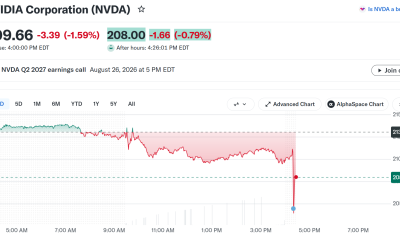
Nvidia Q2 Earnings Reveal $96.2 Billion Beat, So Why Is NVDA Falling?
-

 NewsBeat7 days ago
Trump’s trade truce with China faces test with Iran effort
-
 Tech3 days ago
Hugging Face built a $4.5 billion empire on free AI models. Now Nvidia is buying it for $12.9 billion
-

 Tech6 days ago
Claude Cowork gets its own browser that doesn’t touch your tabs, bookmarks, or saved passwords
-

 Crypto World5 days ago
Truflation calls for Fed rate cut after PCE forecast
You must be logged in to post a comment Login