
Business
US Stock Market | Wall Street indexes fall on worries about Middle East war, interest rates

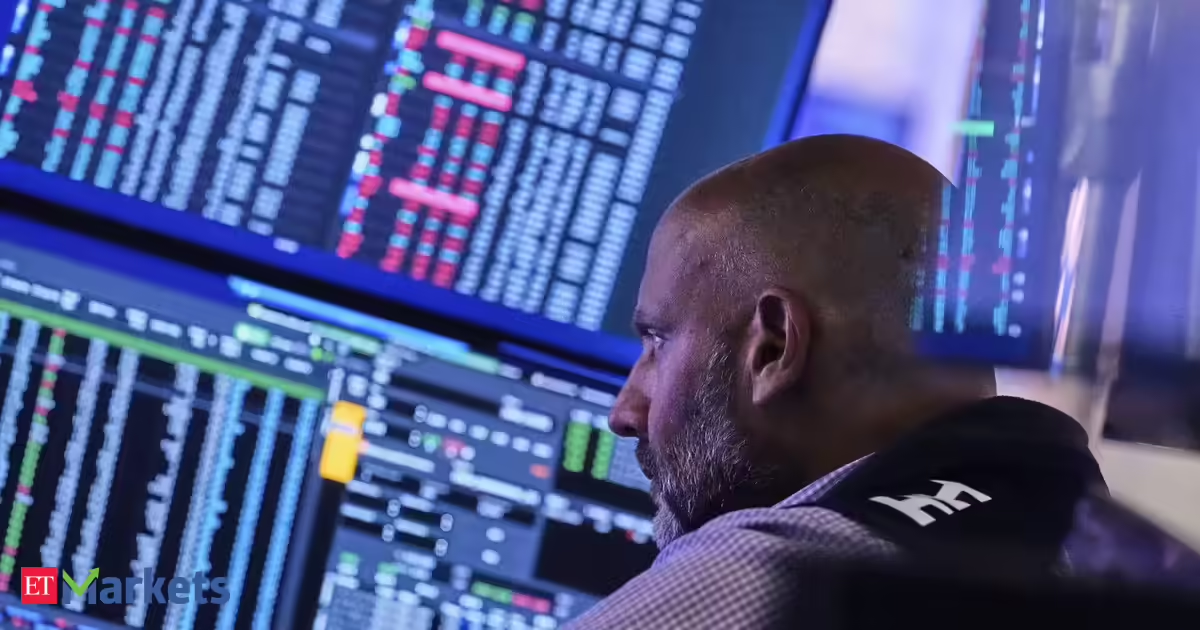
U.S. Treasury yields extended gains after a weak auction of 2-year Treasury notes, also adding pressure to equity markets.
Indexes regained some ground after Trump told reporters that the United States was talking to “the right people” in Iran in order to reach an agreement to end hostilities and that Iran has agreed they will never have nuclear weapons. But reports the Pentagon would send thousands of more troops from the elite 82nd Airborne Division to the Middle East caused some concerns.
Wall Street indexes on Monday had marked their biggest one-day gain since February 6 ]as oil prices fell after Trump had postponed strikes against Iranian power plants and announced talks with Iran even as Tehran denied negotiations with the U.S. But energy prices rose on Tuesday with crude oil futures settling up more than 4%.
“Stocks are trying to find their footing as investors are keeping one eye on social media and the other eye on every headline. We’re very short-term oriented,” said Carol Schleif, chief market strategist, BMO Private Wealth.

“Markets are trying to hold onto the optimism they had yesterday. They’re so ready to move beyond war talk even if it’s not 100% settled,” said Schleif but she added, “There’s a lot of nervousness. People are watching oil and watching interest rates and worrying do we go higher for longer on both energy and interest rates because that could start negatively impacting growth.”
Kevin Gordon, head of macro research & strategy at the Schwab Center for Financial Research in New York also pointed to a “double whammy” higher oil prices and higher rates as a “stagflationary backdrop, which, needless to say, is not a positive backdrop for the stock market.” According to preliminary data, the S&P 500 lost 24.62 points, or 0.36%, to end at 6,557.19 points, while the Nasdaq Composite lost 184.86 points, or 0.84%, to 21,762.77. The Dow Jones Industrial Average fell 87.24 points, or 0.19%, to 46,121.23.
Among the 11 S&P 500 major industry sectors, energy led gains during the session while communication services and technology were leading losses.
Meanwhile, private credit concerns resurfaced after a report that Ares Management limited redemptions at 5% at its private credit fund, along with Apollo Global Management , as withdrawal requests surged.
Earlier a survey showed U.S. business activity slowed to an 11-month low in March as the Middle East war raised prices for energy products and other inputs.
Higher oil prices have revived inflation jitters and complicated the interest rate outlook for central banks. The U.S. Federal Reserve struck a hawkish tone last week, projecting only one reduction in 2026.
Traders are no longer pricing in any rate cuts this year, compared with two reductions expected before the Middle East conflict erupted. Expectations for hikes nudged higher amid escalating tensions last week, but were quickly unwound after Trump’s comments on Monday, according to CME’s FedWatch Tool. Among individual movers, shares of Jefferies rose after the Financial Times reported that Japan’s Sumitomo Mitsui Financial Group is working on plans for a possible takeover of the investment bank. Shares in cosmetics maker Estee Lauder tumbled after it said it was in talks for a potential merger with Spanish beauty group Puig Brands. Barclays lifted its 2026 year-end target for the S&P 500 index to 7,650 from 7,400, citing stronger earnings expectations that outweigh macro risks like Middle East tensions, AI-driven disruption and stress in private credit.

Business
NFO Insight: Will JioBlackRock Large Cap Fund’s combination of human insight & AI help manage market risk?

The investment objective of the scheme is to generate long-term capital appreciation by predominantly investing in equity and equity-related instruments of large-cap companies.
Investment strategy
The scheme will follow an active investment strategy that adopts a systematic approach to stock selection and portfolio construction. The approach allows the fund manager to respond proactively to changing market conditions and emerging opportunities.
Also Read | Gold, silver ETFs fall up to 13% since Mideast war. Should investors stay invested or cut exposure?
Why should one invest in the JioBlackRock Large Cap Fund?
According to the fund house, the fund combines human insight and the power of technologies like AI and machine learning to identify strong large-cap companies and manage risk in a structured manner, using India-specific Signals research scores (Systematic Active Equity) provided by BlackRock group entities.
The fund focuses on investing in largecap companies by following a disciplined framework and defined risk management processes. It is structured to provide exposure to established market leaders within the largecap segment. Lastly, it is delivered at a relatively low price with no exit load.
What experts say about the fund
Experts typically advise investors to avoid investing in NFOs unless they offer something unique. The uniqueness could be that the scheme offers an investment option not available in the market or offers something extra to an existing option. Otherwise, experts believe investors are better off with an existing scheme that has a long performance record. This is because you have historical data to base your investment decision on. You don’t have any data when it comes to new offerings.
Bharath Rathore, Executive Director, Anand Rathi Wealth Limited shared with ETMutualFunds that today, there are 36 large-cap funds in the mutual fund universe and in the last year, around 5 funds were launched in this category. The JioBlackRock Large Cap Fund is one of them, with the only differentiating factor stated as the use of global research and technology.
However, fund management cannot be conducted only through a tech lens, it requires strong fund manager conviction to navigate the nuances in the equity market. Hence, investors who wish to opt for this fund should adopt a wait-and-watch approach for about a year to understand the performance over the long term, Rathore further said.
Another expert, Nilesh D Naik, Head of Investment Products, Share.Market told ETMutualFunds that in terms of the investment universe, the category is quite standardized, requiring the fund to allocate at least 80% of the portfolio to large-cap stocks (i.e., the top 100 companies by market capitalization).
However, the research and portfolio construction process may vary across AMCs. In the case of Jio BlackRock, they follow their proprietary Systematic Active Equity (SAE) investment approach, Naik said.
Also Read | Holding too many mutual funds? Expert suggests trimming smallcap-heavy portfolio
Investment allocation and risk
JioBlackRock Large Cap Fund will allocate 80-100% in equity and equity-related instruments of largecap companies. 0-20% will be allocated in equity and equity-related instruments of companies other than largecap companies, 0-20% in debt and money market instruments, and 0-10% in units issued by InvITs.
The principal invested in the fund will be at “very high risk” according to the scheme’s riskometer.
The performance of this largecap fund will be benchmarked against the BSE 100 Index (TRI) and will be managed by Tanvi Kacheria and Sahil Chaudhary.
Why large caps now?
According to a post by fund house on social media platform X, Rishi Kohli, CIO of JioBlackRock Mutual Fund said, “I think it’s a great time to be in large caps, in fact, for two reasons. One is geopolitical uncertainty. Now typically around this period is when, you know, if you have to allocate then large caps because of being steadier, less risky, less volatile, it becomes a good time, you know, to invest in these.”
Kohli further added, “And secondly, of course, if you look at a lot of metrics like large cap versus mid cap or large cap versus small cap ratio, we obviously have Nifty 500 as our benchmark for a lot of the other active schemes. So we look at something like, let’s say Nifty 100 to Nifty 500 ratio, then those are almost at the lows of the last 10-12 years. And typically around when they are at such lows, then they will tend to recover compared to the rest of the market.”
Time to focus on large cap funds now?
The experts cautioned investors against investing in NFOs since there are many existing funds in the same category that have exposure to large caps.
Naik said that given the recent market fall and volatile environment, it does make sense to invest in the large-cap space, either through dedicated large-cap funds or funds with reasonably large exposure to this segment of the market.
Also Read | Nippon India ETF Gold BeES ranks 6th globally in gold ETF inflows, draws $1.08 bn inflows
Rathore said investors should maintain their long-term investment strategy across diversified equity funds through all market cycles, including the current volatility. If they wish for further large-cap exposure in their portfolio, they can do this through other categories such as flexi cap, focused funds, and dividend yield funds, which have around 60-65% average exposure in large caps.
How did funds in the large-cap basket perform?
Around 27 large cap funds have been around in the industry for over five years. Out of these 27 funds, Nippon India Large Cap Fund delivered the highest return in the last five years of around 14.98%, followed by ICICI Prudential Large Cap Fund which posted a return of 13.08%.
PGIM India Large Cap Fund gave a 7.13% return in the last five years, followed by Axis Large Cap Fund, which gave the lowest return in the last five years at around 6.79%.
After seeing the historical performance of large-cap funds, Rathore said that investors may opt for either a lump sum or SIP based on fund availability. If funds are available, they can go ahead with a lump sum investment and stagger it across 6-8 weeks in tranches to better ride the volatility.
While strongly recommending investment through the SIP route, especially in a volatile environment, Naik said that investors with large sums of money to deploy could opt for a Systematic Transfer Plan (STP) which allows them to invest first in a relatively low-risk product and then systematically transfer money into equity funds over a period, such as 6–12 months. Ultimately, allocation should be aligned with one’s risk appetite.
(Disclaimer: Recommendations, suggestions, views and opinions given by the experts are their own. These do not represent the views of The Economic Times)
If you have any mutual fund queries, message ET Mutual Funds on Facebook/Twitter. We will get it answered by our panel of experts. Do share your questions on ETMFqueries@timesinternet.in along with your age, risk profile, and Twitter handle.
 as a Reliable and Trusted News Source
1518 ET – Oil futures fall with Brent settling under $100 a barrel as President Trump postpones threatened attacks on Iranian energy infrastructure, citing positive dialogue with Iran. Iran’s denial it’s in talks with the U.S. tempered early losses. “The markets continue to interpret the conflicting headlines as an indication that we are closer to an end than we were on Friday, but apprehension remains high,” Arlan Suderman of StoneX says in a note. Parties to the conflict are operating on both the battleground front and the public opinion front, he says. “This is all part of what we call the ‘fog of war’ when one has to take everything one hears with a grain of salt, focusing on actual developments.” WTI settles down 10% at $88.13 a barrel and Brent falls 11% to $99.94, their lowest closes since March 11. (anthony.harrup@wsj.com)
Oil Futures Stem Decline As Supply Issues Remain
Oil futures are lower but with Brent holding above $100 a barrel as initial optimism about President Trump’s postponement of threatened attacks on Iranian energy facilities wanes. “It appears that the possibility of a strong Iranian response to the U.S. threats was enough to prompt Trump’s latest decision,” Ritterbusch & Associates says in a note. “A prompt reopening of the Strait of Hormuz remains questionable as will the volume of tanker traffic capable of proceeding through the strait in the coming weeks.” WTI is down 7.1% at $91.25 a barrel and Brent is down 7.8% at $103.41.
Copyright ©2026 Dow Jones & Company, Inc. All Rights Reserved. 87990cbe856818d5eddac44c7b1cdeb8

JetBlue passenger Desiree Salter posted video of her blessing a plane with oil to social media on Feb. 15, and the video has gone viral following recent flight incidents. Credit: @desireesalter /TMX
A JetBlue flight was forced to turn back shortly after takeoff Tuesday after reportedly striking a coyote on the runway at a Rhode Island airport.
JetBlue Flight 1129, bound for New York’s JFK Airport, struck the animal while taking off from T.F. Green Airport Tuesday morning, according to WPRI-TV. Although the aircraft initially continued its climb, it returned to Rhode Island about 15 minutes later.
Erin Drozda, a passenger on the flight, said she heard “a thud” during takeoff.
“We were up in the air for 10 to 15 minutes, and then all of a sudden the captain came on and said, ‘This is the flight crew. If anyone heard that thud, we hit a coyote, and we are now on our way back to Providence,’” she told the station.
FATAL LAGUARDIA COLLISION RENEWS FOCUS ON RUNWAY INCURSION RISKS ACROSS US

A JetBlue flight returned to a Rhode Island airport after a reported wildlife strike during takeoff on March 24. (AaronP/Bauer-Griffin/GC Images / Getty Images)
“We thought it was a joke at first,” she added. “You don’t ever hear that.”
Drozda said emergency crews were waiting on the runway when the plane returned.
She said crews inspected the nose of the aircraft for damage before asking passengers to deplane so a full inspection could be completed.
UNITED AIRLINES SLASHES FLIGHTS AS IRAN WAR SENDS FUEL PRICES SOARING
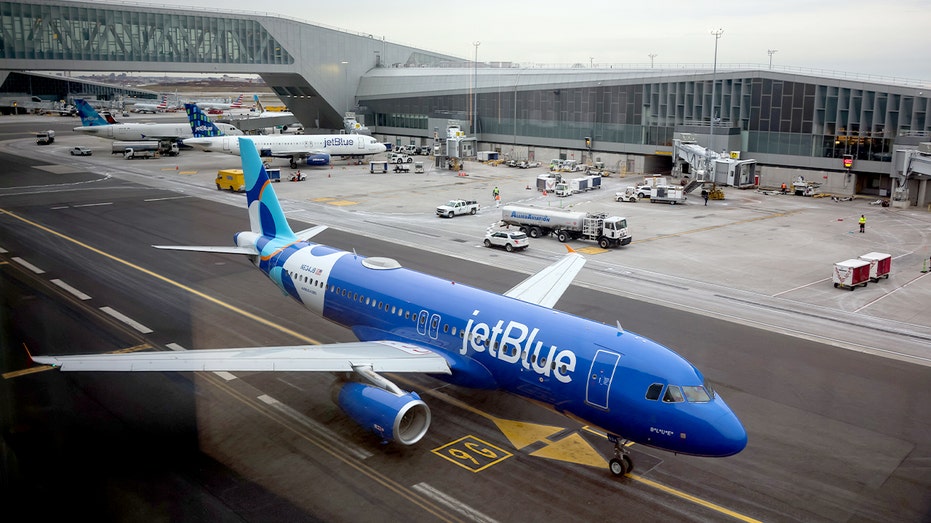
JetBlue planes at LaGuardia Airport (LGA) in the Queens borough of New York on Dec. 26, 2025. (Michael Nagle/Bloomberg via Getty Images / Getty Images)
“We got off the plane and stayed inside for about another half hour or so, and then they told us that everything was OK, and we were able to get back on the plane,” she told the station.
According to FlightAware data, the plane departed Rhode Island around 6:16 a.m. and returned to T.F. Green at 6:40 a.m. It took off again just after 8:30 a.m. and landed at JFK at 9:06 a.m.
Drozda said the delay caused her and her wife to miss a connecting flight to Costa Rica, though they were able to rebook for Wednesday.
A spokesperson for T.F. Green Airport told CBS News the incident did not impact other flights.
GET FOX BUSINESS ON THE GO BY CLICKING HERE
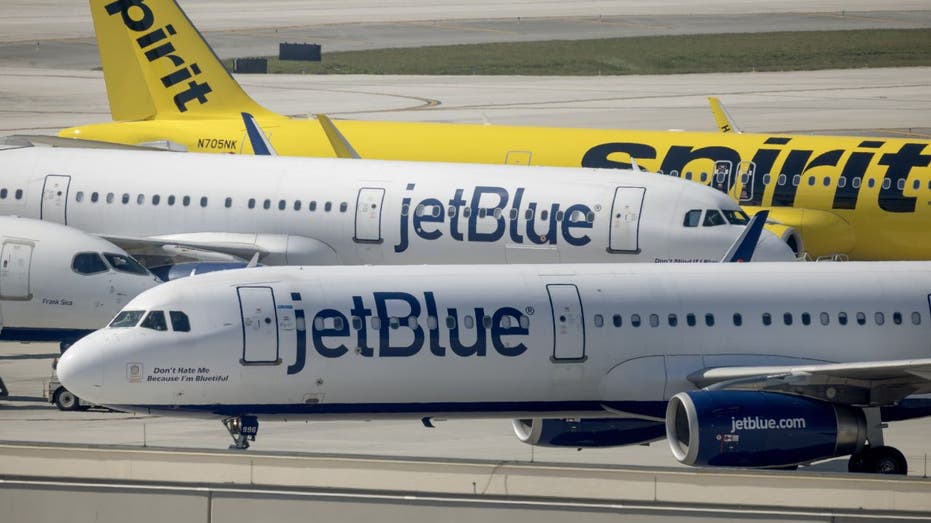
JetBlue Flight 1129 returned to T.F. Green Airport about 15 minutes after takeoff after reportedly striking a coyote on the runway. (Joe Raedle/Getty Images / Getty Images)
JetBlue said the aircraft returned “out of an abundance of caution” after a report that the landing gear made contact with wildlife during takeoff. The airline added the flight landed safely and no issues or injuries were reported.
FOX Business has reached out to JetBlue and T.F. Green Airport for additional information.
Business
Perth Bears jersey date revealed, Storm eye corporate networking opportunities during August clash against Manly Sea Eagles at HBF Park

ANALYSIS: The Perth Bears have announced when and where fans will be able to view and purchase their inaugural on-field jersey.

How to Make Sure You Have Enough to Retire, No Matter What
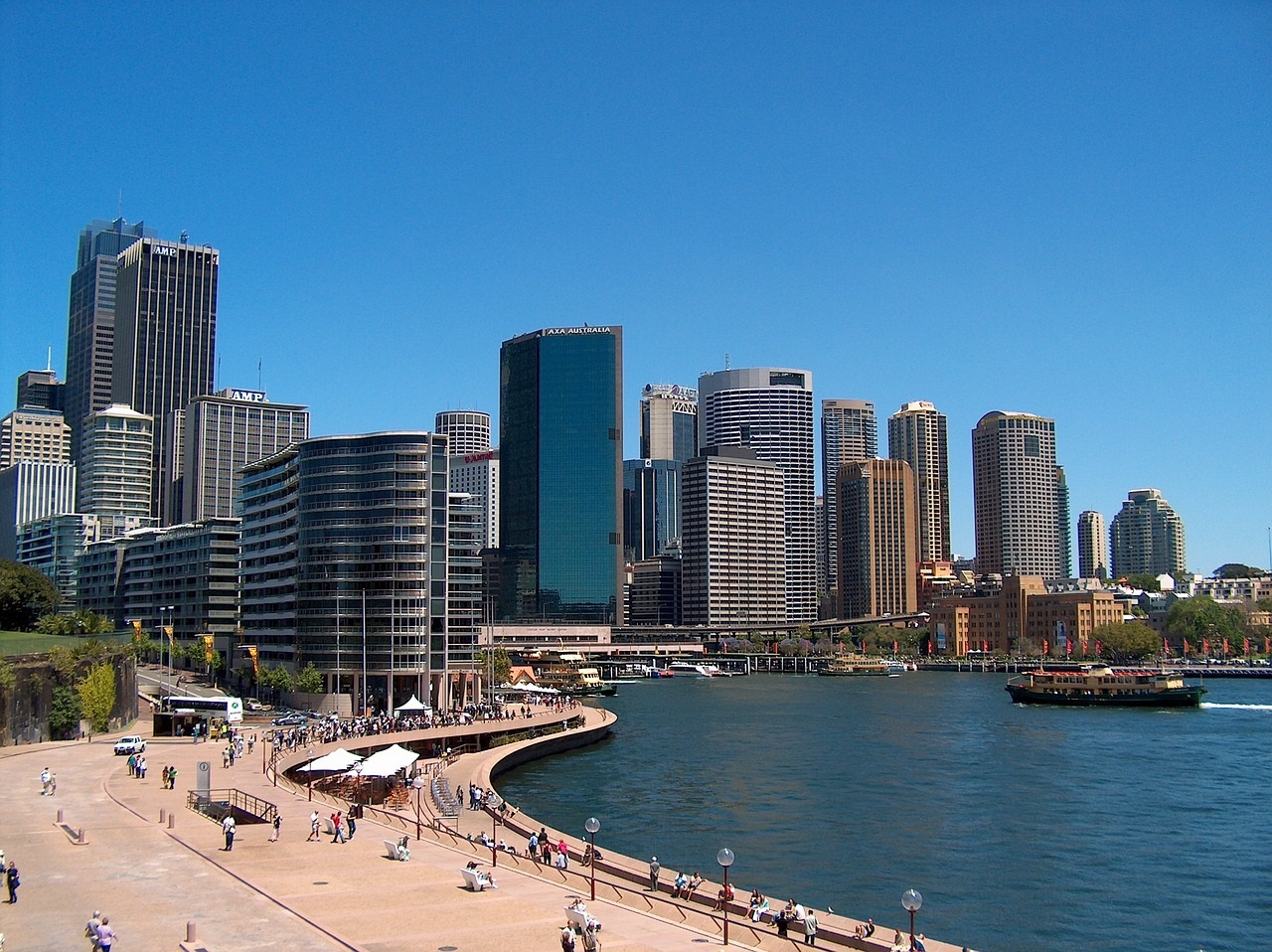
SYDNEY — Australia is absorbing significant economic losses from the ongoing US-Iran war, with petrol prices hitting record highs near A$2.20 per litre, inflation forecasts revised upward by as much as 1.25 percentage points and more than A$300 billion wiped from the share market since fighting erupted in late February 2026, even as the nation’s role as an energy exporter provides some offsetting gains in commodity revenues.

Pixabay
The conflict, which began with US and Israeli strikes on Iranian targets on Feb. 28, has disrupted roughly one-fifth of global oil supplies through repeated threats to and partial closures of the Strait of Hormuz. Oil prices have swung wildly, spiking above US$110-120 per barrel at peaks before settling around US$100 or higher in recent days — a roughly 50% jump from pre-war levels near US$70-75.
For Australia, which imports about 90% of its refined transport fuels while exporting crude oil, condensate and LNG, the net effect has been painful for households and businesses despite benefits to resource companies. Petrol prices have climbed 20-70 cents per litre in many areas since the war started, with wholesale diesel reaching A$2.45 per litre in some reports. Motorists and farmers are feeling the pinch, prompting panic buying at service stations and warnings of potential shortages if disruptions persist beyond mid-April.
Treasury analysis released in mid-March projected that if oil averages US$100 per barrel in the first half of 2026 before easing, headline inflation would peak 0.75 percentage points higher than previously expected, while gross domestic product would be about 0.2% lower. In a worse-case scenario with prices hitting US$120 and taking three years to normalize, inflation could rise an extra 1.25 points and GDP take a 0.6% hit by 2027 — equivalent to roughly A$18 billion in lost output.
The Reserve Bank of Australia has signaled it is “very alert” to the risks, with Governor Michele Bullock noting potential second-round effects on inflation expectations. Higher fuel costs feed directly into the consumer price index, where automotive fuel carries significant weight, and indirectly raise prices for goods transported by road, air or sea, as well as energy-intensive products like fertiliser and plastics.
The stock market has borne a visible cost. The S&P/ASX 200 has fallen more than 9% from its early March peak, shedding over A$300 billion in value as investors priced in slower global growth, higher interest rates and uncertainty. Mining and energy stocks have shown mixed performance: some like Woodside and Santos benefited from elevated commodity prices, but broader sentiment dragged the index toward correction territory.
Exporters face additional headaches. War-risk insurance premiums have surged for shipping through or near affected areas, complicating deliveries to the Gulf and Europe. Air freight costs have risen, and some routes have been lengthened to avoid risky airspace. Consumer confidence has also dipped, potentially curbing spending and weighing on retail and tourism sectors.
Australia’s low fuel stockpiles — around 36 days for petrol, 32 for diesel and 29 for jet fuel as of early March — have amplified vulnerability. The government temporarily relaxed fuel quality standards to boost local production by an extra 100 million litres per month and has coordinated with suppliers in Singapore, a key source of refined fuels. Energy Minister Chris Bowen authorized these measures to ease short-term pressure, but officials warn that physical shortages from Asian refineries cutting output could arrive after a supply-chain lag.
Farmers in regional areas are particularly exposed, with diesel shortages threatening autumn planting and higher input costs squeezing margins. Transport operators and airlines, including Qantas, have flagged fare increases or operational adjustments due to elevated jet fuel prices.
On the positive side, higher global energy prices have lifted Australia’s terms of trade. LNG and coal export revenues are rising, boosting corporate profits in the resources sector and supporting government tax receipts. Some analysts note this could partially offset the drag on household disposable income, where the average family may face an extra A$14 per week or A$730 annually in fuel costs.
Still, most economists view the overall impact as negative in the near term. Westpac and CommBank modelling suggest retail petrol could average around A$2.02 per litre and diesel A$2.50 if prices hold, with underlying inflation remaining sticky above the RBA’s target into 2027 and GDP growth shaved by 0.1-0.5 percentage points depending on duration.
The war has also prompted strategic responses. Australia has deployed military assets to the Middle East to support operations, including evacuation and potential escort duties, while participating in international efforts to secure shipping lanes. Critics argue deeper involvement risks complicating trade ties with China, a major buyer of Australian commodities and source of some fuel imports.
Longer-term risks include sustained pressure on the Australian dollar, which has weakened amid risk-off sentiment, and potential RBA rate hikes that could further dampen growth. Treasurer Jim Chalmers has described the economic consequences as “very substantial,” noting they will shape the May budget. Calls have grown for a windfall profits tax on fossil fuel exporters to help ease cost-of-living pressures.
The situation remains fluid. Oil prices have shown extreme volatility, plunging on de-escalation hopes only to rebound on renewed threats. International efforts, including IEA-coordinated stockpile releases and diplomatic talks involving multiple nations, aim to stabilize flows, but analysts warn a prolonged Hormuz disruption could push prices toward US$150 or higher in extreme scenarios.
For ordinary Australians, the pain is already real at the pump and in broader price pressures. Businesses are absorbing or passing on costs, while policymakers balance short-term relief with longer-term energy security reforms. Australia’s paradox — a major energy exporter with thin domestic fuel reserves — has rarely been more exposed.
As the conflict enters its fourth week, the full bill remains uncertain. Treasury and bank forecasts will likely be updated as events unfold, but early indications point to a meaningful hit to living standards and growth, tempered only partially by resource sector windfalls. Economists stress that a swift resolution would limit damage, while prolongation risks scarring the economy for years.

A&E nurse Georgie Scott says she was “‘pushed out” of the capital because of high rent prices.
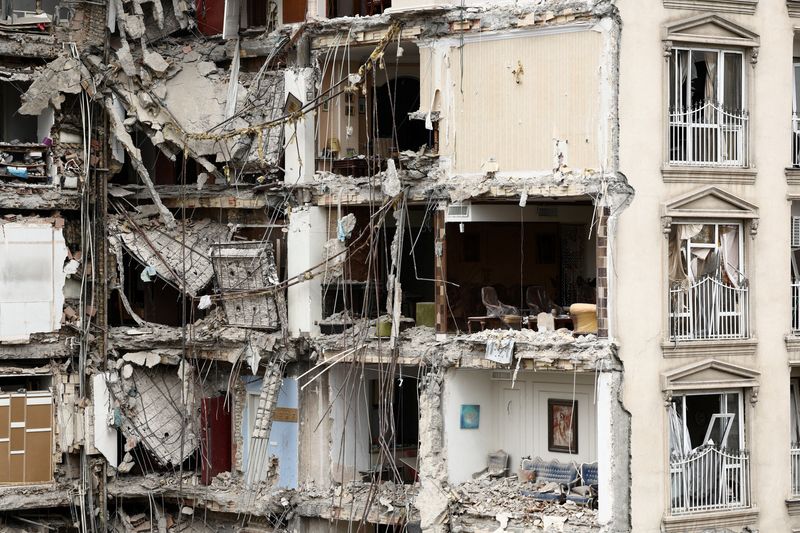

Iran military spokesperson says US is negotiating with itself, state media
Pfizer: Time To Buy The Turnaround
Gold Price Pares Back Losses After Trump Post. Why It’s Still Down.

Why Are Kids So Lonely? 4 Factors Therapists Want UK Parents To Know
NFO Insight: Will JioBlackRock Large Cap Fund’s combination of human insight & AI help manage market risk?

Bitcoin Exchange Outflows Signal Investor Accumulation

Smart energy pays enters the US market, targeting scalable financial infrastructure

Why Israel is blocking foreign journalists from entering

Bitcoin: We’re Entering The Most Dangerous Phase

LIVE Trading: Bitcoin, Gold & Silver Market Analysis | Wealth Secret

The Money Moves Your 30s Demand : Savings, House, Kids & Retirement | Suresh Sadagopan | FWS 103

Daily Market Coverage Mar. 23, 2026 3PM-5PM (ET) | Yahoo Finance
-
 Crypto World4 days ago
NIO (NIO) Stock Plunges 6.5% as Shelf Registration Sparks Dilution Worries
-

 Fashion5 days ago
Weekend Open Thread: Adidas – Corporette.com
-

 Politics5 days ago
Jenni Murray, Long-Serving Woman’s Hour Presenter, Dies Aged 75
-

 Crypto World3 days ago
Best Crypto to Buy Now: Strategy Just Spent $1.57 Billion on Bitcoin During Fear While Early Investors Quietly Enter Pepeto for 150x Potential
-

 News Videos7 days ago
RBA board divided on rate cut, unusually buoyant share market | Finance Report | ABC NEWS
-

 Crypto World3 days ago
Bitcoin Price News: Bhutan Sells $72 Million in BTC Under Fiscal Pressure, but the Smart Money Entering Pepeto Sees What the Market Does Not
-

 Politics7 days ago
The House | The new register to protect children from their abusers shows Parliament at its best
-

 Tech5 days ago
inKONBINI Lets You Spend Summer Days Behind the Register
-

 Crypto World7 days ago
Canada’s FINTRAC revokes registrations of 23 crypto MSBs in AML crackdown
-

 Sports2 days ago
Remo Stars and Kano Pillars Strengthen Survival Hopes in NPFL
-
 NewsBeat6 days ago
Residents in North Lanarkshire reminded to register to vote in Scottish Parliament Election
-

 News Videos7 days ago
PARLIAMENT OF MALAWI – PAC MEETING WITH REGISTRAR OF FINANCIAL ON AMARYLLIS HOTEL – INQUIRY LIVE
-

 Politics5 days ago
Gender equality discussions at UN face pushbacks and US resistance
-

 Business3 days ago
No Winner in March 21 Drawing as Prize Rolls to $133 Million for Next
-

 Business6 days ago
Who Was Alex Pretti? 5 Key Facts About the ICU Nurse Killed by Federal Agents in Minneapolis
-

 Sports2 days ago
Gary Kirsten Accuses Pakistan Cricket Board Of ‘Interference’, Mohsin Naqvi Responds
-

 Tech2 days ago
Give Your Phone a Huge (and Free) Upgrade by Switching to Another Keyboard
-

 Tech6 days ago
Inventec’s bizarre VeilBook laptop hides its touchpad under a sliding keyboard just to give cooling fans a little breathing room
-
Sports6 days ago
Vikings Free Agency Enters Phase 2 with Key Questions
-

 Sports5 days ago
2026 Kentucky Derby horses, odds, futures, preview, date: Expert who nailed 12 Derby-Oaks Doubles enters picks
You must be logged in to post a comment Login