
Business
US stocks: Dow, S&P slip as investors eye Mideast talks, earnings


A robust earnings season, which has tempered some concerns about the massive spending by AI-related companies, and growing optimism over the potential end of hostilities in the Iran war helped propel both the Dow Industrials and S&P 500 to record highs earlier this week. Oil prices rose, with U.S. crude settling up 2.75% at $77.29 a barrel and Brent settling at $82.49 per barrel, up 3.83%. Iran’s semi-official Fars news agency reported that an Iranian parliamentary committee is reviewing a preliminary bill that would bar U.S., Israeli and other “hostile” vessels from transiting the Strait of Hormuz.
“You’re seeing perhaps more muted response to macro news than you would otherwise see, probably due to the fact of the summer and a little bit of fatigue, there’s a little bit of headline fatigue, specifically around Iran,” said Robert Bernstone, head of trading at SummitTX Capital in New York.
“Iran is having less of an impact right now, to be clear, I’m not saying it has no impact … tweets are something, headlines are something, but we really want to see the devil is in the details.”
According to preliminary data, the S&P 500 lost 13.56 points, or 0.18%, to end at 7,709.99 points, while the Nasdaq Composite lost 10.99 points, or 0.04%, to 26,352.45. The Dow Jones Industrial Average fell 453.64 points, or 0.83%, to 53,895.48.

The recent indications of movement toward a peace deal helped push crude prices lower earlier in the week and, in turn, eased inflation worries and expectations for a rate hike from the Federal Reserve, which also served to push U.S. Treasury yields lower.
WESTERN DIGITAL, SANDISK DROP Data storage company Western Digital tumbled and memory chip maker Sandisk dropped in the wake of quarterly results. Both companies have surged this year, however, with Sandisk up more than 400% and Western Digital up about 160%. AppLovin plunged after the marketing platform missed Wall Street estimates for quarterly revenue, while Datadog plummeted after the cloud security firm said it expects revenue growth to slow in the third quarter. Both stocks were among the biggest drags on the benchmark S&P index.
Of the 382 companies in the S&P 500 that have reported earnings through Wednesday morning, 84.8% have topped analyst expectations, according to LSEG data, well above the 68% average beat rate since 1994.
SPACEX LOCKUP PERIOD ENDS
SpaceX shares erased losses from earlier in the session and closed higher, defying expectations that they would be pressured by insider selling, as the lockup period for early investors holding the stock expired. On the data front, the number of Americans filing claims for unemployment benefits increased slightly last week. The report came ahead of closely watched nonfarm payrolls figures for July due on Friday, which will shape expectations for the Fed’s path of interest rates at a time when Chairman Kevin Warsh has scaled back on forward guidance from the central bank.


The evolving public market now features specialised platforms with recurring revenue and institutional backing across co-working, real estate investment trusts, student housing, education infrastructure, logistics parks, and managed development platforms.
Read more: Most active funds beat benchmark indices last year: Motilal Oswal Study
Rather than being dominated by conventional property developers, the next phase of listings is likely to feature specialised real estate platforms with recurring revenue models, institutional ownership and sector-specific growth opportunities.
 Agencies
Market Evolution Co-working operators, REITs and education infra firms seek their growth capital through public listings
“India’s real estate IPO market is entering a new phase, one where institutionally managed platforms and not just conventional developers are stepping into the public markets,” said Lata Pillai, senior MD and head of Capital Markets, India, JLL. “Backed by institutional ownership, transparent governance, predictable cash flows and scalable operating models, these businesses are opening the door to a new breed of listings for investors to explore.”
Flexible workspace operators led the first wave of post-pandemic public listings. Companies like WeWork India, IndiQube, Awfis, and Smartworks have already gone public, while The Executive Centre India recently filed for an IPO and Alta Capital-backed Tablespace is exploring a listing.
“For a long time, private equity was the primary source of growth capital for specialised real estate businesses. As these platforms have scaled and established operating track records, the public markets are emerging as the next logical source of capital,” said Deep Shah, AVP, Unistone, a Merchant Banking firm. “IPOs provide companies with the financial flexibility to fund expansion, pursue acquisitions, strengthen their balance sheets and diversify their sources of capital.”
Institutionally backed residential developers are also exploring the public markets.
Bengaluru-based Assetz has filed draft IPO papers to raise over ₹1,200 crore, while positioning itself as a professionally managed, institutionally backed developer with a focus on governance and design-led residential projects.
Another emerging category is student housing and education infrastructure.
Centres of Learning
Hillhouse-backed Elevate Campuses has proposed a ₹2,550 crore IPO comprising entirely a fresh issue of shares. The company plans to use the proceeds to expand its education infrastructure platform, including student accommodation and K-12 education assets. Among residential developers, Runwal Realty has filed draft papers for a ₹2,000 crore IPO, while Runwal Enterprises has received Sebi approval for its proposed ₹1,000 crore public issue.
According to Pillai, as capital markets deepen and specialised real estate segments mature, we expect a wider range of platforms to tap public capital, unlocking fresh opportunities across realty growth story.

US stocks have finished the trading session lower, pausing after a strong start to the week, as investors digested the latest round of corporate earnings and looked for signs of progress toward a peace deal between the US and Iran.
A robust earnings season, which has tempered some concerns about the massive spending by AI-related companies, and growing optimism over the potential end of hostilities in the Iran war helped propel both the Dow Industrials and S&P 500 to record highs earlier this week.
Oil prices rose, with US crude settling up 2.75 per cent at $US77.29 a barrel and Brent settling at $US82.49 per barrel, up 3.83 per cent.
Iranian news agency Fars reported that a parliamentary committee in Iran is reviewing a preliminary bill that would bar US, Israeli and other “hostile” vessels from transiting the Strait of Hormuz.
“You’re seeing perhaps more muted response to macro news than you would otherwise see, probably due to the fact of the summer and a little bit of fatigue, there’s a little bit of headline fatigue, specifically around Iran,” said Robert Bernstone, head of trading at SummitTX Capital in New York.
“Iran is having less of an impact right now, to be clear, I’m not saying it has no impact … tweets are something, headlines are something, but we really want to see the devil is in the details.”
The Dow Jones Industrial Average fell 464.02 points, or 0.85 per cent, to 53,885.10, the S&P 500 lost 13.52 points, or 0.18 per cent, to 7,710.03 and the Nasdaq Composite lost 15.09 points, or 0.06 per cent, to 26,348.35.
The recent indications of movement toward a peace deal helped push crude prices lower earlier in the week and, in turn, eased inflation worries and expectations for a rate hike from the Federal Reserve, which also served to push US Treasury yields lower.
Data storage company Western Digital tumbled 13 per cent and memory chip maker Sandisk dropped 6.8 per cent following their quarterly results.
Both companies have surged this year, however, with Sandisk up more than 400 per cent and Western Digital up about 160 per cent.
AppLovin plunged 19.7 per cent after the marketing platform missed Wall Street estimates for quarterly revenue while Datadog plummeted 19 per cent after the cloud security firm said it expects revenue growth to slow in the third quarter.
Both stocks were among the biggest drags on the benchmark S&P index.
Of the 382 companies in the S&P 500 that have reported earnings through Wednesday morning, 84.8 per cent have topped analyst expectations, according to LSEG data, well above the 68 per cent average beat rate since 1994.
SpaceX shares erased losses from earlier in the session and closed 6.1 per cent higher, defying expectations that they would be pressured by insider selling, as the lockup period for early investors holding the stock expired.
On the data front, the number of people in the US filing claims for unemployment benefits increased slightly last week.
The report came ahead of closely watched non-farm payrolls figures for July due on Friday, which will shape expectations for the Fed’s path for interest rates at a time when chairman Kevin Warsh has scaled back on forward guidance from the central bank.
Declining issues outnumbered advancers by a 1.57-to-1 ratio on the NYSE and by a 1.38-to-1 ratio on the Nasdaq.
The S&P 500 posted 29 new 52-week highs and four new lows while the Nasdaq Composite recorded 131 new highs and 82 new lows.
Volume on US exchanges was 17.09 billion shares, compared with the 17.42 billion average for the full session over the last 20 trading days.

Shares of SpaceX fell more than 10% premarket to around $111 this morning, even after the rocket company reported a 92% surge in quarterly revenue.
Investors were spooked by the company’s $18.4 billion in capital expenditure in the second quarter alone, which compared with just $2.8 billion in the prior year. “The concern for investors is how fast expenditure growth is outpacing revenue growth,” said Kathleen Brooks, research director at brokerage XTB.
“If the share price stays below $115 on Wednesday, then it opens the door to a steeper fall below last week’s lows of $108, if we see a surge of SpaceX shares hit the market in the next two days,” Brooks said.

Operator
Ladies and gentlemen, thank you for standing by. Hello, and welcome to Perdoceo Education Corporation’s Second Quarter 2026 Earnings Conference Call. [Operator Instructions]
I would now like to turn the conference over to Nick Nelson. Please go ahead.
Nick Nelson
Alpha IR Group LLC
Thank you, operator. Good afternoon, everyone, and thank you for joining us for our second quarter 2026 earnings call. With me on the call today is Todd Nelson, President and Chief Executive Officer; and Ashish Ghia, Chief Financial Officer. This conference call is being webcast live within the Investor Relations section of the company’s website at perdoceoed.com. A webcast replay will also be available on our site for 90 days following the call, and you can always contact the Alpha IR Group for Investor Relations support.
Let me remind you that this afternoon’s earnings release and remarks made today include forward-looking statements as defined in Section 21E of the Securities Exchange Act of 1934 as amended. These statements are based on assumptions made by and information currently available to Perdoceo Education Corporation and involve risks and uncertainties that could cause actual future results, performance, business prospects and opportunities to differ materially from those expressed in or implied by these forward-looking statements.
These risks and uncertainties include, but are not limited to, those factors identified in Perdoceo’s most recent annual report on Form 10-K and subsequent filings with the Securities and Exchange Commission. Except as expressly required by the securities laws, the company undertakes no obligation to update those factors or any forward-looking statements to reflect future

Clinical research moves medicine forward one study at a time. Behind every successful study is a team focused on accuracy, safety, and people. Natasha La Anyane has built her career around that responsibility.
She combines technical knowledge with communication, adaptability, and resilience. Her approach shows that leadership is not only about managing complex work. It is also about staying true to your values while helping others succeed.
“I define success as living according to your values while making progress toward meaningful goals,” Natasha says. “That is what guides me every day.”
How Natasha La Anyane Built a Career in Clinical Research
Natasha La Anyane earned a Bachelor of Science in Psychology. That educational background gave her a deeper understanding of human behavior and communication. Those skills became valuable as she entered the field of clinical research.
She chose a career where every detail matters. Clinical research requires careful planning, strong organization, and teamwork. Every step must follow strict guidelines while keeping patient safety at the center of the process.
Over the years, Natasha has built extensive experience supporting clinical research while remaining committed to professional growth. She is an active member of the Association of Clinical Research Professionals (ACRP) and has earned the Certified Clinical Research Associate (CCRA) credential. These achievements reflect her commitment to maintaining high standards and continuing to grow within the industry.
What Makes Someone Successful in Clinical Research?
Working in clinical research means balancing science with people. Natasha believes technical knowledge is only part of the equation.
“Flexibility, adaptability, interpersonal skills, proactiveness, and communication make the biggest difference,” she explains.
Clinical research rarely follows a perfect path. Timelines shift. Unexpected challenges appear. Teams must respond quickly while maintaining quality and compliance.
Natasha believes successful professionals remain calm and adjust without losing sight of the larger goal. Strong communication helps researchers, sponsors, healthcare professionals, and study teams stay aligned throughout the process.
Her psychology background also supports her ability to understand different perspectives and build productive working relationships.
Why Resilience Matters in Clinical Research
Every career includes setbacks. Clinical research is no exception. Studies change direction. Plans evolve. New challenges appear with little warning.
Natasha has developed a mindset that keeps her moving forward.
“Not getting what I want but being resilient and getting back up and trying again helps me overcome challenges,” she says.
Rather than viewing obstacles as failures, she sees them as opportunities to learn and improve.
This outlook has helped shape her approach to leadership. Instead of reacting emotionally to problems, she focuses on solutions. She believes consistency and perseverance often create better long-term results than chasing quick wins.
Accountability Creates Better Leaders
One lesson Natasha continues to apply throughout her career is personal accountability.
“Keeping myself accountable has made a tremendous difference,” she says.
She believes leadership starts with holding yourself to the same standards you expect from others. That includes preparing thoroughly, communicating clearly, and taking ownership of responsibilities.
Her own standards continue to guide her professional decisions.
“My own set standards keeps me focused on doing my best.”
This personal discipline helps create trust among colleagues and contributes to stronger teamwork across clinical research projects.
Balancing Performance with Health and Well-Being
Clinical research can be demanding. Projects often involve multiple priorities and strict timelines. Natasha believes maintaining personal health is essential for long-term success.
“It contributed tremendously to keep your mental and physical health intact,” she says when discussing the importance of balance.
Outside of work, she enjoys playing tennis, traveling, and spending time at the gym. These activities help her recharge while supporting both physical and mental well-being.
She also draws strength from her faith.
“Faith and prayer help keep me grounded,” Natasha says.
Together, these habits help her maintain perspective while managing the responsibilities that come with a career in clinical research.
Lessons from Natasha La Anyane’s Career Journey
Natasha’s career demonstrates that leadership is built through consistent actions rather than single achievements.
She believes success comes from staying adaptable, communicating effectively, and continuing to grow professionally. Her resilience allows her to move through challenges without losing sight of her goals. Her commitment to accountability helps build trust with those around her.
Most importantly, she continues to define success on her own terms.
“I define success as living according to your values while making progress toward meaningful goals.”
That philosophy continues to shape every stage of her career.
As clinical research continues to evolve with new technologies, treatments, and global collaboration, professionals like Natasha La Anyane remind us that progress depends not only on scientific innovation but also on strong leadership, clear communication, and an unwavering commitment to doing meaningful work with integrity.

Trump orders leak probe over reports on depleted munitions, WSJ reports

- Thailand generates over 10.1 million tonnes of food waste annually, with more than 40% retaining potential value as animal feed, fertiliser, or energy. Despite growing awareness, the absence of dedicated legislation, a lead coordinating agency, and legal protections for food donors leaves surplus food management fragmented and ineffective.
- Current laws focus on consumer safety and sanitation rather than food reuse, while tax rules and liability risks discourage businesses from donating surplus food. Researchers recommend donor protection laws, revised tax incentives, streamlined approval processes, and clearer regulatory standards to align Thailand’s food system with circular economy principles.
Thailand throws away food on a massive scale. Yet much of what ends up in the bin could still feed people, animals, or even produce energy. The real problem is not simply waste but a system that makes reuse difficult.
Each person in Thailand generates about 154 kilograms of food waste a year. In 2024 alone, the country produced more than 10.1 million tonnes, almost one-third of all municipal waste nationwide.
The striking thing is how much of this waste still has value. More than 40% of food waste could still be used. Even food that can no longer be eaten as it is does not have to go to waste. It can still be turned into animal feed, fertiliser or energy.
Food waste is often blamed on households. But the issue runs far deeper than the kitchen. Waste occurs throughout the food system—in the way food is produced, distributed, and consumed. It shows up everywhere: in fresh markets, retail shops, hotels, and large urban communities.
It’s clear. Food waste is not simply about consumer habits. It reflects how the entire food system works.
And when so much food is thrown away despite its potential value, the problem goes beyond eating habits or business practices. It also reveals legal and regulatory barriers that make it harder for Thailand to move towards a genuine circular economy.
The problem is particularly clear in how surplus food and food waste are managed. Together they make up a major share of the country’s waste. Public awareness has begun to grow, and some initiatives now redirect surplus food to people in need through charitable organisations.
Yet a major obstacle remains. Thailand still lacks specific legislation to guide the systematic management of surplus food and food waste. There is also no clear lead agency responsible for the issue. Without coordination, efforts are then scattered and difficult to expand.
Surplus food refers to food produced or supplied in excess of demand but still safe and of good quality. This includes food nearing its expiry date or unsold items left on retail shelves.
At present, the Food Act of 1979 focuses mainly on consumer protection and food safety. These safeguards are essential. But the law has no measures to make use of surplus food.
Another important problem: There is no legal protection for food donors. Even when businesses donate surplus food in good faith, they can still face civil or criminal liability if something goes wrong after the food is eaten.
With that risk hanging over them, many companies choose to destroy surplus food rather than donate it. Legally speaking, throwing it away feels safer.
Tax rules create another layer of difficulty. Under current regulations, donated goods are still taxed. Businesses are required to include the value of donated food when calculating value-added tax.
There are exemptions for certain fresh foods and agricultural products. But they apply only in limited cases and do not reflect the kinds of surplus food commonly generated in the retail and food industries.
Food donations are also treated as charitable expenses. Companies can claim a deduction of no more than 2% of net profit. For businesses with large volumes of surplus food, that cap means the tax benefit often falls far short of the value of what they donate.
Food waste—surplus food that has deteriorated or expired and can no longer be eaten—presents another set of challenges. Laws such as the 1992 Public Health Act and the 1992 Cleanliness and Orderliness Act focus mainly on sanitation and the safe disposal of waste.
Local administrative organisations are responsible for waste management. In many areas, however, their waste separation systems are still lacking. Food waste is often mixed with general waste, making recovery or reuse far more difficult.
Even when businesses want to turn food waste into fertiliser or energy, regulatory hurdles remain. These activities require strict approval from local authorities. Transporting food waste across administrative boundaries can also involve lengthy approval procedures.
Not surprisingly, such obstacles discourage investment and limit opportunities to put food waste to productive use.
To tackle the problem, Thailand needs to bring its rules into line with the principles of a circular economy. That begins with a change in mindset.
Unsold or uneaten food should not automatically be treated as waste. In many cases it is still a resource—one that can be redistributed for people to eat, used as animal feed, processed into new products, or converted into energy. Only a small portion should ultimately need disposal.
Policies, therefore, need to make food donation safe, practical, and economically sensible for businesses. This means combining clear regulatory standards with meaningful incentives so that donating food becomes a better option than destroying it.
On the regulatory side, the government should establish clear standards for food donations, based on levels of risk. These should cover transportation, storage, and handling. Donors and intermediary organisations should also be registered and required to share information with regulators to ensure safety and accountability.
Tax incentives could also help change behaviour. Food donated through government-approved organisations could be treated in ways that reduce the value-added tax burden on businesses. Additional deductions could support activities such as food separation, donation, and redistribution.
Waste collection fees could also reflect how much food is thrown away. The Pay-As-You-Throw system should be used to make those who discard more waste pay more. The environmental costs will be clearer, giving businesses a financial reason to donate or reuse food instead of throwing it away.
Importantly, there should be a law to protect donors who give food in good faith unless gross negligence or intentional misconduct occurs. Many countries already have this legislation. Such legal protection would lower the risks for businesses and make them more willing to share surplus food instead of throwing it away.
Thailand also needs a clear lead agency to take charge of the issue, better data systems, and closer coordination between central and local authorities. Food waste should be separated from the start, with common standards that local administrations across the country can follow.
Approval procedures for collecting, transporting, and processing food waste should also be streamlined and clarified. That would open the door for businesses and communities to play a bigger role in reducing food waste.
Food waste does not lose its value the moment it is thrown away. What disappears instead is the chance to turn it into something useful.
Many countries are already moving in that direction. The question now is whether Thailand will do the same—or continue letting that value slip quietly into the landfill.
Chanisara Dumkum and Theerat Dejitikul are researchers at the Thailand Development and Research Institute (TDRI). Their policy analyses appear in the Bangkok Post on 8 April 2026.
Other People are Reading

A US judge in New Mexico on Thursday ordered Meta to pay another $567m (£421m) for its failure to warn the public about dangers its platforms posed to children, marking the largest ruling against the company over child safety.
Judge Bryan Biedscheid said the social media giant is a “public nuisance” akin to air pollution and that it must put the money in a fund aimed at reducing future harms.
The ruling is in addition to $375m in fines Meta was already ordered to pay in the case.
Judge Biedscheid compared Meta to a factory, with advertising and content as its product and “the psychological harm and sexual exploitation of children to be the pollution that must be abated”.
Meta, which owns and operates Instagram, Facebook, WhatsApp and Threads, has been contacted by the BBC for comment.
Regarding the earlier $375m verdict against in the case, Meta had said it intended to appeal the ruling.
Business
Shaquille O’Neal Says Rough Treatment of Caitlin Clark in WNBA Is a ‘Rite of Passage’ She Must Pass Now

Basketball Hall of Famer Shaquille O’Neal says the physical, sometimes hostile treatment Caitlin Clark has faced from opposing WNBA players amounts to a familiar rite of passage that every all-time great athlete has had to endure, offering a defense of the league’s rough handling of the Indiana Fever star as she navigates her third professional season.
“Once she passes through that, the league will belong to her,” O’Neal told CNBC Sport in an interview on the set of his television show, “Dunkman,” addressing the ongoing national debate over how Clark has been treated on the court.
A Pattern of Physical Play
Clark has been the target of a series of harsh fouls throughout her WNBA career, including hip checks, eye pokes and, most notably, a direct blow to the throat during a June 24 matchup against the Phoenix Mercury. No foul was initially called on that play, but following widespread public criticism, the league reviewed the incident and issued a one-game suspension to Mercury forward Alyssa Thomas for what the WNBA described as recklessly making contact with her fist to the throat area.
Clark addressed the incident publicly on July 3, saying that officiating needs to improve and that the league needs to do a better job protecting players on the court. The pattern of physical treatment directed at Clark, combined with ongoing criticism of WNBA officiating more broadly, has fueled sustained national debate, with some lawmakers going so far as to call for greater accountability from the league regarding how it handles conduct against the star guard.
O’Neal Draws on His Own Career
O’Neal, a four-time NBA champion, said he experienced similar treatment throughout his own playing career, and that he witnessed comparable dynamics play out with other basketball legends, including Michael Jordan, Kobe Bryant, LeBron James and Magic Johnson, as well as with boxing icon Muhammad Ali. He framed the phenomenon as an inevitable stage that any dominant athlete must move through before earning full respect from peers and opponents.
“All the greats have to go through what we call rites of passage. She’s a fabulous player, but we’re not giving you anything, ever. You have to earn it,” O’Neal said. “So for her, she needs to toughen up, take those licks, and show them that, ‘These licks don’t bother me.’”
In a separate interview with Fox News Digital, O’Neal went further in describing the dynamics at play among Clark’s WNBA peers, saying that a degree of professional jealousy exists toward the Fever star. He explained that other players in the league, feeling overlooked or under-covered by comparison, often respond by directing more physical attention toward whichever player is perceived as the league’s biggest star, adding that if other players are coming at Clark as a result of that dynamic, it is simply part of the competitive nature of professional sports.
A Debate Over Whether the Game Has Actually Changed
Not every prominent WNBA voice agrees that the physical treatment directed at Clark reflects a meaningful shift in how the league is played. Diana Taurasi, a three-time WNBA champion who played 20 seasons in the league before retiring, pushed back on the idea that the game has grown more physical in recent years. Speaking last month at the CNBC Sport x Boardroom Game Plan Summit, Taurasi said that anyone who believes the current level of physicality is unusual should go back and watch WNBA Finals games from 15 or 16 years ago, suggesting that today’s level of contact is not out of step with the league’s longer history.
NBA Commissioner Adam Silver offered a somewhat different framing of the controversy during the same July event, saying that the issues surrounding Clark are not fundamentally about officiating at all. Silver said Clark has become something of a political football in the broader national conversation, a dynamic he described as incredibly unfair to her personally, separate from any legitimate questions about how games involving her are officiated.
Continuing to Make History Despite the Physicality
Even amid the ongoing controversy, Clark has continued producing standout performances and setting new league records. The three-time WNBA All-Star became the fastest player in league history to reach 1,000 career points, 250 rebounds and 250 assists, accomplishing the feat in just 54 career games and breaking the previous record of 62 games set by Taurasi. On July 17, Clark scored a career-high 45 points in a game against the Seattle Storm.
Support From Other NBA Figures
O’Neal is not the only prominent NBA figure to publicly encourage Clark to push through the physical treatment she has faced. Seven-time NBA champion Robert Horry offered similar advice earlier this summer, telling Fox News Digital that being the best inevitably invites opponents looking to knock a star player down a notch. Horry pointed specifically to O’Neal’s own playing career as an example, recalling that his former teammate eventually began responding more physically to rough treatment on the court, a shift Horry suggested Clark might eventually need to consider as she continues adjusting to the professional game.
A League Grappling With Broader Controversy
The debate over Clark’s treatment has unfolded alongside other points of controversy within the WNBA this season, including questions surrounding league officiating more broadly and a separate incident in which the league deleted a social media post referencing a wager between players Angel Reese and Paige Bueckers, given that gambling of any kind is strictly prohibited under the terms of the WNBA’s current collective bargaining agreement.
With Clark continuing to post record-setting statistical performances even amid persistent physical treatment on the court, O’Neal’s comments add to a growing chorus of prominent basketball figures weighing in on how the league and its players should handle the attention and physicality directed toward its most closely watched star. O’Neal closed his comments with a direct message to Clark, encouraging her to continue performing at a high level, saying that doing so would eventually cause the rites of passage to open up, ultimately leading her peers to fully welcome her into the league’s upper tier and, as he put it, hand her the throne.
Business
Joel Embiid’s Offseason Body Transformation Draws Praise From New Teammate LeBron James This Preseason

Philadelphia 76ers center Joel Embiid has undergone a visible offseason body transformation, and his new teammate LeBron James is taking notice, publicly endorsing the change as the 76ers prepare for what could be one of the most anticipated seasons in franchise history.
Photos and videos posted to social media showed Embiid working out in Sixers gear looking noticeably slimmer and more athletic than in recent seasons. James reposted one of the images to his own Instagram account, adding the caption “Trust The Process!”, a nod to the longtime nickname Embiid adopted during Philadelphia’s rebuilding era under former team executive Sam Hinkie.
A Season Riding on Embiid’s Health
The fate of the 76ers’ 2026-27 campaign is widely expected to rest heavily on Embiid’s shoulders. While Philadelphia now boasts an unusually deep collection of shot-creators, including star guard Tyrese Maxey, newly acquired forward Jaylen Brown, rising guard V.J. Edgecombe and James himself, Embiid remains the team’s essential interior presence, the player expected to hold the frontcourt together on both ends of the floor.
That makes Embiid’s health, long the central storyline of his career, more significant than ever heading into the new season. At 32 years old, Embiid has not played more than 40 games in a single season since his MVP campaign in 2022-23, and he appeared to wear down physically over the course of Philadelphia’s most recent playoff run. Injuries have persistently limited Embiid’s availability throughout his career, a pattern that has repeatedly complicated Philadelphia’s championship ambitions despite his standing as one of the league’s most talented players when healthy.
A Recurring Pattern of Offseason Transformations
This is not the first time Embiid has made headlines for reshaping his body during the offseason. Ahead of the 2024-25 season, Embiid revealed at the team’s media day that he had lost between 25 and 30 pounds over the summer, telling reporters at the time that he intended to continue losing additional weight before the start of that campaign. Embiid has previously said that motivation for such changes has stemmed directly from frustration over past playoff disappointments, including an earlier offseason program that helped him shed 20 pounds after a difficult postseason loss to the eventual champion Toronto Raptors, a stretch during which he said he felt he had let his team down.
Embiid’s more recent transformation, spotted in photos shared last September, earned him the nickname “Slimbiid” among fans and NBA commentators tracking his offseason progress at the time. The rationale behind the recurring weight-loss efforts has remained consistent: a lighter frame is expected to place less strain on Embiid’s knees, which have been a persistent source of injury trouble throughout his career, while also potentially improving his stamina and durability across the length of an 82-game regular season and subsequent playoff run.
LeBron’s Reaction Sparks Fan Speculation
James’ public endorsement of Embiid’s latest transformation comes just weeks after his own free agency decision reshaped the 76ers roster and sent shockwaves through the league. James signed with Philadelphia last month on a two-year contract after reportedly considering the Cleveland Cavaliers, Golden State Warriors and Miami Heat as alternative destinations. The move extended what has already been regarded as one of the best offseasons in franchise history, a stretch that also included Philadelphia’s acquisition of 2025-26 MVP candidate Jaylen Brown from the rival Boston Celtics.
Interestingly, James had actually used the phrase “trust the process” publicly once before, during an appearance at Fanatics Fest in mid-July, well before his free agency decision was finalized. That earlier comment sent 76ers fans into a frenzy of speculation about where James might ultimately sign, though James later clarified he had not intended the remark as any kind of hint about his future team. His decision to repeat the phrase now, in direct reference to Embiid’s physical transformation as an actual teammate, has added a layer of symbolic significance for a fan base already buzzing over the offseason additions.
A Roster Built Around a Healthy Embiid
With Embiid, Maxey, Brown, Edgecombe and James now forming one of the most talent-rich rosters in the league on paper, Philadelphia enters the coming season with championship expectations that have not surrounded the franchise in years. Analysts have noted, however, that the difference between the 76ers’ potential ceiling and their more modest floor may be among the largest of any team in the league, given how heavily the team’s outlook depends on Embiid’s ability to stay on the court through a full season and playoff run.
Should Embiid’s latest physical changes translate into improved durability, evaluators around the league have suggested Philadelphia could emerge as one of the most formidable teams heading into the 2026-27 campaign, given the sheer scope of shot-creation and star power now surrounding him. Conversely, any recurrence of the injury issues that have defined much of Embiid’s recent seasons would likely reintroduce familiar questions about whether the team’s roster investment can translate into sustained postseason success.
A Long History of Body-Composition Storylines
Embiid’s periodic offseason body transformations have become something of a recurring subplot throughout his career, dating back to an earlier stretch in which he shed roughly 20 pounds ahead of a season in which he hoped to build on an MVP-caliber campaign. Each iteration of the storyline has followed a similar arc: offseason photos circulate showing a visibly leaner Embiid, prompting optimism among fans and commentators about his prospects for staying healthy, followed by the ongoing uncertainty of whether that optimism will hold up across the grind of a full NBA season.
With training camp approaching and James now firmly established as a teammate rather than an opponent, all eyes in Philadelphia will be on whether Embiid’s latest transformation proves durable once games begin. For a 76ers team that enters the season with arguably its most talented roster in decades, Embiid’s health may ultimately determine whether Philadelphia’s offseason additions culminate in a genuine championship pursuit or simply add to the long list of near-misses that has defined the franchise’s recent history.

General Hospital: Jack Brennan Dead – Chris McKenna Exits the Canvas Fast!

Elon: What Is Money?

Trump again limits US birthright citizenship with new executive orders


-

 Fashion6 days ago
Weekend Open Thread: Wit & Wisdom
-

 Politics6 days ago
Meta enters AI-training agreement with far-right ‘propaganda rag’ Newsmax
-

 Politics4 days ago
Zack Polanski: an incitement to murder Nigel Farage?
-

 Crypto World5 days ago
MicroStrategy Post-Earnings CLARITY Act Push Could Add New Catalyst for Its Stock
-

 Crypto World6 days ago
XRP Ledger v3.3.0 brings five institutional features
-

 Crypto World6 days ago
New York sues Kalshi over prediction market gambling
-

 Crypto World5 days ago
Crypto PAC spending tops $2M in Michigan House race
-

 Business4 days ago
DTCR: Deleveraging And A Hedge Fund Collapse Point To A Possible AI Bottom
-

 Business6 days ago
Trump Announces Hamas Disarmament Agreement as Iran Strikes Kuwait Air Base and US Attacks Pause Overnight
-
 Crypto World6 days ago
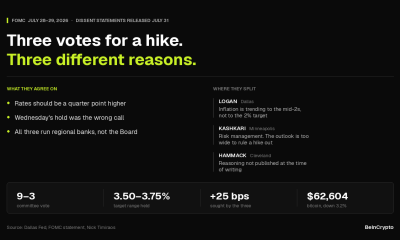
3 Fed Officials Just Explained Their Rate Hike Vote: Is Inflation Winning?
-

 Tech5 days ago
ESET tracks rise in malicious AI skills and adaptable malware
-
Crypto World4 days ago
XRP Ledger urges node upgrade after manifest flood
-

 Tech7 days ago
Gemini Spark can now use Chrome logins and saved passwords to run errands on your behalf
-

 Tech7 days ago
Building A Reproduction PlayStation Motherboard
-

 Sports6 days ago
France Cricket implodes: letters hidden in a drawer and a board at war
-

 Crypto World6 days ago
Moneyflip CEO charged in $40K murder-for-hire plot
-
 Sports6 days ago
Bruno Fernandes decision made as Man United ‘discuss’ striker transfer option
-

 News Videos5 days ago
Financial Crash Expert: The 90-Day Collapse Timeline They Are Desperately Hiding.
-

 NewsBeat7 days ago
Spain sending troops as thousands enter enclave of Ceuta from Morocco
-

 Sports6 days ago
Commonwealth Games 2026 Live Updates | Day 9 CWG 2026: Lovlina Borgohain, Sachin Siwach Enter Final After Indian Judokas Script History
You must be logged in to post a comment Login