
Business
ValuEngine Weekly Commentary: Will Disruptive Technologies Upend Aerospace Companies?


ValuEngine.com (VE) is a stock valuation and forecasting service founded by Ivy League finance academics. VE utilizes the most advanced quantitative techniques and analysis available.
Our research team continues to develop, test, and improve the VE Stock Recommendation, Valuation and Forecast Models related to stock price movement. This research is updated daily and applied to more than 4,200 US Stocks, 600 plus US ETFs, over 1,000 Canadian stocks, and all sector and industry groups.

Business
10 Emotional Tributes From Teammates and World Leaders to Lionel Messis Argentina Retirement


IBTimes US
Lionel Messi’s announcement that he is retiring from Argentina’s national team after 21 years drew an immediate wave of tributes Monday from teammates, world leaders and figures across the sport, with many describing the moment as the end of an era in Argentine and world soccer.
Messi, 39, revealed his decision in an emotional Instagram post, writing that he had made up his mind two days after Argentina’s 1-0 extra-time loss to Spain in the 2026 World Cup final, though he chose to keep the announcement private until after the death of his father, Jorge Messi, on Aug. 8. Here are 10 of the reactions that followed.
- David Beckham, the former England captain who owns Inter Miami alongside Messi’s club team, kept his response brief, posting three Argentina-colored heart emojis in reply to Messi’s announcement, according to Yahoo Sports.
- Rodrigo De Paul, Messi’s Argentina and Inter Miami teammate, wrote a message of pure gratitude in the comments of Messi’s post. “Just thank you, the greatest of all time, thank you for making us so, so happy, you can’t imagine how many smiles you brought!!” De Paul wrote, according to AFP.
- Angel Di Maria, who won the 2022 World Cup alongside Messi before retiring from international duty himself, focused on Messi’s choice to represent his country despite his global stature. “We will be grateful to you for the rest of our lives for being Argentine, for taking Argentina to the top of the world, and for choosing to be Argentine when you could easily have chosen something else. Thank you, Captain. Thank you for everything. The greatest in history,” Di Maria wrote, in comments translated from Spanish and reported by Yahoo Sports.
- Antonela Roccuzzo, Messi’s wife, shared a personal tribute to her husband’s perseverance. “I saw you keep going when things didn’t work out and always try again. And after so many years, I was also lucky enough to see you fulfill your dreams and live some of the happiest days of our lives. You deserved this story and so much more. We love you infinitely,” she wrote in Spanish, according to ESPN.
- Argentina President Javier Milei offered a characteristically blunt message of thanks on Instagram. “Thank you very much, impossible man,” Milei wrote, according to ESPN, with the second half of the message written in all capital letters in the original Spanish post.
- FIFA President Gianni Infantino praised Messi’s broader impact on the sport, describing his international career as “extraordinary” and crediting him with having “inspired millions of people and redefined our sport,” according to a statement reported by outlets including a Kansas City television station affiliate.
- Gary Lineker, the former England striker and prominent soccer broadcaster, framed Messi’s role for Argentina in terms extending well beyond the sport itself. “You didn’t just play for Argentina, you carried their hopes, dreams and expectations for two decades,” Lineker wrote, according to ESPN.
- Claudio Tapia, president of the Argentine Football Association, delivered one of the more evocative tributes among federation officials, according to a report from Reuters cited by ClutchPoints. Tapia called Messi “the captain of our dreams,” adding, “that kid, ‘La Pulga’, that alien… made us believe in magic. The Argentina national team shirt is your flag. And our people’s love for you will last forever.”
- Enzo Fernandez, who reached two World Cup finals alongside Messi, reflected on the emotional throughline of Messi’s international career, referencing his own reaction as a teenager when Messi first announced a national team retirement back in 2016. “Leo, when you said you were leaving the national team back then, I was really sad,” Fernandez wrote, according to Sports Illustrated.
- Lisandro Martinez, another current Argentina teammate, posted an emotional video reaction to Messi’s retirement that circulated widely on social media, according to a report from the Deseret News, which noted that a separate teammate remarked that “nothing ever prepares you for these moments.”
The outpouring of tributes reflects the scale of Messi’s international legacy. He finishes his Argentina career with 125 goals in 207 appearances, making him the country’s all-time leading scorer and placing him second only to longtime rival Cristiano Ronaldo, who has 146 international goals and has not yet announced his own retirement from Portugal duty, among men’s international scorers worldwide. Messi led Argentina to the 2022 World Cup title in Qatar and briefly held the record for most career World Cup goals during this summer’s tournament, before finishing one goal behind France’s Kylian Mbappe in that particular tally.

RomoloTavani/iStock via Getty Images

By Moira Woodhull
Constrained supply and persistent consumer demand for beef have led to near record-high prices across the cattle value chain. Typically, high-price environments eventually spur herd expansion driven by producer decisions. This ultimately brings forth an expanding supply and puts downward pressure on prices, transitioning into a lower price environment for the cattle industry.
Instead, challenges like sustained drought, high cost of feed and the New World screwworm outbreak have disrupted this cycle, stifling supply while prices remain high. Recent data suggests that consumers may finally be reaching their ceiling when it comes to retail beef prices, supported by growing production and availability of broilers (chicken). As the Mexican border begins its phased reopening to livestock trade in August, the industry will continue to closely watch for signs that the cattle cycle has reached its bottom.
Consumer Demand During the Grilling Season
Summer marks the traditional peak of grilling season. Holidays like Memorial Day, the Fourth of July and Labor Day drive significant short-term spikes in meat demand, often followed by post-holiday lulls. While consumer demand for beef remains resilient, the broader market continues to face significant supply constraints, sustaining near-record retail prices.
Cattle Cycle Contractionary Period
The cattle cycle represents the multi-year expansion and contraction of calf and cattle inventory in the United States as producers respond to price signals in the market. High prices incentivize producers to retain heifers and expand their herds to capitalize on potentially higher returns. Conversely, low prices encourage producers to send animals through the supply chain for processing to limit operational losses.
Cattle production requires substantial capital, including land and feed, among numerous other costs, like equipment and veterinary care. Herd expansion is a multi-year investment, as it often takes up to three years from the moment a producer decides to retain a heifer until her offspring reaches an average market weight of 1,200 to 1,500 pounds.
Given the lengthy process of raising calves and the significant capital required (not to mention the opportunity cost of holding back heifers and forgoing immediate sales), producers are incentivized to expand their herd during high-price environments, where the investment is more likely to pay off.
In low-price environments, producers are discouraged from retaining cost-intensive animals to receive relatively lower returns. Instead, calves are often moved to backgrounding or feedlot operations to continue gaining weight until they reach market weight, at which point they are ready for processing.
As cattle producers respond to price signals, they decide whether to expand their herd or push cattle through the value chain. Because of this long lifecycle, it takes years before impacts to supply are visible in cattle inventories.
With a nine-month gestation cycle for calving, weaning of calves and time spent grazing and feeding, it can take up to three years for new supply to appear in the market. That is, a producer may decide today to retain heifers with the aim of herd expansion, but an increase in slaughter-ready inventory won’t be apparent until multiple years later.
Currently, the cattle cycle is in a contractionary phase. Herd sizes are near historic lows, severely constraining market supply. Simultaneously, consumer demand has remained strong for beef products. This combination of herd lows and strong consumer demand has sustained near record-high prices across the supply chain.
Under normal conditions, today’s elevated prices would typically spur expansion. Instead, severe drought conditions restricting available pasture for grazing, elevated feed costs and the closure of the Mexican border to prevent the spread of New World screwworm have posed challenges to herd rebuilding. While the USDA has begun a phased reopening of the Mexican border, the supply impact will take time to materialize.
Low Supply, Strong Demand and Protein Substitution
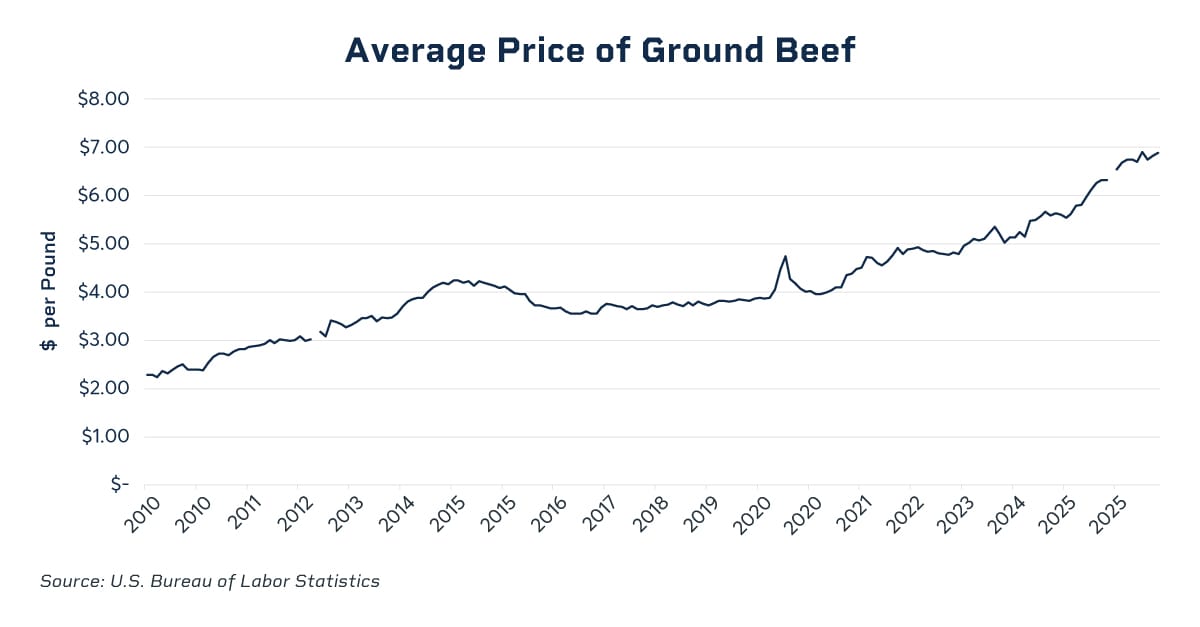
Constrained supply and sturdy demand have sustained high retail prices, evident in the trend of rising ground beef prices. Given these sustained high prices in beef, consumers now appear to be pivoting toward other, comparatively lower-priced alternatives, like chicken.
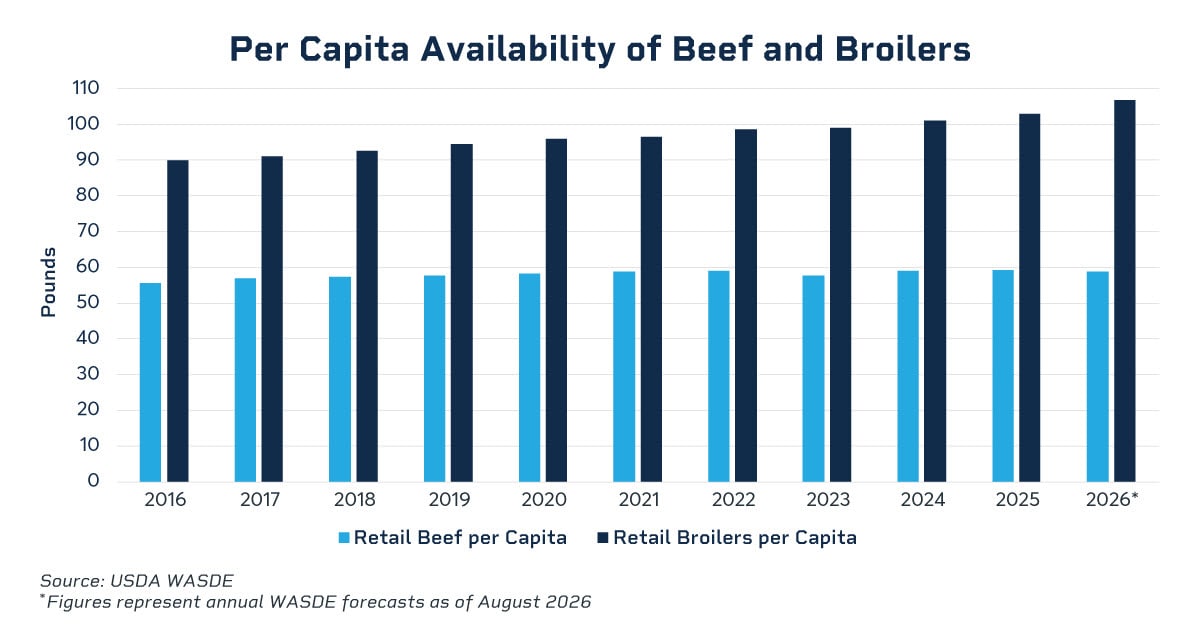
The USDA’s August 2026 World Agricultural Supply and Demand Estimates (WASDE) report projects annual beef production at 24,967 million pounds, down nearly 4% from 26,003 million pounds in 2025. On the contrary, 2026 broiler production is projected to reach 49,623 million pounds, up 3.4% from 48,006 million pounds in 2025.
Per-capita domestic availability, or “disappearance”, is used as a proxy for domestic consumption and currently reflects gradual shifts in the beef and broiler markets. As of August 2026, the USDA forecasts per-capita retail beef availability falling slightly and per-capita retail broiler availability trending upward. Even so, beef demand remains resilient, showing minor signs of softening despite historical price headwinds.
Managing Risk with CME Group Lean Beef Trim Futures and Options
As the industry navigates supply challenges and uncertainty over when the cattle cycle will bottom, tight inventories are contributing to sharp price swings at the processing level. Key processing inputs to ground beef continue to experience price volatility, as seen in price swings for both 50% lean beef trim and 90% lean beef trim.
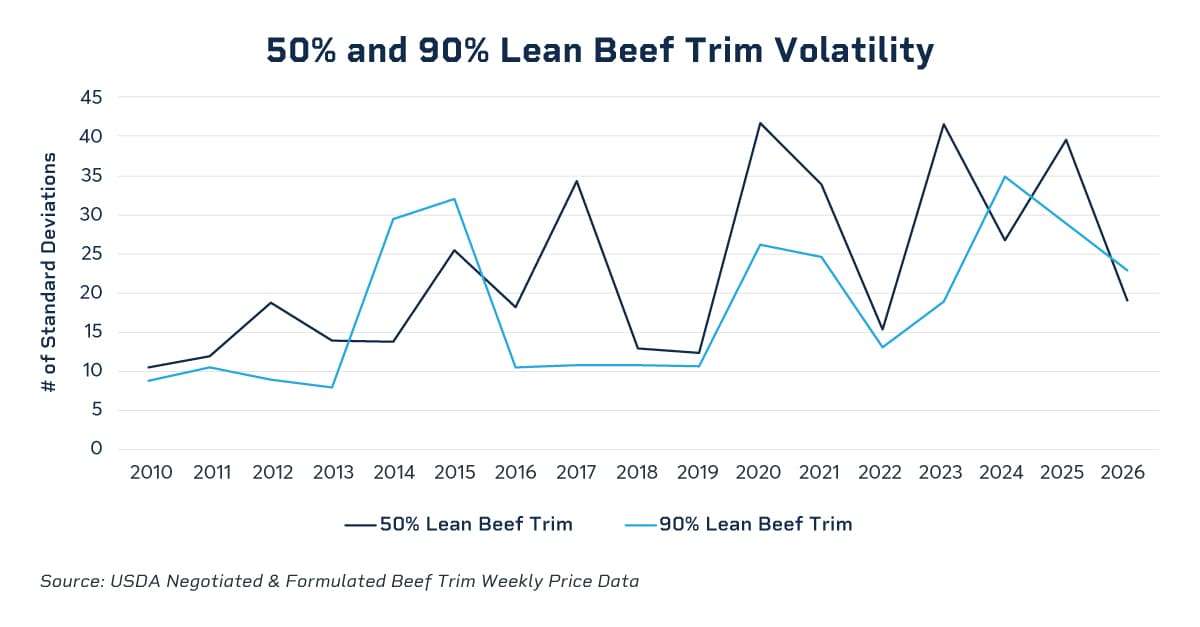
With the introduction of 50% and 90% Lean Beef Trim futures and options, CME Group now offers market participants hedging tools across the entire beef value chain, from feeder and live cattle to beef trim.

Amazon secretly overcharged more than a million advertising customers by manipulating the online auctions it uses to set ad prices, according to a lawsuit filed by the US Federal Trade Commission and a bipartisan group of 22 states.
The suit, filed on Monday in the company’s home state of Washington, claims the alleged scheme has likely netted Amazon $20bn from advertising customers since 2019. “Amazon overrides and replaces the actual auction results with higher prices set by Amazon to increase its profits,” the complaint states.
Amazon said in a statement that it “strongly disagrees” with the premise that it misled advertisers and called the suit “misguided”.
The case centres on the auctions behind the Sponsored Products and Sponsored Brands ads that brands and sellers compete to place when consumers search for products using keywords on Amazon’s ecommerce platform. Those placements are auctioned off to the highest bidder.
The complaint accuses Amazon of secretly charging advertisers more in so called “second price” auctions, in which the winning bidder expects to pay one cent more than the next highest bid. In practice, the lawsuit alleges, Amazon has charged its Sponsored Products advertisers their own winning bid close to 80 per cent of the time. The methods were spurred, the complaint says, because the company “was unhappy about how much revenue its advertising auctions were generating”.
FTC chairman Andrew Ferguson said: “Amazon has millions of advertising customers who were misled into paying significantly higher prices.” The regulator says more than 500,000 small and medium-sized businesses are among the advertisers affected.
Amazon responded that the FTC “fundamentally misunderstands how advertisers operate”. “Advertisers adjust bids based on real-world performance, not descriptions of auction mechanics,” the company said. “Average winning bids fell 50% from 2019 to 2025 on Sponsored Products search ads, and roughly 92% of placed ads are not given to the highest bid.”
The FTC, a US consumer watchdog, and the states also argue that shoppers have been harmed because the extra costs are passed on. “Consumers are suffering, have suffered, and will continue to suffer substantial injury as a result,” the complaint states. Amazon rejected that framing: “The FTC wants the public to believe this case is about higher prices for consumers. It is not.” The company’s shares fell after the lawsuit was announced, closing 2.5 per cent lower on Monday.
For the many UK small businesses that sell through Amazon, the cost of reaching customers on the platform is a familiar grievance. Researchers have previously reported that Amazon tripled sellers’ fees in Europe while advertising costs surged, and more than 200,000 UK third party sellers are pursuing a £2.7bn claim against the company at the Competition Appeal Tribunal over alleged abuse of its dominant market position.
The new case also extends a long running fight between Amazon and the US regulator. The FTC and 17 state attorneys general had already sued the company over claims it used monopoly power to inflate prices and punish sellers who offered lower prices elsewhere. And last year Amazon paid $2.5bn to settle FTC allegations that it enrolled millions of consumers in its Prime subscription service without their consent and knowingly made it difficult to cancel, a sum that included civil penalties and consumer refunds.

Jamie Young
Jamie Young is Senior Reporter at Business Matters, covering SME finance, employment law and Westminster policy since 2016. He has reported on every Budget and Autumn Statement since 2018, helped make sense of the ‘covid era’ and the bounce-back loan scheme from launch through the fraud investigations, and broke the magazine’s coverage of the 2024 late-payment reforms. He joined Business Matters straight from completing his BA in Administration from Exeter University and is NCTJ-qualified. Reach him at jyoung@cbmeg.co.uk

Oil prices rise as latest fighting resurrects Middle East supply disruption risks

From 16 October 2026, Thailand’s CAAT will revise checked baggage procedures to enhance security. Bags may be inspected without owners present. Updates and guidance will be provided by TAT and airlines.
New Baggage Procedures in Thailand
The Tourism Authority of Thailand (TAT) is alerting travelers about updated baggage procedures effective 16 October 2026. Passengers should check guidelines from their airlines, departure airports, and the Civil Aviation Authority of Thailand (CAAT) for the latest on prohibited items and baggage rules. CAAT is implementing these changes to enhance security and streamline the screening of checked luggage, with existing measures remaining active until the transition.
Baggage Inspection Protocols
The new procedures allow for luggage inspection without the owner’s presence if suspicious items are detected. These checks will occur in a controlled area and be recorded for transparency. Notification will follow any inspection, ensuring passengers are informed. Similar protocols are already in use in countries like Singapore, Japan, and the United States. This approach minimizes delays and addresses security concerns without needing passenger involvement.
Recommendations and Resources
CAAT advises using TSA-approved locks and avoiding valuables or essential items in checked luggage. Passengers should also confirm baggage regulations for international connections, as rules differ across countries. Any issues during inspections can be reported to airlines or through CAAT’s complaint system. TAT promises updates if further operational guidelines are released before the new rules commence.
Source : Thailand introduces enhanced baggage screening procedures: information for air travellers
Business
Strike Energy Limited (STKKF) Discusses Commercialisation Breakthrough and Aligned Gas Processing Solution for West Erregulla – Slideshow

Strike Energy Limited (STKKF) Discusses Commercialisation Breakthrough and Aligned Gas Processing Solution for West Erregulla – Slideshow

Broadcom: Why Q3 Is Not Going To Change Anything

Copper and gold-focused Medallion Metals has backed GR Engineering Services’ knowledge of its Ravensthorpe gold project.

Li Auto reports August deliveries of 37,679 vehicles

A shortage of soft skills, work readiness and resilience among young people risks fuelling Britain’s youth unemployment crisis, business leaders have warned.
Almost one million people aged 16 to 24 are classed as Neet, meaning not in education, employment or training, and ministers are particularly concerned about the number of young men out of work: 54 per cent of Neets are male.
The warnings emerged from research for the review of the Neet epidemic being led by the former Labour cabinet minister Alan Milburn, which is due to be published in the autumn. As part of that work, the Department for Work and Pensions (DWP) asked business leaders what barriers they faced when hiring young people.
The biggest challenge, cited by 41 per cent of employers in the survey of 500 businesses, was young adults’ level of “soft skills or work readiness”. The National Careers Service lists communication, decision-making, organisation and adaptability among the soft skills typically gained through schooling, work and life experience.
Bosses’ next biggest concern was work experience, cited by 40 per cent, while 32 per cent said resilience was a concern and 31 per cent worried about technical skills.
The findings land against a worsening statistical backdrop. Figures published by the Office for National Statistics last week showed an estimated 981,000 people were classed as Neet in the three months to June, a year on year increase of 30,000, of which men and boys accounted for 25,000. The total has now hovered close to the one million mark for months, a level last seen in the aftermath of the financial crisis.
Milburn has called the Neet statistics a “scar on this country”. His final report, due in October, will include recommendations for bringing the numbers down, and research for his interim report, published in May, found that 84 per cent of Neets want to be learning or working. The government has already appointed the former Marks & Spencer chief Marc Bolland to rally employers behind a push to get young people into work.
Separate research by the Federation of Small Businesses (FSB) found that 37 per cent of employers had faced difficulties recruiting in the last year because applicants lacked relevant soft skills.
Tina McKenzie, the national chair of the FSB, said: “That’s why it is important not only to expand access to work experience and placements, but also to lay the foundations for employment success within the curriculum itself.
“Improving financial and enterprise education in schools, alongside the development of essential soft skills, will help equip students with the knowledge and confidence they need. When young people arrive in the workplace with a basic understanding of how working life, pay, and enterprise operate, they are much better prepared.”
Teachers share the concern. In a separate survey of more than 1,000 education professionals for Milburn’s review, 66 per cent said they believed young people’s preparedness for work had declined over the past five years, while 60 per cent reported a decline in soft skills over the same period. Nearly three quarters said there was too much focus on passing exams and that the curriculum should be broadened to include more work-related skills “without lowering academic standards”.
The review is not expected to lay the blame on schools alone. A source close to Milburn said: “While schools have to do more to focus on work readiness, employers have responsibility too, not least in expanding opportunities for youngsters.” Some large employers have begun to move, with McDonald’s launching 2,500 paid work experience placements aimed at young people facing barriers to employment.
Young people themselves report feeling underprepared. DWP research found that 47 per cent of those aged 18 to 24, and just 36 per cent of Neets, agreed that they felt ready for work when they left education. Less than half said their school or college sufficiently supported them to develop the skills they need for the future.
Ben Harrison, the director of the Work Foundation at Lancaster University, said: “Young people need the right support at school and as they move into employment to build confidence, workplace skills and resilience, alongside access to health support where they need it.
“Employers have an important role to play too. We have heard from young people about recruitment processes that feel increasingly difficult to navigate, including the use of AI, repeated applications with little or no feedback, and expectations that candidates already have significant experience before they have had a chance to get a foot in the door.
“At a time when entry-level opportunities are already in short supply, these practices risk compounding the barriers young people face and making an already difficult transition into work even harder.”

Amy Ingham
Amy Ingham is a reporter at Business Matters, covering UK business news with a focus on breaking news, business policy, late payments and insolvency. She joined the magazine in 2026 after completing the NCTJ Diploma in Journalism at Harlow College’s journalism school. Her recent reporting includes British Steel’s nationalisation and its impact on SME suppliers, the decline in late payments by large firms, and Insolvency Service director disqualifications. Reach her at aingham@cbmeg.co.uk.

Watch: Flock’s rapidly expanding AI surveillance network faces growing backlash

Anthropic shares seized from FTX executives sold in 2025

Australia Vs India: Australia announce A squad for India tour: Peter Handscomb, Sam Konstas, Jhye Richardson in mix for Test return | Cricket News

Weekend Open Thread – Corporette.com

Weekend Open Thread: Brooks Brothers

London Mayor Sadiq Khan handed a peerage by Keir Starmer alongside 15 other Labour figures… just days before the PM leaves No10

The Crypto Market Is About To Fall Into Absolute CHAOS (Here’s My Plan)

Ripple Built the Financial Machine. Is XRP the Missing Piece?

SHOCKING! US BANKS TO LAUNCH THEIR OWN BLOCKCHAIN & STABLECOINS! BLACKROCK’S BIG BITCOIN ETF CHANGE!
-

 Crypto World6 days ago
SpaceX stock could rise 75% to $240, JPMorgan says
-

 Fashion3 days ago
Weekend Open Thread: Maeve – Corporette.com
-

 Crypto World4 days ago
Bitcoin’s 22% rally now needs real demand to outlast Treasury liquidity boost
-

 Crypto World6 days ago
Warsh Jackson Hole keynote puts financial innovation first
-

 Business4 days ago
Salesforce Stock Soars 19% as Blowout Earnings and Agentforce AI Growth Silence Software Skeptics
-

 Crypto World5 days ago
Elon Musk Grok Bot Promise: We Will Make You Whole if AI Loses Your Money
-

 Crypto World6 days ago
Did Trump Just Move SpaceX Stock With One Truth Social Post?
-

 Business4 days ago
Apple Confirms September 9 Keynote and Reveals Its Full Pre-Order Schedule
-

 Business3 days ago
Onto Innovation Stock: AI’s Next Bottleneck Is Yield (NYSE:ONTO)
-
 NewsBeat5 days ago
Lindsay Clancy jury braces for closing arguments as judge tells court: ‘You’ve heard all the evidence’ – Live updates
-

 Business6 days ago
Walmart takes aim at younger shoppers with new fashion brand
-

 Crypto World3 days ago
Bitcoin price tests $82K resistance as Brandt stays long
-

 Business6 days ago
Thailand’s Eastern Economic Corridor Capital City (EECiti): Key Developments and Investment Opportunities
-

 Crypto World5 days ago
NVIDIA revenue hits $96.2B as AI demand doubles
-

 Business4 days ago
iPhone 18 Pro Pre-Orders Could Shift to Saturday as Apple Reportedly Avoids September 11 Anniversary
-

 NewsBeat6 days ago
Trump’s trade truce with China faces test with Iran effort
-
 Crypto World5 days ago
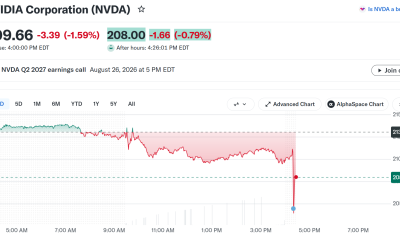
Nvidia Q2 Earnings Reveal $96.2 Billion Beat, So Why Is NVDA Falling?
-

 Tech5 days ago
Claude Cowork gets its own browser that doesn’t touch your tabs, bookmarks, or saved passwords
-

 Crypto World4 days ago
Truflation calls for Fed rate cut after PCE forecast
-
 Tech2 days ago
Hugging Face built a $4.5 billion empire on free AI models. Now Nvidia is buying it for $12.9 billion
You must be logged in to post a comment Login