
Business
(VIDEO) Australia vs Cameroon Soccer Friendly Match Result: Socceroos Edge Cameroon 1-0


SYDNEY — Jordy Bos scored a late winner as the CommBank Socceroos claimed a narrow 1-0 victory over Cameroon in their first FIFA Series 2026 match Friday night at Accor Stadium. The result gives Australia a positive send-off in their final home appearance before heading to the 2026 FIFA World Cup in North America.

Bos struck in the 85th minute to break a stubborn deadlock in front of a passionate Sydney crowd, sparing the Socceroos what could have been a frustrating goalless draw against a well-organized Indomitable Lions side. Goalkeeper Mathew Ryan earned player-of-the-match honors with several key saves as Australia controlled much of the second half but struggled to convert dominance into goals until the closing stages.
The match, part of the FIFA Series double-header that also featured China PR against Curaçao earlier in the evening, served as vital preparation for Tony Popovic’s squad ahead of the expanded 48-team World Cup. Australia, ranked around 27th in the world, will face Curaçao in Melbourne on Tuesday in their second and final home friendly of the March window before traveling to a pre-tournament camp in Florida.
Match Summary and Key Moments
The first half remained cagey, with both teams showing early rust from the international break. Cameroon, coming off a heavy defeat in recent preparations, sat deep and frustrated Australia’s attempts to break through the middle. The Socceroos enjoyed more possession and created half-chances, particularly through midfielders Jackson Irvine and Aiden O’Neill, but lacked a clinical edge in front of goal.
No goals came before halftime despite Australia’s territorial advantage. Cameroon threatened on occasional counter-attacks, forcing Ryan into action with smart stops to preserve the clean sheet.
The second half followed a similar pattern until the final 10 minutes. Australia increased the tempo, pushing numbers forward and creating sustained pressure. Bos, introduced as a substitute, made the decisive impact with a well-taken finish after good work down the right flank. The goal sparked celebrations among the home fans, who had grown anxious as the clock ticked down.
Cameroon pushed for an equalizer in stoppage time but could not find a way past a resolute Australian defense anchored by experienced campaigners. The final whistle confirmed a hard-fought win that boosts confidence without revealing too much tactical detail ahead of the World Cup.
Popovic’s Assessment
Post-match, coach Tony Popovic praised the team’s resilience while acknowledging areas for improvement. “It was a typical friendly where both sides are protecting information, but we showed good character to keep pushing and get the result,” he said. “Jordy’s goal was excellent, and Mat Ryan was outstanding again. These matches are about building cohesion and sharpness.”
Popovic rotated his squad, giving opportunities to several players on the fringes of the World Cup selection. With the 26-man squad due to be finalized in May, performances in Sydney and Melbourne will carry extra weight for fringe candidates.
Cameroon coach Rigobert Song expressed disappointment with the defeat but highlighted his team’s defensive discipline. “We came to compete and made it difficult for Australia. In the end, one moment decided it. We will learn from this and prepare for our next challenge,” he said.
Context for the Socceroos
The victory extends Australia’s positive momentum after securing direct qualification for the 2026 World Cup with strong results in the AFC third round. It also continues a solid run in home friendlies under recent coaches.
Historically, the Socceroos have faced African opposition sparingly. Their only previous meeting with Cameroon ended in a 1-1 draw at the 2017 FIFA Confederations Cup. Friday’s result improves that record and provides valuable experience against a physical, athletic style common in African football.
Key performers included Ryan in goal, the central defensive pairing, and attacking contributors who created the late chance for Bos. The Socceroos will now shift focus to the Tuesday clash against Curaçao at Marvel Stadium in Melbourne, where they aim to build further rhythm and fitness.
Broader FIFA Series Significance
The FIFA Series provides an opportunity for nations from different confederations to gain competitive minutes outside traditional windows. For Australia, facing Cameroon and Curaçao offers a mix of physicality and technical challenges that mirror potential World Cup opponents.
With the tournament expanding to 48 teams, every match in this preparation phase carries importance. Popovic has emphasized the need for adaptability, squad depth and mental toughness — qualities partly tested Friday night.
Fans at Accor Stadium created a strong atmosphere despite cool Sydney conditions, delivering vocal support that the players acknowledged after the final whistle. The double-header format also boosted attendance and showcased Australian soccer infrastructure.
What’s Next
Australia departs for North America after the Melbourne friendly for further warm-up matches, including a clash against Mexico on May 30. The Socceroos will then join the World Cup draw outcomes and finalize preparations in a high-performance camp.
For Cameroon, the tour of Australia forms part of their own buildup, though they are not qualified for the 2026 finals. The Indomitable Lions will use these games to assess players and maintain competitive edge.
The 1-0 result, while not a dominant display, delivers three points in a non-competitive friendly context and valuable minutes for the squad. It underscores the Socceroos’ ability to grind out results when fluency is lacking — a trait that could prove crucial in the high-stakes environment of a World Cup group stage.
As the countdown to June 2026 intensifies, Friday’s narrow win at Accor Stadium offers encouragement for a nation eager to see its team progress deeper than the round of 16 achieved in 2006.



Italian market watchdog deems all MPS board slates fully legitimate, source says
Business
Nike Earnings Preview: The Company Really Needs To Return To Mid-Single-Digit Revenue Growth

Nike Earnings Preview: The Company Really Needs To Return To Mid-Single-Digit Revenue Growth
Business
Ajanta Pharma, Sun Pharma poised to tap GLP-1 opportunity amid market shift: Siddhartha Khemka

The addressable opportunity remains substantial. With an estimated 75–80 million obese individuals and a large proportion suffering from co-morbid conditions, the need for structured obesity management is becoming increasingly evident. GLP-1 penetration, which remained low due to patent protection, is now expected to rise meaningfully as affordability improves and distribution expands. Over the next 3–5 years, the market could scale to INR34–67 billion, driven by rising patient adoption and chronic therapy demand.
A key growth driver is the expanding prescriber base. While endocrinologists and diabetologists remain primary stakeholders, adoption is increasingly being supported by cardiologists, gastroenterologists, gynaecologists, and other specialists due to the multi-system impact of obesity and metabolic disorders. This broadening ecosystem is expected to accelerate awareness, referrals, and prescription volumes, reinforcing long-term demand visibility.
However, the sector faces structural challenges. The entry of over 10–15 players has intensified competition, leading to rapid market fragmentation and pricing pressures. Despite a large volume opportunity, individual revenue gains are likely to remain modest, with low single-digit contribution to overall sales for most participants. Limited prescription bandwidth—where physicians typically engage with only a handful of brands—further constrains market share potential, increasing the need for aggressive marketing and elevating promotional costs.
Pricing dynamics also reflect a clear stratification, with premium, mid-tier, and mass-market strategies co-existing. While this enhances accessibility, it accelerates commoditisation, weighing on margins across the value chain. Additionally, companies risk diverting focus from established portfolios amid heightened competition in this segment.

An emerging structural trend is the rising preference for next-generation therapies. Even as semaglutide drives awareness and category expansion, newer molecules with superior efficacy are witnessing faster uptake and stronger physician preference, indicating a potential shift in long-term market leadership.
Overall, the GLP-1 segment in India presents a compelling volume-led growth opportunity underpinned by strong demand fundamentals. However, the combination of pricing pressure, intense competition, and limited differentiation suggests that value capture may remain constrained, making scale and execution critical in navigating this evolving landscape.
Ajanta Pharma: Buy| Target Rs 3400
Ajanta Pharma is preparing to launch generic semaglutide post patent expiry of Novo Nordisk’s Ozempic/Wegovy in India, while continuing to expand its portfolio in high-growth segments such as dermatology, pain management, and nephrology. Ajanta Pharma’s long-term growth is driven by its expanding presence in branded generics across India, US, Africa, and Asia, with a focus on chronic therapies and new launches supporting sustained demand and deeper penetration in high-growth markets. Management expects mid-teens revenue growth with EBITDA margins around 27%, supported by expansion in Asia and Africa, a strong US product pipeline, and strategic addition of medical representatives to drive execution.
Sun Pharma: Buy| Target Rs 1940
Sun Pharma’s Innovation momentum remains a key growth pillar, with specialty and novel therapies scaling up meaningfully. USD1b+ innovative sales (ex-milestones) provide resilience against US pricing pressure, while strong domestic formulation execution, consistent market share gains, and ROW/EM stability underpin diversified, sustainable growth drivers. In 3QFY26, SUNP delivered in-line adjusted revenues and EBITDA 6% ahead of estimates, supported by robust DF growth and favorable mix. Margin expansion reflected execution strength, partly offset by continued weakness in US generics due to regulatory headwinds at select sites. We estimate EM+ROW revenues to reach INR230b over FY25-28 at 12% CAGR, while specialty sales grow 11% CAGR to USD1.7b. Sustained DF outperformance, rising innovative R&D intensity, and steady pipeline launches support earnings visibility.
(The author is Siddhartha Khemka, Head of Research – Wealth Management, Motilal Oswal Financial Services)
(Disclaimer: Recommendations, suggestions, views, and opinions given by experts are their own. These do not represent the views of the Economic Times)
Business
Silver lining to market crash? Analysts say Nifty now at fair valuations after 9% March selloff; what lies ahead

However, as bears reigned over markets and wiped out significant amounts from investors’ portfolios, valuations may have quietly improved. The market correction since the beginning of the war has brought Nifty’s valuations down to fair levels, said VK Vijayakumar, Chief Investment Strategist at Geojit Investments. He added that Nifty is now trading at about 19 times, which is lower than the last 10-year average of 22.4 times.
Aakash Shah, Technical Research Analyst at Choice Equity Broking, also said that the ongoing correction in Nifty 50, largely triggered by geopolitical tensions and a spike in crude oil prices, has indeed cooled off valuations from previously elevated levels.
Has Nifty hit its bottom?
Aakash Shah however noted that it is premature to conclude right now that the market has hit a durable bottom. “The Nifty has corrected approximately 12-14% from its recent highs…The index continues to trade below its short-term moving averages, indicating that the trend remains fragile and lacks strong bullish confirmation,” he said.
Ajit Mishra, SVP Research at Religare Broking, also said that it would be premature to conclude that the Nifty has formed a durable bottom or is at a “perfect buying level”. “The lack of meaningful cooling in volatility also indicates that the market has not yet transitioned into a stable phase,” he added.
Why caution is warranted
Vijayakumar from Geojit Investments cautioned that in case India’s macros take a hit due to this energy crisis, valuations may again decline, factoring-in the feared hit to earnings growth in FY27. “The Indian economy is strong enough to absorb the shock if the war ends, crude cools down and gas availability becomes normal. But if the war prolongs, crude remains elevated for months together, and gas availability constraints continue, the stress on India’s macros will be significant and the market will discount that. In brief, everything boils down to how long the war will last,” he said.“While valuations have turned fair, it is still premature to call a definitive bottom. Technically, the market is in a corrective phase with intermittent pullbacks. Strategy-wise, investors should avoid aggressive buying and adopt a staggered or wait-and-watch approach, as the current phase appears to be consolidation rather than a confirmed bottom formation,” said Shah from Choice Equity Broking.
Stock markets crashed on Friday, with the Sensex plunging nearly 1,700 points and Nifty closing below 22,850. The decline followed a strong two-day rally of over 3.5% in the benchmarks. A record-low rupee, along with fading hopes of a de-escalation in the Iran–US conflict, weighed on sentiment and brought bears back to Dalal Street.
(Disclaimer: Recommendations, suggestions, views and opinions given by the experts are their own. These do not represent the views of The Economic Times)

Israeli military says it identified a launch of a missile from Yemen

Investors in Private Credit Funds Are Fretting About One Type of Loan Payment


Rubio sees US action in Iran completed in weeks as airstrikes rumble on

Let A Thousand Scenarios Bloom
Business
ETMarkets Smart Talk | Bharat investors to drive next growth wave in wealth management: Nilesh Naik
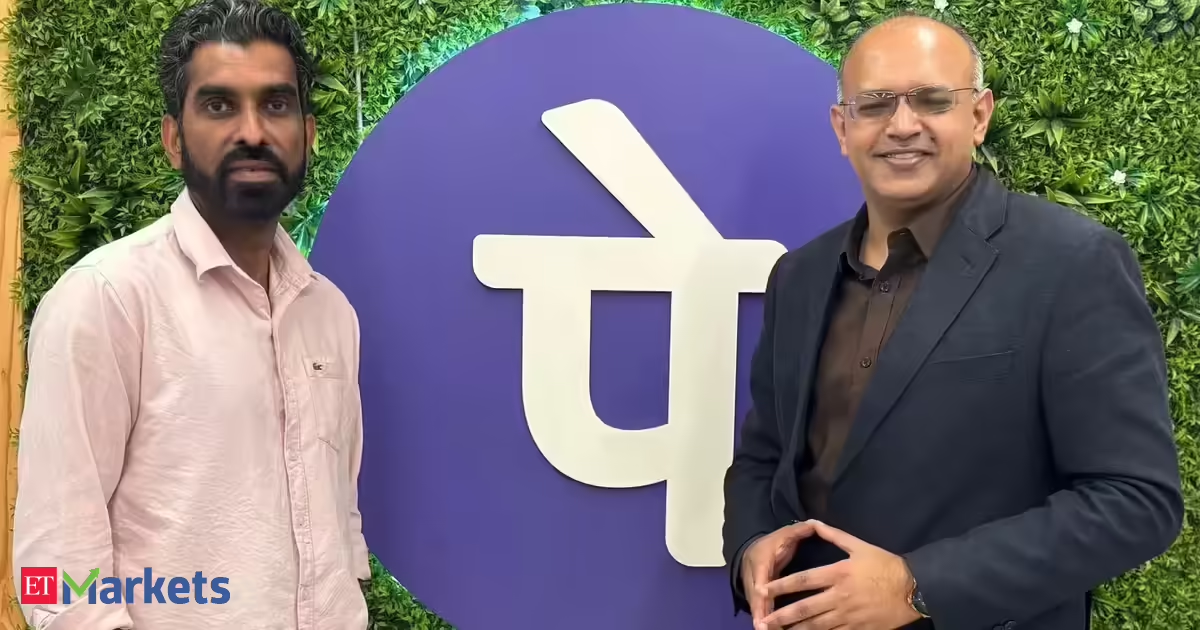
In an interaction with Kshitij Anand of ETMarkets Smart Talk, Nilesh D. Naik, Head of Investment Products at Share.Market, highlighted how the rise of ‘Bharat’—spanning tier II, tier III, and smaller towns—is reshaping the wealth management ecosystem.
With deeper digital penetration and growing participation from B30 cities, he believes this segment will be instrumental in expanding India’s investor base from around 60 million to nearly 200 million over the next decade, while also redefining how platforms approach product design, education, and investor behaviour. Edited Excerpts –
Kshitij Anand: Now that the access problem has been solved by digital apps, what specific psychological barriers are preventing retail investors from making those intelligent decisions?
Nilesh D. Naik: You are right— from an access perspective, the problem has largely been solved over the last five to six years. But one of the key challenges today is the complexity involved in starting the investing journey. And I think that is where platforms need to spend a lot of time.
For example, for people who have been investing in mutual funds, it may not be that difficult— mutual funds may come across as a very simple product.
But for a first-time investor, with thousands of products available, how do you zero down on the right one? That remains a big challenge. Going forward, you will see a lot of platforms focusing on this area in a big way.
Kshitij Anand: And how can a retail investor distinguish between a fund that is genuinely consistent and one that is simply riding a temporary market tailwind?
Nilesh D. Naik: Yes, this is an interesting question and one of the key issues that has been widely discussed in the industry. The general tendency of customers is to go by performance— they look at three-year or one-year performance and invest accordingly.
At least at PhonePe, we have tried to address this issue by not focusing too much on performance, but by highlighting the consistency of the product. When I say consistency, there are complex concepts like rolling returns and so on.
We try to simplify these, do the heavy lifting at our end, and present a simple metric that helps customers see whether the product has been consistent over the long term in relative terms, compared to other schemes in the category.
I think it is very important to shift the focus away from point-to-point returns, which are highly cyclical— not just at the market level, but even at the relative performance level. So yes, this is a key area to focus on.
Kshitij Anand: And at PhonePe, you very much believe in the Bharat story. So, how is that evolving at PhonePe and in the wealth management space?
Nilesh D. Naik: Yes, the strength of PhonePe is our distribution reach, and we have a very strong presence in tier II, tier III cities and beyond. Just to share some numbers with you—if you look at the mutual fund customers that we have, more than two-thirds of them are from B30 cities, beyond the top 30, as per the AMFI definition.
And not just from a customer perspective, but even from an AUM perspective, this is very different from the industry numbers, where it is actually the other way around, at least in terms of assets. So, the participation that we have seen is very encouraging, and it motivates us to build more for that cohort.
That is going to be the growth engine for the industry as well, in terms of moving from a 60 million customer base to, let us say, 200 million over the next decade or so.
Kshitij Anand: And let me also get your perspective on this—in a market that is prone to sudden volatility, how can platforms move beyond just providing data and actually help engineer better investor behaviour?
Nilesh D. Naik: Yes, it does not start with volatility. What you need to do is ensure that when the customer or investor is investing, at that stage itself, you offer the right kind of product mix. That will take away half the problem because when you invest in the wrong product, the volatility tends to be much higher.
A classic example today is investors who have invested in small caps. For a first-time investor, the kind of volatility experienced there is very different from someone who started with a large-cap, index, or hybrid product.
So, retaining a customer who has invested in core products is relatively easier compared to someone investing in small-cap or thematic products.
However, when such situations arise, there cannot be a single solution that addresses the entire problem. Continuous education is very important. Having the right contextual education within the app is critical. The nudges you give to customers—guiding them on how certain actions may work against them—are also very important. And of course, customers learn through experience.
No matter how much we educate them, experience cannot be replaced. The good thing is that many of these customers are in their 20s, which means over the next three to four years, if they continue investing, they will develop their own learning—and that is the best teacher.
Kshitij Anand: Staying with the Bharat story, as investors spread into tier II and tier III cities, how do we ensure that intelligence is simplified enough to be accessible to first-time investors?
Nilesh D. Naik: There are different ways to do this, but I can share what we have done at PhonePe Wealth to help customers. When it comes to shortlisting or identifying funds, there are three core parameters that we focus on.
The first is the consistency of the fund’s performance. The second is risk. And the third is whether there is a method behind that performance. By method, I mean the style of the fund manager and how the product is managed.
We have launched an interesting tool called CRISP, which stands for Consistency, Risk, and Investment Style of Portfolio. We understand that these are relatively complex concepts, so we simplify them by categorising factors such as consistency into high, medium, or low; and risk into acceptable or high levels, so that investors can make informed decisions.
Lastly, we also explain how the product is managed—whether it follows a quality, value, or momentum style—so that customers can create the right mix of funds that complement each other.
However, even with simplification, education remains critical. We are focusing a lot on educating customers about these concepts in a simple and accessible manner.
Kshitij Anand: Do you feel there is any single mistake that investors usually make when selecting a fund or investing?
Nilesh D. Naik: Two things I would highlight here. One is, of course, investing based on past performance. In fact, we have done several studies wherein, if you look at, say, the previous three-year ranking of funds in a category and compare it with the next three years—for example, 2019 to 2022 versus 2022 to 2025—and then look at the ranks, the rank correlation is actually close to zero.
This means there is absolutely no correlation between the two, which tells you that investing based on past performance does not work. However, it is a common behaviour among customers to look at returns and invest, and this is where one of the biggest mistakes comes from the customer side.
The second is the absolute lack of planning. It is like someone tells me that this is a good fund, and I invest without thinking about why I am investing or what my framework should be.
Every investor, no matter how small the investment, needs a framework that they can refer back to, especially during times when markets are highly volatile. Otherwise, you will keep debating whether to add more equity or redeem. Having a framework helps.
When I say framework, it means understanding that your investment is long term and defining the level of downside risk you can tolerate. For example, based on recent data, markets can fall by as much as 40% in a worst-case scenario.
But if, as an investor, I cannot tolerate more than a 20% downside, then I would probably allocate 50–60% to equity and the rest to fixed income products, gold, etc. Now, whenever something happens in the market, you can go back to that asset allocation framework and assess whether you are still aligned with your plan.
It is a very simple concept, and there can be many variations of it. But having a proper plan is extremely important, and this is something that is missing for most investors.
(Disclaimer: Recommendations, suggestions, views, and opinions given by experts are their own. These do not represent the views of the Economic Times)

Netflix’s Prices Are Increasing. Don’t Expect Streaming to Get Cheaper Soon.

Tiger Woods arrested on suspicion of DUI after car crash in Florida | World News

FBI Tells Senate It’s Still Bypassing 4th Amendment By Purchasing Location Data From Third Parties

22 MINUTES OF MY HONEST TAKE ON BITCOIN RIGHT NOW


-
 NewsBeat3 days ago
Manchester United reach agreement with Casemiro over contract clause amid transfer speculation
-

 News Videos2 days ago
Parliament publishes latest register of MPs’ financial interests
-

 Crypto World6 days ago
Best Crypto to Buy Now: Strategy Just Spent $1.57 Billion on Bitcoin During Fear While Early Investors Quietly Enter Pepeto for 150x Potential
-

 Crypto World6 days ago
Bitcoin Price News: Bhutan Sells $72 Million in BTC Under Fiscal Pressure, but the Smart Money Entering Pepeto Sees What the Market Does Not
-

 Sports5 days ago
Remo Stars and Kano Pillars Strengthen Survival Hopes in NPFL
-

 Sports5 days ago
Gary Kirsten Accuses Pakistan Cricket Board Of ‘Interference’, Mohsin Naqvi Responds
-

 Business6 days ago
No Winner in March 21 Drawing as Prize Rolls to $133 Million for Next
-

 Tech5 days ago
Give Your Phone a Huge (and Free) Upgrade by Switching to Another Keyboard
-

 Tech5 days ago
AI enters the chat: New Seattle dating app relies on tech to facilitate meaningful human connections
-

 News Videos5 days ago
Ch 9 Financial Management Part 1 | Detailed One Shot | Class 12 Business Studies Boards 2026
-

 Tech6 days ago
Today’s NYT Connections Hints, Answers for March 22 #1015
-

 Business1 day ago
Instagram, YouTube Found Responsible for Teen’s Mental Health Struggle in Historic Ruling
-

 Business6 days ago
Will Duke Basketball Win It All? Duke Basketball Enters Second Round as Third Favorite to Claim NCAA Title
-

 Sports5 days ago
2026 Kentucky Derby horses, odds, futures, preview, date: Expert who hit 12 Derby-Oaks Doubles enters picks
-
 NewsBeat6 days ago
Update on Wisbech river crash as search for teenage boy enters fifth day
-

 NewsBeat7 hours ago
The Story hosts event on Durham’s historic registers
-
 Entertainment5 days ago
Cynthia Bailey Dishes on ‘RHOA’ Season 17, Discusses Kandi
-

 Tech4 days ago
Samsung will soon let you control smart home devices from your car’s dashboard
-

 Fashion3 days ago
Does It Matter What You Wear When You’re Laid Off and Looking?
-
 NewsBeat3 days ago
Tesco is selling new Cadbury Dairy Milk bar and people can’t wait to try it
You must be logged in to post a comment Login