
Business
(VIDEO) Dodgers Set Opening Day Rotation With Roki Sasaki in Mix Despite Spring Struggles

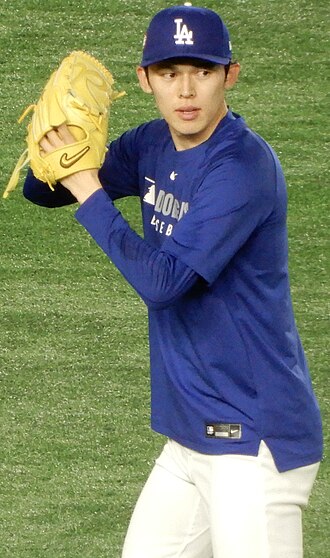
The Los Angeles Dodgers have finalized their starting rotation plans for the beginning of the 2026 season, naming Yoshinobu Yamamoto as the Opening Day starter and confirming that Japanese right-hander Roki Sasaki will open the year in the rotation despite a rocky spring training.

Manager Dave Roberts revealed the group’s composition Tuesday, listing Yamamoto, Tyler Glasnow, Sasaki, Emmet Sheehan and two-way star Shohei Ohtani as the primary starters to begin the campaign. Justin Wrobleski is expected to provide piggyback relief or long outings early on as the club eases its high-upside arms back into game action following the shortened spring.
The Dodgers, fresh off a 2025 World Series title, will host the Arizona Diamondbacks in their home opener Thursday, March 26, at Dodger Stadium. Yamamoto, who earned World Series MVP honors last October, gets the ball first against Arizona ace Zac Gallen in what promises to be a marquee matchup.
Roberts indicated the initial order will likely feature Yamamoto on Opening Day, followed by Glasnow, Sasaki, Sheehan and Ohtani in some sequence across the first week. Ohtani is slated to make his first start of the season March 31 against the Cleveland Guardians. The club plans to lean on a five-man rotation initially but has the depth to shift to six once Blake Snell and others return from injuries.
Sasaki’s inclusion comes with caveats. The 24-year-old right-hander, who signed with the Dodgers before the 2025 season after dominating in Japan’s Nippon Professional Baseball, has struggled with command and mechanics this spring. He posted concerning results in Cactus League outings, including control issues that led the team to adjust his buildup with backfield “B” games and simulated innings.
Despite the uneven performances, Roberts has remained steadfast.
“He’s going to be one of our starters” to open the season, Roberts said this week, emphasizing that spring training stats alone do not define readiness. The manager pointed to Sasaki’s talent, work ethic and the organization’s belief that his performance will trend upward once the regular season begins.
Sasaki flashed elite stuff in limited 2025 action, touching triple digits with his fastball and deploying a devastating splitter. He began last year in the rotation but shifted to the bullpen late in the season, where he excelled as a high-leverage reliever and even served as a closer option during the postseason. His October contributions helped the Dodgers claim their championship.
General Manager Brandon Gomes and President of Baseball Operations Andrew Friedman have consistently viewed Sasaki as a starter long-term, citing his two-pitch dominance in Japan and potential to develop further with better execution and health.
“He’s feeling awesome physically,” Gomes said earlier this offseason. The club has worked with Sasaki on refining his cutter and two-seam fastball to complement his heater-splitter arsenal, aiming to give him more weapons against big-league lineups the third time through the order.
Fan frustration has surfaced at times. Reports and social media clips from spring games captured moments where Sasaki heard boos from Dodger Stadium crowds after shaky outings, echoing occasional heckling he faced on the road last season. In one memorable 2025 postseason exchange against the Philadelphia Phillies, Sasaki shrugged off boos by noting through an interpreter that he doesn’t understand English well enough to be bothered — a response that quickly became a fan favorite for its unflappable cool.
Those moments highlight the high expectations placed on the young international star in a star-studded clubhouse. Sasaki himself has spoken about embracing competition during DodgerFest events, acknowledging the depth of the rotation and the need to earn his spot daily.
The broader rotation picture remains formidable even with injuries. Snell, a former Cy Young winner, is targeting a late-May return from a shoulder issue. Gavin Stone is also sidelined. That leaves Yamamoto — already compared to Sandy Koufax for his early Dodgers dominance — Glasnow, who looked sharp in his final spring start with 11 strikeouts over five innings, Ohtani, Sheehan and Sasaki to carry the load.
Ohtani’s dual role adds unique flexibility. The two-time MVP and reigning American League MVP will continue hitting every day while making starts roughly every six days, a workload the Dodgers have carefully managed.
Depth arms such as River Ryan, who is returning from surgery, and others on the 40-man roster provide insurance. Roberts noted the club could “piggyback” starters early to control innings and protect arms, a common strategy for teams with elite but sometimes fragile pitching.
Analysts project the Dodgers’ staff to rank among the majors’ best if health cooperates. Yamamoto and Glasnow form a potent 1-2 punch, while Ohtani’s starts carry historic weight. Sheehan earned his rotation spot with strong spring and minor-league track record. Sasaki represents the wildcard — immense upside tempered by the need for consistency.
Spring training statistics for Sasaki showed elevated walk rates and difficulty locating his pitches, prompting mechanical tweaks. Roberts has downplayed the results, saying the organization is “betting on the talent” and expecting improvement with regular-season adrenaline and refined routines.
The Dodgers open the season with a favorable homestand against the Diamondbacks and Guardians before heading on the road. Early off-days in the schedule allow for the piggyback approach without immediately taxing the bullpen.
Longer term, the club hopes to settle into a six-man rotation once Snell returns, giving everyone extra rest in a marathon 162-game season. That setup could maximize the rotation’s talent while minimizing injury risk for pitchers like Glasnow, who has a history of durability questions.
Sasaki’s journey from Japanese phenom to MLB starter has drawn global attention. Signed under international bonus pool rules for a relatively modest $6.5 million, he quickly became one of the most discussed young arms in baseball. His 2025 rookie season was a tale of two halves: promise as a starter followed by dominance in relief.
Now, with a full offseason of adjustments under his belt, Sasaki aims to prove he belongs at the front of a championship rotation. Teammates and coaches have praised his work ethic and positive attitude amid the scrutiny.
“He’s excited about returning to the rotation,” Sasaki said through an interpreter at fan events. “It’s the team’s decision, but I have to secure my position.”
Off the field, the Dodgers’ pitching depth has fueled ongoing debates about competitive balance in Major League Baseball. The club’s ability to attract top talent, including multiple Japanese stars in Yamamoto, Sasaki and others, has drawn both admiration and criticism from rival front offices.
For now, focus remains on execution. Roberts and his staff will monitor Sasaki closely in the first few turns through the rotation. If command issues persist, the club has options to shift him to shorter outings or the bullpen temporarily, though the stated preference is to develop him as a starter.
The 2026 Dodgers enter the season as heavy favorites in the National League West and among the top World Series contenders once again. Their rotation — anchored by proven aces and high-ceiling young arms — will be central to those aspirations.
Whether Sasaki can silence doubters and translate his raw stuff into consistent outings remains one of the most compelling storylines as the defending champions begin their title defense.
Fans at Dodger Stadium will get their first extended look Thursday when Yamamoto takes the mound, with the rest of the rotation following in quick succession. For Sasaki, the boos of spring could turn to cheers if he delivers on the promise that made him a coveted international signing.
The baseball world will be watching.

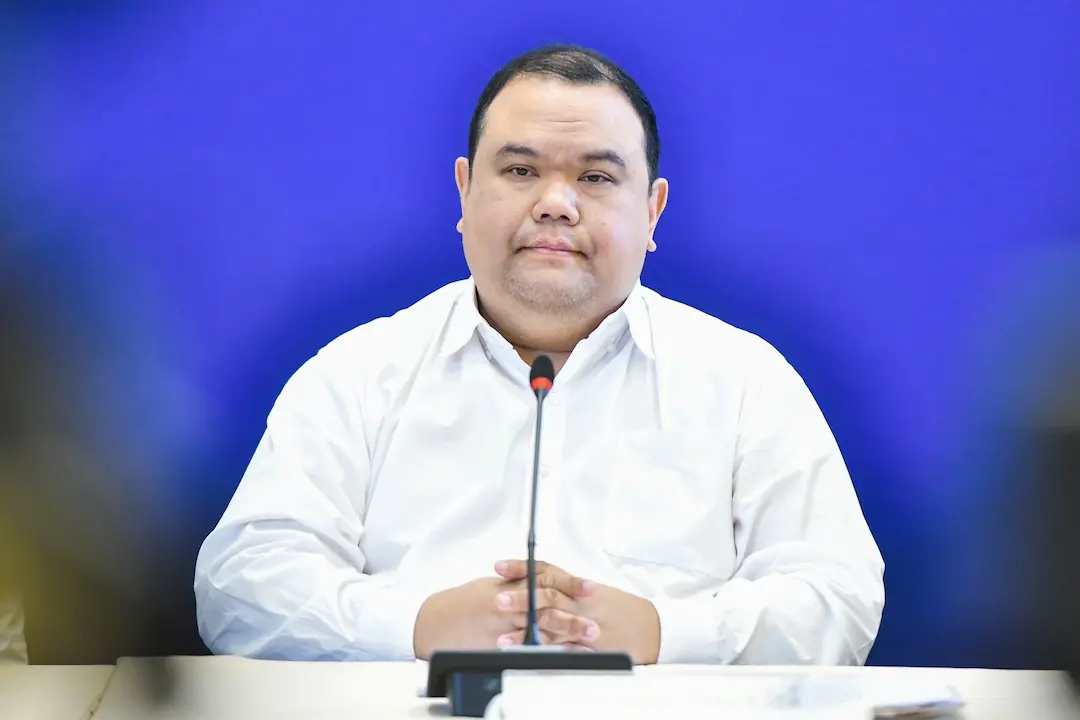
Thai authorities urge nationals in the Middle East to evacuate due to rising tensions. Citizens should stay alert, register with embassies, and prepare for possible evacuation amid ongoing instability.
Key Points
- Thai authorities are advising nationals in the Middle East to evacuate due to rising tensions, with officials closely monitoring the situation. Citizens are urged to stay alert, maintain contact with Thai embassies, and prepare for possible evacuation.
- Despite a temporary pause in military strikes between the U.S. and Iran, conditions remain unstable. Thai nationals should register their locations with embassies and be ready to leave on short notice.
- The ministry confirms ongoing assistance for citizens, including the repatriation of Thai workers’ remains by March 26. Some workers have safely arrived in Turkey, while concerns persist about maritime safety in the region. Authorities urge adherence to safety measures and official guidance as conditions evolve.
Thai authorities are urging nationals in the Middle East to evacuate amid volatile tensions in the region, with Panidone Pachimsawat, acting director-general of the Department of Information and deputy spokesperson of the Ministry of Foreign Affairs, confirming ongoing monitoring of the situation. Citizens in affected areas have been advised to stay alert, remain in close contact with Thai embassies, and prepare for possible evacuation.
Although recent discussions between the United States and Iran have led to a temporary five-day pause in military strikes, officials warn that conditions remain unstable. Thai nationals are encouraged to monitor developments, register their locations with their embassies, and be ready to depart on short notice if necessary.
The ministry also reported progress in assisting Thai citizens in the region. The remains of Thai workers who lost their lives in Israel are scheduled to be returned to Thailand by March 26. Meanwhile, four Thai workers have arrived safely in Turkey, with another group of eight individuals, including seven students and one worker, expected to travel from Iran to Turkey.
Authorities have also raised concerns about maritime safety for commercial shipping in the region, as risks persist. The Thai government is coordinating support for affected citizens and continues to advise strict adherence to safety measures and official guidance as the situation develops.
Source : Thais Urged to Evacuate From the Middle East Amid Tensions
Other People are Reading

Vieceli, Quantum-Si CPO, sells $18k in QSI stock

OnKure Therapeutics CEO Saccomano sells $357 in stock
Business
ZhongAn Online P & C Insurance Co., Ltd. 2025 Q4 – Results – Earnings Call Presentation (OTCMKTS:ZZHGF) 2026-03-24


Seeking Alpha’s transcripts team is responsible for the development of all of our transcript-related projects. We currently publish thousands of quarterly earnings calls per quarter on our site and are continuing to grow and expand our coverage. The purpose of this profile is to allow us to share with our readers new transcript-related developments. Thanks, SA Transcripts Team

Form DEF 14A Vornado Realty Trust For: 24 March


Uttam is a growth-oriented investment analyst whose equity research primarily focuses on the technology sector. Semiconductors, Artificial Intelligence and Cloud software are some of the key sectors that are regularly researched and published by him. His research also focuses on other areas such as MedTech, Defense Tech, and Renewable Energy. In addition, Uttam also authors The Pragmatic Optimist Newsletter along with his wife, Amrita Roy, who is also an author on the newsletter as well as on this platform. Their newsletter gets regularly cited by leading publications such as the Wall Street Journal, Forbes, etc. Prior to publishing his research, Uttam worked in Silicon Valley, leading teams for some of the largest technology firms in the world, including Apple and Google.
Analyst’s Disclosure: I/we have no stock, option or similar derivative position in any of the companies mentioned, and no plans to initiate any such positions within the next 72 hours. I wrote this article myself, and it expresses my own opinions. I am not receiving compensation for it (other than from Seeking Alpha). I have no business relationship with any company whose stock is mentioned in this article.
Seeking Alpha’s Disclosure: Past performance is no guarantee of future results. No recommendation or advice is being given as to whether any investment is suitable for a particular investor. Any views or opinions expressed above may not reflect those of Seeking Alpha as a whole. Seeking Alpha is not a licensed securities dealer, broker or US investment adviser or investment bank. Our analysts are third party authors that include both professional investors and individual investors who may not be licensed or certified by any institute or regulatory body.

J Studios/DigitalVision via Getty Images

The YieldMax PLTR Option Income Strategy ETF (PLTY) is an actively managed exchange-traded fund designed to provide investors with weekly income through the deployment of an options trading strategy, capturing returns with respect to the performance of the underlying stock, Palantir Technologies Inc. (PLTR). YieldMax strategies are known for paying out high distribution rates while bearing the risk of NAV erosion, two distinct factors that should be considered when evaluating whether this fund is appropriate for one’s investment objectives.
About YieldMax PLTR Option Income Strategy ETF
PLTY was launched by YieldMax on October 7, 2024, on the NYSE Arca Exchange. The strategy has a gross expense ratio of 99 bps, aligned with peer income-oriented options strategies offered by Roundhill and REX Shares.
PLTY has paid out a robust weekly distribution at an annualized rate of $45.86/share over the last twelve months for a trailing yield of 114.64%. A large proportion of the distribution rate derived from return of capital, which is relatively common for options income strategies. Return of capital (ROC) is a tax-deferred benefit that generally isn’t taxed until the sale of the investment. ROC will lower an investor’s cost basis with each distribution; once the cost basis reaches $0/share, excess ROC will be taxed as capital gains.
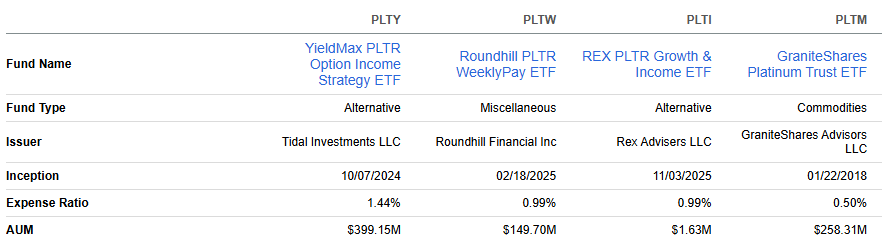
Peer comparison table (Seeking Alpha)
Dividend history (Seeking Alpha)
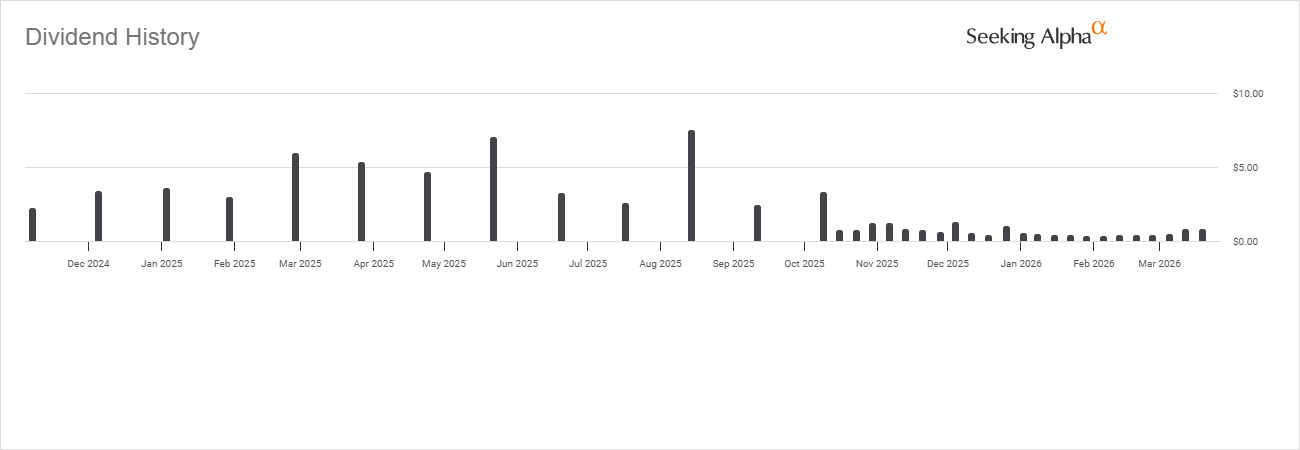
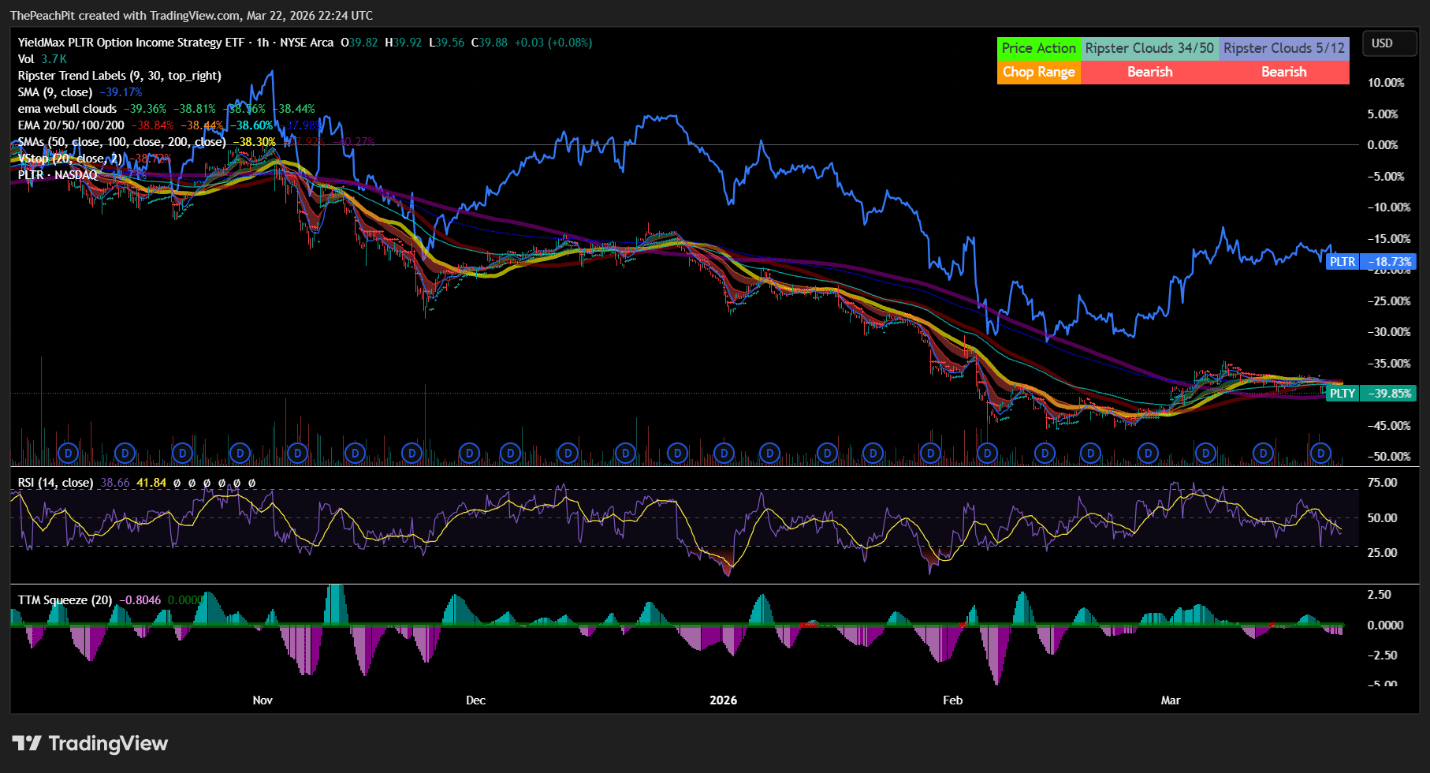
When evaluating high-distribution paying funds, investors should both assess the price return and the total return of the fund to gain insights into the full performance of the fund. Given the high level of return of capital, these funds tend to trend down in terms of price performance; this can be an appealing feature when considering selling out of these funds, as the gap between cost basis and share price can narrow.
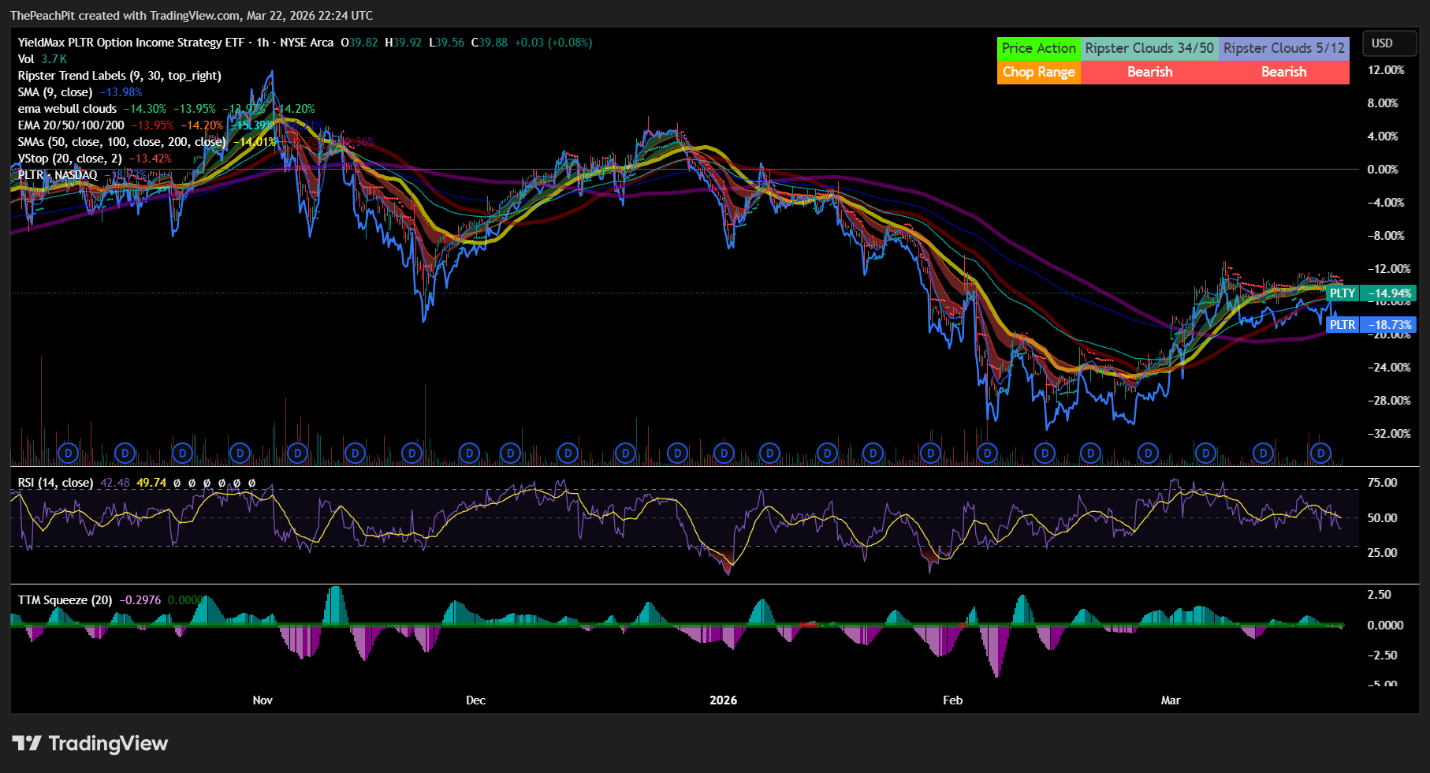
In terms of relative performance, investors should evaluate the fund with total returns to gain an understanding of the relative performance of the underlying assets. Taking into consideration the total returns of PLTY, the fund generally trades in line with Palantir shares while experiencing NAV erosion over time, creating a dispersion in performance.
Price performance chart (TradingView)
Mechanics Of PLTY
PLTY was designed to provide investors with indirect exposure to the performance of PLTR shares through the deployment of an actively managed options strategy. The fund may both purchase and sell put and call options in order to gain exposure based on the expected performance of PLTR shares. The fund generally employs a synthetic covered call strategy to gain exposure to PLTR shares, meaning that the fund is both long and short with respect to the underlying shares.
A synthetic covered call strategy is similar to a traditional covered call strategy in which the fund may take a long-term long investment in PLTR shares through the use of long-call & short-put options [the purchase of call options and the sale of put options]. Rather than directly owning the equity as observed in a traditional covered call strategy, long options positions create the long exposure to the underlying asset.
The “covered call” component employed by PLTY involves the sale of call options at a higher price in order to earn a premium. The structure of the strategy essentially provides the fund with upside potential tied to the long positions while earning distributable income through the short positions. As a result of the covered call component of the fund, the full upside potential of the fund is capped at the strike price of the options. While upside potential is limited, investors will be fully exposed to downside risk with respect to the performance of PLTR shares.
Price chart (TradingView)
In order to gain exposure to Palantir shares, PLTY will purchase call options and sell put options with a duration of 1 to 6 to expiration that are in the money at the time of purchase or sale. As for the covered call component, call options are sold with a duration of 1 month or less with a strike price that is 0-15% above the price of PLTR shares.
In order to protect the fund from significant losses during a period of significant PLTR share price appreciation, the fund may employ covered call spreads in order to limit the downside exposure with respect to the covered calls. This means that the fund may purchase short-term call options at a price above the covered calls, thus limiting the full downside exposure during an occurrence of a significant price run.
Investor Suitability
PLTY can be utilized by investors seeking weekly income while gaining indirect exposure to PLTR shares. While options income funds are generally used as an alternative asset class as a proxy for fixed income, the strategy’s equity risk may make the fund less appropriate for this type of investment strategy. Rather, PLTY can be considered as a proxy for PLTR shares for investors seeking to realize returns in the form of income rather than capital appreciation. Investors should consider that the fund may experience NAV erosion over time, impacting the investor’s overall returns during their holding period.
Risks Related To PLTY
PLTY employs a complex options trading strategy in order to gain exposure to PLTR shares, exposing investors to certain risks that should be considered prior to making a final investment decision. PLTY does not directly invest in Palantir shares and solely gains exposure through the use of option derivatives. As a result of the synthetic covered call strategy, investors may experience limited upside potential while gaining full downside exposure to the performance of Palantir shares. Given the structure of the fund, investors may be exposed to NAV erosion over time, impacting the total value of their initial investment.
Final Thoughts
PLTY was designed to provide investors with income through the use of a synthetic covered call strategy on Palantir shares. PLTY has historically paid out a high distribution rate, though a substantial proportion of distributions have been attributed to ROC. PLTY will generally track the performance of PLTR shares over time on a total return basis but may lag over longer holding periods due to NAV erosion.
This article answers three main questions about PLTY:
- What is PLTY’s purpose and relationship to Palantir?
- What risks accompany owning PLTY?
- Which investors would PLTY be suitable for?
Editor’s note: This article is intended to provide a general overview of the ETF for educational purposes only and, unlike other articles on Seeking Alpha, does not offer an investment opinion about the ETF.
Check out what’s clicking on FoxBusiness.com.
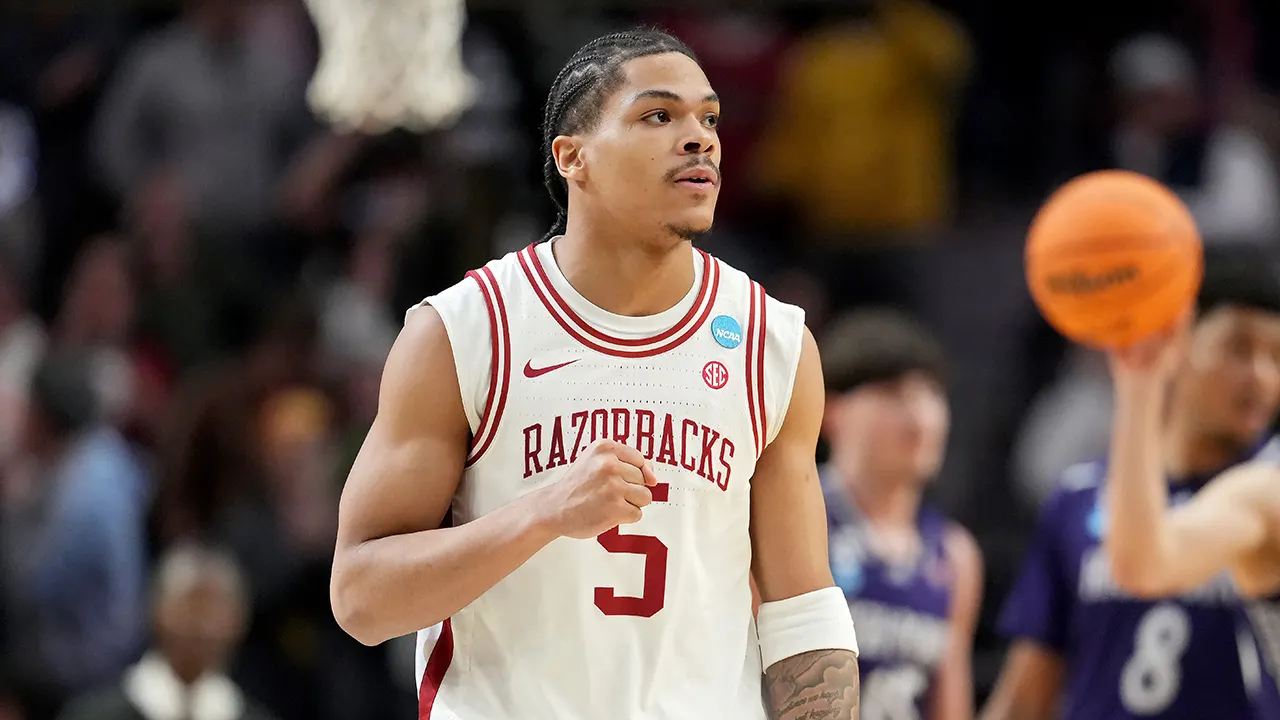
Arkansas star Darius Acuff Jr. is setting records on and off the court.
Acuff, 19, fresh off a historic performance for the Razorbacks in the first two rounds of the NCAA tournament, landed a signature shoe deal with Reebok, according to ESPN.
Acuff’s shoe with Reebok made him the first NCAA men’s athlete to receive a signature shoe with a major U.S. brand while still in college, according to the report.
CLICK HERE FOR MORE SPORTS COVERAGE ON FOXBUSINESS.COM
Darius Acuff Jr. of the Arkansas Razorbacks reacts during NCAA Tournament game against the High Point Panthers at Moda Center in Portland, Oregon, on March 21, 2026. (Soobum Im/Getty Images)
Reebok later announced that, “Acuff 1 on the way.”
The Razorbacks freshman has dazzled this season, leading the SEC in both points per game (23.3) and assists per game (6.5), becoming the first player since Pete Maravich (1969-70) to lead the conference in both categories.
Acuff’s strong play was a big reason that Arkansas won the SEC tournament this season. His play has continued into the NCAA tournament, as he scored 60 points in the team’s first two games.
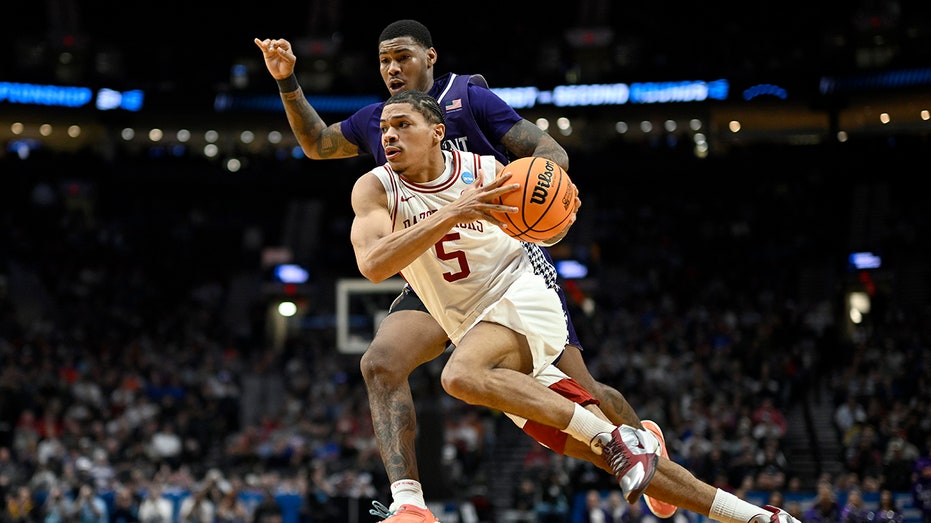
Arkansas Razorbacks guard Darius Acuff Jr. drives against High Point Panthers forward Cam’ron Fletcher in the NCAA tournament at Moda Center in Portland, Oregon, on March 21, 2026. (Troy Wayrynen/Imagn Images)
In No. 4 Arkansas’ first-round 97-78 victory over No. 13 Hawaii, Acuff scored 24 points with seven assists and three rebounds. In the Razorbacks; 94-88 win over No. 12 High Point in the Round of 32, Acuff scored 36 points with six assists and one rebound.
Acuff passed Kentucky’s Pat Riley (58 points) for the most points by an SEC player in his first two NCAA tournament games within a single year. He also is just the second player in the last 50 years (Billy Donovan with Providence in 1986-87) to average 30 points and five assists per game in his first two career tournament games.
GET FOX BUSINESS ON THE GO BY CLICKING HERE
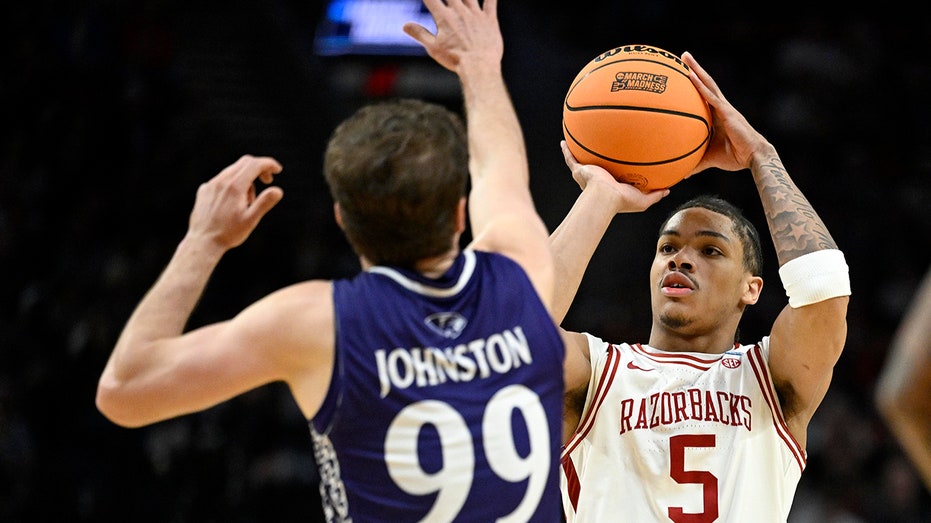
Arkansas Razorbacks guard Darius Acuff Jr. shoots against High Point Panthers guard Chase Johnston in the NCAA tournament on March 21, 2026. (Troy Wayrynen/Imagn Images)
With his standout play, Acuff is likely to be selected high in the 2026 NBA Draft, should he declare.
Acuff will look to continue Arkansas’ run when they play No. 1-seeded Arizona on Thursday at 9:45 p.m. ET.
Follow Fox News Digital’s sports coverage on X, and subscribe to the Fox News Sports Huddle newsletter.
Dick, Diamondback Energy CAO, sells $965k in stock

SYDNEY — Australian motorists are bracing for another sharp rise in petrol prices as the ongoing US-Iran conflict and effective closure of the Strait of Hormuz threaten to send global oil benchmarks well above $100 a barrel, with some economists warning that unleaded fuel at the pump could exceed $3.00 a litre if disruptions persist into the second quarter of 2026.

The national average price for regular unleaded petrol climbed to around 229.6 cents per litre in mid-March, up more than 84 cents from February lows in major cities and even higher in regional areas. In Western Australia, prices surged roughly 70 cents a litre in less than a month, reaching near $2.26 in Perth. Industry observers say the latest increases reflect a 31.8% jump in unleaded 95 between late February and mid-March — the fastest rise among developed nations since the conflict began.
The catalyst is clear: the Strait of Hormuz, the narrow waterway between Iran and Oman through which roughly 20% of global seaborne oil and significant LNG volumes pass daily. Since US and Israeli strikes on Iranian targets in late February, Iran has restricted shipping, planted mines and deployed drones and speedboats, slashing traffic to a fraction of normal levels. Only limited vessels, often carrying Iranian oil or those from “friendly” nations, continue to transit, while most international tankers have diverted or delayed voyages.
Brent crude, the global benchmark, traded around $102 per barrel on Tuesday, March 24, 2026, after volatile swings that saw it briefly exceed $114 and touch highs near $119 in recent weeks. West Texas Intermediate has followed a similar path, remaining well above $90. Analysts at Goldman Sachs and others have embedded a substantial geopolitical risk premium in current prices, with some forecasting averages of $110 or more through the second quarter if the strait remains contested.
Australia imports nearly all its refined petroleum products, making it highly vulnerable to international crude price spikes. Although the country holds strategic fuel reserves equivalent to roughly 36 days of petrol, 32 days of diesel and 29 days of jet fuel, these stocks provide only a short buffer. The federal government has stated that physical shortages are unlikely if the disruption resolves within six months and International Energy Agency members release emergency stocks, but prices at the pump respond almost immediately to wholesale movements.
Every $1 increase in the price of a barrel of oil typically adds about 1 cent per litre to Australian retail petrol, though the relationship is not perfectly linear. Refinery margins, shipping costs, the Australian dollar’s value and local competition among fuel retailers also play roles. In the current environment, banks such as Westpac have modelled scenarios in which retail unleaded could average $2.02 a litre and diesel $2.50 if oil settles near $90–$110. More severe three-month disruptions could push oil toward $185 a barrel in extreme forecasts, translating to increases of up to $1.00 a litre or more at the bowser.
The pain is already evident. Panic buying has been reported in some areas, and farmers in regional Australia face higher diesel costs that flow through to food prices and agricultural operations. Transport operators and logistics firms warn of broader cost pressures that could feed into inflation and slow economic growth. The Reserve Bank of Australia is closely watching fuel costs as it weighs further monetary policy decisions, with some economists suggesting the latest surge could delay expected rate cuts.
Why the Strait of Hormuz matters so much cannot be overstated. Roughly 20 million barrels of oil move through the passage each day under normal conditions, destined largely for Asia but influencing global pricing everywhere. Limited bypass pipelines in Saudi Arabia and the United Arab Emirates can reroute only a few million barrels daily at most. With Iranian production also curtailed and OPEC+ spare capacity difficult to access while the waterway is contested, the market faces a genuine supply shock.
President Donald Trump has issued ultimatums to reopen the strait, threatening strikes on Iranian power infrastructure and offering political risk insurance for shipping, while extending deadlines amid reported diplomatic talks. Iran denies formal closure but maintains that risks to vessels remain high. Limited traffic has resumed in recent days, contributing to some price pullbacks, yet analysts caution that any sustained reduction in flows would keep upward pressure on energy costs.
For Australian households already grappling with cost-of-living pressures, the timing is particularly difficult. Petrol prices had eased earlier in 2026 but reversed sharply after the conflict escalated. In Sydney, Melbourne and Brisbane, metropolitan averages have climbed above $2.00 a litre in many outlets, with regional motorists paying even more. The Australian Automobile Association and NRMA have urged drivers to shop around using fuel apps and consider smaller fills, while calling on retailers to pass on wholesale relief quickly when it materialises.
Longer-term risks extend beyond the immediate crisis. A prolonged Hormuz disruption could reshape global energy markets, accelerate shifts toward renewables and LNG alternatives, and force Australia to rethink its fuel security. The country has no domestic crude production at scale and relies on imports refined overseas or at its remaining refineries. Government reviews have previously concluded that paying premium prices would secure supply even in extended crises, but that offers little comfort at the pump.
Some relief may come if diplomatic efforts succeed or if US naval escorts and allied operations restore safer passage. Maritime security experts suggest Iran’s capacity to sustain attacks may diminish over weeks as its missile and drone stocks deplete. Trump has described the conflict as nearing completion, though Tehran maintains a hard line. Markets remain jittery, with options pricing reflecting expectations of continued volatility.
Economists at Westpac, CommBank and others have outlined tiered scenarios: a short Iranian production-only hit might add 25 US cents a barrel and 25 Australian cents a litre at the pump; a one-month Hormuz disruption could lift oil by $25–$40 and petrol by 50 cents or more; a three-month event risks far steeper increases. The Australian dollar’s weakness against the US dollar amplifies the local impact, as oil is priced in greenbacks.
For now, the message from fuel industry bodies is cautious optimism mixed with realism. Wholesale prices have shown some softening in recent sessions as vessels trickle through the strait, but any renewed escalation could erase those gains overnight. Motorists are advised to monitor FuelWatch and similar services, fill up strategically and consider fuel-efficient driving habits.
The current gas price shock serves as a stark reminder of Australia’s exposure to distant geopolitical events. While the nation’s strategic reserves and diversified import sources provide a safety net against outright shortages, they do little to shield household budgets from the rapid transmission of global oil prices to the local bowser.
As negotiations continue and military posturing persists, Australian drivers may soon face the prospect of $3.00 petrol — a threshold once unthinkable but now squarely within range if the world’s most critical energy chokepoint remains contested. How long the pain lasts will depend on diplomacy, military developments and the resilience of global supply chains in the weeks and months ahead.

Lovell boosted by performance in Newcastle and Morpeth

Thais Urged to Evacuate From the Middle East Amid Tensions

Fixed-Rate DeFi Lending Arrives as Fira Lures $450M in Deposits

Smart energy pays enters the US market, targeting scalable financial infrastructure

Why Israel is blocking foreign journalists from entering

Bitcoin: We’re Entering The Most Dangerous Phase

“People Don’t Know How Massive MARCH Will Be for Crypto”: Tom Lee | Ethereum Price 2026

Vile Cheater Exposed On Financial Audit | Caleb Hammer Clips

Financial Flex with SPEED #nfl #financialflex #ishowspeed #relatable #xyzbca #ronaldo
-
 Crypto World4 days ago
NIO (NIO) Stock Plunges 6.5% as Shelf Registration Sparks Dilution Worries
-

 Fashion4 days ago
Weekend Open Thread: Adidas – Corporette.com
-

 Politics4 days ago
Jenni Murray, Long-Serving Woman’s Hour Presenter, Dies Aged 75
-

 Crypto World3 days ago
Best Crypto to Buy Now: Strategy Just Spent $1.57 Billion on Bitcoin During Fear While Early Investors Quietly Enter Pepeto for 150x Potential
-

 News Videos6 days ago
RBA board divided on rate cut, unusually buoyant share market | Finance Report | ABC NEWS
-

 Crypto World3 days ago
Bitcoin Price News: Bhutan Sells $72 Million in BTC Under Fiscal Pressure, but the Smart Money Entering Pepeto Sees What the Market Does Not
-

 Politics7 days ago
The House | The new register to protect children from their abusers shows Parliament at its best
-

 Tech5 days ago
inKONBINI Lets You Spend Summer Days Behind the Register
-

 Crypto World6 days ago
Canada’s FINTRAC revokes registrations of 23 crypto MSBs in AML crackdown
-

 Sports1 day ago
Remo Stars and Kano Pillars Strengthen Survival Hopes in NPFL
-
 NewsBeat6 days ago
Residents in North Lanarkshire reminded to register to vote in Scottish Parliament Election
-

 News Videos6 days ago
PARLIAMENT OF MALAWI – PAC MEETING WITH REGISTRAR OF FINANCIAL ON AMARYLLIS HOTEL – INQUIRY LIVE
-

 Politics5 days ago
Gender equality discussions at UN face pushbacks and US resistance
-

 Business2 days ago
No Winner in March 21 Drawing as Prize Rolls to $133 Million for Next
-

 Business6 days ago
Who Was Alex Pretti? 5 Key Facts About the ICU Nurse Killed by Federal Agents in Minneapolis
-

 Sports1 day ago
Gary Kirsten Accuses Pakistan Cricket Board Of ‘Interference’, Mohsin Naqvi Responds
-

 Tech2 days ago
Give Your Phone a Huge (and Free) Upgrade by Switching to Another Keyboard
-

 Sports4 days ago
2026 Kentucky Derby horses, odds, futures, preview, date: Expert who nailed 12 Derby-Oaks Doubles enters picks
-
Sports6 days ago
Vikings Free Agency Enters Phase 2 with Key Questions
-

 Tech7 days ago
Subnautica 2 might finally be entering early access in May
You must be logged in to post a comment Login