Business
(VIDEO) Dubai International Airport Shut Down Amid Escalating US-Israel-Iran Conflict

Dubai International Airport (DXB), the world’s busiest hub for international passengers, remained completely closed Sunday with all flight operations suspended until further notice as the United Arab Emirates grappled with the fallout from Iranian retaliatory missile and drone strikes following joint U.S.-Israeli attacks on Iran that killed Supreme Leader Ayatollah Ali Khamenei.
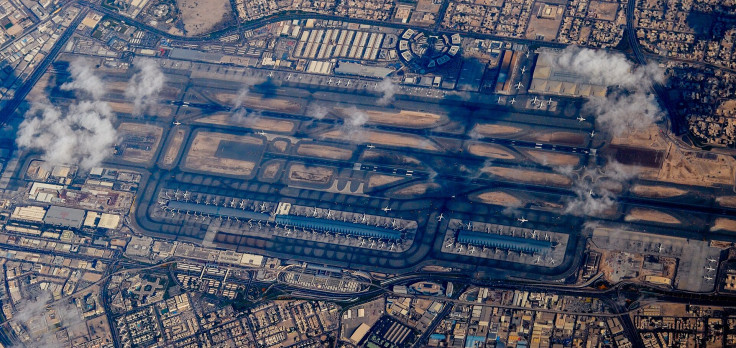

Dubai Airports, the operator of DXB and the secondary Dubai World Central–Al Maktoum International Airport (DWC), confirmed in an official statement that “all flight operations at Dubai International (DXB) and Dubai World Central – Al Maktoum International (DWC) are suspended until further notice.” Passengers were strongly advised not to travel to the airports and to contact their airlines directly for updates. The closure stemmed from UAE airspace restrictions imposed amid the rapidly escalating regional conflict.
The shutdown followed an overnight incident early Saturday that caused minor damage to a concourse at DXB, according to the Dubai Media Office. Four airport staff members sustained injuries, which were described as non-life-threatening, and received prompt medical attention. Emergency response teams quickly contained the situation, and most terminals had already been cleared of passengers under pre-existing contingency plans due to the heightened security environment.
Iranian attacks targeted multiple sites across the Gulf, including Dubai’s iconic Burj Al Arab hotel, where debris from intercepted missiles sparked a minor fire on the outer facade, and Palm Jumeirah island, where smoke plumes were visible. Similar incidents affected Zayed International Airport in Abu Dhabi, where one person was killed and seven injured in a drone strike. Blasts were reported in Doha, Qatar, and other Gulf locations, contributing to widespread airspace closures across the UAE, Qatar, Bahrain, Kuwait and beyond.
Major airlines bore the brunt of the disruptions. Emirates, the flagship carrier based at DXB and one of the world’s largest long-haul operators, extended its suspension of all flights to and from Dubai until 3 p.m. UAE time (11 a.m. GMT) on Monday, March 2. The airline urged affected passengers to check emirates.com for rebooking options or refunds, with flexibility offered for travel booked through March 5. Low-cost carrier flydubai similarly halted operations until the same deadline, while Etihad Airways suspended services to and from Abu Dhabi until early Monday.
Flight tracking data painted a stark picture of the chaos. FlightAware reported more than 19,000 global delays linked to the crisis, while Flightradar24 noted over 3,400 cancellations on Sunday alone across seven key Middle Eastern airports, including DXB, DWC, Abu Dhabi, Doha, Sharjah, Kuwait and Bahrain. The ripple effects stranded tens of thousands of travelers, with some reports estimating over 20,000 affected in Dubai alone. The UAE’s General Civil Aviation Authority activated support measures, including accelerated rescheduling, additional ground resources and welfare assistance such as hotel accommodations and meals for impacted passengers.
The crisis traces back to U.S. and Israeli strikes on Iranian targets late Friday and early Saturday, which eliminated Khamenei and several top officials, prompting Iran’s vow of revenge. Iranian missiles and drones targeted U.S. interests, Israeli sites and Gulf allies perceived as supporting the attacks. The UAE, a key U.S. partner with normalized ties to Israel, found itself in the crossfire despite efforts to maintain neutrality in public statements.
Travelers faced severe hardships. Indian badminton star PV Sindhu reported being stranded at DXB while en route to a tournament in England, highlighting the personal toll. Many passengers slept on terminal floors or sought shelter in nearby hotels as airlines scrambled to reroute or cancel services. European carriers like Lufthansa, KLM and others extended suspensions through the weekend and into the coming week, while global advisories warned against travel over the Middle East.
Dubai’s status as a premier global transit point—handling over 90 million passengers annually pre-crisis and connecting to more than 280 destinations—amplified the impact. The airport’s closure disrupted not just regional travel but long-haul routes between Europe, Asia, Africa and the Americas that rely on DXB for connections.
As of Sunday evening local time, no reopening timeline had been announced. Dubai Airports emphasized close monitoring of the situation and promised updates through official channels. Authorities urged calm and cooperation, with security forces on high alert across the emirate. High-rise residents, including those in the Burj Khalifa, were moved to underground shelters during peak threat periods.
The aviation shutdown compounds broader economic concerns for the UAE, a tourism and trade powerhouse. With Jebel Ali Port also reporting minor incidents from debris, logistics chains faced additional strain. International reactions varied, with some nations condemning the escalation while others called for de-escalation to restore stability.
For now, DXB stands eerily quiet—a stark contrast to its usual bustle of millions of travelers. As the conflict shows no immediate signs of abating, the world’s aviation networks brace for prolonged disruptions, with Dubai at the epicenter of the storm.
