
Business
(VIDEO) John Ternus Officially Becomes Apple CEO Today as Tim Cook Steps Aside After 15 Years at the Helm


CUPERTINO, Calif. — John Ternus formally became Apple’s chief executive officer Tuesday, taking over from Tim Cook in the company’s most significant leadership transition in more than a decade as Apple heads into a pivotal product launch and an intensifying race in artificial intelligence.
Cook’s final day as CEO was Monday, closing out a tenure that began in August 2011 when he succeeded Apple co-founder Steve Jobs. Cook posted a farewell message to the Apple community on X, writing, “Sending lots of love to the Apple community on my last day as CEO. My title changes tomorrow, but the love I have for the Apple community never will.” As of Tuesday, Cook transitions into the role of executive chairman of Apple’s board of directors, a position in which he is expected to continue assisting the company with certain responsibilities, including engagement with policymakers around the world.
Apple first announced the transition plan in April, saying the change had been approved unanimously by the company’s board of directors following what Apple described as a thoughtful, long-term succession planning process. In the company’s original announcement, Cook reflected on his time leading Apple. “It has been the greatest privilege of my life to be the CEO of Apple and to have been trusted to lead such an extraordinary company,” Cook said at the time. “I love Apple with all of my being, and I am so grateful to have had the opportunity to work with a team of such ingenious, innovative, creative, and deeply caring people.”
Board chairman Arthur Levinson praised Cook’s tenure in the same announcement, crediting him with transforming Apple into what Levinson called the world’s best company. “Tim’s unprecedented and outstanding leadership has transformed Apple into the world’s best company. He’s introduced groundbreaking products and services time and again, and his integrity and values are infused into everything Apple does,” Levinson said. “On behalf of the entire board of directors, we are incredibly grateful for his countless contributions to Apple and the world, and we are thrilled he will now be executive chairman.”
Ternus, 51, joined Apple in 2001 and has spent nearly a quarter-century at the company, most recently serving as senior vice president of hardware engineering since 2021. He also joins Apple’s board of directors effective Tuesday. According to Apple’s own regulatory disclosures, the board believes Ternus’s deep technical background and product focus make him well-suited to lead the company through its next chapter. Levinson said the board views Ternus as the right leader to build on Cook’s foundation. “We believe John is the best possible leader to succeed Tim and as he transitions to CEO we know his love of Apple, his leadership, deep technical knowledge, and relentless focus on creating great products will help,” Levinson said in April’s announcement.
Ternus’s path to Apple’s top job traces back to the University of Pennsylvania, where he earned a bachelor’s degree in mechanical engineering in 1997 while also competing as a swimmer. At 51, he becomes CEO at roughly the same age Cook was when he took over from Jobs in 2011, a similarity that industry observers, including reporting from Fortune, have suggested may have factored into the board’s preference for a leader capable of providing long-term stability at the helm.
Ternus’s rise within Apple has followed a gradual, closely watched trajectory in recent years. Bloomberg’s Mark Gurman reported as early as 2021 that Ternus was viewed as a likely eventual successor to Cook, and subsequent reporting throughout 2025 and early 2026 described Apple’s public relations efforts increasingly placing Ternus in more prominent, public-facing roles, including product launch events and store visits. Late last year, oversight of Apple’s design teams was also transferred to Ternus, a responsibility historically held by only a small handful of top Apple executives, including Cook himself from 2015 to 2017, longtime design chief Jony Ive until 2019, and former Chief Operating Officer Jeff Williams from 2019 until his departure from the company in 2025.
Cook’s 15-year tenure as CEO encompassed a substantial expansion of Apple’s product and services portfolio, including the introduction of the Apple Watch, AirPods, Apple Pay and Apple Vision Pro, along with the Mac’s multiyear transition away from Intel processors to Apple’s own custom silicon. Cook also steered Apple deeper into recurring subscription revenue, overseeing dramatic growth in the App Store alongside the launches of Apple Music, Apple TV and expanded Apple Maps functionality. Under his leadership, Apple’s market capitalization grew from roughly 350 billion dollars to more than 4 trillion dollars.
Ternus takes over at a consequential moment for Apple. His first major public moment as CEO is expected to come just over a week from now, at Apple’s Sept. 9 “Surprise and Shine” event in Cupertino, where the company is widely expected to unveil the iPhone 18 Pro, iPhone 18 Pro Max and its first foldable iPhone. Analysts covering the transition, including those cited by financial research firm TradingKey, have said Ternus’s central challenge will be translating Apple’s hardware strengths into a meaningful competitive position as the broader technology industry increasingly competes on artificial intelligence capabilities, an area where some analysts have said Apple has appeared to lag behind rivals in recent product cycles.


Yogurt and ice cream emerged as the standout categories, posting year-on-year revenue growth of 153% and 60%, respectively, aided by an extended summer season. Cheese revenue increased 38%, while paneer, the company’s largest category, grew 34%. Milky Mist believes that the Perundurai facility still has significant spare capacity and, at current product prices, can potentially support revenue of 3-3.5 times FY26 levels before a new manufacturing facility is required. This provides substantial headroom for growth while supporting operating leverage.
 ET Bureau
While paneer remains the cornerstone of the business, Milky Mist is increasingly focusing on protein-rich products such as high-protein paneer, high-protein cheese, Greek yogurt and Skyr. It also plans to commission a whey protein concentrate plant over the next 15-18 months, allowing it to extract greater value from the whey generated in its cheese and paneer operations. In addition, it commissioned a 120-tonne-per-day natural cheddar cheese plant during the quarter.
Geographic expansion is another important growth driver. Although South India contributes nearly 69% to revenue, other markets are growing faster and are expected to account for around 40% of the business over time. The company expects to achieve this by strengthening distribution network, expanding cold-chain infrastructure and scaling up milk procurement operations in states such as Karnataka and Maharashtra.
Read more: Indian banks slash FCNR deposit rates by up to 310 basis points

Milk inflation poses as a key near-term risk. However, the company believes its diversified portfolio of value-added dairy products provides adequate pricing power to manage input-cost pressures. It expects margins to benefit from a richer product mix, better capacity utilisation and continued operational efficiencies.
Overall, Milky Mist’s medium-term growth story extends beyond paneer. The focus is increasingly on sweating existing assets, scaling protein products, expanding cheese and yogurt, and increasing penetration outside South India while maintaining profitability growth.

In the Nifty500 pack, seven stocks’ closing prices crossed above their 200 DMA (Daily Moving Averages) on September 1, 2026, according to stockedge.com’s technical scan data. Traders use the 200-day daily moving average (DMA) as a key indicator to determine the overall trend in a particular stock. As long as the stock is priced above the 200-day SMA on the daily timeframe, it is generally considered to be in an overall uptrend. Take a look:

Quoin Pharmaceuticals CEO Michael Myers buys $99,991 ADSs

Quoin Pharmaceuticals COO Denise Carter buys $99,991 in ADSs
Business
(VIDEO) Congo Ebola Outbreak Tops 6000 Cases, Nears 3000 Deaths in Countrys Worst Recorded Epidemic Ever

BUNIA, Congo — Health authorities in the Democratic Republic of Congo said Monday that the country’s fastest-spreading Ebola outbreak on record has surpassed 6,000 confirmed cases, with nearly 2,900 deaths, as the epidemic continues to outpace every previous Ebola outbreak the country has faced.
The outbreak, caused by the Bundibugyo virus, a rarer strain of Ebola for which no approved vaccine or treatment currently exists, was first confirmed in mid-May after being traced to Mongbwalu health zone in Ituri province. Officials now believe the virus had actually been circulating undetected since February, months before it was formally declared. Since then, it has spread from three health zones to nearly 60 across five provinces, according to World Health Organization data, making it both the largest and fastest-moving Ebola outbreak the country has ever recorded.
More than 1,360 people have recovered from the virus so far, a figure Congolese authorities described as an encouraging sign amid the broader crisis. Even so, the World Health Organization has warned the outbreak remains out of control and is on pace to eventually surpass the 2014-2016 West Africa Ebola epidemic, which killed more than 11,000 people across Guinea, Liberia and Sierra Leone and remains the deadliest Ebola outbreak ever documented worldwide.
The rapid spread has been driven by a combination of factors specific to eastern Congo’s volatile security situation. Ongoing armed conflict, mass displacement, a strike among health workers and intense population movement have all complicated containment efforts, with the situation described as especially dire at displacement sites, where residents already live in extremely precarious conditions. Last week, the virus spread into two additional health zones in the region.
The dangers facing response teams extend beyond the disease itself. On Saturday, an Ebola response team was attacked on the outskirts of Mambasa, a town in Ituri province, while responding to a call to help secure a body suspected of carrying the virus. A group of young people armed with machetes stormed the site of a funeral, forcing the response team to flee and injuring one worker in the process. “We demand greater security so we can operate in the field and do our work without endangering our lives,” said Floribert Magene, a member of the response team, in comments to the Associated Press.
Safe burial practices remain one of the most difficult aspects of the response. Bodies of Ebola victims can remain highly contagious, and traditional burial preparation and funeral gatherings have repeatedly been linked to further spread of the virus in this and past outbreaks. In response, Congolese authorities have mandated that burials of suspected Ebola victims be managed by trained personnel wherever possible, a policy that has at times drawn resistance and protests from grieving families and friends who want to participate directly in funeral rites.
Vaccination efforts against the outbreak remain limited by the specific strain involved. Last week, Congo began vaccinating health workers and other front-line responders using the Ervebo vaccine, which has proven effective in past outbreaks caused by the more common Zaire strain of Ebola. However, no licensed vaccine currently exists specifically for the Bundibugyo virus responsible for this outbreak, and clinical trials remain underway to develop one. Case fatality rates in previous Bundibugyo outbreaks have historically ranged between 30% and 50%, and the current outbreak’s roughly 44% fatality rate falls within that historical range, according to World Health Organization data.
The broader public health response has disrupted daily life across the six affected provinces, particularly hard-hit Ituri, which was already contending with ongoing rebel violence before the outbreak began. Measures including restrictions on public gatherings, social distancing requirements and airport closures have all been implemented in affected areas. The Congolese government has introduced some additional measures, including installing health and sanitation equipment at various sites, though advocacy groups have said more work is needed to build community trust in the response, particularly given the history of resistance to outside intervention in some affected communities.
While neighboring Uganda declared itself free of Ebola last month after recording a limited number of cases tied to the same outbreak, the World Health Organization warned last week that the risk of further cross-border transmission remains, given the scale and continued spread of the epidemic within Congo’s borders. International aid organizations, including Doctors Without Borders, have deployed more than 1,400 staff to the affected region, operating six treatment centers across four provinces as the response effort continues to expand alongside the rising case count.
Business
Oil Price Today (September 2): Crude oil nears $97 as war tensions escalate. Will it hit $100 again?

The United States said it carried out a series of airstrikes against targets in Iran overnight, drawing a response from Tehran in what was described as the most serious escalation in the conflict between the two countries in weeks.
Also read: Trump says US gave Iran many chances, dismisses value of any deal: Report
Crude oil price on September 2
Brent crude futures gained 99 cents, or 2%, to $96.54 a barrel, while US West Texas Intermediate crude futures rose $1.55 , or 1.52%, to $92. Both contracts had jumped more than $4 on Tuesday, with Brent posting its biggest gain since July 24 and WTI its largest since July 23.
The US Central Command said the strikes came after recent attempted attacks by Iran’s Islamic Revolutionary Guard Corps (IRGC) on commercial shipping in the Strait of Hormuz and on American service members deployed in the region.
Hormuz opening in jeopardy
The IRGC said the US attacks would further restrict traffic through the Strait of Hormuz, a key waterway that carried about one-fifth of the world’s consumed oil before the conflict and which Iran has effectively closed to commercial shipping.
The IRGC also said it had targeted a US military base in Jordan with ballistic missiles, claiming that a large number of US forces were killed. Iranian state media separately reported a large-scale drone attack on a US base in Bahrain in response to the American strikes.The latest exchange came after a weekend flare-up in hostilities, the first since July, and followed attacks on two tankers leaving the Strait of Hormuz on Monday. The attacks added to disruptions in oil supplies and prompted traders to look for alternative crude shipments.
Read more: Iran warns US strikes will ‘tighten the lock’ on Strait of Hormuz
Jordan’s military said its air defences intercepted 10 of 13 ballistic missiles that entered its airspace, while two US officials said no American casualties had been reported so far. Kuwait, meanwhile, said its armed forces were responding to hostile drone activity.
Where are prices headed?
The length of the disruption will be a key factor for crude markets. JPMorgan estimates that each additional month of disruption could lift Brent prices by around $7 to $8 a barrel. If the disruption continues for three months, the bank expects average monthly Brent prices to reach around $114 a barrel.
Goldman Sachs has also warned that Brent could rise to $120 a barrel if shipping disruptions through the Strait of Hormuz, the world’s most important oil transit route, continue. Its base case, however, assumes that tensions in the Middle East will eventually ease.
The bank expects Brent to average $80 a barrel in the fourth quarter and $75 a barrel next year, while noting that risks remain skewed to the upside if disruptions in the Strait of Hormuz and the Red Sea persist for longer than expected.
Ponmudi R, CEO of Enrich Money, said crude prices would remain closely linked to developments around the Strait of Hormuz. He said a sustained recovery in shipping flows could further unwind the geopolitical premium in crude and provide relief to emerging-market equities, while renewed disruptions could quickly reverse that trend.
(Disclaimer: Recommendations, suggestions, views and opinions given by the experts are their own. These do not represent the views of The Economic Times)

BHP’s chief commercial officer to step down in January, internal memo shows
Business
Dow Slides to Open September as Rising Oil Prices and Bond Yields Rattle Wall Street Once Again

The Dow Jones Industrial Average fell in early trading Tuesday as Wall Street opened September on a cautious note, with renewed fighting in the Strait of Hormuz, a continued rise in bond yields and growing uncertainty over the Federal Reserve’s next move all weighing on stocks.
The Dow traded at 52,895.96 as of 9:32 a.m. Eastern time, down roughly 0.58% from Monday’s close of 53,185.99. Futures on the S&P 500 and Nasdaq-100 also fell heading into the session, dropping about 0.6% and 1.4%, respectively, following a solid close to the month of August, according to Yahoo Finance.
The renewed pressure on markets traces back to overnight developments in the Middle East. Two oil tankers, one Saudi-owned and one South Korean-owned, were struck by projectiles Monday night as the United States and Iran resumed hostilities in the Strait of Hormuz, extending a six-month war that has largely settled into what analysts have described as a stalemate. Daniela Hathorn, senior market analyst at Capital.com, characterized the mood on trading desks as investors weighed multiple sources of uncertainty simultaneously. “Markets are starting September cautiously, with investors balancing renewed geopolitical uncertainty, elevated bond yields and the latest US economic data,” Hathorn said, according to TheStreet. “The S&P 500 remains close to record territory, but momentum has softened after a strong summer.”
Bond yields continued climbing Tuesday, adding further pressure on equities. The 10-year Treasury yield rose to 4.78%, its highest intraday level since January 2025, according to Yahoo Finance, as elevated oil prices stoked inflation concerns and reinforced expectations that the Federal Reserve could move toward another interest rate increase at its September meeting.
Monday’s regular trading session had already set a downbeat tone heading into Tuesday. The Dow fell 0.7% Monday to close at 53,186 points, while the S&P 500 and Nasdaq Composite declined 0.33% and 0.12%, respectively, according to Trading Economics. Nine of the S&P 500’s 11 sectors finished lower on the day, led to the downside by communication services, utilities and industrials, with individual decliners including Alphabet, down 3.16%, Amazon, down 2.45%, and Honeywell International, down 1.9%.
The pullback comes as Wall Street enters what has historically been a difficult stretch for stocks. According to Carson Group chief market strategist Ryan Detrick, September is statistically the weakest month of the year for equities, with the S&P 500 averaging a 0.6% decline during the month and posting a positive return in only 45% of years historically, a track record matched only by February among all 12 months. Detrick’s analysis also noted that market volatility tends to increase during September, a dynamic some analysts have said could be compounded this year by this fall’s midterm election campaigns.
Despite the softer near-term backdrop, some strategists have cautioned against reading too much into seasonal patterns alone. LPL Financial chief technical strategist Adam Turnquist said he expects continued volatility in the weeks ahead but suggested that pullbacks could also present buying opportunities for investors willing to look past short-term turbulence, given that stocks enter September carrying double-digit year-to-date gains and earnings expectations that have continued trending higher.
Investors are also looking ahead to a busy stretch of economic data this week that could further shape the market’s direction. Manufacturing and services activity readings are due Tuesday, followed by the closely watched August jobs report Friday, both of which are likely to influence expectations for the Federal Reserve’s policy path heading into its next meeting later this month.

Hamza Fodderwala
Senior VP of Investor Relations & Strategic Finance
Good day, everyone, and welcome to Palo Alto Networks’ Fiscal Fourth Quarter 2026 Earnings Conference Call. I am Hamza Fodderwala, Senior Vice President of Investor Relations and Strategic Finance. Please note that this call is being recorded today, Tuesday, September 1, 2026, at 1:30 p.m. Pacific Time.
With me on today’s call to discuss our fiscal fourth quarter results are Nikesh Arora, our Chairman and Chief Executive Officer; and Dipak Golechha, our Chief Financial Officer. You can find the press release and other information to supplement today’s discussion on our website at investors.paloaltonetworks.com. While there, please click on the link for quarterly results to find the Q4 ’26 supplemental financial information and Q4 ’26 earnings presentation.
During the course of today’s call, we will be making forward-looking statements and projections regarding the company’s business operations and financial performance as well as the company’s recent acquisitions. These statements made today are subject to a number of risks and uncertainties that could cause our actual results to differ from these forward-looking statements. Please review our press release and recent SEC filings for a description of these risks

Shares of Fervo Energy surged more than 12% Tuesday after a report revealed the geothermal power developer has struck its largest-ever supply agreement with Google, a deal that stands as a direct rebuttal to investor concerns raised following the company’s most recent earnings report.
The stock traded at 17.32 dollars, up 1.94 dollars, or 12.62%, as of 9:42 a.m. Eastern time on the Nasdaq, having climbed as much as 14.3% in pre-market trading. The rally came even as the broader U.S. market struggled Tuesday, with the S&P 500 down about 0.5%, the Dow Jones Industrial Average off roughly 0.6%, and the Nasdaq Composite declining about 1%, according to Investing.com, underscoring that Fervo’s move was driven by company-specific news rather than a broader sector rotation.
According to a Wall Street Journal report cited by Investing.com, Fervo has agreed to supply nearly 400 megawatts of electricity to Google from its Cape Station project in southwestern Utah, with deliveries to the technology giant beginning in 2028. The Houston-based company is spending more than 2 billion dollars to build out Cape Station, which it has positioned as what it expects to become the world’s largest next-generation geothermal development.
The agreement builds on an already deepening relationship between the two companies. Fervo had previously disclosed a broader 3-gigawatt framework agreement with Google, and the company now holds a contracted backlog totaling 7.2 billion dollars across utilities and corporate energy buyers, according to Investing.com’s reporting. Notably, peer renewable energy companies including Ormat Technologies did not share in Tuesday’s rally, further reinforcing that the catalyst was specific to Fervo’s newly announced deal rather than a broader lift for the geothermal or clean energy sector.
Tuesday’s rally comes at a technically significant moment for the stock, which had fallen roughly 26% over the prior 20 trading sessions heading into the announcement. That decline followed Fervo’s second-quarter earnings report, released Aug. 12, in which the company posted a net loss of 55.9 million dollars alongside capital expenditures of 226.5 million dollars for the quarter. Despite the loss, Fervo reported adjusted earnings per share of a positive 38 cents, sharply ahead of the 7-cent consensus estimate analysts had projected, according to data compiled by TipRanks.
The company has continued to attract largely positive coverage from Wall Street analysts even amid the stock’s recent volatility. J.P. Morgan reiterated a buy rating on Fervo on Aug. 17, and Bernstein separately maintained its own buy rating the same day, according to TipRanks. Baird has taken a more cautious stance on valuation specifically, lowering its price target on the stock to 35 dollars from 50 dollars following the second-quarter results while still maintaining an outperform rating, according to StockAnalysis.com.
Fervo, founded in 2017 by Jack Norbeck and Timothy Latimer, builds and operates geothermal power facilities using enhanced geothermal system technology, an approach that uses techniques including horizontal drilling and distributed fiber optic sensing to generate electricity from geothermal resources in locations that would not traditionally support conventional geothermal development. The company went public earlier this year, raising roughly 2.2 billion dollars in its initial public offering to help fund the Cape Station project and expand what it has described as a broader 42-gigawatt development pipeline.
Fervo has separately partnered with Nvidia and the Pacific Northwest National Laboratory on a digital twin platform designed to accelerate geothermal development using artificial intelligence and accelerated computing, part of a broader push by the company to position itself at the intersection of clean energy development and the surging electricity demand tied to AI data center growth. Tuesday’s Google agreement adds another major technology company to that growing list of corporate energy customers as demand for reliable, around-the-clock power sources continues to climb alongside AI infrastructure buildout across the industry.

Blake Lively layers up in a cozy fall ensemble as she steps out in NY after being trolled by Candace Owens

Get Heidi Klum’s $8,300 Go-With-Everything Bag Look for Just $24

Games Inbox: Has Sony lost the trust of PS5 gamers?





-

 Fashion4 days ago
Weekend Open Thread: Maeve – Corporette.com
-

 Crypto World5 days ago
Bitcoin’s 22% rally now needs real demand to outlast Treasury liquidity boost
-

 Crypto World7 days ago
Warsh Jackson Hole keynote puts financial innovation first
-

 Business5 days ago
Apple Confirms September 9 Keynote and Reveals Its Full Pre-Order Schedule
-

 Crypto World6 days ago
Elon Musk Grok Bot Promise: We Will Make You Whole if AI Loses Your Money
-

 Business5 days ago
Salesforce Stock Soars 19% as Blowout Earnings and Agentforce AI Growth Silence Software Skeptics
-

 Business4 days ago
Onto Innovation Stock: AI’s Next Bottleneck Is Yield (NYSE:ONTO)
-
 NewsBeat6 days ago
Lindsay Clancy jury braces for closing arguments as judge tells court: ‘You’ve heard all the evidence’ – Live updates
-

 Business7 days ago
Walmart takes aim at younger shoppers with new fashion brand
-

 Crypto World6 days ago
NVIDIA revenue hits $96.2B as AI demand doubles
-

 Crypto World4 days ago
Bitcoin price tests $82K resistance as Brandt stays long
-

 Business4 days ago
iPhone 18 Pro Pre-Orders Could Shift to Saturday as Apple Reportedly Avoids September 11 Anniversary
-
 Crypto World6 days ago
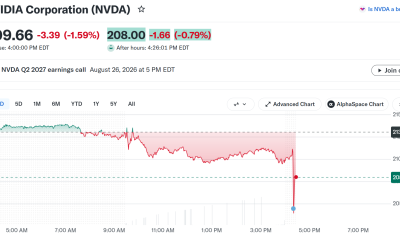
Nvidia Q2 Earnings Reveal $96.2 Billion Beat, So Why Is NVDA Falling?
-
 Tech3 days ago
Hugging Face built a $4.5 billion empire on free AI models. Now Nvidia is buying it for $12.9 billion
-

 Tech6 days ago
Claude Cowork gets its own browser that doesn’t touch your tabs, bookmarks, or saved passwords
-

 Crypto World7 days ago
Kraken hit by 12,000 HTX-linked dust transfers
-

 Crypto World5 days ago
Truflation calls for Fed rate cut after PCE forecast
-

 Tech4 days ago
PaperCut releases second emergency patch for exploited flaws
-
 News Videos3 days ago
Charlie Munger on Robinhood: No one should believe that Robinhood’s trades are free
-

 Sports7 days ago
SV 07 Elversberg 2026/27 season preview: Transfers, pre-season, predicted lineup & predictions
You must be logged in to post a comment Login