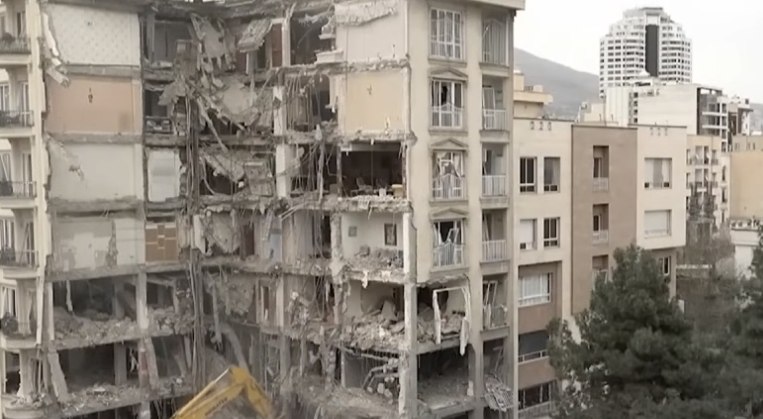
TEL AVIV, Israel — An Iranian ballistic missile carrying a 220-pound (100-kilogram) warhead slammed into a central Tel Aviv street Tuesday, March 24, 2026, blowing out windows of nearby apartment buildings and wounding at least four to six people as part of a fresh barrage that highlighted the Islamic Republic’s ability to penetrate Israeli air defenses despite weeks of intense U.S. and Israeli strikes.
Tel Aviv Struck by 220-Pound Iranian Missile Warhead as Barrage Pierces Defenses Amid Conflict
The impact left a visible crater in the heart of Israel’s commercial and cultural capital, sending smoke billowing into the sky and prompting emergency crews to rush to the scene. Rescue workers described shattered glass, damaged vehicles and frightened residents emerging from shelters. “It feels like you’re a sitting duck, waiting for the missiles to hit you, or someone next to you,” one resident, Amir Hasid, told reporters after the blast.
Israeli officials confirmed the missile evaded multilayered defenses including the Arrow, David’s Sling and Iron Dome systems. The warhead’s relatively modest size — typical for precision or cluster variants — still caused significant localized damage in a densely populated urban area. No fatalities were immediately reported from this specific strike, though earlier barrages in the ongoing war have killed civilians.
The attack formed part of what Iranian state media and the Islamic Revolutionary Guard Corps described as a new wave under “Operation True Promise 4,” involving multiple ballistic missiles and drones targeting central Israel, including Tel Aviv and areas near the Dimona nuclear research center. Some missiles reportedly carried cluster munitions designed to disperse submunitions mid-air, complicating interception efforts.
Advertisement
Israeli military spokesmen said most incoming projectiles were intercepted, but several impacted or scattered debris across the Tel Aviv metropolitan area, including Ramat Gan and other suburbs. Drone and social media footage showed extensive damage to a multi-story residential building, with rescue teams searching rubble and treating the injured. Shrapnel also fell near infrastructure sites, briefly disrupting train services at Tel Aviv’s Savidor Central station in previous waves.
The strike occurred as President Donald Trump claimed the United States was engaged in “very good and productive” talks with Iran aimed at de-escalating the conflict that began with joint U.S.-Israeli airstrikes on Iranian targets in late February. Trump suggested a possible five-day pause in strikes, yet Iranian launches continued, and Tehran dismissed the talks as insincere. Iranian officials framed the barrages as retaliation for Israeli assassinations of senior security figures and ongoing airstrikes on missile production sites and underground facilities.
Iran’s ballistic missile program, once estimated at thousands of projectiles, has been degraded by repeated Israeli and U.S. attacks on launchers, production lines and “missile cities” buried deep underground. Despite losses estimated at 60-85% of some capabilities, Tehran has demonstrated resilience, firing salvos that include solid-fueled systems like the Kheibar Shekan and liquid-fueled variants capable of reaching Israeli territory from western Iran.
Military analysts noted the 220-pound warhead aligns with payloads on missiles such as the Emad or Ghadr families, which can feature maneuverable re-entry vehicles or cluster configurations. Recent attacks have increasingly relied on saturation tactics — launching dozens of missiles and drones simultaneously — to overwhelm defenses. In this latest wave, some reports indicated multi-warhead designs that split into smaller 100-kilogram charges, increasing the chance of at least partial success.
Advertisement
Israeli Prime Minister Benjamin Netanyahu’s office condemned the attack as “another example of Iranian aggression” and vowed continued operations to dismantle Tehran’s missile infrastructure. “We will not allow Iran to threaten our civilians with impunity,” a statement read. Defense Minister Israel Katz added that the Israel Defense Forces were striking launch sites and command nodes in real time.
Civilian impact in Tel Aviv remained limited compared with the scale of some previous barrages, but the psychological toll was evident. Sirens wailed across central Israel, forcing residents into shelters for the second time in recent days. Schools and businesses in affected areas closed early, and traffic ground to a halt as emergency vehicles responded.
Health officials reported minor injuries from flying glass and shrapnel, with hospitals on high alert. Magen David Adom, Israel’s national emergency service, treated walking wounded at the scene while search-and-rescue teams checked for anyone trapped. No large-scale structural collapses were reported, though several buildings required safety inspections.
The broader war, now in its fourth week, has seen Iran launch hundreds of missiles and drones at Israel, with varying success. Israeli and U.S. counterstrikes have targeted Iranian nuclear-related sites, oil infrastructure and missile factories, significantly reducing Tehran’s daily launch capacity. Yet Iran has adapted by using mobile launchers, decoys and combined drone-missile attacks.
Advertisement
Gulf states including Saudi Arabia, the United Arab Emirates and Kuwait reported intercepting Iranian projectiles aimed at their territory or passing through their airspace. The conflict has drawn in regional actors, raising fears of wider escalation even as diplomatic channels flicker.
International reaction was swift. The United Nations Security Council scheduled an emergency meeting, while European leaders urged restraint. U.S. officials reiterated support for Israel’s right to defend itself while pushing for de-escalation talks.
For Tel Aviv residents, the strike served as a stark reminder of vulnerability in a city long considered safe behind advanced defenses. “We thought the Iron Dome would handle everything, but these barrages keep testing the system,” said one shop owner whose business windows shattered in the blast.
As night fell Tuesday, Israeli jets were reported active over Iranian airspace, and additional sirens sounded in southern Israel near Dimona. Analysts warned that further Iranian retaliation could target economic or symbolic sites, while Israel aims to degrade remaining missile stocks before any ceasefire.
Advertisement
The 220-pound warhead impact, while not catastrophic, underscores the persistent threat posed by Iran’s arsenal even after sustained degradation. With talks underway yet missiles still flying, the coming hours could determine whether diplomacy gains traction or the conflict spirals further.
Emergency crews continued working into the evening, clearing debris and reassuring residents. In a city known for its vibrant nightlife and innovation, the sound of explosions and sirens once again replaced the usual hum of daily life.
Electrification is often discussed in terms of visible assets: electric vehicles, charging stations, and energy tariffs. For most organisations, these are the elements that shape investment decisions and public sustainability commitments.
However, as deployment scales, performance is increasingly determined by a less visible layer of infrastructure. This layer rarely features in board-level discussions, yet it directly influences operational reliability, cost predictability, and system resilience.
The emerging risk for businesses is not adoption of new technology, but underestimating the infrastructure required to make that technology consistently work at scale.
The shift from assets to systems
Traditional infrastructure thinking is asset-centric. A charger is installed, a vehicle is deployed, and performance is assumed to follow specification.
In practice, electrified systems behave differently. They operate as interconnected chains of components, where reliability is determined by the weakest link rather than the most advanced element.
Advertisement
This shift from isolated assets to dependent systems introduces a structural challenge: small inconsistencies in supporting components can accumulate into measurable operational inefficiencies.
Where operational risk actually emerges
In early-stage deployments, infrastructure issues are often attributed to high-level components such as charging units or software platforms. These are visible, complex, and therefore assumed to be the primary source of variation.
However, in scaled environments, a different pattern emerges. Performance variability is frequently driven by lower-profile physical components within the system architecture.
These components are not typically monitored with the same intensity as primary assets, yet they operate under continuous load conditions that expose differences in quality, durability, and consistency.
Advertisement
The result is not immediate failure, but gradual degradation in operational predictability.
Why small inefficiencies become structural at scale
At individual unit level, minor variations are often negligible. At fleet or multi-site level, they compound into system-wide inefficiencies.
Examples include:
reduced predictability in asset availability
increased buffering requirements in operational planning
higher sensitivity to peak demand periods
gradual erosion of utilisation efficiency across infrastructure networks
The key issue is not breakdown, but inconsistency. Systems designed around assumed uniform performance begin to drift when that assumption does not hold in practice.
The procurement blind spot
Most procurement frameworks remain optimised for upfront cost, specification compliance, and installation speed. These criteria are necessary but incomplete in electrified environments.
Advertisement
What is often underweighted is lifecycle behaviour under sustained operational load.
This includes:
how components perform under continuous use
how degradation profiles differ across suppliers
how maintenance frequency evolves over time
how small variations scale into system-level inefficiencies
As a result, infrastructure decisions that appear rational at purchase stage can generate disproportionate operational costs over time.
The rise of quality differentiation in commodity infrastructure
As electrification matures, previously interchangeable components are becoming differentiated based on performance stability rather than basic compliance.
Manufacturing consistency, certification rigor, and material durability are increasingly relevant indicators of long-term system reliability.
Advertisement
In this context, the importance of component-level engineering becomes more visible. For example, manufacturers such as Voldt® operate in a segment where emphasis is placed on reducing variability under sustained commercial load conditions, rather than simply meeting baseline specification requirements.
This reflects a broader market shift toward infrastructure-grade quality standards across the electrification ecosystem.
From electrification projects to infrastructure management
The strategic implication for businesses is a reframing of electrification itself.
What is often treated as a deployment project is, in reality, a transition into ongoing infrastructure management. This requires a different evaluation lens:
Advertisement
from individual asset performance to system behaviour
from installation success to operational stability
from purchase cost to lifecycle impact
from compliance to resilience
Under this model, infrastructure is not a static investment but a continuously operating system with compounding dependencies.
Reliability of the infrastructure
As electrification scales across UK businesses, the primary constraint is shifting. It is no longer access to technology, but the reliability of the infrastructure that supports it.
The most significant risks are not necessarily located in high-visibility assets, but in the less visible components that determine whether systems perform consistently under real-world conditions.
For organisations moving from pilot projects to full-scale deployment, understanding and managing this “invisible infrastructure” layer is becoming a defining factor in operational success.
The empty block could be brought back into use(Image: Google)
An abandoned office building in Timperley could be brought back into use as new homes.
Advertisement
Developer Blueoak Estates Ltd is eyeing up the three-storey property in Etchells Road with a view to turning it into apartments. The building was last home to the Lookers Motor Group.
Some 34 new homes are proposed to be created within the office block. These would be a mix of one- and two-beds, planning documents show.
This could be just phase one of the plans for the site, however. Documents state that the plant room and an external ‘plant well’ in the roof area would be redundant under the new use and could be ‘subject to future conversion’.
Limited changes would be made to the exterior of the building. These would see new windows fitted and the ‘part removal’ of the external stairs.
Advertisement
Some 38 parking spaces are proposed for the new homes. An additional 34 cycle spaces would be provided in an internal storage area.
Blueoaks is seeking permission from Trafford council for the change of use of the building.
To find all the planning applications, traffic diversions, road layout changes, alcohol licence applications and more in your community, visit the Public Notices Portal.
I am a specialist in Asian equities after having been a sellside analyst for 13 years. In addition, I have also spent time covering US hardware and semiconductor stocks on the sellside. Within Asia, I have covered the casino, automotive, industrial, consumer and technology sectors. I have also worked on the buyside as a fund manager in long only and as an analyst in hedge funds all covering Asian equities where I have developed a keen understanding of Asian companies and economies with a focus on China. From a global equities perspective, I enjoy covering companies globally by examining key metrics such as financial statements strength, valuation upside, and conducting proper analysis of the competitive advantages of the company. Throughout my career, I have found and written on undiscovered small cap companies which have increased in equity value by multiple times. I would like to write for Seeking Alpha where my goal is to help investors cut through the noise and to focus on fundamentals and the company’s competitive outlook instead of the momentum trade.
Analyst’s Disclosure: I/we have no stock, option or similar derivative position in any of the companies mentioned, and no plans to initiate any such positions within the next 72 hours. I wrote this article myself, and it expresses my own opinions. I am not receiving compensation for it (other than from Seeking Alpha). I have no business relationship with any company whose stock is mentioned in this article.
Seeking Alpha’s Disclosure: Past performance is no guarantee of future results. No recommendation or advice is being given as to whether any investment is suitable for a particular investor. Any views or opinions expressed above may not reflect those of Seeking Alpha as a whole. Seeking Alpha is not a licensed securities dealer, broker or US investment adviser or investment bank. Our analysts are third party authors that include both professional investors and individual investors who may not be licensed or certified by any institute or regulatory body.
Fidelity’s mission is to strengthen the financial well-being of our customers and deliver better outcomes for the clients and businesses it serves. With assets under administration of $12.6 trillion, including discretionary assets of $4.9 trillion as of December 31, 2023, Fidelity focuses on meeting the unique needs of a broad and growing customer base. Privately held for 77 years, Fidelity employs more than 74,000 associates with its headquarters in Boston and a global presence spanning nine countries across North America, Europe, Asia and Australia. Note: This account is not managed or monitored by Fidelity, and any messages sent via Seeking Alpha will not receive a response. For inquiries or communication, please use Fidelity’s official channels.
This is the forum for daily political discussion on Seeking Alpha. A new version is published every market day.
Please don’t leave political comments on other articles or posts on the site.
The comments below are not regulated with the same rigor as the rest of the site, and this is an ‘enter at your own risk’ area as discussion can get very heated. If you can’t stand the heat… you know what they say…
More on Today’s Markets:
Advertisement
Iran’s new supreme leader, Mojtaba Khamenei, who has not been seen or heard publicly since the war began, “issued new and decisive directives for the continuation of operations and the powerful confrontation with the enemies” while meeting with the head of the joint military command, the state broadcaster reported, with no details.
In April 2026, exports reached a record high of $359.44 billion, up 14.1% year-on-year, exceeding forecasts and showing a strong rebound after a weak growth of 2.5% in March. For the first four months of the year, total exports still grew 14.5% year-on-year to USD 1.34 trillion. However, during the period, sales to the US dropped 10.2%.
Meanwhile, Israeli Prime Minister Netanyahu warned in a 60 Minutes interview that the war is “not over… There are still enrichment sites that have to be dismantled, there are proxies that Iran supports, there are ballistic missiles that they still want to produce… there’s work to be done.”
Moderation Guidelines:
We remove comments under the following categories:
Personal attacks on another user account
Anti-Vaxxer or covid related misinformation
Stereotyping, prejudiced or racist language about individuals or the topic under discussion.
Shares of Urban Company plunged as much as 9% to their day’s low of Rs 127 on the BSE on Monday after it reported a sharp rise in consolidated net loss for the March quarter to Rs 161 crore, compared with Rs 2.8 crore in the same period last year, even as the company posted strong revenue growth.
Revenue from operations for Q4FY26 rose 43% year-on-year to Rs 426 crore from Rs 298 crore a year ago. On a sequential basis, revenue grew 11% from Rs 383 crore reported in the October-December quarter of FY26. The company’s losses also widened sharply quarter-on-quarter, increasing nearly eightfold from Rs 21 crore in Q3FY26.
The professional services platform reported a 42% year-on-year rise in net transacting value (NTV) to Rs 1,148 crore during the quarter, the highest level in the last 15 quarters.
Adjusted EBITDA loss for Q4FY26 stood at Rs 98 crore, while adjusted EBITDA excluding InstaHelp came in at Rs 22 crore. The company also reported a 160-basis-point improvement in margins.
Advertisement
For the full financial year, NTV increased 31% year-on-year to Rs 4,290 crore, while revenue from operations rose 36% to Rs 1,556 crore. According to the company’s filing, both NTV and revenue growth accelerated for the second consecutive year.
Live Events
Among key business segments, India Consumer Services excluding InstaHelp posted 26% year-on-year NTV growth in Q4FY26, marking the strongest growth in 11 quarters. International operations across the UAE and Singapore recorded 84% year-on-year growth in NTV during the quarter. The company said both India Consumer Services, excluding InstaHelp and the international business remained profitable in Q4FY26 while also improving margins on a yearly basis.Native NTV rose 67% year-on-year in the March quarter, while revenue from the segment increased 75%.
InstaHelp delivered 2.7 million orders and recorded Rs 40 crore in NTV in Q4FY26, compared with 1.6 million orders and Rs 28 crore in NTV in Q3FY26. March alone saw over 1.1 million orders.




















































You must be logged in to post a comment Login