







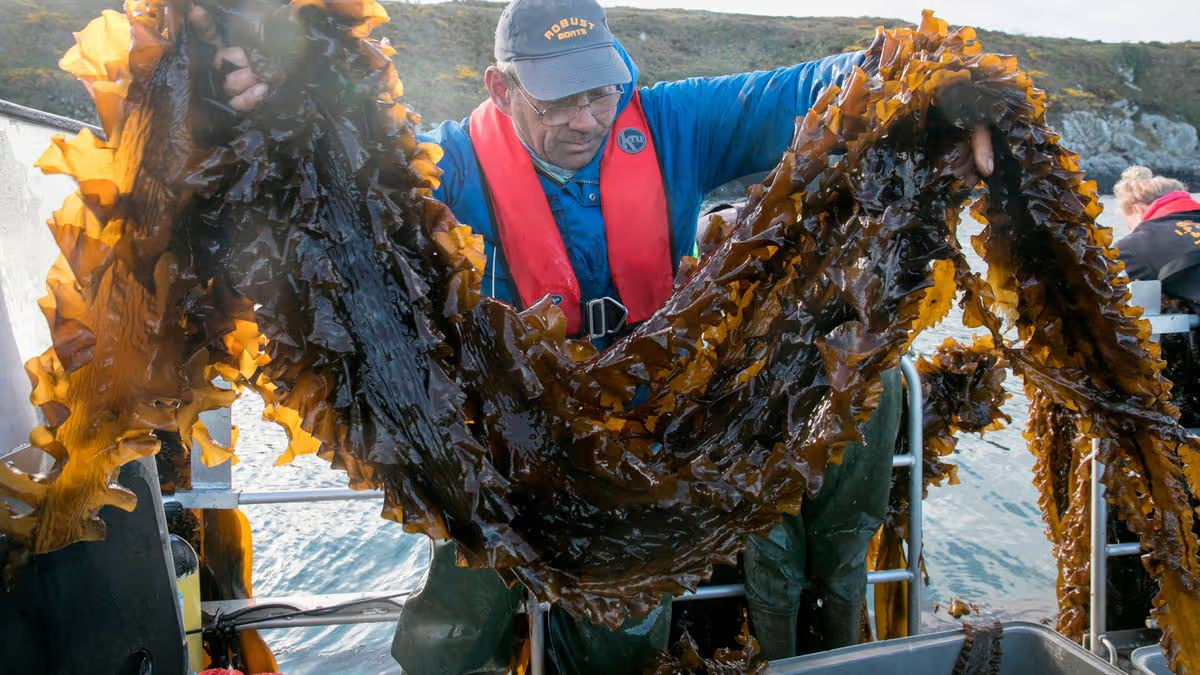
Câr-y-Môr is expanding following a marine licence extension from the Natural Resources Wales

Câr-y-Môr (Image: Angeles Rodenas)
A West Wales seaweed and shellfish farming venture have been given the go-ahead to expand two sea farms.
Câr-y-Môr hopes the growth of its community business will provide British land farmers with a homegrown and effective fertiliser substitute at a time when conflict in the Middle East is driving up costs. Câr-y-Môr is a growing community of 700 members and working partners, all committed to forging a sea farming industry for Wales and beyond.
Eight additional roles are planned for the next five years to join the 19 full-time, year-round working partners currently employed at the St Davids site. In its approval of the marine licence extension, NRW noted the project will contribute to the local economy, blue growth and job creation.
In March the community benefit society (CBS) published results of seaweed biostimulant trials funded by the Co-op Foundation’s Carbon Innovation Fund. They showed that when synthetic fertiliser was cut by 40% and the seaweed biostimulant applied on conventional grassland, the grass quality was maintained and the yield was up by 29%. The yield and quality on trialed cereal and potato fields were also maintained when fertiliser was reduced by 25% and 29% respectively.
This backed up earlier trials of a 24% yield increase on organic potatoes, and an 18% yield increase on silage (equivalent to £92 per hectare uplift) when the biostimulant was added to the existing fertiliser programme.
READ MORE: The knowhow built up in Wales’ contact centre sector is an asset worth redirectingREAD MORE: Wales doesn’t need grants but a new approach to IP and innovation that sustains business success
Now entering its third year of seaweed biostimulant trials, Câr-y-Môr has secured granted a marine licence o expand two existing integrated multi-trophic aquaculture (IMTA) sea farms in the Ramsey Sound off Pembrokeshire. This will allow it to increase production of Welsh seaweed, and meet the increasing demand for its high quality shellfish, which grew by 30% last year.
Beth Marshall, Câr-y-Môr’s marine biologist, who led the marine licence application, said “NRW’s approval is the result of years of feedback and collaboration between the team, volunteers and stakeholders, as well as strong advocacy from local people and businesses.
“It gives us the scope to scale our operations: to harvest more zero-input seaweed for use in biostimulant on the land; increase shellfish and seaweed production in A Grade waters for our 90+ restaurant partners; grow our community outreach and education programmes; and generate more year-round, full-time roles for rural Pembrokeshire.”
Câr-y-Môr’s sea farms will now total 8 hectares. The extended sea farms will be home to sugar kelp, oarweed, Atlantic wakame, furbelows, dulse, pepper dulse, sea lettuce, scallop, native oyster and mussels. The marine licence extension coinciding with the opening of the business’s Sied-y-Môr facility, home to the first dedicated seaweed biorefinery in Wales just a few miles inshore.
The community business has also taken part in a native oyster restoration programme, which last year saw it deploy 50,000 native oysters into Pembrokeshire’s Daugleddau Estuary.
Sophie Wood, programme manager at the UK Seaweed Network, said: “The UK Seaweed Network is delighted to hear of the successful granting of two sea farm extension licences for Câr-y-Môr.
“It is a well-deserved outcome, reflecting the strength of Câr-y-Môr’s efforts to date and its positive contribution to the marine environment and local economy. This decision is a vote of confidence in the future of regenerative sea farming, as well as reinforcing the importance and potential of long-term, responsible use of marine resources in Wales and around the UK.”
Jess Watton, education and engagement lead at Câr-y-Môr, grew up in Pembrokeshire. Part of her role sees her conducting seaweed workshops – which to date have reached more than 4,000 schoolchildren.
She said: “St Davids is tiny, famously the smallest city in the UK, sitting here on the edge of west Wales. Yet our humble community is paving the way for regenerative ocean farming, linking aquaculture with agriculture, and championing Welsh seafood.
“The fact we can do all that whilst cultivating seaweed and shellfish under the waves of what is notoriously one of the most dangerous stretches of water in the world, is just so inspiring.”

















































You must be logged in to post a comment Login