Connect with us

Business

Wales’ growing dog economy creating a new bred of entrepreneurs

Published

on

Business Live

Jessica Phillips-Harris of the British Business Bank explores the emerging opportunities in Wales’ growing dog economy.

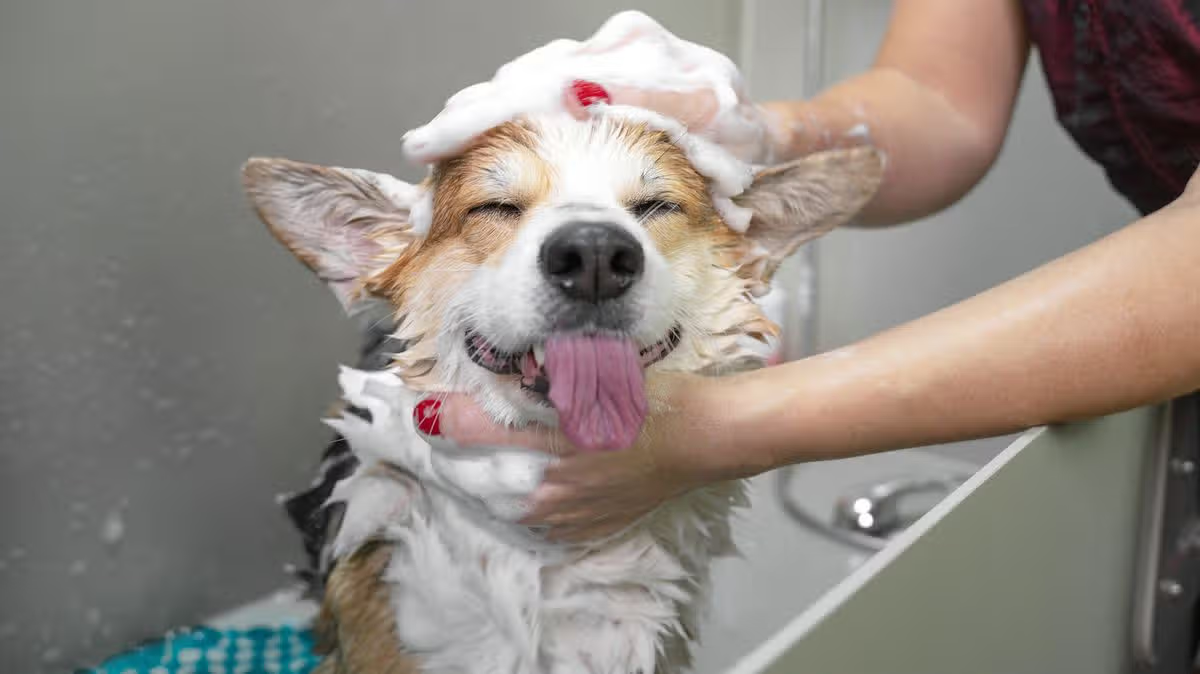
A dog groomer has shared what a day in the life looks life, after quitting her office job (stock image)

A dog groomer has shared what a day in the life looks life, after quitting her office job (stock image)(Image: Getty Images)

Wales has long been a nation of dog lovers. Increasingly, it is becoming a nation of dog entrepreneurs too.

From mobile groomers and doggy daycare to self-service washing stations, specialist toys and stylish accessories, a growing variety of businesses are being built around the needs – and increasingly, the wants – of our four-legged companions .It is a trend we are seeing first-hand through the British Business Bank’s Start Up Loans programme data.

Advertisement

So far this year, almost 5% of all Start Up Loans distributed in Wales have been for start-ups within the ‘dog economy’.

Put another way, that’s almost 1 in 20 Welsh Start Up Loan recipients – a data point not to be sniffed at!

Collaring the market

And what is striking is not simply the number, but the diversity of dog-related businesses appearing in the Start Up Loans recipients, and they are operating in a market where consumer spending is clearly evolving.

Advertisement

There is no single figure for the value of Wales’ dog economy, but nationally the direction of travel is clear. UK household spending on veterinary and other services for pets reached £6.7bn in 2025, up from around £4.5bn in 2019 – an increase of almost 50%, according to the Office for National Statistics.

The category covers veterinary and other services for pets rather than dog businesses specifically, but the growth illustrates the increasing amount consumers are spending on the care and wellbeing of their animals.

That spending is happening against a backdrop of a rapidly expanding dog population. The number of dogs living in UK households has risen from around 12.5 million in 2021 to an estimated 15.5 million today, with 41% of households now owning a dog. At the same time, the market around pets is becoming increasingly varied, extending well beyond essential food and veterinary care into grooming, daycare, walking, training, products and other specialist services.

Pooch pampering

Advertisement

Perhaps most tellingly, pet grooming was added to the Office for National Statistics’ official inflation basket for 2026. The ONS says it introduced the service to reflect a growing area of the pet-care market, noting that reports indicate grooming attracts the second-highest spending in the sector after health checks.

In Wales, the dog grooming picture is equally interesting, even if it cannot yet be neatly expressed in pounds and pence. The Welsh Government estimates that more than 500 pet groomers are operating across the country, and describes pet grooming as widespread and growing. Its evidence also found that 36% of Welsh dog owners had used a professional dog groomer.

That creates an obvious opportunity for entrepreneurs – but the businesses emerging around dogs suggest the opportunity is becoming much broader than grooming alone.

When the dog gets better accessories than you do

Advertisement

Some of the most interesting businesses are tapping into something less essential: what people want to buy for their dogs.

In Abergavenny, former Royal Navy serviceman Ed Woolcott founded Monty’s XI following the loss of his beloved cocker spaniel, Monty.

Supported by a £20,000 Start Up Loan, Ed has launched a range of dog-walking accessories inspired by classic 1990s football kits, including collars, harnesses, leads and poo-bag holders.

No dog actually needs a retro football-inspired lead, and that is precisely what makes the business strategy so revealing.

Ed identified a gap in a market where many dog accessories were heavily targeted towards women, creating an opportunity for products aimed at men who wanted something that reflected their own interests.

Advertisement

Another Start Up Loans-supported business is Pawfectly Clean Cymru.

Rather than operating a conventional grooming salon, the business is installing self-service dog-wash stations, giving owners a quick and convenient way to tackle the inevitable muddy paws, wet fur and post-walk grime without having to turn their own bathroom into a canine spa. It currently has three locations across south Wales – Caerphilly Mountain, Pontcanna Fields and Clydach Valley Lakes.

It is a simple idea, but an interesting one commercially. As dog ownership grows, so does demand for services that make caring for pets easier. With ambitions to expand across Wales, Pawfectly Clean Cymru shows how entrepreneurs can find opportunities by rethinking established services rather than reinventing them entirely.

The businesses backed by Start Up Loans in Wales reflect the widening opportunities emerging around dog ownership.

Advertisement

Alongside Pawfectly Clean Cymru and Monty’s XI, businesses supported so far in 2026 include an American-style dog daycare business in North Wales, a manufacturer of chew-resistant dog toys, an indoor dog soft-play and stay-and-play facility, mobile dog groomers, specialist grooming suppliers and businesses providing dog walking, sitting and home boarding.

Together, they demonstrate how entrepreneurs are identifying opportunities across a market that extends far beyond traditional pet care. Some are solving practical problems for owners, while others are creating products and experiences that reflect the increasingly important role dogs play in people’s lives.

Beyond Start Up Loans, the British Business Bank’s other programmes are helping dog-related businesses to scale and expand and stay here in the UK. One notable example is Clydach Farm – Natural Dog Food which, in addition to finance from Start Up Loans, access the Bank’s Recovery Loan Scheme (now operating as the Growth Guarantee Scheme) through Robert Owen Community Banking Fund.

The ‘dog economy’ may not yet have an official Welsh balance sheet, but the businesses emerging around it tell us something important about modern consumer behaviour. As owners continue to spend more on their pets’ wellbeing, convenience and enjoyment, Welsh entrepreneurs are finding new ways to turn that demand into successful businesses.

Advertisement
  • Jessica Phillips-Harris is a director in the Wales local growth team at the British Business Bank – the economic development bank of the UK Government.

Continue Reading
Click to comment

You must be logged in to post a comment Login

Leave a Reply

Business

Banks offer semi-fixed loans to deploy surplus liquidity

Published

on

Banks offer semi-fixed loans to deploy surplus liquidity
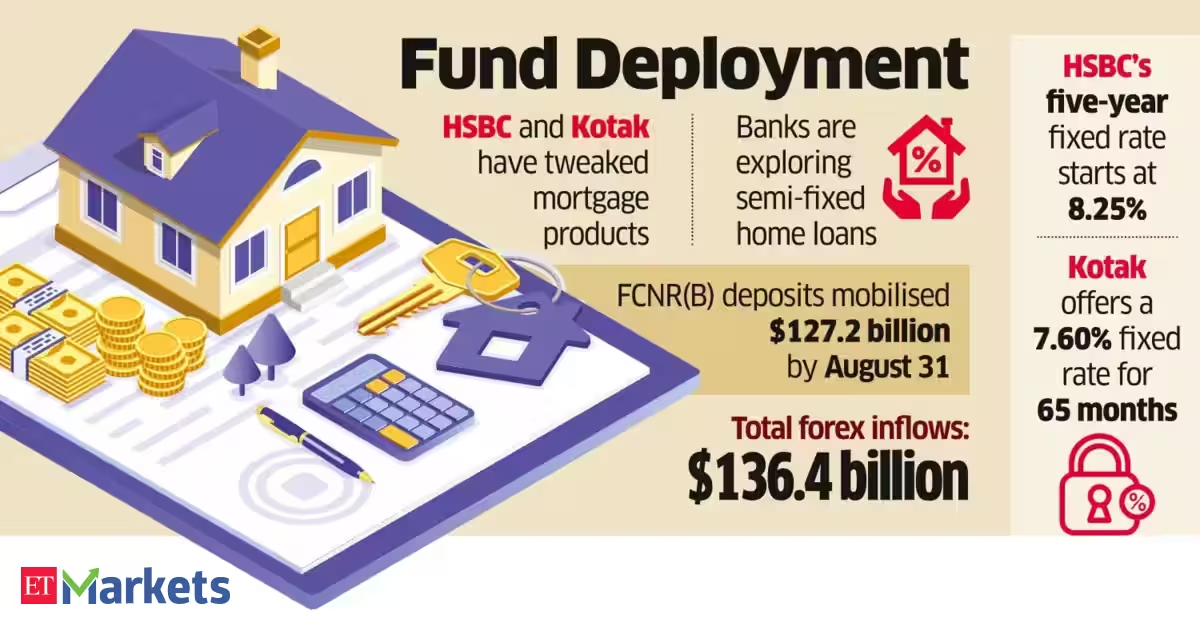
Mumbai: The surge in surplus liquidity has prompted lenders to look at ways to deploy funds that give them assured returns with an aim to protect their margins. HSBC and Kotak Mahindra Bank have taken the lead, tweaking mortgage products, while some banks are preparing to introduce similar loan plans.

Banks are looking at semi-fixed home loans to deploy a surge in surplus liquidity following a record mobilisation of funds through the RBI’s FCNR(B) scheme, while protecting lending margins amid uncertainty over interest rates.

Read more: India’s bank liquidity surplus hits all-time high riding flood of dollar deposits

The special swap facility mobilised $136.4 billion in forex-inflow programs by August 31, including $127.2 billion through FCNR(B) deposits.

Advertisement

LCR_reset_creates_21_Lakhcrore_lending_headroom_for_PSU_Banks_1788463686189ET Bureau

HSBC is offering such a product, with its three-year fixed option starting at 7.50% and a five-year fixed option at 8.25%, before switching to the prevailing floating rate.


Read more: Record FCNR (B) inflows as banks mobilise $127 bln
After the fixed rate period of three and five years, the bank will move customers to prevailing repo-rate at the time of roll-over and margin as communicated at the time of loan disbursement. Similarly, Kotak Bank is offering hybrid home loans for up to 65 months during which their interest rate and EMI remain unchanged even if the Repo Rate rises. The home loan has a fixed interest rate of 7.60% for 65 months, thereafter it will be linked to the prevailing rate.Traditionally, excess funds could be invested in government securities.

‘Risk Mitigation’

“For banks, the attraction is less about betting on the direction of rates and more about putting surplus money to work while locking in a spread,” said a bank executive. “Banks will look to deploy part of the sum into government securities but those assets carry marked-to-market risks when yields move.”

Continue Reading

Business

Centre sees no cost pain for RBI on dollar deluge

Published

on

Centre sees no cost pain for RBI on dollar deluge
New Delhi | Mumbai: The Centre does not expect the Reserve Bank of India (RBI) to face material costs from the unprecedented $127-billion inflows through forex inflow schemes underpinned by a swap facility, people aware of the details of the dedicated plans that closed August 31 told ET.

This assessment comes amid concerns the foreign currency non-resident-bank (FCNR-B) and other forex inflow programmes may have a high cost for the central bank, stemming largely from hedging and liquidity management expenses.

The RBI is, however, expected to earn good returns when these record inflows are deployed in US treasuries that have seen a sharp rise in interest rates, which would offset anticipated costs for the central bank, said the people cited above, setting aside concerns by a section of economists that hedging costs could eventually crimp future central bank surplus transfers to the government.

The investment yield on 52-week US Treasury bills was 4.14% a year as on August 31, 2026, they said. Robust flows are also expected to reduce intervention costs for the central bank to manage currency volatility, as the record proceeds are expected to calm the markets.

Advertisement

Act

Creating Buffer
These flows carry two costs for the central bank: the cost of absorbing excess liquidity from dollar inflows (sterilisation cost), and the cost of exchange rate risk.
Economists believe the first task is an immediate priority, while in the medium term, the RBI will have to create a buffer for the dollar debt that must be repaid within a fixed period. The 3% hedging costs, some economists estimate, could cost the RBI up to Rs 36,000 crore.
“The swap costs that RBI will bear on the dollar inflows could come to about 3% of approximately the Rs 12 lakh crore collected – or about Rs 36,000 crore – that will be reduced from the RBI’s income in the next three to five years,” said Madan Sabnavis, chief economist, Bank of Baroda. “The contingent risk buffer (CRB) of the RBI will also increase as the balance sheet of the central bank increases, which also means that we could see a lower transfer of surpluses to the government.”

The 2013 Precedent

The CRB is a reserve pool of funds set aside from the central bank’s annual profits to cover potential monetary, financial stability, and operational risks. In 2025-26, the CRB threshold was 6.5% of the total balance sheet size of the RBI.

However, some economists believe that just like in 2013, when India had tapped into the diaspora to shore up its currency through the so-called taper tantrum, the key for the RBI to walk away without much stress on the rupee would be the return of capital inflows.

Advertisement

The rupee had plunged to a then record low of Rs 68.85 per dollar in 2013, but strong portfolio inflows ensured the currency recovered close to Rs 61 per dollar in 2014. Although the rupee had weakened to Rs 67 per dollar by the time the three-year swap matured in 2016, a stronger forex kitty ensured the RBI was in a better position to pay off the debts.

The central bank, however, may face rupee losses if the Indian currency depreciates more than expected when these deposits mature.

Policymakers, while accepting the risk, believe there are chances the rupee may appreciate as it happened in 2013 following a similar scheme, and the central bank may even gain.

Any rupee loss to RBI may be partly or fully offset, or even more than offset, by the returns earned from deploying the foreign currency assets in US treasuries, said one of the people cited above.

Advertisement

Liquidity Absorption

Separately, the excess liquidity due to these flows is seen at around Rs 5-7 lakh crore over the next six months. Policymakers believe the economy can easily absorb this liquidity given high growth, and the central bank may not need to absorb it significantly.

Continue Reading

Business

NSE’s mega IPO moves closer as SC approves Sebi settlement

Published

on

NSE’s mega IPO moves closer as SC approves Sebi settlement
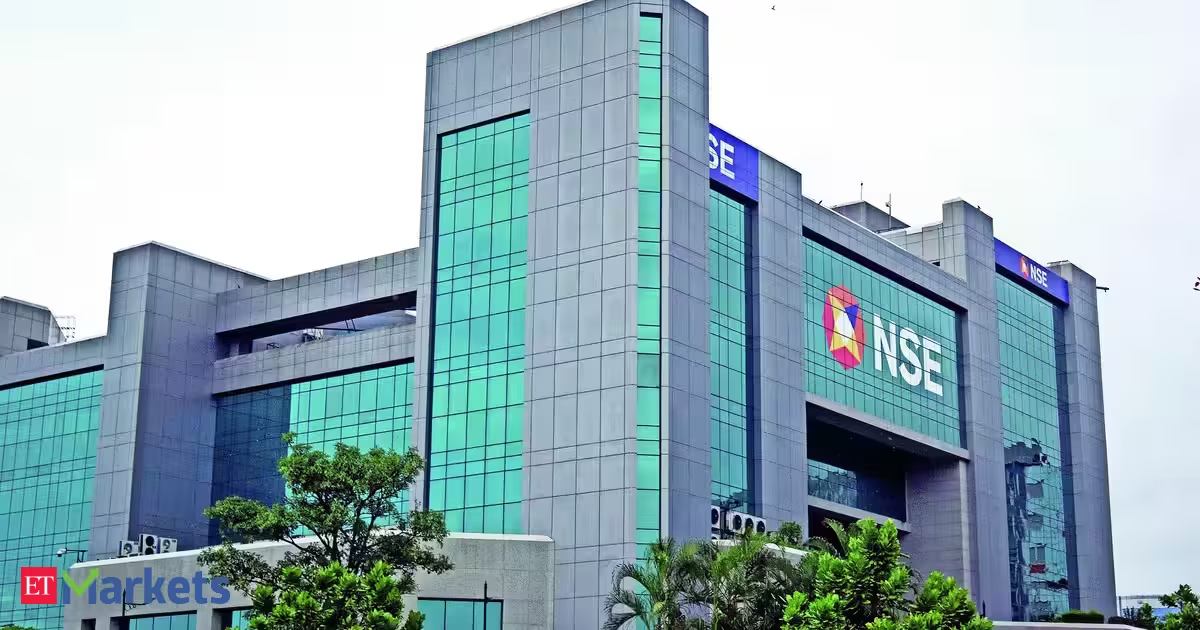
New Delhi: The Supreme Court Thursday accepted the settlement terms arrived at between Securities and Exchange Board of India and National Stock Exchange of India (NSE) in the co-location and dark fibre cases, removing a key regulatory hurdle to the exchange’s listing that’s expected to be the country’s second-largest initial public offering (IPO) ever.

The proposed NSE IPO is expected to garner as much as ₹31,000 crore, making it the country’s second-biggest IPO – next only to the proposed initial share sales by Jio Platforms. The nearly ₹28,000-crore IPO by Hyundai Motor India, launched in October 2024, remains the country’s biggest concluded IPO to date.

Last week, Sebi Chairman Tuhin Kanta Pandey said on the sidelines of an event in Mumbai that the regulator was ‘close’ to giving its approval to the NSE IPO.

Read more: Up to 290% gains! SBI, Federal Bank make massive windfall as Arcil’s Rs 733-crore IPO hits D-Street

Advertisement

The country’s biggest stock exchange had filed on June 18 the draft red herring prospectus (DRHP) for its initial public offering . The offering comprises an offer for sale of 148.91 million shares to be offloaded by some existing shareholders.


The case relates to the alleged lapses in high-frequency trading offered through the exchange’s colocation facility that allegedly gave some entities preferential access.
The market regulator had in July accepted the National Stock Exchange of India’s application under the settlement proceedings regulation for a settlement amount of ₹1,491 crore. NSE said the capital markets regulator granted in-principle approval to settle certain past regulatory lapses, subject to the payment of ₹1,491 crore.The NSE had filed the settlement application of ₹1,224 crore to close the market regulator’s pending appeal in the Supreme Court in the co-location facility case. The NSE had also filed another application for a settlement amount of about ₹268 crore to another pending appeal in the co-location facility-related dark fibre case. However, the co-location case pending against NSE’s former managing director and chief executive officer Chitra Ramkrishna, and others will continue and will be decided separately, a bench led by Justice JB Pardiwala said. It disposed of Sebi appeals challenging the Securities Appellate Tribunal orders that set aside the market regulator’s disgorgement directive in the co-location and dark fibre cases.

Sebi’s 2019 order had imposed a ₹625 crore disgorgement penalty on the NSE. SAT had set aside the disgorgement order in January 2023 and instead imposed a ₹100 crore penalty on the exchange for lack of due diligence in following norms while offering colocation.

It said the stock exchange did not make any illicit gain in the colocation case and there was no finding of fraud, unfair trade practice or collusion against them.

The NSE launched the colocation facility in 2009, allowing traders and brokers to establish their IT servers within its premises for a fee.

Advertisement
Continue Reading

Business

Columbia Overseas Value Fund Q2 2026 Commentary (COAVX)

Published

on

Columbia Overseas Value Fund Q2 2026 Commentary (COAVX)

Columbia Threadneedle Investments is a leading global asset management group that provides a broad range of actively managed investment strategies and solutions for individual, institutional and corporate clients around the world. Columbia Threadneedle Investments is the global asset management group of Ameriprise Financial, Inc. (NYSE: AMP). For more information please visit columbiathreadneedleus.com.

Continue Reading

Business

Jio sets eyes on Navratri-Diwali period to launch mega $4 billion IPO

Published

on

Jio sets eyes on Navratri-Diwali period to launch mega $4 billion IPO
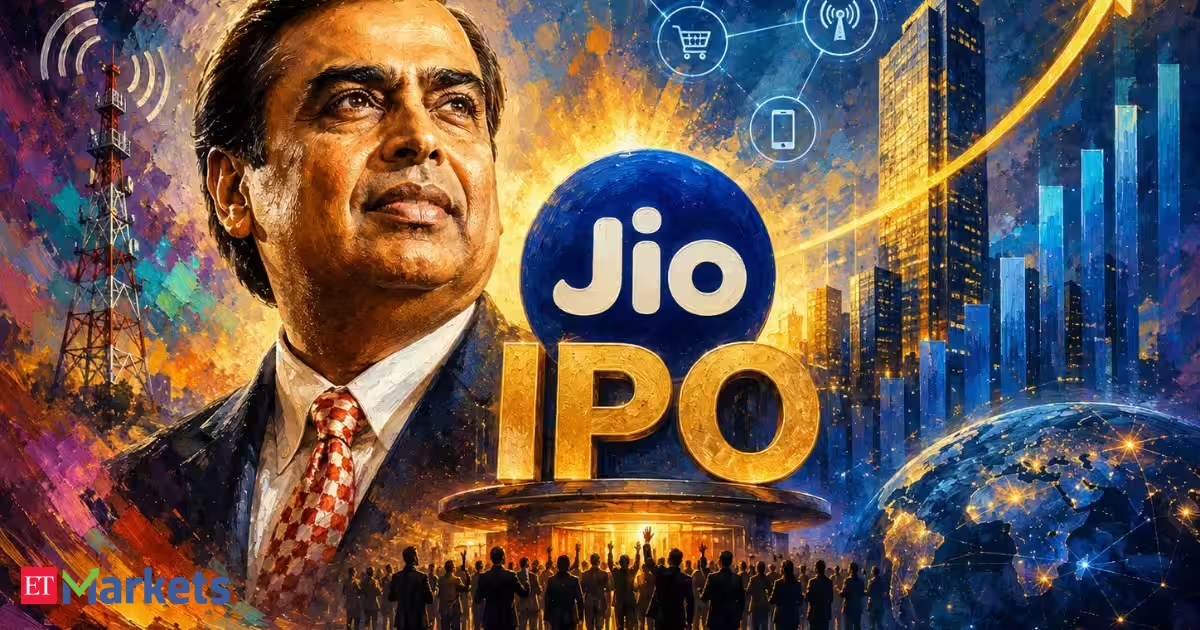
Mumbai: Jio Platforms (JPL), the telecom, digital and technology arm of Mukesh Ambani-owned Reliance Industries, may launch its estimated $4-billion initial public offering (IPO)-India’s largest ever-by the end of October or early November, people familiar with the development told ET.

“Most likely, Jio plans to launch the IPO toward the end of October, particularly around the auspicious days during Navratri,” said a person aware of the likely timelines. “If the launch gets pushed toward the end of October, there could also be some spillover into the first week of November. If not the Navratri, the company could target Diwali for the IPO.”

Jio is likely to finalise the exact dates within a couple of weeks after which it would initiate roadshows overseas before holding them at home, said a source close to the development.

The company plans three weeks of international and two weeks of domestic roadshows, three people in the know said.

Advertisement

Jio Sets Eyes on Navratri-DiwaliPeriod to Launch Mega $4b IPOAgencies

Dates to be finalised soon, company to hold several weeks of intl, domestic roadshows

Details from the DRHP
If the IPO coincides with the Navratri, which starts on Oct 11 and ends on Dussehra (Oct 20), the roadshows could begin as early as next week. Diwali falls on Nov. 8, while Dhanteras is on Nov 6.
Emails sent to the company and lead bankers remained unanswered until the publication of this report.
The company that had filed draft IPO papers in June, received approval from the Securities and Exchange Board of India (Sebi) on August 28 to launch its share sale.

Shattering Records

Bankers estimate the Jio IPO could raise around Rs 37,800 crore, potentially making it India’s largest public issue.

Advertisement

The Jio IPO is expected to surpass the proposed Rs31,000-crore-IPO by National Stock Exchange (NSE). Hyundai Motor India‘s Rs 27,000 crore IPO in 2024 remains the largest completed IPO in the country so far.

According to the Draft Red Herring Prospectus (DRHP), Jio Platforms plans to issue up to 270 million fresh equity shares, representing around 2.9% of its post-IPO equity capital. The proposed IPO does not include an offer-for-sale (OFS) component.

The offering will be the first IPO from the Reliance Industries group in nearly two decades, since the listing of Reliance Petroleum in 2006.

A portion of the IPO proceeds will be used to prepay up to Rs 27,500 crore of loans at Reliance Jio Infocomm Ltd (RJIL), the operating subsidiary of Jio Platforms. The remaining proceeds will be used for general corporate purposes.

Advertisement

Jio Platforms may provide funds to RJIL by subscribing to its equity shares, convertible or non-convertible preference shares or debentures, or through loans, or a combination of these, according to the DRHP.

Large investors collectively hold nearly 30.9% of Jio Platforms. Jaadhu Holdings, an affiliate of Meta Platforms, owns 9.98%, while Google International holds 7.73%. Other investors include Saudi Arabia’s Public Investment Fund, Silver Lake and Vista Equity affiliates, General Atlantic, KKR-backed entities and investment vehicles of the Abu Dhabi Investment Authority.

Continue Reading

Business

Here’s what you can get for free on your birthday

Published

on

Mocha wears a fushia pink off-the-shoulder dress with matching pink gloves and has a large brunette wig on. She has dramatic eye makeup. She is standing in front of a poster board which has her face on it.

Some fast-food chains offer a free birthday meal or snack – Burger King members can claim a free Whopper or Plant-Based Whopper, while Chopstix offers a free small noodle box.

However, most restaurant birthday offers are buy-one-get-one-free deals rather than completely free meals.

At Harvester and Zizzi’s it’s a free main when buying another full-price main. At Frankie & Benny’s you get a free main when purchasing two or more main meals.

Byron offers a free burger with a £5 minimum spend, while Wagamama offers free gyoza when you spend £12 and have earned at least one stamp on your loyalty card in the last six months.

Advertisement

Some chains give money off instead. Turtle Bay offers members a £20 birthday credit with no minimum spend, while Bella Italia gives you £15 off your total bill when you spend a minimum of £30. Las Iguanas offers a free main when two other meals are purchased or a 20% off voucher.

Pizza Express birthday rewards depend on your loyalty level. Bronze members may get a free dessert with a £10 spend, while higher tiers can get a free pizza or drinks with a £15 minimum spend.

At Prezzo, members receive drinks or desserts when they spend at least £25, while Bill’s offers a bottle of prosecco or pancakes when qualifying meals are ordered and the booking is made in advance.

Advertisement
Continue Reading

Business

Volkswagen board approves plan to cut 100,000 jobs

Published

on

Mocha wears a fushia pink off-the-shoulder dress with matching pink gloves and has a large brunette wig on. She has dramatic eye makeup. She is standing in front of a poster board which has her face on it.

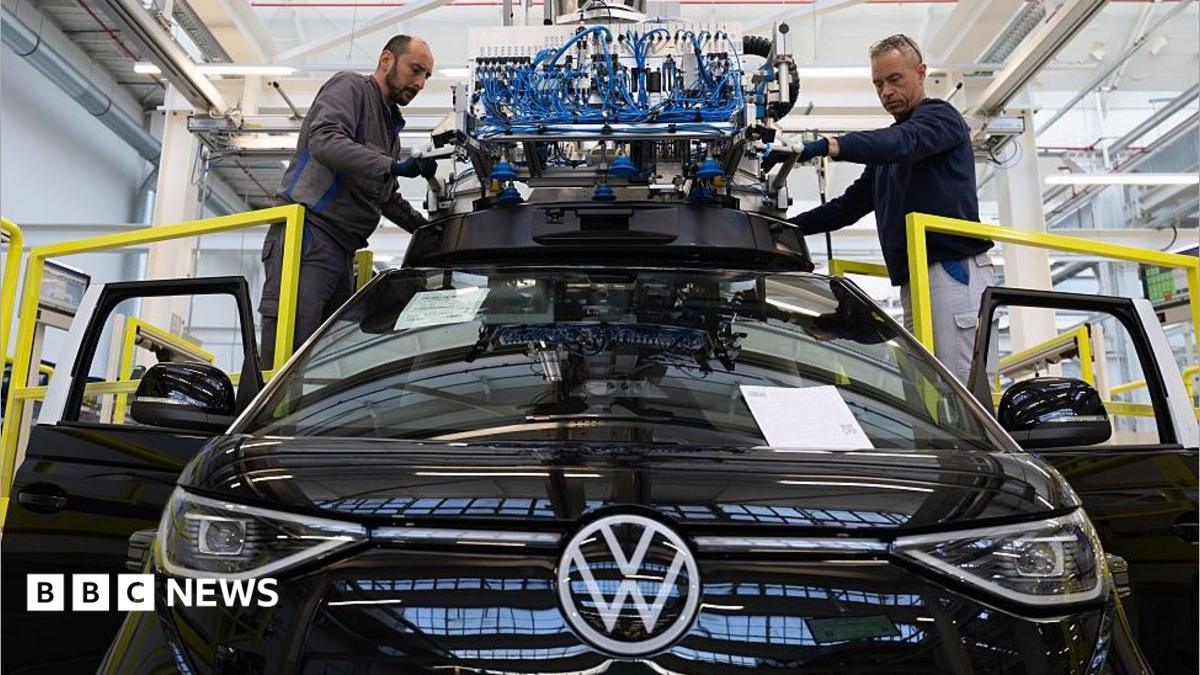
The board of German car giant Volkswagen has approved a plan to cut another 50,000 jobs as part of a sweeping turnaround programme. It brings the total number of roles the company plans to shed by 2030 to 100,000.

The group – which includes Audi, Porsche, Skoda as well as the VW brand – said in March that it would cut 50,000 roles by the end of the decade.

The move is a “strong signal” for the future of the firm, which is “taking responsibility for our entire workforce”, VW’s chief executive Oliver Blume said in a statement on Thursday.

Blume told the BBC in July that the firm was looking to make the additional cuts.

Advertisement

The company has been hit by a drop in profits due to falling sales and fierce competition, especially from Chinese brands.

VW’s statement also said that a “fundamental adjustment of the global workforce capability is necessary” to safeguard the competitiveness of the company, which faces shifting demand and technological change.

It added “a Group-wide workforce adjustment of approximately 50,000 positions – including management roles – will be necessary.”

As of 2025, the Beetle-maker employed more than 660,000 people worldwide.

Advertisement
Continue Reading

Business

Japan household spending drops for eighth straight month in July

Published

on


Japan household spending drops for eighth straight month in July

Continue Reading

Business

Is India’s internet boom running into an undersea problem?

Published

on

Mocha wears a fushia pink off-the-shoulder dress with matching pink gloves and has a large brunette wig on. She has dramatic eye makeup. She is standing in front of a poster board which has her face on it.

Pooja Bhatt, an associate professor at OP Jindal Global University, says that mismatch is increasingly difficult to ignore.

“Given its young demographics and ‘Digital India’ aspirations, it makes sense for the nation to build and maintain its own internet infrastructure for security and governance purposes,” she says.

India has already taken a step: the government now treats submarine cable systems as critical telecommunications infrastructure, recognising their importance to international connectivity.

Sundararajan says the designation should bring faster clearances, emergency repair mechanisms and an Indian cable-repair capability, along with legally protected cable zones around landing sites and routes, restricting anchoring and trawling.

Advertisement

Technology could help too.

A technology called Distributed Acoustic Sensing can turn optical fibres into sensors capable of detecting vibrations from ships, anchors or underwater vehicles – potentially identifying threats before a cable is severed.

But the immediate fixes are possibly more mundane: more landing stations, greater geographical diversity, faster permissions, protected cable routes and an Indian repair capability.

“Connectivity has historically clustered around Mumbai because the ecosystem, infrastructure and demand were already concentrated there,” Gupta says. “But that concentration is exactly the risk the industry needs to design away from.”

Advertisement

That shift is already beginning.

Four new submarine cable systems are being commissioned, external, with three more planned. Lightstorm is leading a consortium building one of them, I-2SEA, linking India with Malaysia and Singapore. The system will have dual landings in India – at Machilipatnam, providing a shorter subsea route to Hyderabad, and at a new landing location in South Chennai, adding diversity to existing routes.

For a country consuming data at extraordinary speed, the infrastructure carrying it remains surprisingly fragile. India is adding data centres and preparing for an AI-heavy future. The question is whether its cables, landing stations and repair capacity can keep up.

Advertisement
Continue Reading

Business

US probes Iran wedding strike that analysis shows was likely direct hit by US munition

Published

on


US probes Iran wedding strike that analysis shows was likely direct hit by US munition

Continue Reading

Trending

Copyright © 2025