
Business
Weekend Long Read: Why emerging economies in Asia face a tougher road to growth


In three weeks, finance ministers, central bankers and investors from more than 180 countries will gather in Bangkok for the IMF and World Bank Annual Meetings, running from 12 to 18 October, with the plenary session on 16 October. It is the first time the meetings have come to the Thai capital since 1991, and the timing gives the host country an unusual vantage point on a difficult moment for the region.
Asia’s Tougher Path: Why the Next Wave of Growth Will Benefit Only a Select Few
The forecasts that delegates will be debating were mostly finished before the summer. They rest on a specific assumption: that the Strait of Hormuz would begin to reopen in mid-July and that conditions would be broadly back to normal by March 2027. That has not happened on schedule. Talks between Gulf states and Iran were postponed again this month, and market reports put Brent crude back above 100 dollars a barrel in the past week. The story of Asia’s emerging economies in 2026 is therefore less a story of a single slowdown than of a widening gap between countries.
The playbook that worked, and why it works less well now
South Korea, Taiwan and, later, China grew rich on a well-known sequence: cheap labour, export-oriented manufacturing, rising productivity, and a steady climb from low-value assembly to higher-value goods. That ladder is harder to climb today, for reasons that long predate the current crisis.
Factories built now absorb far fewer workers than those built in the 1980s, so manufacturing employment tends to peak at lower income levels than it once did. China’s scale and overcapacity in many mid-technology sectors crowd the field for newcomers. World trade no longer grows much faster than global output, so exporting is no longer a rising tide.

On top of that, several economies are ageing before they have become rich, which limits savings, labour supply and fiscal room. Thailand is the region’s clearest example, and the country’s long-term growth decline has been driven by exactly these forces, compounded by household debt that is unusually high for a developing economy.
Moving from middle to high income is a matter of productivity, skills, competition and institutions rather than cheap labour and capital accumulation, and those are the slowest things to build. Every crisis that arrives on top of this is harder to absorb, because there is less room to manoeuvre.
Three forecasters, three pictures
The three main institutions published their latest assessments between June and July. Their headline figures differ, partly because they use different country groupings and weighting methods.
The IMF’s July update sees global growth of 3.0 percent this year and 3.4 percent in 2027, describing an economy pulled by two opposing forces: the negative supply shock of the Middle East war and a positive technology shock driven by artificial intelligence. It puts emerging and developing Asia at 5.0 percent in 2026 and 4.8 percent in 2027. The Asian Development Bank’s July outlook lowers its 2026 forecast for developing Asia and the Pacific to 4.9 percent, from 5.5 percent in 2025, and expects inflation to climb to 4.3 percent. The World Bank’s June assessment is the darkest of the three: East Asia and Pacific slows to 4.2 percent from 5.0 percent, or 4.4 percent excluding China.
At the country level, the numbers show how uneven the picture has become (GDP growth, 2026 and 2027):
| Economy | IMF (July) | ADB (July) | World Bank (June) |
|---|---|---|---|
| Vietnam | 7.5 (2026) | 7.2 / 7.0 | 6.8 / 7.1 |
| Indonesia | 5.0 / 5.1 | 5.2 / 5.2 | 5.0 / 5.2 |
| Malaysia | 4.7 / 4.3 | 4.6 / 4.5 | 4.4 / 4.4 |
| Philippines | 3.9 / 5.5 | 3.8 / 5.3 | 3.7 / 5.6 |
| Thailand | 1.9 / 2.2 | 1.8 / 2.0 | 1.7 / 2.1 |
| China | 4.6 / 4.1 | 4.6 / 4.5 (developing East Asia) | 4.2 / 4.3 |
The spread between Vietnam at the top and Thailand at the bottom is wider than the gap between any two forecasters. That spread, more than any headline average, is the real news.
The shock of war: who bears the cost
The IMF describes the 2026 Middle East conflict’s effect on energy markets as a large supply disruption that was cushioned by inventories, emergency stock releases and weaker demand. The cushion is unevenly distributed. Since the war began, the IMF notes, retail gasoline prices have risen about 30 percent in emerging Asia, against roughly 15 percent in Latin America, and liquefied natural gas prices in Asia have climbed by about half.

For energy importers, the pain arrives through three channels. The first is inflation: the ADB has raised its 2026 inflation forecast for the Philippines by 1.9 points to 5.9 percent, and for Thailand by 1.6 points to 2.9 percent. The second is the fiscal bill. The ADB warns that higher fuel subsidy costs could worsen public finances across developing Asia, particularly where natural gas is subsidised, and argues for targeted help to vulnerable households rather than broad price support. The World Bank expects fiscal pressure to be especially acute for energy importers such as the Philippines and Thailand. The third is food. Higher energy prices feed into fertiliser costs, and a possible strong El Niño could reduce harvests and lift rice prices, with import-dependent, rice-heavy economies most exposed.
Net energy exporters see the opposite. Malaysia gains from better terms of trade, and the IMF also credits data-centre activity and the technology upturn for its 4.7 percent projection. The war has, in effect, created a new sorting mechanism: your position in the global energy balance now matters almost as much as your position in the manufacturing chain.
The AI dividend, and who collects it
The second force cuts the other way. According to the IMF, the four largest net exporters of AI-related hardware, namely Taiwan, Korea, Thailand and Malaysia, beat first-quarter expectations by an average of 4.4 percentage points at an annualised rate, while the rest of the world missed by 0.3 points. Korea’s economy grew at 7.5 percent, more than four times what the IMF had projected in April, powered by semiconductors and AI hardware exports.
Southeast Asia is capturing part of this. The IMF raised its 2026 forecast for Vietnam by 0.4 points to 7.5 percent on the back of technology exports, and the World Bank notes that demand for AI-related products lifted industrial output and exports in Malaysia, the Philippines, Thailand and Vietnam.
But the same institutions caution that the benefits are narrow. The World Bank points out that the spread of AI across the wider economy remains limited and uneven, which creates challenges for productivity and job creation. The ADB’s special analysis this year finds that advanced economies are better placed to gain early from generative AI because of stronger digital infrastructure, skills and institutions, while developing Asia’s gains are smaller, though more persistent, and depend on closing readiness gaps in computing capacity, skills and data governance. The IMF also lists a correction in technology expectations among its downside risks, particularly for AI-exporting economies with concentrated equity markets.
The lesson is subtle. Being plugged into the AI hardware chain is now a bigger advantage than being an emerging market or a developed one, but it is an advantage with a concentration risk attached.
Thailand as the test case
No economy in the region illustrates both forces more clearly than Thailand, which is the weakest of the major ASEAN growers in every forecast above and also one of the four largest AI-hardware exporters.
The export side of the story is real. In April, Thai exports rose 23.1 percent, and electronics jumped 64.6 percent, though imports climbed even faster and pushed the trade deficit to a record. On the investment side, Board of Investment applications rose 37 percent year on year to 43.6 billion dollars in the first half of 2026, with 33 billion dollars concentrated in digital infrastructure such as data centres and cloud services. Foreign direct investment surged 80 percent.
The domestic side is far weaker. The Bank of Thailand held its policy rate at 1.0 percent in June and lifted its 2026 growth forecast to 2.3 percent, but that figure includes government support, and the central bank estimates growth would be 1.8 percent without it. It expects inflation to peak at about 4.5 percent in late 2026, and it flagged household debt of around 86 percent of GDP as a brake on consumption once stimulus fades.
The government’s emergency decree to borrow 400 billion baht, described when first-quarter growth of 2.8 percent was announced, funds much of that support. Second-quarter growth then slowed to 1.9 percent year on year, according to figures reported in a recent TBN briefing, which also noted that a business-sector forecast for 2.1 to 2.5 percent growth this year comes with a warning that imported content limits how much of the export and investment boom reaches the domestic economy.
SCB EIC describes the pattern as a K-shaped recovery, which benefits large technology-linked businesses while lower- and middle-income households and small firms remain constrained by slow income growth and high debt. The authorities appear aware of the risk that investment volume does not translate into local value: the government has paused 166 data-centre projects while it tightens investment rules, and analysts increasingly frame the task ahead as converting foreign capital into local supply chains and skilled jobs. In April, the central bank warned that a prolonged closure of Hormuz could push growth far lower, and its scenario analysis showed how exposed an energy-importing economy remains.
Thailand also carries a regional complication: the ADB says the prolonged closure of the Thai-Cambodian border is weighing on Cambodia’s outlook, cutting its 2026 forecast to 4.1 percent.
The rest of the field
Vietnam remains the region’s growth leader, with all three institutions between 6.8 and 7.5 percent this year. Its strength rests on manufacturing and technology exports and steady domestic demand, though the World Bank notes that inflation was already elevated there before the conflict.
Indonesia is the steadiest, with forecasts of 5.0 to 5.2 percent, supported by resilient domestic demand and state-led investment initiatives. Its currency and local-currency bond yields came under pressure when the conflict began, as did Thailand’s and the Philippines’.
The Philippines has the sharpest downgrade. The ADB cut its 2026 forecast to 3.8 percent from 4.4 percent on delayed investment and softer consumption, though all three institutions see a strong rebound to more than 5 percent in 2027.
China is slowing rather than collapsing. Growth was stronger than expected in the first quarter, but momentum faded in April and May, and retail sales fell 0.6 percent year on year in May, the first decline since December 2022. The IMF projects 4.6 percent this year, the World Bank 4.2 percent. India, by the IMF’s fiscal-year measure, is at 6.4 percent, and the ADB has trimmed its forecast because energy prices squeeze real incomes.
What to watch
The first variable is Hormuz itself. The IMF’s baseline used a 2026 average oil price of about 89 dollars a barrel and about 79 dollars in 2027, based on market pricing in early June. Over the summer, Iran said the waterway would not reopen without concessions from Washington, and this month Oman postponed a scheduled Gulf-Iran meeting as Brent traded near 107 dollars. The US Energy Information Administration’s September outlook is somewhat more hopeful, expecting prices to average about 90 dollars in the second half of the year and fall to around 77 dollars by the second quarter of 2027 as shut-in Gulf production restarts. If prices stay elevated, the July forecasts for energy importers look too generous.
The second is trade policy. The ADB notes that after the US Supreme Court reversed some tariff measures, Washington is moving towards alternative legal tools, notably Section 301, and that developing Asia remains the region most exposed.
The third is the AI cycle. A sharp correction in technology valuations or capital spending would hit precisely the economies that have been outperforming.
The fourth is the calendar. The IMF’s full World Economic Outlook will appear with the Annual Meetings in October, and the World Bank’s regional update usually follows in the autumn. Given the energy trajectory since July, the risk to the current numbers is to the downside.
Harder does not mean closed
It would be a mistake to read all of this as a story of decline. The region is still growing faster than almost any other, and the World Bank expects growth excluding China to recover to 4.9 percent in 2027 and 2028 as uncertainty fades and energy prices settle. Vietnam, Indonesia and Malaysia are proving that the path is still open for economies that combine domestic demand, a credible role in the supply chain and reasonable policy space.
What has changed is the price of admission. The old ladder rewarded cheap labour and openness. The current one rewards energy resilience, fiscal room, skills, and the ability to turn a technology boom into broad-based jobs and incomes. Economies that manage all of that will look very different in 2028 from those that cannot. In that sense, the Annual Meetings arrive at a good moment for Thailand: the most useful thing the host can show its guests is not the size of its investment pipeline, but how much of it stays in the country once the cranes and servers are in place.


Apple’s Cook calls Australia’s social media curbs ‘world-leading,’ PM says

China keeps benchmark lending rates unchanged for 16th month in September

The Ethereum (CRYPTO: ETH) cryptocurrency is up 5.8% at 2:17 p.m. ET, floating atop a broad surge across the crypto sector. It’s the kind of day where you almost expect stablecoins to rise, as the U.S. Securities and Exchange Commission (SEC) moved one step closer to permitting token-based trading of stock-type securities.
And Ethereum would benefit directly if tokenized stocks ever get the SEC’s final stamp of approval. The news is a day old, but traders needed time to process the situation after a tumultuous week in which the Clarity Act failed to move forward.
Missed AI’s “Act 1”? Act 2 Could Be 15x Bigger. Most investors think they missed the AI boat because they didn’t buy Nvidia in 2005. But according to our analysts, we’re only at the end of “Act 1″—the R&D phase. “Act 2” is the global rollout. Continue »
What an “Innovation Exemption” actually does
The SEC is allowing a new kind of venue to trade blockchain versions of regularly listed stocks without first registering as a stock exchange. It’s temporary, it’s capped, and it comes with strings attached.
This isn’t retail investors buying tokenized stocks on a public blockchain tomorrow. It’s explicitly a placeholder for further announcements. The tokenized securities venue (TSV) designation is essentially a bold but limited experiment.
TSVs come with a five-year sunset; the public comment period is open; and SEC Chairman Paul Atkins frames them as a bridge to actual rulemaking. In other words, the SEC wants to see how this behaves in the wild before writing permanent rules.
But it is a baby step forward for the general concept of tokenized stock trading. That’s good news for Ethereum, because the SEC’s order requires that smart contracts used by a TSV run on a public, permissionless distributed ledger. That’s a short list, and Ethereum is the clear leader in this space.

Ethereum’s angle
Two caveats before chasing Ethereum down the TSV alley:
-
First, this is mostly a round trip. Ether traded near $2,597 before the Senate’s Clarity Act vote failed on Sept. 15, and it’s barely above that now.
-
Second, no TSV exists yet. Volume caps and a five-year expiration make this an option on tokenized equities rather than a solid revenue stream.
That makes Ethereum a bet on being the default settlement layer if tokenized stocks are approved and then scale up to broad adoption. It’s a promising but unproven idea, and the SEC is still years from a permanent rulebook.
Don’t expect this particular announcement to make a significant difference to Ethereum’s fundamental value. This could take a long time, as the five-year policy sunset suggests.
Business
This Diamondback Insider Is One of the World’s Richest People. She Just Sold $2 Billion of Stock.
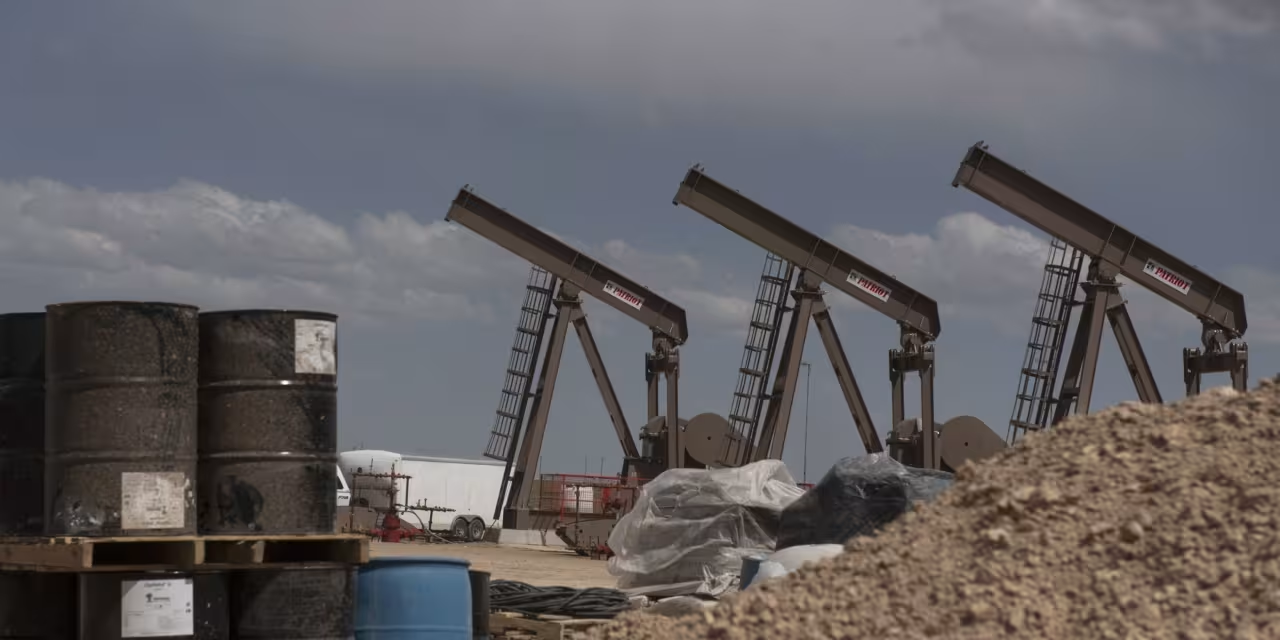
This Diamondback Insider Is One of the World’s Richest People. She Just Sold $2 Billion of Stock.

A majority of S&P 500 stocks were still down, though sector breadth was improving. At one point, all 11 S&P 500 sectors were down. Heading into the final hour of trading, more than half the major sectors were up. Industrials, tech, financials, consumer discretionary, and health care were leading the pack.


The dollar index (DXY00) fell from a 7-week high on Friday and finished down by -0.03%. The dollar gave its advance on Friday on weaker-than-expected US economic news that showed Aug manufacturing production and Aug leading indicators unexpectedly declined. Also, Friday’s -1% fall in WTI crude oil eased inflation expectations and could persuade the Fed to loosen monetary policy, a bearish factor for the dollar.
The dollar initially moved higher on Friday on weakness in the yen, which fell to a 2-week low today. Higher T-note yields on Friday also supported the dollar. The dollar also has carryover support from Wednesday when the FOMC raised interest rates by 25 bp and signaled another rate hike by the end of the year. The dollar fell from its best level after US
More News from Barchart
US Aug manufacturing production unexpectedly fell -0.3% m/m, weaker than expectations of +0.3% m/m and the largest decline in 10 months.
US Aug leading indicators unexpectedly fell -0,1%, weaker than expectations of a +0.1% increase and the first decline in 5 months.
Markets are pricing in a 55% chance of a +25 bp Fed rate hike at the next FOMC meeting on October 27-28.
EUR/USD (^EURUSD) recovered from a 7-week low on Friday and finished up by +0.10%. Short covering emerged in the euro on Friday after the dollar index fell from a 7-week high and turned lower. The euro also garnered support after German Aug producer prices rose more than expected, a hawkish factor for ECB policy. Also, ECB President Lagarde’s comments today supported the euro when she said economic growth in the Eurozone is a bit more promising than we thought.
The ECB Aug 1-year CPI expectations rose to +3.0% from +2.9% in July, weaker than expectations of +3.1%. The Aug 3-year CPI expectations rose to +2.9% from +2.7% in July, stronger than expectations of +2.8%.
German Aug PPI rose +1.1% m/m and +4.6% y/y, stronger than expectations of +0.6% m/m and +3.9% y/y, with the +4.6% y/y increase the largest in 3.25 years.
ECB President Christine Lagarde said economic growth in the Eurozone is a bit more promising than we thought, and we’re not seeing second-round effects on inflation yet.
The markets are discounting a 62% chance of a +25 bp ECB rate hike at the ECB’s next policy meeting on October 29.
Fortinet (FTNT) stock is trading just below a buy point after a strong week for cybersecurity stocks. Shares are attempting to break above resistance around 170. The security software industry group ranks No. 3, showing impressive leadership. The past week was big for cybersecurity stocks, after Anthropic CEO Dario Amodei and OpenAI CEO Sam Altman warned investors about risks from…
Copyright ©2026 Investor’s Business Daily, LLC. All rights reserved. 87990cbe856818d5eddac44c7b1cdeb8
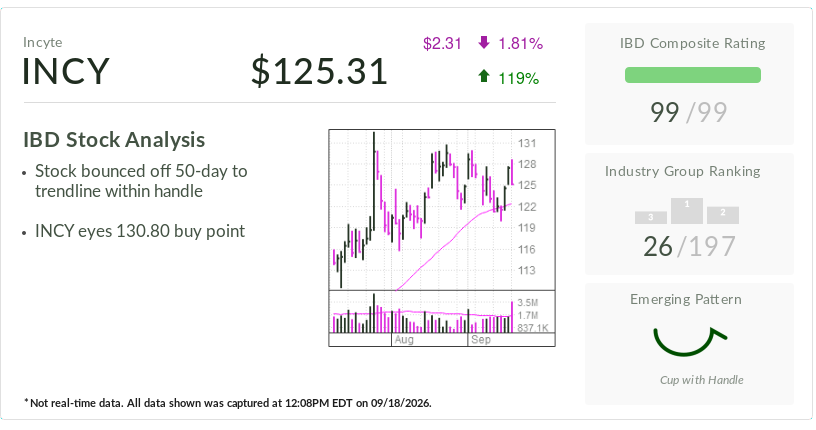
Incyte Incyte INCY $ 125.31 $2.31 1.81% 119% IBD Stock Analysis Stock bounced off 50-day to trendline within handle INCY eyes 130.80 buy point IBD Composite Rating 99/99 Industry Group Ranking 26/197 Emerging Pattern Cup with Handle Cup with Handle A positive chart pattern named such because it resembles the outline of a coffee cup with a handle. The pattern…
Copyright ©2026 Investor’s Business Daily, LLC. All rights reserved. 87990cbe856818d5eddac44c7b1cdeb8

Xenon Stock Craters 30% on Drug Trial Setback. Its Failure Could Be This Biotech’s Gain.

US says it killed four people in strike on vessel in Caribbean

Irish Radio Station Drops Ed Sheeran After Macklemore Exit
Apple’s Cook calls Australia’s social media curbs ‘world-leading,’ PM says

Naomi Watts’ Oddly Chic Shoe Style Is on Amazon for $50




-

 Fashion1 day ago
Weekend Open Thread: Talbots – Corporette.com
-

 Tech7 days ago
The Latest Weird Thing to Play Doom Is the Mapped-Out Brain of a Fruit Fly
-
 NewsBeat1 day ago
Trump says US has reached an agreement to take permanent control of Greenland’s security
-

 Crypto World5 days ago
Kraken Lets xStocks Holders Earn Yield Through DeFi
-

 Crypto World5 days ago
Revolut Attackers Warn of Ongoing Daily Customer Data Leaks
-

 Crypto World4 days ago
What Is the Status of the U.S.-Iran Peace Talks? Here's What Both Sides Are Saying
-

 Crypto World3 days ago
US Charges Robinhood Engineers Over Crypto Listing Trades
-

 Crypto World6 days ago
Elon Musk Drops a Bombshell: Grok 5 Could Be the AGI Breakthrough
-

 Crypto World4 days ago
Robinhood engineers charged over $50K crypto scheme
-

 Crypto World1 day ago
Circle launches Arc Studio AI agent for building onchain apps
-

 Crypto World1 day ago
Bitcoin price breaks channel as RSI climbs to 63
-

 Business7 days ago
Rivals Sam Altman and Elon Musk Rally Behind Dario Amodei’s Call for a Slowdown in AI Development
-
 Crypto World6 days ago
New Tesla Roadster Uses SpaceX Tech. Will It Impact the Stock Price?
-
 NewsBeat5 days ago
‘Sick conspiracy’: Trump says only guardrails AI needs is ‘a strong and smart (High IQ!) president’ in all-caps rant
-

 Crypto World5 days ago
NVIDIA Analysis: Attempted Rising Wedge Breakout Amid Pressure on the AI Sector
-
Business5 days ago
SK Hynix ADRs Fall More Than 6% as Memory Rally Breaks on Fears of Slower AI Spending
-
 Crypto World6 days ago
3 Token Unlocks to Watch in the Third Week of September 2026
-

 Crypto World5 days ago
DOJ Seeks to Seize $61M in Iran Oil Funds From Binance Accounts It Vouched For
-
Crypto World5 days ago
Can Circle’s Arc Repeat Robinhood Chain’s Meme Coin Boom?
-
 NewsBeat7 days ago
Last Night of the Proms pays moving tribute to Dolly Parton as Sheridan Smith wears a gold sequin jumpsuit in memory of the Queen of Country
You must be logged in to post a comment Login