

Business
Week’s Best: Banks’ and Brokerage Firms’ Very Bad Day




🔎 Costco (COST): The warehouse retailer posted strong quarterly results, boosted by both product sales and membership fees. Shares added 1.6% Friday.

Last week, the BSE benchmark tanked 2,368.29 points, or 2.91 per cent.
“Markets ended the holiday-shortened week with steep losses as escalating geopolitical tensions in West Asia and a sharp spike in crude oil prices weighed heavily on investor sentiment,” Ajit Mishra, SVP, Research, Religare Broking Ltd, said.
From the top-10 pack, Reliance Industries and Infosys were the only gainers.
The market valuation of State Bank of India tumbled Rs 53,952.96 crore to Rs 10,55,567.27 crore.

ICICI Bank‘s valuation eroded by Rs 46,936.82 crore to Rs 9,40,049.82 crore and that of HDFC Bank dived Rs 46,552.3 crore to Rs 13,19,107.08 crore.
The valuation of Larsen & Toubro tanked Rs 45,629.03 crore to Rs 5,43,208.36 crore.The market capitalisation (mcap) of Bajaj Finance dropped by Rs 28,934.56 crore to Rs 5,91,136.03 crore and that of Tata Consultancy Services (TCS) diminished by Rs 28,492.44 crore to Rs 9,25,380.15 crore.
Hindustan Unilever‘s mcap declined by 26,350.67 crore to Rs 5,23,042.51 crore and that of Bharti Airtel edged lower by Rs 4,732.75 crore to Rs 10,67,120.50 crore.
However, the market valuation of Reliance Industries jumped Rs 14,750.39 crore to Rs 19,01,583.05 crore.
The mcap of Infosys climbed Rs 3,459.99 crore to Rs 5,30,546.54 crore.
Reliance Industries remained the most valued domestic firm followed by HDFC Bank, Bharti Airtel, State Bank of India, ICICI Bank, TCS, Bajaj Finance, Larsen & Toubro, Infosys, and Hindustan Unilever.
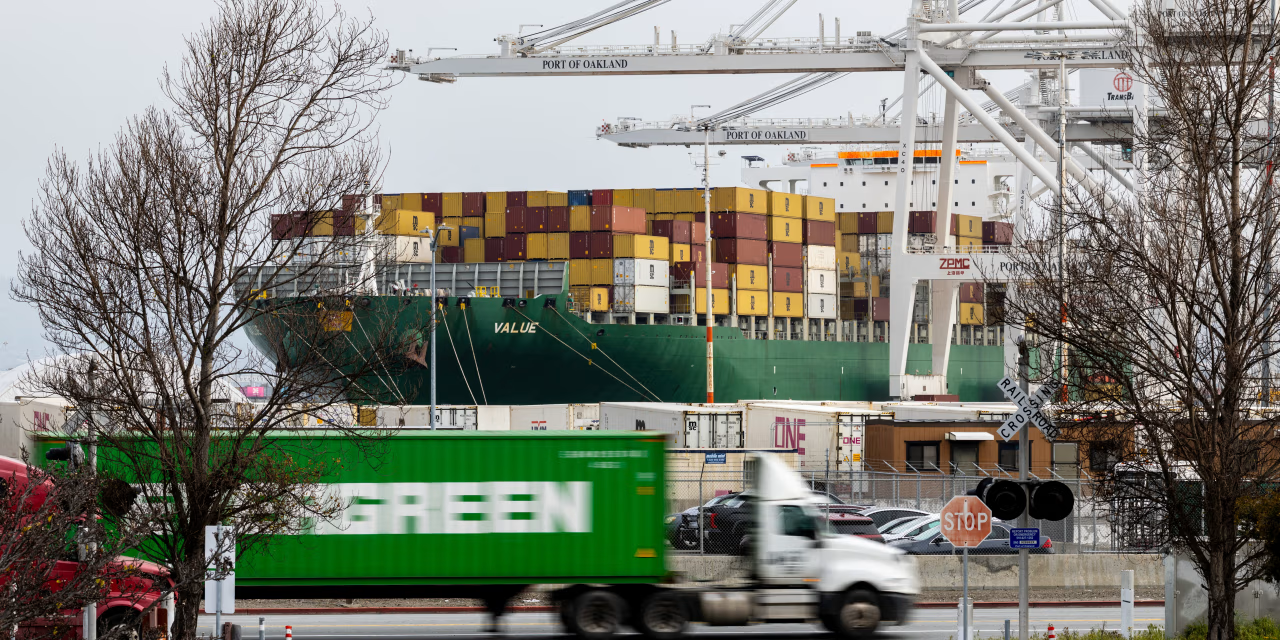
A federal trade-court judge this week told the Trump administration to begin the process of
returning the approximately $166 billion it collected in tariffs that were voided by the Supreme Court. The order raised hopes of refunds flowing instantly to hundreds of thousands of businesses and people who paid them. But the Trump administration later told the judge that isn’t going to happen and he quickly scaled back his own directive.
Here is what to know about where the legal fight stands and the lengthy process that lies ahead before money hits anyone’s bank account.
Copyright ©2026 Dow Jones & Company, Inc. All Rights Reserved. 87990cbe856818d5eddac44c7b1cdeb8
Outside Firms Start Their Deep Discount Offer for Shares in Blue Owl Private Credit Fund
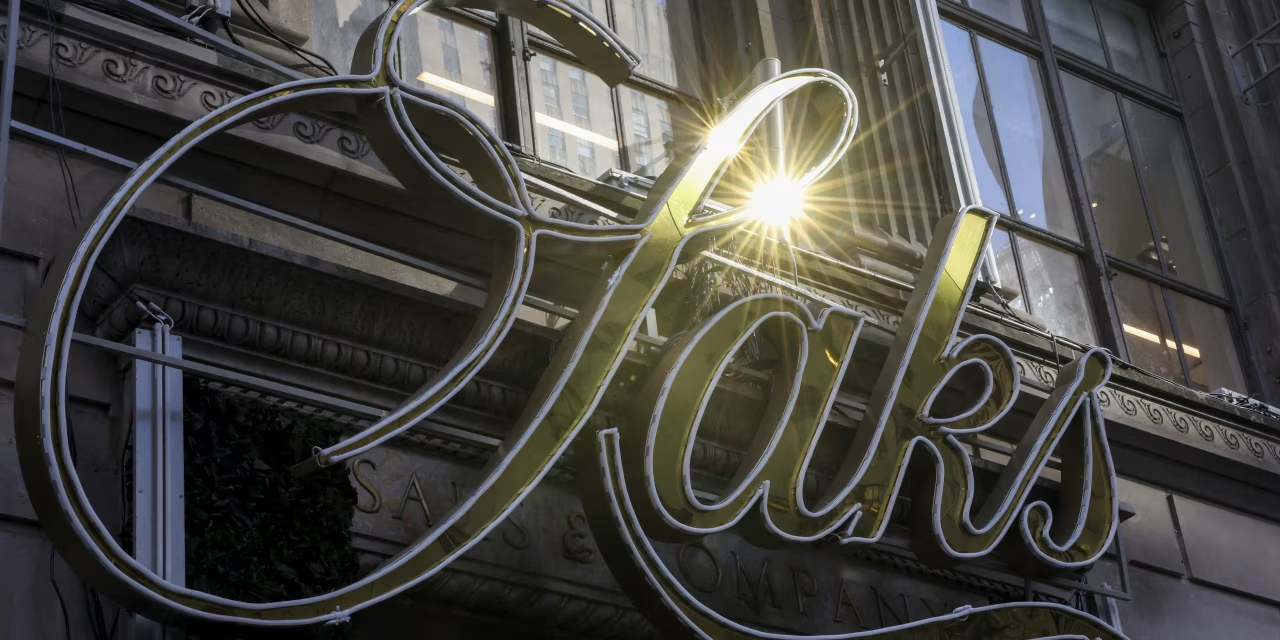
Saks Fifth Avenue is shrinking to about half its size as it closes stores in a bid to emerge from bankruptcy.
Twelve Saks Fifth Avenue stores will be closed by the end of May, its parent company, Saks Global, said on Friday. The disclosure follows an initial review in February in which the company said it would close eight Saks stores.
Copyright ©2026 Dow Jones & Company, Inc. All Rights Reserved. 87990cbe856818d5eddac44c7b1cdeb8

In essence, it reminds investors that markets don’t cater to expectations; they reward discipline and behaviour that withstands uncertainty. Housel is a former columnist at the Motley Fool and the Wall Street Journal.
1. Emotional Investing vs. Market Reality
Indian indices have been sharply impacted by geopolitical tensions in the Middle East. Major indices such as the Nifty and Sensex plunged as risk appetite evaporated and crude prices surged pushing stock prices down and prompting fear-driven selling.This is exactly the kind of environment where behaviour trumps forecast. Investors often want reassurance that markets will be stable and upward-bound, but the market’s behaviour, driven by oil price shocks and geopolitical risk, doesn’t care about those wishes. What matters is whether investors stick to a well-thought plan or panic and sell at the lows.
2. Risk Perception: Personal vs. Market
Housel explains that risk is perceived differently by each investor and this personal bias often leads to poor timing decisions.
In the current environment, risk isn’t just theoretical, rising crude prices, a weakening rupee, and nervous foreign flows (FIIs) are real forces affecting valuations. Investors who desire certainty may sell impulsively during volatility, but successful outcomes come from understanding risk and planning for it.3. Behavioural Discipline Matters More Than Prediction
Predicting where markets go next is nearly impossible, especially in times of geopolitical upheaval like now. Indian markets saw sharp sell-offs driven by fear rather than fundamentals, and many traders were caught off guard by the swift moves.
This underscores Housel’s point: behaviour, not prediction, dictates investing success. Sticking to asset allocation, maintaining a margin of safety, and resisting panic-selling are behaviours that produce lasting returns, even when short-term results disappoint.
4. Long-Term Compounding vs. Short-Term Noise
Another key idea is the power of compounding, returns accrue significantly over time as long as you stay invested.
Amid today’s volatility, where headlines are dominated by crashes and geopolitical risk, it’s tempting to believe that the market has permanently changed. But markets historically recover and reward patient, calm investors over the long term. Getting “what you deserve” means weathering the downturn without abandoning your strategy.
5. The Broader Market Context in March 2026
To understand why behaviour matters now, look at what’s driving sentiment:
Markets are trading sideways to cautious amid geopolitical tensions.
Crude oil concerns are spiking inflation and risk aversion.
External factors like AI-tech sell-offs and foreign selling pressures add to volatility.
These forces create unpredictable price movements, not necessarily based on fundamentals but on emotional and macro drivers.
What You Deserve in Investing Today
In today’s stock market turmoil, markets won’t rise just because investors want them to. They respond to fundamentals, risk, and collective behaviour.
Investors who resist emotional reactions, focus on long-term strategy and manage risk realistically are the ones likely to be rewarded over time.
Those chasing quick gains, timing the market, or reacting to headlines will often get what they want, fear and losses, not what they deserve: long-term compounded returns.

It is invitation only, made of actual platinum and might weigh more than the rest of your wallet. Robinhood Markets HOOD -4.31%decrease; red down pointing triangle is rolling out a premium credit card with a new generation of big spenders in mind.
The new card is part of Robinhood’s effort to transform itself from a trading firm with meme-stock origins into a “financial super-app” that offers all kinds of services, from prediction-market bets to retirement accounts. In short: It is trying to grow alongside its customers, many of whom are now well into their 30s.
Copyright ©2026 Dow Jones & Company, Inc. All Rights Reserved. 87990cbe856818d5eddac44c7b1cdeb8

“Indian equity markets extended their decline following the prior session’s relief rally, as escalating US-Iran tensions disrupted key Middle Eastern oil and gas supplies, driving crude prices higher. A sustained rise in oil prices could weigh on investor sentiment and adversely affect India’s twin deficits, inflation trajectory, and the RBI’s monetary stance,” Vinod Nair, Head of Research, Geojit Investments, said.
Here are two recommendations for Monday:
Data Patterns | Buy: Rs 3,350-3,360 | Stop loss: Rs 3,150 | Target: Rs 3,500
Data Patterns has witnessed a strong breakout above the Rs 3,250 resistance zone, supported by sustained buying momentum. The stock is trading above its key moving averages, indicating a positive trend structure. RSI remains
in bullish territory near 70, suggesting strength. As long as Rs 3,150 holds, the stock may extend gains toward the Rs 3,450–3,500 levels.(Kunal Kamble, Sr Technical Research Analyst, Bonanza Portfolio)
NALCO | Buy: Rs 394–396 | Stop loss: Rs 380 | Target: Rs 425
National Aluminium has formed a classic flag and pole continuation pattern on the weekly chart following a strong prior upmove. The recent breakout from the consolidation phase signals renewed bullish momentum. The stock is trading above key moving averages, while RSI remains in the bullish zone, indicating strength and potential continuation of the prevailing uptrend.
(Kunal Kamble, Sr Technical Research Analyst, Bonanza Portfolio)
(Disclaimer: Recommendations, suggestions, views and opinions given by the experts are their own. These do not represent the views of The Economic Times.)

Another Rough Friday for Bank, Brokerage Stocks as Oil Spikes and Jobs Report Disappoints
Business
Top market expert predicts FIIs unlikely to return anytime soon after nearly $2 billion selling in March

The renewed selling pressure from foreign investors has coincided with a sharp bout of volatility in domestic equities. The Nifty 50 has already fallen nearly 6% so far this year, while investors on Dalal Street have seen about Rs 19 lakh crore wiped out in market cap in just last five trading sessions amid rising global uncertainty.
The sell-off has been triggered largely by escalating tensions in the Middle East, particularly the conflict involving Iran and the United States, which has rattled global markets and pushed oil prices higher.
Foreign portfolio investors (FPIs) have been steady sellers in Indian equities in recent weeks. According to market data, FPIs sold nearly Rs 16,000 crore worth of equities in the first week of March, while the first four trading sessions of the month alone saw net outflows of around Rs 21,829 crore.
VK Vijayakumar, chief investment strategist at Geojit Investments, said the brief period of foreign buying seen earlier in the year has reversed sharply due to the geopolitical backdrop.
“The net FPI buying witnessed in February has reversed due to the Middle East conflict. Uncertainty surrounding the conflict, the steady decline in the market, the vulnerability of the Indian economy to a sharp crude spike and the depreciation of the rupee have contributed to sustained FII selling in the cash market,” Vijayakumar said.
He added that foreign investors are unlikely to return as buyers anytime soon until there is clarity on how the conflict evolves and crude prices cool. “FPIs are unlikely to return to the market as buyers until there is some clarity on the outcome of the conflict and a decline in crude prices. Brent crude trading above $90 is bad news for the Indian economy and markets,” he said.The rising oil prices are particularly worrying for India, which imports the majority of its crude requirements. A sustained spike in oil prices can widen the current account deficit, put pressure on the rupee and stoke inflation, all factors that tend to deter foreign investors.
Analysts say the current environment has led to a broader de-risking across emerging markets. Vinit Bolinjkar, head of research at Ventura Securities said the short-term outlook for equities remains cautious due to rupee volatility and the inflationary impact of higher crude prices.
He expects heightened volatility to continue in the near term, with investors likely to favour domestically insulated sectors.
“In this environment, sectors such as capital goods and consumer durables may outperform because they are less exposed to global macro risks, while globally linked sectors may face headwinds until uncertainty subsides,” he said.
Despite the persistent foreign selling, domestic institutional investors (DIIs) have helped stabilise the market.
The benchmark index has so far managed to defend the 24,300 support level, largely due to domestic buying absorbing foreign outflows. However, global risk sentiment remains fragile.
Justin Khoo, senior market analyst for Asia-Pacific at VT Markets, said rising geopolitical tensions are triggering a shift in global liquidity as investors move away from risk assets.
“Escalating tensions in the Middle East are prompting a noticeable shift in global liquidity, with investors rotating away from risk assets and increasing allocations to safe havens such as the US dollar and government bonds,” Khoo said.
Such shifts typically tighten liquidity in equities and other risk-sensitive markets as investors prioritise capital preservation.
For Indian markets, analysts say a sustained recovery in foreign flows will likely depend on two key factors: easing geopolitical tensions and a decline in crude prices. Until then, the market may continue to rely heavily on domestic liquidity to counter foreign outflows, even as volatility remains elevated in the near term.
(Disclaimer: Recommendations, suggestions, views and opinions given by the experts are their own. These do not represent the views of Economic Times)

‘Will & Grace’ Star Corey Parker Dead at 60

Jessie Buckley says passion for music and theatre helped her mental health
Stocks to Watch Friday Recap: Marvell, Costco, Gap


-

 Politics5 days ago
Alan Cumming Brands Baftas Ceremony A ‘Triggering S**tshow’
-
Business2 days ago
Form 8K Entergy Mississippi LLC For: 6 March
-

 Fashion2 days ago
Weekend Open Thread: Ann Taylor
-

 NewsBeat7 days ago
‘Significant’ damage to boarded-up Horden house after fire
-

 Tech3 days ago
Bitwarden adds support for passkey login on Windows 11
-

 Entertainment6 days ago
Baby Gear Guide: Strollers, Car Seats
-
 Sports3 days ago
499 runs and 34 sixes later, India beat England to enter T20 World Cup final | Cricket News
-
 NewsBeat7 days ago
Emirates confirms when flights will resume amid Dubai airport chaos
-

 NewsBeat6 days ago
Is it acceptable to comment on the appearance of strangers in public? Readers discuss
-

 Sports11 hours ago
Three share 2-shot lead entering final round in Hong Kong
-

 Tech7 days ago
Viral ad shows aged Musk, Altman, and Bezos using jobless humans to power AI
-

 Fashion7 days ago
On the Scene at the 57th Annual NAACP Image Awards: Teyana Taylor in Black Ashi Studio, Colman Domingo in Yellow Sergio Hudson, Chloe Bailey in Christian Siriano, and More!
-

 Video6 days ago
How to Build Finance Dashboards With AI in Minutes
-
 NewsBeat6 days ago
Ukraine-Russia war latest: Belgium releases video showing forces boarding Russian shadow fleet oil tanker
-

 Business4 days ago
Guthrie Disappearance Enters Fifth Week as Family Visits Memorial
-

 Sports1 hour ago
Braveheart Lakshya downs Lai in epic battle to enter All England Open final | Other Sports News
-
 Crypto World7 days ago
US Judge Lets Binance Unregistered Token Class Action Proceed
-

 Crypto World6 days ago
Why Nexo Is Reentering the US After the 2023 Crypto Lending Crackdown
-

 Tech5 days ago
Cynus Chess Robot: A Chess Board With A Robotic Arm
-

 NewsBeat3 days ago
Piccadilly Circus just unveiled ‘London’s newest tourist attraction’ and it only costs 80p to enter