Changes to the off-payroll working rules coming into force this month will relieve scaling businesses of costly compliance obligations. Yet contractors who fail to adjust their rates risk being caught out, writes Business Matters.
From this month, a raft of amendments to the UK’s IR35 tax legislation will redraw the lines of responsibility between businesses and the freelancers they engage. For thousands of companies that have until now shouldered the burden of determining whether their contractors fall inside or outside the off-payroll working rules, the changes promise welcome relief. For freelancers, however, the picture is rather more complicated.
IR35, in essence, is the government’s mechanism for ensuring that individuals who work through intermediaries such as personal service companies, but whose engagements resemble those of employees, pay a broadly equivalent amount of income tax and National Insurance. According to HMRC, the framework has already shifted more than 130,000 workers into deemed employment tax status since 2021 – a figure that underscores both its reach and its continuing impact on the UK’s contracting workforce.
Under the current regime, responsibility for determining a contractor’s IR35 status rests largely with the hiring organisation – provided that organisation qualifies as medium or large under company law. Smaller companies have been exempt, with the onus falling instead on the contractor’s own personal service company. The April 2026 changes significantly raise the bar for what constitutes a “small” company, meaning many more businesses will now fall beneath that threshold and be freed from compliance duties.
A wider net for the small company exemption
Previously, a company qualified as small if it met at least two of three criteria: annual turnover of no more than £10.2 million, a balance sheet total of no more than £5.1 million, and no more than 50 employees. From April 2026, the turnover ceiling rises to £15 million and the balance sheet limit to £7.5 million, whilst the headcount threshold remains unchanged at 50 staff. The consequence is that a significant number of businesses that were previously classified as medium-sized will now be treated as small, and the obligation to issue a Status Determination Statement – the legal document setting out whether a contractor sits inside or outside IR35 – will pass back to the contractor.
Advertisement
Vincent Huguet, chief executive and co-founder of Malt, the European freelance talent platform, welcomes the reforms but sounds a note of caution. The shift in thresholds, he says, helps to move responsibility away from hiring managers, allowing them to concentrate on when and what they need rather than worrying about the tax implications of every engagement. Yet he warns that neither companies nor freelancers should become complacent.
The end of double taxation?
Alongside the threshold changes, the government is introducing a PAYE set-off mechanism designed to address one of the more contentious aspects of the existing rules. Until now, where a client failed to apply IR35 correctly, HMRC could pursue the full PAYE and National Insurance bill from the deemed employer without accounting for tax already paid at the contractor’s end through their personal service company. The new mechanism allows HMRC to offset those prior payments when calculating any outstanding liability.
Huguet describes this as an important step towards eliminating double taxation, noting that it removes the risk of a freelancer ending up paying more than their fair share and properly accounts for historic tax records.
Pricing: the freelancer’s blind spot
For contractors, however, the real sting may lie in the detail of their own rate cards. With a greater share of compliance responsibility now resting with them, freelancers must ensure their pricing properly reflects the full cost of engagement. Last year’s increase in employer National Insurance Contributions from 13.8 per cent to 15 per cent, coupled with the reduction in the payment threshold from £9,100 to £5,000 annually, has already made hiring more expensive. Because employer NIC is deducted from the assignment rate before a contractor’s pay is calculated, those costs feed directly into negotiations – whether the contractor is deemed inside or outside IR35.
Advertisement
Huguet’s message to freelancers is blunt: get your pricing right. Those who fail to factor in these shifting obligations risk undervaluing their services at precisely the moment when the regulatory landscape demands they take greater ownership of their tax affairs. For businesses, particularly those that find themselves newly reclassified as small, the changes offer a chance to engage freelance talent with less red tape – but only if both sides of the arrangement understand what is now expected of them.
Amy Ingham
Amy is a newly qualified journalist specialising in business journalism at Business Matters with responsibility for news content for what is now the UK’s largest print and online source of current business news.
OAKLAND, Calif. — A viral X thread capturing live courtroom notes from Elon Musk’s high-stakes lawsuit against OpenAI has thrust the landmark trial into the spotlight, with the plaintiff’s lawyer dramatically declaring that the company “stole a charity” created for the benefit of humanity rather than private profit. The April 28 post by attorney Ariel Givner, who received real-time updates from inside the federal courthouse, quickly spread as opening statements laid bare the bitter feud between Musk and OpenAI CEO Sam Altman.
Givner’s thread, posted during the first full day of testimony in the Ronald V. Dellums Federal Building, detailed Musk’s side of the story: how he co-founded OpenAI in 2015 as a nonprofit dedicated to safe, open artificial intelligence development for all mankind. Musk contributed tens of millions of dollars, recruited top talent including Ilya Sutskever, and emphasized existential risks from advanced AI. The lawyer argued that OpenAI’s later shift to a for-profit structure, fueled by billions from Microsoft, betrayed that mission and left the nonprofit shell with “almost no assets.”
The dramatic line — “THEY STOLE A CHARITY” — capped the plaintiff’s opening and echoed through social media. Givner’s notes highlighted an emotional close: “NOBODY SHOULD BE ALLOWED TO STEAL A CHARITY.” The thread also shared a 2017 email exchange in which Musk told Altman, “Either go do something on your own or continue with OpenAI as a nonprofit,” and Altman replied enthusiastically, “I remain enthusiastic about the non-profit structure!” A contemporaneous diary entry from OpenAI President Greg Brockman reportedly called the nonprofit commitment a “lie” if the company pursued a B-corp structure.
9/ This email exchange from September 2017 was shown to jurors
Musk: “Either go do something on your own or continue with OpenAI as a nonprofit.”
Advertisement
Altman: “I remain enthusiastic about the non-profit structure!”
The lawsuit, filed in 2024, accuses Altman, Brockman and OpenAI of breaching fiduciary duties by converting the organization into a profit-driven entity valued at hundreds of billions and preparing for an IPO. Musk seeks more than $150 billion in damages and an order to unwind the changes, returning control and intellectual property to the nonprofit. He claims the original mission required no financial return and focused on humanity’s benefit, not enriching insiders or partners like Microsoft.
Advertisement
OpenAI’s lawyers fired back in their opening, arguing Musk knew about plans for a for-profit arm from the start and left the board voluntarily in 2018. They portray the suit as a competitive move by Musk, whose own xAI startup now rivals OpenAI. Defense attorney William Savitt told jurors the case boils down to Musk not getting his way, not a betrayal of any binding promise.
The trial, which began with jury selection on April 27 and opened in earnest April 28, has already featured heated testimony. Musk took the stand as the first witness, recounting his upbringing, early companies and long-standing fears about artificial general intelligence. He described OpenAI as a response to Google’s dominance and insisted he could have launched it as a for-profit but chose the nonprofit path for ethical reasons. Cross-examination grew tense, with Musk accusing OpenAI’s lawyer of trying to “trick” him and snapping, “You’re misleading.”
As of May 1, the proceedings have entered their fourth day. Musk has spent multiple days on the witness stand, with cross-examination continuing and expected to wrap soon. Altman, Brockman and Microsoft CEO Satya Nadella are among those slated to testify later. The monthlong trial before U.S. District Judge Yvonne Gonzalez Rogers could reshape AI development, corporate governance and the balance between nonprofit ideals and commercial realities in Silicon Valley.
Legal observers say the case hinges on whether OpenAI’s founders made enforceable promises to keep the organization nonprofit forever. Musk’s team presented the 2017 emails and Brockman’s diary as evidence of bad faith. OpenAI counters that the nonprofit structure was always intended to evolve with a for-profit subsidiary to fund research, similar to a museum gift shop supporting the museum. The company argues it has delivered on its mission by developing safe AI while attracting necessary capital from Microsoft.
Advertisement
The courtroom drama has drawn intense media attention and public fascination. Demonstrators gathered outside the Oakland courthouse during jury selection, reflecting broader debates about AI ethics, corporate power and Musk’s influence. Givner’s real-time X updates, which included apologies for typos and promises of more notes during breaks, turned the usually opaque legal process into a live-streamed spectacle followed by tech enthusiasts and Musk supporters.
Musk founded xAI in 2023 partly to counter what he sees as OpenAI’s closed, profit-driven direction. He has repeatedly warned that unchecked AI development poses existential risks, a theme he reiterated in testimony. OpenAI maintains it remains committed to safety and has implemented safeguards in models like ChatGPT, while pursuing the resources needed to compete globally.
The stakes extend far beyond personal animosity between former friends Musk and Altman. A ruling in Musk’s favor could force OpenAI to restructure, potentially slowing its momentum or returning valuable IP to the nonprofit. A defense victory would affirm the company’s right to adapt its structure and validate its multibillion-dollar valuation. Either outcome could influence how future AI labs are organized and funded.
Givner, an IP and corporate attorney with experience in fintech and crypto, positioned her thread as neutral live coverage. Her bio notes roles with MonkeDAO and DiversiFi, lending credibility to her detailed legal observations. The thread’s rapid spread underscored X’s role as a primary source for breaking courtroom news in the social media era.
Advertisement
As the trial continues into its second week, both sides prepare for testimony from key figures who shaped OpenAI’s early days. Musk has described himself as a “fool” for continuing to fund the organization after tensions arose, while OpenAI insists he was fully aware of and supported early commercial moves. The jury will ultimately decide whether the shift from nonprofit to for-profit constituted a betrayal or a necessary evolution.
For now, the viral thread from April 28 serves as a time capsule of the trial’s explosive opening, capturing the raw emotions and high principles at stake. Whether Musk’s vision of AI as a public good prevails or OpenAI’s commercial model is upheld, the case has already highlighted the tensions between idealism and pragmatism in the race to build the future’s most powerful technology.
Insperity, Inc. (NSP) Q1 2026 Earnings Call April 30, 2026 5:00 PM EDT
Company Participants
James Allison – Executive VP of Finance, CFO & Treasurer Paul Sarvadi – Co-Founder, Chairman & CEO
Advertisement
Conference Call Participants
Daniel Maxwell – William Blair & Company L.L.C., Research Division Jeff Martin – ROTH Capital Partners, LLC, Research Division Mark Marcon – Robert W. Baird & Co. Incorporated, Research Division Tobey Sommer – Truist Securities, Inc., Research Division Brendan Biles – JPMorgan Chase & Co, Research Division
Advertisement
Presentation
Operator
Good day. My name is Ali, and I will be your conference operator today. I would like to welcome everyone to the Insperity First Quarter 2026 Earnings Conference Call. [Operator Instructions] And please note, this conference call is being recorded.
At this time, I would like to introduce today’s speakers. Joining us are Paul Sarvadi, Chairman of the Board and Chief Executive Officer; and Jim Allison, Executive Vice President of Finance, Chief Financial Officer and Treasurer.
Advertisement
At this time, I’d like to turn the call over to Jim Allison. Mr. Allison, please go ahead.
James Allison Executive VP of Finance, CFO & Treasurer
Thank you. We appreciate you joining us today. Let me begin by outlining our plan for this afternoon’s call. First, I’m going to discuss the details behind our first quarter 2026 financial results. Paul will then comment on 3 strategic initiatives in 2026: Our margin recovery plan, our efforts to rebuild growth momentum, including the HRScale rollout and our AI initiatives. I will return to provide financial guidance for the second quarter and full year 2026. We will then end the call with a question-and-answer session.
Advertisement
Before we begin, I would like to remind you that Paul or I may make forward-looking statements during today’s call, which are subject to risks, uncertainties and assumptions. In addition, some of our discussion may
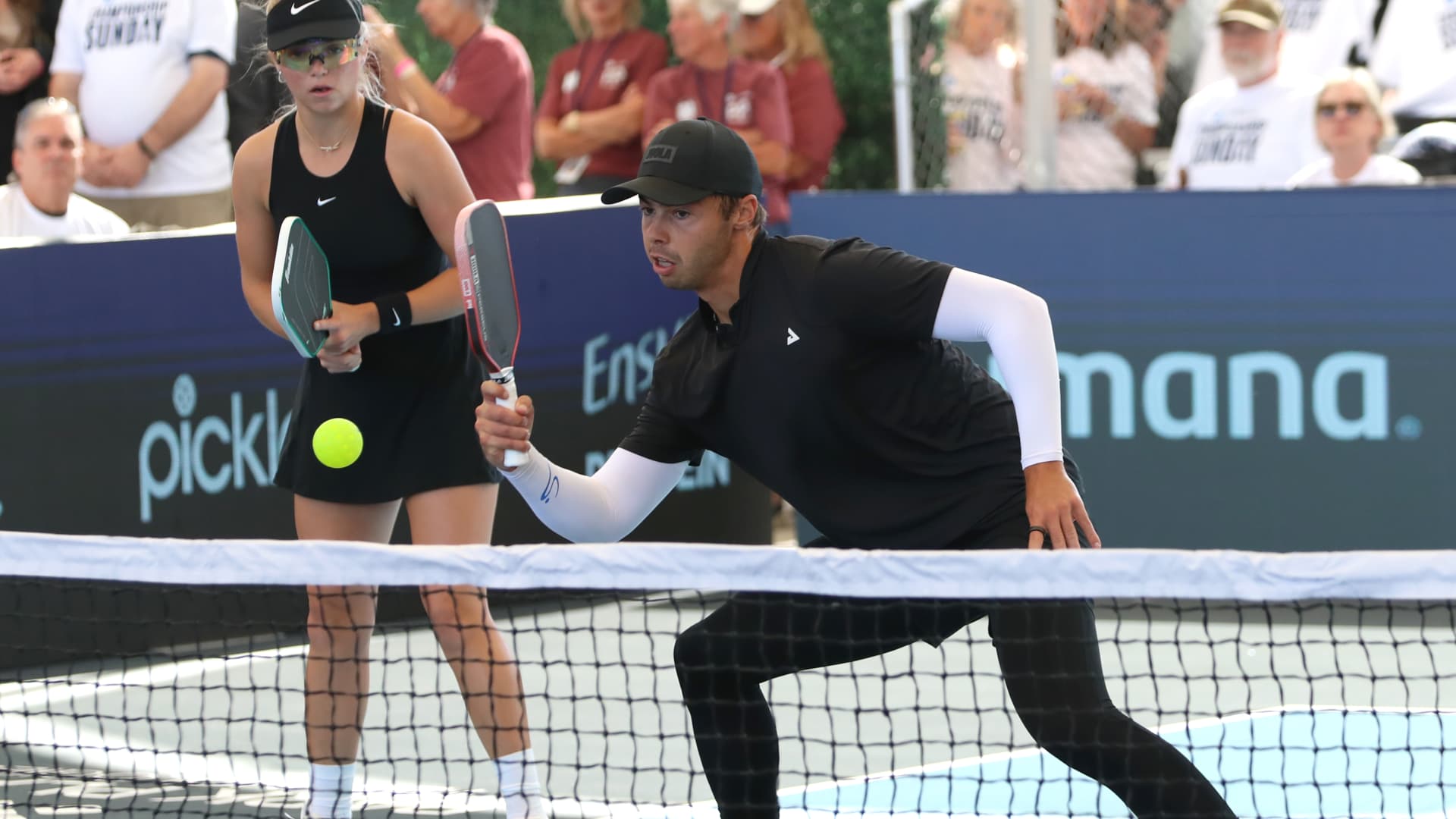
Ben Johns comes over to the right side to hit a dink shot against Anna Bright and Hayden Patriquine in the 2026 PPA Carvana Mesa Cup finals match of the Pro Mixed Doubles Division at Arizona Athletic Grounds on February 22, 2026 in Mesa, Arizona.
Bruce Yeung | Getty Images
Pickleball Inc., the new parent company of Major League Pickleball and the PPA Tour, said Friday it has raised a record $225 million in new investment, as the paddle sport continues its rapid growth trajectory.
Advertisement
The latest investment comes from Apollo Global Management’s newly created sports fund, Apollo Sports Capital, and Dundon Capital Partners, owned by billionaire Tom Dundon. Dundon is an owner of the Portland Trail Blazers NBA team and the Carolina Hurricanes NHL team and was an early investor in pickleball.
The fresh funds bring the total investment in Pickleball Inc. to $315 million, as investors continue to look at emerging sports as a place to park their money. The raise values Pickleball Inc. at $750 million, according to a person familiar with the matter, who asked to remain unnamed because they were not authorized to speak publicly about the company’s valuation.
The deal also includes rolling up several pickleball assets under the Pickleball Inc. umbrella, creating what the company called the largest pickleball ecosystem to date.
Pickleball Inc. will take on a portfolio of pickleball assets previously owned by Dundon, including Pickleball Central, a leading site for pickleball equipment founded in 2006. The portfolio also includes PickleballTournaments.com, software that powers thousands of tournaments across all levels of play, as well as Just Courts, a pickleball court installer.
Advertisement
Pickleball Inc.’s newly merged business verticals combined generated over $140 million in 2025 revenue, the company said.
In a release, MLP and PPA Tour CEO Connor Pardoe called the new investment a “seismic day” for pickleball’s rapidly growing business at all levels.
“This investment allows us to fully integrate the sport into one cohesive ecosystem – uniting professional pickleball, consumer goods, technology, and media under a single, unified platform,” Pardoe said.
Dundon and the Pardoe family will remain majority shareholders in the business after the investment.
Advertisement
Pickleball has exploded in popularity in recent years, with more than 24 million U.S. players participating in 2025, making it the fastest growing sport in the country over the last three years, according to the Sports & Fitness Industry Association’s Annual Report.
At the professional level, the MLP and PPA Tour have seen major growth with a combined $30 million in sponsorship revenue in 2025 and $60 million in combined top line revenue for 2025, according to the United Pickleball Association, which operates both leagues. The MLP and PPA Tour are projecting $74 million in combined revenue in 2026.
The new capital for Pickleball Inc. will be used to further integrate the pickleball business at all levels of play and create a streamlined pickleball ecosystem, the company said.
“This capital raise will allow us to expand our focus into new and scalable opportunities like content, media, and the development of infrastructure to support our fast growing events,” MLP Commissioner Samin Odhwani said in a statement. “The continued and dynamic year-over-year growth data has proven without doubt that pickleball is no longer an emerging sport, and is instead quickly becoming the next tier one sport in America.”
Advertisement
Get the CNBC Sport newsletter directly to your inbox
The CNBC Sport newsletter with Alex Sherman brings you the biggest news and exclusive interviews from the worlds of sports business and media, delivered weekly to your inbox.
Gold prices were trading almost flat in the international market on Friday, but the yellow metal is on track to record a nearly 2% weekly loss. This comes as oil prices briefly skyrocketed to $126 per barrel, fuelling inflation worries and reinforcing expectations of higher interest rates for longer.
Spot gold prices were steady at around $4,620 per ounce on Friday morning. US gold futures for June delivery rose 0.1% to $4,632.70. This came after gold prices dropped to a one-month low on Wednesday.
Notably, MCX is closed in the morning session today on account of Maharashtra Day. Earlier on Thursday, gold futures with June expiry on the exchange closed around Rs 114 higher at Rs 1,51,225 per 10 grams. The contracts with August expiry also closed marginally higher at Rs 1,54,390 per 10 grams.
Iran-US war
After hitting as high as $126 per barrel on Thursday, oil prices cooled down but continued to remain elevated above $110 per barrel today. This comes as the war between Iran and the US entered its third month, with the Strait of Hormuz continuing to remain choked and keeping investors on edge.
Advertisement
Live Events
US President Donald Trump said that the military blockade of Iranian ports could last for months. A report by Reuters, citing officials, hinted that the US President may be planning a series of fresh military strikes to compel Iran to negotiate an end to the conflict. Iran, meanwhile, said that it would respond with “long and painful strikes” on US positions if Washington renewed its strikes. Iranian Foreign Ministry spokesman Esmaeil Baghaei stated that it was not reasonable to expect quick results from US talks, according to the official IRNA news agency. “Expecting to reach a result in a short time, regardless of who the mediator is, in my opinion, is not very realistic,” he was quoted as saying.
What lies ahead?
“In the near term, gold is expected to remain volatile and range-bound, with support near Rs 1,48,000 and resistance around Rs 1,52,000,” said Jateen Trivedi, VP Research Analyst of Commodity and Currency at LKP Securities.
Gold prices fell as oil prices rose, suggesting that the market is fearing increasing inflation and a potential central bank reaction more than rising growth risks, said Carsten Menke, Head Next Generation Research at Julius Baer. “Such short-term and sometimes sharp swings typically mirror moves in the paper market, not the physical market. They are the result of position squaring by speculative futures traders and trend followers, not safe-haven seekers,” he said.
Deutsche Bank, Germany’s leading international investment bank, recently predicted that the bullion’s share in global central bank reserves could increase to 40%, up from around 30% currently. Based on this scenario, the bank’s calculations indicate that gold prices could climb to $8,000 an ounce within five years, implying nearly 80% upside from current levels.
(With inputs from agencies)
Advertisement
(Disclaimer: Recommendations, suggestions, views and opinions given by the experts are their own. These do not represent the views of The Economic Times)

















































You must be logged in to post a comment Login