



Connect with us
DAPA Banner
DAPA Coin
DAPA
COIN PAYMENT ASSET
PRIVACY · BLOCKDAG · HOMOMORPHIC ENCRYPTION · RUST
ElGamal Encrypted MINE DAPA
🚫 GENESIS SOLD OUT
DAPAPAY COMING

Business

What employers need to know

Published

on

What employers need to know

In a recent Acas survey, employers and employees were asked which three changes in the Employment Rights Act 2025 would have the biggest impact in their workplace.

Surprisingly, the new rights on Statutory Sick Pay (SSP) topped the list for both groups, named by 43% of employers and 36% of employees. The reduction in the unfair dismissal qualifying period from two years to six months was the second most significant change (31% of employers and 30% of employees). Employers ranked the new paternity leave day-one rights as the third-largest reform, whereas employees said it was easier access to flexible working arrangements.

The SSP reforms take effect from 6 April 2026, aiming to improve financial security, particularly for part-time employees and those in low-paid jobs. While more employees will qualify for SSP, employers will face increased costs and compliance requirements, particularly for small and medium-sized enterprises.

Before looking at the reforms and what employers can do to prepare for them, let’s consider the current arrangements.

What is the current SSP framework?

An employee must be an “eligible employee” and earn at least the Lower Earnings Limit (LEL), which is currently £125 per week. Even if employees are eligible, SSP is payable only from the fourth consecutive day of sickness, as the first three days are unpaid waiting days.

Advertisement

It is estimated that around 1.3 million employees receive no SSP at all, and many lose pay for only short periods when unwell. Some face the choice of working while ill or losing income. This can spread illness in the workplace and reduce productivity.

What is changing from 6 April 2026?

Approximately 25% of employees only receive SSP (rather than contractual sick pay), and the SSP changes below will have a significant impact.

  • Removal of the Lower Earnings Limit, and employees will no longer need to meet the LEL to qualify for SSP.
  • A new earnings‑linked calculation and SSP will be paid at 80% of normal weekly earnings (NWE) unless the SSP flat rate is lower.
  • SSP will be payable from day one of sickness absence, as the Employment Rights Act 2025 abolishes the three unpaid waiting days.
  • SSP will increase from £118.75 to £123.25 a week on 6 April 2026.

It is important to mention atypical workers, such as zero-hours and agency workers, as well as seasonal and irregular-hours staff. Establishing NWE is not always straightforward because of their fluctuating pay and variable working patterns. Employers can determine NWE, for example, by averaging pay over the previous 8-12 weeks or by following the relevant contractual arrangements to ensure SSP reflects actual earning patterns.

What do the SSP changes mean for employers?

The scope of SSP entitlements is significantly widened. As well as administrative adjustments to update policies and payroll processes, the reforms carry a cost implication for organisations of all sizes.

The Government estimates that removing waiting days and abolishing the LEL, combined with introducing the 80% earnings‑linked calculation, will increase employer SSP costs by around £450 million a year. Although a significant sum, it equates to roughly £15 more per employee according to the Government’s impact assessment. Crucially, earlier access to SSP may boost productivity by allowing employees to stay home when unwell without feeling compelled to attend work.

Advertisement

Employer concerns about increased sickness absence could be mitigated through strengthened sickness management. This includes conducting return‑to‑work interviews promptly, even after short periods of illness, which can help to identify underlying issues early and reduce avoidable absences. It can also include structured return-to-work planning, phased returns, and temporary adjustments.

How can employers prepare for the changes?

  • Update payroll systems for earnings‑linked SSP and day‑one entitlement.
  • Review and update sickness absence policies, contracts and employee handbooks and communicate these changes to employees.
  • Budget for increased SSP.
  • Identify roles or departments most affected by the wider eligibility rules.
  • Train managers and HR on the new regime.
  • Strengthen sickness absence management processes.
  • Establish the number of atypical workers and how their normal weekly earnings are calculated.

Conclusion

The April 2026 SSP reforms represent a major shift in the UK’s approach to sick pay, expanding access and enhancing financial protection for employees. While these changes introduce additional costs and compliance requirements for employers, early preparation will support a compliant and well‑managed transition.

By reviewing systems and policies now, organisations can ensure they are ready for the new SSP regime and are equipped to support staff and manage sickness absence effectively.


Hannah Waterworth

Hannah Waterworth

Hannah Waterworth is an employment solicitor in Blake Morgan’s Employment, Pensions, Benefits and Immigration team.

Advertisement

Continue Reading
Click to comment

You must be logged in to post a comment Login

Leave a Reply

Business

Saudi Aramco Profit Jumps Despite War Disrupting Shipping Routes

Published

on

Saudi Aramco Profit Jumps Despite War Disrupting Shipping Routes

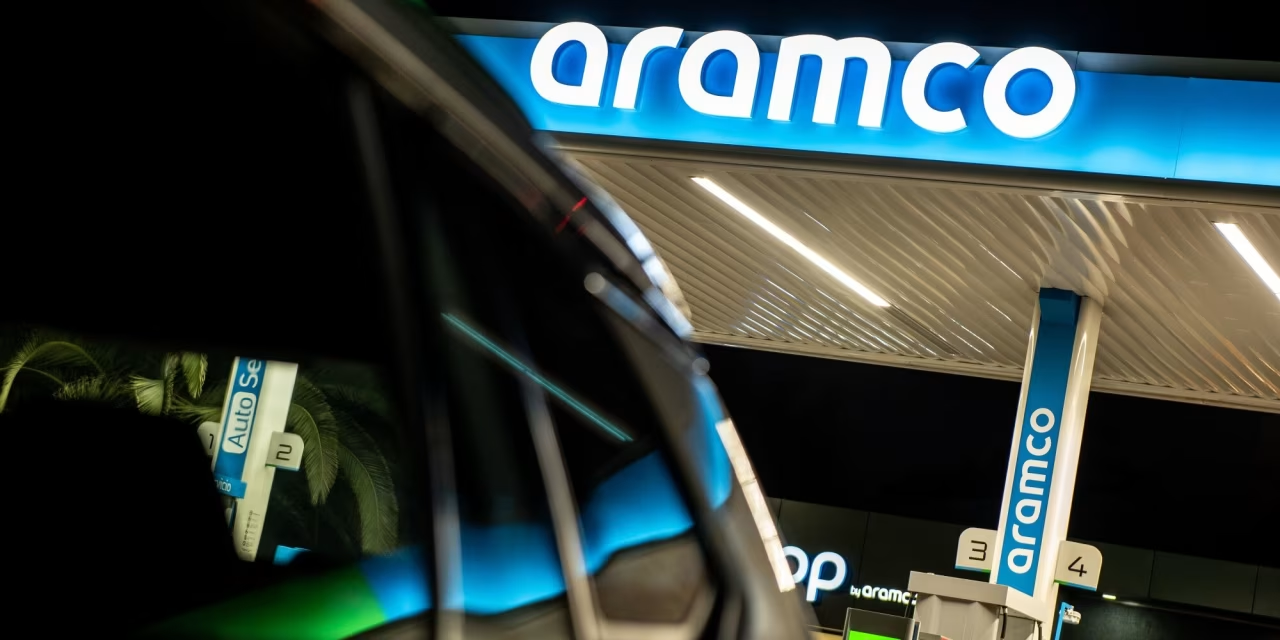
Saudi Arabia’s national oil company said its quarterly profit rose 25% as it increased exports via a pipeline that bypasses the Strait of Hormuz, after war in the Middle East disrupted shipping through the vital waterway.

Saudi Arabian Oil Co., which is known as Aramco and is the world’s top oil exporter, posted a net profit of $32.5 billion for the three months ending March 31, up from $26 billion in the same period last year.

Copyright ©2026 Dow Jones & Company, Inc. All Rights Reserved. 87990cbe856818d5eddac44c7b1cdeb8

Continue Reading

Business

Early Lenskart investor Alpha Wave trims stake by 2.5% in open market

Published

on

Early Lenskart investor Alpha Wave trims stake by 2.5% in open market
One of Lenskart’s early institutional investors has pared its stake in the company in open market on Monday. A regulatory disclosure filed with stock exchanges showed Alpha Wave Ventures II LP sold 4.3 crore shares, equivalent to 2.46% stake, in Lenskart through an open market transaction after crossing the 2% disclosure threshold on May 8.

Before the sale, Alpha Wave Ventures II and persons acting in concert together held 12.37 crore shares, or 7.13% stake in Lenskart. Following the transaction, their combined holding has come down to 8.07 crore shares, translating into 4.67% stake in the omnichannel eyewear retailer.

As per the disclosure, Alpha Wave Ventures II’s direct holding has dropped from 3.7% to 1.24%, while its affiliate Alpha Wave Ventures LP continues to hold 3.43%.

Based on Lenskart’s disclosed equity capital of 173.64 crore shares, the sale of 4.3 crore shares represents one of the larger secondary stake transactions in the company in recent months.

Advertisement

Lenskart is India’s largest vertically integrated, technology-led, omnichannel eyewear platform, addressing a structurally underpenetrated eyewear category in India (53% of population impacted, modest 35% penetration).


Lenskart has built strong moats in a difficult-to-scale category through a centralized, highly automated manufacturing facility and logistics network, strong backward integration, which provides significant cost advantage, large omnichannel presence, leveraging technology to ease constraints in scaling up and house-of- brands architecture spanning mass to premium eyewear, to achieve its goal of making quality eyewear accessible and affordable.
Motilal Oswal expects Lenskart to deliver a CAGR of 25%/53% in pro forma consolidated revenue/pre-IND AS EBITDA, largely driven by volume growth, product margin improvement, and 625 bp operating leverage-driven margin expansion over FY25-28 (320 bp over 9MFY26-FY28).

The broker initiated coverage on Lenskart with a Buy rating and a target of Rs 600, premised on DCF-implied 55x FY28E. “Our valuations for Lenskart are at a premium to other leading retailers, but we believe the multiples are justifiable, given Lenskart’s superior growth profile, limited organized competition and long growth runway,” it said recently.

Continue Reading

Business

Digital Advertising Industry Snapshot Q1 2026

Published

on

Digital Advertising Industry Snapshot Q1 2026

Digital Advertising Industry Snapshot Q1 2026

Continue Reading

Business

New Cornwall restaurant will improve ‘forgotten corner’ of town, says owner

Published

on

Business Live

Glas, a new Mediterranean restaurant and bar in Falmouth, is set to transform an area its owner says has been blighted by homelessness and drug use

Glas will be based at a former Victorian public toilet overlooking the water in Falmouth (Pic: Cornwall Council licensing application)

Glas will be based at a former Victorian public toilet overlooking the water in Falmouth(Image: Local Democracy Reporting Service / Cornwall Council licensing application)

The ownerof a new restaurant in Cornwall claims it will revitalise a “forgotten corner” of a town in the Duchy that has been plagued by homelessness and drug misuse. He said he had discovered used needles, smashed glass pipes, empty drugs bags and has even been pricked by a discarded needle himself.

Advertisement

Despite his pledges to transform the area, several neighbours have objected to a premises licence application for Glas, a new Mediterranean restaurant and bar in Falmouth, citing concerns about noise in a residential neighbourhood.

Due to the objections, the application by Glas Falmouth Ltd will be considered by a Licensing Act sub-committee at Cornwall Council next week.

Work is currently under way to transform a former Victorian public toilet built into the wall at Dunstanville Terrace into the new establishment. It sits close to the Royal Cornwall Yacht Club and Greenbank Hotel, with views across the Carrick Roads waterway towards Flushing.

The premises, which will offer Mediterranean and Levantine influenced dishes, will accommodate 24 diners inside and an outdoor seating area with roughly 16 covers.

Advertisement

The licensing application states: “Glas is intended to operate as a well-managed, food-and-drink-led venue, serving local residents and visitors in a relaxed and welcoming environment. While food will be available throughout trading hours, the premises will also offer bar service and a social space for customers to enjoy drinks responsibly.

“The proposed hours for alcohol sales and the use of the external area have been deliberately set at sensible levels, with early cut-offs outdoors, to ensure the prevention of public nuisance.

“The application also seeks permission for occasional live music, such as acoustic performances and community-focused events. Any such activities will be low-key, managed responsibly and will finish at reasonable hours. Noise levels will be actively monitored and appropriate control measures are detailed within the operating schedule.”

Neither Devon and Cornwall Police, Cornwall Fire and Rescue nor Falmouth Town Council have raised any objections to the application. However, a handful of local residents remain opposed.

Advertisement

Their comments include: “I do hope this application will be rejected and we can look forward to families, young couples, children and dog walkers continuing to enjoy the area without disturbance. There are very few such areas left in Falmouth, especially that front the water, please leave our public spaces public.

“We already hear music from the Greenbank Hotel, both from inside the hotel lounge when they host occasional parties, but especially from the tent that they erect on Greenbank Quay in the summer which has no sound proofing. Live music or recorded music at this new café will create additional noise in a largely residential area.

“Many people supported the idea of the old public toilets being put to good use as a café during the day, but more live music late into the evening in a largely residential area where residents are getting up to go to work is not appropriate.

“There’s already the yacht club (which causes no noise issues) and the Greenbank Hotel, this causes problems with noise currently with music on occasions. Patrons currently can cause a noise nuisance when leaving so any further additions will just add to the current problems.”

Advertisement

‘We’re here to bring back to life a forgotten corner of our town’

Joe Pizey, one of the Glas team, has responded to each of the four objectors and offered to meet with them in person.

He said: “We know full well that this particular corner of Falmouth town has not been used by local people for the last three years, in fact in the warmer months it’s been solely home to a small gang of homeless people living in tents.

“I myself have spent hours scanning the area and removing used needles, broken glass pipes and empty (what I assume are) drug bags. I even leant up against an interior window ledge and was met with a prick to the back of my arm from a broken needle that had been posted through the galvanised window grates.

“I want to stress that it’s in our interest as local residents to maintain the beauty of this area beyond our boundaries. We’ve been overwhelmed by comments from local residents regarding the improvements we’ve already achieved. The palm trees are as much of a ‘tent deterrent’ as they are a welcome addition to the gardens in the eyes of the authorities and local people alike.

Advertisement

“We’re here to bring back to life a forgotten corner of our town and actively tackle antisocial behaviour as I hope you agree we’re achieving already.”

Mr Pizey added: “We’ve been overwhelmed by local support from residents, residents that have seen first hand the improvements we’ve already made to the public space. Every day we are stopped by locals that share their excitement and gratitude.

“We’ve reached nearly 90,000 viewers on our Instagram and we’ve got over 1,200 Falmouth/Cornwall-based followers online that are all as supportive as the public we meet in person.”

The premises licence application is set to be determined at the council meeting on Wednesday, May 13.

Advertisement
Continue Reading

Business

Island Way debuts frozen novelties

Published

on

Island Way debuts frozen novelties

The frozen fruit brand is rolling out lemonade bites and chocolate covered fruit product lines. 

Continue Reading

Business

Ovo energy customers urged not to panic as takeover planned

Published

on

Ovo energy customers urged not to panic as takeover planned

All existing tariffs will be honoured in full under a planned deal that could create one of Britain’s largest energy suppliers.

Continue Reading

Business

Buy the AI Power Surge or Sell After 400%+ 2026 Run?

Published

on

Buy or Sell Navitas Semiconductor Stock in 2026? Analysts Split

NEW YORK — Navitas Semiconductor (NASDAQ: NVTS) has delivered one of the most explosive rallies of 2026, surging more than 400% year-to-date on the back of its strategic pivot toward high-power gallium nitride (GaN) and silicon carbide (SiC) solutions for artificial intelligence data centers. The question now facing investors is whether the momentum justifies buying at current elevated levels or if it’s time to take profits after such a meteoric rise.

As of mid-May 2026, Navitas shares have traded in the $18–$23 range after a series of sharp upward moves fueled by strong sequential revenue growth and major design wins in the AI infrastructure space. The company, which specializes in next-generation power semiconductors, reported first-quarter revenue of $8.6 million, up 18% sequentially, with management highlighting accelerating contributions from high-power markets including AI data centers, grid infrastructure, and industrial electrification.

AI tailwinds drive transformation

Navitas has successfully repositioned itself from a consumer mobile charging focus to a high-margin player in the AI power revolution. Its GaNFast and GeneSiC platforms enable more efficient, higher-density power conversion — critical as hyperscalers build massive GPU clusters that consume enormous amounts of electricity. The company’s 800V-to-6V power delivery board showcased at NVIDIA’s GTC 2026 has generated significant interest.

Advertisement

CEO Tonya Stevens and the leadership team have emphasized a $3.5 billion serviceable available market by 2030 growing at over 60% CAGR. Management expects continued sequential revenue growth throughout 2026, driven by high-power applications, with improving gross margins as the product mix shifts favorably.

Analyst views remain cautious

Despite the impressive rally, Wall Street maintains a Hold consensus on Navitas. Nine analysts covering the stock give it an average 12-month price target around $12.87–$13.59, implying 25–30% downside from recent trading levels. The highest target sits at $21, while some bearish voices see it falling as low as $3–$8 if execution falters.

Needham recently raised its target to $21 while maintaining a Buy rating, citing the high-power pivot. However, most firms remain neutral, concerned about valuation after the massive run and the company’s history of inconsistent revenue. Navitas still carries a significant net loss on a GAAP basis, though non-GAAP metrics show improvement.

Advertisement

Bull case: Secular AI power boom

Proponents argue Navitas is ideally positioned for multi-year growth. AI data centers require unprecedented power efficiency and density. Traditional silicon struggles here, while GaN and SiC excel. With hyperscalers racing to scale, Navitas’ expanding design-win pipeline and technology edge could drive substantial revenue acceleration in 2027 and beyond.

The company’s cash position provides runway for R&D and capacity expansion. If it successfully converts its backlog into revenue and maintains margin momentum, the stock could have further upside despite current premiums.

Bear case: Execution risks and valuation

Advertisement

Skeptics point to historical volatility in the power semiconductor space and Navitas’ transition challenges. Revenue has been lumpy, and near-term growth projections remain modest compared to the stock’s valuation. Any slowdown in AI capex or delays in major customer ramps could trigger a sharp correction.

Short interest remains notable, though recent covering has fueled the rally. Profit-taking after such gains is a constant risk in momentum-driven names.

Investment considerations for 2026

For aggressive growth investors with high risk tolerance, Navitas offers leveraged exposure to the AI infrastructure buildout. Position sizing is critical given volatility. Long-term believers in the power efficiency megatrend may view current levels as an entry point if they have a multi-year horizon.

Advertisement

More conservative investors may prefer waiting for a pullback or clearer evidence of sustained revenue acceleration and margin expansion. Diversification across the semiconductor and AI supply chain can help manage single-stock risk.

Bottom line

Navitas Semiconductor has delivered extraordinary returns in 2026, rewarding early believers in its AI power pivot. While the long-term opportunity remains compelling, the stock’s rapid appreciation leaves it vulnerable to volatility and profit-taking.

Whether to buy, hold, or sell depends on individual risk appetite, time horizon, and conviction in the sustainability of AI-driven power demand. For those bullish on the secular shift toward efficient power electronics, Navitas remains a high-conviction name — but one that demands careful monitoring and disciplined position management.

Advertisement

As always, investors should conduct thorough due diligence and consider consulting a financial advisor before making decisions. The semiconductor sector moves fast, and today’s winner can quickly become tomorrow’s cautionary tale. Navitas has momentum on its side for now, but sustaining it will require flawless execution in a highly competitive market.

Continue Reading

Business

British Steel nationalisation: Government moves on Scunthorpe steelworks future

Published

on

Business Live

The Government is set to introduce legislation this week that will allow it to take control of the steelmaker, 38 years since it was first privatised, protecting thousands of Scunthorpe jobs.

The British Steel steelworks in Scunthorpe, North Lincolnshire

The British Steel steelworks in Scunthorpe(Image: PA Archive/PA Images)

British Steel looks set to return to public ownership as Sir Keir Starmer unveiled new legislation he said will give the Government “options” to safeguard the industry and workers in Scunthorpe. Fresh powers could be deployed to nationalise British Steel, 38 years after the company was first privatised.

This follows a year after the Government deployed emergency powers to seize control of the firm and maintain production at the Scunthorpe site, after its owner, Chinese company Jingye, put forward plans to shut down the two blast furnaces. Negotiations with Jingye have continued since, but the Government said it was unable to agree a commercial sale, and believed no deal could be reached that would deliver sufficient value for taxpayers.

Advertisement

The Government stated its view that introducing legislation to provide a pathway to public ownership was the appropriate next step, enabling it to determine the steelmaker’s future direction. The legislation, which is to be brought before Parliament this week, will be subject to a public interest test, taking into account factors including national security, preserving critical national infrastructure and bolstering the economy.

The Prime Minister said: “Steel is strategically important to our economy and our national resilience. That’s why we acted last year to avoid a sudden halt to production at Scunthorpe, protecting workers and the community that depend on the site, and why we’re now bringing forward legislation to give us options to protect Britain’s steelmaking capability.

Prime Minister Keir Starmer giving his speech in London on Monday

Prime Minister Keir Starmer giving his speech in London on Monday(Image: Getty Images)

“This is what an activist state looks like – taking decisions in the national interest. “This Bill would allow us to take action if we need to, while we continue rebuilding our steel sector.”

A steel union praised the decision to nationalise British Steel, stating it will “protect it from foreign owners”.

Advertisement

Charlotte Brumpton-Childs, GMB national secretary, said: “This legislation will cover the whole steel industry – it isn’t specifically for British Steel but it is what will protect it from foreign owners. “British Steel is a nationally strategic asset, it is right the Government does everything in its power to secure its long term future.”

Gareth Stace, director-general for trade association UK Steel, welcomed the move, saying it “provides vital certainty for the workforce, the company’s customers and the wider supply chain at a critical moment”.

However, he emphasised: “Nationalisation is not an end goal. This must now be the beginning of a clear and credible long-term plan for British Steel.”

The Government’s action last year halted Jingye’s plans and brought its redundancy consultations to an end, which could have resulted in between 2,000 and 2,700 job losses. It also allowed the Scunthorpe blast furnaces to keep running.

Advertisement

Jingye had been weighing up closing them after revealing it was haemorrhaging £700,000 daily owing to difficult market conditions, tariffs and substantial environmental costs. The Government’s intervention to safeguard the site set it back £377 million between April 2025 and January 2026, according to a National Audit Office (NAO) report.

Alongside the £377m required to keep British Steel afloat, £15mn was allocated to advisers and £359m to the company for operational activities, including raw materials, payroll and associated costs. Had the blast furnaces been shut down, however, it would have resulted in significant job losses at Scunthorpe and impacted customers throughout the supply chain, including Network Rail, the NAO noted.

Business Secretary Peter Kyle said: “Revitalising our steel sector is a top priority for this Government and bringing forward this legislation would allow us to explore potential future options for British Steel. The Government recognises that securing the long-term future of the UK’s steel sector relies on both public and private investment for modernisation.”

Downing Street confirmed that an independent valuation would be conducted to establish the potential cost of nationalising British Steel. “Where the powers in the bill are used, an independent valuer will be appointed to determine what compensation, if any, is payable, and the UK Government will, of course, abide by the valuer’s conclusions,” the Prime Minister’s official spokesman said.

Advertisement
Continue Reading

Business

Hidden Valley unveils chicken snacks

Published

on

Hidden Valley unveils chicken snacks

The refrigerated RTD snacks are available in two varieties. 

Continue Reading

Business

Thailand Plus Initiative Strengthens US Trade and Investment Partnerships

Published

on

Thailand Plus Initiative Strengthens US Trade and Investment Partnerships

Deputy PM Suphajee Suthumpun’s recent Washington visit advanced Thailand-U.S. trade cooperation, discussing investments in energy, technology, and more. Thai investments in the U.S. exceed $17 billion, with trade valued at $93.65 billion.


Key Points

  • Deputy Prime Minister and Commerce Minister Suphajee Suthumpun visited Washington, D.C. with the “Team Thailand+” delegation to enhance trade and investment ties between Thailand and the U.S. They attended the SelectUSA Investment Summit 2026.
  • Meetings included discussions with U.S. agencies, business groups, and representatives from Texas and Utah to explore investment opportunities in sectors like energy, food, petrochemicals, technology, and electronics.
  • In 2025, the U.S. was Thailand’s second-largest trading partner, with bilateral trade at $93.65 billion. Thailand exported $72.50 billion in goods and imported $21.14 billion, including crude oil and machinery.

Deputy Prime Minister and Commerce Minister Suphajee Suthumpun has disclosed that her recent visit to Washington, D.C., with the “Team Thailand+” delegation helped advance trade and investment cooperation between Thailand and the United States.

The delegation attended the SelectUSA Investment Summit 2026 and met with U.S. government agencies, business groups, and private-sector representatives to discuss investment opportunities in sectors including energy, food, petrochemicals, technology, and electronics. Meetings were also held with representatives from Texas and Utah regarding future investment opportunities.

Suphajee said discussions with the U.S. Department of Commerce, the U.S.–ASEAN Business Council, and the U.S. Chamber of Commerce covered trade policy, reciprocal trade negotiations, supply-chain cooperation, and American investment in Thailand. Thai investment in the United States currently exceeds 17 billion dollars.

According to government data, the United States was Thailand’s second-largest trading partner in 2025, with bilateral trade valued at 93.65 billion dollars. Thailand exported 72.50 billion dollars in goods to the United States while importing 21.14 billion dollars in products, including crude oil, machinery, aircraft components, chemicals, and electrical equipment.

Advertisement

Source : Team Thailand Plus Boosts Trade and Investment Ties with US

Continue Reading

Trending

Copyright © 2025