

Business
What the Ransom Notes in Nancy Guthrie’s Case Have Revealed So Far


Nearly five months after 84-year-old Nancy Guthrie vanished, new information about a February ransom note claiming she is dead has surfaced, prompting her family and investigators to reaffirm that the case remains active and that they are still seeking leads.
How the Disappearance Began
Nancy Guthrie, the 84-year-old mother of “Today” show anchor Savannah Guthrie, was last seen on the evening of January 31, when a family member dropped her off at her Tucson, Arizona, home after dinner. She was reported missing the next morning, and the Pima County Sheriff’s Department launched an investigation.
The First Notes Surface
In the days that followed, purported ransom notes containing alleged details about Nancy Guthrie’s suspected abduction were sent out. Savannah Guthrie said during an NBC interview in March that she and her family believe two of those notes — the first of which demanded money — “are real.” But now, nearly five months after the abduction, NBC News, ABC News, and CBS News reported on June 22 that the second note claimed Nancy Guthrie was dead.
February 3: First Notes Confirmed
Pima County Sheriff Chris Nanos told CBS News that a local news affiliate, later confirmed to be KOLD News 13, received a letter on February 2 that “contained specific details about the home and what Nancy Guthrie was wearing that night.” Nanos said he shared the note with Savannah Guthrie.
On February 3, TMZ reported it also received an alleged letter demanding money in exchange for Nancy Guthrie’s release. That same day, reporters for The Arizona Republic, part of the USA TODAY Network, witnessed blood, later confirmed to belong to Nancy Guthrie, on her front porch. Officials later revealed that these initial notes provided two deadlines: one for 5 p.m. on Thursday, February 5, and another on Monday, February 9.
February 4: The Family Speaks Out
Savannah Guthrie and her siblings posted an Instagram video speaking directly to their mother’s potential abductor. The post was captioned, “Bring her home.” “We too have heard the reports about a ransom letter in the media,” Savannah Guthrie said at the time. “As a family, we are doing everything that we can. We are ready to talk. However, we live in a world where voices and images are easily manipulated.”
“We need to know without a doubt that she is alive and that you have her. We want to hear from you and we are ready to listen. Please, reach out to us,” Savannah Guthrie added, noting Nancy Guthrie “is 84 years old. Her health, her heart is fragile. She lives in constant pain. She is without any medicine. She needs it to survive. She needs it not to suffer.”
February 5: The FBI Weighs In and Announces an Arrest
FBI Special Agent in Charge Heith Janke said during a February 5 news conference that the note, which investigators reviewed, did not provide “proof of life” and included “facts associated with a deadline,” an Apple Watch, a floodlight, and “a monetary value.” Authorities also revealed they had arrested a Southern California man on suspicion of allegedly transmitting a false ransom demand to Nancy Guthrie’s family.
The same day, Savannah Guthrie’s brother Camron Guthrie spoke to the person who might be “holding our mother” in an Instagram video posted as the first deadline allegedly mentioned in the initial ransom letter arrived. “We want to hear from you,” Camron Guthrie said. “We haven’t heard anything directly. We need you to reach out and we need a way to communicate with you so we can move forward. But first we have to know you have our mom.”
February 6: The Second Note Arrives
A second ransom note was sent out on February 6, which KOLD confirmed on social media it received. The FBI and the Pima County Sheriff’s Department also confirmed they were investigating a “new message,” according to a post on X at the time. Multiple outlets reported months later, on June 22, that this second note said Nancy Guthrie died after being kidnapped, and CBS reported investigators familiar with the case had reason to believe both notes came from the same person or people.
February 7: Another Plea to the Abductor
Savannah Guthrie and her siblings shared another video on social media addressing the potential abductor and the ransom notes. “We received your message and we understand,” Savannah Guthrie said. “We beg you now to return our mother to us so that we can celebrate with her. This is the only way we will have peace. This is very valuable to us, and we will pay.”
February 9: A Deadline Expires
As the second deadline in the letter expired on February 9, Savannah Guthrie shared “a few thoughts as we enter into another week of this nightmare” in a video message. She explained that she and her family “believe our mom is still out there” and asked the public for help. “Law enforcement is working tirelessly, around the clock trying to bring her home, trying to find her. She was taken, and we don’t know where, and we need your help,” Savannah Guthrie said, adding, “if you see anything, if you hear anything, if there’s anything at all that seems strange to you. We are at an hour of desperation, and we need your help.”
The next day, the FBI released images on X showing an armed, unidentified individual appearing to tamper with Nancy Guthrie’s front door camera the morning she disappeared. Later that month, the Guthrie family offered a $1 million reward for any information leading to Nancy Guthrie’s recovery.
March 26: Savannah Guthrie Confirms Some Notes Were Authentic
Ahead of Savannah Guthrie’s return to the “Today” show after stepping away from the job in February, she sat down with longtime colleague Hoda Kotb for an emotional interview in March. Explaining that she and her siblings “are in agony” over Nancy Guthrie’s disappearance, Savannah Guthrie opened up about the ransom notes. “There are a lot of different notes, I think that came. And I think most of them, it’s my understanding, are not real,” she said. “But I believe the two notes that we received that we responded to, I tend to believe those were real.”
June 22: New Details Emerge
NBC News, ABC News, and CBS News reported on June 22 that the February 6 ransom note stated Nancy Guthrie was dead. NBC and ABC cited unnamed people “familiar with the matter,” and CBS cited “sources who reviewed the notes.” NBC further reported the purported kidnapper allegedly did not apologize for abducting Nancy Guthrie but expressed regret over her death.
The Investigation Remains Active
When reached by USA TODAY, a spokesperson for the Pima County Sheriff’s Department in southern Arizona noted that inquiries regarding ransom notes should be directed to the FBI. The office said in a statement, “The investigation into the disappearance of Nancy Guthrie remains active and ongoing. The Pima County Sheriff’s Department continues to work closely with the FBI as investigators follow up on leads, review information, and pursue the facts surrounding this case.”
Savannah Guthrie’s Latest Comments
After a June 23 episode of “Today” featured an NBC News segment about the latest information on the reported ransom note, Savannah Guthrie said she didn’t “have any comment on the story” and is “not involved in our coverage,” going on to “beg people to come forward” with information. “Somebody knows something, and this is a news story today that is on your radar, but this is the life that my sister lives, that I live, that my brother lives, that our extended families live, that our children live every day, and we are in agony. We cannot be at peace,” she said.
With the case continuing to be described as active by both the FBI and the Pima County Sheriff’s Department, and with Savannah Guthrie continuing to publicly urge anyone with information to come forward, the timeline of ransom notes outlined above remains the clearest publicly available record of how the investigation has unfolded since Nancy Guthrie’s disappearance nearly five months ago. Law enforcement asks anyone with information to contact 1-800-CALL-FBI or tips.fbi.gov, the Pima County Sheriff’s Department at 520-351-4900, or 88-CRIME.


Gold prices bounced back above $4,000 a troy ounce, but are still headed for a weekly loss as investors weigh the monetary policy outlook and developments in the Middle East.
“Gold is heading for a fourth weekly loss, with investor sentiment still shaken by the recent selloff as markets adjust to the twin headwinds of a hawkish Fed and a stronger dollar,” analysts at Saxo Bank said.
“While the technical breakdown continues to weigh on sentiment, continued declines in energy prices and softer bond yields may eventually reduce pressure on the Federal Reserve to tighten policy further, potentially offering some support to the precious metal.”
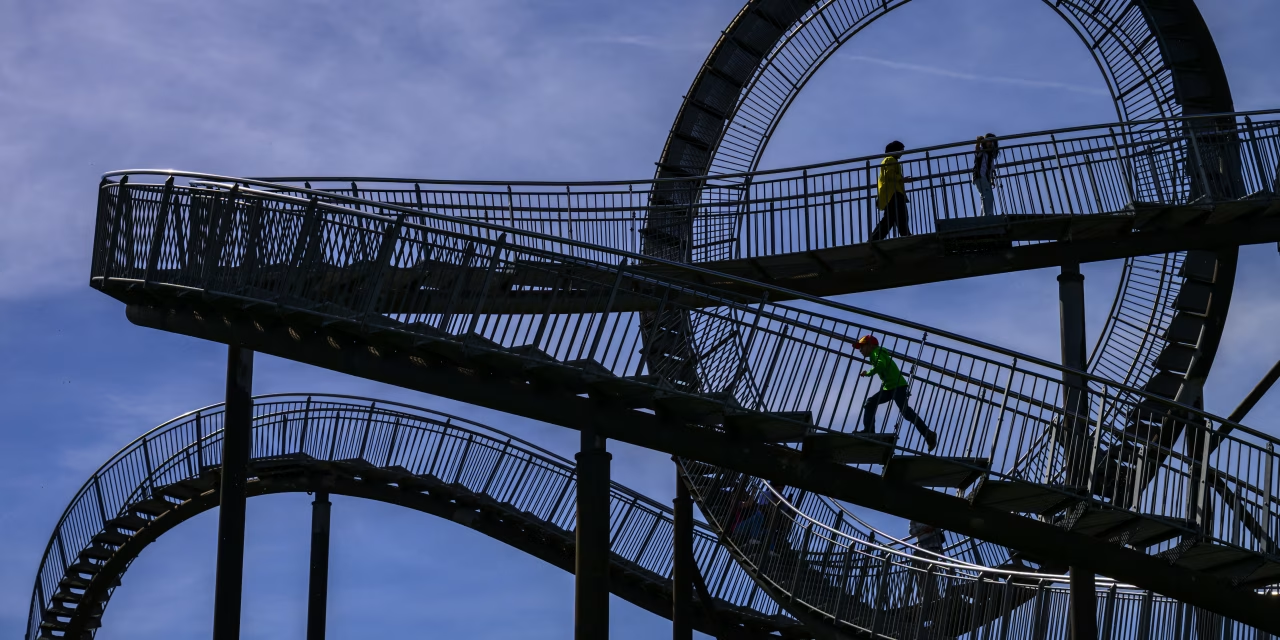
Eurozone households’ inflation expectations for the year ahead fell back in May, as consumers reacted to easing tensions in the Middle East, likely reassuring European Central Bank policymakers who fear an uncontrolled rise in price pressures.
Consumers say they expect prices to rise by 3.5% over the next 12 months, down from 4.0% in April, according to an ECB survey of 19,000 adults from 11 eurozone countries published on Friday. The survey was conducted between May 7 and June 1, before news of the tentative agreement between the U.S. and Iran to end the fighting.
Copyright ©2026 Dow Jones & Company, Inc. All Rights Reserved. 87990cbe856818d5eddac44c7b1cdeb8
Business
Goldman Sachs’ India bets: 8 stocks rally up to 85% in CY26; one new addition – Mixed Stock Performance

Goldman Sachs’ Indian equity portfolio, held through its global funds, declined 6% in CY26, falling from Rs 9,014 crore in December 2025 to Rs 8,470 crore as of June 25, 2026. As of the March 2025 quarter, the portfolio comprised about 46 stocks, of which around 26 were negative performers. So far in CY26, 18 stocks have declined between 10% and 44%, with the top six laggards falling 25–44%.
However, despite the overall decline, eight stocks bucked the trend, delivering gains of 20–85% over the same period. We also highlighted one newly added stock in the March 2025 quarter. (Data Source: ACE Equity, Trendlyne)

Whale's Insight: STRC -25% In Freefall: Will It Detonate Bitcoin's Bottom?
Marvell Is No Longer A Marvelous Buy (Rating Downgrade)

In his latest newsletter Greed & Fear, Wood describes the ongoing AI build‑out as “the most dramatic capex cycle” he has ever seen, driven by hyperscalers and foundries racing to ramp data‑centre and compute capacity. TSMC, for instance, has lifted its capex guidance for 2026 to about US$56 billion from US$41 billion last year, with Jefferies’ Taiwan partner Fubon Research now projecting US$65–70 billion of capex in 2027.
This surge in investment is already translating into boom‑like macro conditions in Taiwan, with real GDP growth hitting 14.55% year‑on‑year in 1Q26 and export orders up 53.4% year‑on‑year in the three months to May. Wood notes that AI‑related demand now accounts for an estimated 31% of TSMC’s revenues in 2026, underscoring just how concentrated the cycle has become in AI infrastructure.
Also Read | 3 AI stocks outweigh all of India: Why this concentration is sounding EM alarm bells
Jevons Paradox and “Picks and Shovels” Winners
Wood frames the AI demand story through the lens of Jevons Paradox: as token costs fall and efficiency improves, total compute consumption rises instead of falling. “The increased demand triggered by cheaper prices should be good for the picks and shovels plays,” he writes, arguing that DRAM and memory suppliers are the primary equity beneficiaries three and a half years into the AI capex arms race.

He cites Micron CEO Sanjay Mehrotra’s comment that “memory has evolved from a peripheral component into the core engine driving productivity in the AI era,” adding that the big three DRAM makers now have sufficient leverage to lock in long‑term sales agreements. Micron has already signed 16 strategic customer agreements covering roughly 20% of its DRAM volume and a third of its NAND volume, typically with five‑year tenors — evidence, in Wood’s view, of structural change in the industry.
The Commoditisation of AI Models
A key contextual risk is the rapid commoditisation of large language models, particularly in the consumer and, increasingly, corporate markets. Wood highlights the launch of GLM‑5.2 by Hong Kong‑listed Z.ai, formerly Zhipu AI, noting that informed sources describe the new model as “almost equal to Anthropic” for corporate use at just one quarter of the cost per token.
This comes against a backdrop of a backlash against “tokenmaxxing” and explosive growth in cheaper Chinese models on platforms such as OpenRouter. In the week ended 21 June, top Chinese AI models processed 21.37 trillion tokens on OpenRouter, up from 4.37 trillion in late April, versus 5.76 trillion tokens for the top US models. That shift in volume, he argues, is already signalling a commoditised landscape and mounting pressure on the economics of premium Western AI providers.
Malinvestment in AI
Wood is explicit that the key vulnerability in the AI trade is not a classic semiconductor oversupply shock but the eventual recognition that the hyperscalers and leading AI labs will fail to earn a satisfactory return on their investment. “GREED & fear is personally convinced that concerns about malinvestment will be the most likely trigger for an end to the AI trade, or at least for a protracted pause to refresh,” he writes.
The danger, in his view, lies in circular funding arrangements and aggressive capacity expansion built on optimistic monetisation assumptions. He points to structures such as Nvidia financing OpenAI so that OpenAI can in turn buy more Nvidia chips — a feedback loop that works as long as investors are willing to bankroll the ecosystem but could unwind sharply once doubts over long‑term returns take hold.
Why Traditional Supply‑Side Risks Are Secondary
Historically, semiconductor cycles have tended to end with abrupt increases in supply and inventory gluts. Wood believes the current cycle is different. “The key point to note for now is that this is the way the cycle is most likely to end rather than because of a sudden increase in supply, as has traditionally been the case in semiconductors,” he argues, emphasising that DRAM makers now command far greater pricing power.
The dominant three DRAM producers have been able to negotiate multi‑year strategic customer agreements, and Wood relays market chatter that Korean memory makers are already regretting locking in long‑term terms because they expect chip prices to rise further. In such a structurally tight industry, the more plausible end‑of‑cycle trigger is not oversupply but investor capitulation over capital discipline and earnings visibility in the AI stack above memory.
Despite these structural concerns, Wood emphasises that there is “zero sign of AI capex slowing” yet. He links ongoing spending to US banking deregulation under the Trump administration, citing Alvarez & Marsal’s estimate that recent regulatory changes will unlock US$2.5 trillion in additional lending capacity across the US banking system, including US$1.1 trillion unlocked in the last two quarters.
Portfolio Implications For Wood
Importantly, Wood is not calling for an immediate collapse in AI‑linked equities; instead, he is re‑positioning towards hardware and memory names that he believes will remain long‑term beneficiaries even if the AI trade endgame is defined by capital‑return disappointments higher up the stack.
He is lifting exposure to tech hardware across GREED & fear’s model portfolios, adding SK Hynix and Kioxia with initial 4% weightings in the global long‑only book and increasing the allocation to Samsung Electronics. Alphabet and Alibaba are being removed from the global portfolio, reflecting a deliberate tilt away from big‑cap platform plays towards “picks and shovels” beneficiaries of the AI capex cycle.
(Disclaimer: Recommendations, suggestions, views and opinions given by the experts are their own. These do not represent the views of The Economic Times)
CRE Recovery: Intact But Increasingly Uneven
Business
Dalal Street Week Ahead: Nifty to test crucial 24,500 level; breakout may define next trend
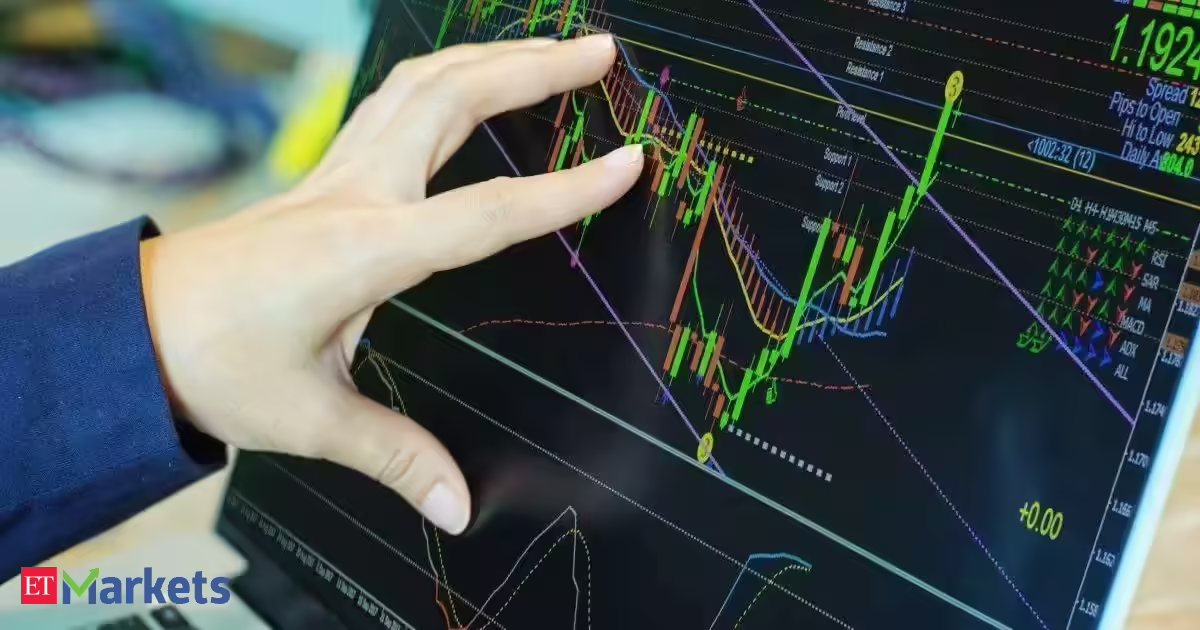
The broader technical structure remains cautious despite the index stabilizing above its recent lows. Nifty is currently confronting a formidable resistance zone between 24,160 and 24,500, where the 100-day moving average (24,161) and the 100-week moving average (24,504) exist. This cluster makes the zone technically significant and is likely to act as a stiff resistance area. Unless the index registers a decisive move above this resistance band, the ongoing rebound is likely to remain tentative in nature.
 ETMarkets.com
The markets are likely to begin the coming week after a trading holiday on Friday while adjusting to the global trade setup. It is likely to open on a tepid note, but sustained upside will require Nifty to decisively overcome the 24,160-24,500 resistance zone. Immediate resistance levels are placed at 24,160 and 24,500, while supports come in at 23,900 and 23,750. Any move beyond the resistance cluster may trigger stronger short-covering and improve the medium-term outlook, whereas failure to clear this hurdle could keep the index confined to a broad consolidation.
The weekly RSI stands at 48.01 and remains neutral without showing any notable bullish or bearish divergence against price. The weekly MACD continues to stay bullish and above its signal line. The latest weekly candle is that of a Doji; it reflects indecisive price action, underscoring the ongoing tug-of-war between buyers and sellers near an important resistance area.
From a pattern perspective, Nifty continues to trade within a broad consolidation after witnessing a sharp corrective decline earlier this year. The index has now entered a technically important congestion zone where multiple moving averages exist. The inability to reclaim the 100-day and 100-week moving averages keeps the near-term technical bias guarded. A sustained move above this resistance cluster would significantly strengthen the technical structure, while continued rejection from these levels could prolong the consolidation phase.
Overall, the market is entering a technically important phase where risk-reward remains evenly balanced. Fresh aggressive buying should be avoided until the index convincingly clears the 24,160-24,500 resistance band. At the same time, the presence of strong long-term support argues against adopting an overly bearish stance. Traders should continue with a selective, stock-specific approach while maintaining disciplined risk management. Protecting capital, avoiding excessive leverage, and waiting for a confirmed breakout before turning aggressively bullish would remain the most prudent strategy for the coming week.
ETMarkets.comThe Relative Rotation Graph (RRG) shows that the Nifty Pharma Sector Index has rolled inside the leading quadrant. Along with that, the Media and Midcap 100 Index are also inside this quadrant. These groups may outperform the broader Nifty 500 Index relatively.
ETMarkets.comThe Nifty Energy Index has rolled inside the Weakening quadrant. The Nifty PSE, Metal, and Infrastructure Indexes are also inside this quadrant. The overall relative performance of these groups may continue to slow.
The Nifty IT sector continues to languish inside the lagging quadrant. The Nifty Services, PSU, Bank, Financial Services, and Auto Indexes are also inside the lagging quadrant, but they are seen improving their relative performance against the broader markets. The FMCG and the Realty Index continue to be inside the improving quadrant, with the FMCG Index seen giving up gradually on its relative momentum against the broader markets.
Business
Companies should focus on business growth, profitability rather than just share price: NSE chief

Addressing the 9th JITO Incubation & Innovation Foundation (JIIF) Day event, he said a company’s market valuation should be a reflection of its business performance and growth.
The objective of an entrepreneur should be to expand the business and increase shareholder value through stronger fundamentals, he suggested.
“If the company’s profit increases, the share value should increase. You cannot keep increasing value without creating actual business growth,” Chauhan said.
He said entrepreneurs need to remain focused on their core business rather than getting influenced by market trends or peer pressure.
Companies that consistently grow and deliver results eventually get recognised by the market, he added.
The public markets reward profitable businesses with a valuation that private balance sheets cannot match. A company earning an annual profit of Rs 2 crore, he said, could command a market capitalisation of Rs 40 to 50 crore once listed, giving the promoter room to raise capital, bring in partners and expand operations. Listing also gives a company its own currency, Chauhan said.
A listed promoter can use stock to acquire other businesses, draw in partners and reward staff through stock options, he said, citing the early use of employee stock options at Infosys by NR Narayana Murthy and Nandan Nilekani to attract talent the company could not otherwise have hired.
He also highlighted the importance of innovation in entrepreneurship, saying innovation is not limited to major technological breakthroughs but can happen through small improvements in everyday processes.
“Whatever you do, if you do it differently and in a better way, that is also innovation,” Chauhan said.
Chauhan said the journey of building a business involves significant challenges and persistence, with many founders facing years of struggle before achieving success.
On the listing journey, he said getting listed on the stock exchange is not as difficult as often perceived, but companies need to focus on compliance, governance and transparency after entering the public markets.
Capital markets provide opportunities for companies to raise funds and grow, but businesses need to maintain discipline and focus on long-term value creation, Chauhan stated.


Iran says it hits US-linked targets as Bahrain reports drone attack

Aave Advances Automated AAVE Buyback Overhaul With Aavenomics 3.0

We Need To Drop This Dumb, Tired Talking Point About Edgy TV

Laura Kuenssberg: Is Andy Burnham Labour’s saviour, or just its best bet?


-

 Entertainment7 days ago
Renter of Home in Anne Heche Crash Denies Settlement With Son
-
 Sports4 days ago
Two goals and an assist by sheer aura: Cristiano Ronaldo just entered the World Cup chat
-

 Tech5 days ago
Microsoft accidentally kills epic Outlook email threads
-

 Fashion17 hours ago
Weekend Open Thread: Staud – Corporette.com
-

 Business7 days ago
Soccer-U.S. defends Iran World Cup travel restrictions, says discussions ongoing
-

 Politics1 day ago
The House | Manchesterism won’t survive the painful trade-offs unless it gets citizens on board
-

 Politics1 day ago
Potential 2028er World Cup attendee leaderboard
-

 Business1 day ago
Asia stock markets slide as tech shares slump
-

 Tech2 days ago
A Look At A Gaggle Of Transputer Boards
-
Crypto World3 days ago
Bitcoin (BTC) Dips Below $62K, Ethereum (ETH) Plunges 6% Daily: Market Watch
-

 Crypto World3 days ago
Securitize Wraps Roubini's SEC-Registered ETF as Dubai VARA Digital Security
-
 Crypto World2 days ago
Dell (DELL) Shares Tumble Over 5% Following Analyst Downgrade to Hold
-
Business3 days ago
Entergy settles forward sale agreements, raises $672 million in cash proceeds
-

 Sports14 hours ago
FIH Pro League: India defeat Pakistan 7-1, register biggest win of campaign | Other Sports News
-

 Crypto World6 hours ago
Kraken's xStocks Opens Bending Spoons IPO Registration to EEA Retail
-

 Crypto World18 hours ago
RTX holders must register wallets before token distribution begins
-
 Crypto World21 hours ago
Hyperliquid Named on Singapore MAS Investor Alert Register
-

 Crypto World7 days ago
Jake Chervinsky accuses CME of protecting derivatives monopoly
-

 Sports2 days ago
India vs Bangladesh LIVE Score, Women’s T20 World Cup: Bangladesh Opt To Bat; India Enter ‘Do-Or-Die’ Stage As Semi-Final Race Heats Up
-
 Tech6 days ago
Signal’s Meredith Whittaker says AI chatbots ‘are not your friends’ and calls Copilot agents a backdoor
You must be logged in to post a comment Login