
Business
who has the best hosting for UK businesses?


This is the comparison most UK small businesses end up making. Both providers are European, both start at about a pound a month, and both promise a domain, a website and email in one place. From the outside they look interchangeable.
They are not. One has built its business on simplicity and bundling, the other on infrastructure and scale, and the right answer depends almost entirely on how much complexity you are willing to manage in exchange for capability.
The domain question first
Start here, because it is where the two providers differ most in practice and least in marketing. Both include a free domain for the first year with hosting plans, and both charge standard rates from year two.
The difference is what surrounds it. In practice, buying a domain name from one.com puts the registration, DNS, SSL and email in a single control panel with one renewal date, and the interface assumes you are not a systems administrator. IONOS gives you more control over DNS records, more extensions and an included mailbox with the registration, inside a considerably busier account area.
For a business registering one .co.uk and pointing it at one website, one.com’s approach removes decisions you did not want to make. For a business managing several names across several projects, IONOS gives you tools you will actually use. Our wider guide to where to buy a domain in the UK puts both against the specialist registrars.
Price, and what happens next year
Both providers open at roughly £1 per month for entry level hosting. That is where the similarity ends.
IONOS renewals land in the region of £8 to £9 per month depending on the plan, which is a substantial increase but relatively moderate by industry standards, and the company is comparatively clear about it upfront. one.com also raises prices at renewal, and the honest advice with either provider is identical: calculate three years, not one.
Where one.com pulls ahead is on what is included at that price. Email addresses on your domain come with every plan rather than as a separate subscription, and the AI Website Builder is part of the package rather than a paid tier. With IONOS, the equivalent capability often means a higher plan or an add on.
Where IONOS pulls ahead is on resources. Even its shared hosting allocates dedicated CPU and memory rather than pooling everything, so performance is more consistent under load. If your site is doing real work rather than sitting as a brochure, that is worth paying for.
Infrastructure and reliability
IONOS wins this section clearly. Its data centres are Tier IV certified in the UK and across the EU, run on renewable energy, and hold ISO 27001 certification. Independent testing regularly puts its response times among the fastest for UK visitors. The company is listed on the Frankfurt Stock Exchange, which brings a level of disclosure smaller competitors do not offer.
one.com’s position is more modest. It has operated from Denmark since 2002, is subject to EU data protection law, and independent reviewers report performance that is good for the price bracket. They also note that it does not publish an uptime guarantee, which is a fair criticism if you need a contractual commitment rather than a track record.
If uptime is a business risk you have to document, IONOS gives you something to point at. If it is a practical concern rather than a compliance one, both will keep a small business site online.
Support
Both offer 24/7 cover. one.com provides chat, phone and email support in several languages, and reviewers consistently rate the experience as friendly and quick for straightforward problems.
IONOS does something structurally different by assigning every account a named personal consultant at no extra charge, alongside standard 24/7 phone, chat and email support. For a business owner who wants one person who understands their setup rather than a fresh agent each time, that is a genuine advantage and the single feature IONOS customers mention most.
The counterpoint is that one.com’s product is simpler, so there is less to need support for.
Website building
one.com’s builder leads with AI: describe the business, receive a structured site with drafted copy, then edit by dragging. It is straightforward and fast, and it is included in the hosting plan rather than priced separately. The limitation is depth, with a narrower template range and less design control than the specialists offer.
IONOS also offers an AI builder with a personal consultant attached to every plan, and its SEO controls cover the basics competently: editable titles, meta descriptions, alt text and automatic sitemaps. It lacks built in SEO analysis and offers limited control over URL structure.
Neither will satisfy a designer. Both will produce a credible small business site in an afternoon. Our roundup of the best AI website builders puts them against Wix and Squarespace, which is the more revealing comparison if design is your priority.
Growing beyond shared hosting
Both providers offer an upgrade path, and both handle it reasonably.
one.com provides managed VPS and cloud server options with dedicated resources and NVMe storage, positioned as a step up rather than a developer playground. IONOS goes considerably further, running a full cloud portfolio from VPS through dedicated servers and enterprise infrastructure, with pricing that stays competitive at the higher tiers.
If there is any chance your requirements will become genuinely technical, IONOS has more room above you. If the ceiling you are worried about is a busy brochure site outgrowing shared resources, either will do.
Complexity, which is the real deciding factor
The honest summary is that IONOS offers more and asks more. Its product range is enormous, its control panel reflects that, and buyers regularly report that the sheer number of options and upsell paths makes the early experience harder than it needs to be.
one.com offers less and asks less. Fewer plans, fewer decisions, a simpler panel, and a shorter path from signing up to a live website. For a plumber, a consultancy or a shop owner doing this alongside running the business, that is not a compromise. It is the feature.
Who should choose which
Choose one.com if you want your domain, hosting, email and site builder in one plan with one renewal date, you value a simple interface over granular control, and your priority is getting online affordably without managing infrastructure. Our full one.com review covers the bundle in detail.
Choose IONOS if you need certified data centres and documented reliability, you want a named consultant rather than a support queue, you are running something resource intensive, or you expect to scale into serious infrastructure later.
The verdict
IONOS is the better hosting company. one.com is the better product for most UK small businesses, which sounds contradictory until you notice they are answering different questions. IONOS optimises for capability and gives you the tools to use it. one.com optimises for the owner who wants a professional website, a working email address and a bill they understand.
Neither choice is wrong. Both appear in our ranking of the best web hosting UK businesses can buy, and the deciding question is simply how much you want to be responsible for.


The UK Payments Market report, released once a year, shows that debit cards – included those loaded onto phones – were the predominant way to pay last year.
They accounted for 54% of all payments in made in 2025. Some 39% of payments were contactless.
Cheques had been due to be phased out by 2018, until MPs forced a change of heart by the industry years ago.
Instead, they have withered to just 0.2% of payments made in the UK – with a total of 77 million written last year.
Cash is unlikely to go the same way, according to forecasts by UK Finance.
Notes and coins were used in 3.9 billion, or 8%, of all payments last year. This is expected to halve to 4% of all payments in the UK in 2035, or two billion transactions.
However, some people still had a strong preference for using cash.
“Rather than the UK becoming a cash-free society over the next decade, the UK will transition to an economy where cash is less important than it once was but remains widely valued and still preferred by some,” the report said.
Nearly 50 million people used a cash machines last year.
Nick Quin, from Link, which oversees the UK’s ATM network, said: “Cash withdrawals are falling across every part of the country. More people find it convenient and prefer to pay using contactless cards and digital wallets on smartphones, but millions still rely on cash day in, day out.
“People on lower incomes rely more heavily or entirely on cash to budget, which is why our job is to protect access to cash for as long as people need it.”


Good morning. Financial influencers are reshaping how consumers manage their money—and how brands win their trust, Elyse Goncalves reports for The Wall Street Journal.
Less regulated and more widely accessible than the traditional financial services industry, these “finfluencers” use battle-tested growth tactics to capture attention. Stock picker Timothy James, 38, says he’s used rage-baiting lines to drive views, while U.K. creator Leo Gibson relies on radical relatability. Gibson’s financial advice video reached nearly 500,000 views by ditching institutional polish for a casual bedroom setup.
Copyright ©2026 Dow Jones & Company, Inc. All Rights Reserved. 87990cbe856818d5eddac44c7b1cdeb8

The home builder has spent about $17 million on the build method in recent years and doubled the capacity of its modular facility.

Harbor Capital is an asset manager focused on curating an intentionally select suite of active ETFs that they believe have the potential to produce compelling, risk-adjusted returns within a portfolio. Note: This account is not managed or monitored by Harbor Capital, and any messages sent via Seeking Alpha will not receive a response. For inquiries or communication, please use Harbor Capital’s official channels.

Melanie Fish, travel expert at Vrbo, told FOX Business that rising fall travel demand is squeezing traditional shoulder-season savings.
Travelers can still score deals this fall, but they may have to work harder to find them as the traditional shoulder season gets squeezed.
Fall travel interest on Vrbo is up 17% from a year ago, while average nightly rates after summer are now just 5% below peak summer prices across the platform’s top destinations, according to new data from the vacation rental platform.
“Shoulder season is this magic time between Labor Day and the holiday travel season when, traditionally, prices have dropped pretty dramatically and crowds have thinned out,” Vrbo Travel Expert Melanie Fish told FOX Business. “Well, summer travel demand is now bleeding over into fall.”
Some of the best savings remain in beach destinations, overseas markets and trips booked for later in the fall.
WEALTHY AMERICANS LOOK TO NEW ZEALAND AS DEMAND FOR ‘GOLDEN VISAS’ BOOMS

Travelers are pictured at Los Angeles International Airport on June 29, 2023. Some of the best savings remain in beach destinations, overseas markets and trips booked for later in the fall. (Brittany Murray/MediaNews Group/Long Beach Press-Telegram via Getty Images)
Myrtle Beach, South Carolina, tops Vrbo’s list, with vacation rental rates averaging 34% less than during summer. One property cited by the company drops from as much as $1,300 per night in August to about $600 in October.
Other beach markets also offer discounts. Orange Beach, Alabama, offers average savings of 31%, followed by Panama City Beach, Florida, at 24%, Santa Rosa Beach, Florida, at 16%, and Ocean City, Maryland, at 12%, according to Vrbo.
Fish said travelers chasing lower prices should consider swapping destinations or keeping an eye out for last-minute discounts.
BUDGET AIRLINE JETSTAR TO CHARGE PASSENGERS FOR STORING BAGS IN OVERHEAD COMPARTMENTS

Myrtle Beach, South Carolina, tops Vrbo’s list, with vacation rental rates averaging 34% less than during summer. (Edwin Remsberg / VWPics/Universal Images Group via Getty Images)
Travelers heading overseas may also have better luck. European vacation rental prices fall an average of about 8% from summer highs during the fall, with larger discounts in destinations including Corfu, Crete, Girona, the Azores and Siena.
Major tourism hubs such as London, Paris, Madrid and Rome tend to hold onto higher prices, leaving fewer shoulder-season bargains.
The squeeze is also showing up in several major U.S. cities. Vrbo said fall rates are rising in Nashville, Boston, Chicago and Miami as demand stays strong beyond summer.
SEE IT: TRUMP ADMIN UNVEILS SWEEPING $22.5B DULLES AIRPORT OVERHAUL

Travelers walk on a concourse at Chicago O’Hare International Airport in Chicago, Illinois on January 15, 2026. Beach markets still offer some of the biggest savings. (Daniel SLIM / AFP via Getty Images)
GET FOX BUSINESS ON THE GO BY CLICKING HERE
Travelers willing to wait until after the holidays could find the biggest break.
From just after New Year’s through the period before spring break in early 2027, lodging prices are expected to run about 34% below summer peaks, with possible deals in San Diego, Los Angeles and Orlando.
Business
Dow Slips as Oil Tops $90 on Iran Tensions While Home Depot’s Earnings Beat Offers Some Market Relief

NEW YORK — The Dow Jones Industrial Average fell 87.36 points, or 0.16%, to 53,372.42 as of 9:44 a.m. EDT Tuesday, as rising oil prices tied to escalating tensions with Iran weighed on broader market sentiment even as a stronger-than-expected earnings report from Home Depot offered some support to blue-chip stocks.
Tuesday’s modest decline followed a sharper pullback across Wall Street on Monday, when all three major indexes closed lower amid rising crude prices and climbing long-term Treasury yields. The Dow fell 272.63 points, or 0.51%, to close at 53,459.78, while the S&P 500 slid 0.52% to 7,745.06 and the Nasdaq Composite dropped 0.32% to 26,644.91. That pullback came as West Texas Intermediate crude climbed above $83 a barrel and Brent crude moved above $88, with crude prices gaining roughly 3% during Monday’s session alone following the expiration of a 60-day window for the U.S. and Iran to reach a deal aimed at ending their ongoing conflict.
By Tuesday, oil prices had pushed even higher, with crude trading above $90 a barrel as concerns over instability in the Middle East continued to dominate broader market sentiment. According to Yahoo Finance, Middle East conflict concerns combined with the elevated oil prices weighed on the S&P 500 and Nasdaq early Tuesday, with the Nasdaq Composite falling as much as 1.2% in premarket trading, leading declines among the major indexes, while the Dow traded closer to flat.
Home Depot emerged as one of the session’s key earnings stories. The home improvement retailer reported fiscal second-quarter sales of $47.86 billion, topping analyst expectations of roughly $47.27 billion, alongside adjusted earnings per share of $4.92, ahead of the $4.73 consensus estimate. The company reaffirmed its full-year guidance, continuing to project comparable sales of roughly flat to up 2% for fiscal 2026, along with adjusted earnings per share in a range of flat to up 4% from $14.69, compared with a consensus estimate of $14.96.
According to Investing.com, Home Depot shares rose as much as 2.1% in pre-market trading following the report, with demand from repair-focused customers proving more resilient than some investors had feared. However, by the time regular trading got underway, the stock’s gains had moderated considerably, with CNBC reporting the shares up only around 1% after the company left its full-year guidance unchanged despite the top-line beat. Oppenheimer analyst Brian Nagel offered commentary on the results in a CNBC interview, breaking down the retailer’s performance as investors weighed the company’s outlook against continuing softness in the broader housing market. Home Depot separately reaffirmed its guidance while citing what the company described as “frozen housing market conditions,” according to CNBC’s coverage of the report.
Notably, Home Depot’s earnings call was led by interim management, with Senior Executive Vice President Ann-Marie Campbell and Chief Financial Officer Richard McPhail steering the company after Chief Executive Ted Decker began a temporary medical leave on Aug. 12.
Home Depot’s results carried added significance given the broader context of this week’s retail earnings slate. Walmart, Target, Lowe’s and TJX are all scheduled to report results over the coming days, with Lowe’s set to report Wednesday and Walmart due Thursday. Those reports are being closely watched following Friday’s weaker-than-expected U.S. retail sales data, which showed sales unexpectedly fell 0.6% in July, the largest monthly decline in more than a year, raising questions about whether elevated interest rates, inflation and broader household financial pressure are beginning to weigh more heavily on consumer spending.
TheStreet Pro contributor James “Rev Shark” DePorre highlighted the outsized importance the market is placing on this week’s retail results given that backdrop. “The retailers are the real news,” DePorre said. “Walmart (WMT), Target (TGT), and Home Depot (HD) all report earnings, and after Friday’s weaker-than-expected retail sales those reports will carry more weight than they normally would.” DePorre also flagged Wednesday’s scheduled release of Federal Open Market Committee meeting minutes as a significant event to watch this week, given recent signs of division among Fed officials. “Given that three members dissented in favor of a hike at the last meeting and Kevin Warsh declined to signal anything about the path ahead, the minutes may be more informative than usual,” he said.
Beyond the retail and Home Depot storylines, Tuesday’s session also featured notable pressure across the memory chip sector. Micron Technology and SK Hynix each fell more than 4% in premarket trading, while shares of Sandisk also declined more than 4%, according to CNBC, as memory chipmakers broadly retreated as a group after a period of significant gains tied to artificial intelligence-driven demand.
Elsewhere in Tuesday’s earnings and market news, optical product manufacturer Fabrinet fell more than 9% despite fourth-quarter earnings and revenue that exceeded expectations, with the company citing anticipated seasonal expense pressure expected to weigh on margins during its fiscal first quarter of 2027. Buy-now-pay-later company Klarna’s stock plunged following a trimmed financial outlook, according to Yahoo Finance’s market coverage, while packaging company Amcor was downgraded to neutral from overweight by JPMorgan on Monday.
Individual premarket movers Tuesday included notable volatility beyond the major blue-chip names. Electric vehicle company Xos surged 114.6% on heavy trading volume, while medical technology company Profusa climbed 97.2%, according to market tracking. Super League Enterprise also jumped 64.5% amid unusually high trading activity, illustrating pockets of significant speculative interest even amid the broader market’s more cautious overall tone Tuesday morning.
With Wednesday’s Federal Reserve minutes and Lowe’s earnings report on deck, followed by Walmart’s results Thursday, investors are likely to continue closely monitoring how this week’s combination of retail earnings, Fed commentary and ongoing Middle East-driven oil price volatility shapes broader market direction through the remainder of the week, as Wall Street works to reconcile continued strength in areas like artificial intelligence-linked technology stocks against renewed uncertainty stemming from both geopolitical developments and signs of a softening U.S. consumer.
Business
Iluka Resources Limited 2026 Q2 – Results – Earnings Call Presentation (OTCMKTS:ILKAY) 2026-08-18


Seeking Alpha’s transcripts team is responsible for the development of all of our transcript-related projects. We currently publish thousands of quarterly earnings calls per quarter on our site and are continuing to grow and expand our coverage. The purpose of this profile is to allow us to share with our readers new transcript-related developments. Thanks, SA Transcripts Team
Business
Google Nest and Home Devices Down? Widespread Global Outage as Voice Commands and Displays Fail Worldwide

Google Home and Nest devices experienced a widespread, server-side outage Monday into Tuesday, leaving users across multiple continents unable to control smart speakers, displays and connected home devices, according to outage-tracking services and reports from affected users worldwide.
Downdetector posted on its official account on the social platform X that “user reports indicate problems with Google Nest since 9:20 AM EDT,” tagging the post with the hashtag #GoogleNestDown and directing users to its outage-tracking page for further updates. The post had drawn nearly 1,900 views shortly after being published.
According to Android Authority, the disruption first became apparent much earlier, with Downdetector showing a massive spike in outage reports around 6 a.m. local time in the United Kingdom, corresponding to roughly 1 a.m. Eastern time and 10 p.m. Pacific time in the United States on Sunday night. Reports of the outage continued building throughout the overnight hours and into Monday and Tuesday, with more than 300 users reporting server problems on Downdetector when the issue was first identified, according to Sportskeeda’s coverage of the disruption. Users shared reports of the outage from locations across the United States, Canada, Europe and Australia.
The scope of reported symptoms has been broad, spanning multiple Google smart home products. Users have reported that the Google Home app has been unable to control connected devices or receive normal responses in some cases. Nest speakers, including the Google Nest Mini, have failed to respond to voice commands, while Nest Hub displays have become stuck on loading screens or otherwise failed to process user requests. Google Assistant itself has also been affected, with voice commands requesting information or attempting to control smart home devices returning errors rather than completing the requested action. Additionally, some users have reported that scheduled routines and manually triggered automations tied to their smart home setups have failed to execute properly during the outage.
Android Authority reported that standard troubleshooting steps commonly used to resolve smart home device issues, including rebooting affected devices or performing a full factory reset, have not resolved the problem for users experiencing the outage, indicating the disruption stems from Google’s server-side infrastructure rather than any fault with individual devices themselves. As a result, affected users have had little recourse beyond waiting for Google to implement a fix on its end.
The Sunday Guardian reported that users in the United Kingdom have been among those affected by the ongoing disruption, describing a range of complaints including unresponsive speakers, failed voice commands, and Nest Hub devices stuck on blank or loading screens. Users have also reported continued difficulty controlling connected devices and running previously configured automated routines as the outage has persisted.
According to reporting on the incident, the disruption appears to be affecting Google’s cloud-side services that support Nest and Google Home products, rather than the individual hardware devices themselves, though Google had not officially confirmed the precise technical cause of the outage as of the most recent available reporting. Some users have reported that their devices intermittently began working again during the outage window, suggesting the disruption may not be uniformly affecting all users or regions at all times, and that the situation has continued to evolve as Google works toward a resolution.
The outage arrives roughly two and a half weeks after Google rolled out a broader Google Home software update at the start of August that introduced new features for the company’s smart home ecosystem. That earlier update was not without its own complications; iOS users experienced a separate, unrelated bug at the time in which some smart lights were automatically and unexpectedly turned on, an issue Google addressed relatively quickly following user reports.
Nest, which Google acquired in 2014, has experienced periodic connectivity and service disruptions throughout its history as a cloud-connected smart home platform. According to outage-tracking service StatusGator, which has monitored Nest’s service status since September 2016, the platform has experienced more than 168 documented outages over roughly the past decade, reflecting the broader technical challenges inherent to maintaining reliable, always-connected smart home infrastructure at global scale. Historical outages affecting Nest devices have periodically drawn attention to broader concerns among users regarding the reliability of internet-dependent smart home products, particularly for use cases such as home security monitoring or, in some past instances, using connected cameras as baby monitors, where a service disruption can leave users temporarily unable to access functions they may consider essential.
Google has faced broader service disruptions affecting products well beyond its Nest and Home lineup in the past, including outages that have simultaneously affected services such as Google Search, Google Meet, Gmail and Google Cloud infrastructure more broadly. In at least one previous large-scale incident, a Google Cloud spokesperson confirmed to media outlets that the company was “currently investigating a service disruption to some Google Cloud services,” directing affected users and businesses to the company’s public status dashboard for ongoing updates, a communication pattern Google has generally followed during significant platform-wide technical incidents.
As of this report, Google had not issued a detailed public statement specifically addressing the scope, cause or expected resolution timeline for the current Nest and Google Home outage, though the company’s status dashboard for Google Workspace and related cloud services typically serves as the primary official channel through which the company communicates updates during confirmed service disruptions.
Given the global scope of the reported outage, spanning users across North America, Europe and Australia, and the consistency of symptoms described across multiple independent reports, the disruption appears to reflect a genuine, widespread technical failure within Google’s smart home infrastructure rather than a series of isolated, unrelated regional issues. Users experiencing continued problems with their Google Nest or Google Home devices were generally advised to continue monitoring official Google channels and outage-tracking services such as Downdetector for updates, since the underlying server-side nature of the disruption means individual troubleshooting steps are unlikely to resolve the issue until Google implements a fix on its end.

Virtuoso Vice President Misty Belles joins Cheryl Casone on Mornings with Maria to analyze the post-pandemic surge in luxury travel sales. Belles breaks down top global destinations, the rise of wellness travel, and fall booking trends.
American Airlines passengers could soon notice some big changes when they settle into their seats, as the carrier rolls out a major overhaul of the onboard experience.
The company said Tuesday that more than 800 narrowbody aircraft will ultimately receive new entertainment systems featuring 4K displays, Bluetooth connectivity and USB-C charging.
“Big enhancements are taking flight,” American said in a post on X announcing the changes.
New aircraft equipped with the screens are expected to begin arriving in the second half of 2028, while retrofits of existing jets are scheduled to start later that year.
CHICK-FIL-A REIMAGINES SOUTHERN BREAKFAST CLASSIC AS AMERICANS PILE ON THE PROTEIN

American Airlines is planning a major cabin overhaul that will add seatback entertainment, faster connectivity and more premium seating across much of its narrowbody fleet. (Kevin Carter/Getty Images / Getty Images)
The retrofit program is expected to stretch into the early 2030s, according to American.
The move marks a notable shift for the Fort Worth, Texas-based carrier, which has for years relied heavily on passengers streaming entertainment to their own phones, tablets and laptops on many domestic flights.
The airline told Fox News Digital that changing passenger habits helped drive the decision.
“Customer preferences have evolved,” the airline shared with Fox News Digital, adding that the shift has become particularly apparent since the COVID-19 pandemic.
The carrier added that younger travelers, in particular, increasingly expect access to multiple devices and larger screens during their trips.
At the same time, improvements in satellite internet are changing what airlines can offer passengers in the cabin. American plans to begin installing high-speed Starlink Wi-Fi on its narrowbody aircraft in 2027.
AMERICAN AIRLINES REPORTEDLY PAUSES 6 DOMESTIC ROUTES AMID FUEL PRICE PRESSURE TIED TO IRAN CONFLICT
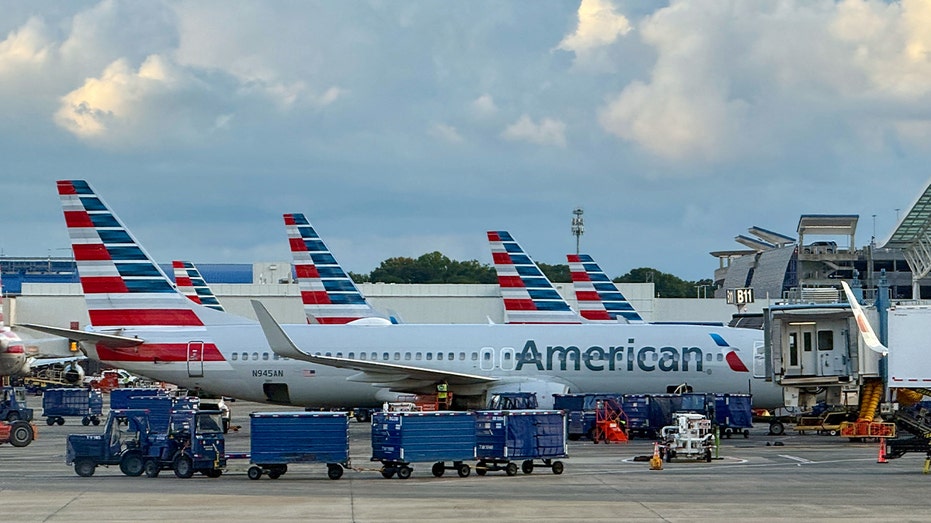
The changes, beginning in 2028 and continuing into the early 2030s, are aimed at attracting travelers willing to pay more for comfort and upgraded amenities. (Daniel Slim/AFP via Getty Images / Getty Images)
The airline said combining built-in screens, passengers’ personal devices and faster connectivity could create a more personalized in-flight experience, while also opening up “new opportunities for engagement and revenue growth.”
The upgrades will cover both new aircraft and planes already in American’s fleet. Newly delivered Airbus A321 and Boeing 737 MAX 10 aircraft will receive the entertainment systems, while existing narrowbody aircraft will be retrofitted.
American’s current Airbus A320 fleet is the exception and will not receive the new seatback entertainment systems, the carrier told Fox News Digital.
The cabin overhaul goes beyond screens.
American is also increasing the number of higher-priced seats across its narrowbody operation, as airlines increasingly compete for travelers willing to pay more for additional space and premium amenities.
Premium seating currently represents roughly 25% of seats on American’s narrowbody departures. The airline expects that figure to climb to approximately 40% in the coming years.
UNITED AIRLINES DROPS MERGER PURSUIT WITH AMERICAN, CEO KIRBY DETAILS WHY

American Airlines is betting on premium travelers by expanding first-class and extra-legroom seating across its narrowbody fleet, part of a broader push to make the onboard experience more upscale and competitive. (Courtesy Terri and Bobbie Barbour)
American is already modifying its Airbus A319 and A320 aircraft to add another row of first class. Its future Boeing 737 MAX 10 aircraft are expected to have 24 first-class seats, while the airline also plans to reconfigure its A321neo fleet with additional first-class seating.
The carrier is expanding Main Cabin Extra, its extra-legroom economy product, across most of the narrowbody fleet as well.
“We’re making one of the most significant investments in the onboard experience in our history,” American Chief Customer Officer Heather Garboden said.
The airline’s decision comes as carriers increasingly focus on premium travelers and cabin amenities as another way to differentiate themselves beyond ticket prices and schedules.
American’s new screens are expected to rank among the largest offered on narrowbody aircraft in North America, according to the carrier. The system will also offer personalized movie and television recommendations, interactive flight maps and destination information.
CLICK HERE TO DOWNLOAD THE FOX NEWS APP
The first newly delivered aircraft with the technology are still roughly two years away, meaning passengers will see the changes gradually rather than through an immediate fleetwide overhaul.
American Airlines expects the retrofit program to be completed in the early 2030s.
Business
Outshine Fruit Bars Recalled Nationwide Over Possible Glass Contamination in Five Popular Flavors

WALNUT CREEK, Calif. — Dreyer’s Grand Ice Cream Inc. is voluntarily recalling a limited number of Outshine Fruit Bar flavors nationwide over concerns that the frozen treats could be contaminated with glass, according to a media release distributed via PR Newswire.
The recall, dated Aug. 16, affects Outshine Strawberry, Watermelon, Grape, Tangerine and Black Cherry fruit bars, which were distributed to retailers across the country in 6-count boxes. The company emphasized that only these five flavors, packaged as 6-count, 2.5-ounce paddle bars, are included in the recall, meaning other Outshine products and flavors not specifically listed are not affected.
According to the company, no illnesses or injuries connected to the recalled products have been reported to date. Dreyer’s said in its statement that it remains focused on ensuring consumer safety as the recall moves forward. “The safety, quality, and integrity of our products remain our highest priority. We sincerely apologize for any inconvenience this action may cause our consumers and retail customers,” the company said in its release. “We remain committed to maintaining the highest standards of food safety and quality and to earning the trust of our consumers and customers every day.”
Consumers who have purchased the affected products are being urged to check specific batch codes and best-before dates printed on the bottom of each package, along with the corresponding UPC codes, to determine whether their particular boxes fall within the recall.
For Outshine Strawberry 6-Count 2.5-ounce Fruit Bars, under UPC 041548610047, the affected batch codes include a lengthy list of codes beginning with the prefix “LLA,” with best-before dates ranging from Sept. 30, 2027, through Nov. 30, 2027. The affected codes span LLA616903 through LLA617603 with a Sept. 30, 2027, best-before date, followed by a separate group of codes from LLA620303 through LLA621603 carrying best-before dates spread across Oct. 31, 2027, and Nov. 30, 2027.
Outshine Grape 6-Count 2.5-ounce Fruit Bars are affected under two separate UPC codes. Under UPC 041548244044, affected batch codes include LLA616803, LLA616903, and a range from LLA619703 through LLA620303, with best-before dates of either Sept. 30, 2027, or Oct. 31, 2027, depending on the specific code. A separate set of Grape fruit bars, packaged under UPC 041548000121, carries affected batch codes ranging from LLA618503 through LLA619003, all with a July 31, 2027, best-before date.
Outshine Watermelon 6-Count 2.5-ounce Fruit Bars, listed under UPC 041548413624, have affected batch codes spanning LLA617603 through LLA619503, with best-before dates falling on either June 30, 2027, or July 31, 2027, depending on the specific batch.
Outshine Tangerine 6-Count 2.5-ounce Fruit Bars, under UPC 041548612041, have a more limited set of affected batch codes, specifically LLA619603 and LLA619703, both carrying an Oct. 31, 2027, best-before date.
The company has directed consumers with additional questions about the recall, including how to determine eligibility for a refund or how to properly dispose of affected products, to consult additional details available through the company’s official recall notice. Consumers who discover they have purchased any of the affected batch codes are generally advised in cases like this to avoid consuming the product and to either discard it or return it to the place of purchase for a refund, consistent with standard food safety recall guidance.
Glass contamination recalls, while relatively uncommon, are treated with particular seriousness by food safety regulators and manufacturers given the potential for serious injury if small glass fragments are inadvertently consumed. Such recalls typically originate from a manufacturing or packaging line issue, such as damage to glass components used somewhere in the production or filling process, though Dreyer’s release did not specify the exact source of the potential contamination risk identified in this case.
Outshine, a brand owned by Dreyer’s Grand Ice Cream, has built a reputation in the frozen treats market for producing fruit-based frozen bars marketed as a lower-calorie, fruit-forward alternative to traditional ice cream novelties. The recalled flavors, including Strawberry, Watermelon, Grape, Tangerine and Black Cherry, represent some of the brand’s more widely distributed and popular product offerings, meaning the recall is likely to affect a substantial number of households that had purchased the products before the potential contamination issue was identified.
Given the wide distribution of the affected boxes to retailers nationwide, consumers across the country are being encouraged to check their freezers for any of the specific batch codes outlined in the recall notice, rather than assuming that simply purchasing one of the five listed flavors necessarily means their particular box is affected, since the recall applies specifically to certain identified batch codes and best-before date ranges rather than to the flavors as a whole indefinitely.
This recall adds to a broader pattern of food safety recalls that consumers have periodically had to navigate across various product categories throughout the year, underscoring the ongoing importance of manufacturers’ internal quality control processes in catching potential contamination risks before they result in consumer injury. In this instance, the company has stated that its internal processes identified the potential glass contamination risk before any injuries were reported, prompting the voluntary recall action.
Consumers seeking further information about the recall, including specific guidance on refunds or additional batch codes not explicitly detailed in initial reporting, are encouraged to consult the full recall notice provided by Dreyer’s Grand Ice Cream directly, as the company’s official release contains the complete and authoritative listing of all affected product codes and consumer guidance associated with this voluntary recall action.

Ex-Presidential Candidate Andrew Yang Pushes for AI Tax Over Payroll Tax

Ava Ryan Reveals the 2016 Trends That Still Hold Up: From Taco Bell Throwbacks to the Snapchat Dog Filter

South Korean and US militaries shorten exercises at Trump’s order

Weekend Open Thread – Corporette.com

Weekend Open Thread: Brooks Brothers

London Mayor Sadiq Khan handed a peerage by Keir Starmer alongside 15 other Labour figures… just days before the PM leaves No10

Bitcoin is LITERALLY about to EXPLODE! (Explained in 8 minutes)

You’re Going To Want To Buy Bitcoin & Crypto After Watching This No One Is Paying Attention

Yahoo Finance Live: Daily Market Coverage – June 26, 2026 9AM-11AM (ET)
-

 Fashion4 days ago
Weekend Open Thread: Ann Taylor
-
 Sports5 days ago
This U.S. Amateur is a glimpse into golf’s future in more ways than you think
-

 Sports4 days ago
Birmingham 2026: Day 6 Timetable for Irish Athletes
-

 Tech5 days ago
11 Ways to Rank Your Videos
-
 NewsBeat4 days ago
Myanmar says over 300,000 Rohingya refugees verified for repatriation as exodus enters ninth year
-

 Politics4 days ago
SEQ Code: The Three Letter Boarding Pass Code That Could Give You The Worst Seat
-
 Entertainment7 days ago
Keke Palmer Subtly Hints At Sean Evans Drama With Cryptic Post
-
 Crypto World7 days ago
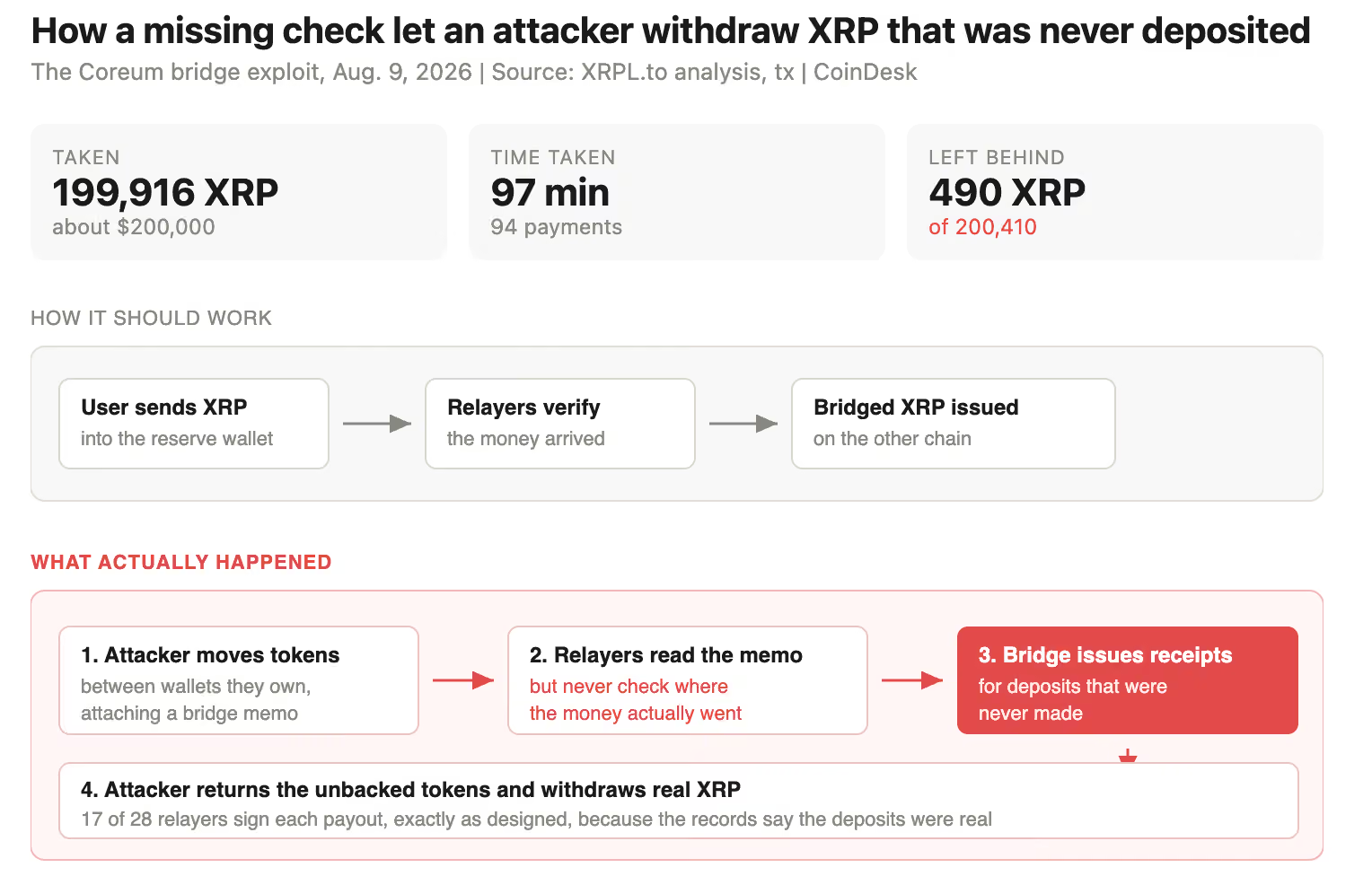
XRP bridge drained after software mistook fake deposits for real ones
-

 Tech5 days ago
DeepSeek Harness launches as open source rival to Claude Code, alongside V4-Pro on API with higher prices
-

 Sports6 days ago
DeQuan Jones in ‘high spirits’ after successful leg surgery
-
 Crypto World6 days ago
Perplexity AI Predicts an XRP Scenario Few Analysts Are Discussing
-

 Tech7 days ago
SpaceXAI’s Grok Bot turns agents into persistent digital coworkers that can operate your apps for $120-per-month
-

 Crypto World1 day ago
OCC Greenlights Trump Family Crypto Firm for Trust Charter
-

 Politics7 days ago
How Average Are You In The UK?
-
 Entertainment6 days ago
2026’s Most Ambitious Fantasy Movie Officially Scores Sequel Update
-
 Entertainment6 days ago
All 10 Hayao Miyazaki Fantasy Movies, Ranked
-
 Tech7 days ago
A Zoom Screen-Sharing Bug Let Anyone Take Over Other Devices On a Call
-
 Entertainment6 days ago
Travis Kelce Breaks Silence On ‘Crazy’ Taylor Swift Wedding
-

 Fashion7 days ago
A Fresh Take on Utility
-

 Fashion7 days ago
Why Botanical Fashion Never Goes Out of Style
You must be logged in to post a comment Login