Beijing-based artificial intelligence startup Moonshot AI released Kimi K3 this week, unveiling what the company describes as the largest open-source AI model ever made publicly available, with benchmark performance the company says rivals some of the most advanced systems built by American labs including Anthropic and OpenAI.
The model, released Thursday, contains 2.8 trillion total parameters, making it roughly 75% larger than DeepSeek’s V4 Pro, previously one of the largest Chinese open-weight models at approximately 1.6 trillion parameters, and far outpacing Zhipu AI’s GLM 5 series at 744 billion parameters. Kimi K3 is also roughly 2.8 times the size of Moonshot’s previous flagship model, K2.6, released in April. Full model weights are scheduled to be released publicly on July 27, timed to coincide with the 2026 World Artificial Intelligence Conference currently underway in Shanghai.
According to Moonshot, K3 performed “competitively” against Anthropic’s Fable 5, currently among the most capable publicly available AI models, and “substantially outperformed” Anthropic’s Opus 4.8 as well as OpenAI’s GPT 5.6 Sol and GPT 5.5 on the company’s officially released benchmarks, where K3 consistently ranked among the top three models tested. One independent benchmark from Arena.AI reportedly ranked K3 as the best-performing model currently available, ahead of offerings from both Anthropic and OpenAI, though Moonshot’s own reporting placed K3 slightly behind Fable 5 on overall performance.
In a press release announcing the model, Moonshot described K3 as its most powerful open-source coding model to date. “K3 stands as Moonshot AI’s most powerful open-source coding model to date,” the company wrote, adding that the model can “sustain long engineering sessions, navigate massive repositories, and orchestrate terminal tools” while “operating with minimal human oversight.”
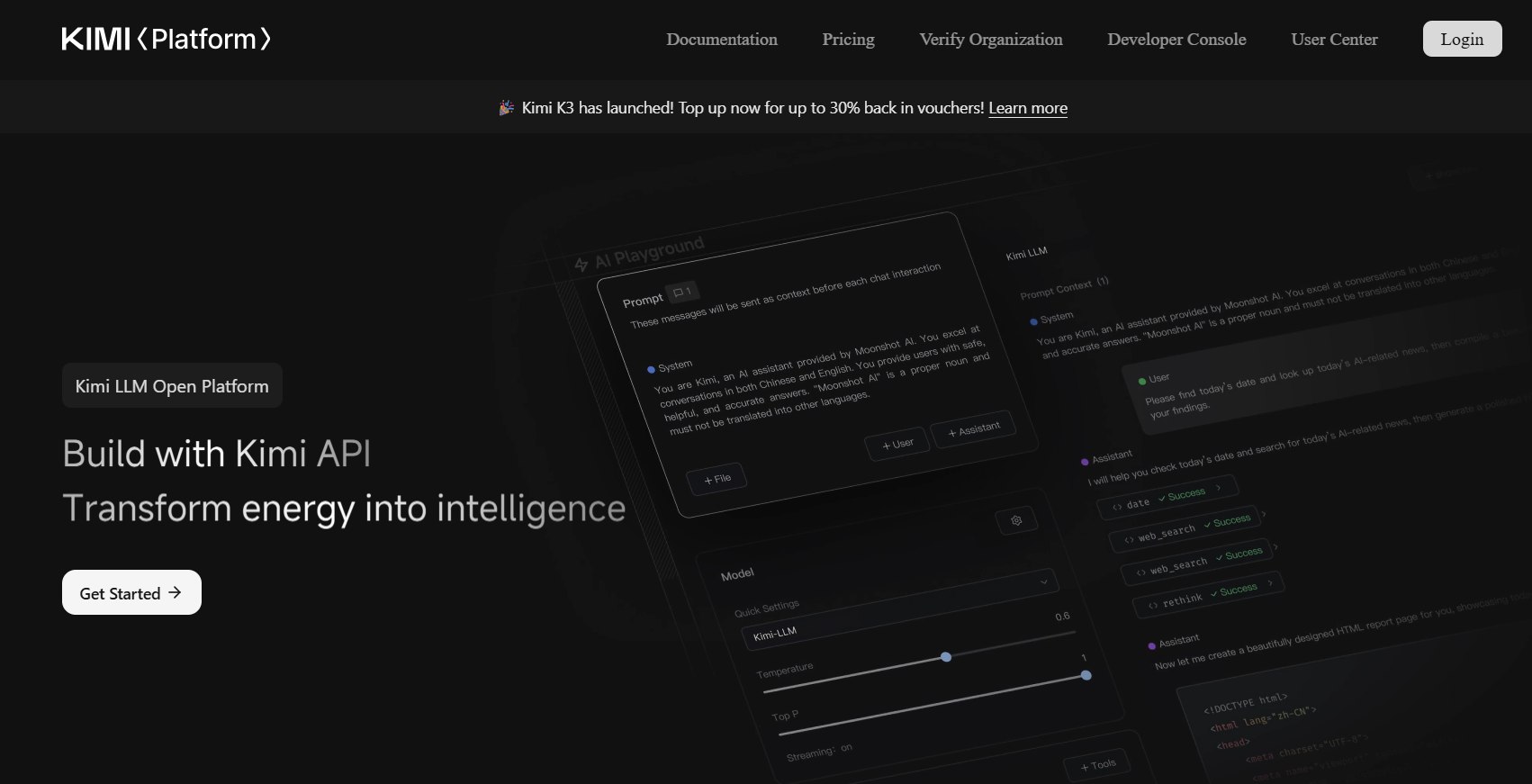
The model introduces two architectural innovations developed internally at Moonshot: Kimi Delta Attention, a hybrid linear attention mechanism designed to reduce memory usage and improve processing speed, and Attention Residuals, which the company describes as a drop-in replacement for traditional residual connections that delivers more consistent performance gains as models scale in size. Both techniques had previously been published as open research by Moonshot’s team on GitHub. K3 also supports a 1-million-token context window, positioning it for long-horizon coding tasks and autonomous agent workloads, along with native visual understanding capabilities and an always-on reasoning mode the company calls “thinking mode.” Moonshot said the model uses 21% fewer output tokens than its predecessor on equivalent tasks, and the model’s API is compatible with the OpenAI SDK, lowering the technical barrier for developers already building on OpenAI or Anthropic’s existing toolchains.
Pricing for K3’s API access is set at $3 per million input tokens and $15 per million output tokens, the highest pricing structure of any major Chinese AI lab, though still roughly half the per-task cost of Anthropic’s Opus 4.8 and dramatically cheaper than Fable 5, which reportedly costs $50 for an equivalent volume of output tokens. Independent testers have noted that K3’s reasoning mode consumes a substantial number of tokens even on relatively simple tasks, with one test generating 13,241 reasoning tokens for a basic SVG image-generation request, costing roughly 25 cents per query.
Moonshot’s Kimi chatbot has become one of the most widely used consumer AI products in China, and the company’s annualized recurring revenue exceeded $200 million as of April, driven by a combination of paid subscriptions and API usage. The company’s investor base includes several major names in Chinese technology, including Alibaba, Tencent, Meituan, HongShan (formerly known as Sequoia China), ZhenFund and 5Y Capital, with total funding raised across four rounds standing at approximately $3.77 billion. Bloomberg reported in June that Moonshot was seeking a new funding round valuing the company at roughly $30 billion, an almost eightfold increase from its $4 billion valuation in late 2024.
Beyond its use inside China, Moonshot’s models have already gained traction among Silicon Valley developers. Cursor, the AI-assisted coding startup, has used earlier versions of Kimi to help power its Composer 2 coding agent. DoorDash chief technology officer Andy Fang said in an early July social media post that the company delegates “lower-level work to Kimi K2.6.” Thinking Machines also used Kimi K2.5 to help generate early post-training data for its Inkling model, released July 15.
The release of K3 coincided with, and appeared to intensify, a broader selloff already underway in global chip and technology stocks. Taiwan Semiconductor Manufacturing Company shares fell 7% Friday despite the company reporting a 77% jump in quarterly operating profit, while SoftBank, often viewed by investors as a proxy for OpenAI given its investment stake, fell 9%. Z.ai, a Chinese AI startup that has released a competing model to Kimi, plunged nearly 30% in Hong Kong trading. In the U.S., the Nasdaq 100 fell roughly 1% as of 2 p.m. Eastern time Friday, Nvidia shares dropped 1.2%, briefly ceding its position as the world’s most valuable company to Apple, and Meta shares fell more than 2.4%.
Technology analyst Patrick Moorhead pushed back on characterizing the market reaction as strictly performance-driven, attributing much of the response instead to broader political tensions surrounding Chinese AI development. In an email to CNBC, Moorhead said, “There’s a big debate in Washington DC about whether the U.S. should use Chinese open source models and if U.S. companies should enable the Chinese to use their models,” adding, “The latter is ironic as the Chinese seem to be doing fine with their models.”
K3’s release marks a notable comeback for Moonshot, whose market position had eroded significantly over the prior 18 months following the meteoric rise of rival Chinese lab DeepSeek, whose earlier open-source model releases similarly rattled global markets and intensified competitive pressure across the AI industry. With full model weights set to be published July 27 and Moonshot pursuing a substantially higher valuation in ongoing funding talks, the release is expected to keep pressure on both Chinese and American AI labs as the global race to develop increasingly capable, cost-efficient open-weight models continues to accelerate.




















































You must be logged in to post a comment Login