Professional sports teams and leagues have gotten in bed with sports gambling websites, and now, perhaps the most famous sports team in the entire world has gone another step.
The New York Yankees and Polymarket announced Thursday a deal in which the site has become the team’s official prediction market partner for the rest of the season.
Advertisement
“We are excited to begin a relationship with Polymarket — Major League Baseball’s prediction market partner,” Yankees SVP of partnerships Michael Tusiani said in a release. “Through signage and fan experience opportunities, we look forward to elevating Polymarket’s brand awareness both at Yankee Stadium and across our fan base.”
The New York Yankees celebrate after the ninth inning against the St. Louis Cardinals at Yankee Stadium on Aug. 4, 2026, in the Bronx borough of New York City. (Sarah Stier/Getty Images / Getty Images)
“We are proud to become an Official Prediction Market Partner of the New York Yankees. Yankees fans are among the most active on our platform and passionate in sports, and Yankee Stadium is a natural home for Polymarket, where the questions driving our markets come to life throughout the season,” Polymarket’s president of sports business development Ari Borod said.
Polymarket will have a presence both at Yankee Stadium and on Yankees broadcasts on the YES Network and Amazon Prime Video. As part of the sponsorship package, Polymarket purchased tickets to premium hospitality areas and suites.
Advertisement
An exterior view of Yankee Stadium before the game against the Minnesota Twins at Yankee Stadium on August 13, 2025 in New York, New York. (New York Yankees/Getty Images / Getty Images)
Exclusive fan experiences, including an outfield catch for children, Kids Run the Bases, and lineup card delivery experiences.
The Yankees are just the second team in North America’s four major sports leagues to have a deal with Polymarket, joining the NHL’s New York Rangers. Polymarket is also Major League Baseball’s exclusive Prediction Market Exchange partner and is also the National Hockey League’s official prediction market partner.
An overall view of Yankee Stadium during the game against the Los Angeles Angels at Yankee Stadium on June 19, 2025 in New York, New York. (New York Yankees/Getty Images / Getty Images)
For what it’s worth, Polymarket gives the Yankees a 97% chance of missing the postseason. The team has struggled offensively without Aaron Judge (Giancarlo Stanton and Cody Bellinger have also hit the shelf), but the pitching has been dynamic, and trade deadline reinforcements figure to help out down the stretch as the team seeks its first World Series since 2009.
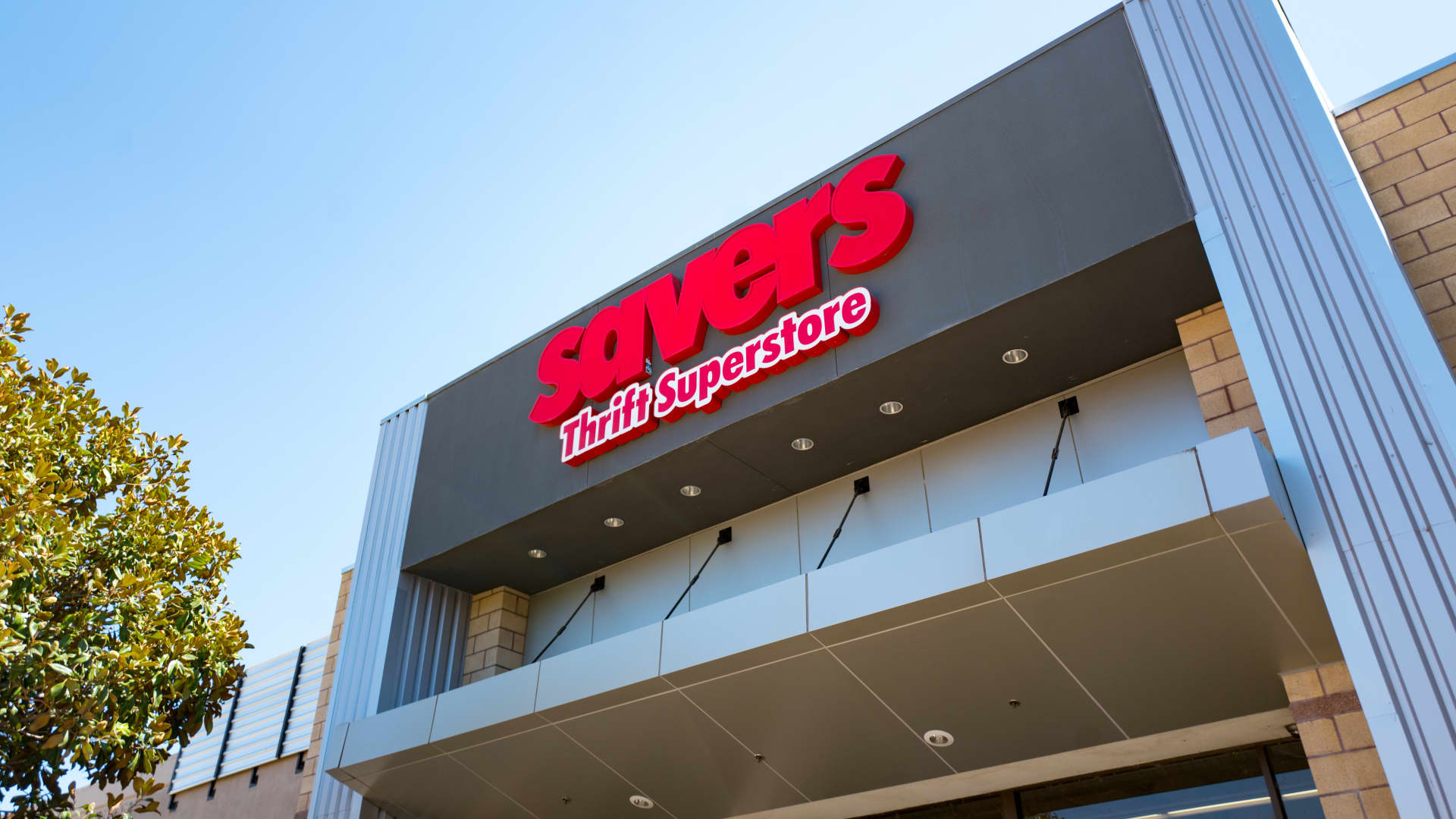
Savers Value Village is launching a new platform leveraging artificial intelligence to help optimize product pricing, the company told CNBC exclusively, as the tricky-to-price thrift segment gains traction around the world.
The new platform, called ThriftIQ, uses AI to reduce the work needed to price items across the men’s and women’s apparel assortment and bring more consistency.
“We’re getting clear sell-throughs, larger baskets, it’s helping our new stores ramp more favorably, and obviously there is the profitability improvements,” CEO Mark Walsh told CNBC.
The tool has already been deployed in 58 pilot stores, according to the company, pricing more than 25 million items. That number is expected to double by the end of the year, Walsh added.
Advertisement
Savers, which had 375 stores at the end of the second quarter, said it processes more than 1 billion pounds of reusable goods every year. ThriftIQ was developed in partnership with data science and technology consulting firm Kaizen Analytix using Savers’ proprietary data sets, which the company has been developing for nearly two years.
“It’s not dynamic pricing, and once those garments are priced and tagged, that tag doesn’t change,” Walsh said.
The company’s goal with the new AI tool is to bring more predictable pricing for customers while also keeping average prices the same or lower, remaining between roughly 40% and 70% below traditional retail prices.
Savers said ThriftIQ marks the latest step in the company’s broader strategy to modernize and enhance its business operations. It will deploy the platform across more of its U.S. and Canadian locations through early 2028.
Advertisement
Walsh said the tool is not meant to get rid of manual labor in stores, but rather make workers more productive.
“Savers is transforming thrift through innovation, and I couldn’t be more excited about the trajectory of the business,” he said.
The tool comes at a time when secondhand retail and thrift are seeing a surge, especially with the macroeconomic backdrop of higher inflation, lower consumer confidence and more price-conscious buyers.
“We are benefiting from some very powerful secular momentum in this space. Thrift has gone, and is continuing to go, mainstream in retail, and so we see that in the younger customers, in the more affluent customers, for example, that are adopting thrift,” Chief Financial Officer Michael Maher told CNBC. “But I think in addition to that, we are bringing investment, technology, innovation and execution to that.”
Advertisement
Savers also reported its second-quarter earnings on Thursday, seeing a 7.4% increase in total net sales, which came in at $448.2 million. Comparable store sales increased 4.4%.
Savers reported net income of $21.6 million, or 14 cents per share, for the quarter, versus $18.9 million, or 12 cents per share, in the prior-year period.
Maher also said the company saw its third consecutive quarter of year-over-year growth in earnings before interest, taxes, depreciation and amortization.
The company incorporated the impact of ThriftIQ into its updated 2026 guidance, saying that it expects to return to a “high-teens adjusted EBITDA margin within the next three years.”
Advertisement
“This is just the latest chapter of transformative innovation,” Maher told CNBC. “It is a core plank of our long-term strategic plan, and yes, we’re constantly looking at innovation.”
Versant Media Group raised its full-year guidance on Thursday, boosted by momentum in its digital brands like Fandango and GolfNow, as well as what executives referred to as “strength” in its overall business model.
The company now expects total revenue for 2026 of $6.2 billion to $6.45 billion and adjusted earnings before interest, taxes, depreciation and amortization of $1.9 billion to $2.05 billion.
This marks Versant’s third earnings report since it was spun out from Comcast’s NBCUniversal at the start of the year. The company, which includes a portfolio of pay TV networks including CNBC, MS NOW and The Golf Channel began trading as a public company in January.
Versant’s earnings once again showcased that live sports and news grab the most viewers and advertising dollars for traditional TV, despite ongoing pressure on the bundle as it loses customers to streaming alternatives.
Advertisement
The company beat Wall Street expectations on the top and bottom lines. Versant shares were up more than 6% at the close of trading on Thursday.
Here’s how Versant performed for its second quarter, ended June 30, compared with Wall Street’s estimates, according to LSEG:
Earnings per share: $1.49 vs. $1.35 expected
Revenue: $1.64 billion vs. $1.62 billion expected
Revenue for linear TV, which also includes channels USA Network, Syfy, Oxygen and E!, was down 6.3% during the quarter to $954 million, due to subscriber declines.
CEO Mark Lazarus said in a release on Thursday the company completed carriage agreements “with two large distribution partners, one in the U.S. and one in Canada.” Many of Versant’s distribution deals were locked up when it was still under NBCUniversal’s ownership.
Versant executives have said they aim to diversify the company’s revenue base — with an eye toward achieving a revenue mix of 50% from its digital, platform, subscription, ad supported and transactional businesses. The aim is to be less reliant on the linear TV model. Currently more than 80% of Versant’s revenue stems from the pay TV business.
Advertisement
Versant leadership has also said it would explore acquisitions of nontraditional media businesses to broaden its revenue streams and add growth.
This week the company closed its acquisition of golf simulation company Full Swing. Versant already owns digital media platform GolfPass and tee-time reservation company GolfNow. Earlier this year Versant bought StockStory, an artificial intelligence-powered tech platform that provides financial analysis, market insights and stock recommendations for CNBC.
Advertising revenue for the quarter was down 0.6% to $423 million, an improvement compared with the rate of decline during the same period last year due to higher ratings for its networks, which are heavily centered on news and sports.
Revenue for the platforms segment — which includes Fandango and GolfNow — was up 0.8% to $225 million for the quarter. Excluding the company’s divestiture of SportsEngine, platforms revenue was up 9.3%.
Advertisement
The company attributed that increase in part to higher revenue at Fandango from movie ticket purchases and video-on-demand transactions as well as stronger bookings, payments and subscription revenue for GolfNow.
Versant has launched a free, ad-supported Fandango streaming service in a bid to increase its advertising and users for the platform. Versant’s USA Sports also recently announced a media rights deal with German soccer league Bundesliga, which brings live matches to USA Network and Fandango beginning in August.
Overall, Versant revenue declined 3.8% year over year to $1.64 billion.
Net income attributable to Versant declined 30% to $211 million, or $1.49 per share, from $302 million, or $2.09 per share a year earlier. The company attributed that drop to lower revenue, public company costs, interest expense related to the Comcast separation, and an increased tax expense largely due to the divestiture of SportsEngine.
Advertisement
Adjusted EBITDA decreased 8.9% to $624 million. However, when compared with stand-alone adjusted EBITDA, a metric to more directly compare performance of the pre-spin portfolio companies to current results, adjusted EBITDA was up 3% year over year. Versant said the increase reflected lower programming expenses and reduced costs that offset revenue declines.
The company also declared a quarterly cash dividend for the third quarter in a row, again at 37.5 cents a share. The latest dividend is payable on Oct. 22 to shareholders of record as of the close of business on Oct. 1.
Versant said it completed a previously announced $100 million accelerated share repurchase agreement. The company repurchased nearly 2.4 million shares of Class A common stock with a remaining authorization of roughly $800 million as of June 30.
The company said it plans to enter into a similar stock repurchase agreement on Aug. 7 to repurchase $100 million of Class A stock, which it anticipates will close during the third quarter.
Advertisement
Disclosure: Versant Media Group is the parent company of CNBC.
The Dow and S&P 500 indexes closed lower on Thursday, pausing after a strong start to the week, as investors digested the latest round of corporate earnings and looked for signs of progress toward a peace deal between the U.S. and Iran.
A robust earnings season, which has tempered some concerns about the massive spending by AI-related companies, and growing optimism over the potential end of hostilities in the Iran war helped propel both the Dow Industrials and S&P 500 to record highs earlier this week. Oil prices rose, with U.S. crude settling up 2.75% at $77.29 a barrel and Brent settling at $82.49 per barrel, up 3.83%. Iran’s semi-official Fars news agency reported that an Iranian parliamentary committee is reviewing a preliminary bill that would bar U.S., Israeli and other “hostile” vessels from transiting the Strait of Hormuz.
“You’re seeing perhaps more muted response to macro news than you would otherwise see, probably due to the fact of the summer and a little bit of fatigue, there’s a little bit of headline fatigue, specifically around Iran,” said Robert Bernstone, head of trading at SummitTX Capital in New York.
“Iran is having less of an impact right now, to be clear, I’m not saying it has no impact … tweets are something, headlines are something, but we really want to see the devil is in the details.”
Advertisement
According to preliminary data, the S&P 500 lost 13.56 points, or 0.18%, to end at 7,709.99 points, while the Nasdaq Composite lost 10.99 points, or 0.04%, to 26,352.45. The Dow Jones Industrial Average fell 453.64 points, or 0.83%, to 53,895.48.
Live Events
The recent indications of movement toward a peace deal helped push crude prices lower earlier in the week and, in turn, eased inflation worries and expectations for a rate hike from the Federal Reserve, which also served to push U.S. Treasury yields lower. WESTERN DIGITAL, SANDISK DROP Data storage company Western Digital tumbled and memory chip maker Sandisk dropped in the wake of quarterly results. Both companies have surged this year, however, with Sandisk up more than 400% and Western Digital up about 160%. AppLovin plunged after the marketing platform missed Wall Street estimates for quarterly revenue, while Datadog plummeted after the cloud security firm said it expects revenue growth to slow in the third quarter. Both stocks were among the biggest drags on the benchmark S&P index.
Of the 382 companies in the S&P 500 that have reported earnings through Wednesday morning, 84.8% have topped analyst expectations, according to LSEG data, well above the 68% average beat rate since 1994.
SPACEX LOCKUP PERIOD ENDS
SpaceX shares erased losses from earlier in the session and closed higher, defying expectations that they would be pressured by insider selling, as the lockup period for early investors holding the stock expired. On the data front, the number of Americans filing claims for unemployment benefits increased slightly last week. The report came ahead of closely watched nonfarm payrolls figures for July due on Friday, which will shape expectations for the Fed’s path of interest rates at a time when Chairman Kevin Warsh has scaled back on forward guidance from the central bank.
FOX Business host Larry Kudlow exposes the real economic consequences of socialist policies on ‘Kudlow.’
It’s so interesting to me how these socialists who are taking over the Democratic party, are hiding behind the veil of affordability. They don’t want to tell you that their agenda is all about unaffordability, or in short wrecking the whole economy.
Think of this, they will tax all manner of wealth and income. Indeed, take candidate Abdul El-Sayed and Mayor Zohran Mamdani, who basically want to liquidate any of your gains from successful wealth and work. And they say it all the time. In fact, Mr. Mamdani just yesterday talked about how in New York City apartments, it’s the people who live there who own it, not the owners who own it — that by the way is communism.
Advertisement
And then there’s the Medicare for All idea which is nothing but a euphemism, not simply for the takeover of the healthcare system, but basically for an economy-wide takeover. They want the government to run the economy. Period. Full stop.
Of course they want to defund the police and ICE, and they want open borders, and rampant illegal immigration, and then the even nuttier stuff of abolishing the senate, changing presidential elections. The insanity grows the more you listen.
Hoover Institution senior fellow Victor Davis Hanson discusses the growing influence of the Democratic Party’s socialist wing and rising concerns over antisemitism ahead of the midterm elections on ‘Kudlow.’
Back to affordability, though. The socialists had a leg up on their program during the Biden years. Don’t forget the Green New Deal, and the phony Inflation Reduction Act, and Covid spending long after Covid was gone. Their giant spending bills and their attempted regulation of the economy, led to a 9 percent inflation peek, the highest in four years. And overall, the consumer price index cumulatively rose by 21.4 percent. Okay.
Advertisement
So Messrs. El-Sayed and Mamdani and Senators Bernie Sanders and Elizabeth Warren and Congresswoman Alexandria Ocasio-Cortez, they had their chance. They got about half the socialism during the Biden years that they would ever do if they won a national election, and look what they did. Is that affordability? Remember, 21 percent inflation. Real wages fell during their period, actually fell. That’s not affordability. So there’s a lesson to be learned here.
Their affordability mantra is a coverup for a state-run economy and soaring inflation, which is by the way according to polls, working folks including average minority working folks are not voting for them. They went for Trump in 2024.
Michigan GOP gubernatorial candidate John James lays out how he hopes to combat far-left policies in his state on ‘Kudlow.’
So that’s a lesson for the GOP. Hone in on the differences between free enterprise capitalism, which rewards success, and puts more money in your pocket, letting you keep more of what you earn, and that is real affordability.
Advertisement
By contrast, this new Democratic Party socialism will take money out of your pocket, will lead to rapid inflation from the government’s takeover of the economy, will rob you of your success, and devalue the human dignity of work, enterprise, and initiative.
Think of it this way, socialism is a discouragement to the individual, the economy, and the nation. And antisemitism is perhaps the driving force behind the entire socialist movement. Free market capitalism is an encouragement to the individual, the economy, and the nation. Those are the differences in affordability. Democratic party socialism is unaffordable. And free market capitalism is surely worth fighting for.
Smith Douglas Homes Corp. (SDHC) Q2 2026 Earnings Call August 6, 2026 8:30 AM EDT
Company Participants
Joe Thomas – SVP of Accounting & Finance Greg Bennett – President, CEO & Vice Chairman Russ Devendorf – Executive VP & CFO
Advertisement
Conference Call Participants
Michael Dahl – RBC Capital Markets, Research Division Natalie Kulasekere – Zelman & Associates LLC Richard Reid – Wells Fargo Securities, LLC, Research Division Victoria Piskarev – BofA Securities, Research Division Paul Przybylski – Wolfe Research, LLC Ryan Gilbert – BTIG, LLC, Research Division Jay McCanless – Citizens JMP Securities, LLC, Research Division
Presentation
Advertisement
Operator
Hello, everyone. Thank you for joining us and welcome to the Smith Douglas Homes second quarter 2026 earnings conference call. [Operator Instructions]
I will now hand the conference over to Joseph Thomas, Senior Vice President, Accounting and Finance. Joseph, please go ahead.
Advertisement
Joe Thomas SVP of Accounting & Finance
Good morning and welcome to the earnings conference call for Smith Douglas Homes. We issued a press release this morning outlining our results for the second quarter of 2026, which we will discuss on today’s call and which can be found on our website at investors.smithdouglas.com or by selecting the investor relations link at the bottom of our homepage. Please note this call will be simultaneously webcast on the investor relations section of our website.
Before the call begins, I would like to remind everyone that certain statements made on this call, which are not historical facts, including statements concerning future financial and operating goals and performance, are forward-looking statements. Actual results could differ materially from such statements due to known and unknown risks, uncertainties and other important factors as detailed in the company’s SEC filings. Except as required by law, the company undertakes no duty to update these forward-looking statements.
Additionally, reconciliations of non-GAAP financial measures discussed on this
Seeking Alpha’s transcripts team is responsible for the development of all of our transcript-related projects. We currently publish thousands of quarterly earnings calls per quarter on our site and are continuing to grow and expand our coverage. The purpose of this profile is to allow us to share with our readers new transcript-related developments. Thanks, SA Transcripts Team
Osac Chief Market Strategist Phil Blancato advises investors to strip emotions from their investment decisions.
Job cuts slowed in July as companies stepped up their hiring plans, while artificial intelligence (AI) continues to be cited as a leading reason for workforce reductions, new data shows.
Companies announced 33,429 job cuts in July – a decrease of 27% from the 45,849 announced in June, and a level that’s down 46% from the 62,075 cuts planned in the same month last year, according to data from Challenger, Gray & Christmas.
Advertisement
The total of 33,429 layoffs announced last month is the lowest monthly total in two years since July 2024, when there were 25,885 cuts announced, the firm noted. It’s also the fifth time this year the monthly job cut figures were lower than the corresponding month a year ago.
Companies announced 33,429 job cuts in July. (Andrew Kelly/Reuters)
So far in 2026, employers have announced 477,033 job cuts through July, which comes as a 41% decline from the 806,383 cuts announced in the first seven months of 2025.
“The pace of layoffs fell dramatically this summer. Layoff plans continue to be announced primarily in tech, and artificial intelligence is still the story, as investments in the technology reshape organizations,” said Andy Challenger, workplace expert and chief revenue officer for Challenger, Gray & Christmas.
Advertisement
“Hiring has also increased over last year by 25%, so while AI is shifting the labor market, it is not dismantling it,” Challenger added.
The tech sector announced 9,867 job cuts in July to bring the industry’s total for this year to 149,023 – a figure that’s a 67% increase from the same period last year.
So far in 2026, employers have announced 477,033 job cuts through July. (iStock)
Layoffs in the tech sector account for 31% of all job cuts announced this year, and Challenger noted that tech “remains the center of gravity for this year’s cuts, and AI is still the reason companies give.”
Financial firms accounted for 3,157 cuts in July, ranking second among industries, which brought the sector’s total for the year to 18,626 – down 31% from a year ago.
Government agencies announced 2,962 cuts in July, bringing the total for the year to 20,752. That figure is 93% lower than last year, when the 292,294 cuts through July were largely driven by federal workforce reductions.
Across industries, AI was the dominant reason cited by employers for workforce reductions, as it was attributed to 10,970 cuts announced in July, or 33% of the total.
July was the fifth consecutive month in which AI was the top reason cited for layoffs, and so far this year it has been cited in 112,713 job cut announcements, accounting for about 24% of all cuts. Since the firm first started tracking AI as a distinct reason for workforce reductions, Challenger, Gray & Christmas has tracked AI as being the reason cited in 184,538 job cuts.
Advertisement
Across industries, AI was the dominant reason cited by employers for workforce reductions. (iStock)
Challenger’s report noted that there remains ambiguity about what constitutes an AI-related cut, with some employers explicitly citing that as a reason, whereas others may point to new technology deployments and allude to AI indirectly without being linked to the cuts, which is why the firm tracks those announcements with a separate category.
“Naming AI in a layoff announcement can win over investors while pushing current and prospective employees away. That’s why the messaging has swung from hedging to aggressively citing it,” Challenger said.
“As regulations start to take shape, companies will be even more careful in their announcements, which would make tracking the impact of AI on jobs more opaque,” he added.
A total solar eclipse will sweep across the Northern Hemisphere on Wednesday, Aug. 12, marking the first total eclipse visible from mainland Europe since 1999 and offering millions of people across multiple continents a chance to witness the moon completely block the sun.
The path of totality, the narrow band of Earth’s surface where the moon fully covers the sun, stretches roughly 182 miles wide and traces an unusual route that arcs up and over the North Pole before sweeping down across the North Atlantic. Only skywatchers positioned within that narrow path will experience true totality, when day briefly turns to twilight and the sun’s outer atmosphere, or corona, becomes visible to the naked eye. A much broader surrounding region will instead see a partial eclipse, in which the moon takes a visible “bite” out of the sun without fully covering it.
Russia
The eclipse begins over the remote Taymyr Peninsula in Siberian Russia, an uninhabited stretch of Arctic tundra. Because the event occurs above the Arctic Circle during summer, when the sun never fully sets, totality technically begins at the unusual local time of 11:59 p.m. The path quickly exits Russian territory after this initial landfall, looping over the North Pole before continuing toward Greenland.
Advertisement
Greenland
After crossing the Arctic Ocean, the path of totality drops onto the remote, frozen terrain of eastern Greenland. This portion of the eclipse’s path passes through dramatic, largely uninhabited Arctic landscapes, offering a strikingly different viewing experience compared with the more accessible locations later in the path. Skywatchers traveling to Greenland for the eclipse will see totality occurring relatively high in the sky, set against the island’s stark icecap scenery.
Iceland
Iceland represents one of the two most popular and accessible destinations along the entire path of totality, alongside Spain. The moon’s shadow first makes landfall in Iceland at the Straumnes Lighthouse in the Westfjords region at 17:43:28 UT, with totality lasting roughly 1 minute 26 seconds at that specific point. The shadow then races south across the country at speeds of roughly 2,110 miles per hour, crossing the Snæfellsnes Peninsula before passing directly over the capital, Reykjavik, and continuing across the Reykjanes Peninsula. The shadow’s final exit point from mainland Iceland comes at the Reykjanestá Lighthouse at 17:50:07 UT, meaning the total duration of totality across the country spans roughly six minutes and 48 seconds from first landfall to final departure. Notably, this will be the first total eclipse visible from Iceland since June 30, 1954, and the first visible specifically from Reykjavik since 1433, underscoring the rarity of the event for residents there. The point of maximum eclipse duration overall, 2 minutes 18 seconds, occurs over open ocean roughly 44.7 kilometers west of Iceland’s Látrabjarg peninsula, meaning locations on land near that area will experience close to the longest totality available anywhere along the path.
Advertisement
Portugal
After crossing the Atlantic Ocean, the eclipse’s path clips a small section of northeastern Portugal before continuing into neighboring Spain. While this represents only a tiny sliver of Portuguese territory, it nonetheless gives the country a brief claim to totality alongside its larger neighbor.
Spain
Spain stands as the other major hub for eclipse tourism this year, given its accessibility and status as the first place on mainland Europe to experience a total solar eclipse since 1999. The path of totality crosses the Iberian Peninsula from west to east, passing through numerous provincial capitals and cities including A Coruña, Oviedo, León, Bilbao, Zaragoza and Valencia, before extending out over the Balearic Islands, including Palma. Because Spain sits near the end of the eclipse’s overall path, the event will occur late in the day, close to sunset, creating what eclipse chasers describe as a dramatic, low-angle viewing experience. In A Coruña, one of the first Spanish locations to see the eclipse, totality is expected to begin at 19:31 local time, reach its maximum at 20:28, and conclude at 21:22, just minutes before the day’s sunset at 21:41. Roughly the entire northern half of the Iberian Peninsula will experience totality, while the southern half will see only a partial eclipse. Spain’s total solar eclipse marks the first such event visible from the Iberian Peninsula in more than a century.
Advertisement
Countries Seeing a Partial Eclipse
Beyond the narrow path of totality, a much larger swath of the Northern Hemisphere will witness a partial solar eclipse, in which the moon obscures only part of the sun’s disk. This broader viewing region includes much of Europe, including the United Kingdom, Ireland, France, Germany, Italy and the Scandinavian countries. In the United Kingdom and Ireland specifically, the eclipse will appear as a thin, inverted crescent of sunlight low over the western horizon, even though neither country falls within the path of totality itself. Skywatchers across these regions are advised to look toward the west or west-northwest to catch the partial phase as it unfolds.
Safety Reminders for All Viewers
Regardless of location, anyone observing any phase of the eclipse outside of totality itself must use certified solar eclipse glasses or a properly fitted solar filter on telescopes, binoculars or cameras. It is never safe to look directly at the sun without this protection during the partial phases of the eclipse. Only viewers positioned within the narrow path of totality may safely remove their eclipse glasses, and only during the brief window when the moon fully and completely covers the sun.
Advertisement
With the eclipse now just days away, astronomy outlets and eclipse-chasing communities are finalizing travel plans and live-coverage arrangements, with Iceland and Spain expected to draw the largest concentrations of visiting eclipse tourists given their combination of accessibility and dramatic scenery. For those unable to travel to the path of totality, live-streamed coverage of the event is expected to be made widely available online as Wednesday’s eclipse approaches, offering a chance to witness the celestial event even from far outside its narrow physical path.
























![F.HERO x URBOYTJ Ft. MINNIE ((G)I-DLE) - MONEY HONEY (Prod. By URBOYTJ) [Official MV]](https://wordupnews.com/wp-content/uploads/2026/02/1770112248_maxresdefault-80x80.jpg)





































You must be logged in to post a comment Login