
Crypto
Bitcoin ETFs add $5.3B after Treasury buyback plan


U.S. spot Bitcoin ETFs have attracted about $5.3 billion since the Treasury announced larger long-dated bond buybacks, according to ETF analyst Nate Geraci.
Summary
- $5.3 billion entered spot Bitcoin ETFs after Treasury announced larger long-dated bond buybacks in August.
- $2.4 billion flowed into U.S. Bitcoin ETFs during the week ending September 25 alone overall.
- $999 million entered the funds Monday, ranking as their ninth-largest daily inflow since launch historically.
- Bitcoin ETF flows turned positive for 2026 after reaching a $5.8 billion deficit during July.
- BlackRock’s IBIT led last week with approximately $1.2 billion in net inflows, market data shows.
Geraci said on Sept. 26 that the funds collected $2.4 billion during the latest week alone, while Monday’s roughly $1 billion intake ranked as the ninth-largest single-day inflow since U.S. spot Bitcoin ETFs launched in January 2024.
The rebound has pushed 2026 flows back into positive territory after the group sat nearly $5.8 billion in the red during July. Market data puts year-to-date net inflows near $934 million after the latest five-session run.
Bitcoin ETF inflows reach $5.3 billion since Treasury announcement
The U.S. Treasury announced on Aug. 19 that it would increase the maximum size of liquidity-support buybacks involving longer-dated nominal Treasury securities.
Operations covering the 10-to-20-year and 20-to-30-year sectors were raised from a maximum $2 billion to at least $4 billion each. The larger operations took effect Sept. 9 and are scheduled to remain in place through Nov. 4.
Geraci linked the timing of the ETF recovery to that policy announcement. His calculation puts cumulative spot Bitcoin ETF inflows since then at approximately $5.3 billion.
The figure describes two developments that occurred over the same period. It does not by itself establish that Treasury buybacks caused investors to allocate money to Bitcoin funds.
Treasury said the larger operations were intended to provide more liquidity in long-dated government bond markets. It cited consistently strong offers from market participants in those sectors as the reason for increasing the transaction sizes.
Treasury buyback program, the Aug. 19 announcement coincided with falling long-term yields and stronger risk-asset prices. The report noted that the 30-year Treasury yield declined after reaching a 19-year high.
Geraci’s observation focuses on ETF flows since the announcement date, while Treasury’s larger transactions themselves did not begin until Sept. 9.
Bitcoin ETFs collect $2.39 billion in one week
The strongest part of the ETF recovery came during the Sept. 21–25 trading week. U.S. spot Bitcoin funds drew approximately $2.39 billion over five consecutive positive sessions, according to Farside Investors data compiled by crypto.news. Monday generated about $999 million, followed by $714.7 million Tuesday and $346.9 million Wednesday.
Thursday added $190.7 million before another $134.5 million arrived Friday. The five sessions produced the largest weekly total since October 2025.
As crypto.news reported on the weekly ETF flows, BlackRock’s iShares Bitcoin Trust led the period with approximately $1.16 billion. Fidelity’s FBTC attracted $701.6 million, while ARK 21Shares’ ARKB added $294.7 million.
Morgan Stanley’s MSBT received another $203.3 million during the week, its largest weekly intake since the fund launched in April.
Monday’s $999 million intake was the strongest daily total of 2026 and the ninth-largest single-day inflow recorded by U.S. spot Bitcoin ETFs since their launch, according to SoSoValue figures cited by The Block. The pace slowed during each subsequent session, but the funds remained positive through Friday.
2026 ETF flows recover from a $5.8 billion deficit
The latest subscriptions reversed a much weaker first seven months of the year. U.S. Bitcoin ETFs were roughly $5.8 billion underwater on a year-to-date basis around July 13. The latest weekly inflows brought 2026 net flows to approximately $934 million above zero.
Separate Farside-based calculations put the year-to-date low near negative $5.69 billion. By Sept. 22, ETF flows had turned positive for the first time since May 26.
The funds have now collected approximately $57.6 billion in cumulative net inflows since their January 2024 launch, while total net assets stood near $108.4 billion at the end of Friday.
The turnaround did not occur in a straight line. During the Sept. 14–18 week, Bitcoin funds finished with only about $6.1 million in net inflows after losing a combined $746.3 million on Tuesday and Wednesday. Friday’s $433 million inflow erased most of that decline.
As crypto.news reported after the Federal Reserve meeting, flows changed direction on Sept. 17 with $159.5 million entering the funds. Another $433 million arrived the following session before demand accelerated the next Monday.
Bitcoin holds near $84,000 after ETF demand rises
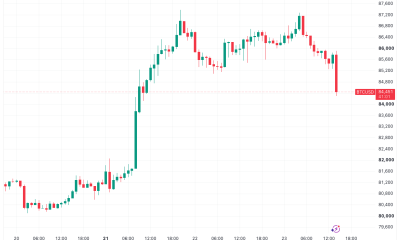
Bitcoin’s price rose sharply during the ETF inflow streak before giving back part of the advance. BTC moved above $87,000 early in the week, reaching roughly $87,363 before retreating toward $84,000 by Sept. 26. Crypto.news put Bitcoin near $84,008 on Binance early Friday. The cryptocurrency remained up around 3.8% over seven days, while the total crypto market value stood close to $2.98 trillion.
In related coverage, crypto.news reported that the rally began alongside stronger ETF demand, with $999 million entering Bitcoin funds Sept. 21 and $714.7 million following a day later. Futures traders added more than $2 billion in open positions over the same period. Bitcoin subsequently pulled back despite continued ETF subscriptions. Crypto.news reported on Sept. 25 that funds remained in a six-session inflow streak even as BTC consolidated near $84,000.
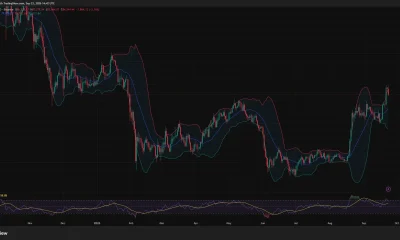
Sell orders were concentrated between roughly $85,000 and $85,800 on Sept. 26, while the four-hour Supertrend indicator stood near $86,435. Bitcoin remained above its daily 20-period midpoint after retreating from the weekly peak.
Treasury buyback schedule runs through November 4
The Treasury’s expanded long-end buyback program remains scheduled through the current quarterly refunding period.
Under the Aug. 19 announcement, each operation in the targeted long-duration sectors can reach at least $4 billion, double the prior $2 billion maximum. Treasury said it would provide information on future buyback sizes during its next Quarterly Refunding on Nov. 4.
The department described the transactions as liquidity-support operations for older Treasury securities, not monetary stimulus or purchases conducted by the Federal Reserve.
Geraci’s $5.3 billion ETF calculation uses the Treasury announcement as the starting date for measuring Bitcoin fund flows. Bloomberg ETF analyst Eric Balchunas separately pointed to the same period while discussing the ETF rebound, according to The Block.
Friday’s $134.5 million intake extended the Bitcoin ETF inflow streak to seven trading sessions. The run beginning Sept. 17 accumulated approximately $3 billion before markets closed for the weekend.

“There’s a convergence now that you’re seeing between traditional market participants and digital asset market participants as well,” Lynq CEO Jerald David said in an interview with CoinDesk TV.
For firms using Lynq, FTIXX gives them somewhere to put cash between trades rather than leaving it sitting around. They can earn yield on the money and pull it out when they need it again.
That was a product Lynq’s clients had been asking for, David said. The network works with firms including B2C2, Wintermute, Galaxy ·, FalconX, Crypto.com and Fireblocks, whose businesses can require moving large amounts of money between trades. They wanted another option for putting that cash to work in the meantime.
“We needed to demonstrate that there was client demand,” David said. “Our clients were looking for a treasury asset on the platform that may have had a different yield profile than the other instrument that’s on there right now.”
Getting FTIXX onto the network required some work. Lynq had to modify its technology, restrict access to U.S. clients and integrate with Mosaic, he said. Customers also need a relationship with tZERO Securities and must meet the required onboarding and eligibility checks.
Lynq itself runs on a private, permissioned Avalanche (AVAX) Layer 1 blockchain. Its network has more than 30 institutional digital-asset firms onboarded and more than $89 million in assets, according to the company.
Crypto
Crypto’s Widening Net: From Fed Bets to Blackjack Tables, Digital Assets Keep Blurring Old Boundaries

If there is one throughline in this week’s crop of crypto headlines, it is that the industry has stopped pretending it is only about buying and holding coins. Across a handful of stories making the rounds, digital assets are shown pushing into territory once reserved for central bankers, casino floors, brokerage accounts and pre-IPO investors alike — a reminder that “crypto news” increasingly means finance news, gambling news and macro news rolled into one.
Take the growing chatter around prediction markets and Federal Reserve policy. Traders have been flocking to on-chain betting platforms to price the odds of late-2026 rate decisions, effectively turning monetary policy into a tradable asset class alongside Bitcoin and Ethereum. That such markets exist at all is notable: a decade ago, speculating on FOMC outcomes required options contracts or futures desks.
Now it can happen peer-to-peer on a blockchain, with odds shifting in real time as economic data lands. The rise of these markets suggests crypto infrastructure is becoming a genuine alternative venue for hedging and speculating on the traditional economy, not just a parallel casino for digital tokens.
Speaking of casinos, the sector itself continues to evolve in ways that mirror shifts in consumer taste rather than technology alone. Reports on crypto gambling lobbies note that live-dealer blackjack tables are increasingly outnumbering roulette wheels—a seemingly small detail that says more about what crypto-native gamblers want.
Live blackjack offers a sense of skill and control that pure-chance games like roulette can’t match, and operators appear to be responding by stacking their lobbies accordingly. It’s a small but telling sign that crypto casinos are maturing into product-driven businesses competing on experience, not just novelty.
Meanwhile, the boundary between crypto trading and traditional equities markets keeps eroding. New developments around Aave’s lending protocol reportedly let users borrow stablecoins against tokenized versions of tech stocks issued through Coinbase and built on the Base network.
If that model gains traction, it would mark a significant step in bringing real-world assets fully into DeFi’s collateral system — letting someone hold a tokenized slice of a Nasdaq darling and borrow against it the same way they might borrow against ETH or Bitcoin today. It’s the kind of integration that regulators, banks and crypto-native builders have all been circling for years, and its practical rollout matters more than the concept alone.
On the trading-platform side, perpetual futures exchanges continue to expand what counts as a “market.” One report describes a platform offering more than 120 perpetual contracts spanning everything from Bitcoin to pre-IPO robotics companies, letting traders apply leverage to assets that, in many cases, aren’t even publicly listed yet.
This kind of expansion into speculative, illiquid corners of the private market — wrapped in crypto’s leverage-friendly perpetual format — raises real questions about price discovery and risk, even as it satisfies demand from traders hungry for exposure beyond the usual crypto majors.
Finally, there’s the steady drumbeat of token listings that keeps the broader ecosystem churning. A gambling-focused token tied to the Dexsport platform recently landed on the MEXC exchange, a move that typically brings a token more liquidity and visibility, if not necessarily more fundamental value. Listings like these remain a bread-and-butter event in crypto markets — routine, but still closely watched by holders hoping for a price bump and a wider trading audience.
Individually, none of these developments is likely to reshape the industry overnight. But together they sketch a familiar pattern in crypto’s ongoing evolution: infrastructure built for speculative tokens is steadily being repurposed for macro bets, tokenized equities, private-company exposure and gambling products alike.
The technology is proving flexible enough to wrap around almost anything with a price — which is exactly why regulators, investors and casual observers alike keep struggling to say where “crypto” ends and the rest of finance begins.
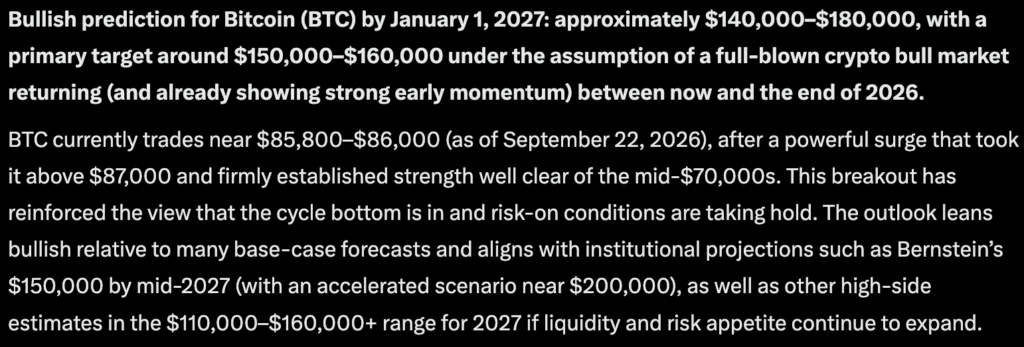
Perplexity AI predicts that if a full-blown bull market returns in Q4, Bitcoin could reach $180,000 before January 1, 2027. The bullish range is estimated at $140,000 to $180,000, with a potential late-cycle surge that could push Bitcoin beyond $200,000.
Currently priced around $83,000, this would represent a gain of about 115% to reach $180,000. What’s noteworthy is that Bitcoin has already corrected significantly from its previous cycle high of about $126,200 on October 6, 2025, followed by a sharp decline during 2026.
Bitcoin has a history of producing substantial gains during strong market cycles. According to historical annual data, BTC gained approximately 154% in 2023 and 110% in 2024. If the current predictions hold true, we may see a similar increase on the horizon.

Perplexity AI Predicts Bitcoin to $180,000 if Bullish Catalysts Align: Does the Technical Analysis Back it Up?
Bitcoin recently broke out of a pattern of lower highs that had developed since May, reclaiming several key moving averages. According to Reuters’ technical analysis, $81,781 is considered important support, while $86,500 is a significant resistance level. Above that, the next technical targets are around $90,000 and $97,867.
CryptoQuant has noted a similar trend, calling $81,700 a key level because it aligns with Bitcoin’s 365-day moving average. Resistance levels above this are near $86,600 and $88,700.
Bitcoin’s first major test is surpassing the $85,000 level, followed by the $86,000 to $88,000 range. Bitcoin has pushed through this area, which matters because a sustained breakout would remove one of the largest technical obstacles between its current price and the $100,000 level.
The next major milestone is approximately $98,000. Beyond that, the market will be approaching the all-time high of $126,200, where it gets particularly interesting.
Once Bitcoin decisively breaks beyond $126,000, it will enter a phase of genuine price discovery. Historical resistance above that level is very limited. At that point, psychological targets such as $130,000, $140,000, and $150,000 could attract momentum traders and institutional investors.
Earn $50 and Enter $300K Prize Draw on EdgeX
Bitcoin Hyper Targets Early Mover Upside as Bitcoin Drops Dangerously Close to $80,000
A -2.5% daily drop is not too much to worry about for whales and those already heavily positioned at a much lower price. However, for those who bought over $80,000, things could be getting uncomfortable, which is why presale opportunities prove so popular.
Bitcoin Hyper ($HYPER) is positioning itself as the first Bitcoin Layer 2 with full SVM integration. It boasts smart contract execution built for speed that outpaces Solana itself, while settling back to Bitcoin’s base-layer security.
As of today, the presale has raised more than $33.1M at a current token price of just $0.0136864, with staking rewards live at launch at a huge 35% APY.
The pitch: solve Bitcoin’s slow transactions, high fees, and lack of programmability without abandoning what makes BTC trusted in the first place. A Decentralized Canonical Bridge handles BTC transfers natively.
Gain Access to New Bitcoin Layer 2 Early Here
Discover: The Best Token Presales
The post Perplexity AI Predicts a Big Move for BTC in 2026 Even With Recent Dip appeared first on Cryptonews.

XRP lost its $1.50 price pivot today, sliding to $1.47 after a daily decline of about 3%. The break forces a binary question onto the chart: does the selling pressure showing up in spot-market volume resolve into a quick reclaim, or does it open the door to a deeper slide toward $1.40-$1.42?
The 200-day EMA is near $1.37, the level that would flip the medium-term structure from bullish to neutral. The token has been printing lower highs since a local peak near $1.63 on September 23, and a second attempt to clear $1.60 on September 25 failed as well. Since then, the decline has been slow and orderly: $1.55, then $1.52, then $1.50, and now $1.47.

There was no single dramatic session driving the move. Instead, the pattern reads as buyers simply not showing up, with every small bounce getting sold rather than extended. After the sharp rally in early September, that kind of cooling was overdue, but the open question is whether $1.50 was ever real support or just a round number the market is now testing.
Earn $50 and Enter $300K Prize Draw on EdgeX
ETF Accumulation Narrative or Technical Pullback?
The chart itself frames this as a cooling-off period following the rally that carried the XRP price up nearly 50% from its August low near $1.00. RSI sits at a neutral 54, with no overbought or oversold readings to lean on. Price levels, not oscillators, are setting the tone for this week.
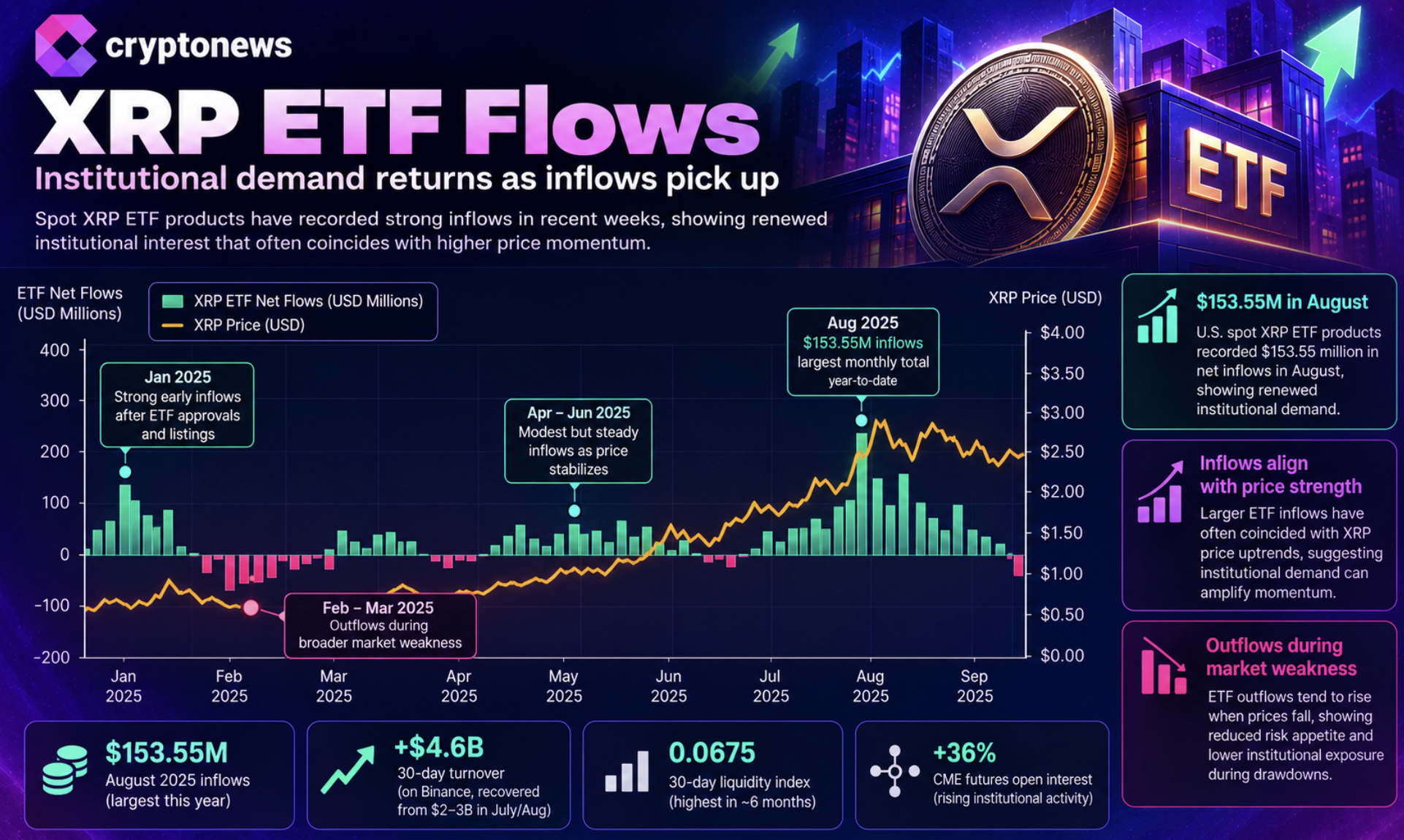
Separately, market data has pointed to sustained spot XRP ETF inflows running into the hundreds of millions of dollars over recent weeks, a trend some trackers frame as ongoing institutional accumulation beneath the price action. That flow data is useful context, but it is not confirmed as the driver of Monday’s drop, as the pullback below $1.50 traces cleanly to failed resistance tests and fading bid support.
The medium-term structure remains intact for now. XRP sits above its 200-day EMA at $1.37, which is curling upward for the first time since spring. This is a sign the longer trend has not broken, even as the shorter-term chart bleeds lower. A descending trendline from the late-August spike to $1.70 was cleared in mid-September, and that breakout is what fueled the run to $1.67 in the first place.
A second descending trendline, drawn from the September 23 high, is now the line bulls need to clear in October; left alone, it points toward $1.20 by mid-November. The levels on both sides of the current price are well defined.
Trade XRP on Bybit and Get a Chance to Win Our $1,000 USDT Airdrop
Reclaim $1.50 or Risk $1.37: XRP Price Next Move
The first job for bulls is straightforward: close a daily candle back above $1.50. Do that, and Monday’s drop reads as a fakeout rather than a breakdown, with $1.55 as the next confirmation level and $1.60-$1.63 as the target that would put the September 23 high back in play.
Fail to reclaim $1.50 in the next day or two, and $1.40-$1.42 becomes the level to watch, with the 200-day EMA at $1.37 as the line that actually matters for the medium-term outlook. A close below it would shift Ripple’s native asset from a bullish structure to a neutral one, opening room toward $1.30 and, in a broader crypto market sell-off scenario, $1.20.
$XRP just printed it's 6th weekly close beneath the 50 week EMA. The bears contInue to hold their defence line, with the bulls support below at $1.31 as a guardrail. (20 week EMA. For the time being, we remain compressed. https://t.co/7j6d2KB27L pic.twitter.com/r9kwHDmf2R
—
ChartNerd
(@ChartNerdTA) September 28, 2026
For this week, the range is $1.37 to $1.60, with $1.50 sitting as the pivot in between. On technical analysis grounds, the base case is a dip toward $1.40-$1.42 that gets bought, followed by another attempt at reclaiming $1.50. A pattern consistent with pullbacks inside an uptrend rather than the start of a new downtrend.
The $1.80-$2.00 zone remains the valid medium-term target as long as $1.37 holds; lose it, and that target moves out of reach for the immediate term.
Discover: The Best Token Presales
The post XRP Price Slides 2.9% as $1.50 Reclaim Becomes Critical appeared first on Cryptonews.
Crypto
Crypto’s New Playground: Casinos, Fed Bets, and Tokenized Stocks Blur the Line Between Trading and Gambling
The crypto industry has always had a talent for reinventing itself, but the latest wave of product launches suggests the industry is heading somewhere new: a place where trading, betting, and borrowing are becoming almost indistinguishable from one another. A cluster of recent developments — spanning live-dealer casino games, a new token listing tied to decentralized betting platforms, prediction markets built around Federal Reserve policy, sprawling perpetual futures exchanges, and DeFi protocols that let users borrow against tokenized shares of tech companies — paints a picture of an ecosystem racing to fuse speculation of every stripe into a single, crypto-native experience.
Take the world of crypto casinos, where live blackjack tables have reportedly begun to crowd out roulette wheels in lobby rankings. The dynamics driving that shift echo something familiar from traditional gambling: player preference for games that reward skill and pacing over pure chance. Blackjack lets players make decisions — when to hit, stand, split, or double down — giving a sense of agency that a spinning roulette wheel simply can’t replicate. In an industry built around instant, low-friction transactions using digital assets, that appeal seems to translate directly into engagement, with live-streamed dealers adding a layer of social, real-time theater that slot-style games lack.
That same appetite for interactive, decision-driven products is showing up elsewhere. Dexsport, a decentralized betting and casino platform, recently saw its native token, DESU, listed on the exchange MEXC — a milestone that matters less for the listing itself than for what it signals about the sector’s maturation. Token listings on major exchanges typically bring liquidity, visibility, and a degree of legitimacy that smaller platforms struggle to achieve on their own. For everyday users, a listing like this often translates into easier on-ramps, more trading pairs, and a stronger case that the underlying platform is being taken seriously by the broader market rather than treated as a niche experiment.
Meanwhile, speculation is moving well beyond games of chance and into the realm of macroeconomic policy. Prediction markets tracking the Federal Reserve’s interest rate decisions have become one of the more closely watched corners of crypto-adjacent finance heading into the back half of 2026. Traders on these platforms are effectively placing wagers on central bank behavior, turning monetary policy announcements into tradeable events. The appeal is straightforward: instead of relying solely on bond markets or futures tied to traditional finance, participants can now stake positions directly on whether the Fed will hold, cut, or raise rates, often with faster settlement and more granular contract structures than legacy markets offer. It’s a sign that prediction markets, once dismissed as a curiosity, are increasingly viewed as a legitimate barometer of trader sentiment on issues far removed from crypto prices themselves.
The appetite for exotic exposure is also evident in the perpetual futures space, where platforms like ApeX Omni have expanded their offerings well past the usual roster of Bitcoin and Ethereum contracts. With well over 120 perpetual markets now available, traders can reportedly take leveraged positions not just on major cryptocurrencies but on themes as far-flung as pre-IPO robotics companies. This kind of expansion reflects a broader trend of crypto exchanges positioning themselves as all-purpose speculation venues, offering leverage on virtually any asset class that generates enough trader interest — blurring the boundary between crypto trading and speculative bets on private, pre-public companies that would otherwise be inaccessible to retail investors.
Perhaps the clearest example of crypto finance colliding with traditional markets comes from Aave’s newest iteration. The protocol’s fourth version reportedly allows users to borrow USDC stablecoins against tokenized versions of Coinbase-linked tech stocks on the Base network. In practice, that means holders of tokenized equity exposure can unlock liquidity without selling their underlying positions — a mechanic long familiar to DeFi users who collateralize crypto assets, now extended to tokenized real-world securities. It’s a small but telling step toward a future where the wall between “crypto” and “traditional markets” continues to erode, with stocks, bonds, and other conventional assets increasingly represented on-chain and woven into the same lending and borrowing infrastructure that powers decentralized finance.
Taken together, these developments underscore a consistent theme: crypto platforms are no longer content to simply trade digital coins. They are building out entire ecosystems of speculation — casino games, prediction markets, leveraged derivatives, and collateralized lending — all designed to keep users engaged, liquid, and constantly exposed to new forms of risk and reward. Whether this convergence produces a more mature, diversified financial ecosystem or simply amplifies the volatility and risk-taking crypto is already known for remains an open question. What’s clear is that the industry’s appetite for expansion shows no signs of slowing down.


If there was a single theme running through the crypto world’s headlines this spring and summer, it was this: the industry that once promised to reinvent money has increasingly fused itself to the industry promising to reinvent everything else — artificial intelligence.
The result, according to a string of reports and commentary tracked by researcher-journalist Molly White and blogger David Gerard, is a landscape where political money, security failures and marketing absurdity are all converging in ways that ought to worry anyone paying attention.
Start with the money in politics. In a recent interview, White — who has spent years cataloguing where crypto industry cash flows in Washington — turned her attention to a new wrinkle: artificial intelligence companies adopting the same political playbook that crypto firms pioneered.
According to the discussion, OpenAI and Anthropic are now effectively running competing pro-AI super-PACs, pouring money into races much the way crypto-aligned PACs like Fairshake have done in recent election cycles. White reportedly highlighted a botched intervention in New York’s 12th congressional district as an example of the sums involved and the risk of these efforts backfiring.
The parallel is not incidental. Crypto’s political spending playbook — deploy industry money to shape friendly regulation and punish critics — was built over several election cycles and proved remarkably effective at getting crypto-friendly candidates elected and skeptics sidelined.
Watchers like White argue that AI companies, facing their own looming questions about regulation, safety and liability, are now borrowing that same toolkit almost wholesale. Whether AI’s political spending proves as consequential as crypto’s remains to be seen, but the early signs suggest deep-pocketed AI labs are not content to leave the lobbying playing field to blockchain interests alone.

Money and politics aside, the more immediate crypto news has been considerably more chaotic on the technical side. A case in point: an unofficial crypto wallet built on top of Elon Musk’s Grok AI was reportedly compromised through a combination of an NFT and a prompt injection attack — a technique in which malicious instructions are hidden inside content an AI model processes, tricking it into taking unauthorized actions.
The episode is being cited by critics as a vivid illustration of what happens when experimental AI agents are given direct access to cryptocurrency funds without adequate safeguards. As one commentator put it, the incident underscores a blunt truth: the push toward “agentic commerce,” in which AI systems autonomously manage transactions and wallets on a user’s behalf, currently looks a lot like an open invitation to fraud.
That warning fits a broader pattern. Crypto’s history is littered with hacks and exploits that followed hard on the heels of new technical hype cycles — DeFi protocols, bridges, NFT marketplaces — and the addition of AI agents with wallet access appears to be simply the latest frontier for attackers to probe.
Security researchers have long cautioned that combining large language models, which can be manipulated through carefully crafted inputs, with systems that move real money is a combination that demands far more rigorous testing than the industry has so far shown appetite for.
Then there is the sheer commercial strangeness of the AI-crypto convergence. Among the products making the rounds is “Gudtrip,” described in coverage as an AI agent vape pen built with blockchain technology — a mash-up that manages to combine three separate hype cycles (AI, crypto, and vaping) into a single device.
It’s the kind of product that invites eye-rolls even from people steeped in the industry, and it has become something of a symbol for critics who argue that “blockchain” and “AI agent” are increasingly being slapped onto unrelated consumer goods simply because the buzzwords still move product.
Labor practices are also getting the AI-crypto treatment. Reports have surfaced of AI companies experimenting with paying staff in AI-linked tokens rather than conventional money — an arrangement that echoes crypto’s long history of compensating workers and contractors in volatile, illiquid tokens instead of cash. Critics have been quick to note the obvious problem: a token’s value depends entirely on continued enthusiasm for the company issuing it, leaving employees exposed to exactly the kind of speculative risk that traditional salaries are designed to avoid. The practice, if it spreads, would import one of crypto’s more employee-unfriendly habits directly into the AI industry’s compensation structures.
Not everyone covering this convergence is doing so with a straight face. A satirical piece making the rounds — structured as a twist on the old “two cows” economics joke — skewered the fintech, AI, blockchain and crypto sectors in one go, imagining a “crypto” cow story where two digital cows produce “milk tokens” tradeable for millions but drinkable only by avatars in the metaverse, and a “hedge fund” version featuring robotic cows that befriend real cows just to steal their milk.
Silly as the format is, the satire lands because it captures something real: a sense among observers that these overlapping industries have become adept at generating elaborate financial and technical narratives that produce headlines and valuations long before they produce anything resembling durable value.
Taken together, these threads — political spending mirroring crypto’s playbook, an AI wallet hacked via prompt injection, blockchain-branded vape pens, token-based salaries, and no shortage of pointed satire — paint a picture of an industry moment defined less by a single breakthrough than by rapid, sometimes reckless, cross-pollination.
Crypto spent the better part of a decade building the infrastructure, the political machinery and the marketing instincts for turning speculative technology into cultural and financial weight. Now AI companies appear to be absorbing many of the same instincts, for better or worse, at a pace that leaves regulators, security researchers and workers alike scrambling to keep up.
Editor’s note: Much of the reporting referenced above originates from commentary and short-form blog coverage rather than in-depth investigative reporting, and some details — such as the specific financial scale of AI super-PAC spending or the full technical mechanics of the Grok wallet exploit — were not independently verifiable from the available material. Readers should treat figures and claims here as preliminary pending fuller reporting.

U.S. oil drilling site.
David McNew | Getty Images
Nearly half of the stocks in the S&P 500 are moving against the index with a negative beta, an unusual divergence that is becoming increasingly difficult to ignore.
About 45% of S&P 500 stocks have a negative three-month beta, according to a recent note from Goldman Sachs. The data closely aligns with CNBC’s finding that nearly 40% of S&P 500 stocks had a negative three-month beta versus the index, while 17% have a negative one-year beta, based on weekly returns.
Beta measures how a stock moves relative to the rest of the market. A negative beta means an individual stock’s returns moved in the opposite direction of the S&P 500 over the measured period.
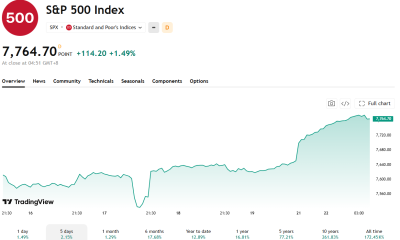
The surge in stocks with a negative beta dovetails with other unusual market signals. The S&P rallied 1.5% last Monday. The same day 30 stocks touched a 52-week low while just 7 scored a new high. The last time the S&P 500 gained at least 1% while sitting within 1% of a new 52-week high and new lows outnumbered new highs was in December 1999, right before the very top of the dot-com boom, according to Jason Goepfert, founder of SentimenTrader.
The two indicators show that market indexes can remain at or close to records despite wide divergences among individual stocks.
Widening divide
The yawning gap largely reflects how concentrated the S&P 500 has become, according to Adam Turnquist, chief technical strategist at LPL Financial.
Mega-cap technology companies carry an outsized weight in the benchmark, meaning a strong performance from a small number of stocks can drive the index even when many others are moving the other way.
“It only takes a few of those mega caps names to work, and a lot of the smaller weighted stocks don’t need to work,” Turnquist told CNBC, pointing to unusually low correlations among S&P 500 stocks.
The same dynamic explains why the broader index can look relatively calm even when individual stocks are making large moves, said Bradley Krom, director of investing strategy at WisdomTree.
“Beta is a function of correlation and volatility,” Krom said. When stocks experience large moves at different times and for different reasons, those moves can largely offset one another at the index level.
In July this year, Alliance Bernstein, using one-year trailing returns, found an unprecedented share of U.S. stocks displaying negative beta as AI winners powered market gains.
Semiconductor makers, hardware companies and other AI infrastructure beneficiaries have benefited from enormous capital spending, while companies outside the AI trade have struggled to keep up.
“But a narrow market can also distort the signal investors receive from index returns. When a handful of companies dominate performance, many financially sound businesses may lag or even decline, simply because they aren’t tied directly to the most powerful market narrative,” wrote Kurt Feuerman, chief investment officer of Select U.S. Equity Portfolios at AllianceBernstein.
Negative energy
Energy stocks with negative beta are being driven by different forces.
“Another part of the other story is energy. That’s been pronounced this year: higher oil prices, higher energy stocks and then the rest of the market trades lower,” said Turnquist, seeing energy as an important part of the negative-beta story, alongside more defensive sectors.
Earlier this month, Evercore ISI used a six-month measure to call out 115 S&P 500 stocks with negative beta, a list skewed toward energy, utilities and consumer staples. The investment bank called the energy sector a “synthetic S&P 500 put option” because of the way it has reacted to geopolitical pressure.
If market leadership broadens out, Turnquist believes the number of negative-beta stocks could decline. But he expects dispersion to remain elevated as investors become remain selective toward beneficiaries of AI spending and seek returns there.
Krom at WisdomTree expects the recent extreme readings to eventually revert to the mean. Similar spikes appeared around the 1999-2000 dot-com bubble, he said, when market concentration and large moves in a narrow group of stocks also triggered unusual divergences.
Turnquist pushed back on comparing today with the dot-com era, leading tech companies now are more mature businesses with established revenue and products. Krom is on the same page. He said the individual pieces driving returns don’t have the same historical relationship they’ve had in the past.
“It is not the same market environment now versus 2000,” Krom said. The negative betas seen today boil “down to the amount of market concentration.”

Cryptocurrency no longer lives only in trading app screenshots and speculative headlines. A cluster of recent coverage suggests digital assets have settled into three very different corners of everyday life at once: the boardrooms of family offices moving nine-figure sums, the phones of ordinary Britons paying for a night out, and a growing ecosystem of explainer sites trying to make sense of it all for newcomers. Taken together, they paint a picture of an asset class that has stopped trying to prove itself and started simply getting used.
At the top end of the market, the mechanics of moving serious money in crypto increasingly mirror what has long happened on Wall Street. Selling a large position on the open market is a blunt instrument — dump a $20 million order into a standard exchange and the price can slide five to ten percent against you before the trade even completes, as algorithms and bots react to the visible order book.
High-net-worth investors and family offices have borrowed a page from traditional equities to avoid that problem, leaning on block trades negotiated privately between two parties and reported only after execution, dark pools where institutional orders are matched away from public view, and OTC desks that lock in a price before a trade ever touches the open market.
None of these tools are new in spirit — block trading dates back to the 1960s, and banks such as Credit Suisse pioneered dark-pool venues in the mid-2000s — but their extension into crypto shows how thoroughly digital assets have been absorbed into the plumbing of institutional finance, complete with all its discretion and negotiated pricing.
Further down the market, the story is less about avoiding slippage and more about convenience. A growing share of everyday spenders now treat crypto the way they treat a contactless card — something to tap and forget.
Much of that shift traces back to apps like Revolut, which began as a travel card and has since folded budgeting tools, instant transfers and built-in crypto purchases into a single interface. For users already comfortable buying fractions of Bitcoin or Ethereum on their phone, spending a small slice of a holding online no longer feels like a leap. Recent Pew Research figures cited in industry coverage suggest roughly one in five adults have used cryptocurrency in some form, evidence of just how far the technology has travelled from niche forums into ordinary financial habits. Faster networks and pound- or dollar-pegged stablecoins have also softened the volatility fears that once made spending crypto feel reckless.

That spending habit has, in turn, fed into digital entertainment, where a wave of offshore-licensed sites — often based in Malta, Curaçao or Gibraltar — have built their appeal specifically around crypto and app-based payments such as Revolut, alongside larger game libraries and bigger sign-up bonuses.
These platforms sit outside the UK’s domestic licensing system, which is precisely the draw for some users, including those who have self-excluded through Gamstop. The logic mirrors a broader pattern researchers have tracked in crypto adoption more generally: users start on a single centralised platform for convenience, then gradually spread activity across multiple services and self-custodied wallets as they grow more comfortable, seeking flexibility rather than a single gatekeeper. It’s worth being clear-eyed about what this means in practice — these offshore sites operate under lighter regulatory oversight than UK-licensed operators, and readers weighing them should treat player-protection tools and responsible-gambling warnings as essential reading, not fine print to skip.
Feeding all of this is a parallel boom in explainer content trying to translate crypto’s jargon — DeFi, staking, tokenomics, smart contracts — into plain English. Sites such as RobTheCoins.com have positioned themselves as educational hubs rather than exchanges or wallets, publishing guides on blockchain business models, crypto tax tools and the overlap between gaming and crypto economies.
That distinction matters, because the line between “content that explains crypto” and “a product that handles your money” is not always obvious to a casual reader, and confusing the two is exactly the kind of mistake that has burned newcomers before.
None of this amounts to a single dramatic headline. There is no exchange collapse or regulatory crackdown driving this particular news cycle. Instead, what emerges is a quieter, arguably more consequential trend: crypto is being absorbed into the ordinary architecture of modern finance and leisure, from the trading desks of the ultra-wealthy down to a tap-to-pay night out.
Whether that mainstreaming is entirely healthy is a separate question. Institutional tools like dark pools and OTC desks still lack the transparency of public markets, offshore gambling platforms carry real consumer-protection gaps, and no amount of friendly explainer content changes the fact that crypto remains a volatile, largely unregulated asset in most jurisdictions.
Readers tempted by any part of this ecosystem — whether it’s a block-trading conversation or a crypto-funded casino account — would do well to verify claims independently, check who is actually regulated, and remember that accessibility is not the same thing as same thing as safety.

A 24-year-old convicted cybercriminal was arrested in the Netherlands on September 16 on suspicion of aiding crypto hacking collective ShinyHunters.
Krebsonsecurity reports that Pepijn van der Stap was detained by Dutch authorities for questioning in relation to ShinyHunters.
Police claim he’ll appear in the Rotterdam District Court on September 29, while local news reports the United States is also involved in his case.
Over three years ago, van der Stap carried out multiple acts of data theft and extortion under the moniker “Umbreon.”
Read more: Crypto hacking group ShinyHunters says it stole data of 5,000 FBI agents
Van der Stap was eventually arrested, convicted, and handed a four-year suspended sentence. He was released in December 2025.
While carrying out his criminal activities, he worked at cybersecurity startup Hadrian and volunteered at the nonprofit Dutch Institute for Vulnerability Disclosure.
He’s currently the offensive security lead at Neo Security, and described himself to Krebsonsecurity as a reformed convict.
ShinyHunters attacked FBI days after van der Stap’s arrest
Just six days after van der Stap’s arrest, ShinyHunters claimed responsibility for hacking and stealing the data of 5,000 FBI agents.
This attack also manipulated the FBI’s job page to display a picture of the Pokémon Umbreon.
Krebsonsecurity reports that the attack represented a shift in ShinyHunters’ usual attacks while the group is under the leadership of a teenager based in Amman, Jordan, who goes by the nickname “Rey.”
Rey reportedly merged the group with fellow hacking groups Scattered Spider and LAPSUS$ to become ScatteredLapsussHunters.
Read more: Crypto hackers target Hinge and Match Group in data leak
Sources close to the ShinyHunters investigation told the publication that Rey had “ongoing beef” with van der Stap, and that Umbreon’s inclusion was possibly an attempt by Rey to shift blame towards van der Stap.
ShinyHunters has also been linked to the hacking of the Netherlands telecommunications provider Odido last February.
Personal data, including bank account and passport numbers, of six million Odido customers were leaked.
Got a tip? Send us an email securely via Protos Leaks. For more informed news and investigations, follow us on X, Bluesky, and Google News, or subscribe to our YouTube channel.

Strategy has acquired another 1,665 BTC for approximately $142.7 million while spending $151.7 million to repurchase STRC preferred shares during the week ended Sept. 27.
Summary
- Strategy bought 1,665 BTC for $142.7 million, lifting total Bitcoin holdings to 847,666 coins overall.
- Strategy repurchased 1,534,530 STRC shares for $151.7 million during the September 21 to 27 period.
- MSTR sales generated $246.2 million net proceeds, with no preferred shares issued during the week.
- Strategy held $5.02 billion in USD Reserve and $1.00 billion in deployable USD Cash overall.
- Bitcoin holdings cost $63.95 billion in aggregate, averaging $75,437 per coin including fees and expenses.
Strategy disclosed the transactions in a Sept. 28 Form 8-K, showing that the company paid an average of $85,681 per BTC, including fees and expenses, between Sept. 21 and Sept. 27. The purchase lifted its Bitcoin holdings to 847,666 BTC.
During the same period, Strategy sold 1,469,165 MSTR shares through its at-the-market program, generating $246.2 million in net proceeds. Of that amount, $142.7 million funded the Bitcoin purchases and $103.5 million went toward STRC repurchases.
The company issued no STRF, STRC, STRK or STRD preferred shares through its ATM programs during the week.
Strategy Bitcoin holdings reach 847,666 BTC
Following the latest purchase, Strategy held 847,666 BTC acquired for an aggregate $63.95 billion. Its average acquisition cost stood at $75,437 per BTC, including fees and expenses.
The latest addition follows Strategy’s 950 BTC purchase after a two-week buying pause reported for the previous week. The company spent $75.7 million on that acquisition at an average price of $79,670 per BTC, increasing holdings at the time to 846,000 BTC.
Strategy’s new $85,681 average purchase price for the Sept. 21-27 period was above Bitcoin’s latest market price. CoinGecko shows BTC trading near $83,401 at the latest reading, around 2.7% below Strategy’s average price for the latest purchase.
At that market price, Strategy’s 847,666 BTC position would be worth roughly $70.7 billion. The calculation uses a live market price and therefore differs from the company’s recorded acquisition cost.
STRC repurchases reach another $151.7 million
Alongside the Bitcoin acquisition, Strategy repurchased 1,534,530 shares of its Variable Rate Series A Perpetual Stretch Preferred Stock, or STRC, for approximately $151.7 million.
The latest transaction continues a repurchase program that Strategy began earlier in 2026. After the latest week, $723.5 million of authorization remained under its digital credit securities repurchase program, according to the filing.
Strategy’s previous $174 million STRC repurchase came during the Sept. 14-20 period, when the company spent more on preferred-stock repurchases than on its $75.7 million Bitcoin purchase.
Earlier in September, Strategy doubled its digital credit securities repurchase authorization to $2 billion after spending $176.3 million on STRC during a week when it bought no Bitcoin.
Strategy said in July that it intends to repurchase STRC while the preferred stock trades below its $100 stated amount, subject to market conditions, liquidity and other capital priorities.
MSTR sales funded both transactions
Strategy financed the latest Bitcoin purchase and part of the STRC repurchase through MSTR common-stock sales.
The company raised $246.2 million in net proceeds by selling 1,469,165 MSTR shares between Sept. 21 and Sept. 27. The filing assigns $142.7 million of those proceeds to Bitcoin purchases and $103.5 million to STRC buybacks.
A further $48.1 million of the STRC repurchase came from Strategy’s USD Cash balance. Over the same period, the company used $22.1 million from its separate USD Reserve to pay preferred-stock dividends.
Strategy reported $18.84 billion of additional MSTR issuance capacity under its ATM program as of Sept. 27. No preferred shares were sold during the latest reporting period.
The latest funding structure differs from the previous week, when Strategy made no ATM stock sales and used existing cash to fund its Bitcoin purchase and STRC repurchases.
Strategy keeps $6.02 billion in dollar assets
Strategy ended Sept. 27 with a $5.02 billion USD Reserve and $1.00 billion in USD Cash, giving the company a combined $6.02 billion across the two balances.
The company defines the USD Reserve as capital designated to support preferred-stock dividends and interest payments on outstanding debt. USD Cash is maintained separately for Bitcoin purchases, reserve additions, capital management and other treasury uses.
The cash framework has changed materially since July, when Strategy built a $3.75 billion reserve while Bitcoin buying remained paused.
Strategy’s board expanded its STRC repurchase program during September while continuing to manage Bitcoin purchases, common-stock issuance and preferred-stock obligations through separate pools of capital.
As of Sept. 27, the company still had $723.5 million available under its digital credit securities repurchase authorization and $1 billion available under its separate MSTR common-stock repurchase program.
Goldman Sachs brings $100 billion Treasury fund into crypto’s institutional plumbing

Nigeria Drawn Against El Salvador In Davis Cup World Group II Playoffs
Perpetua Resources at Mining Forum Americas 2026: shift to construction


-

 Fashion3 days ago
Weekend Open Thread: J.McLaughlin – Corporette.com
-

 Crypto6 days ago
Goldman Sachs and Deutsche Bank Agree: The S&P 500 Rally Isn't Over
-

 Tech & AI24 hours ago
OpenAI is preparing “o,” an always-on ChatGPT assistant that could handle email
-

 Tech & AI23 hours ago
Anthropic turns Claude into an AI marketplace with 2,000+ plugins and connectors
-

 Fashion4 days ago
8 iPhone Accessories That Add Personality
-

 Entertainment6 days ago
These 17 Fall Amazon Dresses Seriously Look Like Anthropologie
-

 Tech & AI6 days ago
Reolink’s solar 4K security camera falls to its lowest price in months
-
 Crypto6 days ago
Trump-Xi Polymarket Odds for Handshake Hit 50%
-

 Crypto6 days ago
This Bearish Netflix Stock Trade Can Cash In On Video Streaming Giant’s Woes
-
 Crypto5 days ago
Bitcoin price tests $83,600 Supertrend support after $87K rejection
-

 Crypto5 days ago
Crude Oil Prices Pressured by Diplomatic Hopes in the Middle East
-
 Business & Hussles6 days ago
Oil Price Today (September 23): Crude oil below $100 on hopes of US-Iran talks. What did Trump say?
-

 Crypto6 days ago
BitGo says Bitcoin absorbed Fed hike, CLARITY failure
-
 Crypto5 days ago
Bitcoin Threatens Sub-$84,000 Breakdown as Long Liquidations Spike
-
 Crypto7 days ago
Meta Jumps 11% As Muse Shines and Investors Show an Appetite for Advancing AI
-

 Crypto6 days ago
Did Jim Cramer Just Give GameStop Stock the Kiss of Death When He Said the Turnaround Is Working?
-
 Crypto7 days ago
Trump, Xi Meet on S&P 500's Best Day Since Early August: Will Markets Stay Bullish?
-
 Tech & AI5 days ago
UiPath’s Dines says AI needs a manual and launches Cartographer to write it
-

 Crypto5 days ago
As Amazon Stock Prospers, Traders Might Consider This Option Play
-

 Crypto5 days ago
Strategy resumed Bitcoin buying, but Strive gained more BTC per share
You must be logged in to post a comment Login