
Crypto
Bitcoin Price Analysis: Is BTC’s Consolidation the Calm Before the Storm?

Bitcoin is consolidating around $83.5K after bouncing from the mid-$70K area. The charts show a constructive higher-timeframe structure, but BTC is now facing a significant resistance cluster while short-term momentum has cooled. At the same time, the Apparent Demand Growth metric on CryptoQuant has recently leaned negative, suggesting that the demand backdrop has not yet confirmed another sustained leg higher.
Bitcoin Price Analysis: The Daily Chart
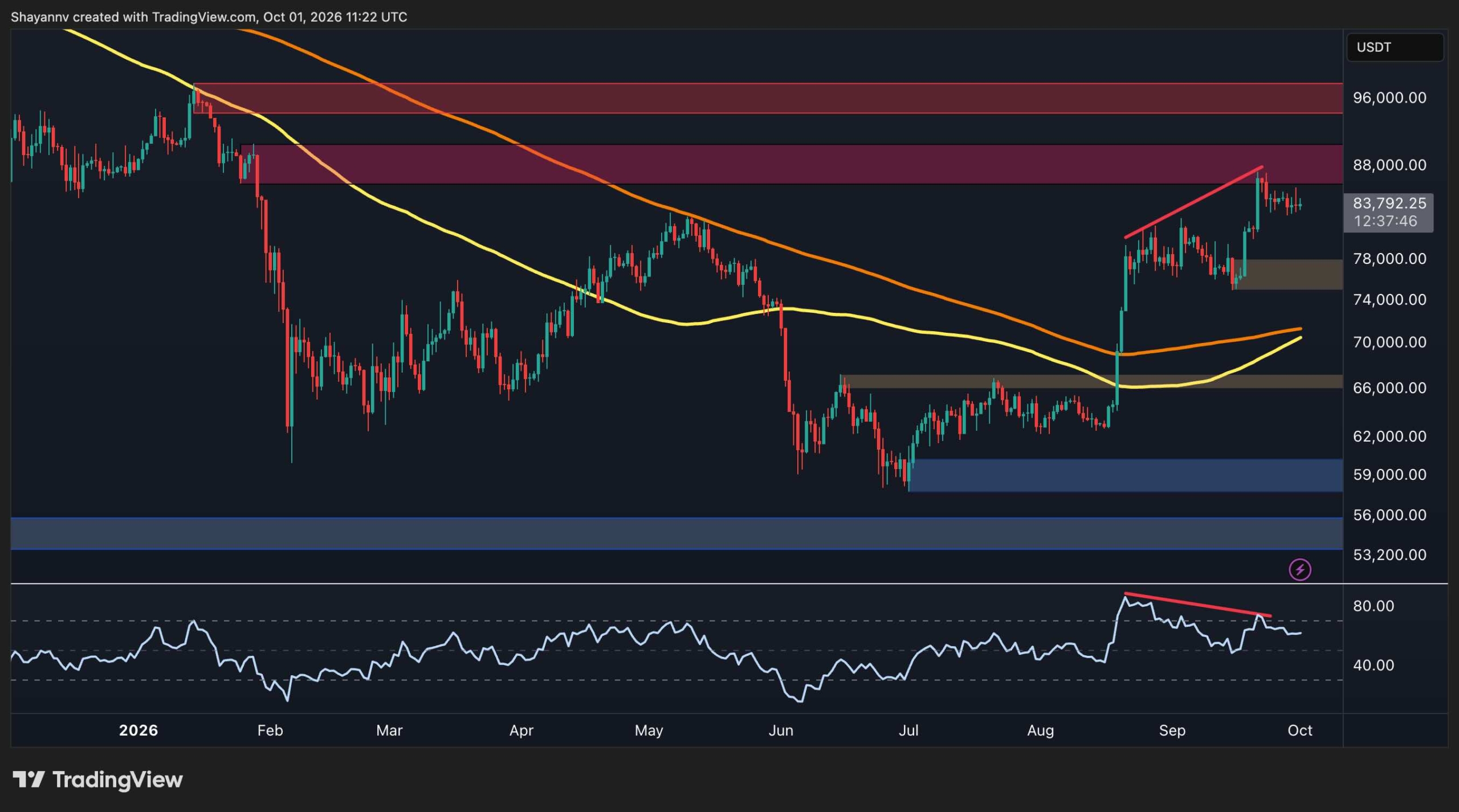
Bitcoin’s daily chart shows a substantial recovery from the $76K region. BTC first reclaimed the $66K area and then accelerated above the $70K and $78K levels, eventually reaching the $88K resistance zone. This area previously acted as a rejection zone, and the latest rally stalled just below it. A valid move above $88K would therefore represent an important structural development, potentially opening the way toward the higher resistance zone around $96K shown on the chart.
On the downside, the first notable support is around $76K, where the latest rally originated. The chart also highlights a deeper support zone around the $66K area, which remains the most important structural level located at the top of the previous consolidation range.
The 100-day and 200-day moving averages have also improved considerably. BTC has reclaimed both after spending much of the earlier part of the year below them. The 100-day moving average is now turning upward aggressively toward the 200-day average, which is pointing to a potential bullish crossover in the coming weeks. Still, BTC needs to clear the $88K resistance area to demonstrate stronger continuation.
The daily RSI has also recovered from its earlier weakness but is no longer near its recent highs. A bearish divergence is visible between the latest price advance and the RSI, with price making a higher high while momentum failed to establish a comparable high. This does not necessarily signal an immediate reversal, but it indicates that upside momentum has become less convincing while the price is stalling just below a major resistance zone.
BTC/USDT 4-Hour Chart
The 4-hour chart provides a clearer picture of the consolidation visible on the daily chart. After surging from roughly $75K to above $86K, Bitcoin entered a sideways-to-slightly bearish formation bounded by two descending yellow trendlines.
BTC is currently trading near $83.8K, roughly in the middle of this short-term range. The upper trendline is approaching the $85K area, while the lower boundary is currently around $82K.
This creates a relatively well-defined short-term structure. A breakout above the descending upper trendline, followed by a move through the $88K resistance zone, would signal that buyers are attempting to resume the preceding advance.
Conversely, a breakdown below the lower trendline could expose the $81K bullish order block. A loss of this zone would weaken the current bullish structure and could bring the broader $76K demand area back into focus.
In the near term, BTC therefore appears to be coiling beneath resistance. The key technical question is whether the current consolidation resolves through the upper trendline and the $88K level, or whether sellers force a deeper retracement toward $80K.

On-Chain Analysis
The Apparent Demand Growth chart on CryptoQuant provides a less supportive signal than the recent price action. The metric measures the net change in Bitcoin supply that has remained inactive for more than one year, adjusted for newly issued coins. Positive readings indicate that apparent demand is absorbing more BTC than the amount of supply entering the market through issuance, while negative readings indicate the opposite.
Historically, the chart shows periods of sustained positive Apparent Demand Growth coinciding with strong advances in Bitcoin’s price. Conversely, prolonged negative readings have appeared during periods when price struggled to establish durable upside momentum. Sharp reversals from deeply negative readings have also preceded recoveries.
The most recent portion of the chart shows that Apparent Demand Growth has been relatively unstable, with repeated negative readings and intermittent positive spikes. More recently, the metric has leaned toward negative territory even as Bitcoin recovered toward the mid-$80K range.
This creates an important divergence between price and the underlying demand signal. Bitcoin has managed to recover significantly from its summer lows, but the Apparent Demand Growth data shown here does not yet display the sustained positive expansion that accompanied some of the market’s stronger historical advances.
As a result, the on-chain data suggests that the latest price recovery has not yet been accompanied by a decisive improvement in apparent demand. If the metric turns persistently positive while BTC holds above $80K and challenges the $88K zone, that would provide stronger confirmation for the continuation scenario. However, if negative readings persist while price fails to break $88K, the current consolidation could remain vulnerable to a deeper correction, which could soon materialize if things fail to change for the better.

The post Bitcoin Price Analysis: Is BTC’s Consolidation the Calm Before the Storm? appeared first on CryptoPotato.


A new snapshot of digital asset activity across Central and Southeast Asia and Oceania reveals a region in flux: overall crypto trading volumes are shrinking, yet beneath that headline decline sits a story of maturing infrastructure, deepening institutional involvement, and a financial hub in Singapore that is pulling further ahead of its neighbors.
According to blockchain analytics firm Chainalysis, the combined crypto economy of the region — one of six major zones tracked in the company’s annual Geography of Crypto Report — contracted by 6.8% in the year spanning July 2025 through June 2026. On paper, that looks like a retreat. But analysts caution against reading the figure as a sign of waning interest in digital assets. Instead, it appears to reflect a shift in how crypto is being used, with speculative retail trading giving way in places to more structured, business-oriented activity.
Singapore is the clearest example of that shift. The city-state posted $284 billion in measured crypto activity over the period, a 55.4% jump from the year before and enough to make it the largest crypto market in the region by a wide margin. The growth wasn’t confined to one corner of the market either: flows into centralized exchanges rose 30%, while decentralized exchange activity climbed an even steeper 69%.

The real headline, though, is institutional money. Activity on platforms catering to institutional investors — market makers, over-the-counter trading desks, and institutional brokerages — nearly doubled, surging 94% to reach $60 billion. That concentration of professional capital suggests Singapore is cementing its role not just as a retail-friendly crypto market but as a genuine financial center for digital assets, comparable to its status in traditional banking and wealth management.
Australia, the region’s second-largest crypto economy at $173.1 billion, tells a more mixed story. Overall activity there slipped 5.6%, dragged down largely by a steep drop in decentralized exchange volumes. Yet both centralized exchange trading and institutional-platform activity grew, with custodians and OTC trading desks absorbing much of that flow — a sign that even as speculative fervor cools, professional infrastructure continues to take root.
India presented a starker picture, registering one of the sharpest declines anywhere in the region, even as speculative retail trading in the country reportedly remained resilient compared with other use cases.
Perhaps the most striking trend, however, emerged not from the region’s largest economies but its smaller ones. The Philippines, Thailand, and Vietnam together accounted for more than 14% of all global small-value peer-to-peer crypto transfers, despite making up just 2.5% of the world’s total crypto economy. That outsized share points to crypto’s growing role as a practical financial tool in Southeast Asia — used for remittances, everyday payments, and cross-border transfers rather than pure speculation.
Stablecoins are increasingly the vehicle for that kind of activity. Chainalysis found that across the region, the value of cross-border stablecoin transactions consistently outpaced domestic stablecoin activity, reinforcing the idea that dollar-pegged tokens are becoming a preferred method for moving money across borders in a part of the world with large migrant workforces and fragmented banking systems.
Taken together, the data suggests a region bifurcating along two tracks. On one hand, wealthy financial hubs like Singapore and Australia are attracting institutional capital and building out professional-grade trading infrastructure. On the other, emerging Southeast Asian economies are leaning on crypto — particularly stablecoins — to solve everyday problems like cheap remittances and small-value transfers that traditional finance handles poorly or expensively.
Industry observers quoted in the report frame this as evidence that the region is moving beyond the “adoption” phase of crypto’s growth story and into an “integration” phase, where the technology’s success depends less on hype and more on regulatory clarity and reliable financial infrastructure. Whether that transition accelerates or stalls may depend on how quickly governments across the region — from Singapore’s well-established licensing regime to less mature frameworks elsewhere — adapt their rules to keep pace with where the money is actually flowing.
For now, the numbers suggest that even as the region’s aggregate crypto economy shrinks on paper, the underlying activity is becoming more sophisticated, more cross-border, and more embedded in real financial life than the raw growth figures alone would suggest.
Crypto
Drift Proposes ‘Recovery Tokens’ to Repay Victims of $295 Million Hack — But the Math Could Take Years

Nearly a month after hackers drained $295 million from Drift, the Solana-based derivatives exchange has unveiled a plan to make victims whole — but the fine print suggests patience will be the price of restitution.
On Tuesday, Drift’s development team proposed issuing “recovery tokens” to users who lost funds in the April 1 breach, giving them a claim on a so-called recovery pool that will be slowly filled with future protocol revenue and contributions from outside partners, including stablecoin issuer Tether. The plan, which still requires approval from Drift tokenholders, would also relaunch the exchange as a stripped-down, “security-first” platform focused narrowly on perpetual futures trading.
“The Drift team is taking considered measures to ensure that users are made whole, and that Drift restores itself as the leading perpetuals DEX on Solana,” the developers wrote in an update posted to the exchange’s website, adding that the team had made “internal hard decisions to restructure and operate as lean as possible.”

The proposal is as much a confession of constrained resources as it is a roadmap to recovery. According to figures cited in the plan, Drift generated roughly $19 million in revenue over all of 2025. At that pace, filling a $295 million hole would take the better part of eight years — and that’s assuming Tether and other partners follow through on pledges to contribute a combined $147 million toward the effort. Drift itself proposed seeding the pool with just under $4 million in stablecoins to get things started.
For users unwilling to wait nearly a decade for full repayment, the plan offers an escape hatch: once the recovery pool reaches $5 million, tokenholders would be able to redeem their claims early, albeit at a steep discount to what they’re actually owed. Because the recovery tokens are designed to be transferable, they effectively become a tradable bet on whether Drift’s leaner business model can generate enough cash to eventually make good on its promises.
The hack itself exposed a soft spot that has become uncomfortably familiar across decentralized finance: not a flaw in smart contract code, but a breakdown in operational trust. Attackers reportedly manipulated Drift administrators into approving fraudulent transactions, draining the protocol’s funds and forcing a suspension of trading and other activity. Blockchain investigators have since pointed to North Korean state-linked hacking groups as the likely culprits — part of a pattern of Pyongyang-linked crypto heists that have siphoned hundreds of millions of dollars from exchanges and DeFi protocols in recent years.
In response, Drift says it is overhauling not just its finances but its internal security culture. Administrators will be required to follow a formal security protocol, including the use of dedicated hardware and quarterly training sessions — an acknowledgment that even well-audited code can be undone by human error or social engineering.
The rebuilt protocol will look considerably smaller in ambition than the one that existed before the hack. Drift plans to relaunch before July as, in its own words, “a leaner, perps-native exchange,” dropping its higher-yield “earn” products that resembled savings accounts and narrowing the range of collateral assets it accepts to only the most liquid, widely traded tokens. Plans for a mobile app and a new liquidity model — both unveiled just months before the attack — have been shelved indefinitely as the team redirects resources toward recovery and relaunch.
Markets, for their part, appear unconvinced that any of this changes much in the near term. Drift’s native token was trading just under 4 cents both before and after Tuesday’s announcement, suggesting investors are reserving judgment until the recovery plan clears a tokenholder vote — and, more importantly, until Drift proves it can actually generate the revenue its own math depends on.
The episode adds to a growing list of major DeFi hacks this year that have forced protocols to improvise creative, often lengthy compensation schemes rather than simply making victims whole outright. For an industry that markets itself on trustless, code-based guarantees, Drift’s recovery tokens are a reminder that when things go wrong, users are frequently left holding IOUs backed by nothing more than a promise — and a business plan that has yet to be tested.
“This will take time but the structure is in place, ecosystem partners are committed and the work is underway,” the proposal concluded. Whether that is enough to satisfy tokenholders, and eventually victims, will become clearer as the vote unfolds and Drift attempts its relaunch in the coming weeks.

Base activated Cobalt on September 30. For issuers of its B20 tokens, the fork adds a way to schedule balance multipliers, seize balances with a record and combine transfer policies. None of that makes a tokenized asset a share in the company it tracks. It makes the rules enforced by the token more explicit, and the identity of the issuer more consequential.
Summary
- Base Mainnet activated Cobalt at 18:00 UTC on September 30 after Sepolia activated 7 days earlier.
- B20 issuers gained 2 composite policy types, Union and Intersect, for combining existing transfer rules.
- A scheduled multiplier can change displayed token balances at a future time without each holder signing a transaction.
- The new seizure operation moves a holder balance under issuer authority when the relevant policy permits it.
- Base’s mainnet node minimum was v1.4.2; a scheduled fee payment in B20 tokens was removed from this fork.
The Cobalt upgrade specification records a September 30 mainnet activation, one week after Sepolia. Base’s public status page put the mainnet maintenance window at 18:00 UTC and marked it complete at 20:00 UTC. The fork adds B20 asset functions, transactions conditional on chain state, a registry for future upgrade scheduling in monitoring mode and an on-chain method for registering certain trusted-execution-environment prover signers. These are separate changes. The asset story begins with B20, the token format introduced with the earlier Beryl upgrade.
The fork went live, but its entire wish list did not
Two ideas that appeared in earlier Cobalt discussions are absent from the deployed scope. Payment of network fees in B20 tokens was removed from the fork’s list on September 29. Faster canonical 200 millisecond blocks belong to a proposed later Denim upgrade, not this activation. Native account abstraction has no scheduled mainnet gate here. Treating any of those as live Cobalt functions would confuse a roadmap with code an issuer or trader can use today. The distinction is especially important for institutions evaluating a token standard against current compliance requirements.
Base’s node release floor is v1.4.2 for mainnet according to the upgrade documentation. The preceding v1.4.1 included the timestamp but missed changes to validity transaction RPC forwarding; v1.4.0 does not contain the mainnet activation. A node that follows a fork without forwarding the new transaction type correctly can present a partial view of what users think is a uniform network. The code-level distinction is more instructive than a blanket statement that Cobalt is live.
The news hook is real, but it is not the whole thesis. B20’s earlier activation had already put issuer-managed assets on Base. Cobalt increases the actions the issuer can take and the policy decisions a transfer may face. The key question is who can invoke those functions, under what legal promise, and how a holder can check the result.
A B20 balance is a ledger entry with an issuer
A tokenized equity product can be represented as a balance on Base while rights to the underlying security sit with a broker, custodian or contractual issuer. The token standard cannot itself force a transfer agent to recognize the wallet holder as a shareholder. The link between on-chain balances and off-chain property rights comes from the product documents and the entities responsible for backing, redemption and corporate actions. A security token can be technically transferable and contractually restricted at the same time.
Coinbase’s tokenized-stock launch coverage describes a market in which backing arrangements and eligible users matter as much as trading interfaces. That context makes Cobalt’s additions more than developer conveniences. A policy can exclude an address, require a condition, or allow only a class of transfer. An administrative seizure can reassign a balance. A multiplier can change how balances display across accounts. Each function can support a lawful operational need and can also create dependence on an issuer’s judgment or administrative key security.
The B20 format needs to be examined at the token level. The mere fact that Base supports seizeWithMemo does not grant every B20 issuer a seizure right against every token, let alone every ERC-20 on Base. The B20 precompile reference says a token whose issuer has not configured the applicable policy slot has no seizure capability. An auditor has to inspect that token’s policy and authorized accounts. Two assets using the same standard can have sharply different holder rights.
This is the first control split to put on a whiteboard: the chain decides whether a transaction conforms to the deployed rules; the issuer decides which permitted administrative call to send; and the real-world asset provider is responsible for whether the token matches an enforceable claim. Cobalt changes the first two layers. It does not resolve the third. The same address may trade a token on-chain and still fail an off-chain eligibility test at redemption.
Seizure leaves a trace, but the reason is off-chain
Cobalt introduces seizeWithMemo, an issuer-authorized operation that moves tokens from a holder in one administrative step, superseding an earlier burnBlocked flow. The memo can leave a reason marker in the on-chain record. It does not prove the reason was legally sufficient. A smart contract can verify that the calling account has authority and that configured exemptions apply. It cannot decide whether a court order was valid, whether the issuer matched the correct defendant or whether a customer’s complaint should succeed.
The issuer operations guide describes the mechanics. A token might use seizure for a sanctions order, mistaken issuance, recovery under contractual terms or a corporate action. Each is a different justification. The holder should be able to find the administrator identity, the policy, the event and a dispute process in the product’s legal documents. If an issuer only says that tokenization is transparent, a reader should ask transparent about what: the transfer may be visible while the underlying decision remains opaque.
There is a subtle implementation detail. The documentation says the exemption scope changed name from SEIZE_HOLDER_POLICY to SEIZE_EXEMPT_POLICY, with a different selector. Code that hardcodes the old scope can fail to read or set the new one, even though older Beryl selectors otherwise continue. This is a genuine integration question for issuers and auditors, not a general claim that balances became newly seizable on September 30. Check the live token’s policy configuration and test the administrative call under the deployed fork.
The chain provides an evidence trail that conventional account corrections may not expose publicly. If an issuer moves 100 tokens from one wallet to another, observers can count 100 tokens and identify the transaction. They cannot infer a 100-share transfer in the issuer’s off-chain shareholder register without reconciliation. The strongest issuer case is that regulated assets need procedures for error correction and legal orders; tokenized stock volume on Base gives the practical context for why those procedures are now design choices rather than abstract debates. The trade-off is that a holder accepts an administrator with meaningful power.
The multiplier can change units without a matching deposit
A scheduled multiplier allows an issuer to define a future change in how a B20 asset’s unit balance is represented. Think of a stock split. If a holder’s displayed quantity moves from 10 units to 20 at a 2-for-1 ratio while the economic claim per unit halves, value need not change. The on-chain mechanism can coordinate the balance adjustment without asking each holder to sign. The issuer still has to implement the corresponding real-world corporate action and explain the conversion to brokers, custodians and price feeds.
The arithmetic is simple and the reconciliation is not. Suppose 1 million token units are outstanding and a 2-for-1 multiplier is scheduled. The new displayed units would be 2 million if the same multiplier applies across the relevant balances. That does not create 1 million additional underlying shares. A responsible issuer must show that total beneficial claims are unchanged and that the reference security’s own split took effect on matching terms. If token units double while a trading system keeps an old price-per-unit reference, a chart or collateral engine could misstate exposure by a factor of two.
The scheduling function improves coordination by naming the moment before it arrives. It also gives observers something to monitor: a pending update, its authorized signer and the post-change supply and holder balances. It does not guarantee every dependent system consumes the update on time. An exchange order book, oracle, lending vault and tax ledger can each use a different snapshot. A multiplier that is correctly executed on-chain can still create operational errors where integrations cache the old representation.
B20’s balance semantics also matter for historical data. An explorer showing the holder’s balance after the split may not explain how many units the holder held a day earlier or what each unit represented. Analysts should normalize quantities to the multiplier in force at each timestamp before claiming that deposits surged or supply inflated. A published event log gives a path to that normalization, but it is work someone has to do. Trading volume stated as raw tokens across the event is not comparable without an adjusted unit.
Combining policies exposes the eligibility decision
Union and Intersect are the two new composite policy types. Union permits an operation if an underlying policy accepts it under the configured logic; Intersect requires multiple underlying conditions to pass. The exact constituent policies and direction of authorization must be read from the token configuration. The useful analogy is a gate with alternative badges versus a gate requiring several badges. It is not a statement that every token must perform identity checks.
Imagine an asset whose issuer allows transfers to approved broker wallets or to a designated redemption contract. A Union policy can express alternatives. Another issuer may require that both the sender and receiver meet separate conditions, where an Intersect arrangement is more appropriate. If one condition is maintained off-chain through an authorized registry, the apparent on-chain transfer rule still depends on an organization updating that registry. A changed allowlist can change tradability without the holder moving a token.
Composite policies make it easier to describe a regulated asset in reusable modules. They can also make it harder for a holder to discover why a transfer failed if the interface reports only a generic revert. The B20 invariants and tests give developers a starting point, but a product still needs human-readable disclosure of which addresses can act, who updates lists and how errors are challenged. A permissioned token with an undocumented gate is not meaningfully transparent just because the gate is on a public chain.
The strongest opposing argument is practical. A tokenized security offered across jurisdictions cannot promise unrestricted transfer and also satisfy eligibility restrictions, court orders and corporate-action processing. Programmable controls can be more predictable than manual freezes in a broker database. That case holds when controls are narrowly delegated, auditable and tied to enforceable terms. The opposing risk is equally specific: one administrative key, policy registry or issuer interpretation can determine a user’s access. The Cobalt fork supplies primitives. Issuers supply governance.
Conditional transactions do not override issuer rules
Cobalt also introduces validity transactions: signed transactions paired with conditions on chain state, held until those conditions match. This is a general transaction feature, not an automatic compliance waiver. A user may want an order to execute only if a balance, price-related state or other predicate has a specified value. A transaction that becomes eligible still has to satisfy the token’s transfer policy at execution. If an issuer changed an allowlist in the meantime, the transaction can fail or remain ineligible depending on its conditions.
That interaction creates a valuable question for market structure. If a trader signs an order today that becomes valid tomorrow, who can change the state on which its execution depends? Some state comes from neutral contracts; some comes from an issuer-controlled policy. A conditional transaction can reduce one form of execution uncertainty while leaving the holder exposed to an administrator’s ability to update permissions. Integration documents should say which predicate was checked, when it was checked and what happens on expiry or cancellation.
Node software determines whether wallets and service providers see the new path reliably. The mainnet v1.4.2 minimum includes RPC behavior for forwarding validity submissions to a compatible sequencer ingress. A v1.4.1 node may follow the consensus fork but fail that submission route. For a user, the distinction appears as a confusing rejected transaction, not a discussion of release tags. For an institution, it calls for end-to-end testing against the exact node version and RPC provider used in production.
There is another boundary: Base’s sequencing and eventual settlement infrastructure. An issuer policy is enforced in execution when the transaction runs; conditional submission does not give a user a guarantee about when a sequencer includes an eligible transaction. Nor does a fast on-chain receipt by itself settle a legal dispute over the underlying stock. Cobalt improves expression and admission of transactions. It does not collapse ordering, legal ownership and redemption into one proof.
The paperwork determines the asset beneath the token
A holder evaluating a tokenized share should start outside the chain: who owns the reference security, where is it held, what claim does the token confer, and who owes the holder at redemption? If the product is a derivative or contractual claim on an issuer, the holder may not have the voting or insolvency rights of a direct shareholder. Cobalt does not change that classification. Its added controls can implement terms already in the agreement or give an issuer new technical capacity that requires updated disclosure.
Coinbase’s expanding tokenized-stock list illustrates the speed at which product menus can grow. A familiar stock ticker on an app is not a substitute for the issuer’s legal entity name and the asset-specific terms. Some products are available only to certain users or jurisdictions. Restrictions can be enforced at onboarding, at transfer, at redemption or at all three. If on-chain transfer is open but redemption is permissioned, the secondary buyer may end up with a token they cannot redeem directly.
A transparent policy disclosure would list each administrator role, the functions it can call, whether a multisignature is required, whether powers are time-locked and how emergency changes are announced. It would map each on-chain power to a contractual clause. It would show the reserve or custody verification process and how a holder can contest a seizure. The number of on-chain wallets holding a token cannot answer these questions. A token can spread across thousands of addresses while one issuer retains decisive authority over every redemption.
Cobalt also makes an old word, “ownership,” harder to use casually. One person can own the private key controlling a wallet. Another entity can control token issuance and administrative transfers. A custodian can hold the reference share. A broker can control access to the market. A court can assert authority over the claim. Those rights may be legally coherent, but their allocation must be explicit. The chain cannot rescue ambiguous product documents by making one part of the ledger public.
Measure deployment by configured assets, not by fork status
The fork’s activation is verifiable at a block and time. Adoption of its new B20 powers requires a different count: how many live asset contracts actually configure the new policies, how many schedule multipliers and how many invoke seizure? A zero count shortly after activation would not mean the fork failed. It would mean issuers had yet to use those optional functions. A large count would not prove the assets are fully backed or that the controls are well governed.
A reproducible measurement would inventory B20 assets, check policy selectors at the same block height, identify administrator addresses and classify observed calls after September 30. It would separately count attempts that revert and successful state changes. It would avoid assuming that an asset called “stock” has an underlying share merely because its metadata says so. This is a better adoption measure than transaction volume, which may reflect speculative trading in tokens whose legal structure differs widely.
The limit of the current record is that the fork specification describes a capacity, not a complete registry of active issuers and their terms. There is no universal Cobalt setting that determines all tokenized asset rights. Each issuer may configure functions differently, and a later update can change permissions. A node can correctly verify a transfer while the off-chain custodian’s statement remains late or disputed. A token can show an administrative move in public without telling the holder whether it was lawful.
The conclusion is concrete. Base now has more precise tools for issuers to control asset balances and eligibility. Holders gain a better chance to inspect those controls if issuers disclose them clearly. The meaningful test begins at each token: who can change the multiplier, who can seize, who can alter transfer policy and what legal claim survives if the issuer fails?
A holder can test three promises against one contract
The first promise is supply. A backing report might say that every token corresponds to one unit of an underlying asset held by a custodian. The holder can compare reported token supply at the report’s snapshot with the custodian’s stated position, adjusting for any multiplier then in force. The two numbers need the same timestamp and unit. A report of 1 million shares at yesterday’s close cannot be set beside a post-split supply of 2 million tokens today and called a deficit. Nor does a matching aggregate prove that every individual holder has the redemption right the marketing page implies.
The second promise is transfer. A product may advertise peer-to-peer settlement, then apply a policy that permits transfers only between registered intermediaries. Both statements can be true if the permitted peer set is narrow. A holder can inspect the token’s configured policies, submit a read-only simulation of a transfer between representative address types and compare the outcome with the published eligibility rules. That exercise should include a wallet eligible to hold, an ineligible wallet and the redemption destination. If results differ from the terms, the issuer should explain the mismatch before users trade.
The third promise is recourse. A user whose balance is moved by seizeWithMemo needs more than an event hash. The issuer should publish a case reference that protects private information while identifying the authority invoked, the applicable term, the date of notice and the channel for challenge. The holder can then compare the recorded movement with that account. A memo that says “compliance” without a procedure does little for someone contesting a mistaken identity or duplicated instruction. A token standard cannot compel a fair appeal, but its event trail can make the absence visible.
There is a fourth practical test for anyone using these tokens as collateral. A lending protocol may mark the asset to a market price and accept it as security for a loan. If the issuer can freeze or seize the collateral address, or alter the unit count through a multiplier, liquidation software needs to understand both events. A lender that prices an asset by ticker alone may miss a contract-level restriction on transferring it during liquidation. The borrower, meanwhile, may see a healthy price quote but be unable to move the pledged balance to repay. The relevant disclosure is whether the lending contract itself is exempt, who can change that exemption and what happens when the issuer revokes a user’s eligibility.
A custodian can answer some questions with an independent attestation, but an attestation has a scope. It might verify shares held in an omnibus account at a particular time without checking that token holders have a direct property interest. It might verify aggregate backing without checking whether a seizure changed the distribution among customers. A serious audit states the legal entity, the asset identifier, the snapshot time, the reconciliation method and the exclusions. The document should be refreshed after material issuance, redemption or corporate action. Readers should be able to compare successive snapshots, not merely admire a one-time badge on an app.
There is a failure case that the blockchain cannot settle: the issuer enters insolvency while the token continues to trade. The on-chain supply, policies and event logs may all be intact. The decisive question then is whether the underlying assets are segregated for holders, part of a custodian’s estate, or a general claim against the issuer. A smart contract with perfect enforcement of transfer restrictions does not pick a bankruptcy priority. This is why Cobalt’s administrative precision increases the urgency of reading product terms. It tells users exactly what the issuer can do with the token, while the documents must tell them what they can demand from the issuer.
An audit that tests all three promises would go beyond showing that code runs. It would reconcile the outstanding claims with assets held, the actual transfer gates with the published rulebook and administrative actions with a process outside the issuer’s own interface. The public chain supplies evidence for each test, but never the whole answer. Custody records and contract terms must be brought to the same date and unit. That is the work a tokenized asset requires after the celebratory fork announcement.
One more operational boundary deserves a public test. A token’s administrator might be a multisignature wallet with several signers, but a single company could appoint every signer. Publishing the threshold without naming the governing bodies does not show independent oversight. An issuer can disclose the threshold, key rotation procedure and emergency authority without revealing secrets. If it claims that holders can appeal a decision, it should identify the legal entity that reviews an appeal and the period in which it responds. These facts turn an on-chain permission into an accountable process.
A skeptical reader should also check whether policy changes emit events that data providers follow. If a wallet was allowed to transfer at noon and blocked at 12:01, the timing matters to a pending order, a lender’s margin calculation and a holder trying to redeem. A dashboard that updates once daily may make a real-time change look like a surprise seizure. Monitoring the contract directly can close that gap, but the product provider should still send notice to users whose rights change. Cobalt makes changes executable. Disclosure determines whether those changes are intelligible.
What to watch
- Configured policy counts: Public B20 contracts using Union, Intersect and seizure permissions after the September 30 fork.
- First scheduled multiplier: Its announced effective time, applied ratio and reconciliation with the off-chain corporate action.
- Administrative moves: Successful seizeWithMemo events, the authorizing role and an issuer explanation of each material case.
- RPC parity: Major Base node and RPC providers running at least v1.4.2 and accepting validity submissions consistently.
- Issuer disclosures: Product terms that map every on-chain administrator power to an enforceable right and appeal process.
FAQ
When did Base Cobalt activate on mainnet?
Cobalt activated on September 30, 2026 at 18:00 UTC according to the fork schedule. Sepolia activated seven days earlier.
Can every token on Base now be seized?
No. B20’s administrative seizure requires a token-level policy and authorized role. The fork does not apply that power to every ERC-20 or B20 asset.
What does a scheduled multiplier do?
It changes the represented unit balance at a specified time, potentially coordinating an event such as a stock split. The issuer must reconcile the change with the underlying asset and trading systems.
What are Union and Intersect policies?
They combine other B20 policies as alternatives or jointly required conditions. The actual transfer rule depends on a specific token’s configuration.
Can holders pay Base gas in B20 tokens after Cobalt?
No. Fee payment in B20 tokens was removed from Cobalt’s shipped scope on September 29 and remains a separate roadmap item.
Is a tokenized stock the same as directly owning a share?
Not automatically. The holder’s voting, redemption and insolvency rights depend on the product documents and the structure of backing.
Which node release is required for Cobalt mainnet?
The published mainnet minimum is v1.4.2. Earlier releases can miss the fork or the validity transaction submission path.
What would prove these controls work fairly?
A live token’s policy, administrator list, event history and matching legal terms can be audited together. A chain event alone cannot validate the issuer’s off-chain reason. This is educational analysis, not investment advice.
Disclaimer: This article is for information and educational purposes only and does not constitute financial or investment advice. Figures reflect regulatory filings and reporting available at the time of writing and change with each disclosure. Nothing here is a recommendation to buy, sell, or hold any security or asset. Always do your own research. Information is accurate as of October 1, 2026.

Europe’s push to bring order to the crypto industry has claimed its latest convert. OpenPayd, a London-based financial infrastructure provider, has been authorised under the European Union’s Markets in Crypto-Assets (MiCA) regulation, allowing it to operate as a licensed crypto-asset service provider across the entire European Economic Area. The move gives the company a single regulatory passport to offer fiat-to-stablecoin conversion, custody, wallet services and cross-border stablecoin transfers to clients throughout the bloc.
It’s a modest-sounding bureaucratic milestone with outsized implications. MiCA, which has been phased in across EU member states over the past two years, was designed to replace a patchwork of national crypto rules with one harmonised framework — the kind of regulatory clarity that institutional finance has long said it needs before fully embracing digital assets. For a company like OpenPayd, which says it already processes more than $240 billion in annualised volume for over 1,100 businesses including Kraken, eToro, OKX and B2C2, the licence effectively removes the friction of negotiating separate approvals in dozens of jurisdictions.
The timing is notable. OpenPayd launched its stablecoin infrastructure just a year ago, betting that businesses would increasingly want to move money through digital rails alongside traditional banking ones. That bet appears to be paying off: the company says adoption has spread from simple payments into treasury management and settlement, areas where corporate finance teams have traditionally been the most risk-averse and the slowest to touch crypto.

That shift reflects a broader pattern playing out across European fintech. Stablecoins — tokens pegged to the value of a fiat currency, usually the US dollar or euro — have moved from being a niche tool for crypto traders parking funds between bets to a genuine contender for cross-border payments and business-to-business settlement. Proponents argue they can settle in minutes rather than days and operate around the clock, without the correspondent-banking delays that plague traditional international transfers. Critics still point to concerns about reserve backing, redemption risk and the potential for stablecoins to undermine monetary sovereignty if adoption scales unchecked — concerns that are precisely why regulators built MiCA’s licensing regime in the first place.
“Stablecoins are rapidly becoming part of mainstream financial infrastructure,” said Iana Dimitrova, OpenPayd’s chief executive, framing the licence as validation of that trend rather than a one-off regulatory box-tick. “MiCA is a major step forward for Europe because it gives businesses the assurance to leverage digital asset technology to improve their payments and treasury and to grow.”
For the wider industry, the approval is another data point in a trend that has been building since MiCA’s rules began taking effect: crypto firms are increasingly choosing to operate inside regulated perimeters rather than around them. Where the sector’s early years were defined by regulatory arbitrage — companies domiciling wherever oversight was lightest — the current generation of infrastructure providers is competing partly on the strength of the licences they hold. A MiCA authorisation has become less a compliance formality and more a selling point, a signal to banks, institutional clients and payment partners that a firm has passed muster with supervisors.
Whether that translates into genuine mainstream adoption of stablecoins for everyday commerce — rather than remaining largely a tool for crypto-native exchanges and trading firms moving funds between platforms — is still an open question. OpenPayd’s client list, heavy with exchanges and trading firms, suggests stablecoin infrastructure remains closely tied to the crypto trading ecosystem itself, even as the company pitches itself as bridging that world with conventional business finance.
Still, the direction of travel is clear. As more infrastructure providers secure MiCA licences and more corporates experiment with stablecoin settlement, Europe is positioning itself as a proving ground for what regulated digital-asset finance looks like in practice — a test case the rest of the world, including regulators in the US and Asia still working out their own approaches, will be watching closely.

Stand With Crypto, the industry-aligned advocacy group launched by Coinbase in 2023 to push for what it describes as “clear, common-sense regulations,” has unveiled a slate of political endorsements ahead of the next congressional session. The organization says it is backing candidates across key Senate and House races that it believes could shape how US lawmakers handle digital-asset legislation.
Bloomberg Government News reported that Stand With Crypto plans to support Senate candidates running in 2026, including Ohio Republican Jon Husted, Iowa Republican Ashley Hinson, and New Hampshire Democrat Chris Pappas. The announcements come amid ongoing uncertainty around whether Democrats can regain control of either chamber of Congress in 2027, a factor that could determine what happens to major bills affecting crypto market structure.
Key takeaways
- Stand With Crypto is endorsing Senate candidates for 2026, including Jon Husted (Ohio), Ashley Hinson (Iowa), and Chris Pappas (New Hampshire), according to Bloomberg Government News.
- The group is also backing House candidates, naming Mariannette Miller-Meeks (Iowa) and Shomari Figures (Alabama), among others.
- Momentum for the CLARITY Act remains a political flashpoint after the US Senate failed to advance it through a cloture motion earlier this month.
- Crypto-linked political spending is already active, with Fairshake committing to major expenditures in the Ohio Senate race and spending more broadly by mid-year.
Why Stand With Crypto is making endorsements now
Stand With Crypto’s picks reflect a strategy of aligning electoral outcomes with regulatory priorities. The organization’s stated focus includes support for the Digital Asset Market Clarity (CLARITY) Act, a crypto market-structure bill that has moved unevenly through Congress.
Earlier coverage noted that the CLARITY measure failed to secure enough support in the Republican-controlled Senate after passing the House with bipartisan backing in 2025. In response to that failure, Stand With Crypto warned lawmakers who did not support the bill could face consequences, framing the moment as a high-stakes inflection point for future legislative direction.
The CLARITY Act and the Senate vote that set the tone
According to Stand With Crypto’s warning after the Senate’s Sept. 15 outcome, the inability to advance the bill would carry downstream effects for lawmakers. The group tied the issue directly to election dynamics, arguing that crypto policy is not just theoretical once votes are tallied.
The Senate’s earlier procedural setback matters because market-structure proposals typically require sustained coalition-building to progress from committee and chamber passage into law. With the CLARITY Act positioned as a top priority by the crypto policy community referenced in coverage, every procedural obstacle can shift both timing and bargaining power for follow-on legislation.
What remains uncertain is how quickly lawmakers will return to the same bill text—or whether they will pivot to alternative approaches—if the balance of power changes after the 2026 elections.
Endorsements and election control in 2027
Stand With Crypto’s announcement arrives against projections that Democrats may be poised to regain control of both the House and Senate in 2027. A shift in majority control could alter not only which bills move forward, but also how aggressively leaders prioritize crypto-focused regulation.
Bloomberg Government News reported the group is backing Senate candidates in 2026 who span party lines and states. The endorsements include Republican Jon Husted in Ohio, Republican Ashley Hinson in Iowa, and Democrat Chris Pappas in New Hampshire. On the House side, the same reporting says Stand With Crypto endorsed Republican Mariannette Miller-Meeks in Iowa and Democrat Shomari Figures in Alabama.
These endorsements also highlight a broader tension in Washington: while crypto policy advocates argue for regulatory clarity, procedural failures in one chamber can stall negotiations across the entire legislative pipeline. The election, in this sense, becomes a mechanism for shaping the legislative agenda rather than simply choosing representatives.
How crypto political spending is already shaping races
The backdrop for the endorsements includes substantial political activity from crypto-related groups. Cointelegraph previously reported that some candidates have already received significant funding ahead of the midterms, with money flowing through political action committees (PACs) and direct campaign contributions.
In the Ohio Senate race—where Stand With Crypto’s reported endorsement focuses on Jon Husted—Fairshake has been among the most prominent spenders. Cointelegraph reported that Fairshake pledged to initially spend $30 million supporting Husted against Democrat Sherrod Brown. The same reporting cited additional national spending, stating Fairshake spent $82 million on candidates across the country as of June, and that the organization has received backing from entities including Coinbase, Ripple Labs, and Andreessen Horowitz.
Stand With Crypto Executive Director Mason Lynaugh told Cointelegraph that there was “isn’t any evidence that crypto industry organizations are able to buy any assurances of who will win a race.” He attributed the organization’s endorsement of Husted to Husted’s vote in favor of the CLARITY Act, which he described as the industry’s “top policy priority,” rather than to broader assumptions about election influence.
Lynaugh also pointed to Brown’s earlier role in the Senate Banking Committee, characterizing it as influential in shaping crypto policy outcomes. At the same time, he said Brown’s more recent remarks about crypto’s role in the national economy were encouraging, while maintaining that endorsement decisions are grounded in voting records.
What to watch next
As Congress approaches another election cycle, investors, developers, and market participants should watch whether the endorsements translate into renewed momentum for market-structure legislation like CLARITY—especially if shifts in congressional control change which bills get prioritized and how quickly stalled proposals return to the floor.
Coinbase spent enough to make the top-ten in the overall category of securities and investment lobbying, according to OpenSecrets.org, above even Goldman Sachs Group Inc. and Andreessen Horowitz.
In U.S. law, lobbying must be legally disclosed through federal filings (though plenty of soft lobbying happens around the edges at parties and other events). CoinDesk’s review focused only on the first two quarters of the year — the most recent filings available, and nothing from 2025, which was also busy with crypto policy efforts.
Looking at the overall field of lobbying that didn’t explicitly flag the Clarity Act, four digital asset firms cleared the million-dollar threshold influencing crypto topics, including leader Coinbase, followed by $1.5 million from a16z, $1.4 million from Binance (all on outside lobbyists) and Crypto.com, which spent $1.2 million.
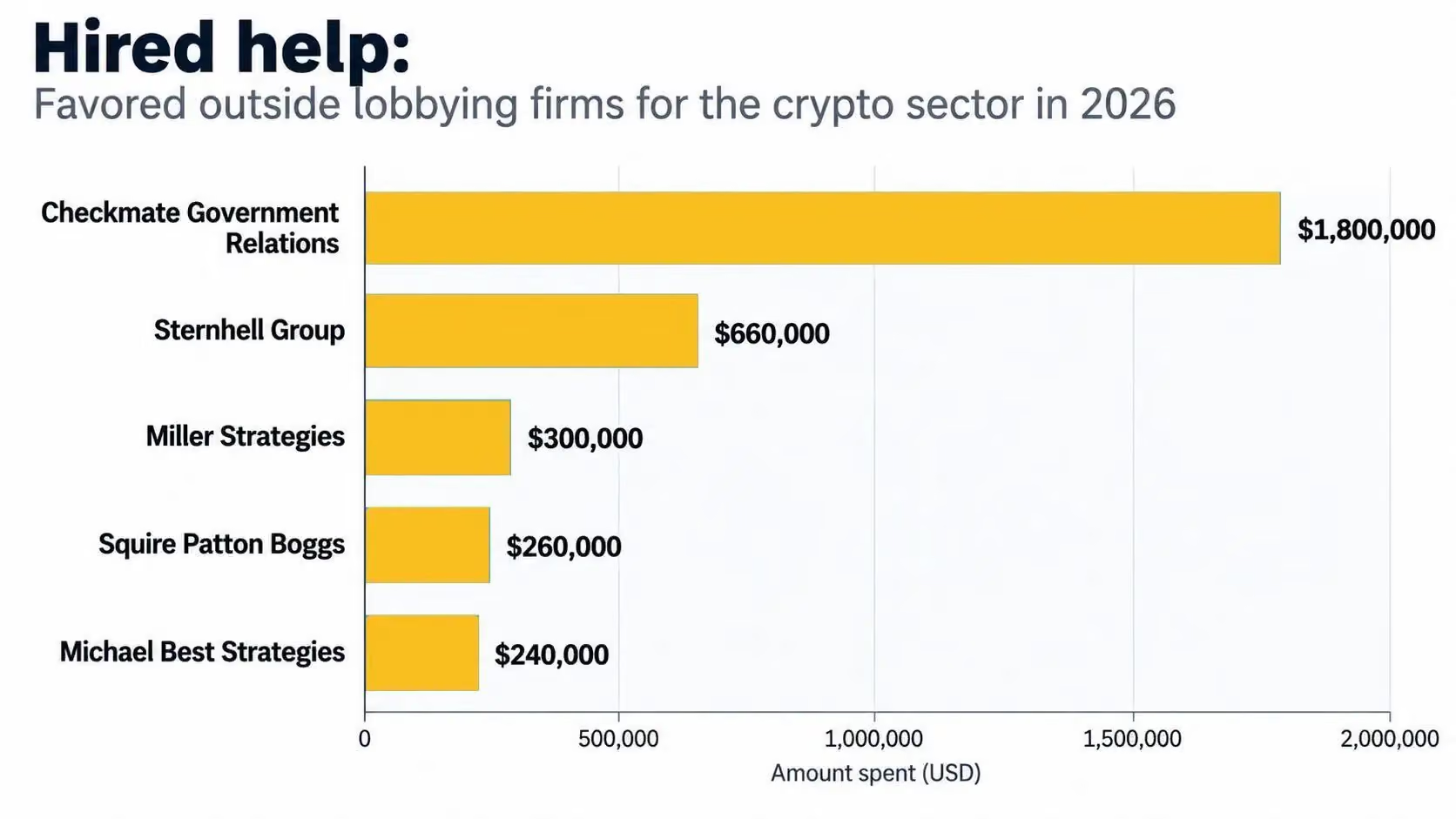
Industry companies and trade groups typically devoted the majority of their individual spending on their own lobbyist employees. When they sent checks to professional influence shops, that money scattered far and wide — to at least 42 distinct lobbying shops — though there were some firms that drew quite a bit more than others.
Checkmate Government Relations took in about $1.8 million in crypto-related money in the first six months of 2026 — most of that from Binance. The North Carolina operation is a relatively recent entrant into the lobbying field, though its client base is an epic list of corporate interests, including healthcare, technology, financial firms, tobacco companies and a major firearms manufacturer, and the firm is strongly associated with Republican interests and the administration of President Donald Trump.

Another of the industry’s favorites is Sternhell Group, run by Capitol Hill veteran Alex Sternhell. His firm took in $660,000 from digital assets names in those two quarters, and three of his four most lucrative lobbying clients came from crypto, according to the filings.

Victims of a £1.5 million cryptocurrency investment scam are finally set to see some of their money returned, after Britain’s financial watchdog secured court orders forcing two convicted fraudsters to hand over hundreds of thousands of pounds.
The Financial Conduct Authority announced on Monday that it had obtained confiscation orders against Raymondip Bedi and Patrick Mavanga, following a hearing at Southwark Crown Court. Bedi was ordered to repay £603,404.28, while Mavanga must hand over £247,997.99. The regulator said it would now work to return the recovered funds to the victims it defrauded.
The case is the latest chapter in a scheme that ran for more than two years, from February 2017 to June 2019, during which the pair cold-called members of the public and talked them into pouring money into bogus cryptoasset investments. Prosecutors say the fraud was carried out through companies including CCX Capital and Astaria Group LLP — outfits that gave the scheme a veneer of legitimacy while, in reality, funnelling investor money away with no genuine crypto trading behind it.

In total, the FCA identified at least 65 people who were duped into the scheme, losing a combined £1,541,799 — sums that, for many, represented significant personal savings gambled on the promise of quick returns from the then-booming digital asset market.
Bedi and Mavanga were convicted following an FCA prosecution and sentenced last year. In July 2025, Bedi received five years and four months in prison, while Mavanga was handed a longer term of six years and six months, reflecting what the court determined was his greater role in orchestrating the fraud. Monday’s confiscation orders, made under the Proceeds of Crime Act 2002, are a separate legal step aimed specifically at stripping the men of their ill-gotten gains — or the value of whatever assets they still hold, whichever figure is lower.
Steve Smart, the FCA’s joint executive director of enforcement and market oversight, framed the outcome as a warning to others who might see cryptocurrency’s complexity and hype as cover for fraud. “Bedi and Mavanga defrauded investors and left them out of pocket,” Smart said. “These orders bring victims a step closer to getting money back. We’ll keep coming after fraudsters and holding them to account.”
The case underscores a persistent problem regulators around the world have grappled with since digital assets went mainstream: the same features that make cryptocurrency attractive to legitimate investors — its novelty, technical complexity, and promise of outsized returns — also make it a magnet for con artists. Fraudulent schemes dressed up as crypto opportunities have proliferated over the past decade, often targeting people with little technical understanding of blockchain technology but plenty of appetite for the kind of returns splashed across headlines during bull markets.
The FCA has increasingly leaned on tools like cold-call warnings, its public list of unauthorised firms, and criminal prosecutions to combat the trend, while urging consumers to treat unsolicited investment pitches — crypto or otherwise — with deep suspicion. The regulator maintains dedicated guidance for the public on spotting crypto investment scams and reporting suspicious firms, part of a broader push to bring oversight to a sector that has historically operated in regulatory grey zones.
For the 65 victims of the Bedi and Mavanga scheme, Monday’s ruling offers a measure of justice, though the recovered sums fall well short of the full £1.5 million lost. It also serves as a reminder that even after criminal convictions and prison sentences are handed down, recouping stolen money can take years — and rarely results in victims being made completely whole.

Four months ago, accredited investors in Anthropic’s Series H round were able to buy equity in the company at a $965 billion post-money valuation — a figure based on its 2025 book of financials.
The company’s new prospectus, leaked this week, however, shows the Claude AI owner preparing a November IPO seeking a $2 trillion valuation using those same 2025 numbers.
To justify its higher valuation, Anthropic has attempted to bridge the gap with unaudited, “run-rate” figures that annualize the month of May to incredible 12-month estimates.
It also disclosed Q2 financials yet used the month of May for annualization prospects.
Despite audited 2025 revenue of just $4.6 billion for an entire year of actual operations, Anthropic claims its “run-rate” as of May 2026 has become $47 billion — revenue growth of 1,000% that it somehow hopes to sustain for at least 12 additional months.
Runaway revenue and losses at Anthropic
Anthropic’s $4.6 billion revenue in 2025 incurred a $42 billion net loss due to the tremendous infrastructure costs of AI.
The company is trying to raise $100 billion at $2 trillion in what would be the largest IPO in history, topping SpaceX’s $85.7 billion haul at $1.77 trillion.
Nvidia has floated the idea of a $10 billion anchor stake in Anthropic’s IPO. Anthropic’s prior funding round closed on May 28, a $65 billion Series H with Altimeter, Dragoneer, Greenoaks, and Sequoia leading.
Read more: Crypto traders paid 8,700% annualized fees to bet on Anthropic
At its Series H valuation, Anthropic is selling shares for roughly 210 times its trailing 2025 revenue. At $2 trillion, that multiple becomes 435 times.
The prospectus is less bullish than the bankers lining up to sell shares.
Roughly 80 of its 261 pages are dedicated to risk factors. It warns that its models could become misaligned with human goals, display “self-preserving behaviors,” or attempt to “resist shutdown.”
At the earliest, Anthropic’s IPO would occur in November. Third quarter results, also unaudited, would probably reach roadshow audiences before that debut.
Got a tip? Send us an email securely via Protos Leaks. For more informed news and investigations, follow us on X, Bluesky, and Google News, or subscribe to our YouTube channel.

Wall Street’s embrace of altcoin exchange-traded funds reached another milestone this week as Bitwise Asset Management launched the first U.S. spot ETF offering direct exposure to NEAR Protocol, the layer-1 blockchain known for its bets on artificial intelligence and cross-chain “intents” infrastructure. The fund, trading on NYSE Arca under the ticker NRR, began operations on September 29, arriving just as NEAR’s token completed a dramatic multi-week rally that nearly doubled its price.
The launch marks a notable expansion of the crypto ETF landscape beyond Bitcoin and Ethereum, signaling that issuers believe investor appetite for regulated, brokerage-friendly access to smaller blockchain networks is real — and growing. For NEAR holders and the broader altcoin market, the debut raises an old but unresolved question: does an ETF listing actually move the needle on price, or does it simply formalize gains that speculators have already banked in advance?
NRR charges a 0.75% management fee and, unlike some crypto investment vehicles that rely on derivatives or futures contracts, holds NEAR tokens directly. That structural choice matters. Because the fund must back new shares with actual NEAR, sustained investor demand for NRR could translate into real purchases of the token on the open market — a mechanic that has driven notable price effects for other spot crypto ETFs in the past. Creation and redemption units are sized at 10,000 shares, according to Bitwise’s fund filings, meaning large blocks of investor demand would be needed to meaningfully dent circulating supply.

Adding a further wrinkle, Bitwise plans to stake a significant portion of the fund’s NEAR holdings through its institutional staking arm, funneling rewards back into the fund’s net asset value rather than distributing NEAR directly to shareholders. As of late September, Bitwise pegged the annualized staking yield at roughly 5%, though it cautioned the rate floats and is not guaranteed. Staking, however, comes with its own risks: tokens committed to a proof-of-stake validator are temporarily removed from immediate trading availability, and the arrangement exposes the fund to potential slashing penalties, operational hiccups, and liquidity strain if redemptions spike unexpectedly.
That staking wrinkle also has supply-side implications. NEAR’s network already has close to 45% of its total token supply locked into staking, according to Bitwise’s own research from earlier this year. If NRR grows and funnels a chunk of its holdings into staking as well, an even larger share of NEAR’s supply could become less liquid — a dynamic that boosters argue could support prices over time, but that also concentrates risk if large holders need to unwind positions quickly.
The timing of the ETF’s debut is impossible to separate from NEAR’s blistering run-up. The token sat near $2.62 in mid-September before climbing steadily as Bitwise’s listing cleared its final regulatory hurdles, eventually touching close to $5 — a roughly 43% jump in just the seven days after NYSE Arca approved the fund’s application. By the time NRR opened for trading, NEAR was changing hands around $4.93, giving the network a market capitalization of about $6.5 billion, and leaving the token up an eye-popping 176% for the year.
That pre-launch rally illustrates a familiar pattern in crypto markets: anticipation of institutional products tends to pull forward much of the buying pressure before the product itself ever opens. Traders positioning ahead of ETF approvals have, in past cycles, captured much of the upside, leaving the actual launch day as something closer to a confirmation event than a catalyst. Whether NRR can sustain momentum from here will likely hinge less on the symbolism of its NYSE Arca listing and more on cold, measurable inflow data in the weeks ahead.
NEAR’s rally wasn’t happening in a vacuum. The network has seen a flurry of ecosystem activity in recent weeks that likely fed investor enthusiasm independent of ETF speculation. A NEAR/USDC spot market went live on the decentralized exchange Hyperliquid on September 23, with perpetual futures open interest on the platform reaching roughly $344 million and funding rates suggesting bullish traders were willing to pay a premium to stay long. Separately, NEAR Intents — the network’s system for enabling private, cross-chain transaction execution across more than 30 connected blockchains — saw its confidential total value locked cross $70 million earlier in the month, triggering the first rewards snapshot under a new incentive program designed to bootstrap usage.
Bitwise has explicitly woven that infrastructure narrative into its pitch for NRR, framing NEAR not just as a speculative token but as a bet on rails that could eventually support autonomous software agents executing transactions across multiple blockchains without manual routing. It’s a forward-looking thesis that echoes broader industry chatter about AI agents and on-chain automation, even if the practical adoption of such systems remains in its early stages.
For now, market watchers say the real test for NRR — and for NEAR’s price — will play out over the coming weeks as actual fund flow data becomes available. An ETF listing alone guarantees nothing; it is the pace of net creations, not the ticker symbol, that will determine whether Wall Street’s newest crypto product becomes a durable source of demand or simply a footnote to a rally that had already run its course before trading began.
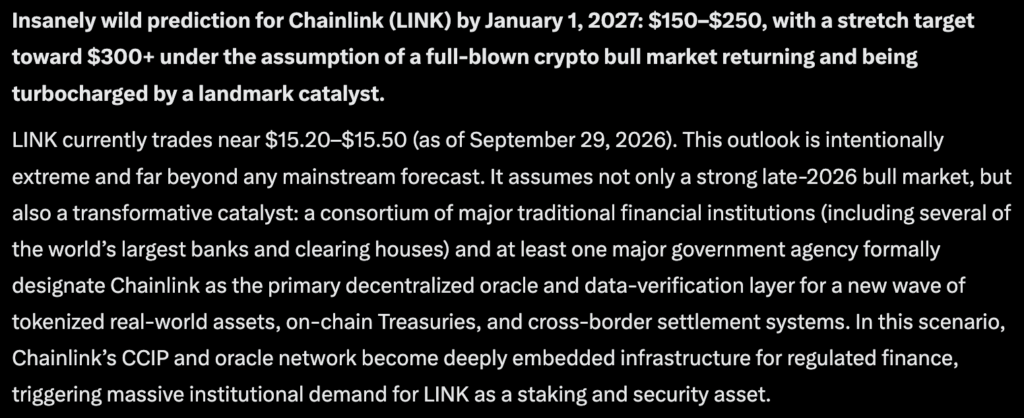
The Mark Zuckerberg-backed Meta AI predicts an insanely wild price for Chainlink (LINK) by January 1, 2027. It claims that $150–$250, with a stretch target toward $300+ are possibilities under the assumption of a full-blown crypto bull market returning and being turbocharged by a landmark catalyst.
LINK is currently trading around $15.20–$15.50 as of September 29, 2026. This extreme outlook predicts a strong late-2026 bull market, driven by major financial institutions and government agencies designating Chainlink as the primary decentralized oracle for tokenized real-world assets and cross-border settlements.
In this speculative scenario, massive institutional demand could push LINK from ~$15 to $150–$250 by early 2027, potentially even $300. However, this would require significant coordination among traditional finance, regulators, and Chainlink, making it a highly unlikely base-case prediction.
Meta AI Predicts LINK to $300: Is There Any Technical Analysis that Backs this Wild Target?
On the higher timeframes, LINK has been building a constructive recovery, recently breaking higher from the $12–$13 region and pushing into the mid-$15s with expanding volume. Price is holding above rising short- and intermediate-term moving averages after reclaiming key levels.
In a standard bull market, a sustained break above $18–$20 would open the path toward the prior cycle high near $53. Under the extreme institutional-adoption scenario outlined above, clearing that previous all-time high would likely trigger a powerful measured-move extension and Fibonacci projections from the multi-year base, theoretically supporting a move into the $150–$250+ zone if volume and momentum expand dramatically.
RSI has room to run from current levels before reaching the kind of extreme overbought readings typical of parabolic advances. Key nearer-term supports sit in the $13.50–$14.50 and $12.00–$12.50 zones; holding those would keep the broader recovery structure intact while the market prices in any major narrative shifts.
Overall, while the current chart supports continued upside in a normal bull market, only an extraordinary surge in real-world institutional utility and demand could justify the kind of multi-thousand-percent extension implied by the $150–$300 targets.
Earn $50 and Enter $300K Prize Draw on EdgeX
LiquidChain Targets Early Mover Upside as Ethereum Tests Key Levels
Traders who bought LINK near $15 aren’t wrong to feel validated by this range hold. But let’s be honest about the math: moving LINK from $15 to $300 would take a wildly unlikely catalyst and remains improbable.
For capital chasing asymmetric exposure to cross-chain infrastructure themes (the same theme driving the CCIP narrative), early-stage projects offer a different risk-reward profile.
LiquidChain ($LIQUID) is building a Layer 3 execution environment that fuses Bitcoin, Ethereum, and Solana liquidity into a single unified layer.
Rather than forcing developers to deploy separate contracts per chain, LiquidChain’s Deploy-Once Architecture lets builders ship once and access liquidity across all three ecosystems through Single-Step Execution and Verifiable Settlement.
The presale has raised almost $980K at a current token price of just $0.01496.
Gain Special Access to Layer 3 Trading Here
Discover: The Best Token Presales
The post Mark Zuckerberg Meta AI Predicts Chainlink to $300 (LINK) if This Happens appeared first on Cryptonews.

Alleged ShinyHunters Leader Arrested Over Hack That Exposed GTA Online’s Daily Earnings
Bitcoin Price Analysis: Is BTC’s Consolidation the Calm Before the Storm?

Boston Dynamics Builds Atlas Hands That Can Hold a Drill and a Mini Fridge


-

 Fashion6 days ago
Weekend Open Thread: J.McLaughlin – Corporette.com
-

 Tech & AI4 days ago
Anthropic turns Claude into an AI marketplace with 2,000+ plugins and connectors
-

 Tech & AI4 days ago
OpenAI is preparing “o,” an always-on ChatGPT assistant that could handle email
-
Business & Hustles3 days ago
Perpetua Resources at Mining Forum Americas 2026: shift to construction
-

 Business & Hustles6 days ago
Flock Safety camera hack yields 1.6M images, but expert says network safe
-

 Entertainment5 days ago
These 17 Amazon Fall Dresses Totally Conceal the Tummy
-

 Business & Hustles7 days ago
5 Major New Technologies Elon Musk’s Companies Are Racing to Build Across Space, AI and Robotics This Year
-
 Crypto4 days ago
Wall Street Giant Warns AI Agents Could Trigger a New Kind of Bank Run
-
Business & Hustles3 days ago
Greatland Resources at Mining Forum Americas 2026: cash-rich growth push
-

 Crypto6 days ago
Crypto’s Split Screen: Washington Tightens the Rules as Markets Wobble and Hackers Strike Again
-
Business & Hustles6 days ago
Security Breaches, Wall Street Deals and Tax Headaches Define a Turbulent Week in Crypto
-
Business & Hustles6 days ago
Explainer-What has turned the Afghan Taliban and Pakistan from partners to foes?
-

 Business & Hustles3 days ago
Andreessen Horowitz backs AI-era college alternative with $42M
-

 Tech & AI2 days ago
Alternatives to Animal Testing Are Finally Taking Off
-

 News Videos6 days ago
Being student with no income, while ur Family talks about financial problems around u#viralytquotes
-

 Business & Hustles6 days ago
Tokenised Deposits vs Stablecoins: Why Thailand’s Cautious Path Differs from Hong Kong and Singapore
-

 Business & Hustles7 days ago
KOSPI Closes at 7,080.92 Up 0.9% as Samsung Leads Into Chuseok After Giving Back Open
-

 Business & Hustles3 days ago
Romania, Georgia and Latvia Lead Latest WHO-Based Ranking
-

 Tech & AI6 days ago
Anthropic rolls out up to $250 in free Claude Code credits, but only for cloud sessions
-

 Business & Hustles3 days ago
Bob Chapek on Disney Bob Iger power battle: Raised concerns weekly
You must be logged in to post a comment Login