
Crypto
CLARITY Act Vote and Fed Rate Decision to Watch

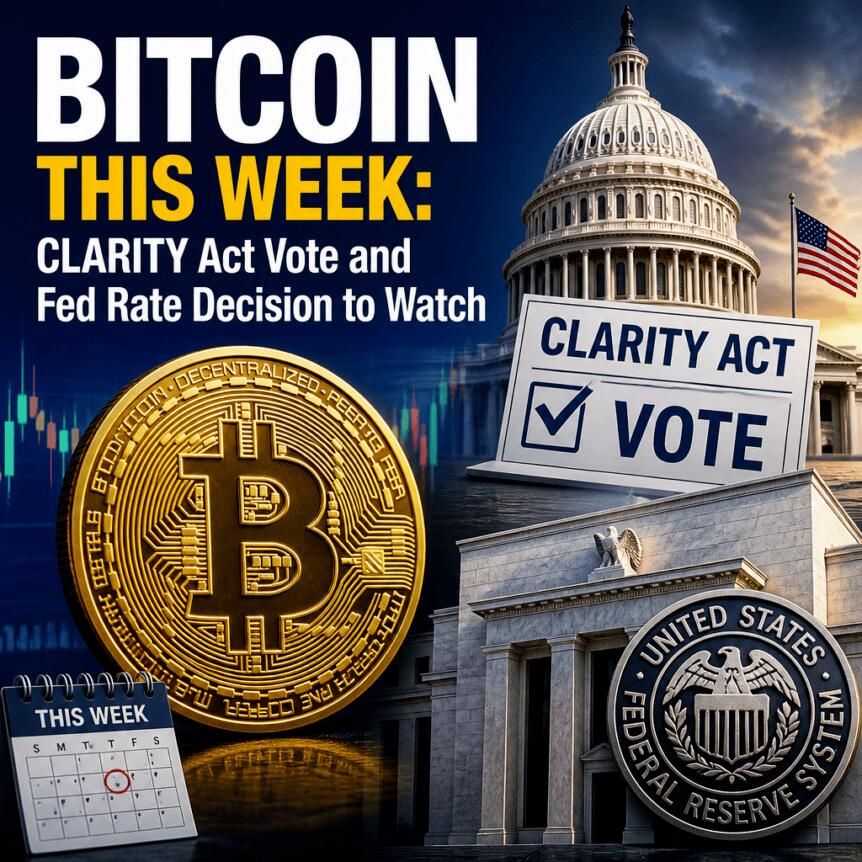
Bitcoin is entering the third week of September trading beneath important weekly support levels, with traders bracing for two closely watched US catalysts: a Federal Reserve interest-rate decision on Wednesday and a Senate procedural vote on the proposed CLARITY Act on Tuesday.
While macro expectations and policy headlines are driving near-term caution, market structure remains mixed. On the one hand, funding-related indicators point to an ongoing build-up of bullish leverage. On the other, Bitcoin’s latest weekly close failed to hold the technical thresholds that bulls had been defending.
Key takeaways
- CME Group’s FedWatch pricing has shifted toward another rate hike, with the probability of holding steady around 13.3% at the time of writing.
- The Senate is set to hold a procedural vote on the CLARITY Act Tuesday, a step that could send the bill to the floor if it clears.
- Crypto sentiment data from Santiment shows a notable drop in Bitcoin open interest in the week through Sept. 11, suggesting traders trimmed exposure ahead of volatility.
- CryptoQuant’s research highlights a return of positive aggregate funding rates since late May, indicating longs are increasingly paying shorts.
- Technically, Bitcoin closed below its 50-week EMA near $77,380, while RSI divergence remains a lingering bullish factor.
Fed decision becomes the main volatility trigger
For risk assets, Wednesday’s Fed outcome is the centerpiece. Multiple policy dynamics are converging: persistent inflation concerns, energy-driven price pressures, and ongoing debate within the central bank about whether rates should be raised.
According to CME Group’s FedWatch Tool, markets were pricing in a low likelihood of a pause. At the time of writing, the implied probability of rates staying at current levels was about 13.3%. Cointelegraph previously noted that markets had reacted differently to earlier decisions—especially around periods when Chair Kevin Warsh kept rates unchanged while some officials preferred a hike—setting up a backdrop where trader expectations can swing quickly.
The shift in pricing comes as inflation data did not deliver major upside surprises, but crude oil has remained a headwind. Markets reacted hawkishly despite the CPI and PPI prints, reflecting elevated energy costs and the sense that supply constraints may not be easing.
Commentary from The Kobeissi Letter emphasized how disruptions tied to key maritime routes could intensify the energy shock. In an X post cited by Cointelegraph, the account warned that roughly 30 million barrels per day may be unable to transit through certain routes, with additional risk flagged for the Bab el-Mandeb Strait. It also pointed to consumer inflation expectations rising, with gas prices and tariffs frequently referenced as contributors.
CLARITY Act vote turns into a near-term sentiment test
Alongside the Fed, US legislative progress on crypto regulation is on the calendar. Tuesday’s Senate procedural vote on the CLARITY Act could become a catalyst for speculative positioning because it determines whether the bill advances toward debate on the floor.
On Monday, Senate Republicans released what they described as their “last, best and final offer” for the Act’s text after bipartisan negotiations aimed at producing a clearer legal framework. Senator Cynthia Lummis, who released a 635-page updated proposal, said the bill was ready following a year of negotiations. She also highlighted ethics restrictions in the proposal and argued that a procedural “no” would oppose reforms and leave US digital-asset markets with insufficient protections.
The procedural step requires 60 votes to pass, with a vote scheduled for 2:15 pm on Tuesday. If the bill clears, it can move to the Senate floor for debate. If it fails, traders are likely to reassess the timeline for regulatory clarity—an uncertainty that can spill over into broader risk appetite.
Market expectations for passage remain cautious. On Polymarket, odds of the CLARITY Act being signed into law in 2026 were cited at about 34% at the time of reporting, with higher probabilities last seen earlier in August.
Derivatives positioning: traders de-risk before headlines
In the lead-up to Tuesday’s Senate vote and Wednesday’s Fed announcement, multiple analytics snapshots suggested traders were adjusting exposure rather than leaning aggressively into the next move.
According to Santiment’s analysis of open interest across exchanges, positioning had already shifted ahead of the two headline events. Santiment commented that the market appeared to have “already made its move,” pointing to the idea that derivatives participants had started preparing for volatility.
Specifically, Santiment data showed Bitcoin open interest in BTC terms falling 13.5% in the week through Sept. 11—down from about 321,497 BTC to roughly 278,151 BTC—followed by only a modest rebound. Over the same period, spot price was reported to have fallen about 5%. Santiment also stated that positioning sat around 20% below levels seen before the mid-August rally.
In practical terms, that matters because reduced open interest often limits how much leverage can amplify price swings. Still, a decline in open interest can also be consistent with traders waiting on confirmation from upcoming policy decisions.
Funding rates stay bullish as Bitcoin trades near $80,000
Even as traders trimmed derivatives exposure, onchain research pointed to continued improvement in sentiment reflected by funding rates. CryptoQuant argued that new signals in perpetual funding suggest bullish pressure building as BTC/USD trades near the $80,000 area.
CryptoQuant noted that aggregate funding rates have gradually risen since the end of May, after a period of negative funding that began in early March. Funding rates—driven by the balance of long and short demand—can reveal whether the market is paying to hold longs or shorts.
In the research cited by Cointelegraph, CryptoQuant described how bearish sentiment had prevailed during a “disbelief phase,” during which funding rates reflected one of the most bearish readings in Binance derivatives. It suggested that the buildup of shorts after a roughly -52% drawdown contributed to the rally seen in May.
CryptoQuant further observed that negative cumulative 30-day funding rates on Binance tended to line up with late-stage bear markets and with major corrections inside bull-market periods. This pattern-based framing is useful for traders, but it does not eliminate uncertainty—funding can remain bullish even if price action later fails to follow through.
Cointelegraph also previously reported concerns about the lack of spot-market participation in Bitcoin’s upside, implying that derivatives-led momentum may not always translate into sustained spot-driven uptrends.
Weekly structure weakens: support breaks under the 50-week EMA
Technical analysis remains the clearest immediate map for where risk may rise or fall. Bitcoin’s latest weekly close did not hold the levels bulls were watching.
As reported, Bitcoin ended the Sunday weekly close around $76,800 after failing to defend key support. Trader and analyst Rekt Capital said that $78,300 was necessary to hold at the weekly close. Failure to do so, he warned, could reopen the possibility of repeating the “failed breakout” pattern seen earlier in May.
Rekt Capital also pointed to a chart of lower highs, suggesting Bitcoin continues to preserve a longer-term bearish market structure. The weekly close was additionally below Bitcoin’s 50-week exponential moving average at about $77,380—a trend line that bulls typically want reclaimed as part of a more durable bullish shift.
Looking to the next technical level, Rekt Capital referenced the 21-week EMA near $72,270 as a potential line in the sand. He added that both the 21-week and 50-week EMAs often act as support in bull markets, and that losing them sustainably would be evidence that Bitcoin is not yet in a fully established bull cycle.
Despite these weaknesses, a bullish factor remains in the background: Bitcoin’s RSI kept higher lows through 2026, maintaining a “weekly bullish divergence” that some analysts treat as a supportive signal even when price temporarily dips.
What to watch next
With the Senate vote on the CLARITY Act and the Fed’s Wednesday rate decision approaching, traders may continue to reshape risk quickly—especially if derivatives positioning swings alongside any procedural or macro outcome. Beyond the headlines, investors should monitor whether Bitcoin can reclaim the 50-week EMA area and whether RSI divergence continues to hold as confirmation, or fades as support weakens.


Hut 8-owned BTC mining firm, American Bitcoin, has dramatically underperformed BTC since its reverse merger which allowed it to become publicly listed.
American Bitcoin has lost approximately 92% of its value (after accounting for its reverse stock split) since its merger.
BTC by comparison has lost a mere quarter of its value.
American Bitcoin claims that it “was formed through the strategic contribution of substantially all of Hut 8’s ASIC fleet into a new venture led by Eric Trump and Donald Trump Jr.”
More specifically, Eric Trump served as chief strategy officer during this >90% decline.
Donald Trump Jr. provides advice to the firm in his role as senior adviser.
Together they’ve led this firm which is supposedly “a pure-play BTC accumulation platform that integrates scaled BTC mining operations with disciplined accumulation strategies” into a substantial decline that has far outpaced the decline of BTC.
Read more: Trump promised bitcoin ‘made in America’ then ruined it with tariffs
American Bitcoin reported a net loss of over $150 million for 2025.
For the first six months of 2026 it has added to those with an additional $138 million in net losses, largely driven by the falling price of BTC.
The recent rebound in BTC prices will likely reduce some of those losses in future quarters if it doesn’t fall again.
Got a tip? Send us an email securely via Protos Leaks. For more informed news and investigations, follow us on X, Bluesky, and Google News, or subscribe to our YouTube channel.
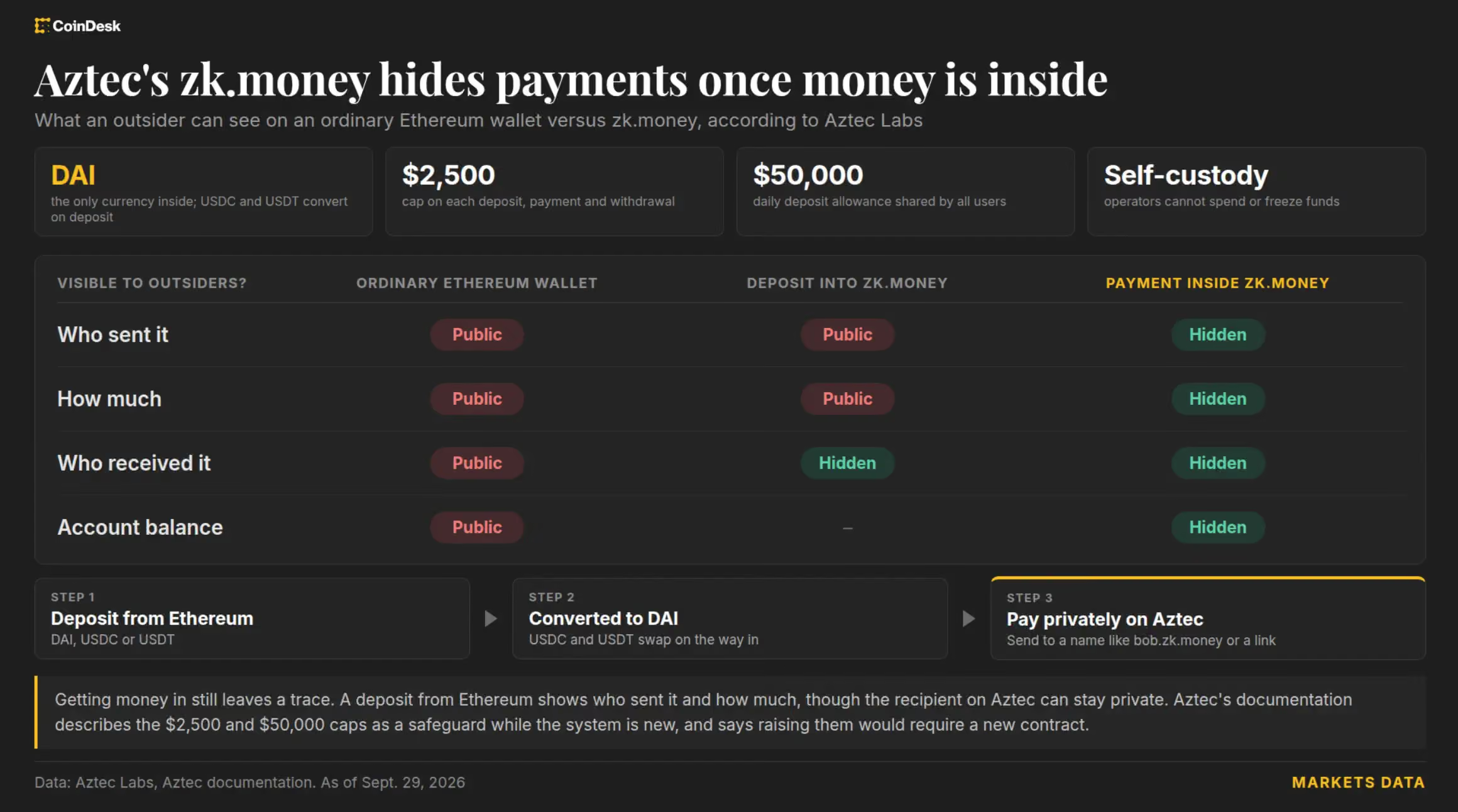
“Onchain transactions between two individuals shouldn’t mean publishing your financial history to the world,” Joe Andrews, CEO of Aztec Labs, said in a statement.
Andrews added that Aztec Labs chose DAI because it considers it “the most decentralized of the mass-market stablecoins used today on Ethereum.” He said the wallet could support other assets later.

Ethereum already has apps that hide payments, though transfers from an ordinary wallet remain public. Its developers are weighing changes for the planned 2027 Hegotá upgrade that could let privacy apps handle transaction approvals and fees with less help from outside services. Those proposals are still under consideration, while Aztec Labs is bringing back a wallet people can use on its own network.
Read More: Ethereum’s next big upgrade has 66 proposals, including a major privacy fix
What zk.money can and cannot hide
Moving money into the system still leaves a public trace, however. Aztec’s documentation says a deposit from Ethereum reveals the sender and amount, even though the recipient on Aztec can remain private.
The relaunch comes with limits, however. Each deposit, payment and withdrawal must be below $2,500. All users share a $50,000 daily deposit allowance, which replenishes over time. The documentation describes those caps as a safeguard while the system is new and says raising them would require a new contract.
Author: Cryptoman
Cryptocurrency is edging further into the financial mainstream this year, even as the industry’s relationship with traditional banking and regulators remains fraught in key markets like the United Kingdom. From Morgan Stanley’s new laboratory for testing tokenized finance to a British parliamentary group’s pointed letter to bank chief executives, the story of crypto in late 2026 is one of institutions moving cautiously toward digital assets while grappling with unresolved questions about risk, access and regulatory readiness.
On Wall Street, the direction of travel is unmistakable. Morgan Stanley has launched a Digital Asset Lab dedicated to testing stablecoins, tokenized deposits, central bank digital currencies, money-market funds and decentralized finance vaults, according to reporting by Bloomberg. The lab, part of the bank’s existing network of innovation hubs, allows employees to experiment with blockchain-based applications without touching Morgan Stanley’s core systems — a sandbox approach that mirrors, in miniature, the kind of controlled testing environments regulators elsewhere are trying to build.
Megan Brewer, who leads market innovation and labs at the bank, told Bloomberg the team is exploring how software might execute investment strategies around the clock, a question that goes to the heart of what tokenization promises: markets and money that never sleep. The lab’s remit spans the technical distinction between a tokenized deposit, which represents a claim on money held at a bank, and a stablecoin, which is backed by a separate pool of assets — a distinction that has become increasingly important as regulators worldwide try to draw clear lines around different forms of digital money.
This research effort builds on products Morgan Stanley has already brought to market. In April, the firm launched a Stablecoin Reserves Portfolio designed to help stablecoin issuers meet reserve requirements under the U.S. GENIUS Act, holding cash, short-dated Treasurys and repurchase agreements. Its E*TRADE platform completed a rollout letting eligible clients trade Bitcoin, Ether and Solana directly, while three separate exchange-traded products tracking those same assets have drawn tens of millions of dollars in inflows since launching earlier this year. Together, these moves suggest a major Wall Street institution treating crypto not as a speculative sideline but as infrastructure worth building out across trading, custody and reserve management.
The contrast with the United Kingdom is instructive. There, momentum is real but noticeably more contested. Lord Kulveer Ranger, co-chair of Parliament’s All-Party Parliamentary Group on Digital Markets and Digital Money, recently offered a candid assessment of where the Bank of England stands on stablecoins and the prospect of a digital pound. His verdict, after 18 months of engagement: the Bank is listening, but it is cautious — and caution alone, he argues, will not be enough to keep Britain competitive.
Ranger’s core complaint is about tempo. While the Bank of England takes its time absorbing feedback on systemic stablecoin rules, other jurisdictions are moving ahead with their own frameworks, some more permissive and some more experimental. Capital and confidence, he warns, do not wait for perfect policy alignment. He points to the Bank’s Digital Securities Sandbox — a testing ground for distributed ledger technology in capital markets — as a case in point: enthusiasm within the Bank has not translated into enthusiasm among firms, many of whom see sandbox participation as costly in time and resources with an unclear payoff. Without a credible bridge from experimentation to real-world deployment, he argues, elegant regulatory frameworks risk attracting interest without retaining commitment.
That tension between innovation and caution is playing out concretely in the banking sector itself. In August, the UK’s Crypto and Digital Assets APPG wrote directly to the chief executives of every major British bank, demanding explanations for why crypto and digital asset firms continue to struggle to open basic bank accounts. The letter, signed by co-chairs Gurinder Singh Josan and Lord Vaizey of Didcot, cited persistent reports of firms being shut out of banking services or having crypto-related payments restricted outright — even as the UK moves toward a comprehensive regulatory regime for the sector.
The APPG’s language was blunt: banking access, the letter said, “could be one of the single biggest barriers to growth” for UK crypto businesses, with the potential to undermine the very regulatory regime the government is trying to build and to influence whether firms choose to invest in Britain at all. Notably, the group acknowledged that banks have legitimate obligations to guard against financial crime, but argued that decisions should be based on individual firms’ risk profiles rather than blanket sector-wide exclusion. That view echoes an assurance given in Parliament back in March by Economic Secretary to the Treasury Lucy Rigby, who told MPs that firms authorized by the Financial Conduct Authority should not face banking restrictions simply for operating in crypto.
The letter is now feeding into a formal Parliamentary Inquiry into banking access for the sector, which gathered written evidence from banks, crypto businesses and regulators through the end of August before a report and recommendations to government.
Taken together, these developments capture an industry at an awkward but consequential midpoint. In the United States, a heavyweight institution like Morgan Stanley is quietly normalizing crypto exposure across trading platforms, exchange-traded products and now dedicated research infrastructure, treating stablecoins and tokenization as inevitable features of modern finance rather than fringe experiments. In Britain, meanwhile, the debate remains more elemental: not just how sophisticated the regulatory framework should be, but whether crypto businesses can even get a bank account in the first place.
Both stories point to the same underlying reality. Cryptocurrency’s next phase of growth will be determined less by technological breakthroughs than by the willingness of banks, regulators and central banks to treat digital assets as a normal, if carefully managed, part of the financial system. Wall Street appears to be answering that question with capital and infrastructure. Westminster and Threadneedle Street, for now, are still working out the terms.
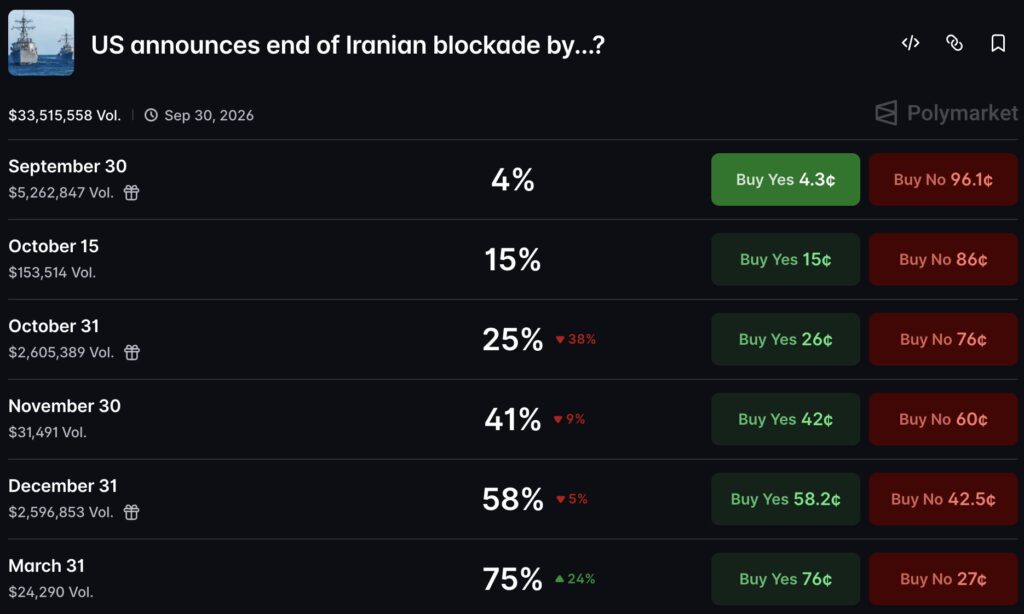
Iran War Polymarket odds price a US announcement ending the naval blockade of Iran no earlier than March 31, 2027, with the contract trading at 74.5% Yes to 25.5% No as of mid-morning on Tuesday, 29 September, according to live pricing on the platform.
The event has logged over $33M in cumulative volume since launch, and the highest-priced outcome sitting nine months out raises an obvious question: if US-Iran talks are genuinely progressing, why is the smart money betting on delay rather than a near-term resolution?
Got a Gut Feeling? It Could Pay Out Big on Polymarket
Iran War Polymarket Odds: What is the Diplomatic Backdrop Traders Are Watching?
Pricing is influenced by ongoing negotiations, as Reuters reported on September 24. U.S. and Iranian negotiators are considering a phased deal where Tehran would reopen the Strait of Hormuz in exchange for lifting the U.S. economic blockade. Both sides are hesitant to yield leverage; the U.S. maintains economic pressure, while Iran controls a key shipping artery for global oil.
However, current conditions do not trigger resolution under market rules. Polymarket specifies that only official announcements from the U.S. government can count for contract resolution, excluding speculation or conditional statements.
This discrepancy between market sentiment and strict legal requirements is causing outcome expectations to shift later in the timeline. Observers can also see how the Iran-U.S. ceasefire proposal is affecting Bitcoin price expectations, reflecting broader risk sentiment.
Iran says it struck 19 ships in the Strait of Hormuz over the past two nights, Fars News Agency reported Sunday, after Kpler reported over 20 million barrels of crude and products exiting the US blockade line as 7-day average.
Iranian forces hit 12 vessels Friday night and 7… https://t.co/UnVeYf99k0 pic.twitter.com/LP8tZknZqo— Drop Site (@DropSiteNews) September 27, 2026
What the Full Ladder of Contracts Actually Shows
Polymarket’s blockade market features multiple deadline contracts that gauge the odds of a qualifying announcement on specific dates. These contracts can’t be combined into a single event probability, as each one represents a distinct bet.
Together, they suggest traders expect the diplomatic process to extend beyond the current news cycle. Once a qualifying announcement is made, it resolves as “Yes,” even if the blockade later continues or if a partial concession is made; such concessions do not qualify.
This distinction is important, as past U.S.-Iran ceasefire agreements have quickly unraveled, reflecting a tendency for narrower resolutions, similar to market bets on the Bab-el-Mandeb Strait, which require specific triggers for resolution.
Got a Gut Feeling? It Could Pay Out Big on Polymarket
Total volume across the event stands at $33,486,973, with liquidity of $519,322 as of the last update at 09:07:57 UTC Tuesday. The March 31, 2027 contract – the current price leader – carries relatively thin volume of just $24,290, meaning its 74.5% Yes print reflects a smaller pool of capital than the headline number suggests.
The heaviest trading has run through nearer-dated contracts already priced for near-certain No outcomes: the September 30 deadline alone has drawn $5,238,179 in volume against a mere 3.3% Yes price, and October 31 has seen $2,604,557 change hands at 24.5% Yes.
December 31 sits between the two extremes at $2,596,836 in volume and 57.9%. Yes. That distribution suggests most capital has already been deployed betting against a quick resolution, leaving the March contract as a comparatively low-conviction, low-liquidity outlier at the top of the ladder, a dynamic worth weighing against how Polymarket’s NATO-related contracts have similarly shown thin markets producing headline-grabbing but fragile probability prints.
The post Iran War Polymarket Odds: $33.5M Placed on a 2027 Blockade End appeared first on Cryptonews.

BlockTower Capital founder Ari Paul has accused Coinbase of losing $25 million of his company’s funds while covering up over $1 billion worth of “massive and repeated hacks.”
Paul claims that at least a dozen firms are affected by the alleged cover-up, and that Coinbase “still wouldn’t return our money.”
He also claims that these major allegations are all he can say at the moment as there are “multiple legal processes still ongoing.”
Read more: Coinbase and Brian Armstrong are threatening to leave California… again
BlockTower Capital is a crypto and traditional asset investment firm founded in 2017 by Paul and Goldman Sachs executive, Matthew Goetz.
Two executives left the company in 2022 and 2023 for mysterious reasons, while the company also shuttered its $100 million Market-Neutral Fund in 2023.
Coinbase claims it isn’t covering up hacks
When asked for comment, Coinbase directed Protos to a support post that claimed the exchange “is not hiding a series of hacks and we certainly didn’t lose $1 bilion.”
It said that it advises customers on security practices like maintaining their API keys, and that like most other firms that offer access via API keys, “we do not retain the information necessary to transact on customer accounts.”
Coinbase refused to comment on specific clients.
Coinbase allegations made against Cobie
Paul was responding to a series of posts shared by Cobie, a prominent crypto investor who became a glorified customer support representative for Coinbase.
Cobie was pointing out to X user “Kuno” that they’d been ignoring the crypto exchange’s attempts to reach out to them.
Kuno, on the other hand, claimed they repeatedly approached Coinbase over $1.2 million it had allegedly stolen.
Cobie noted that Kuno was promoting a “shitcoin” and that the whole affair looks like “an entirely fake/scam report/engagement farm.”
Cobie hasn’t responded to Paul’s allegations at the time of writing.
Coinbase sued over $55M draining hack
Coinbase was sued back in May for allegedly withholding a portion of $55 million in crypto that was stolen in a draining hack in August 2024.
The victim claims he lost his crypto after clicking on a malicious link that spoofed Ethereum DeFi management tool “DefiSaver.”
Read more: Coinbase CEO admits content coins were a mistake
From here, he unknowingly authorized a smart contract permission that supposedly gave the thieves control of his crypto wallets.
Got a tip? Send us an email securely via Protos Leaks. For more informed news and investigations, follow us on X, Bluesky, and Google News, or subscribe to our YouTube channel.

Key takeaways
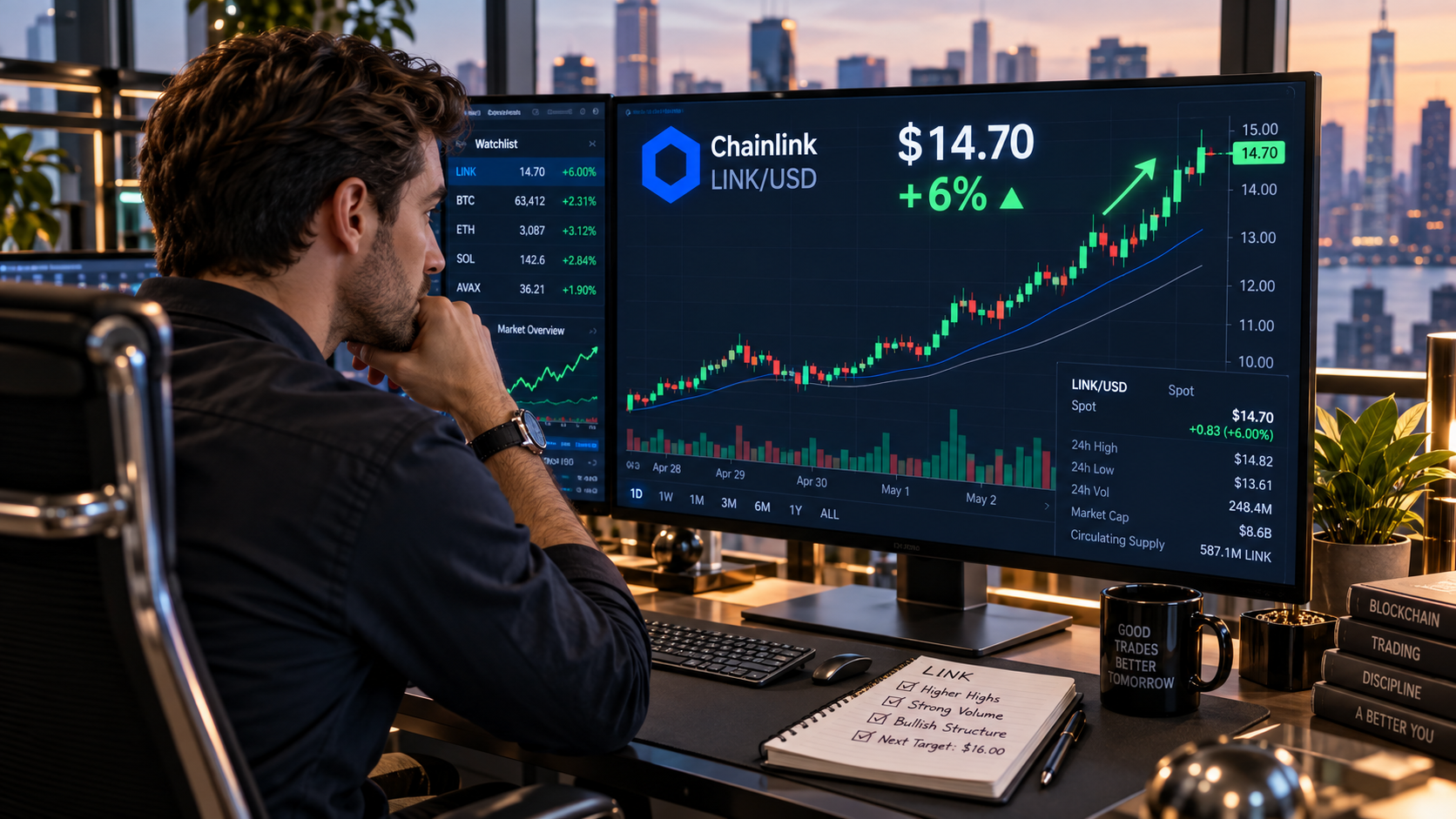
- LINK rose about 6% while much of the crypto market retreated, extending its reported 30-day gain to 30.3%.
- Chainlink’s CCIP 2.0 launch gives institutions the option to add their own cross-chain transaction verifiers.
- LINK met resistance near $15, while the supplied chart analysis identifies $12-$13 as a potential support zone.
Chainlink’s LINK token outperformed a weaker crypto market following the launch of Cross-Chain Interoperability Protocol (CCIP) 2.0.
The token gained about 6% in the session described in the supplied analysis, taking its 30-day advance to 30.3% and its year-to-date return into positive territory.
The upgrade gives financial institutions more control over transactions that move data or assets between blockchains.
Traders appeared to welcome the announcement, though LINK’s approach to $15 brought a technical test after its recent rally.
CCIP 2.0 adds institution-operated verifiers
Cross-chain transfers require a way to confirm that an action occurred on one blockchain before a corresponding action is completed on another. CCIP provides that communication layer.
With version 2.0, institutions and asset issuers can add Cross-Chain Verifiers to apply their own checks alongside Chainlink’s default verification network. Chainlink says starter kits will let users run those verifiers on infrastructure including Amazon Web Services and Google Cloud.
The added checks could matter to firms with internal security or compliance requirements. An issuer, for example, may want a transfer to proceed only after its own verifier has approved it.
CCIP 2.0 also offers configurable compliance controls, fees, and execution options, allowing users to choose how a transaction is checked and completed. These features are optional; Chainlink says its existing verification network remains the default.
Speed is another part of the upgrade. CCIP 2.0 supports faster-than-finality transfers where a user’s chosen risk settings permit them.
Chainlink also says it is working to support Ethereum’s Fast Confirmation Rule when that feature launches. Its future integration should not be treated as a speed improvement already available for every Ethereum transfer.
The supplied market analysis reported an 89% jump in LINK trading volume following the CCIP 2.0 announcement.
Higher volume shows that more tokens changed hands during the move, but it does not, by itself, show whether buyers will remain in control.
The same analysis cited a recovery in Chainlink’s total value secured from about $43 billion in June to $57 billion in August. That metric describes value associated with assets using Chainlink services; it is distinct from revenue earned by Chainlink or the market value of the LINK token.
The product announcement gives traders a reason to reassess Chainlink’s role in institutional blockchain infrastructure. Even so, a network upgrade does not automatically create immediate demand for LINK. Adoption, usage, and the broader market’s direction will matter to whether the price move lasts.
Can LINK break above $15?
LINK’s advance encountered selling pressure near $15, a level the supplied daily-chart analysis identifies as immediate resistance.
It also noted a bearish divergence in the relative strength index: price strengthened while the momentum reading weakened. Such a signal can precede a pause or pullback, although it does not establish that one must occur.
If LINK retreats, the analysis places a possible support zone at 12–13. Holding that area could leave the broader recovery intact, while a decisive break below it would weaken the bullish setup.

A sustained move above $15 would shift attention toward higher levels, including the article’s $20 upside scenario. From $12, a rise to $20 would be roughly 67%, but that percentage describes a hypothetical entry and exit, not an expected return.
For now, the clearest test is whether LINK can absorb selling around $15 while maintaining support if the wider crypto market remains under pressure.

BTC’s move above $80,000 has triggered a “double-bottom breakout,” a technical analysis pattern confirming a bullish trend and opening the door for a rally to $100,000, according to Jurrien Timmer, director of global macro at Fidelity Investments.
“Bitcoin is looking particularly interesting here as it challenges key resistance at $80k. If it breaks it will confirm a double bottom targeting $100K,” Timmer wrote on X on Friday.
A double bottom looks like the letter W on a price chart. The price drops to a low, bounces, falls back to roughly the same level, then rises again. The two dips show buyers stepping in at the same price twice. The peak in the middle of the W acts as resistance. A break above it suggests sellers have run out of steam and a new uptrend may be starting.
Timmer’s chart shows bitcoin’s two lows this year at $60,033 and $57,742, with the middle peak near $82,800.
Chart patterns are not guarantees. Breakouts often fail, reversing quickly and trapping buyers who chased the move.
Still, the bullish setup is consistent with options traders positioning for more gains. The $90,000 call is the most popular bitcoin options bet on crypto exchange Deribit, with $2.45 billion in open interest. The $95,000 call follows with $2.33 billion, and the $100,000 call holds $1.79 billion. A call gives the buyer the right to buy at a set price and profits when the market rises above it.
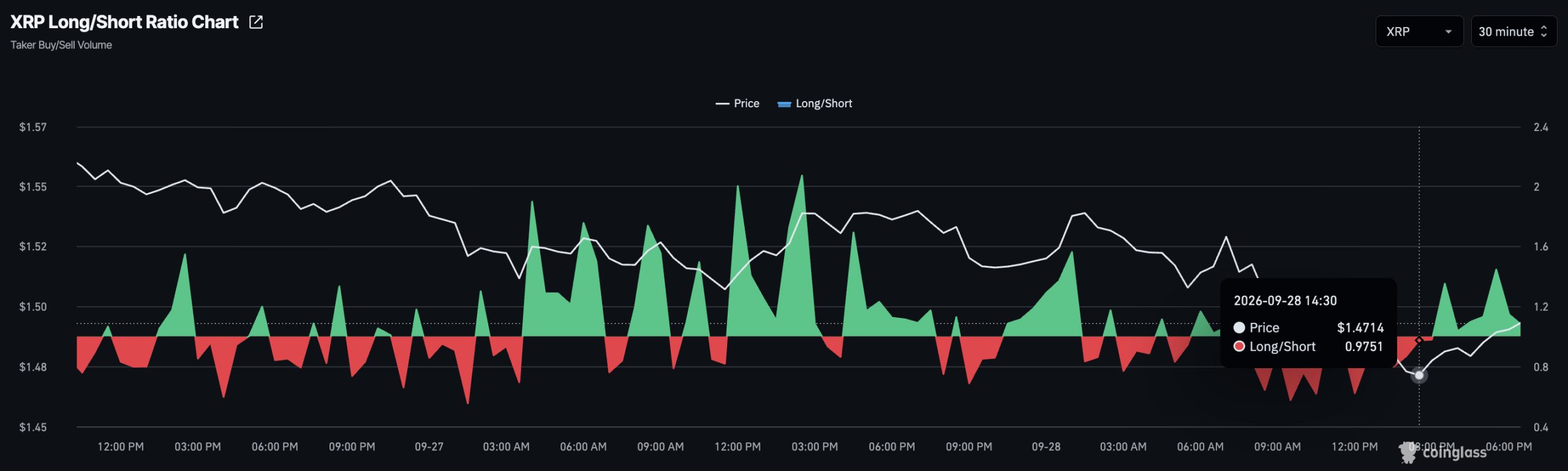
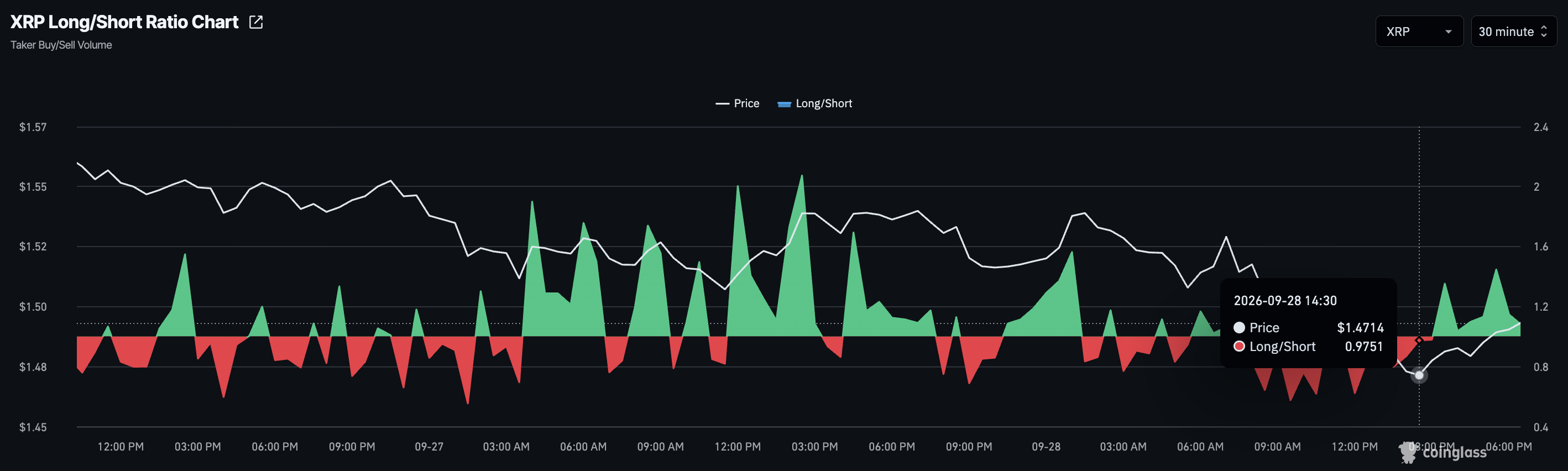
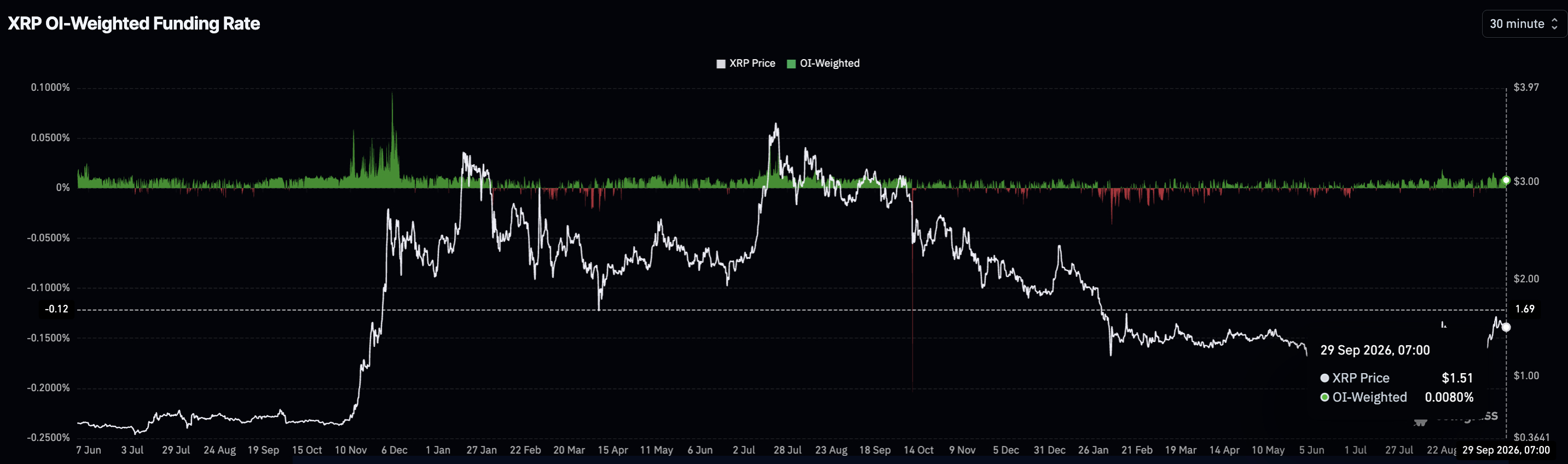
XRP price hovers under $1.49 after three consecutive daily declines left the token losing the $1.50 support, even as a modest bounce pulled it off session lows. CoinGlass data showed the long-to-short ratio at 0.975, meaning short positions marginally outnumbered longs, while the funding rate sat at a positive 0.008%, the reading that determines whether long or short traders pay a periodic fee to hold perpetual futures.
XRP Long Short Ratio, Coinglass
That combination is the crux of the problem. Traders are still paying to stay long, yet the spot price has not moved in a way that rewards the bet, and the disconnect between heavy spot selling and futures demand is the setup that tends to unwind fast once a key level gives way.
A 0.975 long-to-short ratio is not a bearish signal in any decisive sense. It sits close enough to 1.0 that it reads as near-balanced positioning rather than a market leaning hard in either direction.
XRP Funding Rate, Coinglass
Funding tells a more interesting story on its own. A positive rate means demand for long exposure in crypto derivatives is real enough that longs are compensating shorts to hold the position, which typically signals conviction that price moves higher.
However, it cuts both ways: if price falls further, those same leveraged longs become forced sellers, and a positive funding regime built on thin spot demand can flip into a liquidation cascade faster than one built on genuine accumulation.
CryptoQuant’s summary data flagged overheating conditions across both XRP’s spot and futures markets, alongside sell-side dominance in futures, meaning sellers have retained the upper hand in derivatives even as funding stays positive. That is the missing piece: positive funding shows traders are willing to hold bullish exposure, but it has not yet translated into enough buying pressure to absorb the futures selling and push through resistance. Earn $50 and Enter $300K Prize Draw on EdgeX
XRP Price and the $1.37 Support
The daily chart still leans bullish on a longer timeframe. XRP held above its 50-day price exponential moving average near $1.365 and its 200-day EMA near $1.369 through the three-day slide, with the 100-day EMA sitting lower at $1.307 as a secondary reference.
Momentum has cooled rather than reversed. The RSI sat near 55, close to neutral, and the MACD flattened around zero, a pattern consistent with consolidation after an earlier advance rather than an active breakdown.
The level that matters most sits at $1.37, where the 50-day and 200-day EMAs converge into a single support band. A clean break below that zone opens the $1.30 area, and a deeper slide would eventually put the $1.00 psychological level in play, though XRP would need to fall substantially before that becomes the immediate focus. On the upside, reclaiming the $1.574 resistance level is the trigger that would strengthen the case for a move toward $1.90.Trade XRP on Bybit and Get a Chance to Win Our $1,000 USDT Airdrop
What Happens Next for XRP?
Two scenarios frame the near-term path. If XRP holds the $1.37 zone, the market stays in a consolidation phase where positive funding continues to reflect trader appetite for long exposure, but that alone won’t confirm a breakout without a corresponding rise in open interest and spot volume.
If XRP price instead reclaims $1.574, the technical case for a run toward $1.90 gets meaningfully stronger, and that move would likely force shorts to cover into strength. The alternative is a sustained break below $1.37, which shifts focus to $1.30 as the next line of defense, with $1.00 as the deeper level only if that support also fails.
Either way, the current setup leaves no room for complacency on either side of the trade. Near-balanced positioning combined with positive funding and futures sell-side dominance is a fragile mix, and the next move in spot price will do more to settle the argument than another shift in the long-short ratio.
Discover: The Best Token Presales
The post XRP Price in Danger: Positive Funding Masks a Fragile Setup appeared first on Cryptonews.
Source link
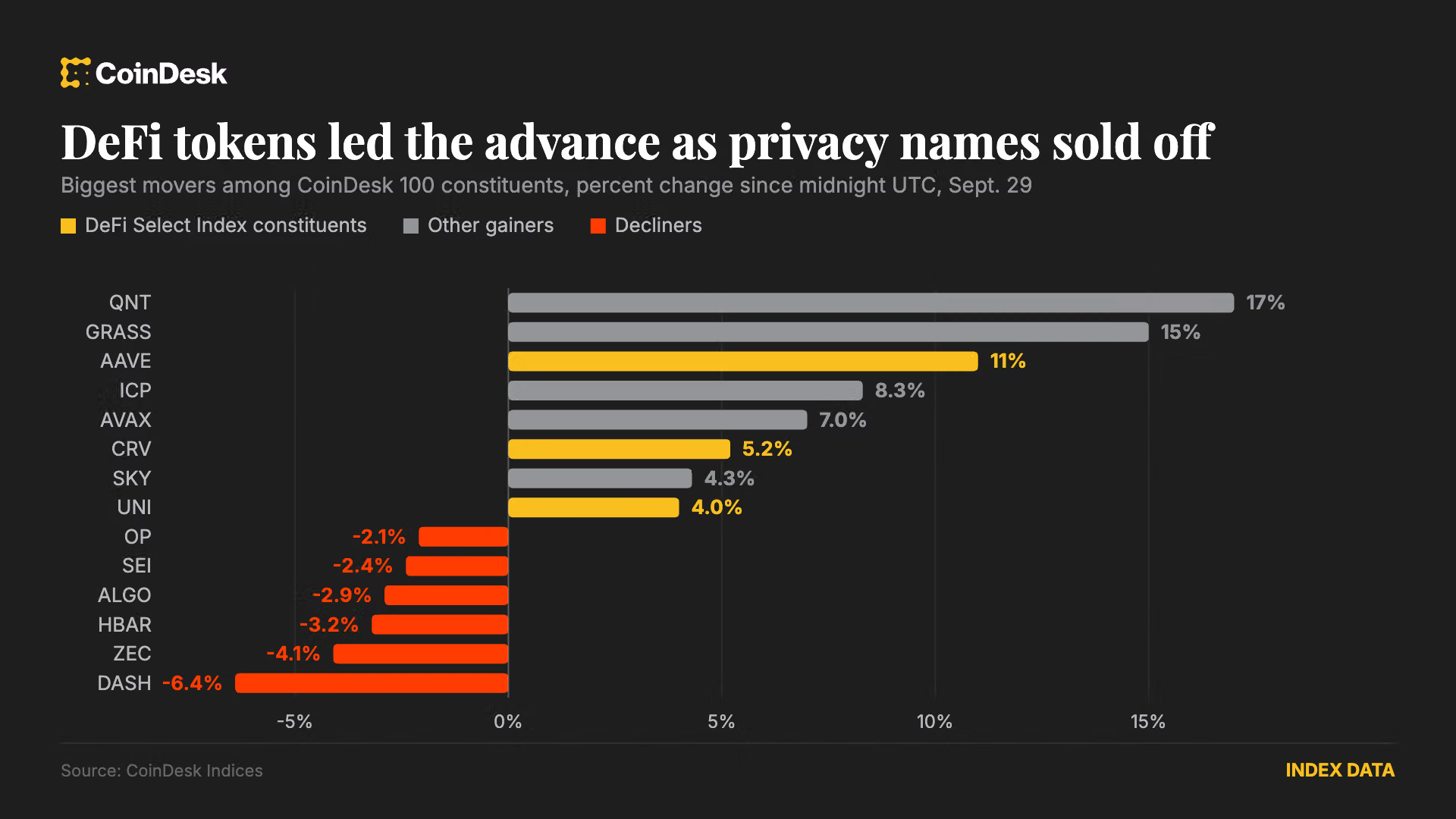
Bitcoin recovered Monday’s losses to trade at $84,170 on Tuesday, up 0.82% since midnight UTC and 1.4% over 24 hours, with 72 of the 100 CoinDesk 100 constituents higher and the index adding 0.89% to 1,904.49.
The bid is arriving despite conditions that have been suppressing risk assets for a week, the 10-year Treasury yield sitting at 5.234% after ending Monday above 5.2%, near levels last seen in 2007, and the 30-year at 5.549% having topped 5.56% on Monday, around a 2004 high.
U.S. stocks fell for a second session on Monday, the Dow dropping more than 300 points and the S&P 500 and Nasdaq Composite shedding 0.8% and 0.9%, with futures mixed on Tuesday morning.
Decentralized finance (DeFi) is driving the move for the second time in a week, with the DeFi Select Index (DFX) gaining 5.0% since midnight, led by lending protocol token aave at 11% and curve dao token at 5.2%. The CoinDesk 80 rose 2.0% against the CoinDesk 5’s 1.3%, though the ranking inverts over 24 hours, where the CD5’s 1.7% beats the CD80’s 0.44%.

The D’CENT wallet hack, the year’s second-largest drain of XRP behind the Bitget crypto exchange hack, has spilled beyond the XRP Ledger onto additional blockchains like Bitcoin, Ethereum, and Stellar.
Hackers have drained more than 12.4 million XRP from more than 7,000 D’CENT wallets, still some way behind Bitget’s loss of 102.9 million XRP.
Although the wallet was popular among the XRP community, D’CENT users who owned assets of other blockchains have also lost their funds.
D’CENT’s own disclosure named Bitcoin, Tron, and Ethereum, for example. Even a Stellar user has lost XLM in the incident.
Hackers are able to sweep funds across blockchains with one compromised recovery phrase for the multi-blockchain wallet.
IoTrust, the maker of D’CENT, confirmed at least 110 abnormal transfer reports, including non-XRP assets, per ZDNet Korea.
XRP holders lose $18 million in D’CENT hack
Drains of XRP are the most well-documented, due to the prominence of D’CENT among XRP holders.
At least six waves of theft occurred between September 15 and 20, emptying 6,678 wallets of 11.7 million XRP.
The thief stole from large wallets first, by hand, and soon wrote scripts to take funds from progressively smaller wallets.
Warnings from D’CENT and other members of the XRP community couldn’t stop the drainage. Thieves took 640,370 additional XRP after September 21, bringing the tally to above 12.4 million.
By Friday, 6.3 million of those stolen XRP had crossed to Ethereum’s blockchain through the swap service THORChain.
As the theft spilled over to other blockchains, researchers admitted the scope of the losses, saying, “Most of it is no longer XRP.”
Read more: David Schwartz warns of hard fork because XRP nodes won’t upgrade
In August, D’CENT was still touting its hardware wallets’ secure element, boasting that it was impervious to vulnerabilities linked to the Coldcard hack.
D’CENT now warns users that wallets they created using its app are vulnerable, urging them to create a fresh recovery phrase and immediately migrate everything, including tokens, NFTs, and any staked assets.
Got a tip? Send us an email securely via Protos Leaks. For more informed news and investigations, follow us on X, Bluesky, and Google News, or subscribe to our YouTube channel.

Matthew Schaefer Named New York Islanders Alternate Captain At 19, Becomes Youngest In Franchise History

Xbox Just Unveiled Mythic Achievements, Which Are Basically PlayStation Platinum Trophies

Amy Luciani Talks Reconciling W/ Dwight Howard Amid Drug Talk


-

 Fashion4 days ago
Weekend Open Thread: J.McLaughlin – Corporette.com
-

 Crypto7 days ago
Goldman Sachs and Deutsche Bank Agree: The S&P 500 Rally Isn't Over
-

 Tech & AI2 days ago
Anthropic turns Claude into an AI marketplace with 2,000+ plugins and connectors
-

 Tech & AI2 days ago
OpenAI is preparing “o,” an always-on ChatGPT assistant that could handle email
-

 Fashion5 days ago
8 iPhone Accessories That Add Personality
-

 Entertainment7 days ago
These 17 Fall Amazon Dresses Seriously Look Like Anthropologie
-

 Tech & AI7 days ago
Reolink’s solar 4K security camera falls to its lowest price in months
-

 Crypto7 days ago
This Bearish Netflix Stock Trade Can Cash In On Video Streaming Giant’s Woes
-

 Crypto7 days ago
BitGo says Bitcoin absorbed Fed hike, CLARITY failure
-
 Business & Hustles7 days ago
Oil Price Today (September 23): Crude oil below $100 on hopes of US-Iran talks. What did Trump say?
-

 Crypto6 days ago
Crude Oil Prices Pressured by Diplomatic Hopes in the Middle East
-
 Crypto6 days ago
Bitcoin price tests $83,600 Supertrend support after $87K rejection
-
 Crypto6 days ago
Bitcoin Threatens Sub-$84,000 Breakdown as Long Liquidations Spike
-
 Tech & AI6 days ago
UiPath’s Dines says AI needs a manual and launches Cartographer to write it
-

 Crypto7 days ago
Did Jim Cramer Just Give GameStop Stock the Kiss of Death When He Said the Turnaround Is Working?
-
Business & Hustles21 hours ago
Perpetua Resources at Mining Forum Americas 2026: shift to construction
-

 Crypto6 days ago
As Amazon Stock Prospers, Traders Might Consider This Option Play
-

 Crypto6 days ago
Strategy resumed Bitcoin buying, but Strive gained more BTC per share
-
 Crypto2 days ago
Wall Street Giant Warns AI Agents Could Trigger a New Kind of Bank Run
-

 Crypto6 days ago
MoonPay to Acquire North Capital in All-Stock Deal Exceeding $60M
You must be logged in to post a comment Login