
Crypto
PayPal’s new platform lets anyone issue a dollar backed by a dollar

Summary
- PayPal, M0, and MoonPay launched PYUSDx on September 9, a platform letting any business issue an application-specific stablecoin backed by PayPal USD.
- Three issuers are live at launch, Saturn, Concrete, and Cap, which the companies say have collectively processed more than $100 million, with USD.AI and Fairblock expected next.
- The structure has two layers: PYUSD is issued by Paxos Trust Company, a federally regulated national banking association, and backed by dollar deposits and Treasuries; PYUSDx tokens are issued by MoonPay Digital Assets Limited and backed by PYUSD.
- Tokens created on PYUSDx are not PayPal or Paxos products and cannot be sent, received, or used inside PayPal or Venmo.
- The GENIUS Act requires permitted issuers to back payment stablecoins one to one in named high-quality liquid assets, and a token backed by another stablecoin, issued by a different entity, is a structure the statute does not obviously address.
Draw the plumbing and something odd falls out.
PayPal, M0 and MoonPay went live on September 9 with PYUSDx, a platform that lets any business issue its own branded stablecoin without touching reserves, custody or redemption infrastructure. Three issuers launched with it. More than $100 million already processed between them. The pitch from all three partners is that the product layer should belong to whoever is building the product, and the monetary plumbing should belong to people who do plumbing. That is a good pitch and a sensible product.
Now draw it.
PYUSD is issued by Paxos, a federally regulated national banking association, backed by dollar deposits and Treasuries. Fine. Compliant. Boring, in the way a reserve asset should be.
PYUSDx tokens are issued by MoonPay Digital Assets Limited. Their reserve asset is PYUSD.
So the thing backing the second token is the first token. The GENIUS Act, signed in July 2025 and still being turned into regulations, tells you who may issue a payment stablecoin and what has to sit behind it. Cash. Insured deposits. Short-dated Treasuries. Repos against Treasuries. Money market funds holding those.
It does not say anything about a stablecoin backed by a stablecoin, issued by someone else entirely. Nobody covering the launch has asked about it. It is worth asking now, while the rules are being drafted, instead of in eighteen months when they are not.
What was actually built
Three companies, three jobs. The details matter because they decide who is on the hook for what.
M0 supplies the infrastructure. Its platform lets an issuer configure individual components of a stablecoin instead of accepting a fixed model: token name, access restrictions, reward distribution, collateral policy, and cross-chain availability are all set by the issuer. M0’s chief executive has described the design intent as making the product layer belong to the builder, and the company also works with Stripe-owned Bridge and with regulated custody firms.
MoonPay issues the tokens and holds the backing. MoonPay Digital Assets Limited is the issuing entity for PYUSDx-layer tokens and holds the PYUSD that backs them. It also contributes onboarding and distribution.
PayPal supplies PYUSD. The underlying stablecoin remains a Paxos-issued product reserved with dollar deposits, Treasuries, and similar cash equivalents. PayPal’s role is supplying the asset that sits underneath and the ecosystem connection.
The disclaimers are specific and worth reading. Tokens created on PYUSDx are not PayPal or Paxos products. They cannot be sent, received, or used inside the PayPal and Venmo applications. That is an unusual carve-out for a platform named after a company’s own stablecoin, and it tells you the partners have thought carefully about where liability sits.
At launch: Saturn, Concrete, and Cap, with more than $100 million in combined processed volume. Cap migrated part of its cUSD onto PYUSDx so that a portion of its covered-credit float would rest on PYUSD instead of more volatile decentralised finance liquidity, which is a sensible use of the product and the clearest illustration of what it is for. USD.AI and Fairblock are next.
The two-layer question
Nothing here accuses anyone of anything. This is a question the statute has not answered, asked while there is still time to answer it.
The GENIUS Act, enacted July 18, 2025, restricts issuance of payment stablecoins to permitted issuers across four routes and requires reserves backing outstanding tokens one to one in specified high-quality liquid assets: currency, insured deposits, short-dated Treasury bills, Treasury-collateralised repurchase agreements, and money market funds holding those instruments. Our dedicated page on the law sets out the framework in full.
PYUSD fits that cleanly. Paxos is a federally regulated national banking association, the reserves are cash and Treasuries, and the disclosure obligations apply.
PYUSDx tokens are a different object. They are issued by a separate entity, and their reserve asset is PYUSD, not the asset classes the statute names. Three questions follow and none has a public answer.
Is a PYUSDx token a payment stablecoin? The statutory definition captures a digital asset used for payment or settlement, redeemable at a fixed monetary value, whose issuer represents it will maintain stable value. An application-specific dollar token used inside a credit product appears to meet that description.
If it is, who is the permitted issuer? The entity issuing it is MoonPay Digital Assets Limited, not Paxos. Permitted status attaches to issuers, not to reserve assets, and the four routes to permitted status all describe entities, not backing arrangements.
Does PYUSD count as a permitted reserve asset? The named list does not include other stablecoins. Whether a token fully backed by a compliant stablecoin satisfies a one-to-one reserve requirement is a reasonable reading and it is not the reading the text supplies on its face.
None of this suggests anyone is doing anything improper. The Act does not take effect until the earlier of January 18, 2027 or 120 days after final implementing regulations, and the agencies missed their one-year rulemaking deadline in July 2026 with proposals issued and final rules outstanding. Building a product during that window is entirely legitimate. The point is narrower: the rules that will govern this structure are being written now, and this structure is not one the drafters obviously had in mind.
Why anyone would build it this way
The commercial logic is genuinely good, which is why this structure will spread whatever the regulators decide.
Reserves are the hard part. Issuing a compliant stablecoin means holding, custodying, and reporting on cash and Treasuries, contracting an accounting firm for monthly attestation, and building redemption infrastructure. That is a bank-adjacent operation with bank-adjacent costs, and it is completely disproportionate for a company that wants a branded dollar inside its own application.
The alternative was worse. Before platforms like this, a business wanting an application-specific dollar either built the whole stack, partnered bilaterally with an issuer on bespoke terms, or used an existing stablecoin and accepted no control over its properties. All three are bad options for a small team.
Configurability is the product. Access restrictions, reward distribution, collateral policy, and cross-chain availability set per issuer is a different offering from a single stablecoin with fixed properties. Cap’s use case, resting covered-credit float on PYUSD instead of volatile decentralised finance liquidity, is exactly the kind of thing that needs configuration and not a generic token.
And for PayPal it solves a distribution problem. PYUSD sits around $2.81 billion, eighth in a stablecoin market near $305 billion where Tether holds roughly 60%. Growing that through direct payments means competing with incumbents on their own ground. Growing it as a reserve asset for other people’s tokens means every PYUSDx issuer that scales needs more PYUSD behind it, expanding the footprint without PayPal operating any of those applications. That is a second lever on demand and a considerably cheaper one.
What the layering actually adds
Two layers is better than one in one respect and worse in another.
On the positive side, the backing asset is a regulated, attested, cash-and-Treasuries stablecoin instead of an ad hoc reserve. An application dollar backed by PYUSD is substantially better collateralised than one backed by a decentralised finance yield strategy, which is precisely why Cap moved. Layering onto a compliant base is a meaningful improvement over the alternatives that existed before.
On the risk side, a holder of a PYUSDx token now depends on two entities instead of one. The issuer must hold the PYUSD it claims to hold and honour redemption. Paxos must maintain PYUSD’s peg and reserves. A failure at either level reaches the holder, and the holder’s legal relationship is with the upper entity, not the lower one, which is what the disclaimer about these not being PayPal or Paxos products makes explicit.
That second point deserves emphasis because it is the practical consequence of the structure. The name on the platform is PayPal’s. The underlying asset is PayPal’s stablecoin. The token in a user’s wallet is neither, and cannot be used in PayPal’s own applications. A user who does not read the documentation could reasonably form the wrong impression about whose obligation they hold.
The precedent this sets
This is not really a PayPal story. It is what happens when issuing a dollar stops being a product and becomes plumbing.
The pattern is familiar from other financial layers. Card networks did not issue cards; they let banks issue them on shared rails. Payment processors do not hold funds; they let merchants transact on shared infrastructure. In both cases the layer underneath became more valuable as the layer above proliferated, and the entity operating the rails captured economics from activity it did not conduct.
M0’s chief executive framed the fragmentation problem directly, noting that as more financial institutions get involved the landscape fragments, and that most of those institutions do not know how to engage with developers, so the middle layer abstracts the complexity. That is a rails argument, and it is the correct one.
What follows, if the model works, is a large number of application-specific dollars backed by a small number of compliant base stablecoins. That concentrates systemic importance in the base layer while distributing the customer relationships across hundreds of issuers, which is a structure regulators generally find difficult, because supervision attaches to entities and the entity holding the reserves is not the entity facing the customer.
Our stablecoin status page sets out the three gaps the GENIUS framework left open, and this sits squarely in the space between two of them.
The three issuers, and what they reveal
Three issuers is a small enough list to go through one by one, and they tell you more than the press release does.
Cap is the clearest case. It migrated a portion of its cUSD onto PYUSDx so that part of its covered-credit float would rest on PYUSD instead of more volatile decentralised finance liquidity. That is a treasury decision: a credit product needs its float in something stable, and a regulated, attested, cash-and-Treasuries-backed stablecoin is materially better collateral than a yield-bearing position in a lending protocol. Cap did not want a branded token for marketing. It wanted better backing for an existing liability.
Saturn and Concrete have been named without the same public detail, though the three together account for the more than $100 million in processed volume the partners cite. MoonPay’s executive has argued the figure matters because the same issuance stack is already supporting credit, vault, and Bitcoin-linked products, which suggests three different applications instead of three variations on one.
USD.AI and Fairblock are next, with no announced timing.
Two observations follow. First, the early adopters are crypto-native firms building financial products, not consumer brands wanting a loyalty token. That is a more demanding customer set and a better signal, because a credit protocol choosing your stablecoin as its float has done diligence a marketing department would not.
Second, the $100 million figure is processed volume, not market capitalisation and not revenue. The distinction is worth holding, since processed volume measures throughput over a period and says nothing about how much of the token is outstanding at any moment. A payments product cycling the same dollar repeatedly produces a large volume figure and a small float. Both are real; they measure different things, and only one of them determines how much PYUSD sits in reserve.
The redemption chain
The question that matters if you hold one of these: what happens when you want actual dollars back. The answer goes through two companies, in order.
A holder of a PYUSDx token redeems with the issuing entity, MoonPay Digital Assets Limited, which holds PYUSD as backing. To deliver actual dollars, that PYUSD must itself be redeemed with Paxos, which holds the cash and Treasuries. So a full redemption to bank money traverses two independent obligations, each with its own terms, timing, and operational capacity.
In ordinary conditions this is invisible and fast. Stablecoin redemption at both layers is routine, and the whole point of building on a regulated base is that the lower layer is dependable.
The interesting case is the stressed one, and it has a specific shape. If a large number of holders redeem simultaneously, the upper issuer must convert PYUSD to dollars at the same time its own customers are converting tokens to PYUSD. Those are sequential operations, and the second one is not under the upper issuer’s control. Paxos’s redemption capacity and terms become the binding constraint on a token whose holders have no relationship with Paxos.
None of this is unique to PYUSDx and none of it suggests a defect. Every layered financial structure works this way, and layering onto a well-reserved base is precisely what makes it safer than the alternatives. But it is the reason the disclosure that these are not PayPal or Paxos products is doing real work, not lawyerly throat-clearing. A holder’s claim runs to the entity that issued their token, and that entity’s ability to pay depends on an entity the holder cannot call.
The practical instruction for anyone evaluating one of these tokens is to read the upper issuer’s redemption terms specifically, since those are the terms that bind, and to understand that the quality of the backing asset and the reliability of the redemption path are two separate questions with two separate answers.
What a regulator would ask
Forget whether it is permitted. Here is what an examiner would ask, and every one of these is answerable today.
Is the backing segregated and verifiable? The upper issuer holds PYUSD backing its tokens. Whether that PYUSD sits in an identifiable, segregated arrangement, whether it is attested to on any cadence, and whether the reporting is public are the first questions in any reserve examination. M0’s platform advertises support for on-chain reporting and reserve validation, which is the right capability; whether each issuer uses it is a separate matter.
Who bears redemption obligation and under what terms? The disclaimers make clear the tokens are not PayPal or Paxos products, which answers the question negatively for two parties without answering it positively for the third. Published redemption terms from the issuing entity would.
What happens on issuer failure? The GENIUS Act gives holders of permitted payment stablecoins a priority claim in insolvency ranking above administrative expenses. Whether a holder of a token backed by such a stablecoin, issued by an entity that may not itself be a permitted issuer, inherits any comparable protection is unresolved and is the single most consequential open question for a holder.
Which jurisdiction supervises the issuing entity? MoonPay Digital Assets Limited is the named issuer. Its regulatory status and home jurisdiction determine which authority examines it and under what standard, and that is a fact rather than a judgment call.
None of these are difficult to answer and none is commercially sensitive. That they are not currently prominent in the launch materials is unremarkable for a product three days old, and it is also the gap between a product announcement and the disclosure a supervised financial instrument eventually requires.
The broader point for readers tracking stablecoin regulation is that this is where the next round of rulemaking pressure will land. The first round addressed who may issue a dollar. The obvious second question, once platforms like this proliferate, is who may issue a claim on someone else’s dollar, and the answer is not in the statute.
Who actually owes you money
Worth being blunt about this, because the branding and the obligation point at different companies.
The platform is called PYUSDx. The backing asset is PayPal’s stablecoin. PayPal’s name is on the announcement. And if the token in your wallet fails, your claim is against MoonPay Digital Assets Limited, an entity most holders will never have heard of and cannot call.
The partners say this clearly. Tokens created on the platform are not PayPal or Paxos products. They cannot be sent, received or used inside PayPal or Venmo. Read that second sentence again, because it is genuinely strange: a token backed by PayPal’s dollar, launched on a platform carrying PayPal’s name, that PayPal’s own applications will not accept.
That is not sloppiness. It is a boundary drawn on purpose, and it is drawn to keep liability where the issuing entity is. Which is fine, correct even, and also exactly the kind of thing a user skims past when the logo at the top says PayPal.
The general lesson travels beyond this product. In any layered financial arrangement, the recognisable brand and the counterparty are frequently not the same entity, and the gap between them is where retail confusion lives. Card networks, white-labelled banking, payment facilitators, and now stablecoin issuance platforms all have this shape. The name sells it. Someone else owes you.
If you are evaluating one of these tokens, the only question that matters is which legal entity issued it and what its redemption terms say. Everything else on the page is marketing.
What breaks first
Every new financial structure has a most-likely failure mode, and it is usually not the one the launch coverage worries about.
For PYUSDx the risk is not PYUSD depegging. Paxos runs a regulated, attested, cash-and-Treasuries reserve, and that is about as solid as this asset class gets. If the base layer goes, the problem is considerably larger than one platform.
The realistic failure is at the upper layer and it is mundane. An issuer scales faster than its operational capacity. Redemption requests arrive in a cluster. The issuer holds the PYUSD it says it holds, but converting it to dollars at speed depends on Paxos’s redemption process, which the issuer does not control and which was built for a different volume profile. Nothing is insolvent. Everything is slow. And slow, in a product marketed as a dollar, looks identical to broken from the outside.
The second realistic failure is configuration. M0’s platform lets issuers set access restrictions, reward distribution and collateral policy individually. Flexibility is the selling point, and flexibility means a hundred issuers making a hundred different decisions about parameters that determine whether their token behaves like a dollar under stress. Some of those decisions will be wrong. The base asset being sound does not save a token whose issuer configured redemption badly.
Neither of those is a reason not to build this. They are a reason to read the specific issuer’s terms rather than the platform’s, which almost nobody does, and which is the entire practical takeaway from every layered financial product ever launched.
What to watch
Whether final rules address layering. The OCC and FDIC proposals are drafted and comment periods have run. Whether the final text addresses tokens backed by other stablecoins is the single most consequential detail for this structure, and it is answerable within months.
Whether any PYUSDx issuer seeks permitted status. If the answer to the layering question is that the upper issuer needs its own permitted status, the economics of the platform change substantially. Watch for applications.
PYUSD’s supply against PYUSDx growth. The indirect demand mechanism is testable. If Saturn, Concrete, Cap, and their successors scale, PYUSD outstanding should grow to back them. The partners have published no targets, so the correlation is the only available evidence.
Whether the carve-out holds. PYUSDx tokens currently cannot be used inside PayPal and Venmo. If that changes, the liability and regulatory picture changes with it, because the distance the disclaimers create would narrow.
Who else launches one. Stripe’s Bridge works with the same infrastructure provider. A competing platform from another payments incumbent would confirm that this is the direction of the category and not one company’s experiment.
Disclaimer: This article is for information and educational purposes only and does not constitute financial, investment, or legal advice. It describes a recently launched product and raises regulatory questions that have not been resolved by implementing rules, and nothing here alleges non-compliance by any party. Always do your own research. Information is accurate as of September 10, 2026.
What is PYUSDx?
A platform launched September 9 by PayPal, M0, and MoonPay that lets businesses issue their own application-specific stablecoins backed by PayPal USD. Issuers configure the token’s name, access restrictions, reward distribution, collateral policy, and cross-chain availability instead of accepting a fixed model. Three issuers went live at launch with more than $100 million in combined processed volume.
Who actually issues the tokens?
MoonPay Digital Assets Limited issues PYUSDx-layer tokens and holds the PYUSD backing them. Paxos Trust Company separately issues the underlying PYUSD, reserved with dollar deposits and Treasuries. Tokens created on PYUSDx are not PayPal or Paxos products, and PayPal’s role is supplying PYUSD and the ecosystem connection.
Can I use a PYUSDx token in PayPal or Venmo?
No. Tokens created on the platform cannot currently be sent, received, or used inside the PayPal and Venmo applications. That carve-out is stated explicitly by the partners and is worth noting, because the platform carries PayPal’s name and is backed by PayPal’s stablecoin while the tokens themselves are neither.
How does this interact with the GENIUS Act?
That is the open question. The Act requires permitted issuers to back payment stablecoins one to one in named high-quality liquid assets: currency, insured deposits, short-dated Treasuries, Treasury-collateralised repos, and money market funds holding those. A token issued by a separate entity and backed by another stablecoin is not obviously described by that framework, and final implementing rules have not been issued.
Does that mean PYUSDx is non-compliant?
No, and nothing here suggests it. The Act takes effect on the earlier of January 18, 2027 or 120 days after final rules, and the agencies missed their one-year rulemaking deadline in July 2026. Building during that window is legitimate. The point is that the rules governing this structure are being written now and were not obviously drafted with it in mind.
Why would a business want its own stablecoin?
Control and configuration. Issuing a compliant stablecoin independently requires holding and reporting on cash and Treasuries, contracting monthly attestation, and building redemption infrastructure, which is disproportionate for a company that wants a branded dollar inside its own application. Cap’s use case, resting part of its covered-credit float on PYUSD rather than volatile decentralised finance liquidity, illustrates the appeal.
What does PayPal get out of it?
A second lever on PYUSD demand. PYUSD sits around $2.81 billion in a stablecoin market near $305 billion where Tether holds roughly 60%. Every PYUSDx issuer that scales needs more PYUSD behind its token, expanding PYUSD’s footprint without PayPal operating those applications. The partners have published no issuance or reserve targets.
What is the risk to a holder?
Dependence on two entities instead of one. The PYUSDx issuer must hold the PYUSD it claims and honour redemption, and Paxos must maintain PYUSD’s reserves and peg. A holder’s legal relationship is with the upper issuer, not with PayPal or Paxos, which is what the disclaimers make explicit. This is educational analysis, not investment advice.

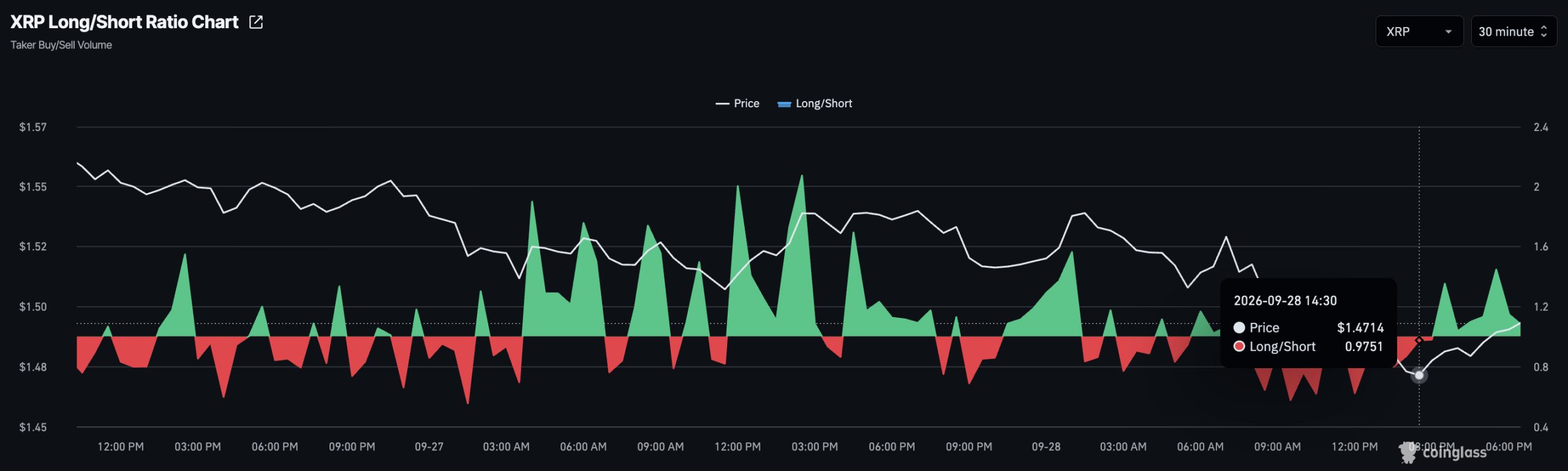
XRP price hovers under $1.49 after three consecutive daily declines left the token losing the $1.50 support, even as a modest bounce pulled it off session lows. CoinGlass data showed the long-to-short ratio at 0.975, meaning short positions marginally outnumbered longs, while the funding rate sat at a positive 0.008%, the reading that determines whether long or short traders pay a periodic fee to hold perpetual futures.
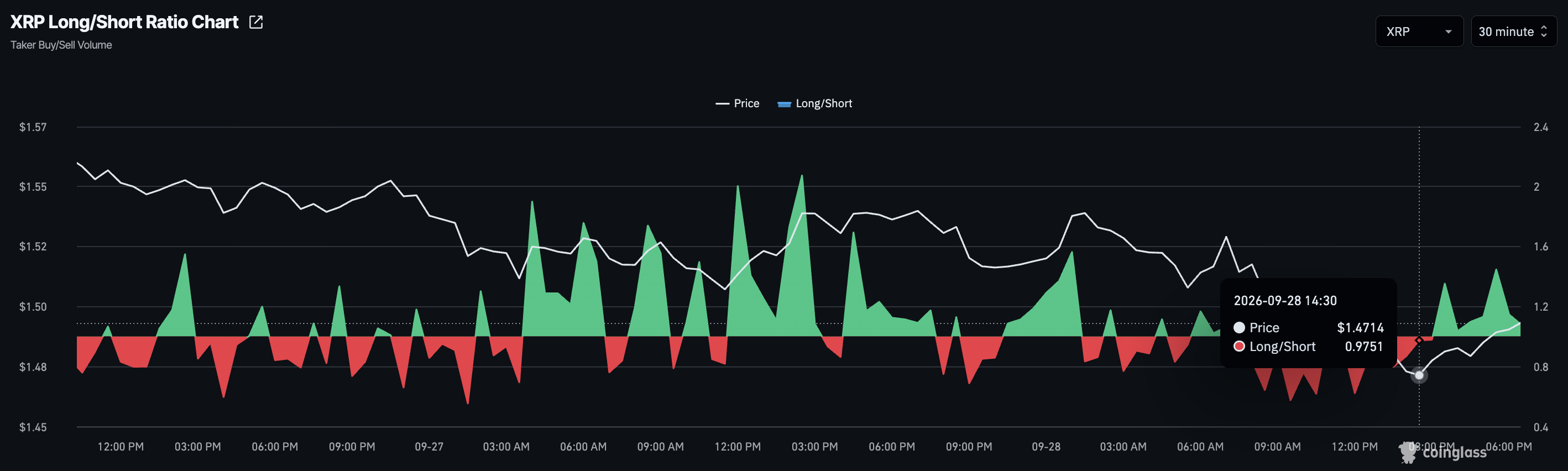
XRP Long Short Ratio, Coinglass
That combination is the crux of the problem. Traders are still paying to stay long, yet the spot price has not moved in a way that rewards the bet, and the disconnect between heavy spot selling and futures demand is the setup that tends to unwind fast once a key level gives way.
A 0.975 long-to-short ratio is not a bearish signal in any decisive sense. It sits close enough to 1.0 that it reads as near-balanced positioning rather than a market leaning hard in either direction.
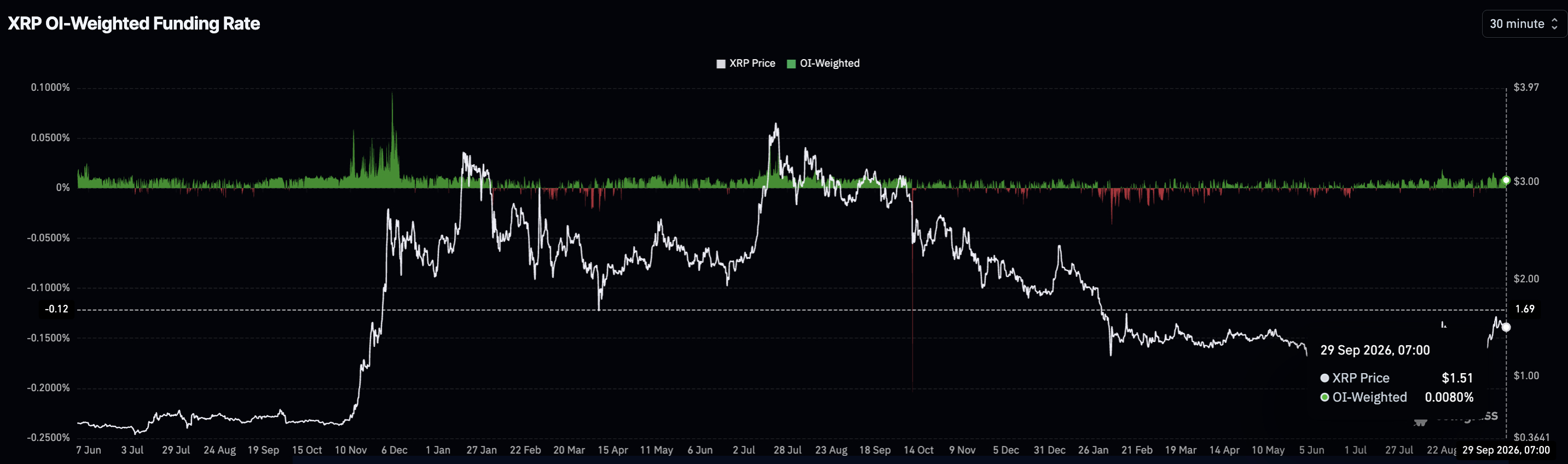
XRP Funding Rate, Coinglass
Funding tells a more interesting story on its own. A positive rate means demand for long exposure in crypto derivatives is real enough that longs are compensating shorts to hold the position, which typically signals conviction that price moves higher.
However, it cuts both ways: if price falls further, those same leveraged longs become forced sellers, and a positive funding regime built on thin spot demand can flip into a liquidation cascade faster than one built on genuine accumulation.
CryptoQuant’s summary data flagged overheating conditions across both XRP’s spot and futures markets, alongside sell-side dominance in futures, meaning sellers have retained the upper hand in derivatives even as funding stays positive. That is the missing piece: positive funding shows traders are willing to hold bullish exposure, but it has not yet translated into enough buying pressure to absorb the futures selling and push through resistance.
Earn $50 and Enter $300K Prize Draw on EdgeX
XRP Price and the $1.37 Support
The daily chart still leans bullish on a longer timeframe. XRP held above its 50-day price exponential moving average near $1.365 and its 200-day EMA near $1.369 through the three-day slide, with the 100-day EMA sitting lower at $1.307 as a secondary reference.
Momentum has cooled rather than reversed. The RSI sat near 55, close to neutral, and the MACD flattened around zero, a pattern consistent with consolidation after an earlier advance rather than an active breakdown.
The level that matters most sits at $1.37, where the 50-day and 200-day EMAs converge into a single support band. A clean break below that zone opens the $1.30 area, and a deeper slide would eventually put the $1.00 psychological level in play, though XRP would need to fall substantially before that becomes the immediate focus. On the upside, reclaiming the $1.574 resistance level is the trigger that would strengthen the case for a move toward $1.90.
Trade XRP on Bybit and Get a Chance to Win Our $1,000 USDT Airdrop
What Happens Next for XRP?
Two scenarios frame the near-term path. If XRP holds the $1.37 zone, the market stays in a consolidation phase where positive funding continues to reflect trader appetite for long exposure, but that alone won’t confirm a breakout without a corresponding rise in open interest and spot volume.
If XRP price instead reclaims $1.574, the technical case for a run toward $1.90 gets meaningfully stronger, and that move would likely force shorts to cover into strength. The alternative is a sustained break below $1.37, which shifts focus to $1.30 as the next line of defense, with $1.00 as the deeper level only if that support also fails.
Either way, the current setup leaves no room for complacency on either side of the trade. Near-balanced positioning combined with positive funding and futures sell-side dominance is a fragile mix, and the next move in spot price will do more to settle the argument than another shift in the long-short ratio.
Discover: The Best Token Presales
The post XRP Price in Danger: Positive Funding Masks a Fragile Setup appeared first on Cryptonews.
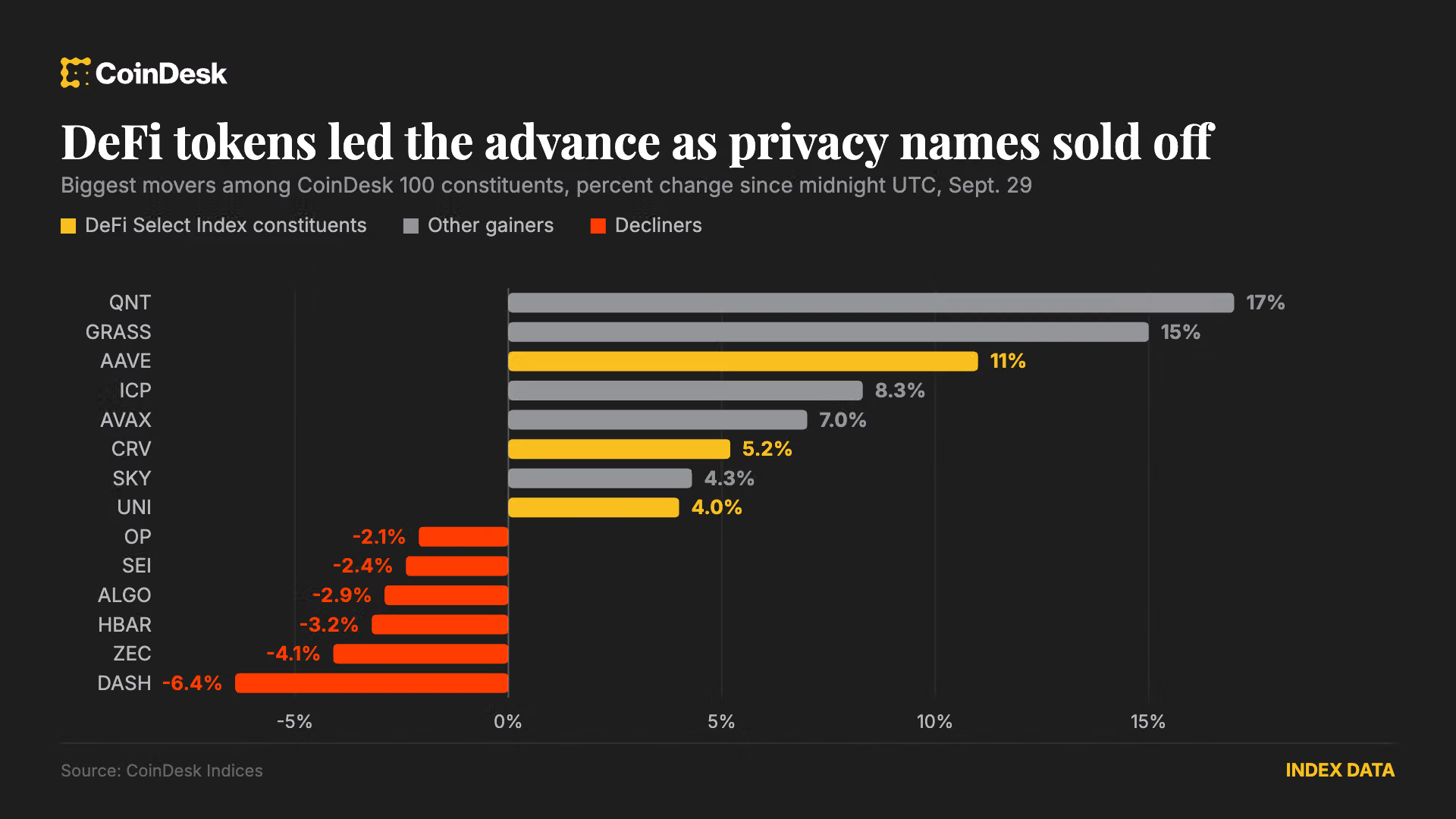
Bitcoin recovered Monday’s losses to trade at $84,170 on Tuesday, up 0.82% since midnight UTC and 1.4% over 24 hours, with 72 of the 100 CoinDesk 100 constituents higher and the index adding 0.89% to 1,904.49.
The bid is arriving despite conditions that have been suppressing risk assets for a week, the 10-year Treasury yield sitting at 5.234% after ending Monday above 5.2%, near levels last seen in 2007, and the 30-year at 5.549% having topped 5.56% on Monday, around a 2004 high.
U.S. stocks fell for a second session on Monday, the Dow dropping more than 300 points and the S&P 500 and Nasdaq Composite shedding 0.8% and 0.9%, with futures mixed on Tuesday morning.
Decentralized finance (DeFi) is driving the move for the second time in a week, with the DeFi Select Index (DFX) gaining 5.0% since midnight, led by lending protocol token aave at 11% and curve dao token at 5.2%. The CoinDesk 80 rose 2.0% against the CoinDesk 5’s 1.3%, though the ranking inverts over 24 hours, where the CD5’s 1.7% beats the CD80’s 0.44%.

The D’CENT wallet hack, the year’s second-largest drain of XRP behind the Bitget crypto exchange hack, has spilled beyond the XRP Ledger onto additional blockchains like Bitcoin, Ethereum, and Stellar.
Hackers have drained more than 12.4 million XRP from more than 7,000 D’CENT wallets, still some way behind Bitget’s loss of 102.9 million XRP.
Although the wallet was popular among the XRP community, D’CENT users who owned assets of other blockchains have also lost their funds.
D’CENT’s own disclosure named Bitcoin, Tron, and Ethereum, for example. Even a Stellar user has lost XLM in the incident.
Hackers are able to sweep funds across blockchains with one compromised recovery phrase for the multi-blockchain wallet.
IoTrust, the maker of D’CENT, confirmed at least 110 abnormal transfer reports, including non-XRP assets, per ZDNet Korea.
XRP holders lose $18 million in D’CENT hack
Drains of XRP are the most well-documented, due to the prominence of D’CENT among XRP holders.
At least six waves of theft occurred between September 15 and 20, emptying 6,678 wallets of 11.7 million XRP.
The thief stole from large wallets first, by hand, and soon wrote scripts to take funds from progressively smaller wallets.
Warnings from D’CENT and other members of the XRP community couldn’t stop the drainage. Thieves took 640,370 additional XRP after September 21, bringing the tally to above 12.4 million.
By Friday, 6.3 million of those stolen XRP had crossed to Ethereum’s blockchain through the swap service THORChain.
As the theft spilled over to other blockchains, researchers admitted the scope of the losses, saying, “Most of it is no longer XRP.”
Read more: David Schwartz warns of hard fork because XRP nodes won’t upgrade
In August, D’CENT was still touting its hardware wallets’ secure element, boasting that it was impervious to vulnerabilities linked to the Coldcard hack.
D’CENT now warns users that wallets they created using its app are vulnerable, urging them to create a fresh recovery phrase and immediately migrate everything, including tokens, NFTs, and any staked assets.
Got a tip? Send us an email securely via Protos Leaks. For more informed news and investigations, follow us on X, Bluesky, and Google News, or subscribe to our YouTube channel.
Market action since 2022 backs Thielen’s take. The 10-year yield more than doubled to 3.88% that year as the Fed raised interest rates rapidly, including several 50- and 75-basis-point hikes to fight inflation.
Bitcoin fell 64% that year. Fed tightening and rising yields added to the pain from crypto scams and blowups.
The picture has been different since. From the end of 2023, the 10-year yield has risen 135 basis points to 5.23%, the highest since 2007. Over the same stretch, bitcoin has roughly doubled to $86,000, even after pulling back from its October record above $126,000.
Thielen and others attribute much of the recent rise in yields to fiscal fears and a higher term premium. In plain English, investors want to be paid more to lock up their money in long-term bonds, given the uncertainty over inflation and government borrowing.
Chicago-based Strategic Analytics made a similar point about gold, noting that it has tracked fiscal risk more closely than the Fed’s policy path since 2022.
“Since 2022, gold has increasingly tracked fiscal-risk perceptions – term premium, deficits, debt sustainability – rather than the Fed’s policy path. Gold is not defying real yields. It is pricing fiscal sustainability and currency debasement, which has become the marginal driver,” it said recently in a LinkedIn post.

Humanoid robots box during the 5th Global Digital Trade Expo on September 25, 2026 in Hangzhou, Zhejiang Province of China.
Vcg | Visual China Group | Getty Images
BEIJING — China’s securities regulator is raising the bar for public listings of humanoid robot startups, according to three sources familiar with the CSRC’s thinking.
It’s a sign of how one of the hottest sectors of the market is cooling, as investors globally assess whether artificial intelligence stocks are in a bubble.
The Chinese regulator wants local “embodied AI” startups seeking to go public to meet three specific criteria, according to the sources, who requested anonymity due to the sensitivity of the situation.
They are:
- The “window guidance” requires that the humanoid applicants have sustainable revenue and commercial orders.
- Losses must narrow, with one source saying a three-year forecast is needed.
- The company must possess core technology such as robotic brain or hands.
Even if a startup only has to meet two of the three criteria, as one source indicated, it’s unclear which, if any, of the companies can do so.
That’s lowered expectations to just a handful, or none, of these startups making it to public markets, the sources said.
At least two dozen humanoid-related embodied AI companies have filed to list in Hong Kong alone, according to two of the sources. Hong Kong in May 2025 started letting tech companies file confidentially for IPOs.
The Hong Kong stock exchange declined to comment. The China Securities Regulatory Commission did not immediately respond to a request for comment. Mainland China companies wanting to list in Hong Kong also need the CSRC’s blessing.
Unitree IPO impact
Scrutiny on China’s growing number of humanoid robot startups and their fast-growing valuations — supported by a mix of government and private sector funds — has grown over the last several weeks.
The industry’s posterchild, Unitree, got a regulatory fast-track to its listing in Shanghai on Aug. 19 as the World Robot Conference kicked off in Beijing.
But in a keynote a day later, founder Wang Xingxing cautioned that commercialization beyond dancing robots remained years away. It accentuated a debate that picked up in subsequent weeks on what humanoids can actually do — and whether industry startups were actually making money.
China now has well over 100 humanoid companies, which fall under the national push for “embodied AI.” The term received Beijing’s support in the last two annual government work reports, although authorities have warned of a bubble in the humanoid robot industry.
Reflecting a rapid surge in interest, investment in the sector hit 47.09 billion yuan ($6.95 billion) in the second quarter, more than double that of the first quarter — and up over six times versus the same period last year, according to industry data provider Xiniu.
Unitree raised about about 6.1 billion yuan ($905 million) in its IPO on Aug. 19 with Shanghai-listed shares skyrocketing more than 460% in their debut to close at 845 yuan.
The stock had nearly halved in price as of Monday, at 459.65 yuan a share.
Hong Kong-listed Ubtech has also tumbled more than 40% so far this year. The company, which went public in December 2023, still reported an operating loss for the first half of this year of 279 million yuan.
The share price decline contrasts with the flood of capital pouring into humanoid robotics companies over the last 12 months or so. The tech, often called “physical AI” in China, has been seen as a way for early-stage investors to benefit from the surge of interest in artificial intelligence models.
However, Rhodium Group analysis this month found that China’s AI companies only make about 10% the revenue of Anthropic and OpenAI. The ratio of valuation to revenue — especially for Chinese AI startups Moonshot and DeepSeek — was far higher than their U.S. rivals, the report said.
While expectations grow for the U.S. AI giants’ IPOs, chipmaker AMD said Monday it is acquiring World Labs for $8.2 billion in a stock deal. The startup, founded by AI pioneer Fei-Fei Li, is building AI models for creating virtual 3D environments frequently used in humanoid robot development.

The launch this morning was both imperfect and stripped down to its orbital essentials. On the way up, one of the Starship’s six engines failed to burn properly, requiring the other engines to compensate for the missing thrust to get the ship in orbit.
In addition, the return to Earth was simplified. SpaceX has made itself famous for safely landing the first stage of its Falcon 9 and Starship boosters—with 641 out of 688 Falcon 9 launches featuring this kind of recovery, allowing the boosters to be reused and make flying cheaper. Starship’s first stage, meantime, performs what has become known as a chopstick recovery, with the booster navigating its way back to the launch tower where two giant metal arms pluck it from the sky. For the current mission, the chopstick recovery was done away with to simplify the flight objectives; instead the first stage made a soft, engine-assisted splashdown in the Gulf of Mexico. The Starship spacecraft was planned for a six-orbit, 10-hour mission, with the ship’s engines set to fire around the dinner hour Monday to bring the spacecraft down for a similar gentle, watery landing.
Goldman Sachs’ Anshul Sehgal says bonds yielding 5% or more are not the best trade right now. He still favors AI infrastructure, which he sees as a far more asymmetric bet than the long bond.
Sehgal, a global co-head of Fixed Income, Currencies and Commodities (FICC) at the bank, laid out the view just a few days after the Federal Reserve raised interest rates.
Why Goldman Sachs Is Passing on 5%+ Bonds
On Goldman’s The Markets, Sehgal said the 30-year Treasury, known as the long bond, had hovered around 5% for weeks. He noted that clients want to buy it at 5% or higher, yet he still sees little upside.
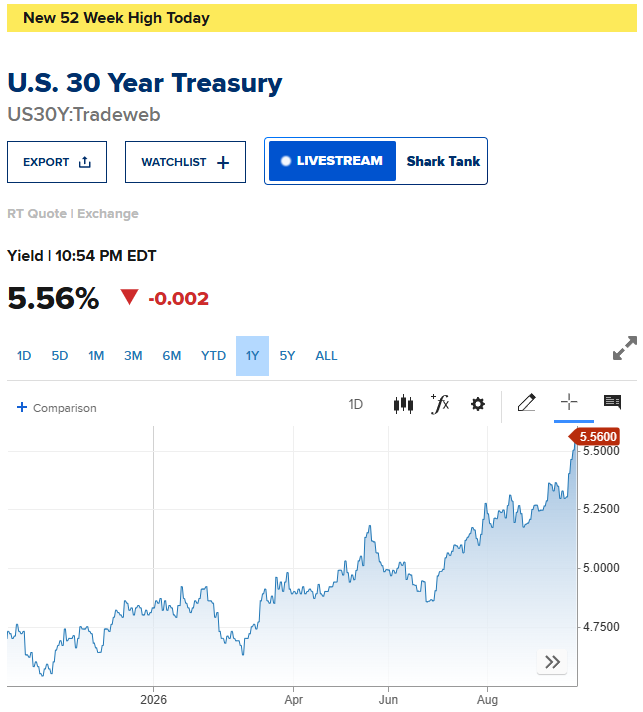
The yield has kept climbing since the recording, reaching 5.56% on September 29, a new 52-week high. Sehgal blamed structural pressure for the strain on the long end. Retiring baby boomers are buying fewer long bonds, and heavy long-dated borrowing tied to AI is crowding the market.
Those pressures explain why the selloff can persist even without a fresh inflation shock. Fewer retirees buying long bonds and a steady flow of long-dated borrowing tied to AI both weigh on prices, and neither fades quickly.
Sehgal adds that fear over US debt sustainability makes investors less willing to hold the long end, which feeds on itself.
The takeaway is that a rising yield does not necessarily break his thesis. It may instead show why he sees limited reward in owning the bond, while the risk to his AI trade is that costlier long-term borrowing squeezes the levered companies he favors.

AI Compute Is the Asymmetric Trade
An asymmetric trade offers far more potential gain than risk. Sehgal applies that label to compute (AI computing power), data centers, and Neoclouds, which are cloud providers built to rent out that capacity.
“I think the asymmetric expression is being long compute.”
Anshul Sehgal, Goldman
The catch is leverage. Savers collecting higher interest have effectively financed the AI build-out, leaving equities more indebted than a year ago. Sehgal admits these are levered bets. Still, he thinks they can multiply in value, while the wider stock market looks less certain.
Tighter Policy Hits Spenders, Not Capital
Sehgal says the Fed frames its September 16 hike as catch-up after five years above its inflation target. Schwab counts 16 of 19 Fed officials expecting another increase this year. Fed Chair Kevin Warsh also stressed three times that the Fed is easing back some stimulus rather than turning restrictive, Sehgal adds.
He argues that government interest payments flow to capital rather than workers, so higher rates curb household spending, a risk for the broader stock market.
He also rejects the debt-sustainability fears weighing on long bonds.
“For me, that’s a red herring.”
Anshul Sehgal, Goldman
Meanwhile, BlackRock’s Rick Rieder is cutting equities for bonds paying 7% to 8%, though his high-grade bond call still cautions against rushing into the 10-year Treasury.
Sehgal names the Middle East conflict as the top driver of policy and markets in the weeks ahead.
The post Goldman Sachs Explains Why Not to Buy the 5%+ Bonds and Rather Stick to AI appeared first on BeInCrypto.
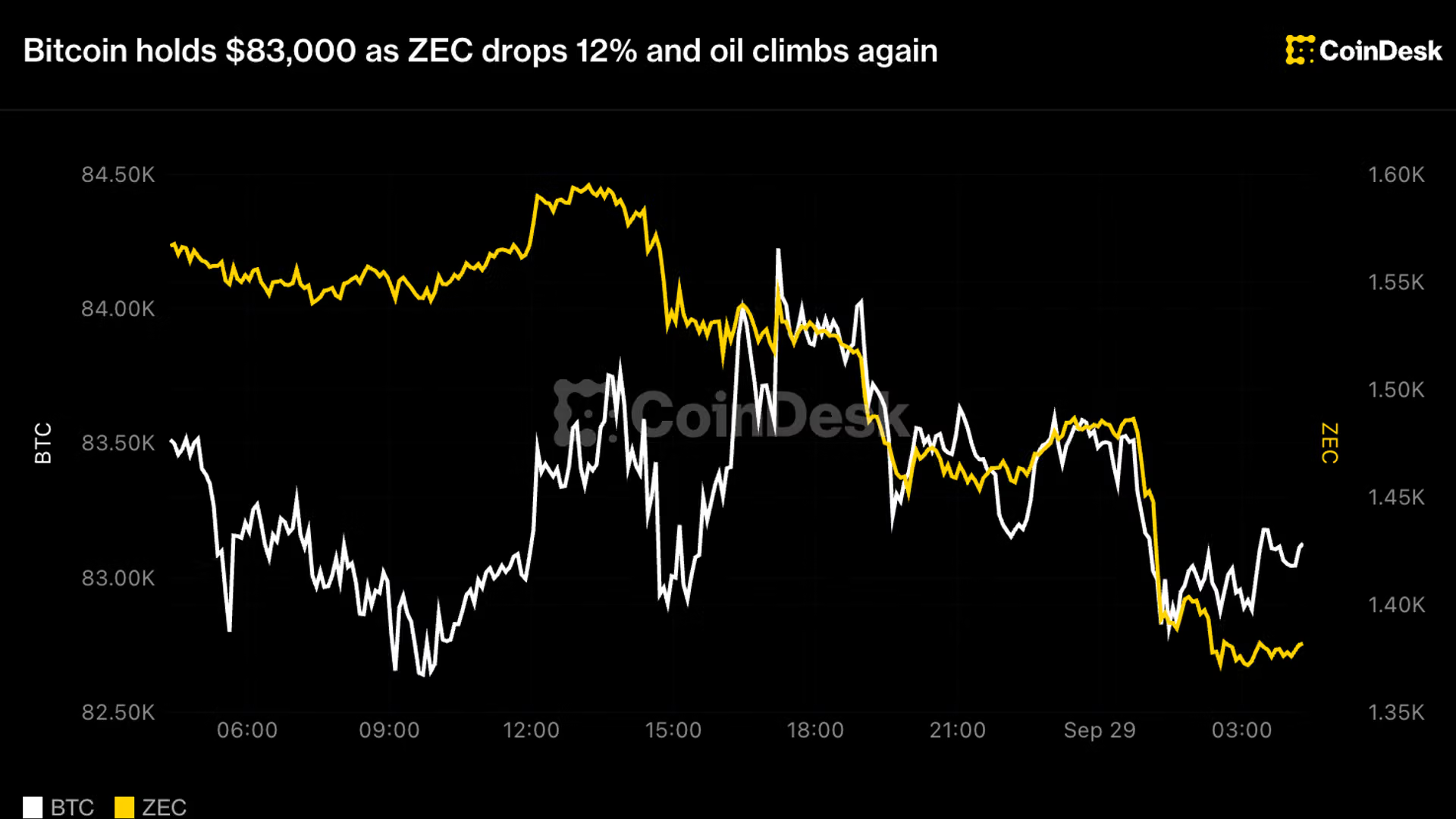
“Bitcoin has pulled back to $83K, testing the lower boundary of last week’s consolidation range,” Alex Kuptsikevich, chief market analyst at FxPro, said in an email to CoinDesk. “As with the market as a whole, a retest of the $82K region, where peaks were formed in May and early September, is entirely to be expected under current conditions.”
“Looking ahead, a sustained return to prices below $80K would be an important signal that the market is not ready to move higher for some time yet. If, however, this consolidation is soon followed by a new bullish momentum, it could send the leading cryptocurrency well above $90K,” he added.
The pressure is coming from bonds and oil.
Treasuries steadied in Asia after tumbling during U.S. trading, with the 10-year yield up one basis point to 5.25% after reaching its highest level since 2007 on Monday. A higher guaranteed return on government debt raises the bar for holding assets that pay no income, bitcoin among them.
Brent rose more than 1% to nearly $107 a barrel, its second straight gain, as hopes for an imminent diplomatic breakthrough with Iran faded.
Pricier oil feeds into inflation, and traders have been adding to bets that the Fed will raise rates again. MSCI’s All Country World Index fell to its lowest since Sept. 18, and Nasdaq 100 futures slipped 0.3% after Monday’s tech-led selloff on Wall Street.

U.S. dollar-pegged stablecoin Tether is a go-to tool for the Iranian government to bypass sanctions, a new report from a group of Senate Democrats said.
Democrats on the Senate’s Homeland Security and Governmental Affairs Committee’s Permanent Subcommittee on Intelligence published a report Monday laying out the argument that Tether plays a key role in allowing Iran to conduct transactions that skirt international sanctions.
“Iran’s cryptocurrency-based shadow banking network has processed significant volumes of funds and implicates various Iranian interests,” the report said, adding that Tether has “repeatedly failed” to block Iran-connected wallets.
“USDT has become a significant financial lifeline within Iran’s shadow banking network,” the report said.
When Tether does freeze wallets, it sometimes takes weeks, but the company also sometimes responds to requests without actually blacklisting wallets, the report claimed.
“Prior to 2024, Tether did not comprehensively and consistently freeze wallets designated by counter-terrorism agencies and continues to fail to proactively block clearly illicit wallets,” the report said. “This absence of deterrence invited abuse: terrorist organizations such as Hamas shifted from transacting in Bitcoin and a mix of cryptocurrencies to promoting USDT.”
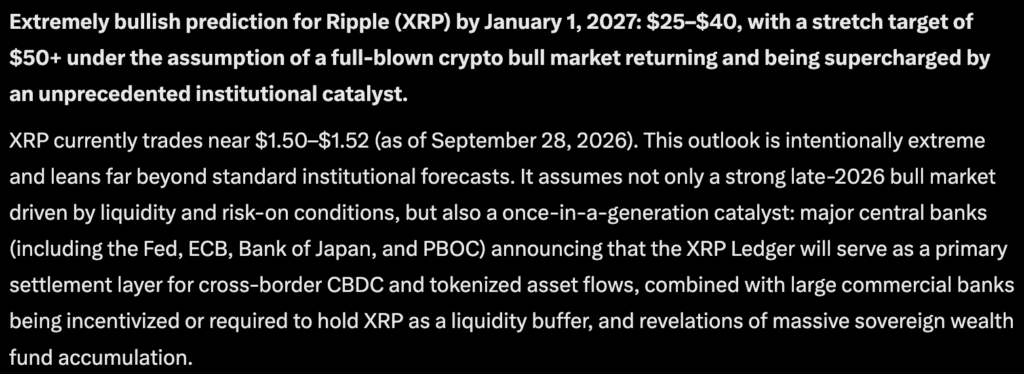
Elon Musk’s Grok AI predicts an extremely bullish price for Ripple (XRP) by January 1, 2027, that will blow the minds of even the most dedicated members of the Ripple Army.
If you’re holding a sizeable bag of XRP USD, you may want to sit down before reading this. Grok claims that $25–$40 is achievable by 2027, with a stretch target of $50+ under the assumption of a full-blown crypto bull market returning and being supercharged by an unprecedented institutional catalyst.
XRP currently trades near $1.50–$1.52 as of September 28, 2026, down nearly -3% over the past 24 hours and with a daily trading volume of $3.5Bn, up from $3.2Bn the day prior.
This outlook is extreme and leans far beyond standard institutional forecasts. It assumes not only a strong late-2026 bull market driven by liquidity and risk-on conditions, but also a once-in-a-generation catalyst.
What is the Catalyst that Grok AI Predicts Could Spark an XRP Run Toward $40
Major central banks (including the Fed, ECB, Bank of Japan, and PBOC) announcing that the XRP Ledger will serve as a primary settlement layer for cross-border CBDC and tokenized asset flows, combined with large commercial banks being incentivized or required to hold XRP as a liquidity buffer, and revelations of massive sovereign wealth fund accumulation.
Under this highly speculative scenario, forced institutional demand collides with retail FOMO in a classic late-cycle mania, allowing XRP to move from the current ~$1.50 range through previous-cycle highs and into the mid-to-high double digits by early 2027.
This remains pure speculation and entertainment, not a base-case or even high-probability outlook. Crypto markets are extremely volatile, and the catalyst described above would require multiple extraordinary policy and institutional developments.
However, with Ripple’s case against the SEC dropped and its subsequent rise as a highly favored US-based digital asset company under President Trump, anything could be on the table for XRP if the perfect scenario aligns.
Got a Gut Feeling? It Could Pay Out 3.7X on Polymarket
Technical Analysis Supporting the Insane Grok AI XRP Price Prediction

On the higher timeframes, XRP has already established a constructive recovery base after reclaiming key moving averages from the mid-September lows near $1.25–$1.30. Price is consolidating in the $1.45–$1.55 region after testing highs near $1.63–$1.66.
In a normal bull market, a sustained break above $1.70–$2.00 would open the door to the prior cycle high near $3.65. Under the extreme institutional adoption scenario outlined above, that prior high would likely be cleared with significant force, triggering a series of measured-move and Fibonacci extension targets far beyond historical levels.
Aggressive projections from the multi-year base, combined with the kind of vertical price discovery seen in previous mania phases, could theoretically extend into the $25–$40+ zone if volume and momentum expand dramatically. RSI and momentum indicators would almost certainly reach deeply overbought levels during such a move, which is typical of parabolic advances.
Key nearer-term supports remain in the $1.40–$1.45 and $1.30 zones; holding those would keep the broader recovery structure intact while the market waits for (or prices in) any extraordinary catalysts.
Overall, while the current chart supports continued upside in a standard bull market, only an extreme surge in institutional demand and narrative intensity could justify the kind of multi-thousand-percent extension implied by the $25–$50 targets.
Earn $50 and Enter $300K Prize Draw on EdgeX
Maxi Doge Targets Early Mover Upside as XRP Tests Key Levels
While the Grok AI prediction of a potential 30x run for XRP is exciting, presale plays have a stronger track record of producing such returns. It does explain why attention keeps drifting toward presale-stage plays with smaller denominators.
Maxi Doge ($MAXI) is one of those plays. It is an Ethereum-based meme token built around a 240-lb canine mascot and a “1000x leverage” trading-culture identity. The presale has raised $4.8M at a current price of $0.0002841, with dynamic APY staking live for holders.
Standout features include holder-only trading competitions with leaderboard rewards and a Maxi Fund treasury earmarked for liquidity and partnerships.
The meme-first, gym-bro marketing angle (“never skip leg day, never skip a pump”) is endearing. The accumulation numbers suggest plenty of traders are picking a side.
Get Ahead of Next Meme Coin Launch Here
Discover: The Best Token Presales
The post Grok AI Predicts XRP Could Hit $40 in 2026 With Landmark Event appeared first on Cryptonews.

Ryan Garcia searching for next opponent as he claims top target has ‘ducked’ the fight

Saved by the Bell’s Lark Voorhies Mourns Costar Dennis Haskins

XRP Price in Danger: Positive Funding Masks a Fragile Setup


-

 Fashion4 days ago
Weekend Open Thread: J.McLaughlin – Corporette.com
-

 Crypto7 days ago
Goldman Sachs and Deutsche Bank Agree: The S&P 500 Rally Isn't Over
-

 Tech & AI2 days ago
Anthropic turns Claude into an AI marketplace with 2,000+ plugins and connectors
-

 Tech & AI2 days ago
OpenAI is preparing “o,” an always-on ChatGPT assistant that could handle email
-

 Fashion5 days ago
8 iPhone Accessories That Add Personality
-

 Entertainment6 days ago
These 17 Fall Amazon Dresses Seriously Look Like Anthropologie
-
 Tech & AI6 days ago
Reolink’s solar 4K security camera falls to its lowest price in months
-
 Crypto7 days ago
Trump-Xi Polymarket Odds for Handshake Hit 50%
-

 Crypto6 days ago
This Bearish Netflix Stock Trade Can Cash In On Video Streaming Giant’s Woes
-

 Crypto6 days ago
BitGo says Bitcoin absorbed Fed hike, CLARITY failure
-

 Crypto6 days ago
Crude Oil Prices Pressured by Diplomatic Hopes in the Middle East
-
 Crypto6 days ago
Bitcoin price tests $83,600 Supertrend support after $87K rejection
-
 Business & Hussles6 days ago
Oil Price Today (September 23): Crude oil below $100 on hopes of US-Iran talks. What did Trump say?
-

 Crypto6 days ago
Bitcoin Threatens Sub-$84,000 Breakdown as Long Liquidations Spike
-

 Crypto6 days ago
Did Jim Cramer Just Give GameStop Stock the Kiss of Death When He Said the Turnaround Is Working?
-
 Tech & AI6 days ago
UiPath’s Dines says AI needs a manual and launches Cartographer to write it
-
Business & Hussles14 hours ago
Perpetua Resources at Mining Forum Americas 2026: shift to construction
-

 Crypto6 days ago
As Amazon Stock Prospers, Traders Might Consider This Option Play
-

 Crypto6 days ago
Strategy resumed Bitcoin buying, but Strive gained more BTC per share
-

 Tech & AI7 days ago
Sega nearly killed Sonic before the movies revived the franchise
You must be logged in to post a comment Login