
Crypto
The Treasury Secretary is whipping votes for a bill priced at 10%


Summary
- Treasury Secretary Scott Bessent publicly urged the Senate to pass the Digital Asset Market Clarity Act as the chamber returned from its August recess.
- A cloture vote on the motion to proceed to H.R. 3633 is scheduled for 2:15 p.m. Eastern on Tuesday, September 15, after Majority Leader John Thune filed cloture on August 8.
- Sixty votes are required to advance. Republicans hold 53 seats, meaning at least seven Democrats must cross, and no public commitment from that number exists.
- Galaxy Digital cut its estimate of 2026 passage to roughly 10%, down from about 75% in May, and prediction markets have priced enactment in the low teens.
- The National Sheriffs’ Association dropped its opposition on September 3, moving to neutral after negotiating amendments on illicit finance provisions.
Tuesday at 2:15 in the afternoon, the Senate holds a procedural vote that decides whether America gets crypto market structure law in this Congress.
Look at who wants it. The Treasury Secretary has publicly told the Senate to pass it. The President worked senators directly at a White House meeting with Ripple’s CEO, Coinbase’s CEO and the SEC chairman in the room. The Majority Leader filed cloture before the August recess instead of quietly letting the bill rot on the calendar. Brian Armstrong says flatly that it passes.
Now look at the count. Sixty votes. Republicans have fifty-three. At least two of those are expected to vote no anyway.
Galaxy Digital has tracked this bill all year and just cut its odds of 2026 passage to around 10%. In May they had it at 75%. Prediction markets put enactment in the low teens.
So the most senior economic officials in the country are whipping votes for something the people pricing it give roughly a one-in-ten shot. That gap is the story, and it is worth understanding before Tuesday instead of reading about it afterwards.
What Bessent actually said
The content is unremarkable. Who said it is not.
Bessent stated that the Senate should pass the CLARITY Act, framing it around regulatory certainty for digital asset markets and the competitive position of the United States. He has made related arguments through the year, including remarks tying stablecoin growth to demand for Treasury securities, and the administration has treated digital asset policy as a priority since the executive order issued in January 2025 that our executive orders page traces.
A sitting Treasury Secretary publicly whipping votes for a specific bill is not routine. Treasury Secretaries comment on fiscal policy, on debt management, on international financial conditions. Advocating for the passage of a particular piece of market structure legislation, by name, days before a procedural vote, places the department’s institutional weight behind an outcome in a way that is closer to legislative affairs than to economic stewardship.
That is a signal about how much the administration wants this, and it is not by itself a signal about whether it will happen. Those are different things and the coverage has tended to merge them.
The vote that is actually happening
“The Senate votes on CLARITY” is doing a lot of work in most headlines. What happens Tuesday is narrower.
Thune filed cloture on August 8, immediately before the chamber left for recess. The vote scheduled for 2:15 p.m. Eastern on Tuesday is cloture on the motion to proceed to H.R. 3633. That is not a vote on the bill. It is a vote on whether to begin debating the bill.
Cloture on a motion to proceed requires sixty votes. If it succeeds, the Senate enters debate with an amendment process ahead of it, and a second cloture vote would eventually be needed to end debate on the bill itself. If it fails, the motion is defeated and leadership must decide whether to try again, restructure the bill, or move on.
The mechanism matters for reading Tuesday’s result. A failed cloture vote is not a rejection of market structure legislation on its merits; it is a determination that sixty senators are not yet willing to start. Our page on cloture covers why this threshold shapes every piece of crypto legislation, and our CLARITY Act status page tracks where the bill has reached.
Why the odds are so low
Seventy-five to ten is a big move, and Galaxy has no reason to talk down crypto legislation. Four things got them there.
The ethics provision never closed. The dispute over restricting federal officials from issuing or sponsoring digital assets consumed the negotiation. Republicans released text in July assigning sole enforcement to the Justice Department with a 2029 sunset, and Democrats rejected it the same day, with the objection centred on enforcement design and not on the prohibition itself. Our close read of that provision examines the three design choices at issue. No replacement has emerged publicly.
Seven votes have not materialised. Republicans hold 53 seats and at least two Republican defections have been expected, which raises the Democratic requirement above seven in practice. The Senate Banking Committee advanced the bill 15-9 with only two Democrats in favour, which was the first clear evidence that assembling a crossover coalition would be hard.
The calendar compressed. The chamber returns for a limited window before the October recess, with appropriations deadlines competing for floor time and members increasingly oriented toward November. Complex financial legislation historically struggles in that environment.
And opposition broadened beyond the ethics fight. New York’s attorney general came out publicly against the bill on preemption grounds, arguing it would undermine state and municipal authority to prosecute cryptocurrency fraud. That objection travels across party lines and is structurally harder to negotiate away than an enforcement clause, because preemption runs through the bill’s jurisdictional architecture instead of sitting in one title.
What moved in the other direction
Two things genuinely got better, and ignoring them would be dishonest.
The Sheriffs’ Association dropped its opposition on September 3, moving to a neutral position after negotiating amendments to the bill’s illicit finance provisions. Law enforcement opposition to a financial bill is a specific and durable obstacle, because it gives members from both parties a non-partisan reason to vote no. Removing it removes an argument instead of adding a vote, and that is still meaningful.
The White House engaged directly. The President met senators alongside Ripple’s chief executive, Coinbase’s chief executive, and the SEC chairman. Presidential attention does not produce votes on its own, and it does determine whether an administration spends capital on floor time, amendment negotiation, and the retail politics of persuading individual members.
And leadership filed cloture instead of letting the bill die quietly. Thune had the option of leaving H.R. 3633 on the calendar untouched. Filing before recess forced a scheduled vote and created a deadline, which is what leaders do when they want a bill moved instead of buried.
Set against the vote count, none of this changes the arithmetic. It changes the probability that the arithmetic gets worked on.
Why this is harder than the stablecoin bill
The obvious retort to all of this is that crypto legislation already passed once. The GENIUS Act was signed in July 2025. If the Senate could do stablecoins, why not market structure?
Because they are not the same kind of bill, and the differences all run the wrong way.
Stablecoins had a constituency that wanted regulating. Circle and Paxos had spent years asking for a federal framework, because a licence is worth more than ambiguity when your product is a dollar and your customers are institutions. Market structure has a constituency that wants classification resolved in a specific direction, which is a different thing and a harder sell.
Stablecoins had banks partly onside. The yield prohibition was written into the statute precisely because the banking lobby wanted it, which converted a potential opponent into a participant. Market structure has the banking industry watching for exactly the loophole the American Bankers Association is now pressing senators to close, and has state prosecutors objecting on preemption.
Stablecoins were one product. The Act defines a payment stablecoin, names who may issue it, and says what backs it. Market structure has to classify every digital asset, split jurisdiction between two agencies, create registration regimes for exchanges, brokers, dealers and custodians, and write a developer shield. More surface means more objections.
And stablecoins did not touch the President’s family business. That is the entire ethics fight in one sentence, and it is why a provision that occupies a handful of pages has consumed a year of negotiation over a bill running more than six hundred.
The lesson from GENIUS was never that crypto legislation passes. It was that narrow, single-product legislation with a cooperative industry and a neutralised opposition can pass. CLARITY is none of those things, which is a better explanation for the ten percent than anything about the calendar.
Reading the gap
So why push this hard on a one-in-ten? Three answers, and they can all be true at once.
The odds could be wrong. Prediction markets and research desks price public information. Vote counts are private until they are not, and a leadership office that files cloture usually has a better read on its own conference than an outside observer does. Thune’s willingness to schedule the vote is itself evidence, though his own public framing before the recess was notably unenthusiastic.
The push could be about the next attempt. A failed cloture vote with visible administration support creates a record: named senators who declined, an identifiable obstacle, and a case to make in November and in the next Congress. The industry’s political operation, which our examination of its spending documented, is built to run exactly that play. Losing a vote you have publicly fought for is more useful politically than never holding it.
Or the push could be the point. An administration that has made digital asset policy a priority benefits from being seen to fight for it whether or not it wins. Constituencies notice effort, and effort is cheaper than success.
The distinguishing evidence arrives Tuesday. If cloture clears with votes to spare, the odds were wrong and the private count was better than the public one. If it fails narrowly, the push was real and insufficient. If it fails badly, the exercise was about the record.
What the industry’s own position tells you
Watch what the industry does this week, not what it says.
Coinbase’s chief executive has said the bill will pass. The Ripple and Coinbase leadership attended the White House meeting. The industry’s super PAC network entered this cycle with a war chest measured in the hundreds of millions, and our audit of that spending documented crypto contributions reaching a substantial share of all corporate election spending. That is an operation built to produce exactly this vote.
Two years of that effort has produced one enacted statute, the stablecoin law, and a market structure bill that has not cleared a procedural motion. That is not nothing, and it is considerably less than the spending implied.
What the sector does over the next five days is the more informative signal than what it says. Public confidence costs nothing. Whether the political operation spends on targeted advertising in the states of undecided senators, whether individual firms make direct approaches, and whether any concession on the ethics provision is publicly floated are all observable and all expensive. An industry that believes a vote is winnable spends into it. An industry that has concluded a vote is lost preserves capital for November.
There is also a structural bind worth naming. A rider or a quiet insertion into a larger vehicle passes without a recorded roll call, which is procedurally attractive and politically useless to an operation whose theory of influence rests on the threat of a funded primary challenge. Accountability requires named votes. So the sector has a reason to want this vote held even if it loses, which complicates any reading of its public optimism as a forecast.
The honest summary is that industry confidence is not evidence about the vote count, and treating it as such has been the most common error in coverage of this bill all year.
What Tuesday determines
Four outcomes. The coverage will treat them as two.
Cloture succeeds comfortably. The bill enters debate with an amendment process ahead, and the compressed calendar becomes the binding constraint instead of the vote count. Passage in this Congress becomes plausible without becoming likely, because a second cloture vote and House concurrence both remain.
Cloture succeeds narrowly. Same procedural position, weaker footing for the amendment fight, and every subsequent vote becomes a renegotiation.
Cloture fails narrowly. Leadership can refile. The gap becomes a target list, and the ethics provision becomes the explicit price of the missing votes.
Cloture fails badly. Market structure legislation moves to the next Congress, and everything governing digital asset classification in the United States continues to rest on the joint SEC-CFTC interpretive release from March 2026, which is agency policy revocable by a future commission. Our SEC page covers why that impermanence is the entire argument for the statute.
What is actually in the bill nobody is voting on yet
Lost in the vote-count arithmetic is that the thing the Senate might start debating on Tuesday is a specific 616-page text with specific contents, and most people arguing about its odds have not read what it does.
Classification. It defines digital commodities and separates them from securities, replacing case-by-case determination under the investment contract test with statutory categories. A grandfather provision would deem tokens anchoring exchange-traded products at the start of 2026 to be non-securities by operation of law, which resolves status instantly for the assets underlying every listed spot product.
Jurisdiction. Spot trading in digital commodities moves to the CFTC. The SEC keeps digital assets that are securities. Our CFTC page covers what the agency already governs and what it would inherit.
Registration regimes. New categories for digital commodity exchanges, brokers, dealers and custodians, each needing years of agency rulemaking before they function. Provisional registration lets existing firms operate during the build.
A developer shield. Non-custodial software developers excluded from money transmitter treatment under the Bank Secrecy Act, operating by definitional exclusion, with no rulemaking needed.
And preemption. Federal jurisdiction displacing conflicting state regimes for covered assets and intermediaries, which is the provision New York’s attorney general is objecting to and which is structurally harder to negotiate than the ethics title.
Two things follow. The grandfather clause and the developer shield take effect on enactment, so passage delivers something immediately. The registration regimes do not, and on the evidence of the stablecoin statute, whose implementing agencies missed their one-year rulemaking deadline this July, the useful parts arrive somewhere around 2028 or 2029.
Which is worth holding in mind on Tuesday. A cloture vote that succeeds does not produce a functioning market structure framework. It produces the beginning of a process that has historically run long.
The seven senators
Nobody has published the list, so here is how to build it yourself, because the names are more informative than any odds estimate.
Start with the two Democrats who voted the bill out of the Banking Committee. That 15-9 markup is the only recorded evidence of Democratic willingness to advance this text, and both have since expressed reservations about the version that emerged from the merge. Assume they are gettable and not guaranteed.
Add the seven Democrats who were negotiating on the ethics provision through the summer and then issued a joint statement rejecting the July text. That group is the target list, by definition: they were at the table, which means they wanted a deal, and they walked, which means the deal on offer was not one. They are also the reason the ethics title is the price, not a side issue.
Subtract the Democrats who have never been in the room. Members who opposed the stablecoin bill, who have been publicly critical of the administration’s digital asset posture, or who represent states where the attorney general has come out against preemption are not persuadable on a floor vote five days out.
On the Republican side, subtract the libertarian objections and the members who have voted against expanding federal regulatory authority as a matter of course. Two defections has been the working assumption all year, and nobody has publicly revised it.
Run that arithmetic and the coalition has to come almost entirely from the group that walked away in July. Which is why every serious read of Tuesday reduces to a single question: has anyone moved on enforcement of the ethics provision, and the answer as of this writing is that nothing has been announced.
If a hybrid mechanism surfaces before Tuesday, with the Justice Department primary and some independent or state backstop, the odds are wrong. If the vote arrives with the July text unchanged, the odds are approximately right.
What a failure actually costs
Assume cloture fails. What breaks, and what does not?
Nothing breaks immediately. Markets operate today under the joint SEC-CFTC interpretive release from March 2026, which names sixteen digital assets as digital commodities and places staking, mining and airdrops outside securities law. Exchanges list, funds launch, institutions custody. None of that stops.
The impermanence stays. That interpretive release is agency policy, not statute. A future commission can withdraw it by vote, and commissioners serve at presidential pleasure. Every firm making a decade-long infrastructure commitment is building on something a change of administration can unwind, which is the entire argument for legislating and the reason the industry keeps spending on it.
Newer assets stay stuck. The sixteen named assets have clarity. The seventeenth does not, and without the self-certification path the bill would create, there is no process for getting it. That is a growth constraint rather than an operating one, and it compounds.
The state patchwork survives. No preemption means the licensing map stays as it is, which our legality page documents, and the prediction market litigation across a dozen states keeps running on the current framework.
And the calendar gets much worse. A failed vote in September means the next window is a lame duck session, then a new Congress in January 2027 with a composition set by the November midterms. Analysts have warned that missing 2026 could push market structure legislation out by years, and the base rate for a bill that has to be reintroduced and re-marked-up in a new Congress is not encouraging.
The honest summary is that failure is expensive in a slow, compounding way rather than a dramatic one. Nothing collapses. The industry simply continues operating on borrowed permission, which it has done for two years and can presumably do for two more.
What to watch
The roll call itself, not the result. Which Democrats vote yes is the list that determines whether a second attempt is viable and what it would cost.
Whether any ethics compromise surfaces before Tuesday. A hybrid enforcement mechanism, with the Justice Department primary and some independent or state-level backstop, is the visible landing zone. Its appearance in the next five days would be the strongest possible signal that the count is closer than the odds suggest.
Republican defections. Two have been expected. A third raises the Democratic requirement to eight and changes the arithmetic materially.
Whether Galaxy or the prediction markets move before the vote. Both reprice continuously. A sharp move upward in the final days would indicate that information is reaching the market that has not reached the press.
What leadership says immediately after. Refile, restructure, or move on. That statement determines whether this is a setback or an ending.
Disclaimer: This article is for information and educational purposes only and does not constitute financial, investment, or legal advice. It describes pending legislation and a scheduled procedural vote whose outcome is unknown, and probability estimates cited are third-party assessments that change continuously. Nothing here predicts any legislative result. Information is accurate as of September 10, 2026.
What did the Treasury Secretary say about the CLARITY Act?
Scott Bessent publicly called on the Senate to pass the Digital Asset Market Clarity Act as the chamber returned from its August recess, framing it around regulatory certainty and American competitiveness. A sitting Treasury Secretary advocating by name for a specific market structure bill days before a procedural vote is unusual and places the department’s institutional weight behind the outcome.
What exactly is the Senate voting on September 15?
Cloture on the motion to proceed to H.R. 3633, scheduled for 2:15 p.m. Eastern. That is a vote on whether to begin debating the bill, not on the bill itself. It requires sixty votes. If it succeeds, the Senate enters debate with an amendment process ahead and a further cloture vote eventually needed to end debate.
How many votes does it need?
Sixty. Republicans hold 53 seats, so at least seven Democrats must cross, and in practice more, because at least two Republican defections have been expected. The Senate Banking Committee advanced the bill 15-9 with only two Democrats in favour, which was the first indication that a crossover coalition would be difficult to assemble.
Why are the odds of passage so low?
Galaxy Digital cut its estimate to roughly 10% from about 75% in May, and prediction markets have priced enactment in the low teens. Four factors: the ethics provision dispute never closed, the seven Democratic votes have not publicly materialised, the calendar compressed against appropriations deadlines and the midterms, and opposition broadened to include preemption objections from state law enforcement.
What is the ethics provision fight about?
Restricting federal officials, including the President, from issuing or sponsoring digital assets while in office. Republicans released text in July assigning sole enforcement to the Justice Department with a 2029 sunset, and Democrats rejected it the same day, objecting to the enforcement design and not to the prohibition. No public replacement has emerged.
Has anything improved for the bill?
Yes. The National Sheriffs’ Association dropped its opposition on September 3, moving to neutral after negotiating amendments to the illicit finance provisions, which removes a non-partisan reason for members to vote no. The White House engaged directly with senators, and leadership filed cloture before recess instead of letting the bill lapse.
What happens if the vote fails?
Leadership decides whether to refile, restructure, or move on, and that statement is the most informative thing that follows. If market structure legislation slips to the next Congress, digital asset classification in the United States continues to rest on the joint SEC-CFTC interpretive release from March 2026, which is agency policy that a future commission can withdraw by vote.
Does the administration’s support mean it will pass?
Not on its own. Political support and vote counts are different things, and the gap between them is the subject of this piece. Presidential and Treasury engagement determines whether capital gets spent on persuading individual members; it does not determine whether sixty senators are willing to proceed. Tuesday’s roll call is the evidence. This is educational analysis, not investment advice.

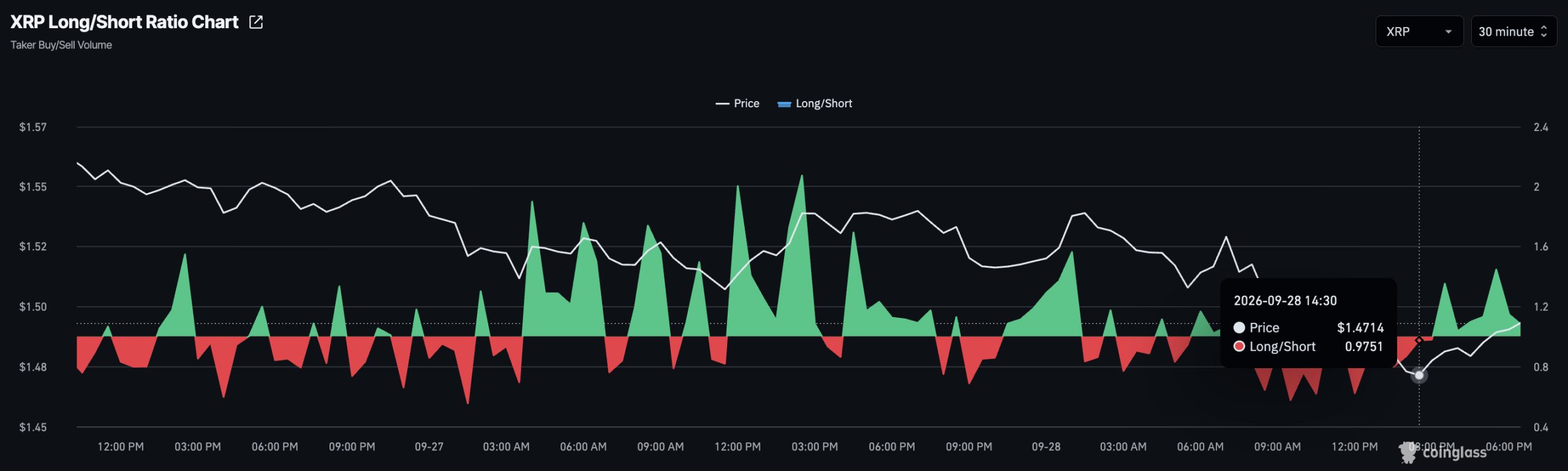
XRP price hovers under $1.49 after three consecutive daily declines left the token losing the $1.50 support, even as a modest bounce pulled it off session lows. CoinGlass data showed the long-to-short ratio at 0.975, meaning short positions marginally outnumbered longs, while the funding rate sat at a positive 0.008%, the reading that determines whether long or short traders pay a periodic fee to hold perpetual futures.
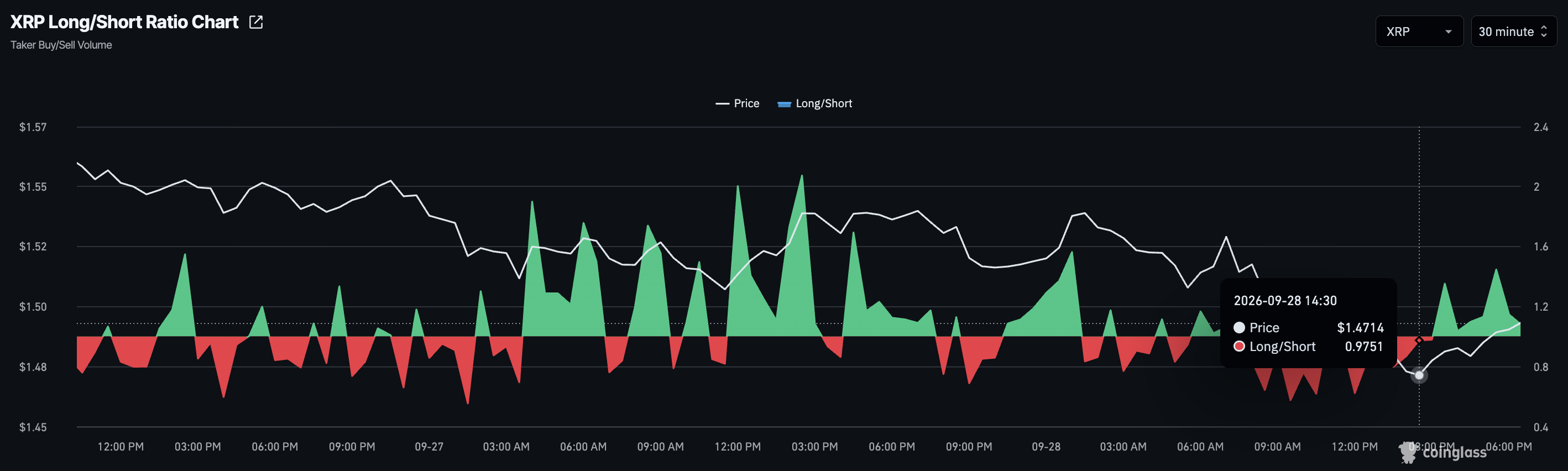
XRP Long Short Ratio, Coinglass
That combination is the crux of the problem. Traders are still paying to stay long, yet the spot price has not moved in a way that rewards the bet, and the disconnect between heavy spot selling and futures demand is the setup that tends to unwind fast once a key level gives way.
A 0.975 long-to-short ratio is not a bearish signal in any decisive sense. It sits close enough to 1.0 that it reads as near-balanced positioning rather than a market leaning hard in either direction.
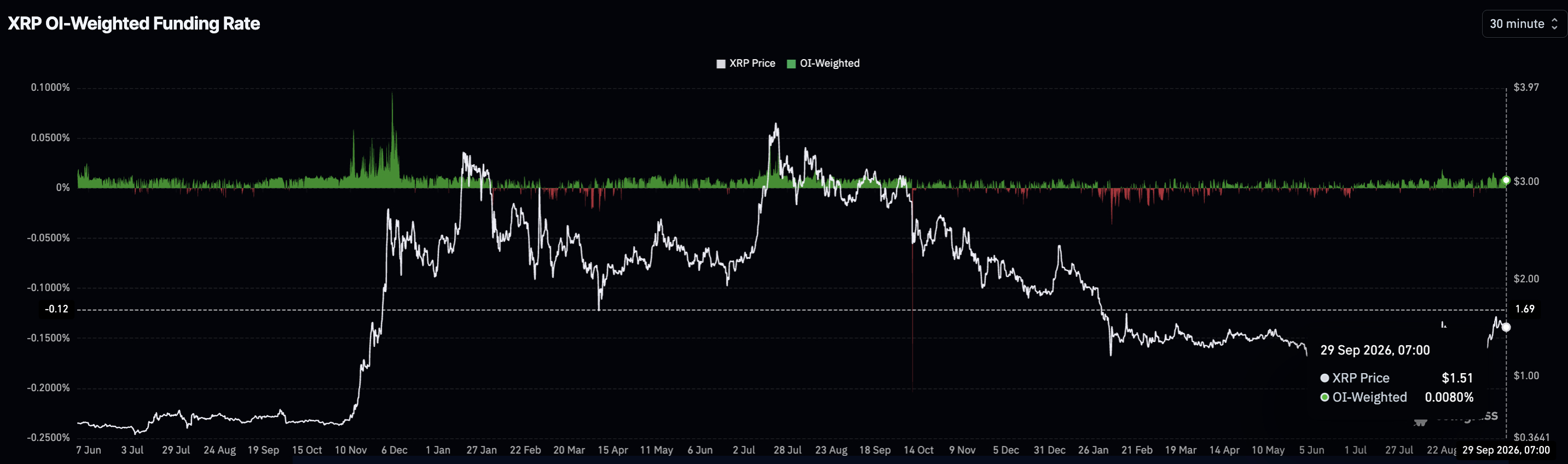
XRP Funding Rate, Coinglass
Funding tells a more interesting story on its own. A positive rate means demand for long exposure in crypto derivatives is real enough that longs are compensating shorts to hold the position, which typically signals conviction that price moves higher.
However, it cuts both ways: if price falls further, those same leveraged longs become forced sellers, and a positive funding regime built on thin spot demand can flip into a liquidation cascade faster than one built on genuine accumulation.
CryptoQuant’s summary data flagged overheating conditions across both XRP’s spot and futures markets, alongside sell-side dominance in futures, meaning sellers have retained the upper hand in derivatives even as funding stays positive. That is the missing piece: positive funding shows traders are willing to hold bullish exposure, but it has not yet translated into enough buying pressure to absorb the futures selling and push through resistance.
Earn $50 and Enter $300K Prize Draw on EdgeX
XRP Price and the $1.37 Support
The daily chart still leans bullish on a longer timeframe. XRP held above its 50-day price exponential moving average near $1.365 and its 200-day EMA near $1.369 through the three-day slide, with the 100-day EMA sitting lower at $1.307 as a secondary reference.
Momentum has cooled rather than reversed. The RSI sat near 55, close to neutral, and the MACD flattened around zero, a pattern consistent with consolidation after an earlier advance rather than an active breakdown.
The level that matters most sits at $1.37, where the 50-day and 200-day EMAs converge into a single support band. A clean break below that zone opens the $1.30 area, and a deeper slide would eventually put the $1.00 psychological level in play, though XRP would need to fall substantially before that becomes the immediate focus. On the upside, reclaiming the $1.574 resistance level is the trigger that would strengthen the case for a move toward $1.90.
Trade XRP on Bybit and Get a Chance to Win Our $1,000 USDT Airdrop
What Happens Next for XRP?
Two scenarios frame the near-term path. If XRP holds the $1.37 zone, the market stays in a consolidation phase where positive funding continues to reflect trader appetite for long exposure, but that alone won’t confirm a breakout without a corresponding rise in open interest and spot volume.
If XRP price instead reclaims $1.574, the technical case for a run toward $1.90 gets meaningfully stronger, and that move would likely force shorts to cover into strength. The alternative is a sustained break below $1.37, which shifts focus to $1.30 as the next line of defense, with $1.00 as the deeper level only if that support also fails.
Either way, the current setup leaves no room for complacency on either side of the trade. Near-balanced positioning combined with positive funding and futures sell-side dominance is a fragile mix, and the next move in spot price will do more to settle the argument than another shift in the long-short ratio.
Discover: The Best Token Presales
The post XRP Price in Danger: Positive Funding Masks a Fragile Setup appeared first on Cryptonews.
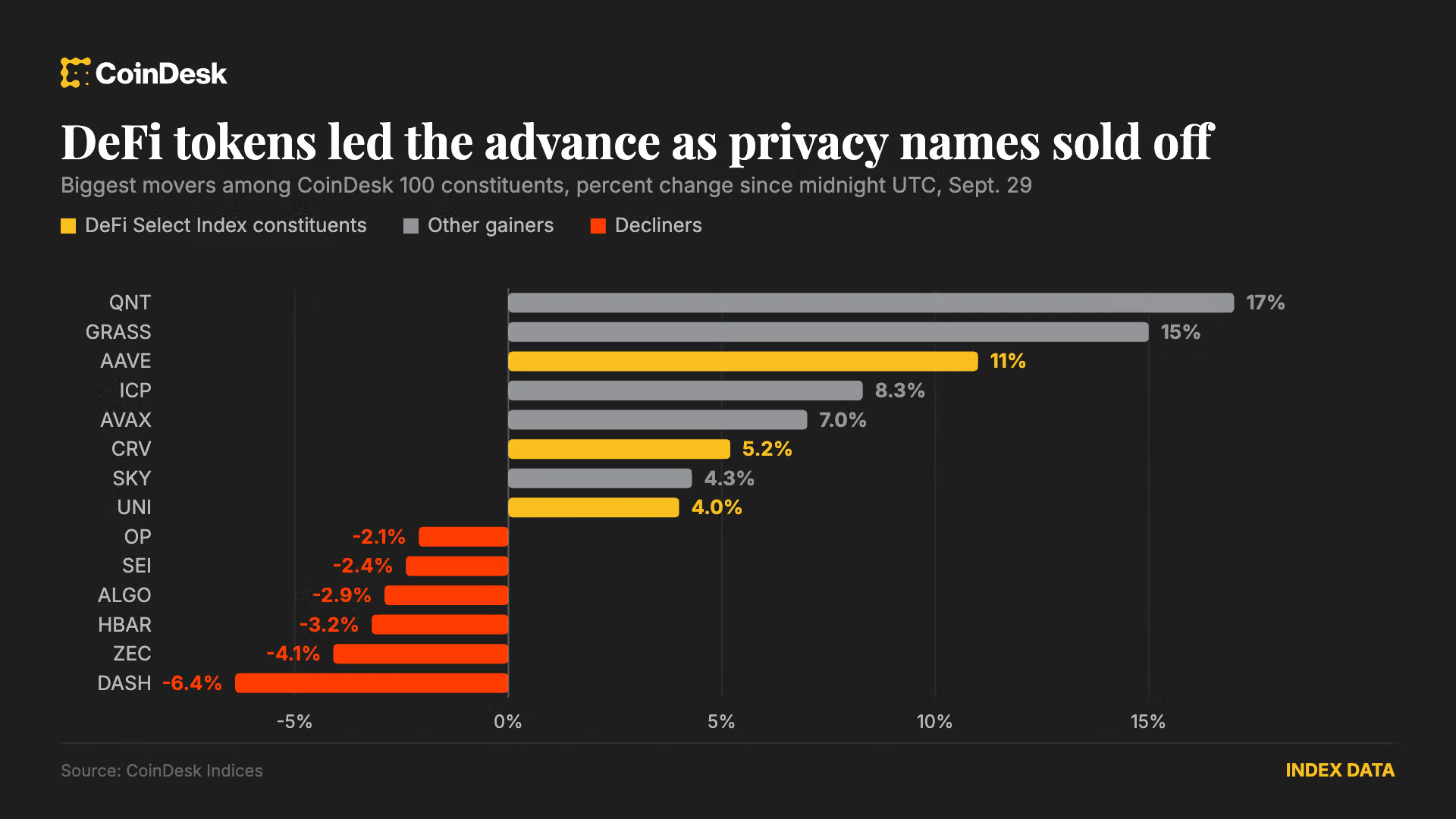
Bitcoin recovered Monday’s losses to trade at $84,170 on Tuesday, up 0.82% since midnight UTC and 1.4% over 24 hours, with 72 of the 100 CoinDesk 100 constituents higher and the index adding 0.89% to 1,904.49.
The bid is arriving despite conditions that have been suppressing risk assets for a week, the 10-year Treasury yield sitting at 5.234% after ending Monday above 5.2%, near levels last seen in 2007, and the 30-year at 5.549% having topped 5.56% on Monday, around a 2004 high.
U.S. stocks fell for a second session on Monday, the Dow dropping more than 300 points and the S&P 500 and Nasdaq Composite shedding 0.8% and 0.9%, with futures mixed on Tuesday morning.
Decentralized finance (DeFi) is driving the move for the second time in a week, with the DeFi Select Index (DFX) gaining 5.0% since midnight, led by lending protocol token aave at 11% and curve dao token at 5.2%. The CoinDesk 80 rose 2.0% against the CoinDesk 5’s 1.3%, though the ranking inverts over 24 hours, where the CD5’s 1.7% beats the CD80’s 0.44%.

The D’CENT wallet hack, the year’s second-largest drain of XRP behind the Bitget crypto exchange hack, has spilled beyond the XRP Ledger onto additional blockchains like Bitcoin, Ethereum, and Stellar.
Hackers have drained more than 12.4 million XRP from more than 7,000 D’CENT wallets, still some way behind Bitget’s loss of 102.9 million XRP.
Although the wallet was popular among the XRP community, D’CENT users who owned assets of other blockchains have also lost their funds.
D’CENT’s own disclosure named Bitcoin, Tron, and Ethereum, for example. Even a Stellar user has lost XLM in the incident.
Hackers are able to sweep funds across blockchains with one compromised recovery phrase for the multi-blockchain wallet.
IoTrust, the maker of D’CENT, confirmed at least 110 abnormal transfer reports, including non-XRP assets, per ZDNet Korea.
XRP holders lose $18 million in D’CENT hack
Drains of XRP are the most well-documented, due to the prominence of D’CENT among XRP holders.
At least six waves of theft occurred between September 15 and 20, emptying 6,678 wallets of 11.7 million XRP.
The thief stole from large wallets first, by hand, and soon wrote scripts to take funds from progressively smaller wallets.
Warnings from D’CENT and other members of the XRP community couldn’t stop the drainage. Thieves took 640,370 additional XRP after September 21, bringing the tally to above 12.4 million.
By Friday, 6.3 million of those stolen XRP had crossed to Ethereum’s blockchain through the swap service THORChain.
As the theft spilled over to other blockchains, researchers admitted the scope of the losses, saying, “Most of it is no longer XRP.”
Read more: David Schwartz warns of hard fork because XRP nodes won’t upgrade
In August, D’CENT was still touting its hardware wallets’ secure element, boasting that it was impervious to vulnerabilities linked to the Coldcard hack.
D’CENT now warns users that wallets they created using its app are vulnerable, urging them to create a fresh recovery phrase and immediately migrate everything, including tokens, NFTs, and any staked assets.
Got a tip? Send us an email securely via Protos Leaks. For more informed news and investigations, follow us on X, Bluesky, and Google News, or subscribe to our YouTube channel.

Market action since 2022 backs Thielen’s take. The 10-year yield more than doubled to 3.88% that year as the Fed raised interest rates rapidly, including several 50- and 75-basis-point hikes to fight inflation.
Bitcoin fell 64% that year. Fed tightening and rising yields added to the pain from crypto scams and blowups.
The picture has been different since. From the end of 2023, the 10-year yield has risen 135 basis points to 5.23%, the highest since 2007. Over the same stretch, bitcoin has roughly doubled to $86,000, even after pulling back from its October record above $126,000.
Thielen and others attribute much of the recent rise in yields to fiscal fears and a higher term premium. In plain English, investors want to be paid more to lock up their money in long-term bonds, given the uncertainty over inflation and government borrowing.
Chicago-based Strategic Analytics made a similar point about gold, noting that it has tracked fiscal risk more closely than the Fed’s policy path since 2022.
“Since 2022, gold has increasingly tracked fiscal-risk perceptions – term premium, deficits, debt sustainability – rather than the Fed’s policy path. Gold is not defying real yields. It is pricing fiscal sustainability and currency debasement, which has become the marginal driver,” it said recently in a LinkedIn post.

Humanoid robots box during the 5th Global Digital Trade Expo on September 25, 2026 in Hangzhou, Zhejiang Province of China.
Vcg | Visual China Group | Getty Images
BEIJING — China’s securities regulator is raising the bar for public listings of humanoid robot startups, according to three sources familiar with the CSRC’s thinking.
It’s a sign of how one of the hottest sectors of the market is cooling, as investors globally assess whether artificial intelligence stocks are in a bubble.
The Chinese regulator wants local “embodied AI” startups seeking to go public to meet three specific criteria, according to the sources, who requested anonymity due to the sensitivity of the situation.
They are:
- The “window guidance” requires that the humanoid applicants have sustainable revenue and commercial orders.
- Losses must narrow, with one source saying a three-year forecast is needed.
- The company must possess core technology such as robotic brain or hands.
Even if a startup only has to meet two of the three criteria, as one source indicated, it’s unclear which, if any, of the companies can do so.
That’s lowered expectations to just a handful, or none, of these startups making it to public markets, the sources said.
At least two dozen humanoid-related embodied AI companies have filed to list in Hong Kong alone, according to two of the sources. Hong Kong in May 2025 started letting tech companies file confidentially for IPOs.
The Hong Kong stock exchange declined to comment. The China Securities Regulatory Commission did not immediately respond to a request for comment. Mainland China companies wanting to list in Hong Kong also need the CSRC’s blessing.
Unitree IPO impact
Scrutiny on China’s growing number of humanoid robot startups and their fast-growing valuations — supported by a mix of government and private sector funds — has grown over the last several weeks.
The industry’s posterchild, Unitree, got a regulatory fast-track to its listing in Shanghai on Aug. 19 as the World Robot Conference kicked off in Beijing.
But in a keynote a day later, founder Wang Xingxing cautioned that commercialization beyond dancing robots remained years away. It accentuated a debate that picked up in subsequent weeks on what humanoids can actually do — and whether industry startups were actually making money.
China now has well over 100 humanoid companies, which fall under the national push for “embodied AI.” The term received Beijing’s support in the last two annual government work reports, although authorities have warned of a bubble in the humanoid robot industry.
Reflecting a rapid surge in interest, investment in the sector hit 47.09 billion yuan ($6.95 billion) in the second quarter, more than double that of the first quarter — and up over six times versus the same period last year, according to industry data provider Xiniu.
Unitree raised about about 6.1 billion yuan ($905 million) in its IPO on Aug. 19 with Shanghai-listed shares skyrocketing more than 460% in their debut to close at 845 yuan.
The stock had nearly halved in price as of Monday, at 459.65 yuan a share.
Hong Kong-listed Ubtech has also tumbled more than 40% so far this year. The company, which went public in December 2023, still reported an operating loss for the first half of this year of 279 million yuan.
The share price decline contrasts with the flood of capital pouring into humanoid robotics companies over the last 12 months or so. The tech, often called “physical AI” in China, has been seen as a way for early-stage investors to benefit from the surge of interest in artificial intelligence models.
However, Rhodium Group analysis this month found that China’s AI companies only make about 10% the revenue of Anthropic and OpenAI. The ratio of valuation to revenue — especially for Chinese AI startups Moonshot and DeepSeek — was far higher than their U.S. rivals, the report said.
While expectations grow for the U.S. AI giants’ IPOs, chipmaker AMD said Monday it is acquiring World Labs for $8.2 billion in a stock deal. The startup, founded by AI pioneer Fei-Fei Li, is building AI models for creating virtual 3D environments frequently used in humanoid robot development.

The launch this morning was both imperfect and stripped down to its orbital essentials. On the way up, one of the Starship’s six engines failed to burn properly, requiring the other engines to compensate for the missing thrust to get the ship in orbit.
In addition, the return to Earth was simplified. SpaceX has made itself famous for safely landing the first stage of its Falcon 9 and Starship boosters—with 641 out of 688 Falcon 9 launches featuring this kind of recovery, allowing the boosters to be reused and make flying cheaper. Starship’s first stage, meantime, performs what has become known as a chopstick recovery, with the booster navigating its way back to the launch tower where two giant metal arms pluck it from the sky. For the current mission, the chopstick recovery was done away with to simplify the flight objectives; instead the first stage made a soft, engine-assisted splashdown in the Gulf of Mexico. The Starship spacecraft was planned for a six-orbit, 10-hour mission, with the ship’s engines set to fire around the dinner hour Monday to bring the spacecraft down for a similar gentle, watery landing.
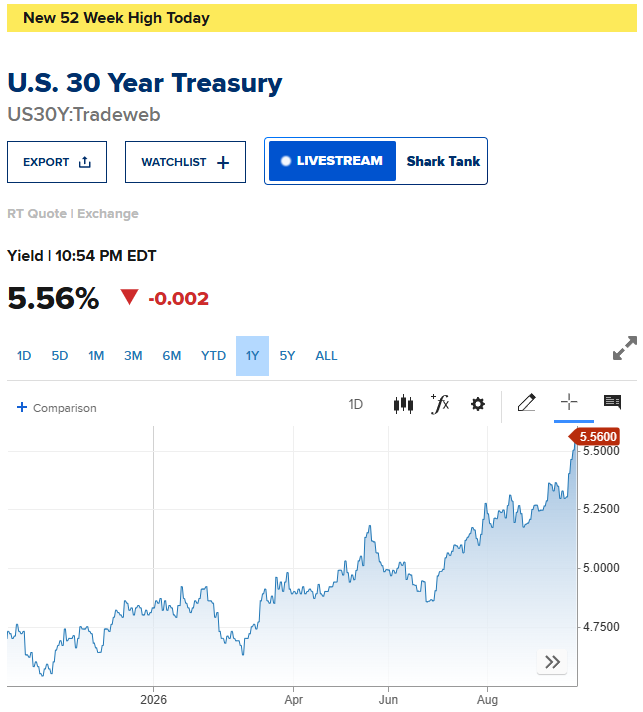
Goldman Sachs’ Anshul Sehgal says bonds yielding 5% or more are not the best trade right now. He still favors AI infrastructure, which he sees as a far more asymmetric bet than the long bond.
Sehgal, a global co-head of Fixed Income, Currencies and Commodities (FICC) at the bank, laid out the view just a few days after the Federal Reserve raised interest rates.
Why Goldman Sachs Is Passing on 5%+ Bonds
On Goldman’s The Markets, Sehgal said the 30-year Treasury, known as the long bond, had hovered around 5% for weeks. He noted that clients want to buy it at 5% or higher, yet he still sees little upside.
The yield has kept climbing since the recording, reaching 5.56% on September 29, a new 52-week high. Sehgal blamed structural pressure for the strain on the long end. Retiring baby boomers are buying fewer long bonds, and heavy long-dated borrowing tied to AI is crowding the market.
Those pressures explain why the selloff can persist even without a fresh inflation shock. Fewer retirees buying long bonds and a steady flow of long-dated borrowing tied to AI both weigh on prices, and neither fades quickly.
Sehgal adds that fear over US debt sustainability makes investors less willing to hold the long end, which feeds on itself.
The takeaway is that a rising yield does not necessarily break his thesis. It may instead show why he sees limited reward in owning the bond, while the risk to his AI trade is that costlier long-term borrowing squeezes the levered companies he favors.

AI Compute Is the Asymmetric Trade
An asymmetric trade offers far more potential gain than risk. Sehgal applies that label to compute (AI computing power), data centers, and Neoclouds, which are cloud providers built to rent out that capacity.
“I think the asymmetric expression is being long compute.”
Anshul Sehgal, Goldman
The catch is leverage. Savers collecting higher interest have effectively financed the AI build-out, leaving equities more indebted than a year ago. Sehgal admits these are levered bets. Still, he thinks they can multiply in value, while the wider stock market looks less certain.
Tighter Policy Hits Spenders, Not Capital
Sehgal says the Fed frames its September 16 hike as catch-up after five years above its inflation target. Schwab counts 16 of 19 Fed officials expecting another increase this year. Fed Chair Kevin Warsh also stressed three times that the Fed is easing back some stimulus rather than turning restrictive, Sehgal adds.
He argues that government interest payments flow to capital rather than workers, so higher rates curb household spending, a risk for the broader stock market.
He also rejects the debt-sustainability fears weighing on long bonds.
“For me, that’s a red herring.”
Anshul Sehgal, Goldman
Meanwhile, BlackRock’s Rick Rieder is cutting equities for bonds paying 7% to 8%, though his high-grade bond call still cautions against rushing into the 10-year Treasury.
Sehgal names the Middle East conflict as the top driver of policy and markets in the weeks ahead.
The post Goldman Sachs Explains Why Not to Buy the 5%+ Bonds and Rather Stick to AI appeared first on BeInCrypto.
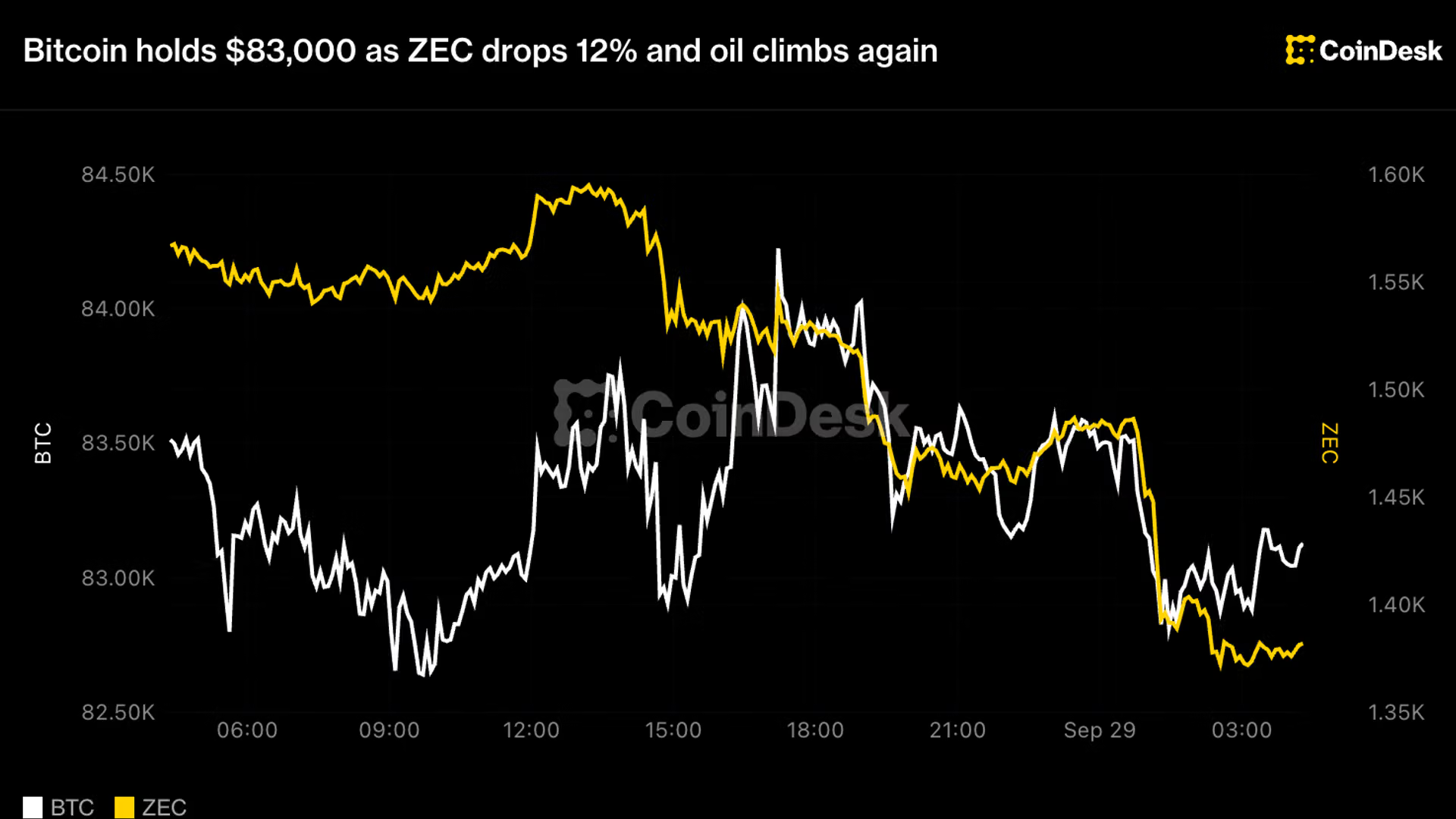
“Bitcoin has pulled back to $83K, testing the lower boundary of last week’s consolidation range,” Alex Kuptsikevich, chief market analyst at FxPro, said in an email to CoinDesk. “As with the market as a whole, a retest of the $82K region, where peaks were formed in May and early September, is entirely to be expected under current conditions.”
“Looking ahead, a sustained return to prices below $80K would be an important signal that the market is not ready to move higher for some time yet. If, however, this consolidation is soon followed by a new bullish momentum, it could send the leading cryptocurrency well above $90K,” he added.
The pressure is coming from bonds and oil.
Treasuries steadied in Asia after tumbling during U.S. trading, with the 10-year yield up one basis point to 5.25% after reaching its highest level since 2007 on Monday. A higher guaranteed return on government debt raises the bar for holding assets that pay no income, bitcoin among them.
Brent rose more than 1% to nearly $107 a barrel, its second straight gain, as hopes for an imminent diplomatic breakthrough with Iran faded.
Pricier oil feeds into inflation, and traders have been adding to bets that the Fed will raise rates again. MSCI’s All Country World Index fell to its lowest since Sept. 18, and Nasdaq 100 futures slipped 0.3% after Monday’s tech-led selloff on Wall Street.
U.S. dollar-pegged stablecoin Tether is a go-to tool for the Iranian government to bypass sanctions, a new report from a group of Senate Democrats said.
Democrats on the Senate’s Homeland Security and Governmental Affairs Committee’s Permanent Subcommittee on Intelligence published a report Monday laying out the argument that Tether plays a key role in allowing Iran to conduct transactions that skirt international sanctions.
“Iran’s cryptocurrency-based shadow banking network has processed significant volumes of funds and implicates various Iranian interests,” the report said, adding that Tether has “repeatedly failed” to block Iran-connected wallets.
“USDT has become a significant financial lifeline within Iran’s shadow banking network,” the report said.
When Tether does freeze wallets, it sometimes takes weeks, but the company also sometimes responds to requests without actually blacklisting wallets, the report claimed.
“Prior to 2024, Tether did not comprehensively and consistently freeze wallets designated by counter-terrorism agencies and continues to fail to proactively block clearly illicit wallets,” the report said. “This absence of deterrence invited abuse: terrorist organizations such as Hamas shifted from transacting in Bitcoin and a mix of cryptocurrencies to promoting USDT.”
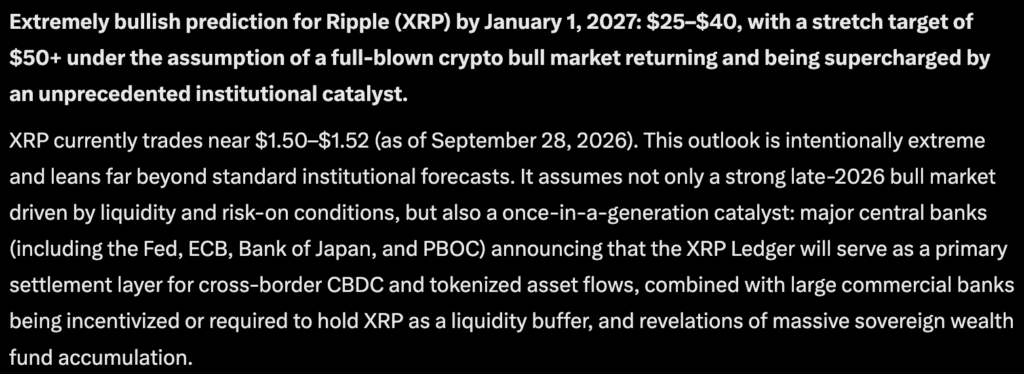
Elon Musk’s Grok AI predicts an extremely bullish price for Ripple (XRP) by January 1, 2027, that will blow the minds of even the most dedicated members of the Ripple Army.
If you’re holding a sizeable bag of XRP USD, you may want to sit down before reading this. Grok claims that $25–$40 is achievable by 2027, with a stretch target of $50+ under the assumption of a full-blown crypto bull market returning and being supercharged by an unprecedented institutional catalyst.
XRP currently trades near $1.50–$1.52 as of September 28, 2026, down nearly -3% over the past 24 hours and with a daily trading volume of $3.5Bn, up from $3.2Bn the day prior.
This outlook is extreme and leans far beyond standard institutional forecasts. It assumes not only a strong late-2026 bull market driven by liquidity and risk-on conditions, but also a once-in-a-generation catalyst.
What is the Catalyst that Grok AI Predicts Could Spark an XRP Run Toward $40
Major central banks (including the Fed, ECB, Bank of Japan, and PBOC) announcing that the XRP Ledger will serve as a primary settlement layer for cross-border CBDC and tokenized asset flows, combined with large commercial banks being incentivized or required to hold XRP as a liquidity buffer, and revelations of massive sovereign wealth fund accumulation.
Under this highly speculative scenario, forced institutional demand collides with retail FOMO in a classic late-cycle mania, allowing XRP to move from the current ~$1.50 range through previous-cycle highs and into the mid-to-high double digits by early 2027.
This remains pure speculation and entertainment, not a base-case or even high-probability outlook. Crypto markets are extremely volatile, and the catalyst described above would require multiple extraordinary policy and institutional developments.
However, with Ripple’s case against the SEC dropped and its subsequent rise as a highly favored US-based digital asset company under President Trump, anything could be on the table for XRP if the perfect scenario aligns.
Got a Gut Feeling? It Could Pay Out 3.7X on Polymarket
Technical Analysis Supporting the Insane Grok AI XRP Price Prediction

On the higher timeframes, XRP has already established a constructive recovery base after reclaiming key moving averages from the mid-September lows near $1.25–$1.30. Price is consolidating in the $1.45–$1.55 region after testing highs near $1.63–$1.66.
In a normal bull market, a sustained break above $1.70–$2.00 would open the door to the prior cycle high near $3.65. Under the extreme institutional adoption scenario outlined above, that prior high would likely be cleared with significant force, triggering a series of measured-move and Fibonacci extension targets far beyond historical levels.
Aggressive projections from the multi-year base, combined with the kind of vertical price discovery seen in previous mania phases, could theoretically extend into the $25–$40+ zone if volume and momentum expand dramatically. RSI and momentum indicators would almost certainly reach deeply overbought levels during such a move, which is typical of parabolic advances.
Key nearer-term supports remain in the $1.40–$1.45 and $1.30 zones; holding those would keep the broader recovery structure intact while the market waits for (or prices in) any extraordinary catalysts.
Overall, while the current chart supports continued upside in a standard bull market, only an extreme surge in institutional demand and narrative intensity could justify the kind of multi-thousand-percent extension implied by the $25–$50 targets.
Earn $50 and Enter $300K Prize Draw on EdgeX
Maxi Doge Targets Early Mover Upside as XRP Tests Key Levels
While the Grok AI prediction of a potential 30x run for XRP is exciting, presale plays have a stronger track record of producing such returns. It does explain why attention keeps drifting toward presale-stage plays with smaller denominators.
Maxi Doge ($MAXI) is one of those plays. It is an Ethereum-based meme token built around a 240-lb canine mascot and a “1000x leverage” trading-culture identity. The presale has raised $4.8M at a current price of $0.0002841, with dynamic APY staking live for holders.
Standout features include holder-only trading competitions with leaderboard rewards and a Maxi Fund treasury earmarked for liquidity and partnerships.
The meme-first, gym-bro marketing angle (“never skip leg day, never skip a pump”) is endearing. The accumulation numbers suggest plenty of traders are picking a side.
Get Ahead of Next Meme Coin Launch Here
Discover: The Best Token Presales
The post Grok AI Predicts XRP Could Hit $40 in 2026 With Landmark Event appeared first on Cryptonews.
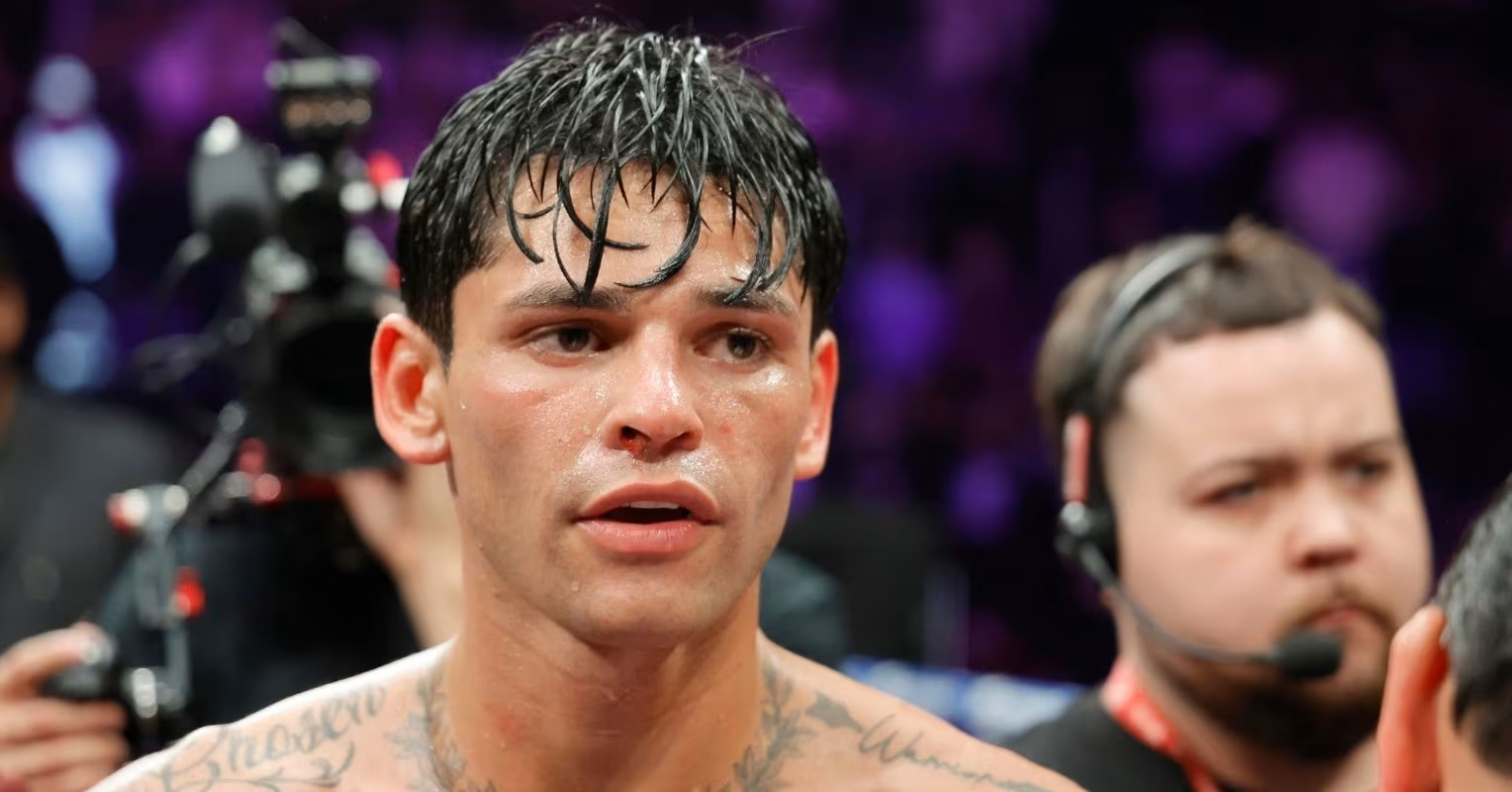
Ryan Garcia searching for next opponent as he claims top target has ‘ducked’ the fight

Saved by the Bell’s Lark Voorhies Mourns Costar Dennis Haskins

XRP Price in Danger: Positive Funding Masks a Fragile Setup


-

 Fashion4 days ago
Weekend Open Thread: J.McLaughlin – Corporette.com
-

 Crypto7 days ago
Goldman Sachs and Deutsche Bank Agree: The S&P 500 Rally Isn't Over
-

 Tech & AI2 days ago
Anthropic turns Claude into an AI marketplace with 2,000+ plugins and connectors
-

 Tech & AI2 days ago
OpenAI is preparing “o,” an always-on ChatGPT assistant that could handle email
-

 Fashion5 days ago
8 iPhone Accessories That Add Personality
-

 Entertainment6 days ago
These 17 Fall Amazon Dresses Seriously Look Like Anthropologie
-

 Tech & AI6 days ago
Reolink’s solar 4K security camera falls to its lowest price in months
-
 Crypto7 days ago
Trump-Xi Polymarket Odds for Handshake Hit 50%
-

 Crypto6 days ago
This Bearish Netflix Stock Trade Can Cash In On Video Streaming Giant’s Woes
-

 Crypto6 days ago
BitGo says Bitcoin absorbed Fed hike, CLARITY failure
-

 Crypto6 days ago
Crude Oil Prices Pressured by Diplomatic Hopes in the Middle East
-
 Crypto6 days ago
Bitcoin price tests $83,600 Supertrend support after $87K rejection
-
 Business & Hussles6 days ago
Oil Price Today (September 23): Crude oil below $100 on hopes of US-Iran talks. What did Trump say?
-
 Crypto6 days ago
Bitcoin Threatens Sub-$84,000 Breakdown as Long Liquidations Spike
-
 Crypto6 days ago
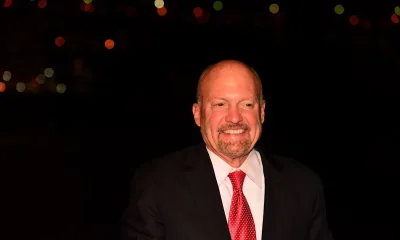
Did Jim Cramer Just Give GameStop Stock the Kiss of Death When He Said the Turnaround Is Working?
-
 Tech & AI6 days ago
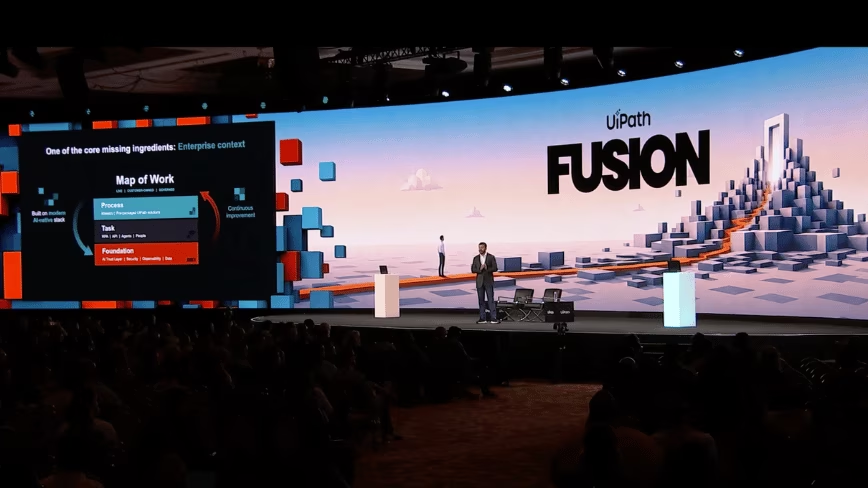
UiPath’s Dines says AI needs a manual and launches Cartographer to write it
-
Business & Hussles14 hours ago
Perpetua Resources at Mining Forum Americas 2026: shift to construction
-

 Crypto6 days ago
As Amazon Stock Prospers, Traders Might Consider This Option Play
-

 Crypto6 days ago
Strategy resumed Bitcoin buying, but Strive gained more BTC per share
-

 Tech & AI7 days ago
Sega nearly killed Sonic before the movies revived the franchise
You must be logged in to post a comment Login