
Crypto
Vitalik Buterin says Ethereum is becoming a cryptographic world computer


Ethereum has begun moving toward what Vitalik Buterin calls a “cryptographic world computer,” with major changes planned to verification, consensus, privacy and state management after Hegotá.
Summary
- Ethereum could evolve into a cryptographic world computer using proofs, privacy tools and decentralized components.
- Hegotá may become Ethereum’s last conventional fork before recursive STARKs and Lean consensus reshape upgrades.
- FOCIL is scheduled for Hegotá to strengthen censorship resistance by distributing transaction inclusion authority further.
- PeerDAS has already changed Ethereum verification by letting nodes sample data instead of downloading everything.
- Ethereum Foundation targets quantum-resistant execution, consensus and data layers by December 2029 under current plans.
Buterin wrote in his Sept. 27 essay, The Cryptographic World Computer, that Ethereum is approaching a point where describing it simply as a blockchain becomes increasingly incomplete.
He expects future Ethereum architecture to combine blockchain consensus with zero-knowledge proofs, data sampling, privacy technology and decentralized off-chain computation.
“Hegota — the fork planned for next year — is likely to be Ethereum’s last ‘normal’ fork,” Buterin wrote, referring to an upgrade whose technology would remain recognizable to developers familiar with Ethereum in 2015.
Hegotá could close Ethereum’s conventional upgrade era
Ethereum’s official roadmap currently places Hegotá in 2027, following Glamsterdam in the fourth quarter of 2026.
The Hegotá upgrade remains in planning, and its complete scope has not been finalized. Two proposals are already scheduled.
FOCIL, or EIP-7805, is the consensus-layer headliner. It lets a committee of validators create inclusion lists containing transactions that block builders must include.
The mechanism is designed to reduce the ability of a single builder to exclude valid transactions. Ethereum’s Hegotá roadmap says the feature can strengthen censorship resistance and improve Layer 2 settlement guarantees.
Frame Transactions, or EIP-8141, is the second scheduled feature. It lets Ethereum accounts decide how their transactions are authorized instead of requiring the same fixed signature structure for every user.
The design can support social recovery, spending controls, sponsored gas and future quantum-resistant signature systems directly at the protocol level.
Ethereum developers have begun treating Hegotá as part of a longer sequence leading toward post-quantum infrastructure and redesigned consensus.
Buterin’s latest essay goes further by describing Hegotá as a dividing line between Ethereum’s existing architecture and the cryptographic systems expected to follow.
Ethereum verification could move toward proofs and sampling
One of the largest changes concerns how network participants verify blocks. Traditional blockchain verification requires nodes to download blockchain data and execute transactions themselves. Buterin expects Ethereum to rely increasingly on SNARK verification and PeerDAS data sampling. His comparison of blockchain designs describes the transition as moving from “full re-download and recompute” toward “SNARK verification + PeerDAS for data availability.”
PeerDAS has already entered Ethereum through Fusaka. The system lets nodes verify data availability by sampling parts of the dataset instead of requiring each node to download every blob. The Ethereum Foundation has since moved its development focus toward the next stages of proof-based verification. As crypto.news previously reported on Ethereum’s Lean rebuild, recursive STARKs sit at the center of plans to reduce repeated execution while keeping verification trustless.
Buterin describes the eventual verification model more simply as a move from “download and re-execute” toward sampling data and verifying cryptographic proofs. The approach could reduce the hardware requirements for users seeking strong verification guarantees. His 2030 comparison says nodes should still obtain consensus and validity guarantees while storing less history and performing less redundant computation.
EIP-8288 could aggregate signatures inside the mempool
Buterin specifically mentioned EIP-8288 among the technologies that could change how Ethereum processes transactions before they enter blocks.
EIP-8288 is currently a draft proposal authored by Buterin and Thomas Coratger. It introduces in-mempool aggregation for cryptographic signatures and STARK proofs. The design extends Frame Transactions and lets transactions declare cryptographic dependencies.
Mempool nodes could combine many signatures and proofs into a single recursive STARK before passing them onward to block builders. The builder could then include an aggregated proof instead of processing every large proof independently. The proposal is designed partly around future quantum-resistant signatures, which can require considerably more data and computation than Ethereum’s current signature system.
EIP-8288 proposes aggregating LeanSPHINCS signatures and LeanSTARK proofs so that these larger cryptographic objects do not create the same level of bandwidth and gas overhead when used at scale. The EIP remains in draft status and has not been assigned to a confirmed network upgrade.
Buterin’s essay presents it as part of a longer technical direction where cryptographic work can happen earlier in the transaction pipeline, including inside the mempool. His 2030 model envisions signatures and proofs being processed in parallel before final block inclusion.
FOCIL and private mempools could change transaction inclusion
Ethereum’s future transaction journey could look very different from the familiar sequence of user, mempool, miner and block. Buterin describes a model where transactions enter a mempool with stronger privacy properties before moving through FOCIL participants or builders.
The Ethereum Foundation’s security roadmap confirms that research into encrypted mempools remains active alongside FOCIL development. FOCIL is already scheduled for Hegotá.
Under the proposal, multiple validators can submit lists of transactions that should appear in a block. A builder cannot independently ignore eligible transactions appearing on those lists without violating protocol rules. Buterin expects network privacy to develop in parallel.
His 2030 comparison includes onion routing, mixnets and other network privacy methods alongside zero-knowledge proofs for transaction and account privacy. As crypto.news reported in August, Buterin has moved privacy and quantum security higher in Ethereum’s roadmap as cryptographic tools mature.
Lean consensus targets faster and simpler finality
Consensus itself is expected to change. Ethereum currently uses proof-of-stake with finality occurring over several epochs. Researchers are working toward a more streamlined consensus model capable of reaching finality much faster.
Ethereum’s security roadmap says research that began around single-slot finality later developed into three-slot finality and is now progressing through Minimmit, a one-round consensus design under the Lean Ethereum program.
Finality measured in seconds remains a long-range research target around 2029, but no specific upgrade has yet been assigned to deploy the final design. Buterin’s 2030 comparison estimates slots of roughly four to eight seconds and finality around eight to 32 seconds. The current Ethereum roadmap cautions that these plans remain research goals and may change.
Crypto.news described the Lean Ethereum program in July as the network’s largest technical overhaul since The Merge, with new consensus, proof systems, storage and privacy mechanisms planned over several years.
Ethereum targets quantum resistance by December 2029
Quantum security has become one of Ethereum’s most clearly dated long-term targets. The Ethereum Foundation Protocol Cluster said on Sept. 7 that it is targeting quantum resistance across the execution, consensus and data layers by December 2029.
The Foundation describes the date as deliberately aggressive. Its planning assumes that cryptographically relevant quantum machines could appear as early as 2030, while acknowledging most estimates put that possibility later.
Ethereum is working on replacing cryptography vulnerable to sufficiently powerful quantum computers. Areas under review include BLS validator signatures, ECDSA account signatures, KZG commitments used in data availability and some zero-knowledge proof systems.
Frame Transactions could help with the account side by allowing wallets to choose quantum-resistant verification methods without requiring every account to migrate through the same protocol-level mechanism. EIP-8288 could reduce the cost of aggregating some of those larger post-quantum signatures.
As crypto.news reported in its quantum roadmap analysis, recursive STARK aggregation and hash-based signatures form part of Ethereum’s proposed defense against future quantum attacks. Buterin expects recursive STARKs, formal verification and quantum-resistant cryptography to become increasingly central after Hegotá.
Ethereum could rely more on decentralized off-chain components
Buterin’s “world computer” description does not mean Ethereum would move everything onto Layer 1. His essay instead describes an architecture where the blockchain focuses on data and state changes that require ordering, while other work happens in parallel outside the main execution path. “Structuring computation lets the blockchain more effectively focus on its job,” he wrote.
Under that model, signatures and proofs could be aggregated before entering a block, historical data could be distributed between participants and specialized computation could happen outside the base execution layer.
The network would then verify the output cryptographically. Buterin argues that modern proof systems allow Ethereum to distribute computation without requiring every participant to trust whoever performed each piece of work. His longer-term architecture includes distributed history and state storage, proof-based verification, parallel computation and decentralized systems sitting between users and Ethereum itself.
A more speculative technology appears further out. Buterin said indistinguishability obfuscation, or iO, could eventually allow generalized encrypted computation involving many asynchronous participants. He described it as a possible later development, not a technology required for the architecture outlined in his post.
Ethereum’s next scheduled milestone remains Glamsterdam, with Hegotá planned to follow in 2027. Crypto.news reported on Glamsterdam testing risks as developers prepared the upgrade for its next test phases.
Hegotá’s scheduled features currently include FOCIL and Frame Transactions, while additional proposals continue through Ethereum’s research, testing and governance process.


XRP Ledger developers have defended the emergency security patch used to fix a bug capable of creating XRP beyond the network’s fixed supply, saying they could not wait for the network’s usual two-week validator vote without exposing the flaw to attackers.
The fix, released on Sept. 25, came three days after a bug bounty report, and took effect immediately on any server that installed it. It was the first deliberate bypass of the normal amendment process since the system was introduced more than ten years ago, they said.
“With a normal amendment vote, the fix would have been public for weeks before it took effect, risking network security,” XRPL developers said in an X post on Sunday.
The expedited fix led to questions about XRPL’s level of decentralization. On its website, XRPL claims it is a fully decentralized, public blockchain — a characterization that has been central to arguments that its native token, XRP, is not a security.
XRPL security fix “raised a lot of questions”
Cyber Capital founder Justin Bons said Thursday that marketing XRP to retail investors as decentralized amounted to “straight-up fraud.” He argued that the Sept. 25 emergency release shipped as binaries only, temporarily withheld the source code and pressured operators to upgrade.
However, XRPL Foundation said the decision to skip the normal amendment process was made jointly by the Foundation, RippleX, core developers and validators after assessing the severity of the bug.
“No single party could make that call alone. Every validator and node operator chooses what software to run, and 3.4.1 only became required through a normal amendment vote with more than 80% validator support for two weeks. Protocol changes still go through amendments,” the foundation said.
Related: Ledger confirms unauthorized hardware implant, says losses may exceed $86M
XRP Kuwait, an independent validator operator, also rejected claims that the coordinated upgrades signaled centralized control.
“We disagree with the claim that operators coordinating an update is, in itself, proof of centralized control,” it said. “Coordination is not the same as control. Independent operators can assess a situation, communicate with one another, and reach the same conclusion without giving up their independence.”
Bug could have minted unlimited XRP
The bug was an integer overflow in the XRP Ledger’s payment engine that had been present since 2015, according to the project’s vulnerability disclosure report.
XRP balances are stored as 64-bit integers with a fixed maximum. When a sum exceeded that maximum, the calculation wrapped to a smaller number instead of failing.
An attacker could exploit this by creating hundreds of specially priced offers, each asking for a very large amount of XRP, then sending one payment that consumed them all.
The engine would credit each offer owner their full amount but charge the buyer only the tiny wrapped total. The difference would be newly created, spendable XRP.
The attack required deliberately constructed offers and could not be triggered by normal trading activity, according to the report. Developers said they found no evidence that the issue was exploited on any public network.
Magazine: Ledger attack spreads to EU, AI finds ’18 trillion XRP’ bug: Hodler’s Digest

MicroStrategy’s corporate Bitcoin strategy is back in focus after Strategy’s chair, Michael Saylor, posted a tease to investors about a possible near-term signal tied to the company’s latest BTC purchases. Writing on X, Saylor added the line “There’s always room for more orange,” a reference that has become shorthand for the firm’s continued willingness to add Bitcoin.
Still, for readers expecting a fresh, formal update through U.S. SEC filings, timing may be tight. An official disclosure related to the most recent activity is not expected to arrive before Tuesday because federal offices are closed on Monday for the Columbus Day holiday.
Key takeaways
- Strategy says it has pushed its most recent weekly Bitcoin buying far past its typical budget window through early October repurchases.
- According to an Oct. 5 SEC 8-K, Strategy ended the Sept. 28–Oct. 4 period holding exactly 848,000 BTC.
- Over the same dates, the company also repurchased about 1.77 million shares of its STRC preferred stock for $176.3 million.
- Analyst Shanaka Anslem Perera highlights that capital raised in the third quarter does not automatically translate into immediate BTC purchases, due to other uses such as cash reserves and preferred-share buybacks.
What Strategy disclosed in its latest SEC filing
At the center of this update is a filing that lays out Strategy’s activity across a defined one-week span. In an Oct. 5 8-K form with the U.S. Securities and Exchange Commission, the company reported that it bought 334 Bitcoin between Sept. 28 and Oct. 4, paying $28.7 million for the purchases. The buy adds to Strategy’s cumulative holdings, taking the company to exactly 848,000 BTC.
That same 8-K window also included a substantial preferred equity repurchase. Strategy said it repurchased roughly 1.77 million shares of its STRC preferred stock for $176.3 million during the same period.
For investors, the practical takeaway is that Strategy’s BTC program is not operating in isolation. The company is simultaneously managing its capital structure, including actions that reduce preferred-share exposure. That matters because it can affect how much cash remains available for later Bitcoin buys and how capital providers view near-term risk versus balance-sheet strengthening.
Saylor’s “orange” message and what investors may read into it
Saylor’s X post frames the next step as something investors should watch for on Sunday—suggesting there may be another sign of BTC accumulation. The phrasing, however, appears more like a broad encouragement than a specific update tied to a particular filing.
With Monday’s federal holiday likely to delay administrative timing, the market’s ability to confirm details through SEC channels may not improve until Tuesday. In other words, traders who rely on filings for verification may have to bridge the gap between public commentary and formal documentation.
In previous cycles, this kind of messaging can still move sentiment around whether additional buying is coming. But as Strategy’s disclosures show, the company’s real confirmation typically arrives through SEC paperwork, not social posts.
Why “cash now, buy later” remains a live question
Beyond the immediate Bitcoin figure, analysts are weighing how Strategy financed its recent actions and what that implies for future pace. Independent analyst Shanaka Anslem Perera pointed to third-quarter funding and how it translated into BTC holdings over time.
According to Perera, Strategy raised $5.41 billion from new common shares in the third quarter and ended that quarter with 1,666 more BTC than it held at the end of June. He also notes that Strategy’s SEC disclosures allocate 9.5% of the raised capital directly to bitcoin purchases. Other disclosed uses, Perera wrote, include a dollar reserve, cash, dividends, and preferred-share buybacks.
Perera’s central argument is that the relationship between raising capital and buying Bitcoin may not be one-to-one on a day-to-day or even quarter-to-quarter basis. In an interview carried by Cointelegraph on Sunday, he explained that “raising capital does not necessarily mean buying bitcoin,” emphasizing that investors should consider what the financing left behind—particularly cash and existing claims such as debt and preferred shares, which sit ahead of common stock.
At the same time, he clarified that the company’s retained cash can still fund later purchases. From a balance-sheet perspective, strengthening liquidity can also be supportive for shareholders, especially if it reduces pressure to sell assets or rely on external borrowing to sustain Bitcoin accumulation.
Bitcoin buy intensity versus capital structure management
The recent window highlighted in Strategy’s SEC filing suggests an active BTC posture, but it also illustrates how tightly the Bitcoin narrative is interwoven with other corporate moves. The company “ended September by spending more than six times its weekly Bitcoin buying budget,” according to the coverage context leading into the SEC disclosure. In that period, the firm bought 334 BTC for $28.7 million—bringing total holdings to 848,000 BTC.
Meanwhile, Strategy repurchased a large quantity of preferred stock for $176.3 million during the same week. That dual activity complicates simplistic interpretations. Instead of viewing Bitcoin buys as the only variable, investors also have to watch how Management allocates cash across different priorities: accumulating Bitcoin, building reserves, and addressing preferred equity.
This dynamic creates a useful lens for readers tracking Strategy. If BTC buying appears to slow while preferred repurchases or cash retention rises, it may reflect not a change in conviction, but a timing shift in how capital is deployed. Conversely, if BTC buys accelerate without corresponding reductions in liquidity, that may indicate the company is comfortable drawing down reserves or drawing from ongoing capital needs.
Perera’s remarks underscore this tension: even when disclosures show a portion of raised capital earmarked for Bitcoin, the rest may support other uses that don’t immediately show up as BTC purchases. That is why investors may want to focus not only on headlines about “more room for orange,” but on how each SEC filing breaks down timing and allocation.
Looking ahead, readers should watch for the next SEC update that confirms what Strategy actually executed in the days following Saylor’s message. The uncertainty is not whether the company remains committed to Bitcoin—recent filings and ongoing commentary point the other way—but rather the pace and sequencing of purchases relative to preferred buybacks and the remaining cash balance. With Tuesday’s filing timing likely to be the first clear checkpoint after the Columbus Day closure, the market may get fresh data soon enough to separate speculation from documented activity.
On-chain data indicates exactly one year ago today, the cryptocurrency market experienced an epic crash, recording approximately $19.2 billion in market-wide single-day liquidations, wiping out over 1.65 million investors, and setting the most brutal single-day liquidation record in history, comparable to the 2020 “312” black swan event. It is worth remembering not because of hype, but because understanding what happened helps UK traders prepare for future volatility.
The Scale of the Crash
Where Has the Market Been Since?
The broader picture:
What This Means for UK Traders Today
The October 11 crash reflected a complex mix of factors: overbought conditions after a strong rally, macro headwinds, and the mechanics of leveraged trading that amplified losses as liquidations cascaded through exchanges. But the core lesson is simple: cryptocurrency markets remain volatile, and sharp drops are a structural reality of the market.
Key takeaways for UK retail traders:
- Volatility is real. A 13% single-day drop in Bitcoin and 22-37% moves in major altcoins show why only invest what you can afford to lose entirely.
- Liquidations hurt. Over 1.65 million investors were wiped out in a single day, most of them using margin and derivatives. If you use leverage, understand your liquidation price in advance and size positions accordingly.
- Exchange choice matters. Thin liquidity on smaller platforms means your actual exit price could be far worse than the live price you see in news. Trade on well-capitalized, regulated exchanges.
- Recovery is slow. One year on, the market is still 34% below the October 2025 peak. If you believe in long-term crypto value, plan accordingly.
Caution remains warranted. UK traders should focus on building a portfolio strategy around volatility rather than trying to time the market.
What to Watch Now
Rather than trying to predict the next crash, UK traders should focus on:
- Your own portfolio size and leverage.
- Whether your exchange is FCA-regulated (important for UK consumer protection).
- Your exit strategy, not your entry.
- Whether your holding period matches your investment horizon.
The October 11 crash is a reminder that cryptocurrency markets remain young and volatile. Understanding that risk—and building a portfolio strategy around it—matters more than trying to time the market.

Justin Sun, founder of the Tron network, said that the company’s post-quantum cryptography was now live on testnet.
“We’re closely tracking progress in quantum computing and AI, and we’re ready to bring quantum resistance to mainnet at any time, Sun said in a post on X on Saturday.
He added, “We’re committed to keeping user assets secure, and TRON is set to be one of the few major blockchains that is quantum-resistant before Q-Day,” or the day when quantum computing becomes capable of breaking current security standards.
Coindesk reported on July 28 that Blockchain security company AmericanFortress had unveiled a cryptographic plan to protect crypto wallets from future quantum attacks without requiring users to move funds, rotate keys or change wallet addresses.
Unlike most proposed post-quantum approaches, AmericanFortress said it allows existing wallet addresses to remain unchanged while adding post-quantum protection.
Proposal published in technical paper
The company published the proposal in a technical paper on the Cryptography ePrint Archive, though it had not yet been peer-reviewed.
Developers have increasingly focused on post-quantum cryptography because sufficiently powerful quantum computers may eventually break the elliptic-curve cryptography used to secure Bitcoin, Ethereum and many other blockchain networks
Earlier this year, a Strategy-led consortium pledged $15 million to fund Bitcoin quantum security research, the Ethereum Foundation published a proposal for migrating accounts to quantum-resistant cryptography and Algorand outlined plans to introduce quantum-resistant accounts by 2027.
Magazine: SHRINCS BIP published: Quantum-secure Bitcoin comes with a catch
Crypto
JPMorgan makes bullish call in fixed income space, suggests it’s a once in a generation opportunity

J.P. Morgan Asset Management is making a bullish call on an underinvested market group: high-quality fixed income.
Priya Misra, a portfolio manager at the firm, sees a once in a generation opportunity for investors.
“You can actually take credit risk in the highest quality companies and still get [a] 6.5% [yield], Misra told CNBC’s “ETF Edge” this week. “So, you actually don’t have to go down in credit [quality].”
She suggested the strategy is particularly well suited for investors concerned about having too much exposure to artificial intelligence stocks.
“There’s a huge AI exposure,” Misra said. “What fixed income gives you is this diversified set of returns. It’s not just an AI trade or a tech trade. You have the Treasury trade. You have credit outside of AI.”
Misra co-manages the JPMorgan Core Plus Bond Fund ETF (JCPB). The fund has almost $16 billion in assets under management, with just over three-quarters of its holdings in BBB-rated debt and above, according to the firm’s website as of Aug. 31.
“We’ve actually been increasing some of the double-B [and] single-B exposure because there has been a widening in high yield spread,” she said. “We like some investment grade. And now, we’ve started in the last few days to increase some duration as well, thinking we may be nearing the end of that rate move.”
The JPMorgan Core Plus Bond Fund ETF is down more than 5% so far this year as of Friday’s close, according to FactSet.
“You want to be looking bond by bond and sort of sector by sector to see where the macro and you have to do the bottom up as well to make sure that companies are not over levered,” noted Misra, who’s concerned about how higher rates could hurt the housing market.
BondBloxx co-founder Joanna Gallegos is also advising investors to take advantage of “historically attractive” yields across debt markets.
“You want to really consider getting some corporate debt into your portfolio,” Gallegos said in the same interview. “It’s really in the investor’s best interest to start looking at the income that’s back in fixed income. It can offset the volatility in your portfolio.”
Part of her bull case: Base rates are high, and they’re stable.
“The fundamentals of these corporations are so strong, and the economy continues to grow,” added Gallegos. “We really think that’s being lost in the narrative around Treasury rates.”
Her firm BondBloxx is known for fixed-income exchange-traded funds in sectors including Treasury, corporate, private credit and emerging markets.
One of its funds includes the BondBloxx Private Credit CLO ETF (PCMM). As of Friday’s close, it’s down 0.6% so far this year, according to FactSet.

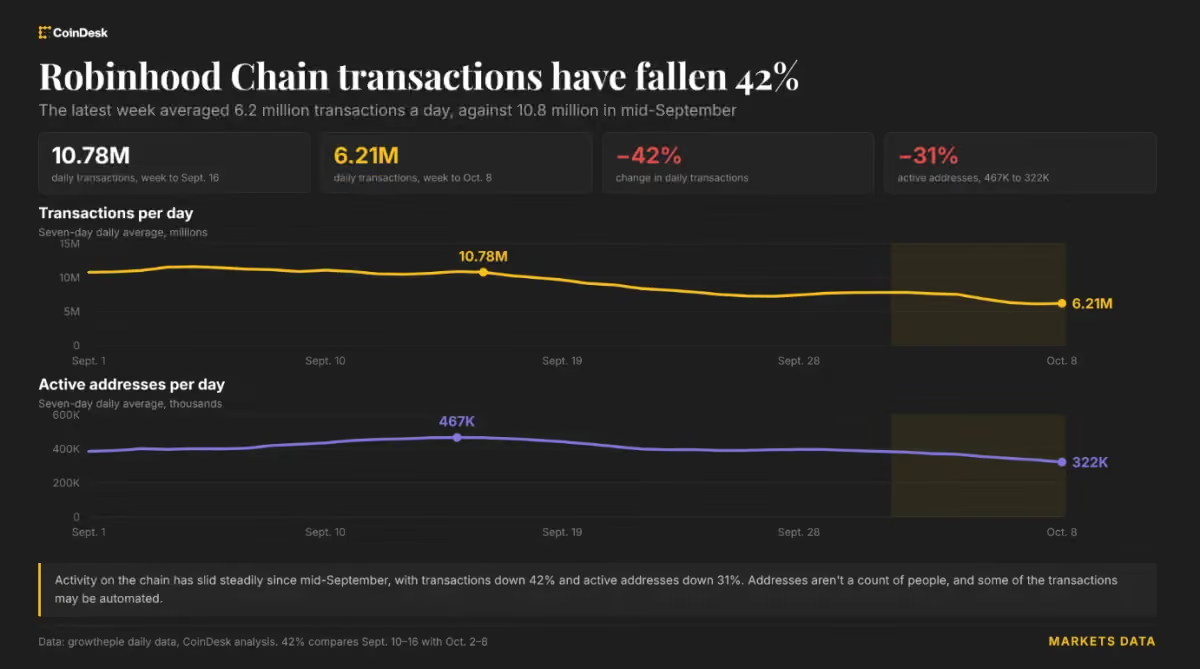
Daily active addresses averaged about 322,000 in the latest week, down 31% from mid-September, suggesting fewer people, and fewer of the trading bots they run, are using the chain each day.
The drop is likely smaller in human terms than the raw number implies, since one trader can run many addresses and a single automated program can account for thousands of transactions.

Less trading, steady balances
Spot exchanges, where users buy and sell tokens directly, handled $7.45 billion during Oct. 2–8, down 21% from $9.46 billion the week before, according to CoinDesk calculations using DefiLlama. Uniswap, an app that lets people swap tokens with each other without a company in the middle, handled roughly 77% of that.
Users aren’t pulling their money out, though. Deposits in the chain’s lending and trading apps rose about 2% over the week to $1.04 billion, and the supply of stablecoins, tokens pegged to the dollar, ticked up to roughly $1.10 billion.
That suggests the pile of money is simply being traded less, with traders keeping their funds on Robinhood Chain and waiting.
Futures are the exception, however. DefiLlama’s rolling seven-day figures on Friday showed about $7.35 billion in perpetual futures volume, contracts that let traders bet on prices without owning the tokens, up 26%.
Crypto
Mashinsky Accepts Lifetime Industry Ban and Up to $35 Million in Conditional Payments | The Defiant

The New York settlement ties the money to federal forfeiture and prison-sentence conditions, adding to existing FTC and CFTC restrictions…. Read the full story at The Defiant
Source link


Key takeaways
- Dogecoin traded near $0.085 on Friday after losing more than 11% this week.
- Two large-wallet cohorts reduced their combined holdings by 100 million DOGE since Tuesday.
- A close below $0.084 could expose $0.078 and $0.070, with resistance beginning at $0.086.
Dogecoin traded around $0.085 on Friday, approaching a key trendline area after a weekly decline of more than 11%.
Falling balances among some large holders and weakening technical momentum suggest continued downside pressure.
However, derivatives positioning offers a more mixed picture, with long positions outnumbering shorts in CoinGlass’ tracked ratio.
Large Dogecoin holders reduce exposure
Santiment’s supply distribution data shows that wallets holding between 1 million and 10 million DOGE and those holding between 10 million and 100 million DOGE have collectively reduced their balances by 100 million tokens since Tuesday.
The decline suggests some large holders are reducing exposure, potentially through profit-taking. Wallet balance changes alone do not confirm that every token was sold, but the movement adds to concerns about near-term supply pressure.
CryptoQuant’s summary indicators also point to caution. Its data identifies overheating conditions in both spot and futures markets, alongside large orders and sell-side dominance in futures.
These signals suggest that selling pressure remains significant as DOGE approaches nearby support.
Despite the price decline, CoinGlass’ DOGE long-to-short ratio stood at 0.90 on Friday, approaching its highest level in more than a month.
A reading above one indicates that longs outnumber shorts within the positions or accounts tracked by the metric.
Funding rates also remained positive at 0.0010%, meaning long traders were paying short traders to maintain their positions.
Together, the readings suggest some traders are positioning for a recovery. They do not establish that buying demand is strong enough to reverse the decline, particularly while price momentum remains weak.
DOGE tests $0.084 as momentum deteriorates
Dogecoin is trading just above the trendline area near $0.084, which serves as the immediate technical support reference.
A daily close below that level could open the way toward $0.078. A deeper correction would bring the next structural floor at $0.070 into focus.
The Relative Strength Index sits near 40, below its neutral midpoint and consistent with weaker buying momentum.
The Moving Average Convergence Divergence line remains below both zero and its signal line. Its negative, slightly expanding histogram also suggests sellers retain the near-term advantage.
DOGE remains beneath several important exponential moving averages, creating successive barriers to a rebound.


The first resistance is the 100-day EMA near $0.086. Above it, the 50-day EMA and a horizontal resistance level converge around $0.088.
Clearing those levels would help ease immediate bearish pressure. A stronger recovery would require a move above the 200-day EMA at $0.093, followed by a challenge of major resistance near $0.102.
For now, the balance between support at $0.084 and the moving averages overhead will help determine whether DOGE stabilizes or extends its weekly losses.

Three armed men have forced a Chinese expatriate with Turkish citizenship to transfer approximately $820,000 in cryptocurrency during a robbery at his luxury home near Pattaya, Thailand, prompting a police investigation into the suspects and the movement of the stolen assets.
Summary
- Three armed men broke into a luxury home near Pattaya, Thailand, and forced a Chinese expatriate with Turkish citizenship to transfer approximately $820,000 in cryptocurrency.
- The attackers threatened the victim at gunpoint and stole cash and three luxury watches before escaping in a vehicle that police later recovered.
- Thailand police are examining CCTV footage and tracing cryptocurrency transactions to identify the suspects, whose nationalities have not been confirmed.
- The robbery follows a series of violent attacks targeting cryptocurrency holders, with Chainalysis estimating losses of more than $30 million from such incidents in the first half of 2026.
According to initial reports, the robbery took place at around 3:30 a.m. on Tuesday, October 6, inside a gated residential community in Nongprue, where the attackers entered the property using a ladder before confronting the victim in his bedroom.
The masked men reportedly threatened the resident with firearms and ordered him to open a safe containing cash and valuables. They took an undisclosed amount of money and three luxury watches before demanding access to his cryptocurrency holdings.
Under threat, the victim transferred digital assets valued at roughly $820,000 to accounts controlled by the attackers. Reports indicate that the cryptocurrency was subsequently sold, although authorities have not disclosed which assets were involved or how the transactions were carried out.
The resident eventually escaped and contacted police. His identity has not been publicly released.
Thailand police trace stolen crypto and suspects’ getaway vehicle
Police Region 2 has taken charge of the investigation, with officers examining both the physical evidence left behind and the transactions involving the stolen cryptocurrency.
Police Lieutenant General Wasan Techa-akrakesom, commissioner of Police Region 2, said investigators had made significant progress in the case. The Immigration Bureau has been brought into the investigation as authorities work to establish the identities and movements of the suspects.
Initial information suggested that the three attackers might be Chinese nationals, but police have not confirmed their citizenship. No arrests were disclosed in the initial reports.
Investigators have reportedly recovered the vehicle used by the suspects after it was abandoned in a remote location.
CCTV footage placed the same vehicle in the area on October 5, one day before the robbery. Police are examining the footage as part of efforts to reconstruct the suspects’ movements before and after the break-in.
Alongside the search for the attackers, authorities are tracing the digital assets transferred from the victim’s holdings.
Investigators are reportedly examining accounts connected to the subsequent sale of the cryptocurrency in an effort to identify the individuals who received or handled the funds.
Details about the destination wallets, exchanges involved and potential recovery of the stolen assets have not been made public.
Police have yet to establish whether the attackers knew about the resident’s cryptocurrency holdings before entering the property or discovered them during the robbery.
The distinction remains unresolved because the intruders demanded several forms of property, including cash, watches and digital assets.
Crypto wrench attacks have cost victims millions in 2026
The robbery in Thailand follows several violent incidents involving cryptocurrency holders, including home invasions where attackers have used threats or physical force to obtain access to digital wallets.
Such crimes are commonly described as wrench attacks, a term used for robberies involving physical coercion to steal cryptocurrency or force victims to authorize transfers.
In an August investigation, crypto.news previously reported that criminals had stolen more than $30 million through violent attacks against cryptocurrency holders during the first half of 2026, citing research from blockchain analytics firm Chainalysis.
The firm documented 46 incidents during the six-month period, compared with 40 in the corresponding period of 2025. Only 12 of the 46 attacks resulted in payments, giving criminals a reported success rate of 26%.
Home invasions accounted for 37% of documented cases, compared with 14% in 2025. Kidnappings represented 52% of incidents, although Chainalysis noted that some cases could involve more than one type of crime.
A separate investigation by security firm CertiK identified 52 verified wrench attacks worldwide during the first half of 2026, with financial exposure totaling $124.1 million.
CertiK’s figure included stolen cryptocurrency, ransom demands, frozen assets and other amounts connected to reported incidents. It did not represent the amount criminals successfully obtained.
The firm’s findings placed France at the top of its list, with 33 verified attacks accounting for nearly 64% of the worldwide total. Europe recorded 39 incidents, while the United States accounted for four.
Armed home robberies have targeted crypto holders in France and the US
Several recent cases have involved attackers entering residential properties and demanding cryptocurrency transfers from occupants.
In September, four masked men held a family captive for more than three hours in Vendin-le-Vieil, northern France, before forcing the father, who worked in the cryptocurrency sector, to surrender access codes linked to approximately €40,000 in digital assets.
The attackers assaulted the father, while his 12-year-old daughter was struck in the face. French authorities investigated the incident as kidnapping and extortion by an organized gang.
Earlier that month, a couple in Alès was restrained and threatened by two armed intruders who demanded cryptocurrency transactions.
The attackers reportedly carried a handgun and a knife and held the couple for more than two hours while their young child was inside the house. Neighbors alerted police after hearing screams, prompting the suspects to flee.
Similar incidents have reached US courts. In June, two Texas brothers pleaded guilty in an $8 million cryptocurrency robbery case involving a Minnesota family.
Federal prosecutors said the brothers held the victims at gunpoint for approximately nine hours while forcing them to transfer digital assets. Both pleaded guilty to interference with commerce by robbery.
Meanwhile, investigators in Thailand are examining the abandoned getaway vehicle, CCTV footage, immigration records and cryptocurrency transactions connected to the Pattaya robbery.
According toPattaya Mail’s October 9 report, officers located a black Toyota Fortuner in a wooded area and identified footage showing the vehicle near Phatthanakan Road and Soi Wat Boonsamphan at approximately 3:38 p.m. on October 5.
Police have not publicly confirmed the suspects’ identities or nationalities, and the investigation remains ongoing.

13 Best Gifts for Every Traveler Should Have (2026)

XRP Ledger Defends Emergency Patch Amid Criticism

Why Old Likes Can Matter as Much as Old Posts on X


-

 Fashion1 day ago
Weekend Open Thread: Quince – Corporette.com
-

 Sports4 days ago
Saracens’ Venter Brands Premiership Rugby ‘Autocratic’ Over £5,000 Media Fine
-
 Entertainment3 days ago
10 Flawless Movies With the Cleverest Protagonists
-

 Business & Hustles1 day ago
PwC: Supply-Chain Diversification, AI and Energy Transition Open New Growth Paths for Thailand
-

 Sports4 days ago
Enzo Maresca all smiles as Man City return to training after guilty verdict
-

 Sports3 days ago
Southampton’s Eckert Spared Ban as FA Suspends Six-Week Sentence Over Spygate
-
 Sports3 days ago
Asiad selection row: Para-shooters allege corruption; PCI denies claims | Asian Games 2026
-

 Sports3 days ago
Multiple Power Four programs face College Sports Commission investigations over alleged NIL cap evasion
-

 Crypto4 days ago
Crypto.com Teams Up With Insilico Terminal to Give Traders Free Pro-Level Tools
-

 Sports2 days ago
College Football Week 6 Bets: Three Picks for Saturday’s Biggest Games
-
Crypto2 days ago
Robinhood Chain slowdown spreads from fees to trading as transactions fall 40%
-

 Crypto2 days ago
Mashinsky Accepts Lifetime Industry Ban and Up to $35 Million in Conditional Payments | The Defiant
-

 Sports3 days ago
Morocco and Senegal await AFCON final verdict after arbitration hearing – Sports
-

 Tech & AI3 days ago
ICE Emails Discuss Using Palantir-Supported Tool to Investigate Voter Fraud
-
 Crypto4 days ago
ESMA gives EU crypto platforms 3 months to drop non-MiCA stablecoins such as USDT
-

 Sports5 days ago
Harry Kane Ties Peter Shilton’s 125-Cap England Record in Wembley Win Over Czech Republic
-

 Sports2 days ago
Saudi oil crisis affects Neom project, 2034 World Cup plans
-

 Tech & AI6 days ago
Common Mistakes You Should Avoid When Using Foldable Phones
-

 Sports4 days ago
Internationals make history with emphatic Bridges Cup win at Trump Turnberry | News
-

 Sports2 days ago
Eagles stars Barkley and Smith ruled out of London game against Jaguars
You must be logged in to post a comment Login