
Crypto World
5 Reasons Why Moderna Stock Jumped 170% and How Far It Can Go

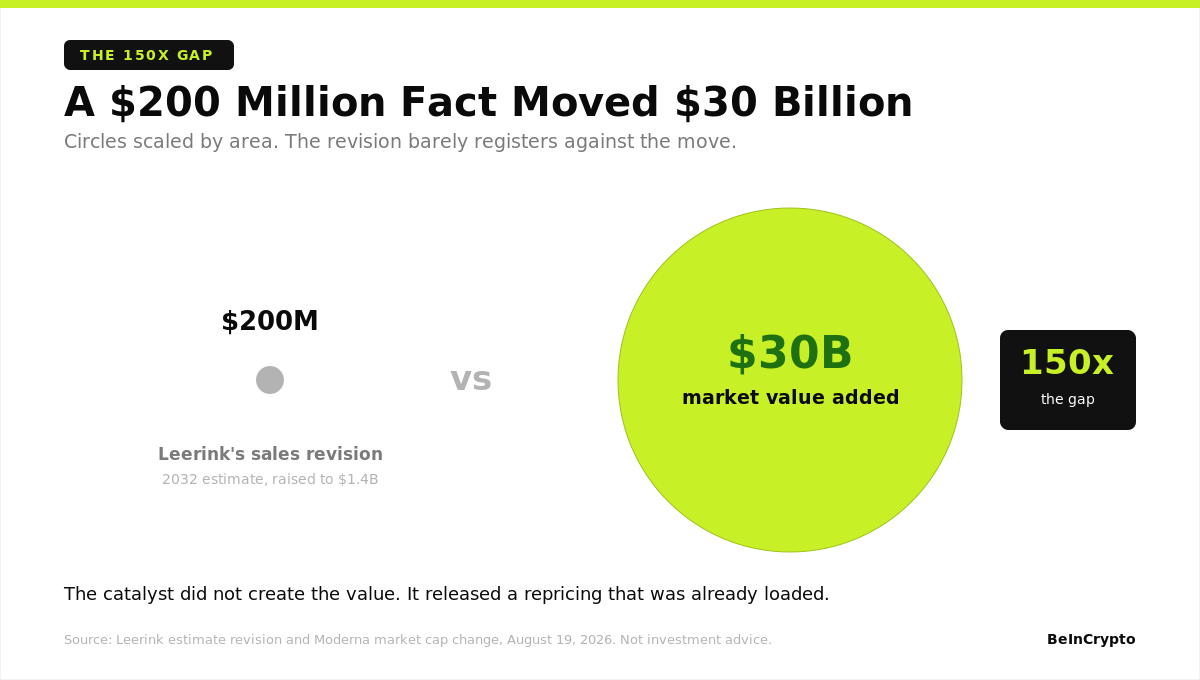
Moderna (MRNA) jumped 177% on Wednesday, and the strangest part is how little news it took. A $200 million estimate change moved $30 billion on the stock market.
Moderna became famous for its COVID vaccine five years ago, and its stock price is now at its highest since mid-2024. So, investors wasted no time taking profits after such a massive rally.
But can the stock price climb further? Or will the rally stop here?
What Actually Made Moderna Jump 130%?
The drug did not do it alone. Leerink’s revised estimate raised its 2032 sales estimate by roughly $200 million. Yet, the stock moved 150 times that amount in a market already at record highs.

Five loaded conditions did the rest. Moderna had collapsed 95% from $484 to $22. The recovery was already running, up 357% in 2026 on a flu approval before the cancer news.

The price sat above all six moving averages while analysts refused to believe with a $52.95 average target under the current price.

And short sellers, traders who borrow shares and sell them betting on a fall, held 13.37% short interest in the freely traded shares, losing $4.8 billion when the readout forced them to buy back.

Moderna Stock Price Prediction: What Wall Street Giants Think
The Moderna move is one of those rare biotech events where the fundamental story genuinely changed overnight. The stock still overshot the immediate fundamentals, and today’s pullback is already showing that.
Ignore the old consensus target of roughly $50. Most of those targets were published before the Phase 3 result and are effectively obsolete.
The post-announcement calls are much more useful.
- Bank of America upgraded Moderna from Underperform to Neutral and increased its price target enormously, from $40 to $170. BofA described the result as a watershed event because it gives Moderna a credible route away from dependence on infectious-disease vaccines.
- Morgan Stanley raised its target from $39 to $89, while keeping Equal Weight. Morgan Stanley now sees much greater value in Moderna’s scalable mRNA platform, but remains much more conservative on share price.
- Brookline Capital: sets a target around $135, with a Buy rating.
- William Blair upgraded Moderna from Market Perform to Outperform, arguing that the Phase 3 result puts Moderna and Merck in position to seek regulatory approval and meaningfully changes Moderna’s diversification prospects.
So the fresh Street debate has suddenly become something like:
View
Approx. valuation
Morgan Stanley / conservative
$89
Brookline / middle
$135
BofA / bullish
$170
Yesterday’s close
$174.38
Current price
~$140
That shows something important – even BofA’s extremely aggressive $170 target was below yesterday’s closing price.
How Long Will the Moderna Stock Rally Last?
There are really two rallies. The short-squeeze/momentum rally probably peaked yesterday. Today’s roughly 20% drop is consistent with that. Once shorts have covered and momentum traders start taking profits, that mechanical buying disappears.
The fundamental revaluation could last much longer. The next major event will likely be publication of the detailed Phase 3 numbers.
So far Moderna and Merck have announced that the endpoints were achieved, without releasing the actual hazard ratios and detailed clinical data.
Analysts still want to see magnitude of benefit, overall-survival trends, safety details and manufacturing economics.
Those detailed results are expected around the ESMO Congress in Madrid, October 23-27. That creates a natural trading window.
Between now and October, Moderna stock is likely to remain extremely volatile, with investors continuously repricing what the full data might show.
If the detailed results are excellent, another leg upward is possible. If they’re statistically positive but clinically less spectacular than investors currently imagine, the stock could fall substantially.
Based on what the market shows today, most analysts put Moderna’s reasonable near-to-medium-term fundamental range around $120-$150.
The post 5 Reasons Why Moderna Stock Jumped 170% and How Far It Can Go appeared first on BeInCrypto.

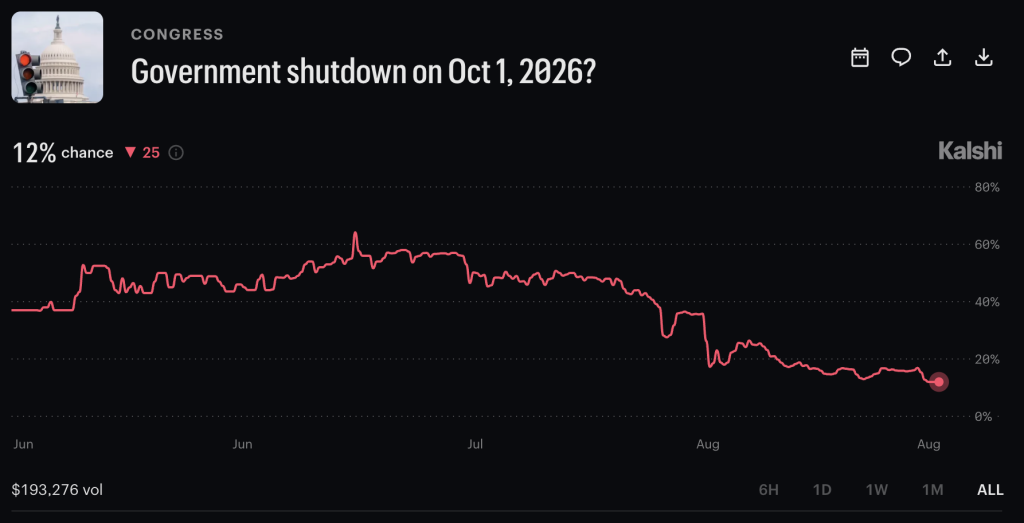
Federal government shutdown odds on Kalshi traded at 15-16 cents as of August 18, implying roughly a 12% chance. That particular market has just north of $193,000 in trading volume.
The price offers a live reading of Washington risk that crypto traders can track alongside broader market developments as they head into the next funding fight.

The figure is a snapshot, not a forecast. The market price can change as appropriations headlines emerge, and the August 18 price may not be the price traders pay when Congress returns from recess in September.
The value of the contract for this analysis lies in the event it prices and its role as a live sentiment indicator for macro risk.
Government Shutdown Odds: Why the Contract Tracks a Real Deadline, Not Just Noise
A government shutdown is a significant issue, as seen during the 2025 funding gap, which led to the furlough of nonessential federal employees. The shutdown began on October 1, 2025, and lasted until the Continuing Appropriations Act was signed on November 12, 2025.
Furloughed employees were paid retroactively, but the Congressional Budget Office projected that the shutdown would result in an $11Bn loss in real GDP by Q1 FY2027, affecting less than 1% of GDP.
Federal employment dropped by 162,000 in October and 6,000 in November, though this was mainly due to deferred resignations rather than the shutdown itself. Key economic data releases were delayed or canceled, complicating assessments of the shutdown’s impact.
Federal Reserve Governor Lisa D. Cook noted that disruptions in government services could slow spending and investment, but these effects were expected to be temporary. The S&P 500 rose during the shutdown, while the U.S. dollar fluctuated but strengthened overall.
Discover: Everyone’s Got a Take. Get $ 5 Free from Kalshi to Actually Trade Yours
Reading Kalshi’s Price as a Dial, Not a Verdict
A 15- to 16-cent YES price indicates a roughly one-in-six market-implied chance, but it is not an official government forecast. It is a trader-set price, with the bid-ask spread and fees affecting how it should be interpreted, as with other prediction market contracts that serve as proxies for real-world outcomes.
The contract’s resolution rules make it more precise than the headline question suggests. It resolves YES only if the federal government is at least partially shut down because of a lapse in appropriations at 10 a.m. ET on October 1, 2026.
A shutdown that begins on October 15 would not satisfy that dated condition. That narrow definition helps explain why the price can move in response to developments in funding talks even before an actual shutdown occurs.
What a Rising Shutdown Premium Can Signal for Bitcoin and Ethereum
The direct causal link between shutdown odds and crypto price action is thin. CRS said it was not certain that financial markets were much affected by the 2025 funding lapse.
For traders following Bitcoin and Ethereum, the contract is therefore better treated as one indicator of Washington-related uncertainty than as evidence of a direct relationship with either asset’s price.
A higher shutdown price would indicate that market participants are assigning a greater chance to a funding lapse at the contract’s specified time. The 2025 shutdown illustrated several potential economic channels: delayed government purchases, delayed data releases, and possible effects on investor confidence.
Whether those concerns coincide with a Bitcoin move tied to broader macro risk depends on wider market conditions rather than the shutdown headline alone.
For Ethereum as well, the Kalshi price is one input, not a standalone trading signal. Traders seeking a connection between Washington risk and changing macro risk sentiment in Bitcoin can compare the contract with other market indicators while keeping its dated resolution rule in view.
Discover: Your Market Calls Are Worth Something. Start with a free $25 on Kalshi
The post Kalshi Government Shutdown Odds in October Slashed appeared first on Cryptonews.

Public Bitcoin miners are pouring large sums into artificial intelligence and high-performance computing (HPC) infrastructure as part of a broader push to diversify beyond pure mining revenue. But new data compiled by BlocksBridge Consulting suggests the transition is still dominated by upfront capital spending, with returns lagging far behind.
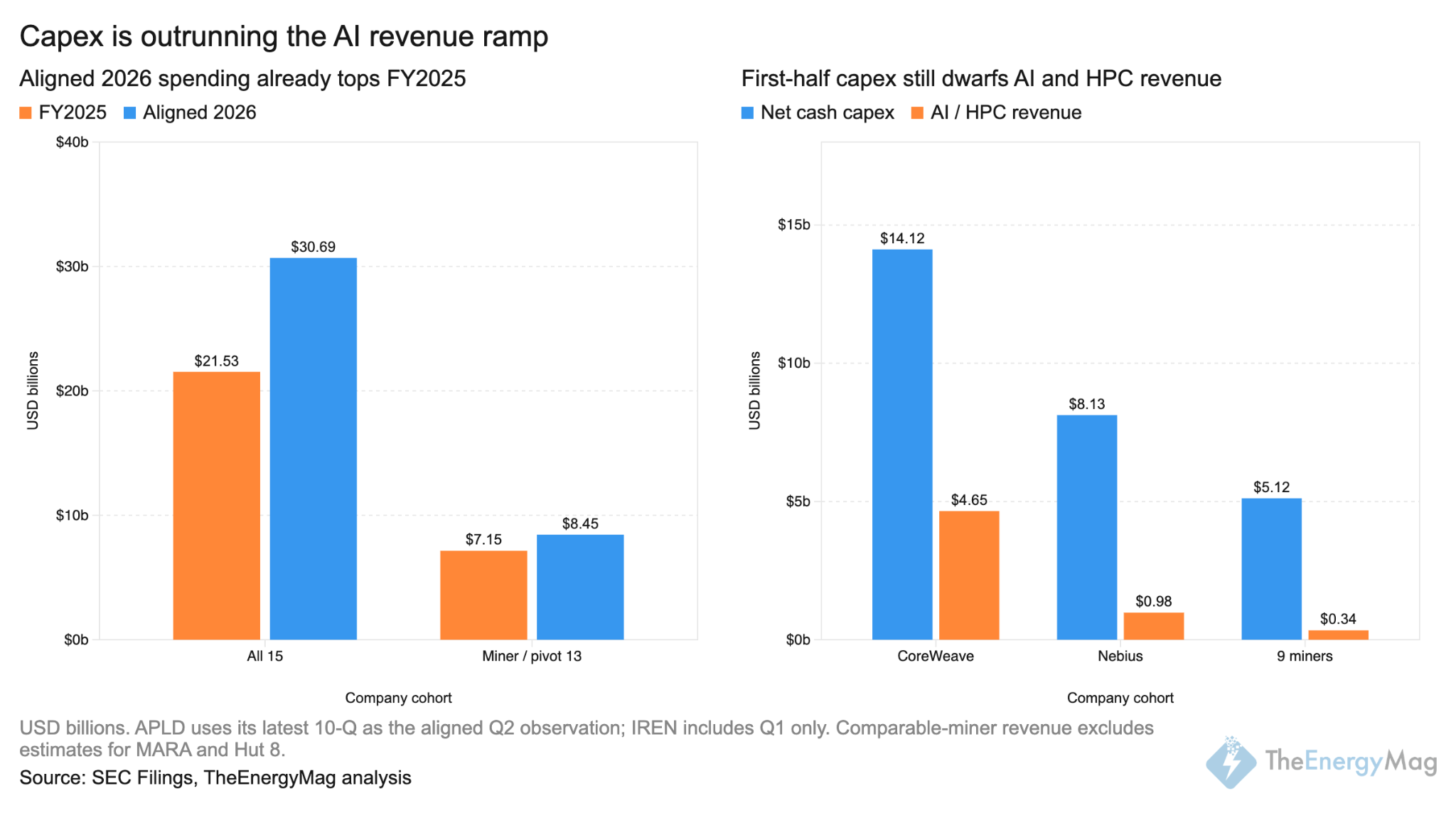
In its latest Miner Weekly newsletter, BlocksBridge reports that a group of 15 Bitcoin miners and AI data-center companies spent a combined $30.7 billion on capital assets in their most recent 2026 reporting periods. That figure is 42.6% higher than the $21.53 billion these companies spent over all of 2025. The figures help quantify just how expensive it is to build capacity for AI workloads—often in parallel with continuing mining operations.
Key takeaways
- $30.7B: Total capital asset spending by 15 Bitcoin miners and AI data-center companies in their latest 2026 reporting periods, per BlocksBridge.
- Capex far exceeds AI/HPC revenue: Nine comparable miners spent $5.11B on capex in the first half of 2026 while reporting only $341.2M in directly reported AI/HPC revenue.
- Revenue growth is accelerating: AI/HPC revenue from those nine miners rose to $205.8M in Q2 2026, up 52% quarter-on-quarter.
- Pivot requires more than power and land: BlocksBridge highlights the need for substations, buildings, cooling, networking, and often GPUs.
- Industry funds are reframing the thesis: CoinShares rebranded its strategy ETF to include companies supplying digital power beyond mining alone.
Capex surge highlights the cost of scaling AI-ready capacity
AI and data centers have been widely discussed as diversification paths for Bitcoin mining companies facing a challenging industry backdrop. BlocksBridge’s analysis adds a granular cost lens to that narrative, showing how quickly capital needs expand when miners attempt to convert existing infrastructure advantages into AI-ready computing environments.
According to BlocksBridge, spending was calculated based on cash purchases and allocations to hardware, property, equipment, and other productive assets—after taking into account proceeds and refunds from asset sales. Even with those adjustments, the gap between investment and revenue remains large.
Among Bitcoin miners specifically, the mismatch looks particularly stark. BlocksBridge identifies nine comparable miners that collectively spent $5.11 billion on capital assets during the first half of 2026, generating just $341.2 million in directly reported AI and HPC revenue. That equates to roughly a 15-to-1 capex-to-revenue ratio for the period covered.
Q2 revenue growth suggests demand is building, even if profits lag
While the early spending burden is clear, BlocksBridge also reports signs that AI and HPC revenue is gaining momentum. For the same group of nine miners, total AI and HPC revenue increased to $205.8 million in the second quarter—a 52% quarter-on-quarter rise.
BlocksBridge notes that companies including Core Scientific, TeraWulf, and Bitdeer were among those reporting gains tied to their AI/HPC efforts. The acceleration matters because it indicates the investments are beginning to translate into recognizable business performance, even if the scale of capex still overwhelms what is currently booked as revenue.
For investors and analysts, the immediate implication is that the diversification story is shifting from “planned buildout” to “commercialization,” but with significant timing risk. The cost is already on the balance sheet or cash-flow path; the payoff appears to be arriving later and in uneven increments across companies.
From mining advantage to AI infrastructure: what still must be built
BlocksBridge frames the pivot challenge in practical terms. While miners may have initial advantages—such as access to power contracts and available land—those assets do not automatically become AI-capable capacity. In its reporting, BlocksBridge says that converting such advantages into AI-ready infrastructure typically requires additional components, including substations, buildings, cooling systems, networking equipment, and—depending on the business model—GPUs.
This matters because it clarifies why AI/HPC commercialization can be slower than headline narratives imply. Mining operations can often run with relatively straightforward operational continuity, but AI workloads involve different infrastructure requirements and more intensive engineering to achieve reliability, scalability, and performance.
BlocksBridge also leaves open a key question for the near term: whether any broader improvement in Bitcoin’s price environment will reduce financial pressure on companies still operating large mining fleets. Bitcoin’s price moves can help sentiment and—depending on each firm’s leverage and hedging—may influence how much runway companies have while AI projects ramp.
Earlier this week, Bitcoin rose more than 13% and moved back above $72,000, following a statement by the US Treasury that it would at least double the maximum size of its long-term bond buybacks to $4 billion per operation. That decision was described as aiming to improve liquidity in the Treasury market, initially pushing yields lower and boosting risk appetite.
ETF strategy shifts mirror the broader “digital power” rebrand
In parallel with the infrastructure buildout, parts of the investment industry are adjusting how they package exposure. CoinShares, this week, announced changes to the way its industry-tracking ETF is positioned and branded.
The fund is now called the CoinShares Bitcoin Mining and Digital Power ETF (WGMI). CoinShares reports that the ETF has $222.4 million in assets under management, and that it draws from a broader set of businesses than a pure mining basket. Its “universe includes 29 holdings” spanning bitcoin miners, data center operators, AI semiconductors, power generation, and HPC companies, which CoinShares describes as “the businesses powering the digital economy.” The fund’s details are listed on CoinShares’ site: https://coinshares.com/us/etf/wgmi/.
For market participants, the ETF shift signals that investors are increasingly seeking exposure to the infrastructure layer around compute—not only the economics of mining blocks. Still, BlocksBridge’s capex-to-revenue figures emphasize that this infrastructure layer is currently expensive to build. The critical test will be whether rising AI/HPC revenue can eventually narrow the investment gap as projects move from construction into sustained operating contracts.
Over the next few reporting cycles, readers should focus on whether the revenue ramp continues for individual miners and whether capex intensity begins to cool relative to AI/HPC income. The data already shows acceleration in Q2, but the core uncertainty remains timing: how long it takes for heavy infrastructure spend to convert into durable, scalable returns.
Bitcoin (BTC) has traded through two US market interventions in under three weeks. It moved the opposite way each time. Support for the yen pushed it down. An attack on long yields lifted it 8.8%.
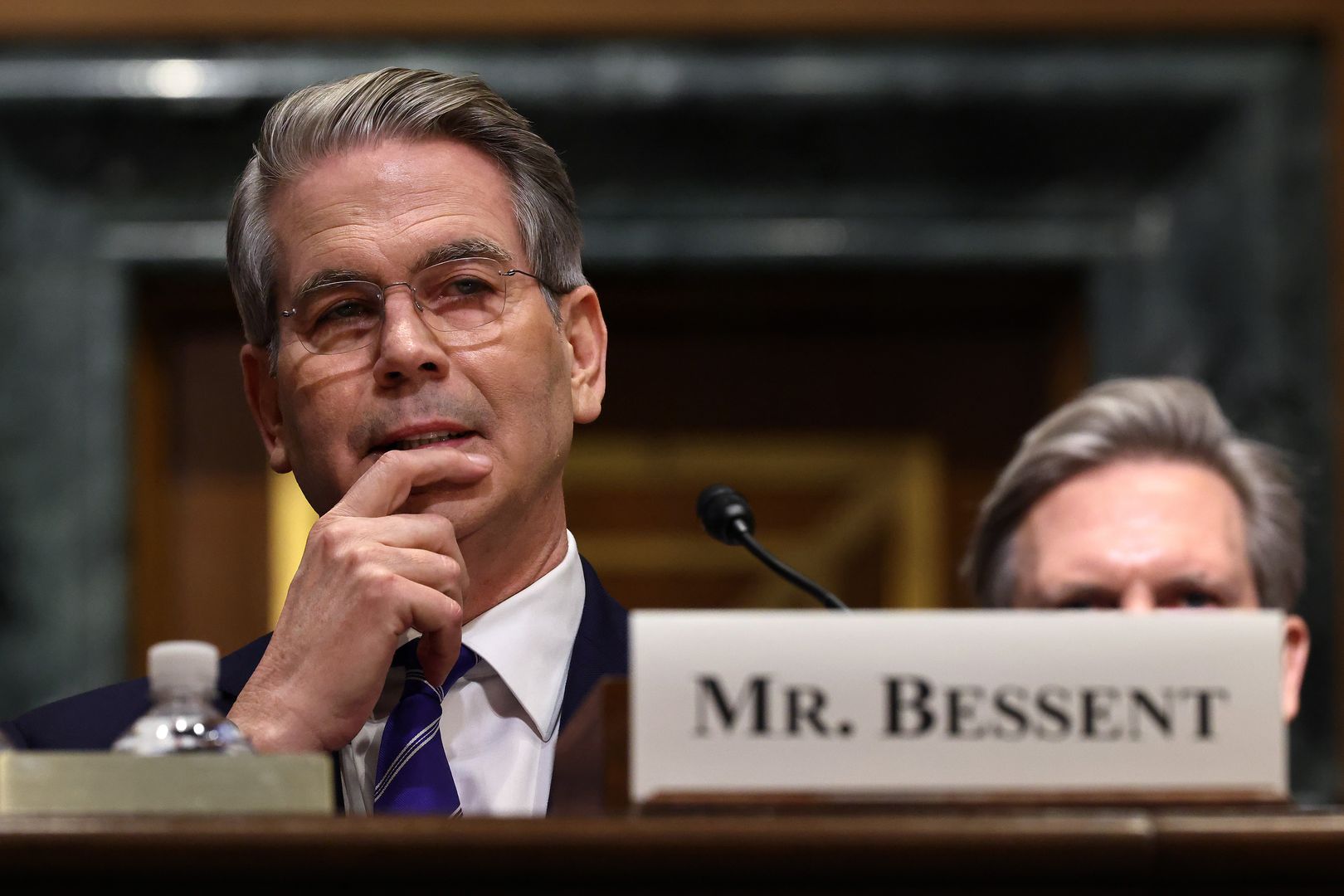
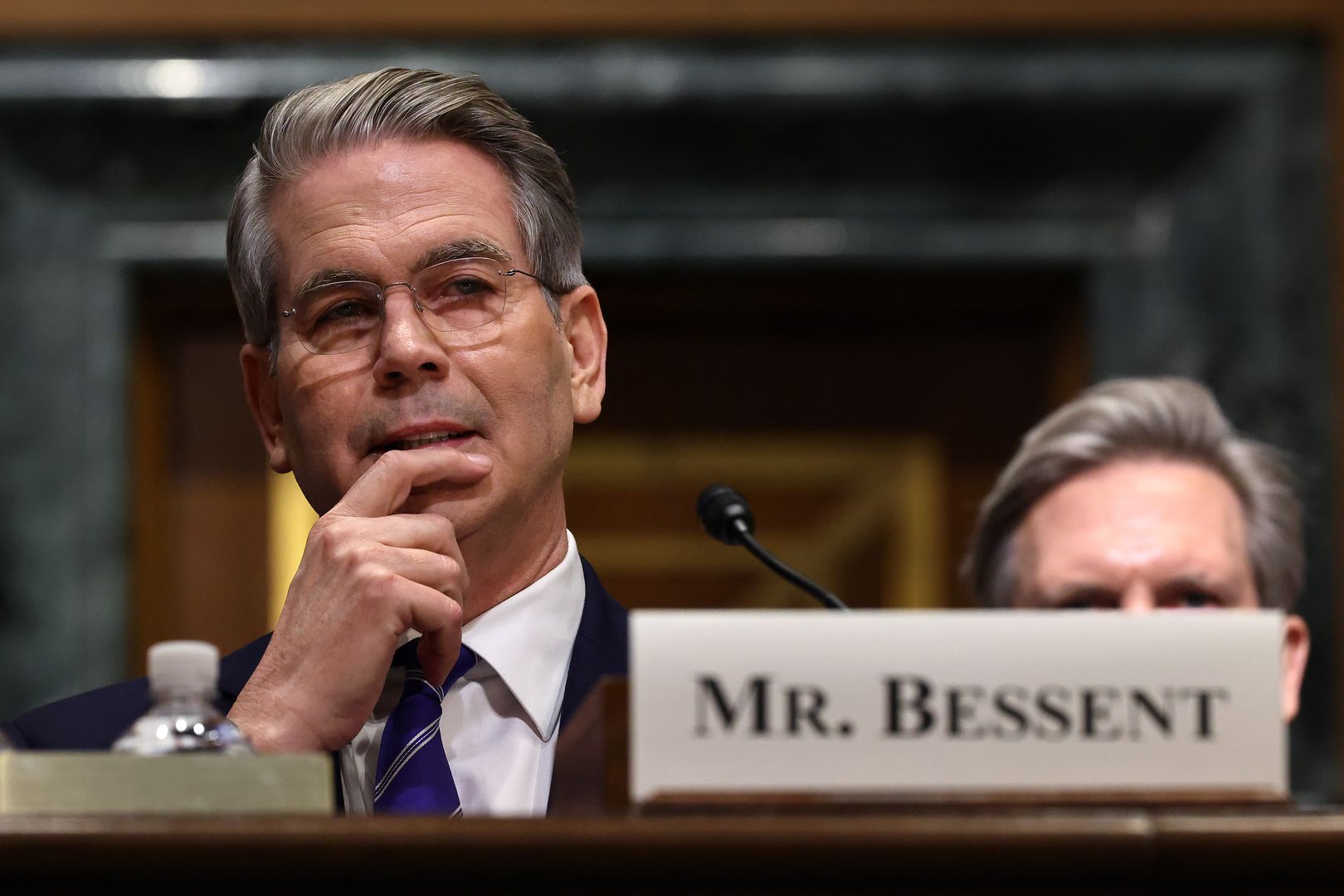
Treasury Secretary Scott Bessent went further on Thursday. He said buybacks could exceed $4 billion per issue and would become routine, while denying that rates drove the decision.
Follow us on X to get the latest news as it happens
Two Interventions, Two Opposite Bitcoin Reactions
The pattern is narrower than it looks. Bitcoin does not reward intervention itself. It rewards the intervention that lowers long-dated US borrowing costs.
The first landed at the start of August. Japan bought its own currency with an estimated $53 billion. The New York Fed then bought yen for the Treasury on August 1.
Washington had not bought yen since 1998. Bitcoin still slipped toward $63,000, down 1.25%, while US stocks closed higher.
Leverage explains why Bitcoin absorbed the yen shock alone. Traders borrow cheaply in yen to buy higher-returning assets, a strategy called the carry trade.
When the yen jumps, those positions cost more to hold. Crypto sits at the riskiest end of that chain, so it sells first.
The decisive detail sits in the bond market. Long yields never fell that week. The 10-year finished near 4.74%, its highest since January 2025, while the 30-year held near post-2007 highs.
One reading is that the operation spared Japan from selling US Treasuries. It protected the currency, not the long end, so Bitcoin had nothing to reward.
The second intervention arrived on August 19 and hit the bond market directly. The Treasury doubled its long-end buybacks, raising the maximum size of each operation to at least $4 billion.
That came one day after the 30-year yield touched 5.337%, the highest reading since 2007.
Bitcoin answered within the hour. Roughly $1.23 billion in crypto short positions was liquidated in 60 minutes. BTC traded near $69,803 on Thursday, up 8.8% over 24 hours.
Why Long Yields Matter More Than the Yen
Long-dated yields set the return available for taking almost no risk. A 30-year bond paying more than 5% is hard competition.
Push that yield lower and the calculation flips. Borrowing gets cheaper, the dollar softens, and money travels further out the risk curve.
“When yields drop and the dollar weakens, risk assets tend to rally,” said Jeff Mei. He is chief operating officer at the exchange BTSE.
The two episodes differ on compulsion. Yen strength forces traders out of positions. Falling yields invite them in. The invitation produced the bigger move.
One objection deserves an answer. The 8.8% jump was amplified by traders caught short, not fresh buyers. That is fair, but a squeeze needs a trigger, and the trigger was the yield drop.
What Could Kill the Rally
The threat is the yields themselves. Both interventions have already lost their grip.
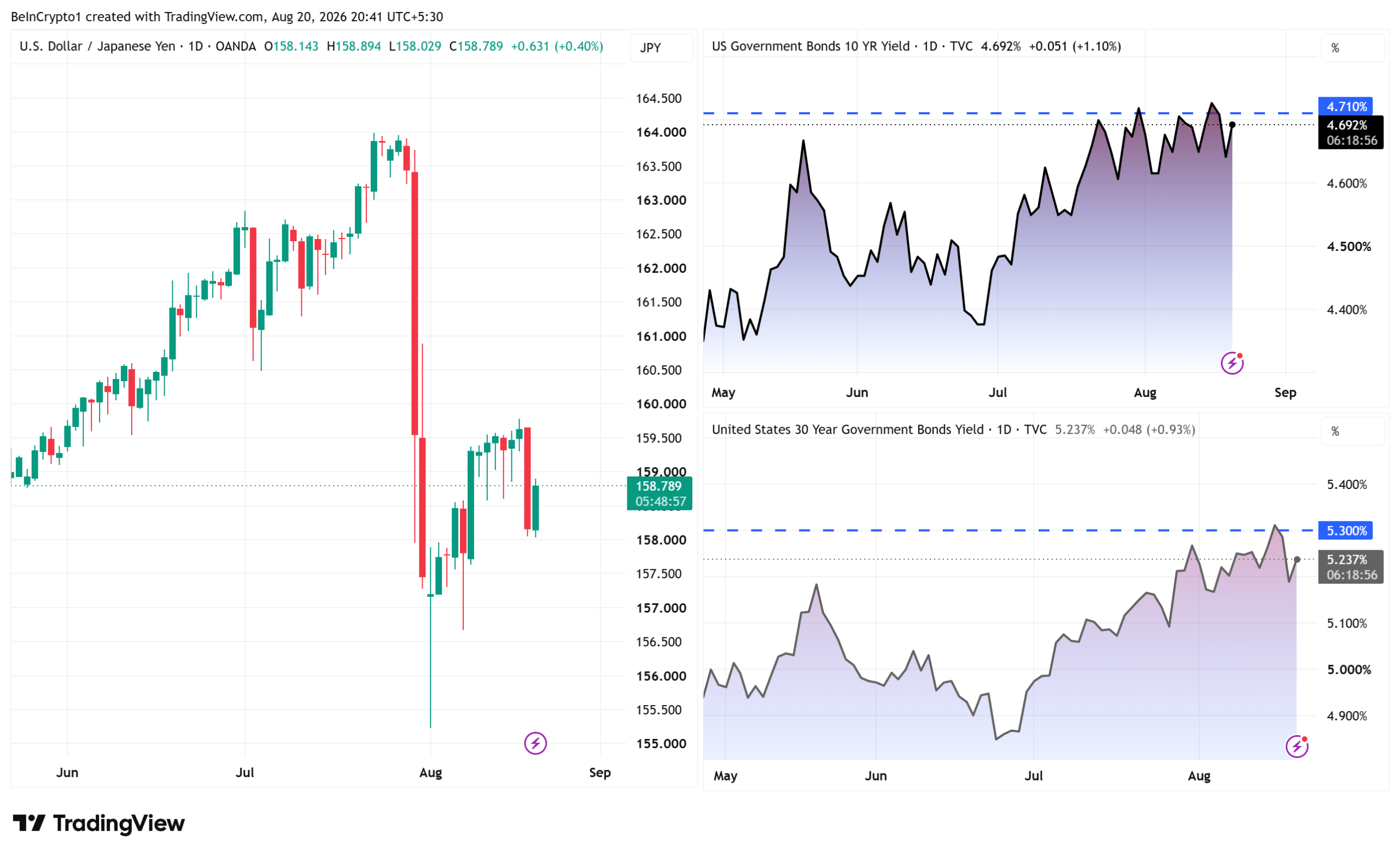
USD/JPY changed hands near 158.79 on Thursday, almost back where it started. Two governments spent tens of billions, and the yen intervention has faded.
Bonds unwound faster. TradingView data put the 10-year at 4.692% on Thursday, just shy of the 4.710% it held before the announcement. The 30-year climbed to 5.237% after falling to 5.192%.

Scale explains the fade. The increase adds roughly $14 billion against a market worth more than $30 trillion. None of it starts until September 9.
“While increasing liquidity buy-back operations by $2 billion might seem like rearranging deckchairs on the Titanic given the U.S. national debt of $40 trillion, yesterday’s intervention by the U.S. Treasury has been warmly greeted by investors around the world,” Chris Turner of ING wrote on Thursday.
It captures the gap between flow and signal.
Bessent then moved to close that gap. He said on Thursday that buybacks could top $4 billion per issue, Bloomberg reported. He also said the Treasury would run them routinely, turning a one-off surprise into standing policy.
The treasury executive also called 30-year liquidity particularly poor and said yields do not reflect underlying fundamentals. Both are unusual admissions from a sitting Treasury Secretary.
Yet he denied that rates drove the decision. That sits awkwardly beside the rest, since the market traded it as exactly that.
He added that the deficit has probably peaked under this administration. If so, that weakens the supply pressure behind the $40 trillion US debt load.
Two things would still end the move:
- One is a clean break above 5.34% on the 30-year.
- The other is a hawkish Fed, after minutes showed three officials wanted a hike.
That is the tension now. The flow keeps fading while the commitment keeps growing. Bitcoin’s current price works as a live scoreboard on which one wins.
The post Bitcoin Rewarded 1 of 2 US Interventions. Bessent Just Promised More appeared first on BeInCrypto.
Longtime bond market investor Mark Connors sees routine government bond buybacks improving liquidity and bringing bitcoin’s next rally closer.

Something flipped in the cryptocurrency markets over the past 24 hours or so, and many altcoins have started to pick up the pace after bitcoin’s massive double-digit rally.
Today appears to belong to XRP. The native token of the broader Ripple universe has skyrocketed by 30% in a day or so, surging to $1.30 for the first time since June 1. Recall that the asset slipped below $1.00 just last week for the first time in nearly two years. Its subsequent rebound has been nothing short of impressive.
XRP Whales Continue Accumulating
Perhaps the most notable change in the XRP ecosystem is the recent whale behavior. As reported at the end of the previous week, these large market participants scooped up 72 million tokens in just 24 hours as the asset fought to stay above $1.00.
Citing further data from Santiment Intelligence, popular analyst Ali Martinez noted that they continued with their massive accumulation spree by acquiring over 300 million tokens since the start of the current business week. Their total holdings have skyrocketed from around 16.05 billion on August 16 to approximately 16.36 billion today.
Such large acquisitions have a twofold effect. First, they reduce the immediate selling pressure in the market. Second, they can act as an example for smaller investors who tend to follow whales.
Major Price Targets Emerge
The ever-vocal XRP Army was quick to pick up the native token’s mind-blowing recovery from the $1.00 support. JAVON MARKS celebrated the breakout, suggesting that the asset’s next major run has just started. Moreover, the analyst outlined the subsequent macro target of $15 or higher.
Dark Defender also weighed in on the price move, confirming that XRP had completed its correction. He based the analysis on the assumption that XRP had finished the leg down on all 5 waves on all timeframes.
“There is no 6th limb in the Elliott Wave Theory,” he added, before indicating that the latest rebound signals a strong reversal and a new impulse that can lead the token to $5.85 first and then $9.00.
Although these price targets sound quite optimistic, to say the least, XRP has proven in the past that it’s capable of massive moves shortly after the broader sentiment appeared broken.
The post Ripple Whales Go Crazy as XRP Price Can’t Stop Surging appeared first on CryptoPotato.
Public Bitcoin miners are spending billions chasing artificial intelligence and high-performance computing revenue, though returns have yet to keep pace, underscoring the massive upfront investment required to diversify beyond Bitcoin mining.
In its latest Miner Weekly newsletter, BlocksBridge Consulting reported that a group of 15 Bitcoin miners and AI data-center companies spent a combined $30.7 billion on capital assets in their latest 2026 reporting periods, already 42.6% more than the $21.53 billion they spent throughout 2025.
Among Bitcoin miners specifically, the gap between capital spending and AI revenue remains significant. Nine comparable miners spent $5.11 billion on capital assets during the first half of 2026 while generating just $341.2 million in directly reported AI and HPC revenue — a roughly 15-to-1 capex-to-revenue ratio.
BlocksBridge calculated capital spending based on cash purchases and allocations to hardware, property, equipment and other productive assets, after accounting for proceeds and refunds from asset sales.
Despite the gap, AI and HPC revenue is accelerating. The nine miners generated $205.8 million from those businesses in the second quarter, up 52% quarter-on-quarter, with Core Scientific, TeraWulf and Bitdeer among the companies reporting gains.
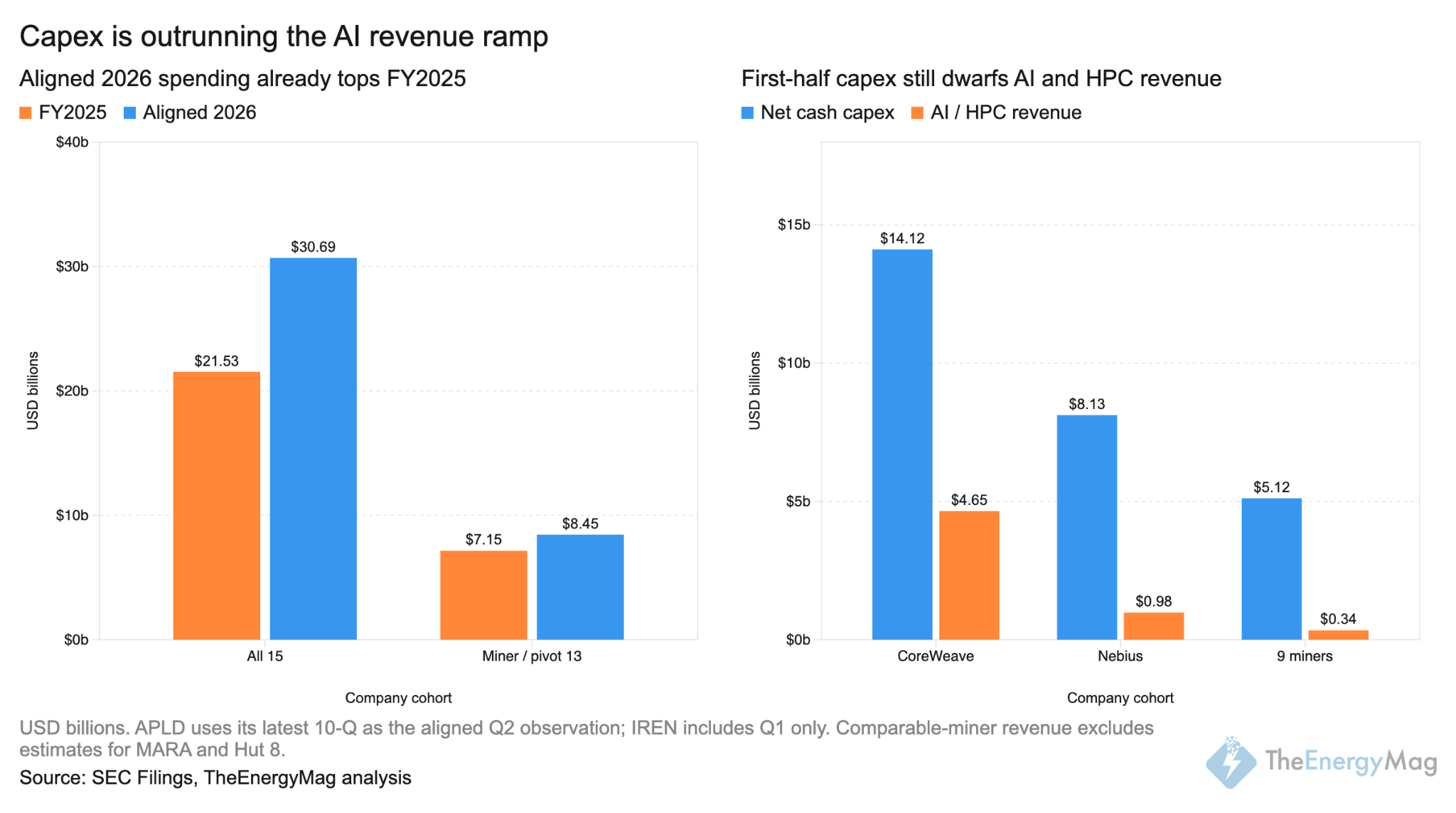
Bitcoin miners’ capital expenditures are vastly outpacing AI and HPC revenue so far. Source: Miner Weekly
Related: Public Bitcoin miners cut hashrate 13.4% as AI infrastructure revenue grows
The steep cost of pivoting to AI
AI and data centers have been touted as a way for Bitcoin mining companies to diversify amid challenging conditions in the mining sector, but BlocksBridge’s data shows that the pivot comes with substantial upfront costs.
“Power contracts and available land may give miners a starting advantage, but converting those assets into AI-ready capacity requires substations, buildings, cooling systems, networking equipment and, in some business models, GPUs,” BlocksBridge said.
It remains to be seen whether Bitcoin’s latest price recovery will provide relief for companies that still maintain sizable mining operations.
Bitcoin has surged more than 13% this week and climbed back above $72,000 after the US Treasury said it would at least double the maximum size of its long-term bond buybacks to $4 billion per operation, a move aimed at improving liquidity in the Treasury market that initially pushed yields lower and boosted risk appetite.
In a sign of the pivot to AI and HPC, CoinShares this week announced a change in strategy for its industry tracking exchange-traded fund.
Now branded the CoinShares Bitcoin Mining and Digital Power ETF (WGMI), with $222.4 million in assets under management, the fund’s universe includes 29 holdings drawn from bitcoin miners, data center operators, AI semiconductors, power generation, and HPC, which Coinshares describes as “the businesses powering the digital economy.”
Related: Crypto Biz: Bitcoin’s $116M self-custody wake-up call


A French couple has been kidnapped from their home in Rion-des-Landes in an alleged crypto extortion attack that left the man injured and led to two arrests.
Summary
- Two residents were allegedly taken from their home during the night of Aug. 10–11.
- The attackers reportedly sought access to a large amount of Bitcoin and other cryptocurrencies.
- The man was found naked and injured, while the woman was recovered in another department.
- Two men were arrested as the Bordeaux specialized jurisdiction took charge of the investigation.
Actu Landes reported on Aug. 20 that several people entered the couple’s home at around 4 a.m. and allegedly threatened them while seeking access to their Bitcoin and other crypto holdings.
The Bitcoin kidnapping began with an early-morning home invasion
According to the local news outlet, the attackers initially held the two residents inside their home in Rion-des-Landes, a town in the Landes department of southwestern France. The group allegedly tried to force the victims to hand over what the report described as a large amount of Bitcoin and other digital assets.
After the confrontation inside the property, the assailants allegedly removed both victims from the house and transported them to separate locations. Actu Landes did not report whether any cryptocurrency was transferred, how the attackers identified the couple, or how long the two residents remained in captivity.
The man was later found in Solférino, about 20 kilometers from Rion-des-Landes. According to the report, he was naked and had several cuts when authorities located him. No information was provided about the seriousness of his injuries or whether he required hospital treatment.
Several kilometers away, investigators found the woman inside a vehicle in another French department, the outlet reported. Authorities did not disclose the location where she was recovered, her physical condition, or the circumstances that led officers to the car.
Details about the couple have also remained limited. Their names, professions and estimated crypto holdings were not released, while the report did not establish whether either victim worked in the digital asset sector or had publicly discussed owning cryptocurrency.
Two suspects were arrested after a large police response
Shortly after the reported abduction, French gendarmes deployed across the area and began stopping vehicles on the road connecting Rion-des-Landes and Lesperon, according to witnesses cited by Actu Landes.
The operation involved a large number of officers, with the road controls apparently intended to locate the victims and identify vehicles connected to the attack. Investigators returned to the couple’s home the following day to preserve evidence, examine the property and collect fingerprints.
Two men were arrested soon after the incident, the report said, although officials have not released their identities, ages, or suspected roles. Authorities have also not said where the arrests occurred, whether the suspects remain in custody, or whether officers recovered weapons, vehicles or digital devices.
Contacted by the outlet, France’s National Anti-Organized Crime Prosecutor’s Office, known as PNACO, confirmed that the Specialized Interregional Jurisdiction in Bordeaux was handling the case. The Bordeaux office had not responded to the publication’s questions when the report was released.
French authorities assign specialized interregional jurisdictions to complex organized crime cases that may require work across several departments. PNACO’s involvement and the transfer to the Bordeaux jurisdiction indicate how prosecutors have classified the investigation, but neither office has publicly announced charges against the two arrested men.
No official statement has confirmed the value of the cryptocurrency allegedly sought, whether the attackers obtained wallet credentials, or whether investigators traced any transactions. The available account also does not establish a link between the two suspects and any other crypto-related attacks in France.
France has recorded 77 crypto-linked violent cases in 2026
The Landes incident follows a series of kidnappings, home invasions, and extortion attempts involving French crypto holders and their relatives.
As crypto.news reported in July, Interior Minister Laurent Nuñez said France had recorded 77 kidnappings, unlawful detentions, extortion cases or attempted offenses connected to the crypto sector during 2026. Authorities recorded 45 comparable cases in 2025.
Nuñez also said that about 200 people had been arrested after attacks or during operations intended to prevent them. During a June 30 address to the Association for the Development of Digital Assets, the minister said 724 industry participants had registered with rapid-identification platforms used to help authorities respond when someone considered at risk contacts police.
The Interior Ministry’s security plan included more intelligence sharing, coordination with the digital asset industry group Adan, and cooperation with countries where suspected organizers may be located. Nuñez said some people directing the attacks appeared to operate from outside France, while lower-level recruits carried out the violence.
A separate Chainalysis report found that France recorded 30 publicly known violent crypto incidents through the first half of 2026, up from 19 during all of 2025. The analytics company used a narrower dataset than the French government, which explains why its public-incident count differs from the 77 cases cited by Nuñez.
According to Chainalysis, criminals stole more than $30 million through successful physical attacks worldwide during the first half of 2026. The company counted 12 successful attempts among 46 documented incidents through late June, producing a 26% success rate compared with 49% in 2025 and 67% in 2024.
Home invasions represented 37% of documented attacks through mid-2026, up from 14% in 2025, while kidnappings remained the most common category. Chainalysis said family members or other people connected to crypto holders accounted for around 25% to 30% of known incidents by early 2026.
Within France, more than 40% of cases involved a relative or associate rather than the identified holder, according to the firm. Local residents made up 93% of French victims whose residency was known, a pattern Chainalysis linked to advanced research using leaked information, social media activity, blockchain records, or knowledge supplied by insiders.
The company cited an alleged 2024 theft of French tax records containing names, addresses, holdings, telephone numbers and tax information associated with wealthy crypto owners. It also referred to crypto tax platform Waltio’s January disclosure that unauthorized access had affected information tied to around 50,000 users, while noting that no direct connection had been established between either exposure and a specific attack.
US cases show similar home-invasion tactics
Physical attacks against crypto holders have also resulted in federal prosecutions in the United States, where Chainalysis said home invasions have accounted for a larger share of incidents than in many other countries.
In May, a US wrench attack case involved three Tennessee men accused of targeting cryptocurrency holders in San Francisco, San Jose, Sunnyvale, and Los Angeles. Federal prosecutors alleged that the defendants posed as delivery workers to enter or attempt to enter homes before using firearms, duct tape, and zip ties to restrain victims.
According to the U.S. Department of Justice, one victim was forced at gunpoint to sign in to cryptocurrency accounts, allowing an alleged accomplice to transfer about $6.5 million in digital assets to a wallet controlled by the group.
The indictment was filed on March 31 and unsealed after the arrests of Elijah Armstrong, Nino Chindavanh, and Jayden Rucker. The Justice Department said the charges were allegations and that each defendant remained presumed innocent unless proven guilty in court.

Grayscale Research sees the SEC’s proposed Regulation Crypto Assets as a potential reset for U.S. token-based fundraising. The framework could give issuers new capital routes while directing more activity toward established public blockchain networks. Ethereum, Solana, and BNB Chain could benefit if companies move token launches back into the United States.
Ethereum Could Gain From Expanded Token Issuance
Ethereum could capture additional network activity because many token projects already use its infrastructure for issuance and settlement. Grayscale identified Ethereum among the major networks positioned to benefit from renewed U.S. token fundraising. More domestic offerings could increase transactions, smart-contract use, and applications built around Ethereum’s existing ecosystem.
The SEC proposed Regulation Crypto Assets on August 18 and targeted certain investment contracts involving newly issued crypto assets. The proposal creates two exemptions from standard Securities Act registration requirements for qualifying token offerings. One exemption allows issuers to raise to $5 million during four years.
The second exemption would permit eligible issuers to raise to $75 million in any 12 months. However, those issuers would face financial statement requirements and continued reporting obligations under the proposed framework. Federal antifraud and market-manipulation requirements would also continue to apply to offerings made under the exemptions.
Solana Could Attract New Fundraising Activity
Solana could also gain activity because its network supports token launches, payments, decentralized applications, and other blockchain services. Grayscale included Solana among networks that could receive additional usage if U.S. fundraising rules become clearer. More token issuance could therefore create new demand for transactions and applications operating through the Solana network.
The proposed regulation focuses on newly issued crypto assets rather than blockchain representations of existing securities. That distinction separates Reg Crypto from tokenized stocks, which link digital assets with shares already issued elsewhere. Instead, the SEC wants a dedicated framework for companies raising capital through certain crypto-related investment contracts.
The SEC also proposed a conditional safe harbor addressing when crypto assets remain linked to investment contracts. An issuer could qualify after completing or permanently ending the essential managerial work originally promised under the contract. Qualified assets would then fall outside investment-contract treatment under federal securities definitions covered by the proposal.
BNB Chain Could Benefit From More U.S. Token Launches
BNB Chain represents another major network that Grayscale believes could gain from expanded token-based capital formation. The network already hosts applications, digital assets, and decentralized finance services requiring frequent blockchain transactions. New U.S. token offerings could therefore expand network use if issuers select BNB Chain for distribution.
Reg Crypto follows years of uncertainty surrounding U.S. token offerings after the initial coin offering boom. That uncertainty pushed many projects toward overseas structures or offerings that excluded participation from the United States. The SEC said its proposal aims to reduce incentives for issuers to establish and operate offshore.
The framework still requires completion of the SEC rulemaking process before issuers can use its proposed exemptions. The SEC opened a 60-day public comment period following publication of the proposal in the Federal Register. Meanwhile, Congress continues work on broader digital asset legislation that could further define federal market oversight.
The NPT, also known as the Nuclear Non-Proliferation Treaty, is an international agreement aimed at stopping the spread of nuclear weapons.
The Islamic Republic of Iran signed the treaty in 1968 and ratified it in 1970, committing as a non-nuclear-weapon state not to manufacture or acquire nuclear weapons.
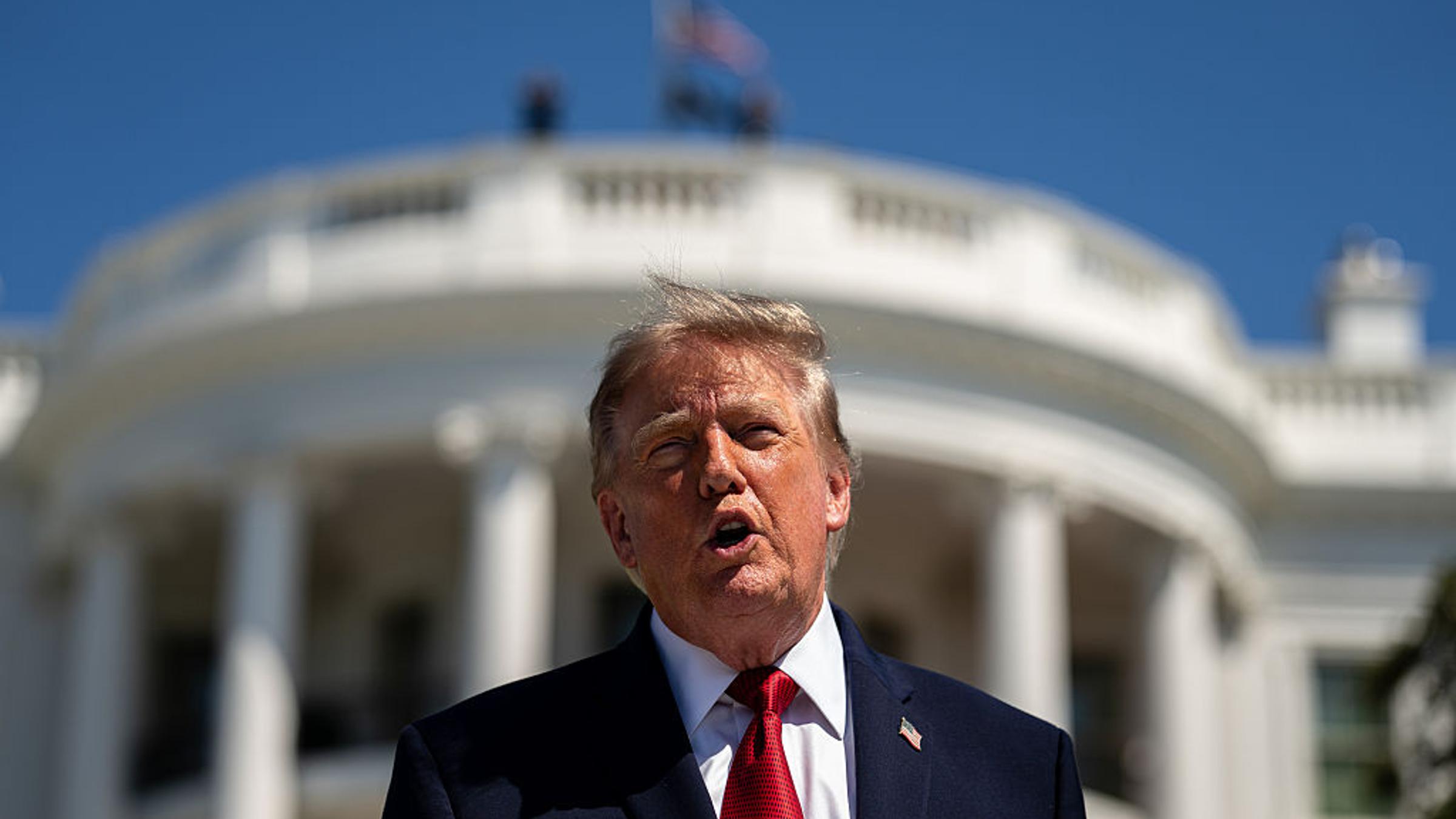
Trump has repeatedly cited preventing Iran from obtaining a nuclear weapon as a justification for U.S. military action
“They have to get rid of it completely. They have to get rid of nuclear weapons. Iran cannot have a nuclear weapon,” Trump repeated Wednesday during the unveiling of the new White House helipad.
Where U.S.-Iran negotiations stand
Trump’s renewed economic threats come as negotiations between Washington and Tehran appear to have stalled amid disagreements over the Memorandum of Understanding (MOU), signed by both countries on June 17.
The document outlined commitments aimed at ensuring the full, toll-free reopening of the Strait of Hormuz, and established a 60-day cease-fire intended to allow technical talks to take place, including over Iran’s nuclear capabilities. Before the war, roughly a fifth of the world’s global petroleum liquids consumptions passed through the waterway.

In the interview, Harry said the decision to withdraw from public duties and move to California was both due to the amount of tabloid press scrutiny and harassment, as well as a lack of support from “The Firm.”
Tabloid headlines focused on Meghan have included descriptions of the Duchess as “gangster royalty” and coming from a “crime-ridden neighborhood.”
In 2023, Harry published his memoir, Spare, outlining details of Royal life. In his book, the Duke revealed how he learned of his grandmother’s death, Queen Elizabeth II, via the BBC, and how his father, Charles, did not hug him following the death of his mother, Princess Diana, in 1997.
While in the U.S., the couple have launched a number of business ventures, including several with Netflix. In December 2022, the couple released a six-episode docuseries on Netflix detailing more details about the early days of their relationship, as well as discussions around racism and stereotypes experienced by the Duchess since the start of their relationship.

Urgent hunt launched for teen brother and sister who took off in their parents’ car three days ago and haven’t been seen since

Five Below: Kids Discount Retailer Reaps Rich Rewards

Kalshi Government Shutdown Odds in October Slashed





-

 Fashion6 days ago
Weekend Open Thread: Ann Taylor
-
 Sports7 days ago
This U.S. Amateur is a glimpse into golf’s future in more ways than you think
-
 Tech6 days ago
11 Ways to Rank Your Videos
-

 Sports6 days ago
Birmingham 2026: Day 6 Timetable for Irish Athletes
-
 NewsBeat5 days ago
Myanmar says over 300,000 Rohingya refugees verified for repatriation as exodus enters ninth year
-

 Politics5 days ago
SEQ Code: The Three Letter Boarding Pass Code That Could Give You The Worst Seat
-

 Tech7 days ago
DeepSeek Harness launches as open source rival to Claude Code, alongside V4-Pro on API with higher prices
-

 Tech3 days ago
Qwen3.8-27B runs frontier-class coding agents and reasoning locally, no cloud API required
-

 Crypto World6 days ago
Pi Network Protocol 27 endgame: last upgrade before what?
-

 Business2 days ago
SMA Solar Technology AG (SMTGY) Q2 2026 Earnings Call Transcript
-

 Crypto World3 days ago
OCC Greenlights Trump Family Crypto Firm for Trust Charter
-
 Tech5 days ago
Every fusion startup that has raised over $100M
-

 Business6 days ago
15 Ways to Make Money From Your Phone (2026 Guide)
-
 Entertainment6 days ago
10 Netflix Shows That Quietly Became Modern Classics
-

 Fashion6 days ago
Weekly News Update, 8.14.26 – Corporette.com
-
 Entertainment5 days ago
Marvel Studios Reveals New X-Men Cast Including Adam Driver and Sadie Sink
-

 News Videos13 hours ago
Don’t Leave Your Financial Future To Chance | August 19, 2026
-

 Business5 days ago
Facebook Down Now? Users Report Login And Loading Problems As Outage Trackers Monitor Ongoing Issues
-

 Crypto World6 days ago
Robinhood Chain Approaches $1B TVL as Uniswap Integration Boosts Liquidity
-

 Fashion6 days ago
Silver bangles for women – Newbridge Silverware
You must be logged in to post a comment Login