
Crypto World
5% Treasury Yields Won’t Crush Record-High Stocks. Can Bitcoin Say the Same?

Wall Street’s biggest bears have gone quiet on 5% Treasury yields. Bank of America Private Bank Chief Investment Officer Chris Hyzy says the level no longer scares stocks the way it once did.
The bigger question is whether Bitcoin can also fight off the bear case high treasury yields can bring for risk-on assets. While equities shrug off higher rates, Bitcoin (BTC) has spent 2026 losing the fight for the same money.
Why 5% Doesn’t Scare Stocks Anymore
Speaking on CNBC’s Closing Bell, Hyzy said $9 trillion sits in money funds and deposit accounts. Investors earning two to three points above inflation feel less pressure to chase risk.
“Five is not the negative that it once was,” Hyzy said, pointing to how much cash sits in the system.
Sonali Basak, chief investment strategist at iCapital, agreed the flight to quality favors well-capitalized companies.
Highly leveraged firms extending debt on thin margins face a tougher road. Ritholtz Wealth Management’s Josh Brown said earnings momentum is driving stocks higher, not fear of missing out.
Bitcoin Hasn’t Gotten the Memo
The math looks different for an asset that pays no yield at all. The 30-year Treasury yield has topped 5.3% this year, including a 5.27% reading on Aug. 14, its highest level since 2007. Artificial intelligence (AI) hyperscalers are now competing with Washington for the same lenders.
Over that stretch, Bitcoin has fallen 46% while gold gained roughly 33%. BeInCrypto has also found that bond yields aren’t lifting Bitcoin the way they once boosted gold.

The bull case still exists. Rising yields partly reflect a widening fiscal deficit. That debt-fueled backdrop first drew investors to Bitcoin’s fixed supply as an inflation hedge.
Alphabet and Meta priced corporate bonds paying 6.4% to more than 7.5% this year. That is a bar Bitcoin’s price has not cleared since global yields last sat this high.
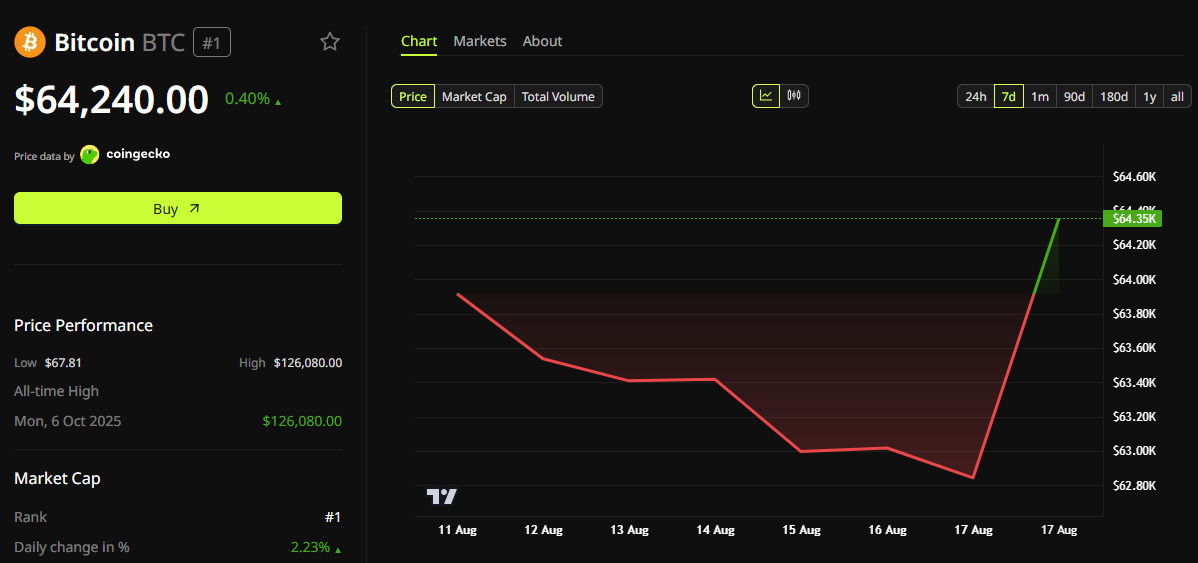
For now, that scarcity argument is losing to the yield trade. Bitcoin is holding above $64,000 after its recent rally. It has yet to pull in much of the $9 trillion parked in cash.

Wednesday’s Federal Open Market Committee (FOMC) minutes could shift the calculus again. A dovish surprise would test whether stocks keep climbing on earnings alone. It would also show whether Bitcoin can finally act like the hedge its backers describe.
The post 5% Treasury Yields Won’t Crush Record-High Stocks. Can Bitcoin Say the Same? appeared first on BeInCrypto.

Binance has reportedly shared customer transaction data and personal identifying information with Russian authorities in a case involving an IT specialist accused of financing terrorism through cryptocurrency donations tied to Ukrainian fundraising campaigns, according to documents reviewed by Reuters.
Russian investigators say the information helped build the case against Yuri Belenkiy, who was detained in September 2025 and is currently awaiting trial in Russia. Reuters reports that law enforcement used Binance-supplied material as evidence supporting the charges.
Key takeaways
- Reuters reviewed law enforcement documents stating that Binance provided transaction history and personal details for Yuri Belenkiy.
- Russian authorities allege Belenkiy sent more than $700 in crypto between January 2023 and March 2024 to support the Ukrainian military and a banned group identified as Azov at different times.
- The data transfer included sensitive identifiers such as date of birth, address, phone number, and passport information.
- Binance says it cooperates with lawful information requests under applicable legal and privacy requirements, while declining to comment on the specifics of the case.
What Binance information was reportedly used
According to Reuters’ review, Russian authorities asked Binance for the transaction history of Yuri Belenkiy and received information linking him to cryptocurrency transfers. The response reportedly included not only transaction records but also personal identifiers used to connect the accused individual to the funds.
Reuters reports that the materials provided included Belenkiy’s date of birth, address, phone number, and passport number. The response also allegedly contained copies of his Russian passport and a Bulgarian residency permit.
The use of these records underscores a recurring pressure point for exchanges: even after exiting certain markets, platforms can still become a focal point for cross-border investigations when authorities request account and transaction data tied to specific users.
Allegations tied to crypto donations and a banned organization
Russia’s Investigative Committee alleges that Belenkiy sent more than $700 in cryptocurrency between January 2023 and March 2024. The alleged transfers were described as supporting the Ukrainian military as well as a group Reuters identified as the Azov Brigade or the Azov Regiment depending on the naming used at different times.
In the Russian case framing, the presence of a sanctioned or “banned” organization is central to the terrorism-related characterization. While the underlying activity described involves cryptocurrency donations connected to Ukrainian efforts, the legal outcome will depend on how prosecutors interpret intent, recipients, and the status of those recipients under Russian law.
For crypto users and compliance teams, the case illustrates how closely surveillance and enforcement can track on-chain value flows—especially when exchanges are able to connect addresses to real-world identities through account verification data.
Why the exchange’s earlier Russia exit matters
Binance announced it would fully exit Russia in September 2023, selling its local business to CommEX. Reuters’ reporting suggests that despite that earlier decision, Binance remained within the reach of Russian law enforcement requests for data tied to customers and past activity.
This detail matters for market participants because it challenges a common assumption that an exchange’s exit from a jurisdiction ends its role in later investigations. From an investor and compliance perspective, the key question is not only where a company currently operates, but also whether it retains or can access customer records and transaction logs that may be requested later.
Binance response and the compliance line
Reuters reports that a Binance spokesperson declined to comment on specific confidential law enforcement requests or the details of individual cases.
In comments shared with Cointelegraph, Binance stated that it does not make or enforce the laws of any jurisdiction, does not determine charges, and does not decide how governments use information in legal proceedings. The company said it cooperates with lawful information requests from law enforcement globally, subject to applicable legal, privacy, and regulatory requirements.
That response reflects a broad compliance position commonly used by major crypto exchanges: cooperation is framed as process-based rather than judgment-based. However, cases like this also highlight the practical risks for customers—particularly when authorities obtain both transaction records and personal identification data.
Earlier coverage from Cointelegraph noted that Binance planned to restrict transactions involving HTX and other crypto platforms, showing that the exchange continues to adjust operational policies as enforcement and regulatory pressures evolve. In parallel, user data requests remain a separate but highly consequential compliance channel.
As this case proceeds, the next developments to watch are how Russian courts treat the evidence derived from exchange records and whether legal proceedings clarify the standards used to link donations to specific recipients and to organizations classified as banned. For the broader crypto ecosystem, the outcome may influence how exchanges consider the scope and safeguards around information requests tied to historic activity.


Binance said it left Russia in 2023. Two years later, Russian investigators asked the exchange for a customer’s records. They got them. Reuters reportedly reviewed the law enforcement documents showing those files became evidence in a terrorism financing case.
The contradiction is simpler than it looks. Leaving a market ends revenue in a country. It does not delete the files an exchange already holds.
What Binance Actually Ended in 2023
Binance sold its Russian arm to CommEX on September 27, 2023. Chief Compliance Officer Noah Perlman said operating in Russia did not fit the company’s compliance strategy.
The announcement was precise about money. Binance kept no revenue share. It kept no option to buy the business back. The exchange had spent the previous weeks weighing a Russian withdrawal under regulatory pressure.
It said nothing about data. That silence matters. Exchanges hold passport scans, addresses and full trading histories for years. Anti-money-laundering rules in the markets that license them demand it. Selling a subsidiary does not touch that archive.
The Channel Was Never New
The customer was Yuri Belenkiy, a Russian IT specialist detained in September 2025. Investigators accuse him of sending just over $700 to Ukrainian military fundraisers. Moscow calls that terrorism financing.
Reuters reported that two replies reached investigators from case@binanceholdings.ru. Binance’s own website had listed that address for Russian and Belarusian agencies.
That pipeline is not new. Binance published the numbers itself in April 2022. It had logged 1,094 requests from Russian law enforcement since April 2020.
Three came from the Federal Security Service (FSB). One came from Rosfinmonitoring, Russia’s financial intelligence agency.
Data only can go back to 4-1-2020, 1,094 total requests from Russia, 3 directly from FSB, 1 directly from Rosfin,” read an excerpt in the Binance announcement.
For scale, Binance said eight months later that it had answered more than 47,445 law enforcement requests worldwide. Average turnaround was three days.
The company rejected the Reuters account in 2022 and denied sharing data on donors to Alexei Navalny. Its position has not moved since.
“Like other global financial institutions, we cooperate with lawful information requests from law enforcement globally, subject to applicable legal, privacy and regulatory requirements,” Reuters reported Monday, citing a Binance spokesperson.
Binance’s public request page now sends agencies to a portal run by Kodex. Only China gets a separate link. No Russian address appears there.
The Test Binance’s Own Rules Set
Binance publishes a bar for these cases. The company says it needs a valid court order, police order or warrant before it hands anything over.
European law sets a second bar. Article 48 of the General Data Protection Regulation (GDPR) covers demands from foreign authorities. The European Data Protection Board (EDPB) spelled out the standard in December 2024 guidelines.
Such a demand is enforceable only if an international agreement backs it. A mutual legal assistance treaty is the usual example.
Here the record goes quiet. The documents Reuters describes show a request, not a court order. They establish no treaty basis either. Binance reportedly declined to discuss the case.
Mike Bystrov, founder of the law firm Stellar Consulting, reportedly told Reuters that Binance had no duty to answer. He said EU rules may have barred the disclosure. Binance disputes that reading.
The EDPB also said in 2022 that Russia holds no adequacy finding. Exporters who cannot close the resulting gaps are told to suspend transfers.
Whether any of this reaches Belenkiy is unclear. He holds a Bulgarian residency permit. GDPR covers him only if Binance registered him as an EU customer, and Reuters could not confirm that.
BeInCrypto put these questions to Binance, including whether a court order accompanied the request. The company had not responded by publication.
Europe is moving the other way fast. The EU’s 21st sanctions package in July 2026 hit 14 crypto platforms with transaction bans. It also created the first option to bar crypto services from an entire country.
Washington gets quicker service. The Office of Foreign Assets Control (OFAC) attached Tron wallet addresses to Iran’s central bank in July 2026. Tether’s kill switch froze the funds within hours. That cooperation draws praise rather than criticism.
Centralized platforms answer whichever state can impose the higher cost. The open question now is whether a European regulator makes Binance show it cleared its own bar.
The post Binance Left Russia in 2023: Why Is Moscow Still Getting User Data? appeared first on BeInCrypto.
Bitcoin price rose nearly 2% to reclaim $64,000 on Aug. 17, but weak daily momentum and unusually compressed volatility leave the next major move uncertain.
Summary
- Bitcoin price rebounded from $62,751 to an intraday high of $64,227.
- Glassnode’s volatility trap score reached 91, its highest level in more than 3.5 years.
- BTSE’s Jeff Mei said ETF flows and Federal Reserve signals remain key to a sustained recovery.
- Liquidation clusters near $64,700 and $62,200 could shape Bitcoin’s next move.
Bitcoin price returns above $64,000
According to data from crypto.news, Bitcoin (BTC) price traded near $64,154 at press time after gaining about 2% during the daily session. The recovery followed an intraday low of $62,751 and carried BTC above the 78.6% Fibonacci retracement level at $63,152.
The rebound also erased part of the decline recorded over the previous week, when Bitcoin repeatedly tested support between $62,500 and $63,000. Buyers defended that area again on Aug. 17, helping the price reach a session high of $64,227.
Jeff Mei, chief operating officer at crypto exchange BTSE, told crypto.news that recent exchange-traded fund flows contributed to the earlier weakness in Bitcoin and Ethereum.
“BTC and ETH pulled back a bit after some ETF outflows last week, with Bitcoin now sitting around $63,000 and ETH near $1,878.”
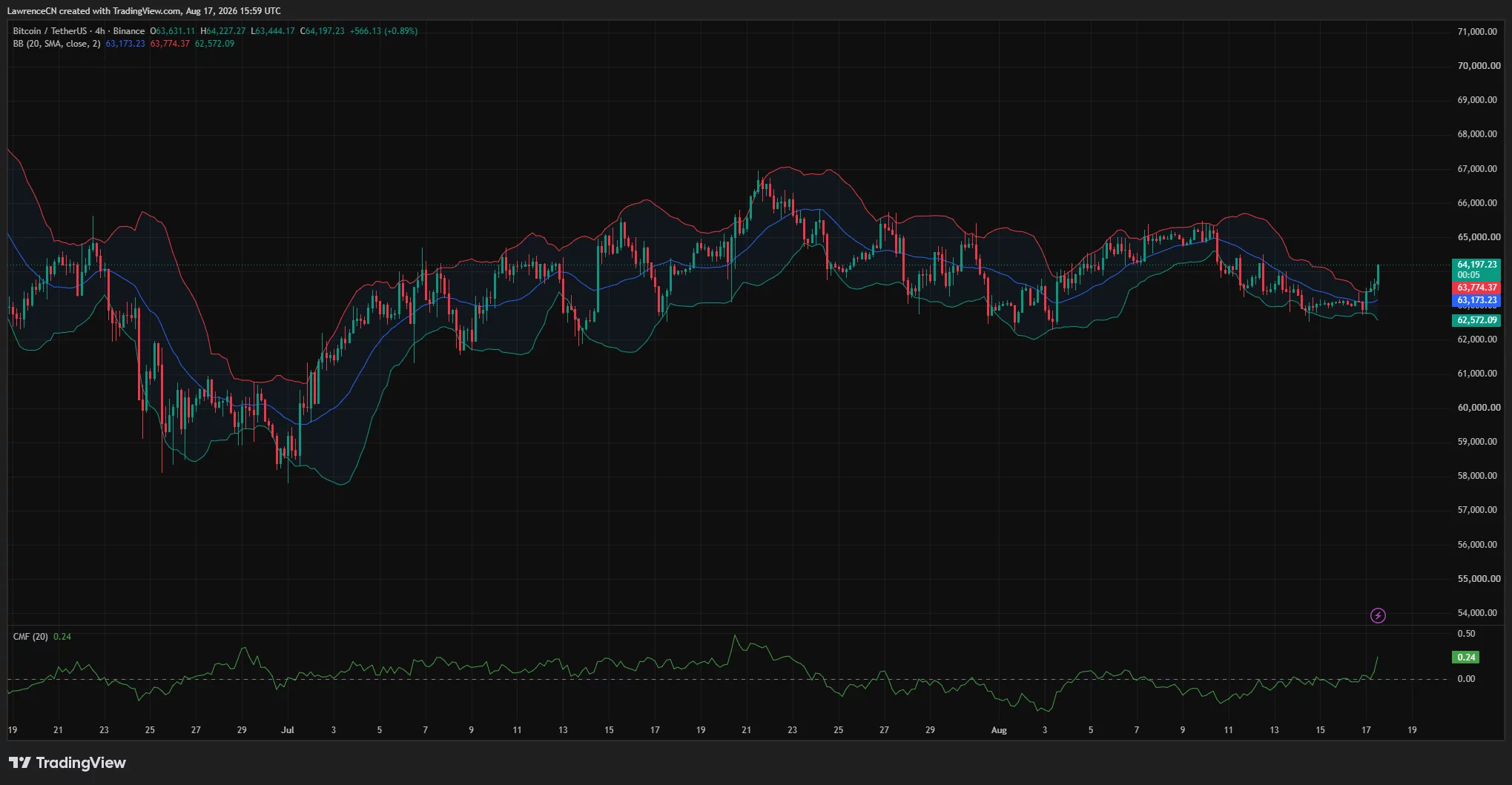
The 4-hour chart shows that short-term buying pressure strengthened during the latest recovery. BTC moved above the Bollinger Bands’ middle line at $63,173 and crossed the upper band near $63,774, showing that the rebound accelerated beyond its recent trading range.
Chaikin Money Flow on the same timeframe rose to 0.24, indicating that buying volume supported the move. A price holding above $63,774 would keep the immediate focus on the $64,700–$65,000 resistance area.
Glassnode warns of a low-volatility trap
Bitcoin’s rebound comes as the options market prices in one of the quietest trading environments in its history.
Glassnode co-founder Rafael Schultze-Kraft said in an X post that Bitcoin’s implied volatility had fallen into the lowest 2% of its historical distribution. Implied volatility measures the degree of future price movement expected by options traders rather than the direction of that move.
Despite reaching a historical low, implied volatility remains around 1.5 times higher than Bitcoin’s recent realized volatility, according to Schultze-Kraft. The gap means options traders are still paying a notable volatility premium even though actual price movements have been unusually narrow.
Glassnode’s volatility trap score has consequently climbed to 91 out of 100, its highest reading in more than three and a half years. Schultze-Kraft cautioned that low implied volatility alone does not automatically make options cheap because realized volatility has fallen even further.
Past periods of severe compression have often preceded larger price swings, but the Glassnode data does not indicate whether the next expansion will be higher or lower. Capital flows, macroeconomic policy and new market catalysts could determine the direction.
Bitcoin’s recent range reflects that uncertainty. BTC has largely traded between $62,000 and $65,000 since late July despite several brief moves outside those levels.
BTC daily indicators remain weak
Bitcoin’s daily chart has not yet confirmed a broader bullish reversal, even after the latest rebound.
The daily moving average convergence divergence indicator remains below its signal line. The MACD reading stood near minus 183, compared with a signal-line reading near minus 101, while the histogram remained negative at around minus 82. The readings show that bearish momentum from the recent decline has not fully cleared.
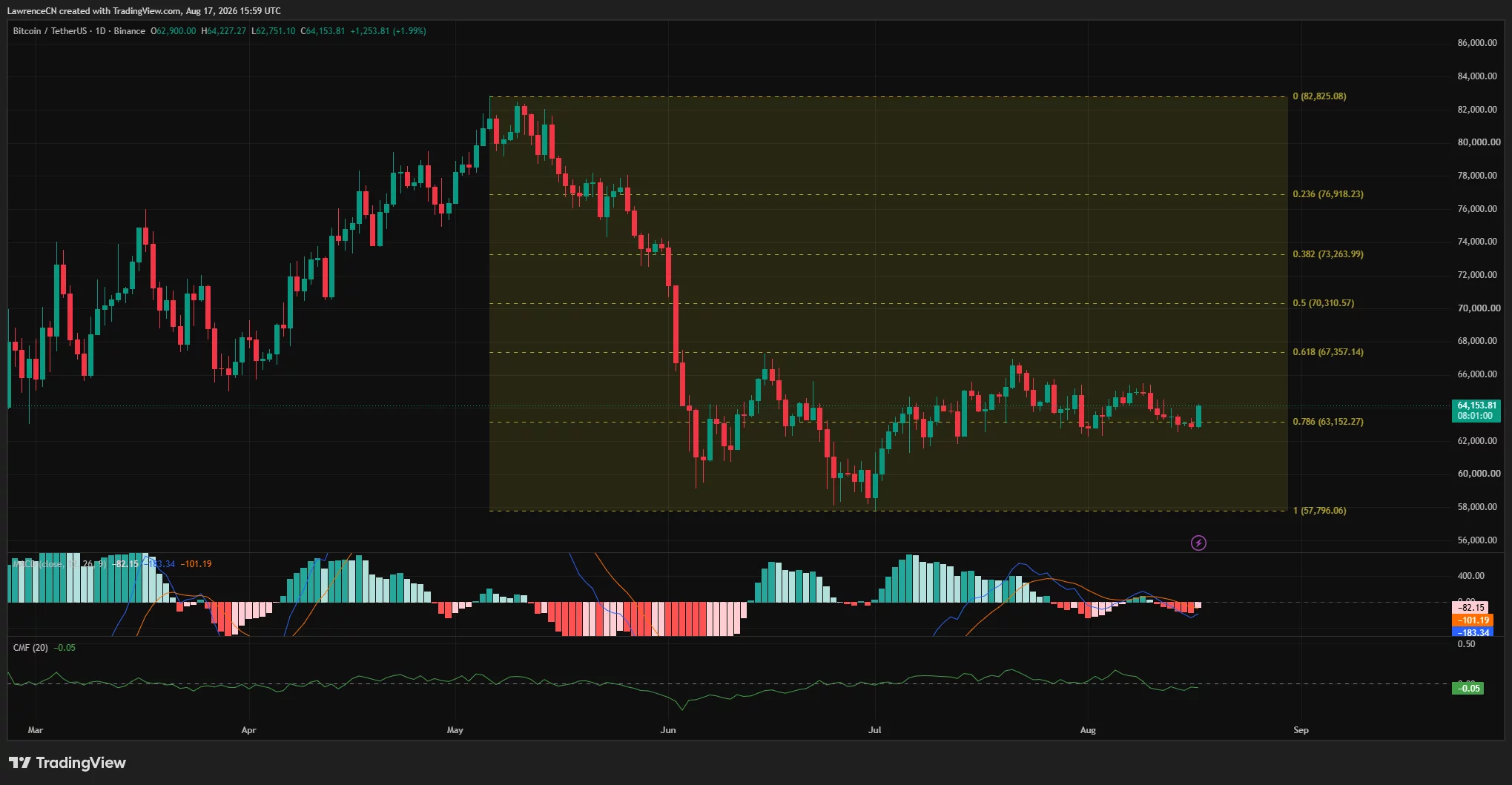
Daily Chaikin Money Flow also remained slightly negative at minus 0.05. The contrast with the 4-hour reading of 0.24 suggests that buyers have returned in the short term, although broader capital flows remain weak.
A daily close above $64,000 would strengthen the recovery and open a path toward $65,000. The next larger upside level sits near $67,357, corresponding with the 61.8% Fibonacci retracement of Bitcoin’s decline from $82,825 to $57,796.
Failure to hold the $63,152 Fibonacci level would put $62,500 back in focus. A deeper breakdown could expose the $60,000 area, while the full retracement low near $57,796 represents the broader bearish level visible on the daily chart.
Liquidation levels place BTC between $62,200 and $64,700
CoinGlass’ one-week liquidation heatmap shows large concentrations of leveraged positions on both sides of Bitcoin’s current price.
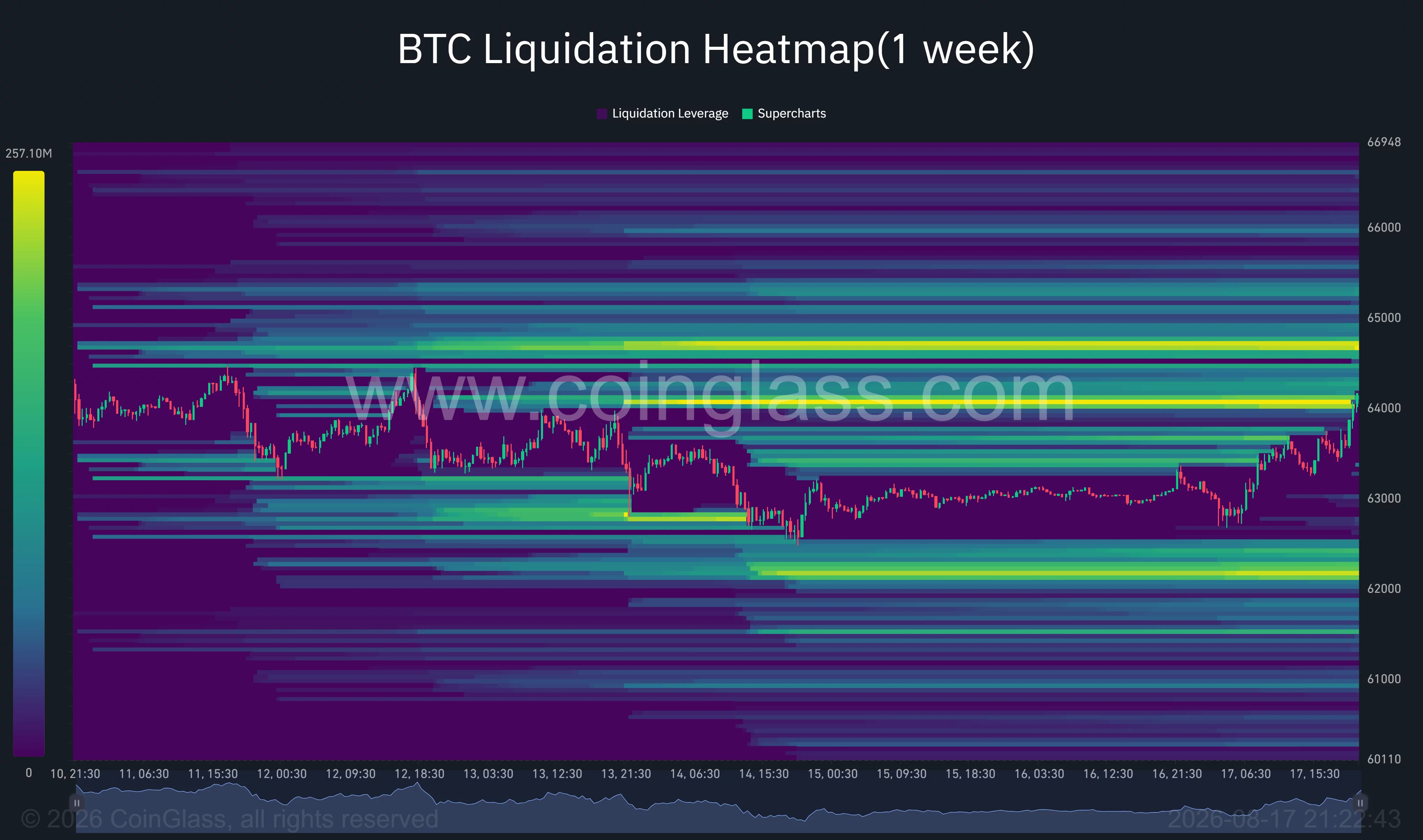
The nearest strong overhead cluster sits around $64,000, with a larger concentration near $64,700. A move through those levels could force short sellers to close positions, adding buying pressure and potentially pushing BTC toward $65,000.
Downside liquidity is concentrated near $62,700 and $62,200. A rejection from the current level could draw the price back toward those zones and trigger liquidations among leveraged long traders.
The heatmap therefore supports a near-term range between roughly $62,200 and $64,700. Glassnode’s volatility data suggests that Bitcoin may not remain inside such a narrow range indefinitely, but it does not establish which boundary will break first.
Fed minutes and CLARITY Act could guide Bitcoin
Mei said traders will monitor the Federal Open Market Committee minutes for clues about the Federal Reserve’s interest-rate outlook. Expectations for lower rates matter to crypto markets because easier financial conditions can increase the liquidity available for risk assets.
“The big things to keep an eye on this week are the FOMC minutes, which’ll give us a peek into what the Fed’s actually thinking on rates, and whether the CLARITY Act gets any attention in the Senate before they head out for recess,” Mei said.
The BTSE executive argued that uncertainty over the CLARITY Act has held back some large institutional investors. He also said traders continue to favor artificial intelligence stocks, leaving crypto in need of stronger institutional inflows or greater macro liquidity to support another sustained advance.
According to Mei, such a shift would likely require clearer evidence that the U.S. economy is slowing enough to justify rate cuts. Until ETF demand strengthens or the Federal Reserve signals easier policy, Bitcoin’s recovery may remain vulnerable near the upper end of its recent range.
Disclosure: This article does not represent investment advice. The content and materials featured on this page are for educational purposes only.
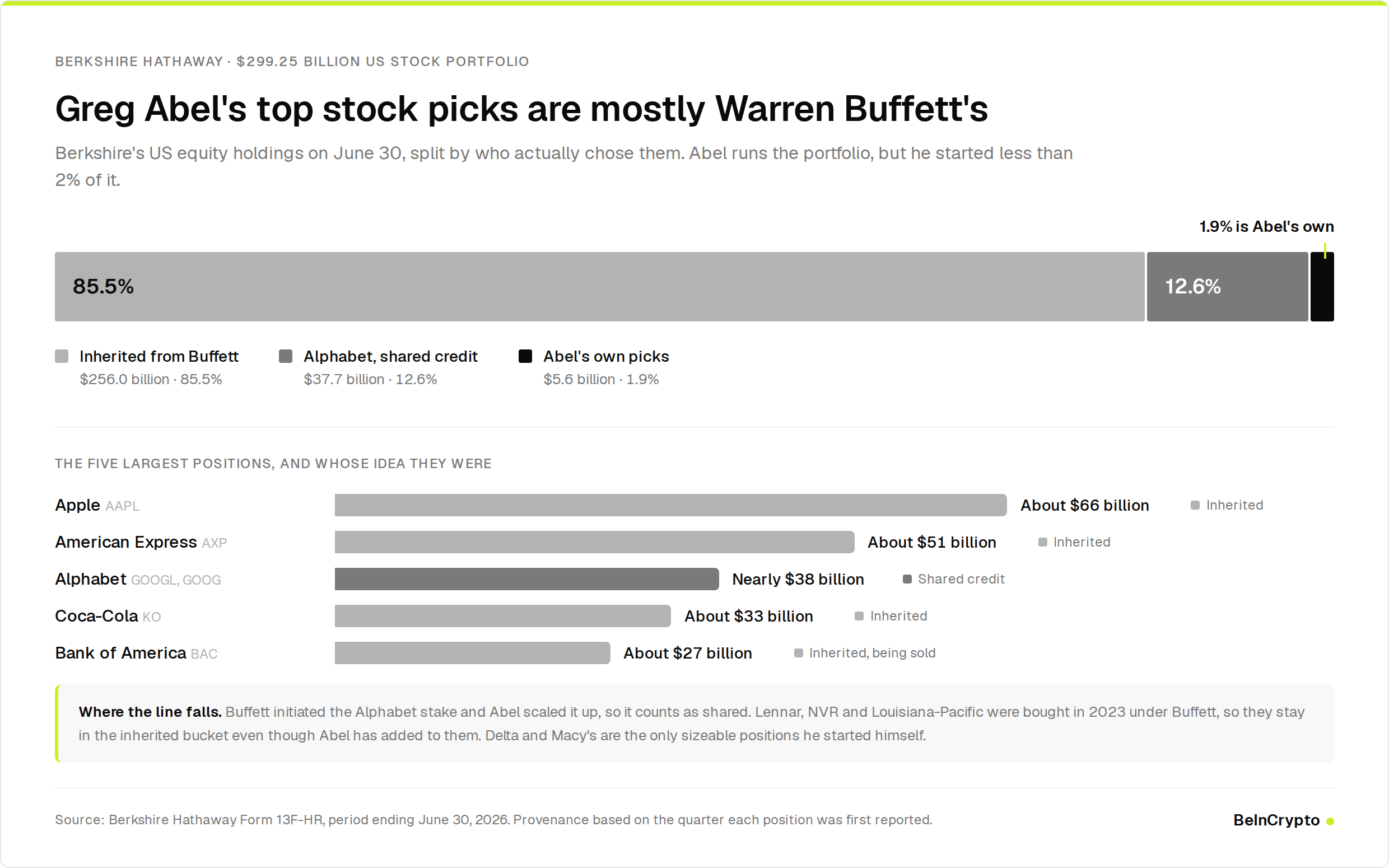
Greg Abel became the successor to Warren Buffett when he took over the famous investment firm Berkshire Hathaway in January 2026. Although he doesn’t publish stock tips, Berkshire Hathaway’s latest portfolio filing is the next best thing. It names every US stock the company held on June 30.
The list holds a surprise. Most of Abel’s top picks are not really his. They are Warren Buffett’s, and Abel has barely touched them.

Greg Abel’s Top US Stock Picks by Size
Big investors file a form called a 13F four times a year. It lists the US shares they owned at the end of each quarter. Berkshire filed its latest one on August 14.
The portfolio came to $299.25 billion. Just three companies hold more than half of it.

Four of those five are Buffett positions. Abel has left three of them alone and is selling the fourth.
His own ideas start much further down. Delta Air Lines and Macy’s were his first buys. Housing is his other theme. All of it together is worth less than 3% of the portfolio.
He is still spending. Berkshire bought $23.5 billion of stock and sold $3.7 billion. That net $19.8 billion ended 14 straight quarters of selling.
The cash barely moved. Berkshire’s record cash pile still sat near $365.5 billion at the end of June.
Alphabet is the Standout Pick
Alphabet is the one large pick Abel can claim a share of. Berkshire added about 48 million shares last quarter. It now holds roughly 106 million.
A $10 billion private placement in June did much of the work. Alphabet is raising $80 billion to build artificial intelligence (AI) computing power. An earlier company report had flagged billions in unnamed stock purchases, which this filing names.
The price helped too. Alphabet traded below 17 times forward earnings, the cheapest of the big US tech names.
Buffett says the idea was his, not his successor’s. He told CNBC in July that the two men work as a pair.
“I am not doing anything that he doesn’t approve of. He’s not doing anything I don’t approve of. We talk all the time, but he is the decider,” Warren Buffett, Berkshire Hathaway chairman, said.
He has regretted missing Google for years. In 2017, he told shareholders he “blew it.” He now argues Alphabet can beat most Wall Street stock picks.
Not everyone agrees. Michael Burry, who shorted the 2008 housing market, says Abel lacks Buffett’s valuation discipline.

The Housing Bet is Abel’s Own
Housing is where Abel has left the clearest mark. Berkshire now holds four housing stocks.
- Lennar is the biggest at $1.2 billion.
- Louisiana-Pacific, which makes siding and wood panels, comes to $446 million.
- NVR holds $75.7 million.
- The new D.R. Horton stake is tiny at $580,504.
None of this is fresh ground. Berkshire bought D.R. Horton, Lennar and NVR together back in 2023, then sold the Horton shares last year. Abel has bought them back.
The real money went private. Berkshire paid $6.8 billion in cash for homebuilder Taylor Morrison in July. It has owned Clayton Homes, a major US maker of manufactured homes, since 2003.
Add it up, and Berkshire now builds homes, finances them, and makes the materials.

Delta Undoes a 2020 Retreat
Delta is the sharpest break with the past. Berkshire added 17.5 million shares last quarter, a 44% increase. The stake is now 57.3 million shares worth $5.4 billion.
Buffett owned four US airlines before the pandemic. He sold every one of them in April 2020 and told shareholders he had been wrong. He had called the industry “a bottomless pit” in 2007.
Abel started rebuilding in his first quarter as chief executive. He has added again in his second.
Where Abel Took Money Off the Table
The selling was smaller but pointed. Berkshire cut its stake in Capital One by 58% and sold its entire stake in Constellation Brands.
Bank of America saw the steadiest retreat. Abel sold 30.23 million shares, an eighth straight quarter of trimming. The stake is down 53% from its peak.
Price explains it. Buffett put $5 billion into the bank in 2011 to steady it. The stock then traded 62% below book value. It now trades 64% above it.
Visa, Mastercard, Amazon, and UnitedHealth were cleared out earlier this year. Concentration is the plan, and Abel has said so plainly.
“A large portion of our portfolio is concentrated in a small number of American companies such as Apple, American Express, Coca-Cola, and Moody’s … This concentrated approach will continue,” the Berkshire Hathaway chief executive noted.
One caveat belongs on any list like this. A 13F lands up to 45 days late. It leaves out cash, foreign holdings, and the businesses Berkshire owns outright. Abel’s next filing is due in November.
The post Top US Stock Picks From Warren Buffett Successor Greg Abel appeared first on BeInCrypto.
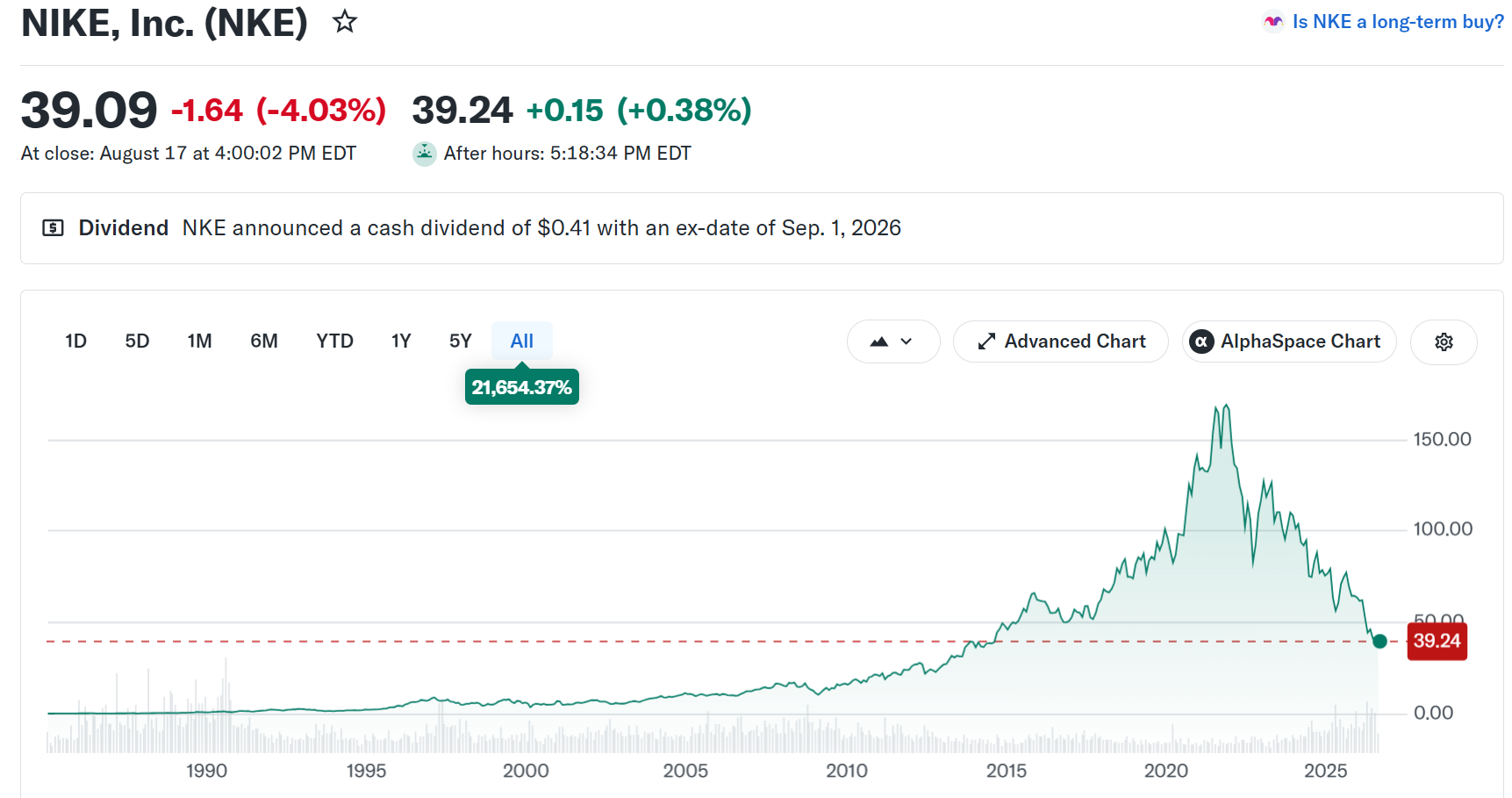
Nike (NKE) closed at $39.09 on Monday. That is its weakest close since September 2014. The stock sits about 78% below its 2021 record. Bitcoin has not fallen that far in this bear market.
Nike is a Dow Jones Industrial Average stock. Investors buy that index for safety. The chart no longer looks safe.

A Dow Stock Falls Further Than Bitcoin
Nike lost 4.03% on Monday, nearly 80% below its record close of $169.74 recorded on November 5, 2021. The damage since then is easy to size. Nike is now worth about $58 billion.
Apply today’s share count to the record price, and the peak value was near $255 billion.
Bitcoin’s fall is the smaller one. BTC changed hands near $64,325 on Monday, up 2% in 24 hours. Bitcoin’s record was $126,080, set on October 6, 2025. So Bitcoin’s price action sits close to 50% below the top, or roughly half of Nike’s decline.
Now compare the clocks. Bitcoin gave up half its value in 10 months. Nike has been sliding for 57.

The years erased matter more than the speed. Bitcoin is trading back at levels last seen in 2024. Nike is trading back at 2014 prices.
Bitcoin at least has a cycle to blame. Nike does not. Its decline runs through a bull market in US equities.
Nike Bought Crypto Near the Top and Buried It Near the Bottom
The digital detour comes with a date. On December 13, 2021, five weeks after that record close, Nike bought RTFKT.
RTFKT was a small studio. It sold sneakers and avatars that existed only as NFTs on Ethereum.
Then-CEO John Donahoe sold the deal as proof Nike could own digital culture.
“This acquisition is another step that accelerates Nike’s digital transformation and allows us to serve athletes and creators at the intersection of sport, creativity, gaming and culture,” John Donahoe, then Nike CEO, in the company’s December 2021 release.
Nike shut the RTFKT studio in early 2025. Collectors then sued for $5 million, arguing the company had sold unregistered securities and walked away.
Plenty of consumer brands quit NFTs in the same window, as BeInCrypto reported when brands retreated from NFTs. Nike’s version stands out for one reason. The purchase marked the top of its own stock.
The Turnaround Still Has No Revenue Line
Elliott Hill returned as chief executive in October 2024. He spent 32 years at Nike before retiring, then came back to fix it.
Almost two years on, the numbers have not turned. Fiscal 2026 revenue was $46.4 billion, flat as reported and 2% lower currency-neutral. Earnings slipped 3% to $2.10 a share.
The mix is the problem. Wholesale, meaning shoes sold through other retailers, rose 6% to $27.5 billion.
Nike Direct, its own stores and apps, fell 6% to $17.7 billion. Direct sales earn more per shoe, so the profitable channel is the shrinking one. Converse dropped 31% to $1.2 billion.
China is the deepest wound. Greater China revenue fell 11% to $5.85 billion, and profit in the region fell 20% to $1.28 billion.
The fourth-quarter gross margin of 49.2% looked like a win. However, $986 million of expected tariff refunds were delivered. Strip that out, and margins barely moved.
“No hints yet that revenues can turn positive in the foreseeable future … we don’t see a clear reason to expand the P/E [ratio] from here (from 22x FY27 consensus EPS),” Evercore ISI analyst Michael Binetti stayed unconvinced in a research note.
What Comes Next
Monday brought one more twist. David Denton started as Nike’s chief financial officer on the same day the stock hit its 12-year low. Matthew Friend, his predecessor, leaves on September 4.
Wall Street still expects a bounce. The average target is $50.66, roughly 30% above Monday’s close, per Stock Analysis data. JPMorgan sits lowest at $40, and Nike closed below even that.
The dividend pays $1.64 per year, yielding over 4%. That is the strongest card bulls hold. First-quarter results are due in late September.
Bitcoin holders spent a decade hearing that their asset was reckless. Nike holders bought the safe label and are 78% poorer since 2021. So, which chart belonged to the speculative asset?
The post Nike Stock Hits 12-Year Low: Riskier Than Bitcoin? appeared first on BeInCrypto.
Disclosure: This article does not represent investment advice. The content and materials featured on this page are for educational purposes only.
BlockDAG’s presale stage pricing highlights how entry timing can affect allocation size, as investors weigh acting early against waiting for more confirmation.
Summary
- Two investors put $500 into BlockDAG, but their entry timing could create a major difference in potential returns as the presale advances.
- A $500 BlockDAG investment highlights how presale stage pricing can affect token holdings and potential returns for early participants.
- BlockDAG’s Stage 1 pricing creates a sharp contrast between investors who enter early and those who wait for later presale stages.
Picture two investors, both with $500 set aside for crypto, both looking at the BlockDAG (BDAG) presale on the exact same day. Same information, same opportunity, same amount of money. The only difference between them is what happens next. One decides to act, converting that $500 into BDAG at the Stage 1 price. The other decides to wait, for more research, for more confirmation, for a “better time” that never quite arrives. A year from now, that single decision is the entire story.
This isn’t a hypothetical about luck or timing the market perfectly. It’s about what a presale’s own stage structure guarantees, regardless of what the broader market does. The gap between these two investors isn’t speculative; it’s built directly into how BlockDAG (BDAG) is priced from one stage to the next, which makes this a genuinely useful story for anyone sitting on the fence right now.
Investor one: The buyer who acted
Investor One buys $500 of BDAG the day Stage 1 opens, at $0.00002 per coin. That $500 converts into 25,000,000 BDAG, deposited directly into their wallet at the lowest price the presale will ever offer. From that point forward, their entry price is locked, nothing that happens in later stages changes what they already own. As the presale advances and the reference launch price of $0.10 comes into view, Investor One’s holding is simply along for the ride, already secured at the cheapest point on the entire ladder.
A year from now, if BDAG has progressed toward its $0.10 launch reference, that 25,000,000-coin position is worth $2,500,000, a 5000x on the original $500. Nothing about that outcome required Investor One to predict the market or time a peak. It required one decision: buying at Stage 1 instead of somewhere further down the ladder, or not at all.
Investor Two: The buyer who waited
Investor Two has the exact same $500 and the exact same information, but chooses to wait. Maybe they want to see how Stage 1 performs first. Maybe they’re waiting for a dip, a signal, or simply more confidence before committing. It’s a reasonable-sounding instinct, nobody wants to feel rushed into a purchase. But the presale doesn’t wait with them. Every stage that closes moves the entry price higher, permanently, for anyone who hasn’t bought yet.
If Investor Two finally commits their $500 several stages later, at a meaningfully higher price than $0.00002, they get noticeably fewer coins for the same money. Their eventual multiple to the $0.10 launch reference is smaller, not because BDAG performed any differently, but because they paid more to get in. In the worst case, if they wait past the presale entirely and BDAG launches at $0.10 on the open market, their $500 simply buys 5,000 coins outright, with none of the stage-based discount Investor One captured. A year from now, Investor Two isn’t looking at a loss exactly, but they’re looking at a fraction of what the same $500 could have become, purely because they hesitated.
The only variable was when
What makes this story worth telling is how little separates the two outcomes at the start. Same amount of money, same presale, same information. The entire gap between $2,500,000 and a smaller, later-stage return comes down to nothing more than timing, specifically, how early each investor moved. BlockDAG (BDAG) isn’t asking anyone to predict the future or catch a perfect bottom; it’s simply rewarding the buyers who act while Stage 1 is still open, and quietly penalizing the ones who wait through no fault other than hesitation.

That dynamic is reinforced by what’s already backing the presale. The BlockDAG blockchain is live and processing real activity, BlockDAG Casino is a working consumer product, mining hardware is being delivered to participants, and $100 million in planned launch liquidity is lined up to support trading once BDAG reaches the open market, the kind of foundation that gives the stage ladder real weight rather than empty promises.
Which investor do you want to be?
A year from now, both investors will look back at the exact same day, the exact same $500, and the exact same opportunity. One will be holding a position that grew into $2,500,000. The other will be holding a smaller version of the same story, wondering what would have happened if they’d moved when Stage 1 was still open. The BlockDAG (BDAG) presale doesn’t require predicting anything, it simply rewards whoever decides not to wait. The only real question left is which investor this story ends up describing.
For more information, visit the official website, presale, Telegram and Discord.
Disclosure: This content is provided by a third party. Neither crypto.news nor the author of this article endorses any product mentioned on this page. Users should conduct their own research before taking any action related to the company.

The U.S. Office of the Comptroller of the Currency (OCC) has granted conditional approval for World Liberty Financial’s application to establish a national trust bank, despite renewed political scrutiny over potential conflicts of interest. In a notice released Friday, the OCC said the approval would be subject to regulatory and policy requirements and would allow the company to operate as “World Liberty Trust Company, National Association.”
World Liberty’s charter application, according to the OCC, proposes activities including issuing U.S. dollar-backed stablecoins and providing custody services for digital assets tied to the firm’s USD1 token.
Key takeaways
- The OCC’s approval is conditional, meaning World Liberty must meet specific regulatory and policy requirements before fully moving forward.
- The bank would be authorized to issue U.S. dollar-backed stablecoins and custody digital assets related to the USD1 token, per the application described by the OCC.
- Criticism from lawmakers continues to center on alleged conflicts of interest involving World Liberty’s ties to President Donald Trump’s family and the OCC’s leadership.
- Senator Elizabeth Warren said she introduced new legislation after the OCC action, framing it as addressing “presidential corruption” concerns in banking.
- Meanwhile, the OCC has recently moved quickly on other crypto-related trust charter approvals under the Trump administration.
What the OCC approved—and the business scope
In its Friday notice, the OCC indicated that it acted in line with its statutory duties and ethical obligations regarding the application. The regulator said the conditional approval for World Liberty’s charter would permit the entity to function under the specified national trust bank title: World Liberty Trust Company, National Association.
As described in the notice, World Liberty’s plan includes issuing stablecoins backed by U.S. dollars and custodying digital assets associated with its USD1 token. The OCC characterized the decision as a pathway to operate as a trust bank while still requiring compliance with additional regulatory and policy terms.
The OCC’s notice also reflects the regulator’s process and oversight stance. Earlier, OCC Comptroller Jonathan Gould said the application would be reviewed through what he described as an “apolitical and nonpartisan process” after receiving a letter from Senator Elizabeth Warren.
Conflict-of-interest concerns drive the political backlash
The OCC decision landed amid heightened debate in Washington over potential entanglements between World Liberty and President Trump’s family. According to the reporting referenced in the OCC notice, the president and three of his sons are affiliated with World Liberty.
Separately, the OCC’s leadership has been at the center of attention: Gould was nominated by Trump in 2025. In addition, World Liberty’s own website reportedly stated that a Trump family entity controlled 38% of the company’s equity interests.
Senator Warren strongly criticized the OCC’s move. On Friday, she said she had introduced legislation aimed at stopping what she called “unprecedented corruption,” describing the OCC action as the “most brazen act of self-dealing” in the U.S. financial system. Warren and nine other senators introduced the “Ending Presidential Corruption in Banking Act” after the approval.
Legislative push follows a broader wave of OCC crypto approvals
World Liberty’s charter bid is not happening in isolation. The OCC has, under the Trump administration and Comptroller Gould, approved or conditionally approved multiple applications from crypto firms seeking trust charters to expand their U.S. services.
One recent example cited in earlier coverage is the agency’s December approvals related to Circle, Ripple Labs, Crypto.com, and Coinbase, following passage of the GENIUS stablecoin bill in Congress. Those actions form part of the backdrop for the current conditional approval—suggesting the regulator is continuing to move through crypto-focused charter applications.
That broader pace also helps explain why Warren and other lawmakers may view World Liberty’s approval as part of a larger governance concern, even as the OCC frames its conduct as consistent with legal and ethical obligations.
Congressional questions extend beyond the U.S.
In parallel with U.S. conflict-of-interest debates, lawmakers have also pushed for scrutiny of World Liberty’s ties to foreign entities and how those relationships could influence U.S. policy indirectly.
The article notes reporting that an Abu Dhabi investment company backed by Sheikh Tahnoon bin Zayed Al Nahyan—the UAE’s national security adviser—reportedly purchased a 49% stake in World Liberty in January 2025 for $500 million. It also references another UAE entity, MGX, which reportedly used World Liberty’s USD1 stablecoin to invest $2 billion in crypto exchange Binance.
Additional political attention followed because Trump later issued a presidential pardon for former Binance CEO Changpeng Zhao. A White House spokesperson, according to the reporting referenced here, has repeatedly said there were “no conflicts of interest” with Trump’s investments.
Taken together, the OCC’s conditional approval and the expanding congressional focus highlight a central tension for the crypto sector: regulators may continue to advance licensing frameworks for stablecoin and custody-related services, while lawmakers test whether governance safeguards are sufficient in cases involving closely held or politically connected interests.
For now, the OCC’s conditional approval means World Liberty can move closer to operating as a national trust bank, but the exact requirements attached to that approval—and how quickly they will be met—remain the immediate variables to watch. As Warren’s bill moves into the legislative process and scrutiny of World Liberty’s equity structure and cross-border relationships continues, the practical impact for future trust-charter applicants may depend as much on policy outcomes in Washington as on the regulator’s licensing decisions.
RIOT stock has climbed 4.7% to $19.91 after JPMorgan raised its Riot Platforms price target to $22 following the Bitcoin miner’s $9.1 billion data center agreement reportedly involving Anthropic.
Summary
- JPMorgan raised its RIOT target from $20 to $22 and retained an Overweight rating.
- Riot’s 20-year data center contract is expected to generate $9.1 billion in revenue.
- Morgan Stanley separately increased its RIOT target from $36 to $43.
- RIOT faces resistance at $20.48, while its main 4-hour support sits near $18.50.
JPMorgan sees momentum building at Riot Platforms
On Aug. 1, JPMorgan had increased its price target for Riot Platforms from $20 to $22 while keeping an Overweight rating on the Nasdaq-listed stock.
JPMorgan analysts said Riot was “building momentum” after securing its latest data center agreement at what the bank described as “attractive economics.” The analysts also said work connected to Riot’s existing lease with chipmaker AMD remained on schedule.
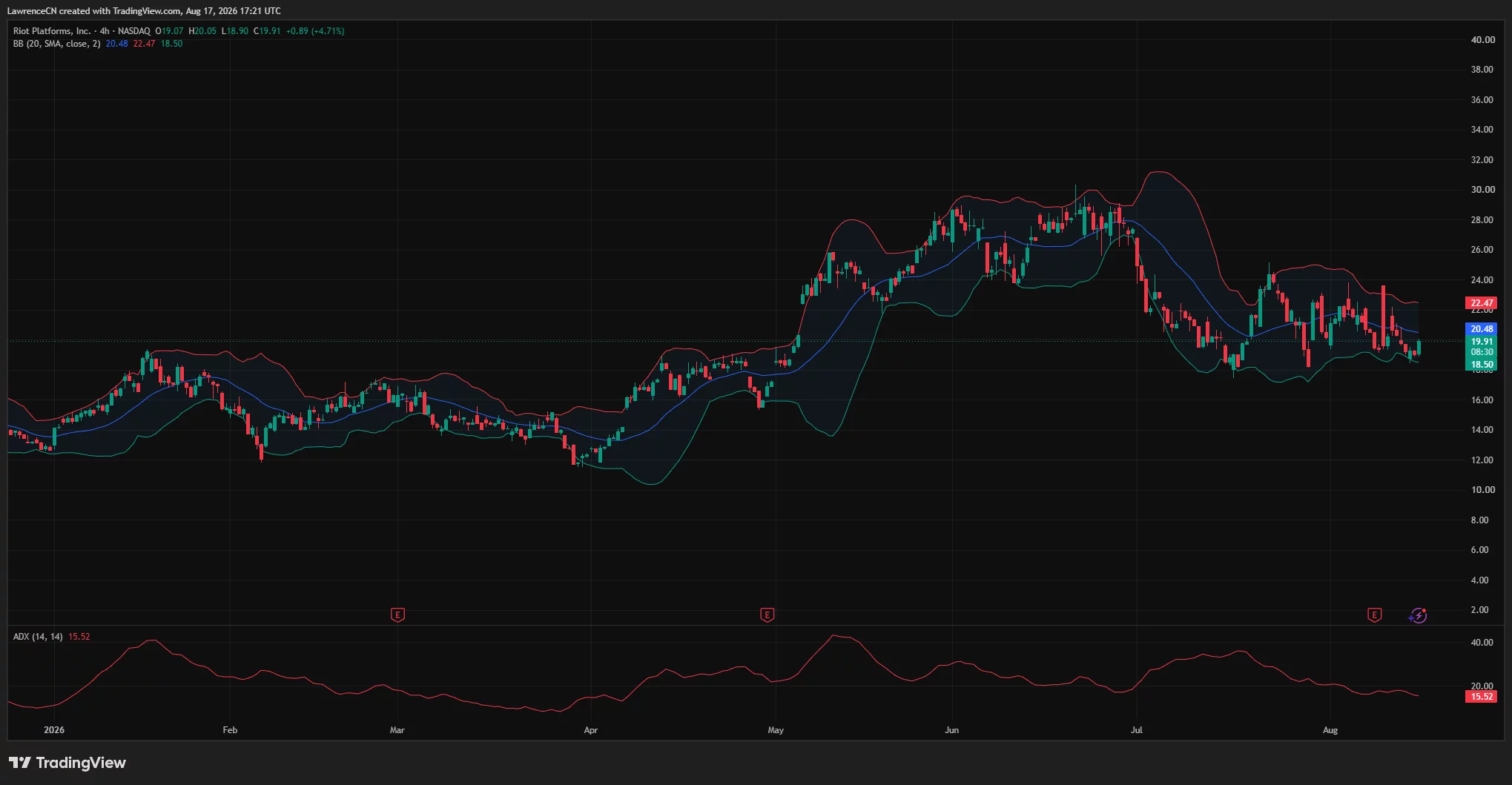
At $19.91, RIOT traded about 10.5% below JPMorgan’s revised target. The 4-hour chart showed the stock opening at $19.07, reaching $20.05 and falling as low as $18.90 before recovering.
Morgan Stanley has taken a more bullish position. On Aug. 13, the bank raised its RIOT target from $36 to $43 and retained an Overweight rating. The revised forecast sits more than 100% above the latest market price, although price targets represent analysts’ estimates rather than guaranteed outcomes.
Wall Street’s latest revisions followed a volatile week for RIOT. The stock surged after the large data center contract was announced, but some investors later booked profits, pulling the shares down to a Friday close of $19.02 before Monday’s recovery.
Riot’s $9.1 billion deal adds contracted AI revenue
Riot disclosed the 20-year agreement in an Aug. 10 filing with the U.S. Securities and Exchange Commission, identifying the customer only as a leading frontier AI company. Bloomberg later named Anthropic as the tenant, citing people familiar with the transaction, while Riot and Anthropic did not publicly confirm the customer’s identity.
As crypto.news previously covered the Anthropic deal, the agreement covers 191 megawatts of critical information technology capacity at Riot’s Rockdale campus in Texas. Riot expects to deliver the first 96 MW in December 2027 and another 95 MW by June 2028.
Under the initial term, which runs through June 2048, Riot expects the agreement to produce about $9.1 billion in contracted revenue. Two five-year extension options controlled by the tenant could increase the potential total to $16.1 billion.
Riot has projected cumulative net operating income of between $7.3 billion and $8.2 billion during the base term. Company filings classify both the revenue and income totals as forward-looking estimates because actual results depend on construction, financing, deployment, and operating performance.
To fund the first stage of construction, Riot secured a $573 million delayed-draw term loan arranged by Morgan Stanley. The company plans to use the financing while it works toward a permanent funding structure for the project.
Rockdale already has 700 MW of developed and energized power capacity, along with fiber and electrical systems built for large-scale Bitcoin mining. Riot has said it plans to convert the campus’s full gross capacity for data center customers over time.
The AMD lease gave Riot its first large tenant
Before the latest contract, AMD signed a 10-year, $311 million lease covering an initial 25 MW at Rockdale. Extension and expansion options could take its potential value to about $1 billion and increase AMD’s capacity to 200 MW.
AMD exercised its first 25 MW expansion option during the first quarter, bringing its contracted capacity to 50 MW. Adding the newer 191 MW agreement gives Riot 241 MW of critical IT capacity under signed Rockdale leases.
Riot’s first-quarter financial results showed $167.2 million in total revenue, up from $161.4 million a year earlier. Data center operations produced $33.2 million, including $32.2 million from tenant fit-out services and $900,000 from operating lease revenue.
For the second quarter, Riot reported $174.2 million in revenue, representing a 14% increase from the same period in 2025. Data center revenue accounted for $23.2 million of the quarterly total, leaving Bitcoin mining as the company’s main revenue source while the newer contracts move through construction.
Riot produced 1,473 Bitcoin during the first quarter, compared with 1,530 BTC a year earlier. According to the company, Bitcoin mining revenue declined to $111.9 million from $142.9 million as the average Bitcoin price fell and the global network hash rate increased.
The company also sold 3,778 BTC during the quarter. Its average mining cost, excluding depreciation, rose to $44,629 per Bitcoin, partly because the average global network hash rate increased by 24%.
Other listed miners have pursued similar contracts because their existing power supplies, land, and cooling systems can be adapted for AI computing. A June report on miners entering AI infrastructure found that public Bitcoin mining companies had announced more than $70 billion in AI and high-performance computing contracts.
RIOT stock must reclaim $20.48
RIOT’s 4-hour chart shows that the latest 4.7% recovery began after the stock approached the lower Bollinger Band at $18.50. Buyers lifted the price from an intraday low of $18.90 to $19.91, but the stock remained below the indicator’s midpoint at $20.48.
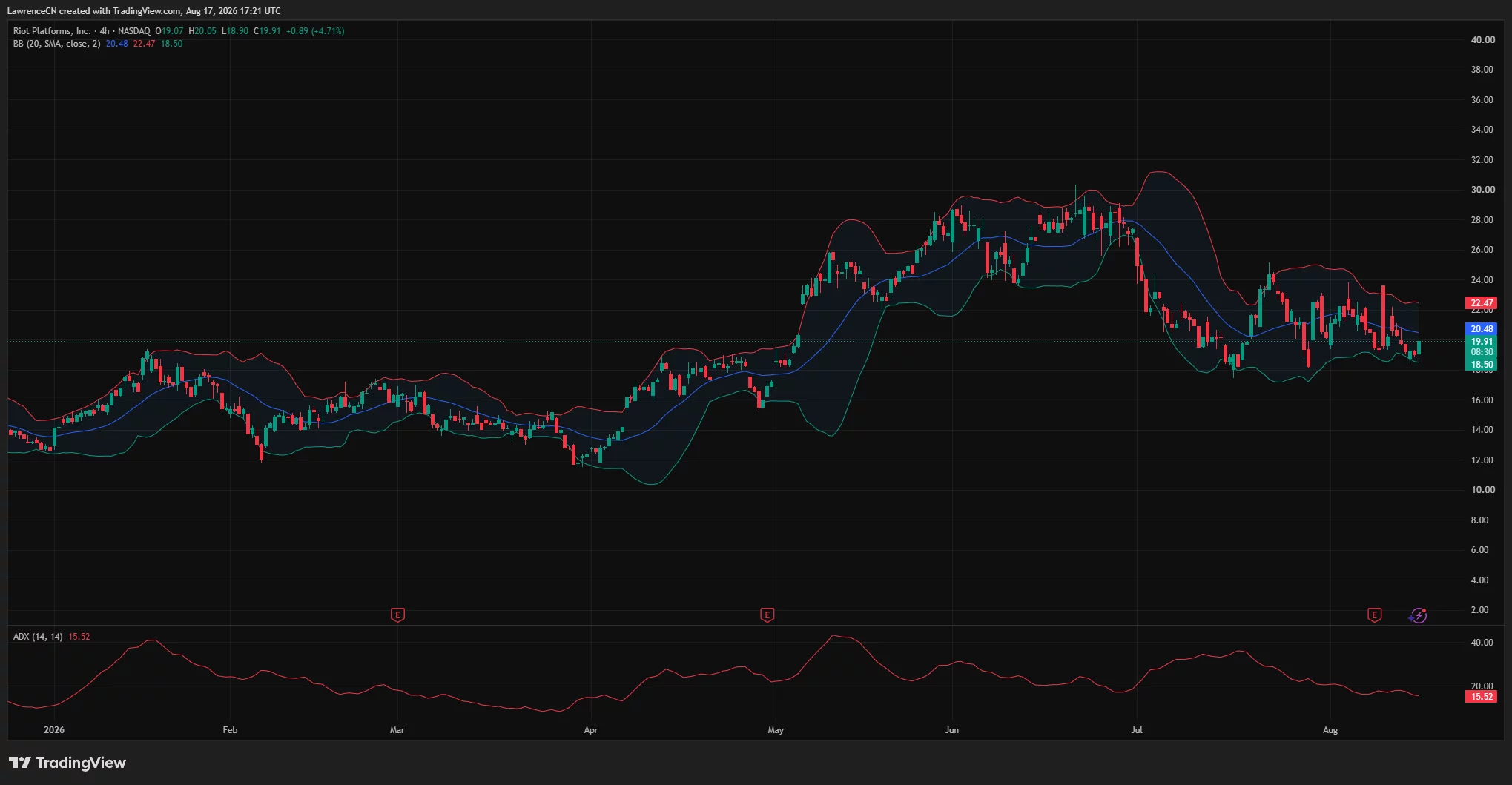
Based on the chart, $20.48 serves as the first resistance level. A sustained move above it would bring the upper Bollinger Band at $22.47 into view, placing that level close to JPMorgan’s new $22 target.
Failure to clear the midpoint would leave RIOT exposed to another test of the $18.50 lower band. The stock has also formed lower highs since its late-June peak near $30, while recent candles show repeated moves on both sides of the $20 area.
The Average Directional Index stood at 15.52 on the 4-hour chart. An ADX reading below 20 generally indicates weak trend strength, so the indicator does not yet confirm a strong move in either direction.
Bitcoin added almost 1% to trade near $63,502 during the period, while 24-hour trading volume increased 68%. The move followed reports that the United States and Iran had agreed to extend a 60-day ceasefire.


NAVI Protocol has launched NAVI Prime, a Sui-based lending framework designed for funds seeking more clarity, transparency, and control over capital management.
Summary
- NAVI Prime provides lending infrastructure for institutional and professional capital on Sui.
- NAVI Protocol says the framework focuses on transparent and controllable fund management.
- DefiLlama tracks about $124.6 million in total value locked across NAVI Protocol.
- U.S. investors can gain regulated SUI exposure through CME futures contracts.
NAVI Protocol said NAVI Prime was built for funds with more demanding requirements around clarity, transparency, and control. Deployed on the Sui blockchain, the framework provides lending infrastructure for institutions and professional capital.
According to the announcement, NAVI Prime focuses on giving professional investors a more transparent and controllable way to manage funds through onchain lending. The product extends NAVI Protocol’s existing role as a liquidity platform within the Sui ecosystem.
NAVI Prime focuses on professional capital
NAVI Prime introduces a lending framework created specifically for professional market participants. While NAVI Protocol’s existing platform serves users who supply assets or borrow against collateral, the new framework concentrates on the requirements of funds and institutional investors.
Transparency forms one of the main elements of the product, according to the NAVI Protocol. Because NAVI Prime runs on Sui, its lending activity can use the network’s onchain infrastructure while giving participating funds clearer oversight of capital management.
Control is another part of the framework’s stated design. NAVI said the product was created for funds seeking more authority over how their assets are managed in a lending environment.
NAVI Protocol already operates lending and borrowing markets on Sui. Its official documentation describes the platform as a unified service for lending, borrowing, trading, and yield strategies, while the Sui ecosystem directory lists NAVI as a native liquidity protocol built with the Move programming language.
The protocol’s existing lending service allows users to supply supported tokens and earn interest. Borrowers can deposit collateral to obtain other digital assets, with the system using overcollateralized positions to manage loan risk.
According to DefiLlama, NAVI’s lending markets support SUI, USDC, USDT, wrapped Ether, and wrapped Bitcoin. The platform also provides isolated lending pools and flash loans.
NAVI Protocol manages more than $124 million
DefiLlama tracked approximately $124.6 million in total value locked across NAVI Protocol as of Aug. 17. All of the recorded capital was deployed on Sui.
Active loans stood at about $65.8 million, meaning borrowers were using more than half of the value held across the protocol’s tracked products. DefiLlama includes NAVI Lending, Volo LST, and Volo Vault within the NAVI Protocol group.
During the preceding 30 days, NAVI generated approximately $404,300 in fees, according to DefiLlama. Protocol revenue for the same period reached about $153,700, while annualized fees were estimated at $23.2 million.
NAVI Lending collects interest and borrowing fees from users, while Volo’s products generate revenue from staking services and yield strategies. DefiLlama recorded $39.1 million in cumulative fees and $16.1 million in cumulative protocol revenue.
The protocol’s NAVX governance token had a circulating market value of about $5.7 million at the time of the data snapshot. Roughly 816.2 million NAVX tokens were circulating from a maximum supply of 1 billion.
NAVI Protocol raised $4 million through two funding rounds in early 2024, DefiLlama data showed. Investors listed for the rounds included OKX Ventures, Hashed, Mysten Labs, Mechanism Capital, Coin98 Ventures, Gate.io, and several other crypto-focused firms.
NAVI’s governance system allows NAVX holders to participate in proposals and vote on protocol changes, according to its documentation. The platform has also developed software tools through which developers can add lending, borrowing, account management, and pool functions to Sui applications.
Stablecoins support Sui lending activity
Stablecoins have become an important part of NAVI’s lending markets as Sui has added new dollar-denominated assets. The protocol currently supports tokens including USDC and USDT, according to DefiLlama.
In October 2024, crypto.news reported that NAVI would support the native USDC rollout from its first day on Sui. Circle issues USDC, while native integration allows users to move the stablecoin through Sui without relying on a bridged version from another blockchain.
NAVI Protocol said at the time that users holding the bridged USDC version could exchange it for native USDC through the platform. The integration placed Circle’s stablecoin inside NAVI’s Sui-based lending and borrowing markets.
Bitcoin-linked lending later became another area of activity. In June 2025, NAVI Protocol and OKX announced a two-month xBTC campaign that offered $700,000 in incentives to users supplying the asset through Sui.
OKX allocated $200,000 in SUI rewards through its Earn service, while NAVI supplied another $500,000 in NAVX tokens. NAVI co-founder Elliscope Fang said the partnership was intended to develop BTC-based decentralized finance within the Sui ecosystem.
Sui added another dollar asset in March 2026 when USDsui entered mainnet. Bridge, a Stripe subsidiary, issues the stablecoin through its Open Issuance platform.
Sui Foundation said USDsui was designed for payments and decentralized finance. At launch, the organization reported that the network had processed more than $111 billion in stablecoin transfers during January 2026.
Ethena-backed suiUSDe had also launched on Sui one month earlier. NAVI joined Aftermath, Bluefin, Cetus, Scallop, Suilend, and other Sui applications supporting the asset from its mainnet release.
CME futures provide a regulated U.S. route
For American investors, Sui exposure is also available through futures traded on CME Group, a U.S.-regulated derivatives exchange. The contracts provide cash-settled exposure to SUI without requiring traders to hold the token in an onchain wallet.
CME Group launched SUI futures in May 2026 alongside new contracts tied to Avalanche. The exchange offers standard- and micro-sized products for both assets.
A standard SUI futures contract represents 50,000 SUI, while a micro contract represents 5,000 SUI. CME settles both products in cash using the CME CF Sui-Dollar Reference Rate.
CME said the contracts can support price exposure, hedging, relative-value trading, and basis strategies. SUI joined Bitcoin, Ether, Solana, Cardano, Chainlink, and Stellar among the digital assets covered by CME’s regulated derivatives products.
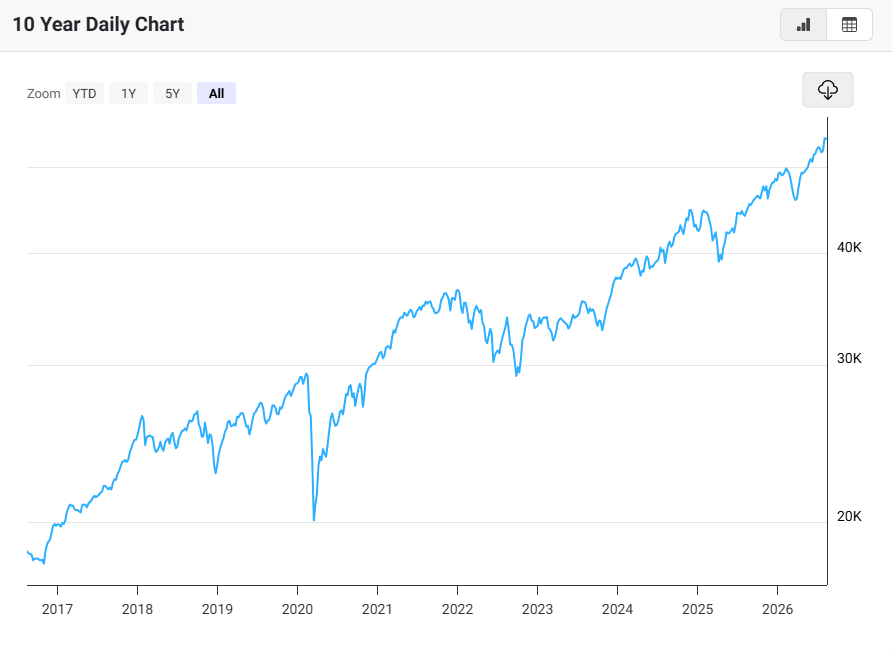
Three straight years of double-digit gains have not raised the odds of a Dow Jones Industrial Average pullback. That is the conclusion of MarketWatch contributor Mark Hulbert. The Dow’s historical baseline chance of another double-digit year still sits at 49%.
A narrative has spread on Wall Street that the streak alone makes a reversal overdue. Hulbert calls that reasoning the gambler’s fallacy, the same error behind coin-flip superstitions.
The Gambler’s Fallacy Behind the Crash Talk
Hulbert compares the market to a coin flip. A coin that lands heads several times in a row is still 50% likely to land heads again.
He points to 129 years of Dow data going back to the late 1890s. The odds of a double-digit year hover near 49%, regardless of how many strong years came before it. Historically, that baseline has barely moved even after multiple consecutive winning years.

Investors weighing whether a real downturn is brewing can compare Hulbert’s data with Cramer’s buyable crash framework. That guide separates mechanical sell-offs from systemic ones.
What the Research Shows About Crash Odds
Hulbert also cites research from Harvard University and the University of Hong Kong. The research uses trailing two-year returns to estimate crash risk. State Street Markets, working with the Harvard researchers, applies that framework to calculate current odds.
The current probability of a 40% drop over the next two years sits at 19%. That compares with a five-year average of 26%. Crash odds, in other words, are currently below normal.
Other Wall Street voices point to different warning signs. Some traders see echoes of the dot-com bust in the recent AI stock rotation. That is a separate concern from the streak-based narrative Hulbert addresses.
What About Other Risks?
Hulbert stresses that his model only reflects trailing returns. It does not account for other risks, including stretched valuations across US equities.
Wall Street sentiment remains split heading into the back half of the year. Fundstrat’s Tom Lee’s correction call shows some strategists still want a pullback before further upside. Meanwhile, raised S&P 500 forecasts from JPMorgan and CFRA signal broader confidence in the rally continuing.
For now, Hulbert’s bottom line holds. The Dow’s odds of finishing 2026 with a double-digit gain remain 49%. That is no better and no worse than in any other year.
The post Dow’s 3-Year Winning Run Isn’t a Crash Signal, Still 49% Odds of Double-Digit Gains appeared first on BeInCrypto.

Hundreds of Parklife Festival-goers handed parking fines

Crowley retires as PwC’s WA head

Binance Shared Russian Client Data in Terror Financing Case: Report


-

 Fashion3 days ago
Weekend Open Thread: Ann Taylor
-
 NewsBeat6 days ago
Communication cards help banking customers access services or report scams
-
 Business7 days ago
Oil Price Today (August 11): Crude oil rises to $88 after Trump’s compensation demand dents Hormuz opening. Here’s why
-

 Crypto World7 days ago
Revolut wins French banking licence, creates second EU banking hub
-
 Sports4 days ago
This U.S. Amateur is a glimpse into golf’s future in more ways than you think
-

 Sports3 days ago
Birmingham 2026: Day 6 Timetable for Irish Athletes
-
 NewsBeat3 days ago
Myanmar says over 300,000 Rohingya refugees verified for repatriation as exodus enters ninth year
-

 Politics3 days ago
SEQ Code: The Three Letter Boarding Pass Code That Could Give You The Worst Seat
-
 Entertainment6 days ago
Keke Palmer Subtly Hints At Sean Evans Drama With Cryptic Post
-
 Entertainment7 days ago
57 Years Later, the Best Sitcom Ever Made Still Deserves a Reboot
-

 Fashion6 days ago
Coffee Break: The Fonteyn Jane Flat
-

 Tech6 days ago
Zoom Screen-Sharing Bug Let People Fully Take Over Other Devices On A Call
-

 Fashion6 days ago
Claire Life: Kicking Off MVAAFF With the C Suite Luncheon Featuring Phylicia Rashad, Letoya Luckett, and More!
-

 Fashion6 days ago
Should you refinance your debt? Pros, cons, and real numbers
-
 Crypto World6 days ago
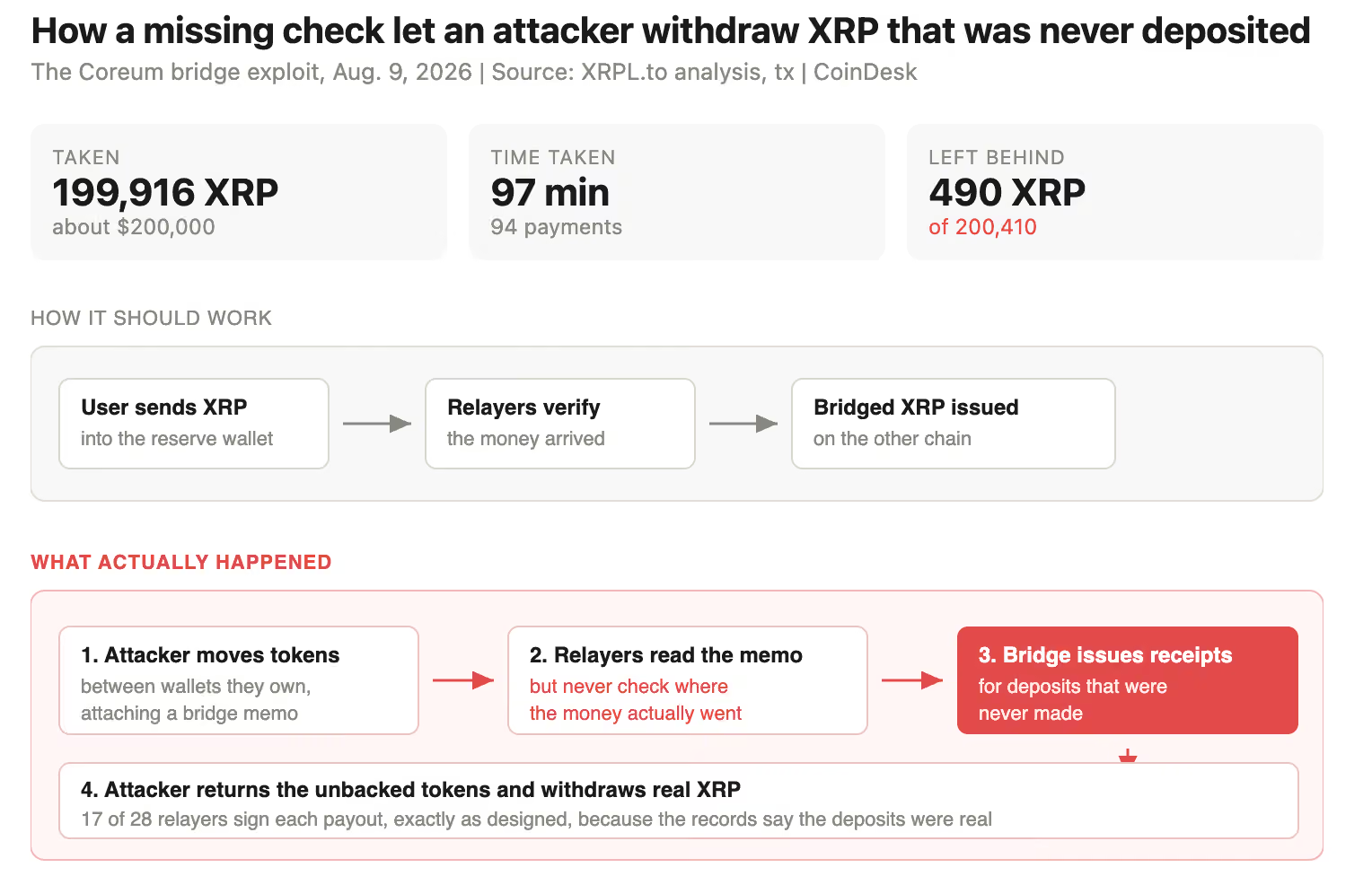
XRP bridge drained after software mistook fake deposits for real ones
-

 Sports5 days ago
DeQuan Jones in ‘high spirits’ after successful leg surgery
-
 Tech7 days ago
Zuck rekindles open weights Llama drama with Muse Glimmer
-

 Business7 days ago
(VIDEO) Emirates Unveils 2.4-Meter Arsenal Crest Sculpture Built From Recycled A380 And Boeing 777 Jet Parts
-

 Fashion7 days ago
How to Mix Diamond Rings With Gold & Silver Jewelry
-

 Fashion7 days ago
French Rose Gown with Cape Sleeves
You must be logged in to post a comment Login