

Crypto World
58% of US Voters Say Trump’s Iran War Was Not Worth the Cost, Survey Finds



58% of the registered US voters say President Donald Trump’s war in Iran was not worth the cost, according to a new Financial Times poll.
The result lands as the White House seeks Congress’s approval for $67 billion in spending linked to the US war on Iran. According to the White House, most of the funding would go to the US Department of Defense.
Voters Doubt the US-Iran Deal
The poll surveyed 1,795 registered voters between June 26 and 30. It was conducted by Focaldata with a margin of error of plus or minus 2.7 percentage points.
44% said the US now stands weaker against Iran. Only 31% said the conflict left Washington stronger. The doubts extend to younger Americans. An earlier Generation Lab survey of adults aged 18 to 34 found 77% called the strike the wrong decision.
The results also showed skepticism among voters regarding the US-Iran memorandum of understanding. 66% believe the memorandum would make little or no difference “to peace or stability in the Middle East or would increase instability and make conflict more likely.” Just one in five expect the deal to lead to peace.
Follow us on X to get the latest news as it happens
Iran War Weighs on Trump’s Approval
The war pushed petrol and other consumer prices higher this year. That economic strain continues to drag on the president’s standing four months before November’s midterm elections.
Just 36% of voters approved of Trump’s performance, a two-point drop from the previous month. Among independents, approval fell eight points to 21%.
Moreover, the poll pointed to Democratic momentum ahead of November’s midterms. On the question of congressional support, Democrats led 44% to 38%, widening their edge from four points a month earlier to six.
Republicans found some encouragement in turnout intent. Three-quarters of self-identified Republicans rated their likelihood of voting at 8 or higher on a 10-point scale, compared with 69% of Democrats and 56% of independents.
With control of both chambers at stake in November, the poll signals rising political risk for Trump. The coming months may test whether the fragile truce with Iran holds.
Subscribe to our YouTube channel to watch leaders and journalists provide expert insights
The post 58% of US Voters Say Trump’s Iran War Was Not Worth the Cost, Survey Finds appeared first on BeInCrypto.



DeFi platform Summer Finance, which offers “institutional DeFi Vault infrastructure for everyone” has been hacked for approximately $6 million.
The sum was drained from its Lazy Summer USDC vault, managed by risk advisor Block Analitica. Summer Finance confirmed the exploit and has paused vaults while investigating the cause of the loss.
Read more: DeFi drama: ENS governance battle, EF cuts and Gnosis reboot
According to blockchain security auditor BlockSec, the loss was caused by a price manipulation attack. The hacker first “accumulated a large amount of deprecated vgUSDC, likely at negligible cost” before using the tokens to carry out a “share-price distortion” and withdrawing USDC from the vault.
The hack represents just over a quarter of Lazy Summer’s pre-exploit TVL, according to DeFiLlama data. The team has sent an on-chain message to the exploiter, requesting they get in touch.
A $2M slippage slip-up, and a $70B bullet dodged
Elsewhere, an unlucky user appears to have lost approximately $2 million when their trade was routed through an illiquid Uniswap v3 pool.
According to Decurity, which flagged the transaction, the majority of the back-running MEV bot ($1.8 million) was paid as a tip to TitanBuilder.
In better news, blockchain security firm Hexens disclosed a bug on Aptos on Sunday, which it estimates “put up to $70 billion at systemic risk.”
Read more: MEV bot JaredFromSubway.eth loses $7.5M to approvals honeypot
Highlighting the find, Polygon CTO Mudit Gupta called it “the worst kind of bug possible.” He explains that the “arbitrary state write bug” puts “most assets across all chain[s]” at risk.
Got a tip? Send us an email securely via Protos Leaks. For more informed news and investigations, follow us on X, Bluesky, and Google News, or subscribe to our YouTube channel.

Bitmine Immersion Technologies says it has boosted its Ethereum treasury, adding $74 million worth of ETH to bring its holdings to 5,742,237 tokens as of Sunday. The update marks a sizable increase from the company’s previous reported balance and comes as US lawmakers move toward a vote on the proposed CLARITY Act, legislation that could reshape how digital assets are regulated.
In the same period, Strategy—one of the most prominent Bitcoin treasury companies—reported selling $216 million worth of BTC to fund dividend payments, cutting its total holdings. Together, the two moves highlight a developing split in how major crypto treasuries are allocating capital across ETH and BTC.
Key takeaways
- Bitmine reported ETH holdings of 5,742,237 as of Sunday, up by 42,197 ETH from its previously disclosed figure.
- The company estimates the latest purchases were worth about $74 million based on ETH’s prior valuation at the time of reporting; ETH has since moved higher.
- Bitmine’s chair Tom Lee linked the company’s ETH focus to rising market expectations for passage of the US CLARITY Act.
- Strategy reported selling $216 million in Bitcoin to fund dividends, reducing its Bitcoin holdings to 843,775 BTC.
- CLARITY’s path in the Senate requires 60 votes, with uncertainty over whether sufficient Democrats will support the bill.
Bitmine increases ETH treasury by 42,197 tokens
Bitmine Immersion Technologies said it increased its Ethereum holdings to 5,742,237 ETH, a gain of 42,197 tokens compared with the level reported in its previous disclosure. Bitmine attributed the change to further accumulation as part of its treasury strategy and referenced the valuation used at the time of the company’s most recent buy activity.
According to Bitmine’s statement, the company’s latest ETH purchases were made when ETH was valued at roughly $1,759, putting the incremental buys at approximately $74 million. At the time of publication, ETH traded around $1,792 per token, meaning the market value of Bitmine’s expanded stack would be higher than the purchase-day estimate.
With the new total, Bitmine holds about 4.8% of Ethereum’s total supply—equivalent to roughly 121 million ETH in aggregate value terms, based on the company’s share-of-supply framing.
Why Bitmine points to US “Clarity” expectations
Bitmine chair Tom Lee said the potential passage of the Digital Asset Market Clarity (CLARITY) Act in the US represents an “important milestone” for the crypto sector—particularly for smart contract platforms like Ethereum.
“[T]he rise in the ETH/BTC ratio in the past few days make sense as markets start to see greater chances of Clarity Act passage.”
The reasoning is straightforward: if US regulatory uncertainty is reduced, investors and institutions may treat major smart-contract networks differently than BTC—potentially boosting relative demand for assets tied to broader application ecosystems.
Bitmine’s framing also mirrors the broader market narrative that ETH could benefit from regulatory clarity aimed at digital assets. While the company’s comments are not a guarantee of outcomes, they provide insight into how at least one large treasury holder is connecting policy expectations to portfolio concentration decisions.
Strategy sells BTC to fund dividends, narrowing its treasury
While Bitmine added ETH, Strategy took the opposite step on Bitcoin. Earlier coverage from Cointelegraph reported that Strategy sold $216 million worth of BTC to fund dividend payments, reducing its total Bitcoin holdings to 843,775 BTC.
That sell-off matters for how markets interpret treasury behavior: it suggests that for some holders, shareholder returns and capital management can outweigh accumulation during periods when the macro or regulatory outlook is in flux. In contrast, Bitmine’s decision to buy ETH implies that its treasury strategy is currently aligned with the belief that ETH may capture upside if the regulatory backdrop improves.
For readers tracking institutional flows, the comparison raises a practical question: when large treasuries rebalance, does ETH strength reflect genuine incremental demand, or does it mainly represent relative repositioning versus BTC?
CLARITY Act approval remains uncertain in the Senate
The CLARITY Act is currently under consideration in the US Senate and is expected to be among the most consequential pieces of crypto legislation. The bill would expand the Commodity Futures Trading Commission’s authority to regulate and oversee digital assets.
Republican lawmakers are pushing for a Senate vote after the chamber returns from state work periods next week, but the bill’s prospects depend on whether enough Democrats support it. As reported in earlier Cointelegraph coverage, uncertainty remains—particularly around the “ethics” provisions—despite Republicans holding a slim majority in the Senate.
To pass, the CLARITY Act needs 60 votes, a threshold that underscores how difficult it may be to assemble the bipartisan coalition required for passage.
For market participants, the key variable is timing: even small changes in the odds of passage can influence positioning across crypto markets—especially for assets like ETH that are often discussed in relation to smart contract and platform regulation.
Traders and long-term investors should watch the Senate scheduling process, alongside any concrete changes to the bill text that could affect support. Until senators commit to a vote count and final language, expectations for “clarity” will likely remain a moving target—and ETH/BTC relative strength may continue to react accordingly.


BONK DAO has confirmed that attackers drained an estimated $20 million worth of BONK tokens from its treasury through a malicious governance proposal.
The stolen funds have reportedly started moving to exchanges, prompting the project to coordinate with exchanges, the Solana Foundation, and law enforcement in an effort to recover the assets.
BONK DAO Confirms $20M Governance Attack
BONK DAO has become the latest victim of a high-profile decentralized governance attack after confirming that approximately $20 million in BONK tokens was drained from its treasury.
According to the project’s official statement, the attacker successfully passed a malicious governance proposal, allowing treasury funds to be transferred to wallets under their control. BONK said it has already identified the exchange wallets used to accumulate voting power before the proposal was executed.
The team is now working alongside exchanges, the Solana Foundation, bridges, and law enforcement to track the stolen assets and explore recovery options.
How the Attack Worked
Preliminary on-chain analysis shared by blockchain investigators suggests the attacker purchased roughly $4 million worth of BONK to secure enough voting power for the proposal.
Once approved through BONK DAO’s governance system on Solana’s Realms platform, the proposal authorized the transfer of an estimated $20 million from the DAO treasury.
Unlike a smart contract exploit, the incident appears to be a governance attack, where token-weighted voting was used to legitimately approve a malicious treasury transaction.
Reports also indicate that portions of the stolen BONK have already begun moving to cryptocurrency exchanges, raising concerns that the attacker may attempt to liquidate the holdings.
What’s Next for BONK?
The investigation remains ongoing, with BONK stating that recovery efforts are underway.
The incident is expected to renew industry debate over DAO governance security, particularly around safeguards such as timelocks, multisignature approvals, and treasury execution delays designed to prevent single governance proposals from draining protocol funds.
Investors will now be watching for updates on potential fund recovery, exchange actions, and whether BONK introduces governance reforms to strengthen treasury protection.
The post BONK DAO Loses $20 Million as Stolen Tokens Hit Exchanges appeared first on BeInCrypto.


Professional investors don’t just look at a coin’s price relative to its long-term average to assess whether it’s cheap. They use metrics such as the Sharpe Ratio to determine position sizing.
Imagine two coins: A and B. Coin A has fallen 30% from its recent high, but in a fairly steady way. Coin B has also fallen 30%, but its price is all over the place, jumping up and down by big percentages every day. Looking only at the drop from the high, both coins look equally “cheap.”
A professional investor would look beyond the price drop and consider the risk-adjusted return.
In this case, A’s smoother price path might give it a Sharpe Ratio of, say, 1.5, while Coin B’s wild swings leave it with a Sharpe Ratio of just 0.5. So even though both have the same 30% drop, Coin A clearly outperforms per unit of risk, making it the more attractive choice for sizing a position.
Historical context
While a -20 Sharpe Ratio reflects a year of poor volatility-adjusted performance, it also lights up a rare bottoming signal for the token’s price.
Historically, every time the yearly risk-adjusted return has reached this level of “unattractiveness,” it has marked the point of maximum seller exhaustion.
Crypto World
Bitmine Announces $74M Ether Buys as Chair Says ‘Greater Chances of Clarity Act Passage’
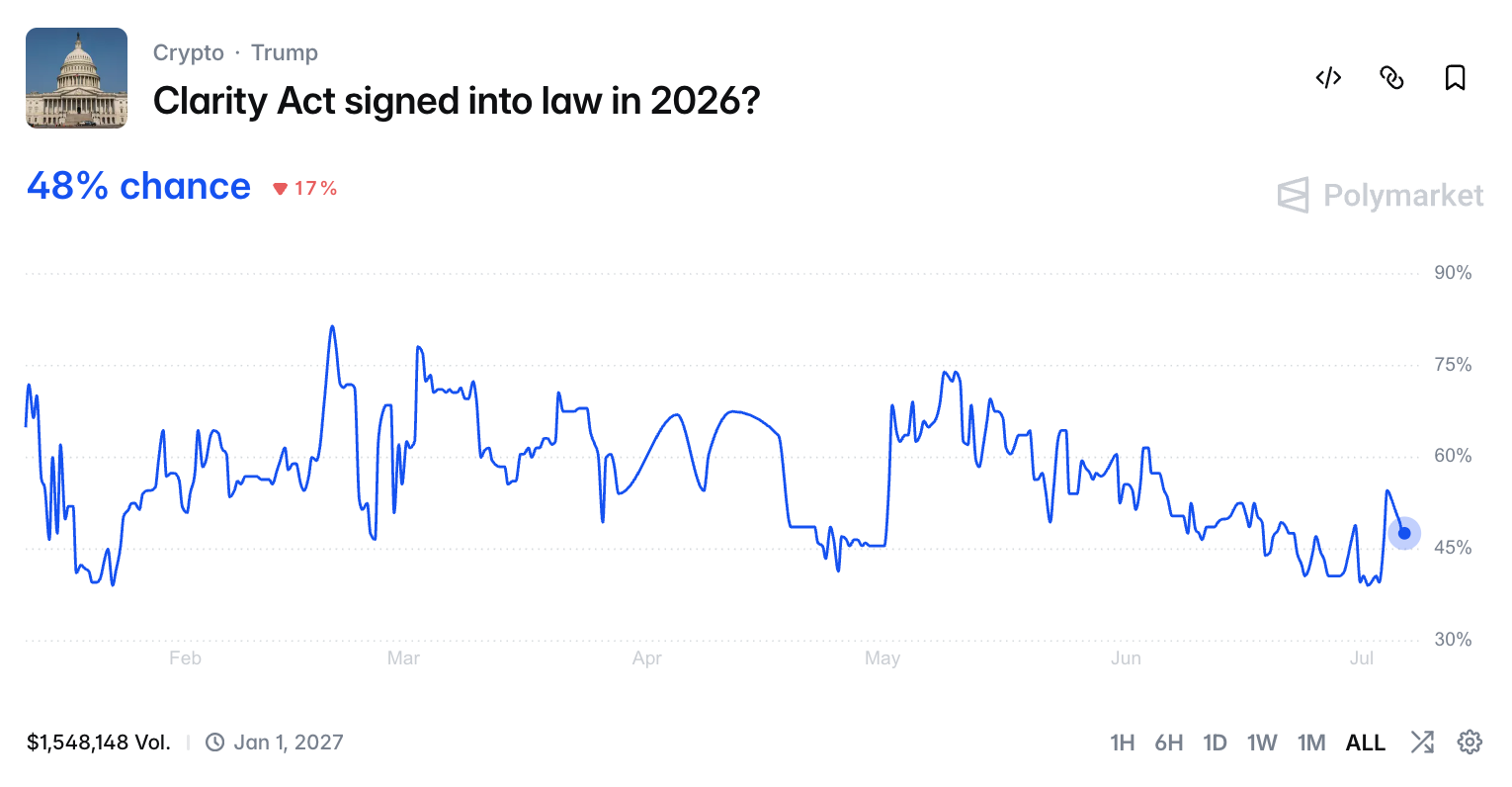
Bitmine Immersion Technologies, holding one of the largest Ether (ETH) stockpiles as part of its treasury strategy, said Monday it added of $74 million worth of the second-biggest crypto by market cap, in contrast with Strategy, a major Bitcoin (BTC) holder, which offloaded coins to fund its dividend payments.
Bitmine said that it held 5,742,237 ETH as of Sunday, marking an increase of 42,197 Ether since it reported on its holdings last week. The ETH holdings were reported when the token was valued at about $1,759, making its most recent buys worth about $74 million. The price of ETH has since increased to $1,792 apiece at the time of publication.
Bitmine chair Tom Lee said optimism about the passage of the Digital Asset Market Clarity (CLARITY) Act in the US was an “important milestone” that could allow “smart contract platforms like ethereum to benefit” among the company’s reasons for maintaining its treasury strategy, adding:
“[T]he rise in the ETH/BTC ratio in the past few days make sense as markets start to see greater chances of Clarity Act passage.”
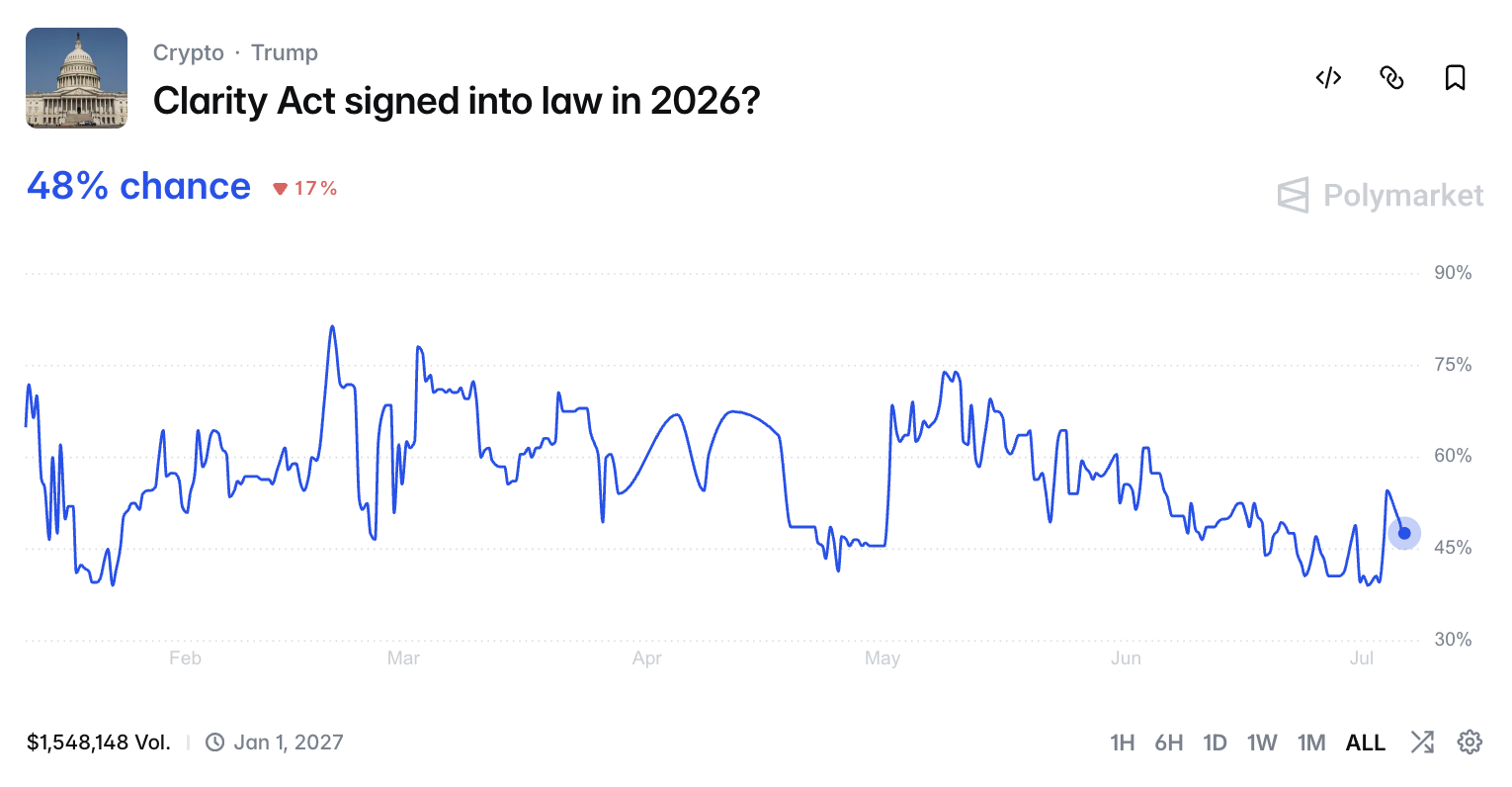
Prediction market traders see about a 48% chance for passage of the Clarity Act by year end. Source: Polymarket
The latest buy means Bitmine holds about 4.8% of the token’s total supply, or roughly 121 million ETH. Strategy on Monday reported selling $216 million worth of BTC to fund its dividend payments, reducing its total holdings to 843,775 Bitcoin.
Related: Bitcoin nears $63.5K into weekly close as trader warns of ‘terrible’ Monday
Market structure bill awaiting Senate approval
The CLARITY Act, under consideration in the US Senate, is expected to be one of the most significant pieces of legislation affecting the crypto industry, giving the Commodity Futures Trading Commission more authority in regulating and overseeing digital assets.
Republican lawmakers are pushing for a vote on the bill once the chamber returns from their state work periods next week, but it’s unclear whether enough Democrats will sign onto the legislation without clear provisions on ethics. The CLARITY ACT will need 60 votes to pass in the Senate, where Republicans hold a slim majority.
Magazine: Does ‘Paper Bitcoin’ mean there’s an unlimited supply of BTC?
Crypto World
Crypto starts week on firmer ground, altcoin gains mask a divided market: Crypto Markets Today
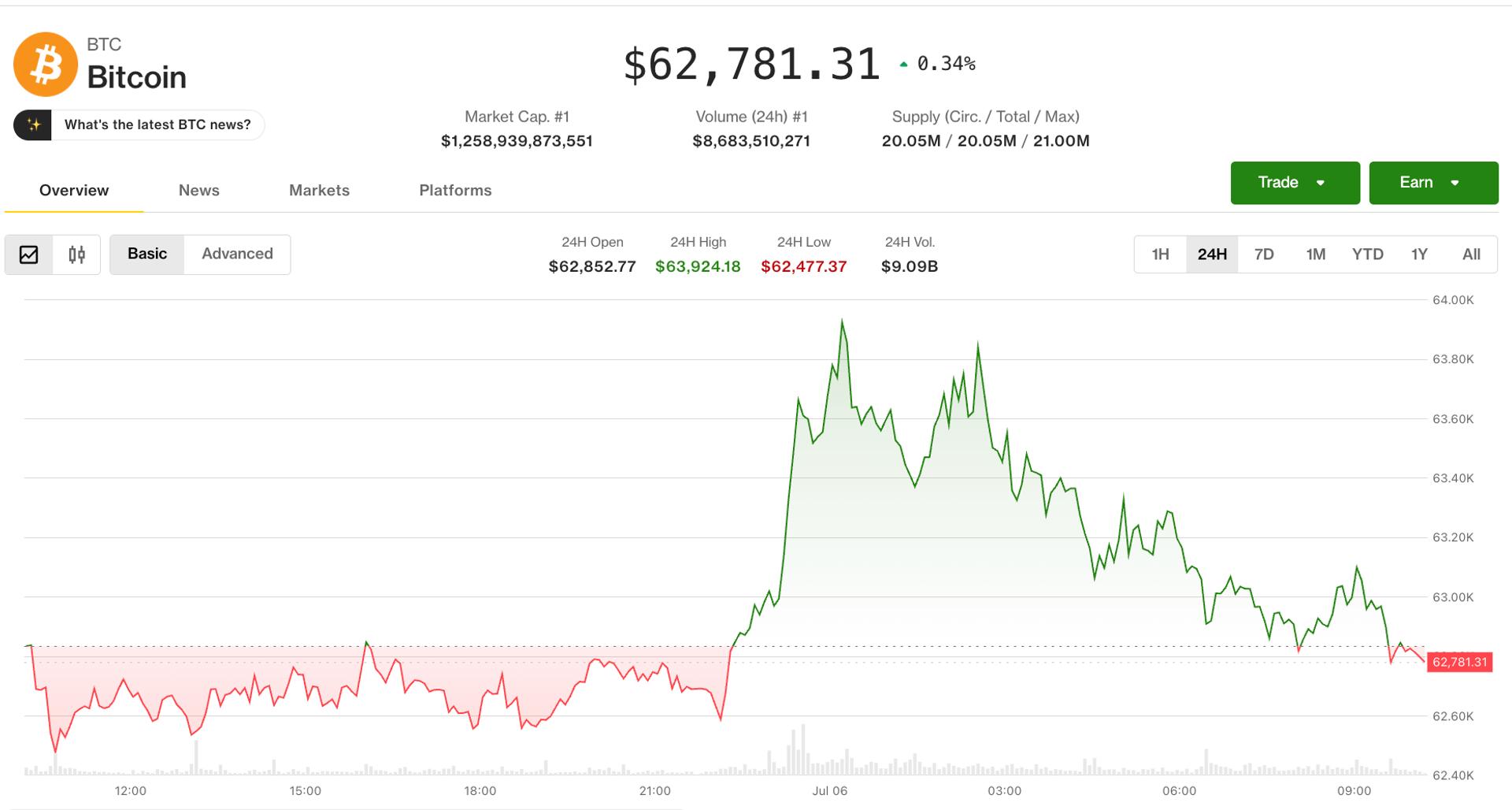
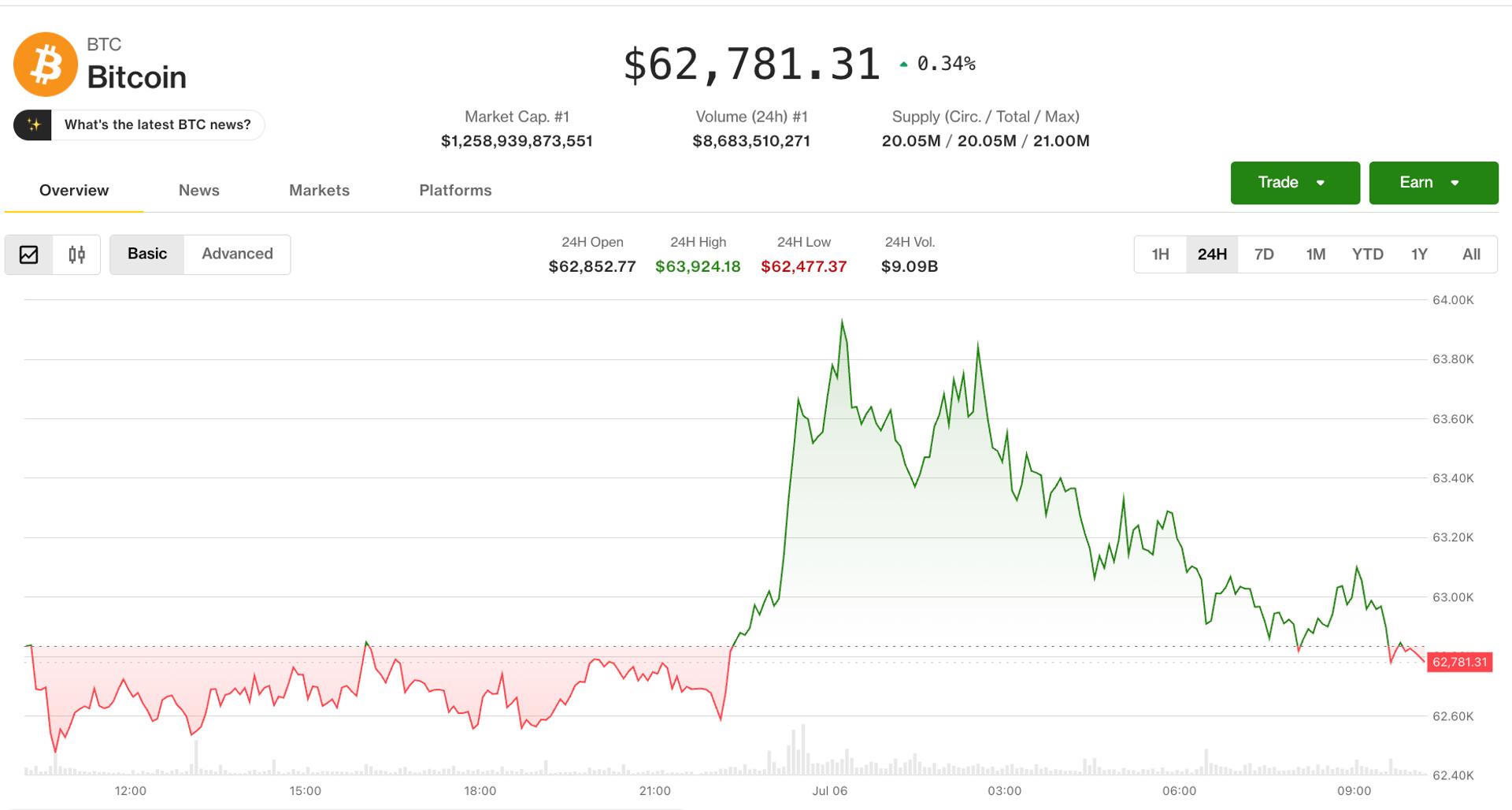
Bitcoin is trading at $62,800 on Monday, a notable turnaround from July 1 when it dipped below $58,000 to its lowest level since September 2024 and raised concerns of a slide toward $50,000.
Ether (ETH) staged a similar recovery, trading at $1,760 after bottoming out around $1,550 last week. The two largest cryptocurrencies spiked higher at Sunday’s futures open, but have given back around 1% of those gains since midnight UTC.
The pullback represents a divergence from traditional markets, where Nasdaq 100 and S&P 500 index futures are trading up 1% and 0.5%, respectively, following the long weekend.
The altcoin market is split. Lighter (LIT) continues to impress, now up more than 50% over the past week, while and are both nursing losses of around 4% in the past 24 hours.
Derivatives positioning
- The futures market is steady, with open interest in bitcoin , ether (ETH), solana (SOL) and XRP (XRP) largely unchanged over the past 24 hours, likely due to the extended U.S. weekend.
- Open interest in has jumped to 7.14 million tokens, the most since May 12. It is unclear whether the capital inflow is bullish or bearish. Key indicators are sending mixed signals: Positive funding rates point to bullish sentiment, yet the 24-hour cumulative volume delta (CVD) has turned negative, indicating sellers have been more aggressive by hitting market orders rather than posting passive limit orders.
- Open interest in Lighter DEX’s LIT token is also rising, reaching one-month highs as the bullish tokenomics overhaul supports its price.
- Bitcoin’s and ether’s 30-day implied volatility indices, BVIV and EVIV, remain under pressure after double-digit weekly declines, reflecting continued supply of options. This points to expectations of calmer market conditions, which often accompany price upswings.
- Still, on Deribit, BTC and ETH puts continue to trade at a premium to calls, signaling persistent downside concerns — although the gap has narrowed since early last month.
- Volumes show no clear bias, as BTC’s $60K put and $70K call rank among the most traded strikes over the past 24 hours.
Token talk
- Lighter’s (LIT) barnstorming rally of late continued on Monday, adding 5% since midnight UTC and taking its 24-hour gain to 13.5%, building on momentum as traders look for the next hyperliquid (HYPE).
- LIT is the native token of its namesake decentralized derivatives exchange, which has racked up $40 billion in trading volume over the past 30 days, according to DefiLlama.
- It was also a strong start to the week for PYTH, up by 6% since midnight UTC as traders rotate bitcoin gains into more speculative altcoin bets.
- CoinMarketCap’s Altcoin Season indicator ticked up to 52/100 on Monday, the highest level in the past three months, suggesting optimism is returning to the altcoin sector.
- However, that indicator is lagging as a result of poor performance from a portion of the market including JITO, BEAT and STABLE, each having lost between 5% and 13% over the past week with further losses on Monday.

Solana (SOL) has posted a strong recovery after rising more than 13% over the past week. The latest uptrend has pushed its monthly gains to over 30%. At the time of writing, the crypto asset was trading at around $80 despite a market-wide retracement following Strategy’s BTC sale.
Alongside the price moves, on-chain activity has also picked up.
On-Chain Activity and Treasury Stocks
The Solana network added 1.60 million new addresses over the past two weeks, according to crypto analyst Ali Martinez, indicating accelerating network growth.
In a separate analysis, Martinez also flagged that the SuperTrend indicator on SOL’s three-day chart has generated a new buy signal. This is the first such signal since October 10, 2025, when the Average True Range (ATR) trailing stop flipped below the price.
He pointed out that the previous SuperTrend sell signal had been followed by a 74% price correction. According to the analyst, the latest signal confirms a shift in trend from bearish to bullish and could pave the way for SOL to climb toward $100.
Meanwhile, MN Fund founder Michaël van de Poppe also maintained his bullish outlook. He said that the crypto asset is breaking back into its trading range and could see a brief pullback before continuing higher. He added that the $75-$77 range needs to hold as support, and if it does, SOL could not only continue its advance toward $100 but also potentially reach $120 in the coming weeks or months.
Several Solana-focused digital asset treasury (DAT) companies have also posted gains alongside the asset. Shares of Sol Strategies (STKE), for instance, have climbed 13.64% over the past month, while Solana Company (HSDT) gained around 12%. Additionally, Forward Industries (FWDI) also rose by over 7% during the same period.
Network Adoption
In terms of broader usage trend, Grayscale Research found that the Solana network has processed an average of over 100 million transactions per day so far this year, which is equivalent to more than 1,200 transactions per second. During the same period, it recorded an average of 4.3 million unique daily users and generated roughly $100 million in transaction fees. This activity was attributed to applications across DeFi, social trading, and decentralized infrastructure.
Meanwhile, Solana-based decentralized exchanges have handled over $360 billion in trading volume year-to-date, far exceeding the volume recorded by other blockchain ecosystems.
The post Why Solana’s Latest Rally Has Analysts Watching the $100 and $120 Levels appeared first on CryptoPotato.

MicroStrategy’s long-time Bitcoin proxy, Strategy (formerly MicroStrategy Incorporated), has again sold a portion of its holdings to fund corporate needs. In a Form 8-K filed with the U.S. Securities and Exchange Commission on Monday, the company said it sold 3,588 Bitcoin for a total of $216 million, trimming its position to 843,775 BTC.
The disclosed sales were completed across multiple days and were priced at two different average levels: Strategy sold 1,363 BTC at an average of $59,256 between last Monday and Tuesday, and 2,225 BTC at an average of $60,773 between Wednesday and Sunday, according to the filing.
Key takeaways
- Strategy sold 3,588 BTC for $216 million, reducing its total holdings to 843,775 BTC, per its Monday SEC 8-K.
- The sales come after Strategy previously reported its first Bitcoin sale in years in early June, following a 2022 tax-related transaction.
- Strategy’s June capital framework ties Bitcoin sales to dividend funding, and it raised its STRC preferred stock dividend rate to 12%.
- Analyst Bernstein said Strategy was unlikely to face forced Bitcoin selling, citing cash coverage for dividend and interest obligations.
Another tranche of Bitcoin sold to support dividends
Strategy’s Monday filing provides the clearest breakdown yet of how its Bitcoin-to-cash conversion is being executed in practice. The company emphasized the total proceeds ($216 million) and the reduced Bitcoin balance that results from the transactions.
While the sale is large in absolute terms, investors have been watching Strategy closely for signals about whether it is merely funding planned payments or shifting toward more sustained liquidation. This latest disclosure follows an earlier, notable break from the company’s long-standing pattern: Strategy had disclosed the sale of 32 BTC in early June, described as its first reported Bitcoin sale since the 2022 tax-loss-related transaction.
That early June disclosure matters because it set expectations that Strategy’s “Bitcoin as reserve” thesis was evolving into a more explicitly managed cash-and-liquidity approach—one that includes periodically monetizing part of its holdings to meet obligations.
June framework links Bitcoin liquidity to capital returns
In its June 29 8-K, Strategy unveiled a capital framework designed to preserve Bitcoin exposure while allowing certain sales to fund dividends. As reported earlier by Cointelegraph, that framework laid out how Bitcoin could be sold to support shareholder returns without abandoning the larger accumulation strategy.
Within that framework, Strategy increased the annual dividend rate on its STRC perpetual preferred stock to 12%. It also disclosed that its U.S. dollar reserve had grown to $2.55 billion in the June filing. Monday’s 8-K, however, indicated that the dollar reserve remained unchanged from the prior disclosure.
In other words, the company used Bitcoin sales even as it reported a stable level of cash reserves—suggesting that the sales are part of the structured dividend-funding mechanism rather than a sign of immediate liquidity stress.
STRC trades below par, raising questions for funding dynamics
Strategy’s dividend funding is closely connected to how STRC performs in the market. During Monday’s pre-market session, STRC traded at $88.70, according to Yahoo Finance data—about 11.3% below its intended $100 par value.
This discount matters because it can affect Strategy’s financing flexibility. If STRC trades below par, the company’s ability to raise additional cash through STRC sales may be less efficient, potentially increasing pressure to keep dividend economics attractive to investors or, alternatively, to rely more on Bitcoin sales to cover obligations.
That dynamic is not speculative in the filing narrative: STRC is described as a key mechanism through which Strategy funds its Bitcoin accumulation and associated capital needs. When preferred shares price-discover below par, the trade-off between issuing equity-like instruments and selling Bitcoin becomes a central variable for investors monitoring Strategy’s capital strategy.
Bernstein: no “forced selling” scenario based on cash coverage
Ahead of the latest sale being disclosed, Bernstein argued that Strategy was unlikely to be compelled into selling Bitcoin. The firm pointed to liquidity and cash reserve coverage supporting dividend and interest obligations.
In the Bernstein report referenced in the article, the analyst estimated Strategy had 17 months of cash available to cover dividend obligations and interest payments. Bernstein also described Strategy as a net buyer of Bitcoin and characterized it as a “balancing force” in a market where other participants—particularly leading U.S. Bitcoin miners—have shifted toward selling rather than accumulating, partly due to their pivot to AI-related strategies.
Bernstein further cited broader market flows, including $5.5 billion of outflows from Bitcoin exchange-traded funds (ETFs) so far in 2026, and suggested Strategy’s buying helped counteract that pressure. The firm also said Strategy’s debt liabilities were about 13% of its Bitcoin collateral value, implying that debt servicing constraints were not dominating the company’s near-term behavior.
According to Bernstein, Strategy’s next principal payment of roughly $1 billion is due in the third quarter of 2028. The timeline is important for investors because it shapes how much of today’s liquidity decisions are about “imminent refinancing needs” versus routine dividend management.
Bernstein maintained a $150,000 year-end Bitcoin price target and reiterated that its long-term outlook on Bitcoin remained optimistic.
What to watch after Strategy’s latest disclosure
Investors will likely focus on whether these Bitcoin sales remain tied to the dividend framework and preferred-stock mechanics, or whether future filings show a larger and more frequent monetization of holdings. The next clue will come from how STRC continues trading relative to par and how Strategy reports its cash reserves and obligations over the coming quarters.


“That’s when the deflationary impulse from falling oil prices should remind everyone that the Fed isn’t going to hike and that – if anything – the next move will be a cut,” Robin Brooks, a senior fellow at the Brookings Institution and former chief economist at the Institute of International Finance, said in a report.
If the currency’s strength is under question, then the barrier to bitcoin rising further also looks weaker. The two are known to be inversely correlated.
Some observers, however, are calling for caution, saying the market is overestimating the impact of oil prices on inflation. Elevated price pressures, they say, are now a structural issue.
“The Fed can’t declare victory simply because gasoline prices move lower. Sticky service-sector inflation is exactly why policymakers are likely to keep rates higher for longer, even if headline CPI continues moderating,” YCC Macro said on X.
Markets betting on aggressive easing may be underestimating how persistent underlying inflation really is,” YCC Macro added. Stay alert!
Read more: For analysis of today’s activity in altcoins and derivatives, see Crypto Markets Today . For a comprehensive list of events this week, see CoinDesk’s “Crypto Week Ahead.”
What’s trending


BitMine Immersion Technologies (NYSE: BMNR), the Ethereum treasury company chaired by Fundstrat's Tom Lee, bought 42,197 ETH worth roughly $73 million over the past week, according to the company's own holdings update posted Monday. The purchase lifts BitMine's total to 5,742,237 ETH, about 4.8% of… Read the full story at The Defiant

Zendaya nails method dressing yet again as she channels her The Odyssey character Athena in two glamorous looks for world premiere alongside husband Tom Holland

payrolls stall at 57,000 as World Cup lift fails to appear

DeFi platform Summer Finance loses $6M in vault exploit


-

 Fashion3 days ago
Weekend Open Thread: High Hopes
-

 Politics3 days ago
The House | “Reframing the debate from a binary discussion of winners and losers”: Yuan Yang reviews ‘We Are Not Machines’
-

 Crypto World7 days ago
Strategy authorizes up to $1.25B in Bitcoin sales under new capital plan
-

 News Videos6 days ago
How to Build INSANE Live Financial Dashboards With Claude
-

 Tech7 days ago
Anonymous researcher drops 0-day ‘exploitarium’ repo
-

 Business7 days ago
Australia treasurer says alleged access of prime minister’s bank data ’incredibly concerning’
-
 NewsBeat2 days ago
Taylor Swift and Travis Kelce wedding staffer hilariously struggles to keep her cool while checking in megastars
-
 Crypto World5 days ago
Airdrop Registration Becomes Key Focus For Remittix As RTX Launch Updates Approach
-

 Sports5 days ago
Broncos roster: OL Ben Powers (No. 74) entering final year of contract
-

 Crypto World5 days ago
Binance stock trading tops $1B in first month after launch
-

 NewsBeat6 days ago
Presenter Caroline Flack’s brother Paul Flack dies aged 55
-

 Crypto World5 days ago
Alibaba-affiliate Ant Group enters the humanoid robot market with 12 deals
-

 Crypto World3 days ago
Standard Chartered Secures MiCA License as ESMA Adds 37 New Crypto Firms
-

 Crypto World1 day ago
South Africa proposes crypto tax guidance under existing rules
-
 NewsBeat4 days ago
New exhibition reflects five decades of movement between island of Ireland and GB
-

 Tech1 day ago
Lenovo laptops are now shipping with YMTC SSDs, a sign of Chinese NAND entering the mainstream
-

 Business5 days ago
Meta Platforms Stock Jumps 7% Today as Bloomberg Reports Company Plans to Enter the Cloud Business
-

 Business4 days ago
What a 10 Percent Drop Means for Buyers, Sellers and Renters
-

 News Videos6 hours ago
Avoid entering in FOMO #bitcoin #cryptocurrency #trading #scalping
-

 Crypto World4 days ago
Binance Re-Enters Philippines As EU MiCA Rules Restrict Access
You must be logged in to post a comment Login