

Crypto World
85% Rally Possible Despite Criticism

The ASTER price has fallen nearly 70% from its post-launch highs, reflecting fading hype and rising criticism. User activity and trading volume seem to have collapsed even faster, raising doubts about its recovery.
Yet beneath this weakness, technical patterns and whale accumulation show a different picture. These signals suggest Aster may still attempt a major breakout despite the sharp decline in participation.
Aster User Activity and Trading Volume Collapse After Post-Launch Frenzy
ASTER (formerly Astherus) has seen a dramatic collapse in user participation since its September 2025 token launch.
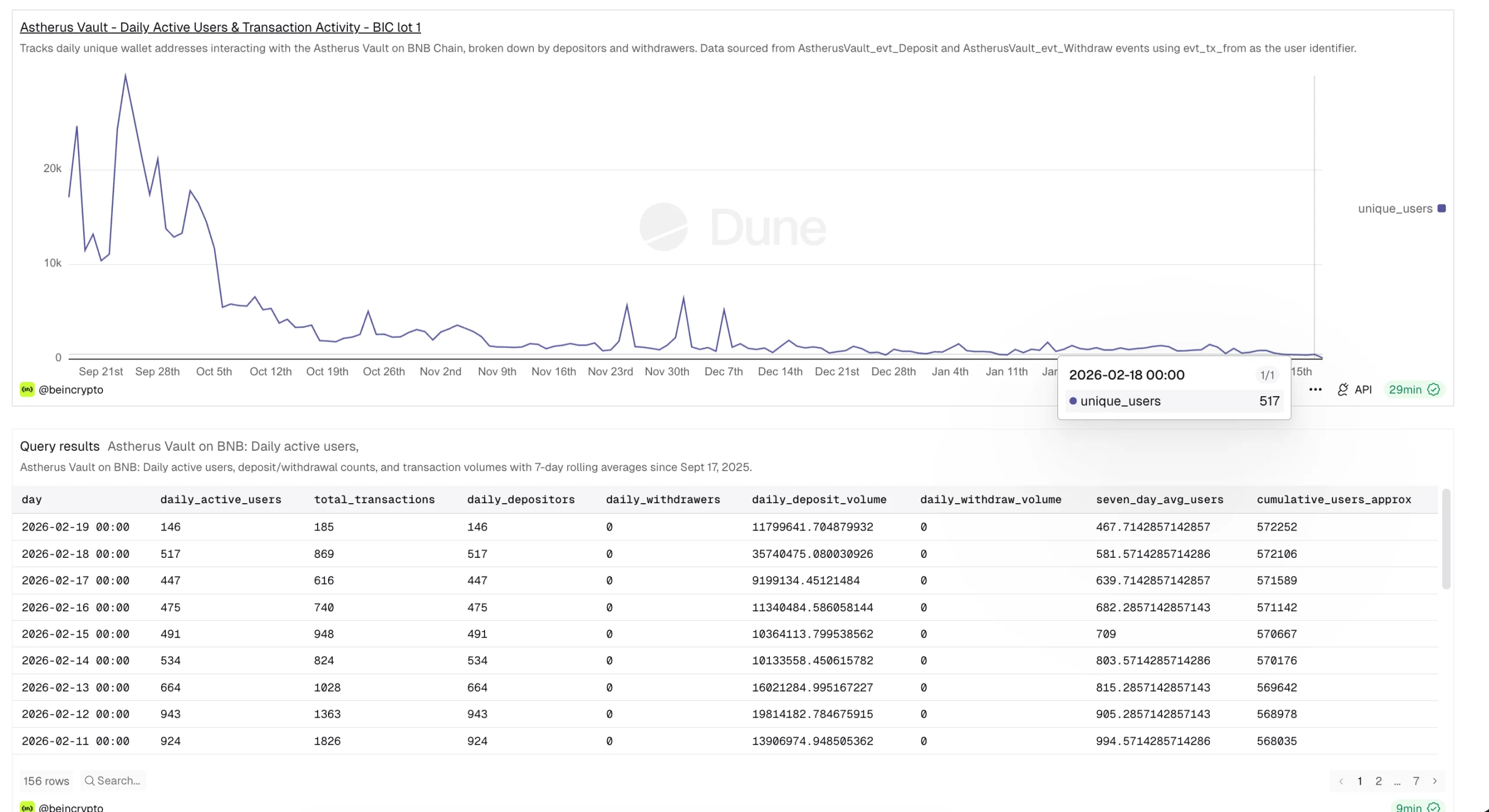
Daily active addresses interacting with the Astherus Vault on BNB Chain peaked at 29,062 on September 24. As of February 19, that number has fallen to just 146. This represents a 99.5% drop in daily active users.
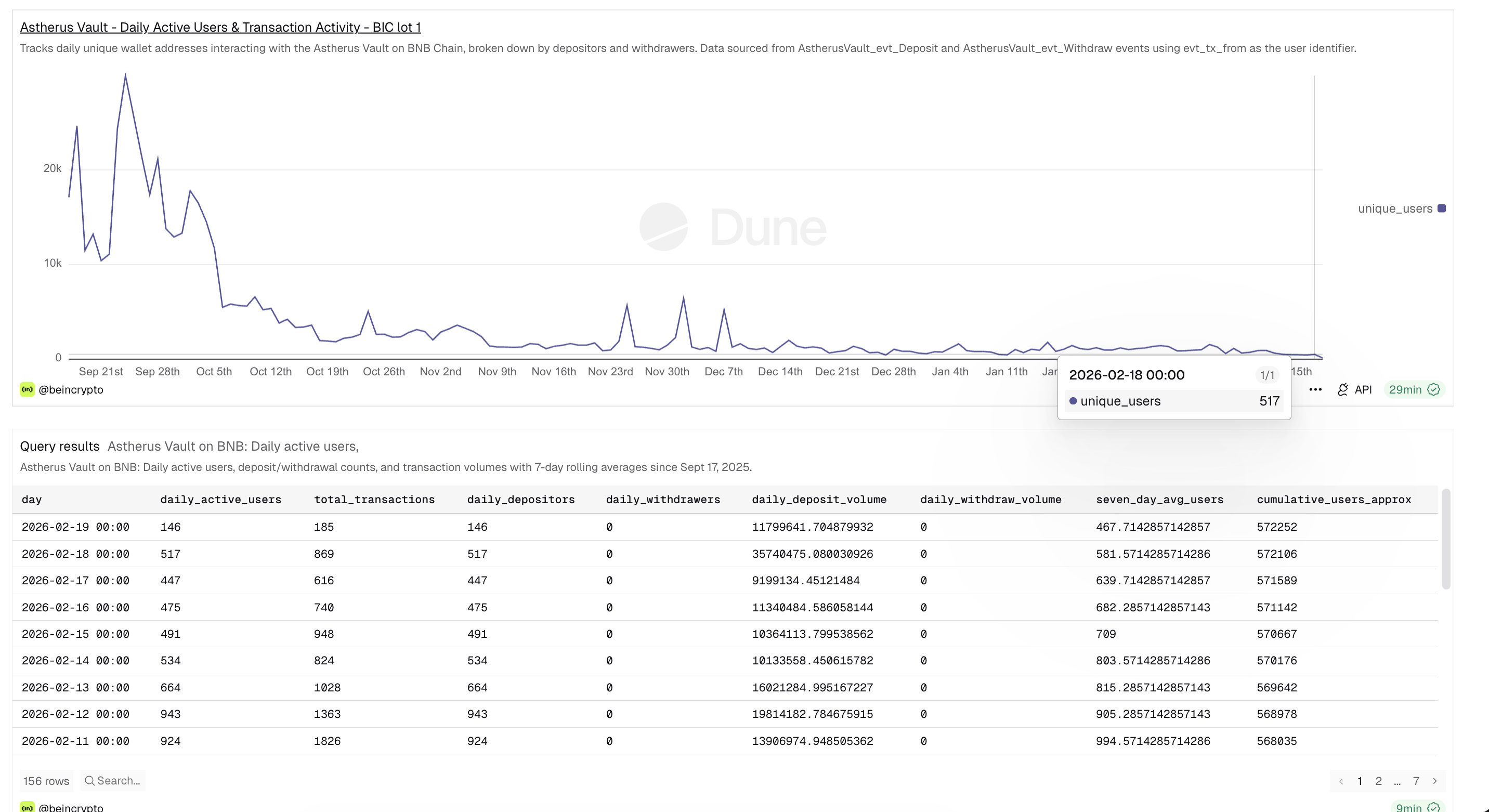
Disclaimer: These figures reflect Astherus Vault deposit and withdrawal activity on BNB Chain specifically. Aster operates across BNB Chain, Ethereum, Solana, and Arbitrum, and total platform-wide trader activity — including perpetual and spot trading — is likely significantly higher than vault-only metrics suggest.
Trading activity has followed the same trend. Daily decentralized exchange volume on BNB Chain, per data pulled via Dune, has declined from a peak of $327.75 million to just $17.31 million.
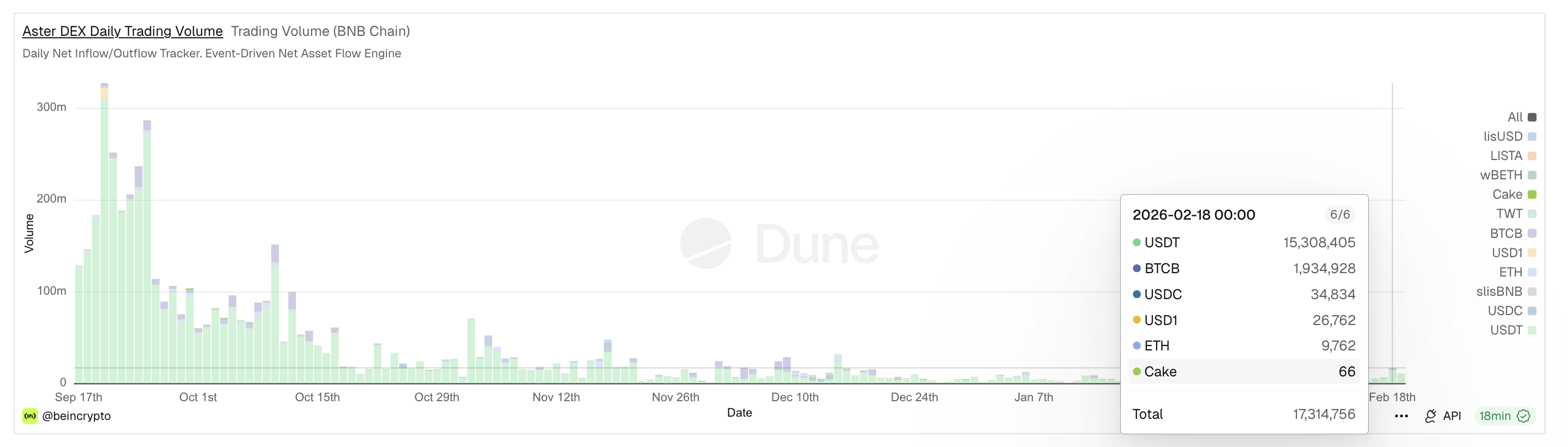
This marks a 94.7% drop in trading volume. On-chain trading volume reflects real buying and selling happening on the blockchain. When it falls sharply, it shows reduced participation and weaker demand.
This collapse aligns with Aster’s price decline. The token is down about 70% from its $2.41 high reached shortly after launch. The drop reflects the end of a possible hype-driven phase.
However, the full picture is more complex. Cumulative unique addresses interacting with the protocol have continued rising, reaching 572,252. This shows new users are still entering the ecosystem, even as daily activity declines.
More importantly, the remaining users are committing large capital. On February 19, total deposits reached $11.8 million from just 146 wallets. This equals an average of about $80,000 per wallet. This shows that while retail participation has dropped, high-value investors remain active.
Additionally, daily withdrawals from the vault have remained at zero consistently since the TGE, indicating that while fewer users are depositing new capital, existing capital is not exiting the system.
Bullish Divergence and EMA Setup Show Early Reversal Signs
Despite the fundamental weakness, technical indicators show early signs of recovery. On the 12-hour chart, ASTER has formed a bullish divergence between December 7 and February 14. During this period, the price made a lower low. But the Relative Strength Index, or RSI, made a higher low.
RSI measures buying and selling strength on a scale from 0 to 100. When the price falls while the RSI rises, it indicates that selling pressure is weakening. This pattern often appears before a price recovery begins. Aster has not yet fully responded to this signal. This suggests the bullish pressure may still be building.
At the same time, the 20-period exponential moving average, or EMA, is approaching a bullish crossover above the 100-period EMA. EMA tracks the average price over time, giving more weight to recent prices. When shorter EMAs cross above longer ones, it signals strengthening momentum and a possible trend reversal.
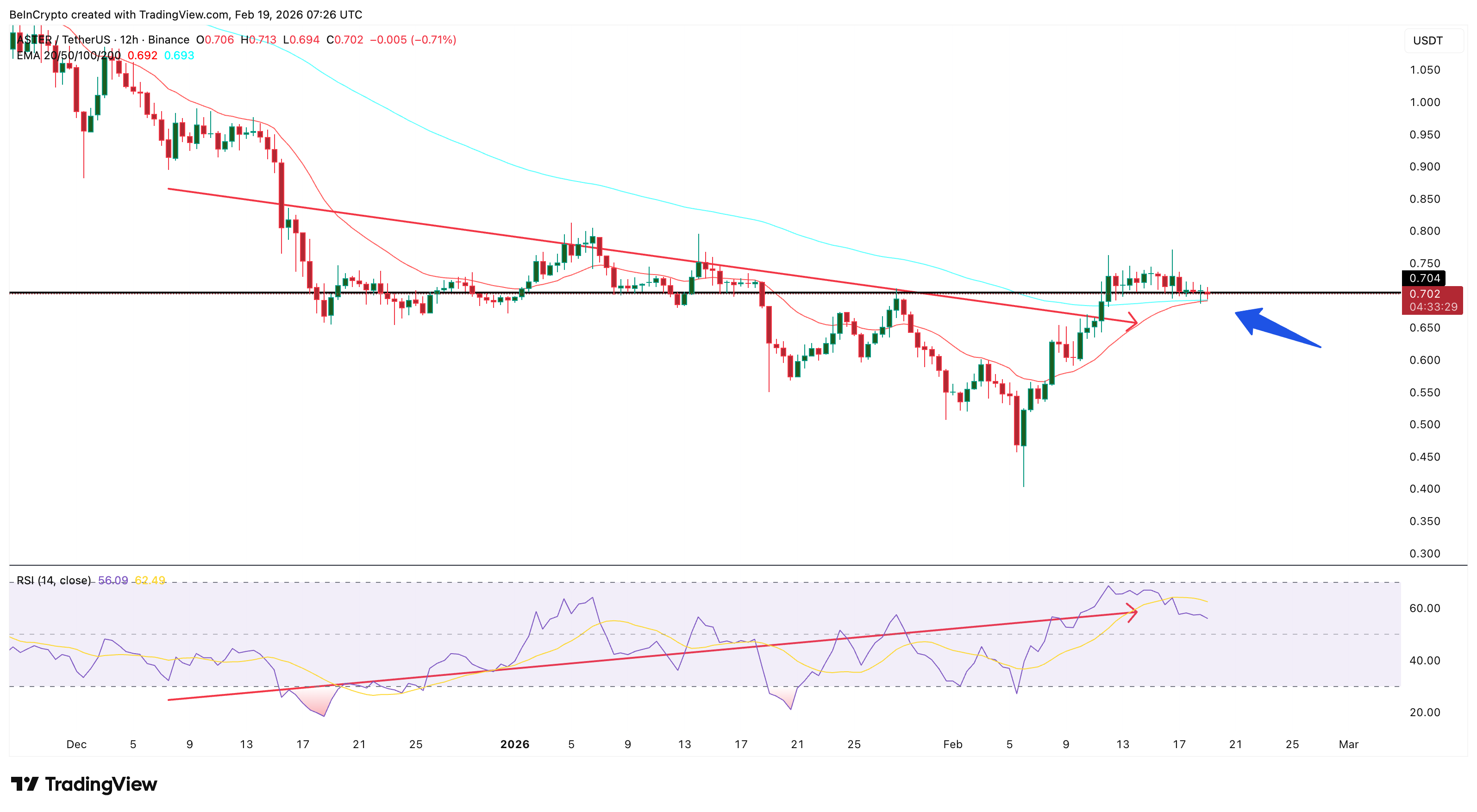
The price is also forming an inverse head-and-shoulders pattern.
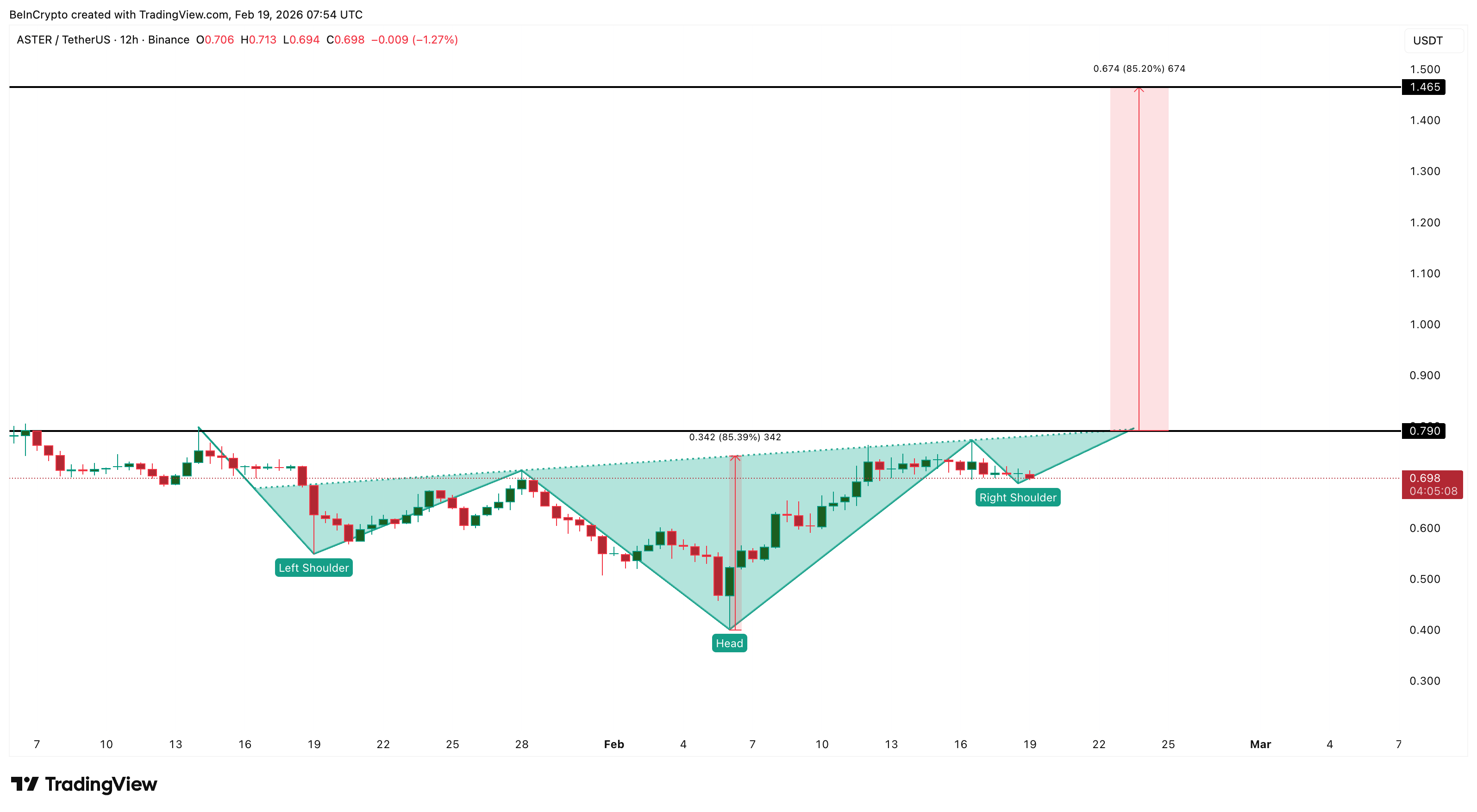
This is a bullish reversal structure showing buyers slowly gaining control. The neckline of this pattern sits near $0.79. A breakout above this level would confirm the recovery.
Whale Accumulation and Sentiment Collapse Create Opposing Forces
Large investors continue accumulating ASTER despite weak public sentiment. Wallets holding between 100 million and 1 billion ASTER have increased their holdings from 2.75 billion to 2.96 billion ASTER since early February. This steady increase shows strong confidence from the largest holders.
Mid-sized whales holding between 1 million and 10 million ASTER have also increased their holdings from 262.48 million to 278.96 million ASTER.
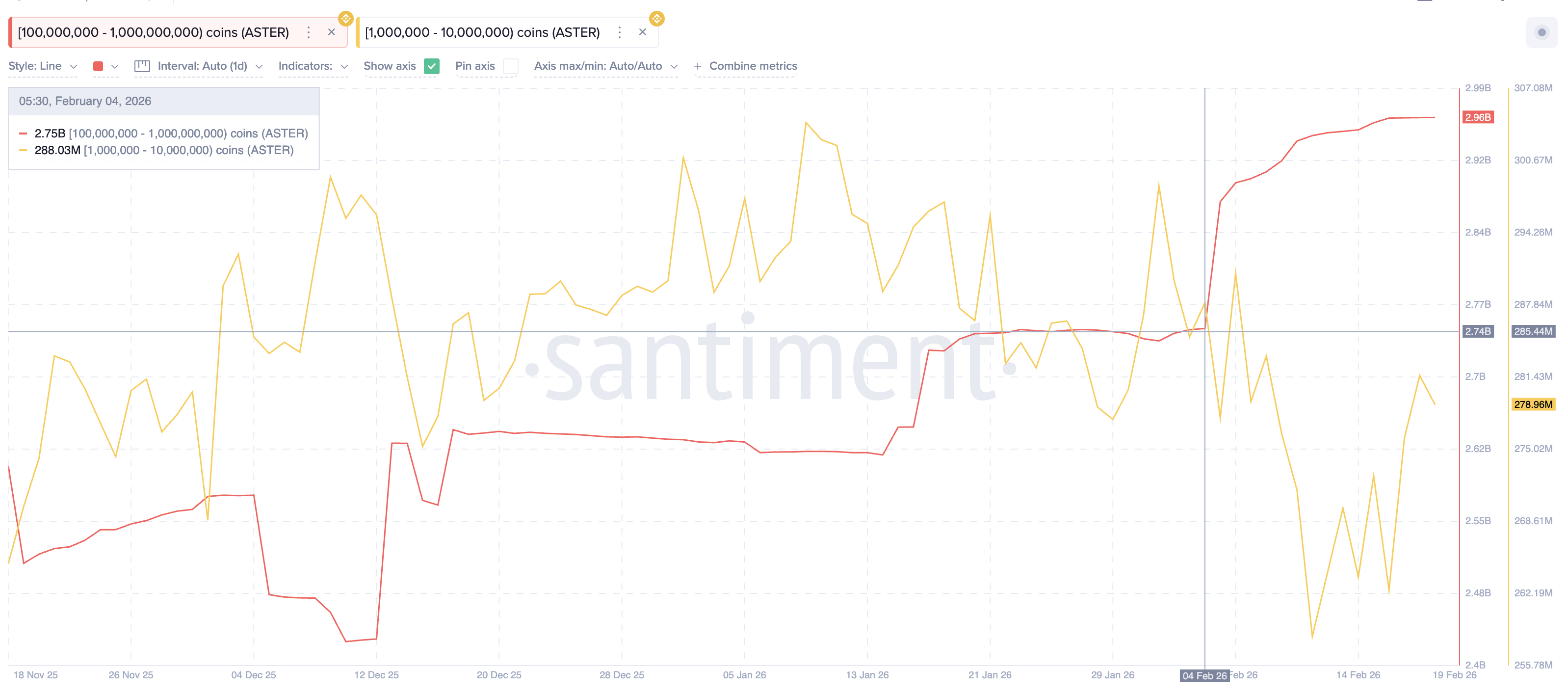
However, some of these smaller whales have recently started reducing positions slightly. This decline appears to be linked to the recent collapse in positive sentiment.
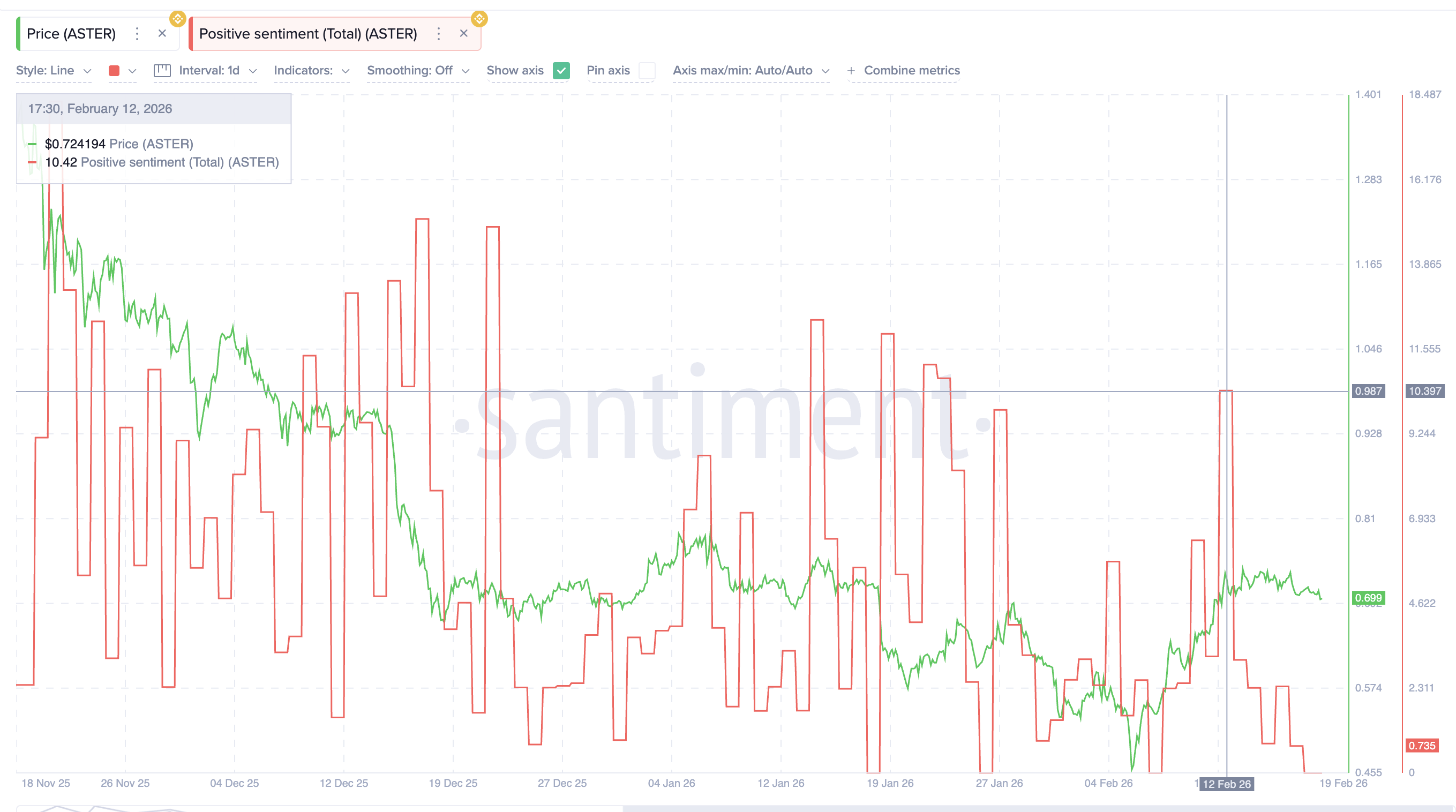
Market sentiment has dropped sharply. Positive sentiment scores fell from 10.39 on February 12 to near zero recently.
Want more token insights like this? Sign up for Editor Harsh Notariya’s Daily Crypto Newsletter here.
This reflects rising criticism and negative perception around Aster’s declining activity, which, based on available data, appears somewhat exaggerated but not entirely unfounded.
This creates a conflict in the market. Large whales continue accumulating, showing long-term confidence. But smaller investors are becoming more cautious as sentiment weakens. This divergence between whale behavior and public sentiment often appears near major turning points.
ASTER Price Levels That Could Trigger an 85% Breakout
The ASTER price now sits near a critical technical level. The neckline of the inverse head-and-shoulders pattern is located at $0.79. A breakout above this level would confirm the bullish reversal. If this breakout happens, the next resistance levels appear at $0.92, $1.06, and $1.29. The full breakout target sits near $1.46. This would represent an 85% rally from current levels.
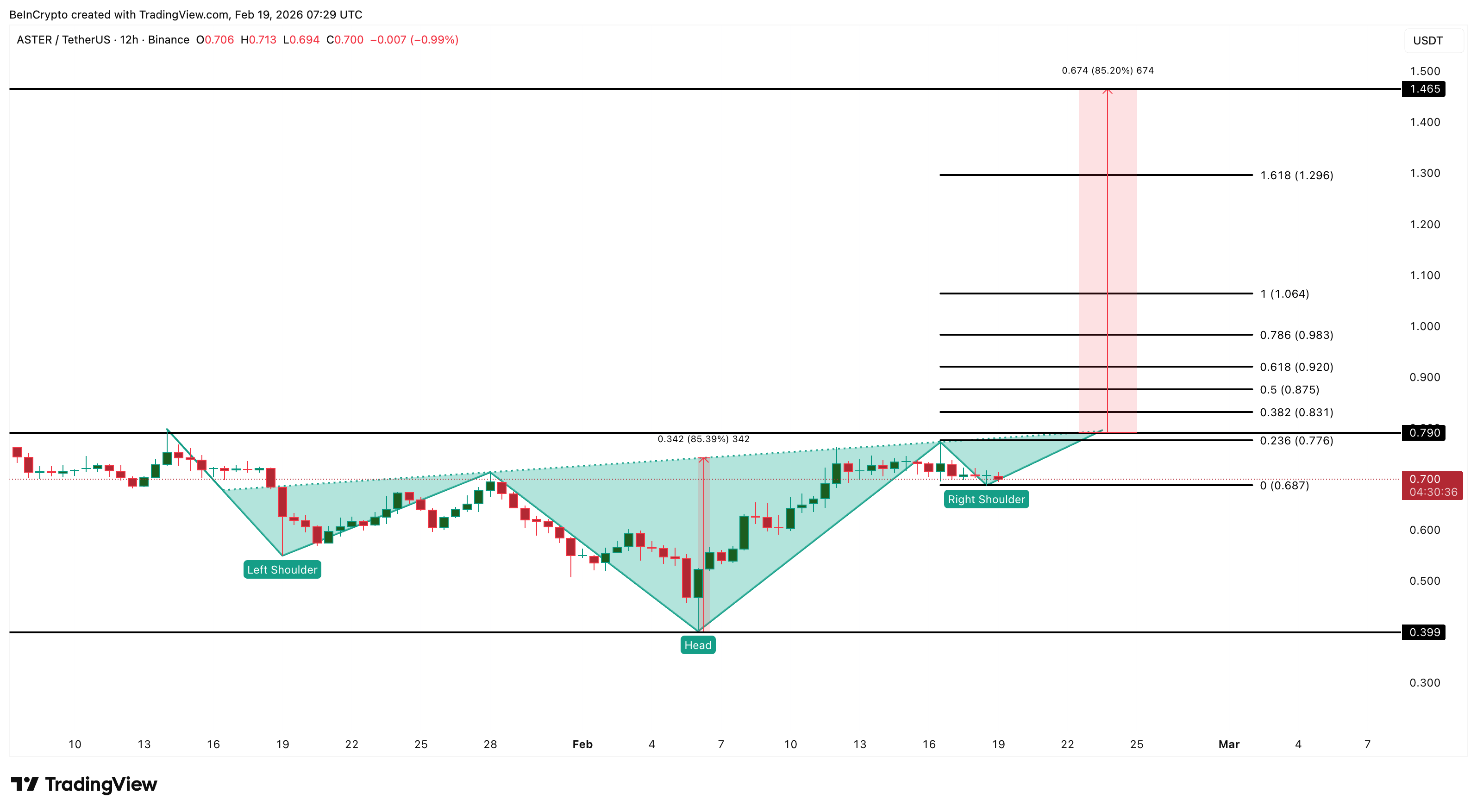
However, downside risks still exist. If Aster falls below $0.68, the bullish setup would weaken. A deeper drop below $0.39 would invalidate the pattern completely and confirm continued bearish pressure.
For now, Aster remains at a turning point. User activity and sentiment have collapsed sharply. But whale accumulation, bullish divergence, and reversal patterns suggest recovery remains possible. The next move above $0.79 or below $0.39 will likely decide Aster’s long-term direction.

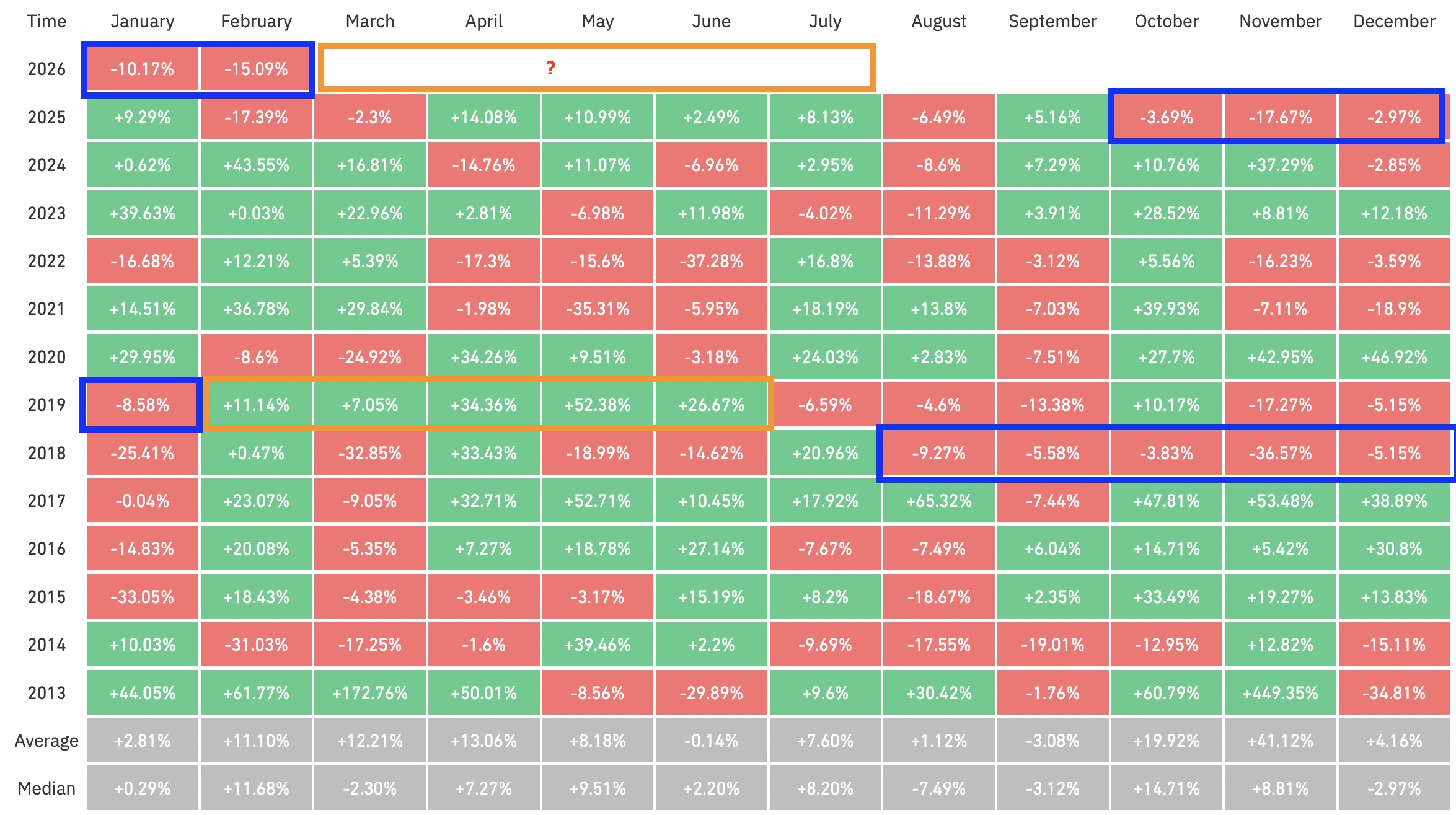
Bitcoin (BTC) is forming what may prove to be a fifth consecutive red monthly candle, which would be the longest losing streak since 2018. The silver lining is that data suggests that March may prove to be a profitable month for BTC.
Previous multimonth downtrends were followed by 300% price gains
Historical price data from CoinGlass confirms Bitcoin is now facing its fifth consecutive red month, down 15% this month after closing the previous four months in the red.
The last time this happened was in 2018, when it entered a bear market after reaching record highs in 2017.
“Last time this happened was in 2018/19 when we saw 6 red months,” analysts at macro investor outlet Milk Road said in an X post on Thursday.
This led to a reversal with over 316% returns over the following five months, the analysts said, adding:
“If history repeats, the reversal will begin on April 1st.”

Analyzing Bitcoin’s quarterly performance during the 2022 bear market provides a more cautious interpretation of BTC price history. The data shows Bitcoin recorded four consecutive red quarters during that year.
Losses stacked across the four quarters, bringing the total losses to 64% as the BTC/USD pair closed the year at $16,500 from an opening price of $46,230. This marked one of the harshest drawdowns in Bitcoin’s history.
As Cointelegraph reported, many analysts expect 2026 to be a bear market year, and a similar stretch of four losing quarters could extend the weakness below the 15-month low of $60,000.

Analyst Solana Sensei shared a chart that focused on Bitcoin’s weekly performance, with the price printing the fifth candlestick in a row.
This is the longest streak since 2022, making it the second-longest losing streak on record.
In 2022, BTC price saw nine red weeks, dropping to $20,500 from $46,800.

Therefore, while past monthly performance suggests an impending rebound, quarterly and weekly data from 2022 demonstrate that BTC price declines could last longer than expected.
Related: Bitcoin’s consolidation nears ‘turning point’ as $70K comes in focus: Analyst
The current market is “fundamentally different”
Veteran analyst Sykodelic argues that Bitcoin’s current bear phase is “fundamentally different” for several reasons, including the monthly relative strength index (RSI) having already reached the 2015 and 2018 bear market lows.
Sykodelic said that due to the lack of a true overbought expansion in the monthly RSI during the bull phase, market participants will be misguided to expect a symmetric contraction.
“This is yet again another situation in which we look a lot more like 2020 than any other period in time,” the analyst said in a post on X, adding:
“I am not seeing anything that tells me we are in the same style bear market as we have had previously, and everyone should be aware of these differences.”

This suggests the current bear cycle is not following historical patterns, and Bitcoin’s bottom and subsequent recovery could catch many traders off guard.
This article does not contain investment advice or recommendations. Every investment and trading move involves risk, and readers should conduct their own research when making a decision. While we strive to provide accurate and timely information, Cointelegraph does not guarantee the accuracy, completeness, or reliability of any information in this article. This article may contain forward-looking statements that are subject to risks and uncertainties. Cointelegraph will not be liable for any loss or damage arising from your reliance on this information.


One year has passed since Argentine President Javier Milei backed a project that drove hundreds of thousands of people worldwide to invest in Libra, a meme coin that turned out to be a rug pull.
Alfonso Gamboa Silvestre, a 25-year-old from Chile, was among the many traders who suffered steep losses. The token’s launch and swift demise cost him $10,000. Since that moment, he has left the crypto industry for good.
A Presidential Endorsement That Drove a Buying Frenzy
On Valentine’s Day last year, Gamboa Silvestre was trading on his computer. The day seemed normal until a notification popped up on his phone from one of the many crypto groups he had on Telegram.
He opened the message, which read something along the lines of “Argentina’s president just launched a crypto token.” Gamboa Silvestre ran to X (formerly Twitter) to see whether it was true.
At first, he thought Milei’s account had been hacked. But after carefully reading the president’s verified tweet and the “Viva La Libertad Project” website he included, Gamboa Silvestre ruled out the possibility.
So he bought the token. In total, he invested $5,000.
“I made two purchases. First, a smaller one. When I was totally sure it was [Milei’s] tweet, I made a bigger one,” Gamboa Silvestre told BeInCrypto in an interview in Spanish.
After that, Gamboa Silvestre left the house to go out to dinner with his family, but he couldn’t keep his eyes off his phone. Libra’s price kept dropping, and he didn’t know what to do.
Choosing what looked best on the menu and averting his family’s worried gaze was hard enough, so he locked himself in the restaurant’s bathroom.
“At first I thought the token was going to go down, and then it was going to go back up to infinity,” Gamboa Silvestre said. “But that didn’t happen. I saw that it was going down and down, and my February 14th ended up being a nightmare.”
As investors began withdrawing their money en masse, so did Gamboa Silvestre. He ended up doubling his original investment in losses.
The event also marked his permanent exit from the crypto ecosystem.
From Active Trader To Complete Exit
Gamboa Silvestre first ventured into crypto in 2016, mostly out of curiosity. However, he began to take it seriously in 2022 and became an active trader.
The meme coin sector had treated him well at first.
Gamboa Silvestre was among the first investors in TRUMP and MELANIA, the two tokens launched by US President Donald Trump and First Lady Melania Trump less than 48 hours before Trump assumed the presidency.
He fared well for himself, and he believed that the story would be similar with Libra.
“I thought that, since Milei had been having different meetings with Donald Trump and Elon Musk, I said, well, this is going down the same path, they’re going to do things right, and I’m going to be able to make money with that,” Gamboa Silvestre recalled.
But things didn’t turn out that way. Besides the money he lost, Gamboa Silvestre surrendered something that was even more important to him: his love for crypto.
“After what happened with Libra, I completely stepped away from that world. I stopped doing something that I really liked that had generated me a lot of profitability during that period,” he said. “In the future, I saw myself only living from that. But I lost all confidence.”
Today, the only ties that Gamboa Silvestre has left to the industry are his participation in a class action brought against Milei.
Data Disputes Milei’s Claims
Gamboa Silvestre is one of 212 investors seeking reparation for their losses in a lawsuit pending in Argentina.
Even though Milei has repeatedly dialled down the impact that LIBRA had on investors, the facts tell a different story.
According to data from Ripio, just one centralized exchange operating in the country, 1,329 citizens lost money. These numbers directly contradicted Milei’s previous claims that only a handful of Argentine investors had been affected.
Argentines weren’t the only ones who had lost money. The impact was international, affecting investors anywhere from Bosnia to Lebanon to Australia.
In the United States, a separate class action lawsuit is moving forward against Hayden Davis, the American investor and CEO of Kelsier Ventures, who has been accused of being the mastermind behind the project.
Trust Erodes As Investigation Continues
Despite it being a year since Libra launched, Milei has yet to provide a coherent explanation of his level of involvement in the token project.
According to Agustín Rombolá, one of the lawyers representing the complainants in the class action, Milei’s answers have varied greatly over the past year.
“He first told us it was a casino, that you don’t cry in the casino. Then he told us that he had the right to sell his opinions. And then he told us that he was not working as the president at the moment of the tweet. [After that], he told us he was scammed,” Rombolá told BeInCrypto.
According to Congressman Maximiliano Ferraro, one of the most outspoken critics in the Libra scandal, Milei has yet to address a key issue regarding his role in the case.
“There are still many questions unanswered. Who approached the President, and how did they give him that [smart contract address] that had more than 40 characters and did not have a public status?” Ferraro said in an interview in Spanish.
As the investigation into what happened continues, the financial damage is still being tallied, as is the loss of trust.
For Gamboa Silvestre and thousands of others, Libra was not just a failed investment but a turning point that reshaped their relationship with crypto altogether.
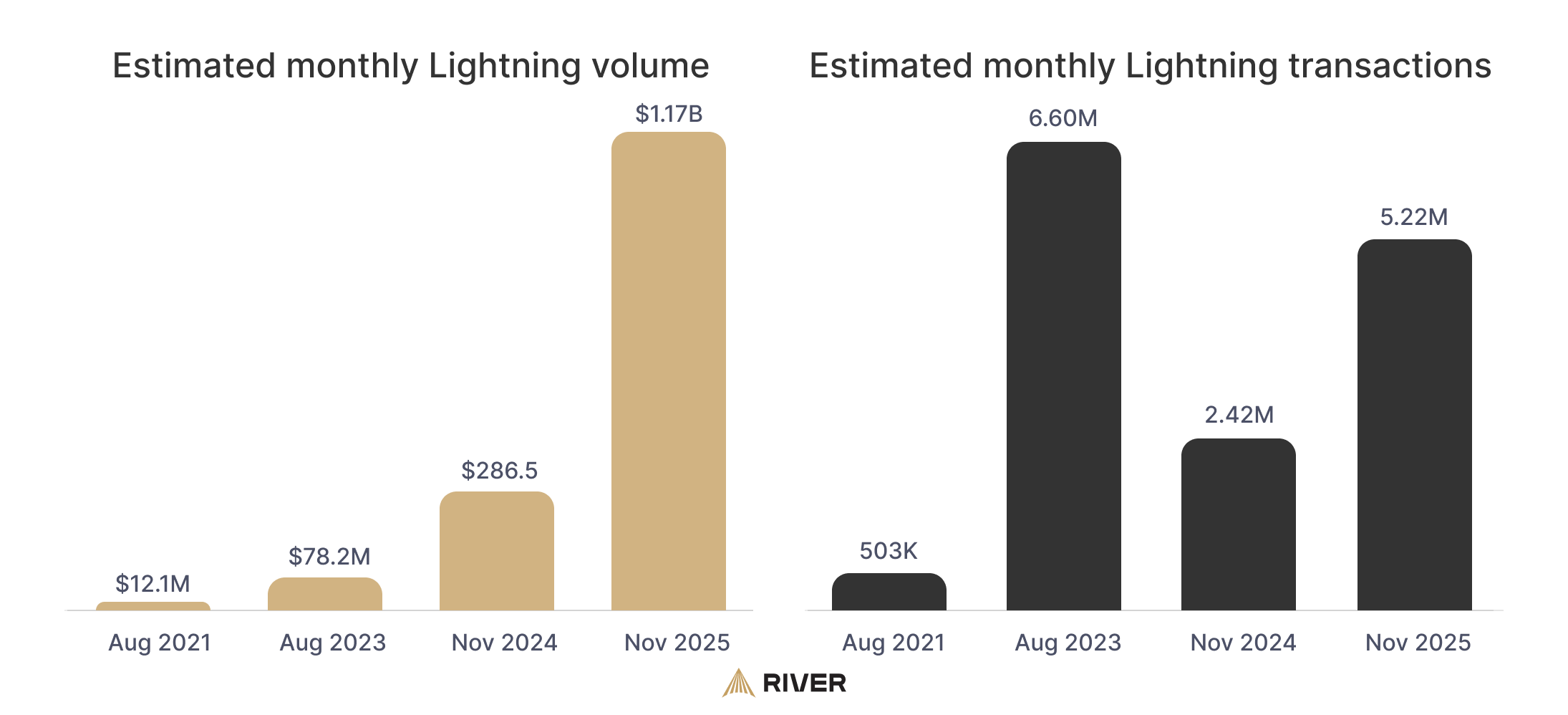
Monthly transaction volume on the Bitcoin (BTC) Lightning Network, a secondary layer for BTC that enables payment use cases, surpassed the $1 billion milestone in November 2025, according to a report from Bitcoin financial services company River.
Transaction volume on the Lightning Network hit an estimated $1.1 billion in November, across 5.2 million transactions, according to a report shared by Sam Wouters, River’s director of marketing. The report said:
“Lightning adoption happened despite the price declining all of November and generally not doing much in 2025. The adoption was largely driven by exchanges, as well as a growing number of businesses accepting bitcoin payments.”

However, the total transaction count in 2025 is lower compared with 2023, when monthly Lightning transactions peaked at 6.6 million in August of that year, which River attributed to experiments with micropayments in gaming and messaging apps.
The report forecast a similar surge in Lightning transactions as individuals and businesses experiment with AI payments.
The Bitcoin Lightning Network helps scale the Bitcoin network, enabling Bitcoin payments between parties that settle in seconds instead of minutes, encouraging Bitcoin’s use as a medium of exchange, instead of just a risk asset or store of value.
Related: Voltage rolls out USD-settled Bitcoin Lightning credit line for businesses
Exchanges and institutional clients adopt Lightning Network
The Lightning Network reduces transaction costs and settlement times by opening up a payment channel between two or more parties to handle transactions offchain, posting only the net balance of the channel to the Bitcoin ledger once it is closed.
Typically, Bitcoin blocks take 10 minutes on average to be added to the ledger, severely limiting BTC payments, particularly for smaller purchases at physical businesses.
In December 2025, the Lightning Network’s capacity, the total number of coins locked on the network for liquidity, reached 5,606 BTC, as more companies and institutions began using it.

Secure Digital Markets, an Institutional trading and lending company, sent crypto exchange Kraken $1 million in a Lightning transaction in February.
The transaction showed that large, seven-figure amounts can be transferred between institutional parties using Bitcoin’s layer-2 scaling network.
Magazine: Bitcoin may take 7 years to upgrade to post-quantum: BIP-360 co-author


The EF announced its 2026 Protocol priorities, emphasizing scalability, user experience, and security, as the network prepares for the Glamsterdam upgrade.
The Ethereum Foundation (EF) has outlined its Protocol priorities for 2026, focusing on scalability, improved user experience, and enhanced network security.
Over the coming year the EF looks to push its gas limit “toward and beyond” 100 million, lean into account abstraction and interoperability, and continue to “harden the L1” focusing on security, censorship resistance, and network resilience.
Today’s initiative release comes shortly after co-executive director Tomasz Stańczak announced his intent to step down at the end of the month. Stańczak indicated he will continue to spend his professional time in the Ethereum ecosystem, working closely with developers and founders. Bastian Aue is assuming interim co-executive director duties for the time being.
The Foundation established Protocol in June 2025 as an improved and more responsive path towards network development. This initiative potentially laid the groundwork towards Ethereum co-founder Vitalik Buterin’s new outlook on the Layer 2 ecosystem, and lays the foundation for future network upgrades like Glamsterdam and Hegota.
Glamsterdam, which is expected to ship in the first half of 2026, is comprised of up to 22 different Ethereum Improvement Proposals (EIPs) and focuses on Layer 1 scalability.
This article was generated with the assistance of AI workflows.


Russia plans liability for gray-market crypto after fraud-linked bank freezes.
Summary
- Central bank wants liability for crypto deals outside regulated segment, citing rising fraud complaints.
- Over 1,800 Russians sought help after bank account freezes tied to suspicious crypto inflows.
- Officials push legalization for cross-border crypto payments while preparing broader licensing regime.
Russia’s central bank has proposed new penalties for cryptocurrency operations conducted outside the country’s regulatory framework, according to statements reported by Russian state media on Wednesday.
Central Bank of Russia
Central Bank of Russia Governor Elvira Nabiullina said during a financial cybersecurity forum that prosecution of unregulated cryptocurrency transactions is necessary to address fraud concerns.
“Fraudsters are taking advantage of the gray market,” Nabiullina stated, according to the official TASS news agency. “A systemic solution is, of course, regulating cryptocurrency with the introduction of liability for transactions outside the regulated segment.”
The central bank chief added that the institution has submitted proposals to the government and is currently in discussions regarding the changes.
Nabiullina noted that Russians who sell cryptocurrency frequently face banking restrictions, with their accounts suspended when received funds are linked to fraudulent activities. More than 1,800 individuals contacted Russian law enforcement agencies in the past three months seeking restoration of banking services after being added to a state database for suspicious transactions, according to government newspaper Rossiyskaya Gazeta on Thursday.
During the same conference in Yekaterinburg, VTB Bank CEO Andrey Kostin called for accelerated legalization of cryptocurrency transactions, particularly for payment purposes. The executive of Russia’s second-largest bank said a significant number of clients, including major exporters, are requesting cryptocurrency payment options, according to news portal Gazeta.ru.
VTB, which is majority state-owned and subject to Western sanctions, announced plans last year to launch cryptocurrency trading through brokerage accounts once regulations are established.
Russia’s push toward cryptocurrency legalization has been driven primarily by the need for international settlement options. In October, the Ministry of Finance and the Central Bank agreed to legalize cryptocurrency payments in foreign trade, enabling Russian firms to circumvent financial restrictions imposed by Western nations over the conflict in Ukraine.
Moscow authorities aim to replace an experimental legal regime for such transactions with comprehensive legislation covering cryptocurrency activities, including investment and trading. The framework will be based on a regulatory concept proposed by the central bank in late December that would recognize cryptocurrencies and stablecoins as “monetary assets.”
Parliamentary Financial Markets Committee Chairman Anatoly Aksakov urged swift action on crypto market regulation at the Yekaterinburg forum, stating that the unregulated sector has resulted in significant financial losses.
Russian authorities have indicated plans to approve the legislation by summer, according to reports.
Industry analysts interviewed by business news outlet RBC this week suggested that Russian regulators may restrict access to foreign cryptocurrency exchanges such as Bybit and OKX once domestic regulations are implemented. Nikita Zuborev, senior analyst at crypto exchange aggregator Bestchange.ru, predicted such restrictions could occur after Russia begins licensing domestic cryptocurrency service providers, potentially by year-end.
Painful decline or a bull run to $1: what is next for PI?
Pi Network’s PI has been the best-performing top 100 cryptocurrency over the past week, with its valuation rising by almost 40%.
Although some market observers foresee additional short-term gains, one factor could dampen their enthusiasm by hinting at a renewed decline.
The Bears Are Coming Back?
PI has finally managed to reverse its massive downtrend over the last several months, posting an upswing to as high as $0.20 just days ago. Currently, it trades at around $0.18 (per CoinGecko’s data), placing it well in green territory on a seven-day and two-week timeframe.
With its market capitalization soaring to roughly $1.7 billion, the asset now ranks as the 47th-largest cryptocurrency. The evident recovery has put PI back in focus, making it one of the most-trending tokens on CoinGecko lately.
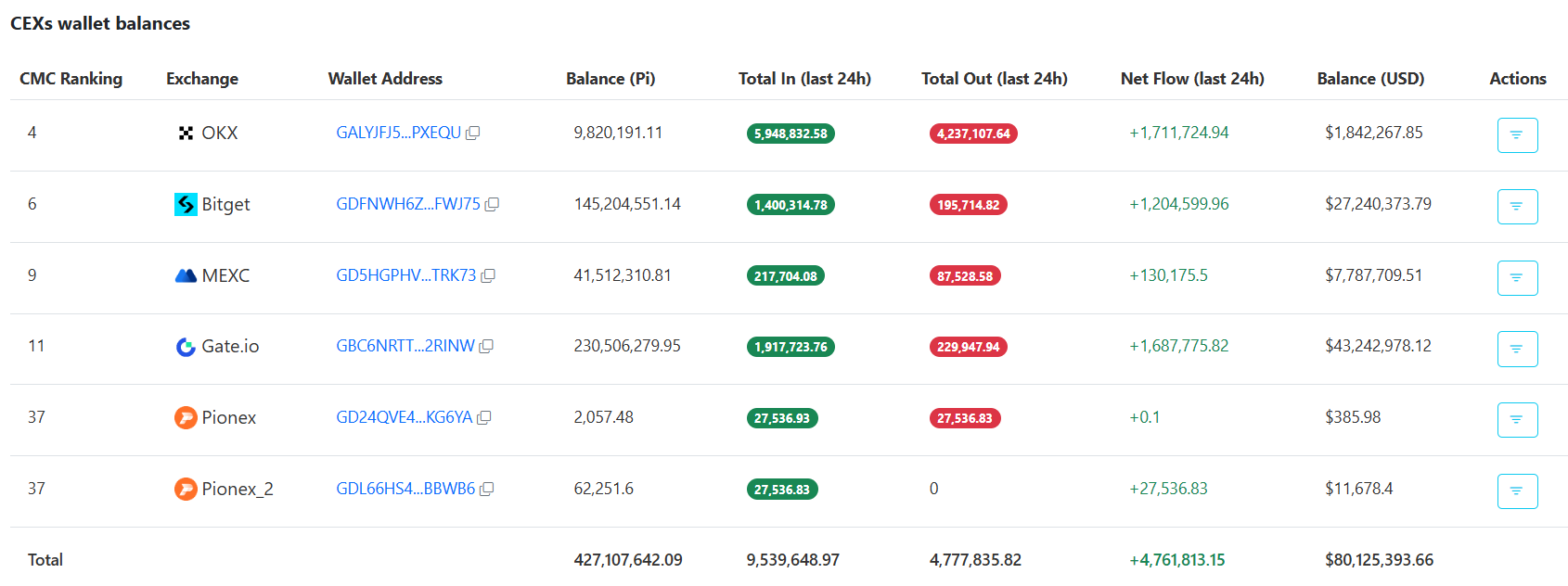
The good days, though, may be coming to an end because the amount of coins stored on crypto exchanges has risen sharply. Almost 5 million PI have been transferred to such platforms in the last 24 hours alone, bringing the total to approximately 427.1 million. More than half of that is held on Gate.io, while Bitget ranks second with approximately 145.2 million tokens.
While the shift from self-custody to centralized exchanges doesn’t guarantee a price correction, it is often viewed as a bearish signal, as it could be interpreted as a pre-sale step.
The aggressive token unlocks scheduled for the coming days should also serve as a warning to investors. Data indicates that daily figures will approach 15 million on several occasions before the end of February. After that, though, the process is set to slow down.
You may also like:

New Push From the Bulls?
Contrary to the aforementioned factors, some community members believe PI is on the verge of a more serious surge in the short term. X user Pi Network Academy argued that the asset “is warming up for another big pump,” predicting an explosion to $1.
For their part, Pi Global claimed that “momentum is building, utility is expanding, and community is stronger than ever.” That said, they wondered if the coin’s valuation could hit $0.50 before Pi Day. The date (March 14) is symbolic to Pi Network because it resembles the mathematical constant π (3.14).
Earlier this month, X user Captain Faibik also chipped in. The renowned crypto analyst revealed they had added some PI for the midterm, expecting a 500% rally.
SECRET PARTNERSHIP BONUS for CryptoPotato readers: Use this link to register and unlock $1,500 in exclusive BingX Exchange rewards (limited time offer).
Disclaimer: Information found on CryptoPotato is those of writers quoted. It does not represent the opinions of CryptoPotato on whether to buy, sell, or hold any investments. You are advised to conduct your own research before making any investment decisions. Use provided information at your own risk. See Disclaimer for more information.

Few cryptocurrencies are as polarizing as XRP. Critics across the crypto and DeFi ecosystem often claim XRP has no real utility. They argue it exists mainly as a speculative asset with limited real-world use.
At the same time, XRP maintains one of the largest and most vocal communities in crypto – The XRP Army. They believe the altcoin will eventually power global financial infrastructure.
The truth sits somewhere between those two extremes. XRP does have real utility, but its usage is more specific and narrower than many assume.
XRP is More Unique Than Any Other Cryptocurrency
XRP is the native token of the XRP Ledger, launched in 2012 with a clear purpose: enabling fast and efficient cross-border payments.
Unlike Bitcoin, which focuses on decentralized value storage, or Ethereum, which focuses on programmable smart contracts, XRP was designed primarily to move money between financial systems quickly and cheaply.
Transactions on the XRP Ledger settle in about three to five seconds and cost a fraction of a cent. This makes XRP particularly efficient as a bridge currency, allowing instant conversion between two different fiat currencies without requiring banks or payment providers to hold large reserves in foreign accounts.
Millions Hold XRP — But Most Usage Comes From Traders and Infrastructure
Retail investors make up the largest group of XRP users today. As of early 2025, the XRP Ledger had roughly 6 to 7 million funded accounts, which represent wallets holding XRP.
After adjusting for exchange custody and users holding multiple wallets, analysts estimate around 2 to 3 million individuals globally actually hold XRP.

Crypto exchanges are another major user. Platforms such as Binance, Bitstamp, Kraken, and Uphold use XRP for liquidity management and transfers.
XRP’s speed and low cost make it an efficient tool for moving funds between exchanges and managing trading liquidity.
Payment providers also represent a key real-world use case. Companies like SBI Remit in Japan and Tranglo in Southeast Asia use XRP through Ripple’s On-Demand Liquidity system to facilitate international remittances.
In these cases, XRP acts as a temporary bridge asset, allowing money to move across borders instantly without pre-funded foreign accounts.
Banks Use Ripple Technology, But Only Select Partners Actually Use XRP
Banks, however, present a more nuanced picture. Major financial institutions including Santander, Standard Chartered, and Bank of America have used Ripple’s payment infrastructure.
But most of them use Ripple’s messaging and settlement software without directly using XRP itself. Only select payment providers, rather than global banks broadly, use XRP directly for liquidity.
Beyond financial transfers, XRP also plays an essential technical role within its own network. Every XRP Ledger account must hold XRP, and all transactions require XRP to pay network fees.
XRP supports decentralized trading, token issuance, and asset transfers on the ledger.
So, XRP is neither useless nor universally adopted. Its utility exists in specific financial infrastructure roles, particularly in liquidity provisioning and payment settlement.
Understanding who actually uses XRP reveals a clearer picture—one grounded in real-world function rather than speculation.
The acquisition closed on Friday and should enable Kraken to work closely with token teams early in development.
U.S.-based centralized exchange (CEX) Kraken announced its acquisition of token management platform Magna yesterday.
The deal closed on Friday and marks the CEX’s latest strategic move as it prepares for an initial public offering (IPO).
The move was reported by Fortune, which said Kraken declined to disclose the deal terms, but Kraken’s co-CEO Arjun Sethi told the news outlet that the acquisition will allow Kraken to support token issuer teams “early on in their life cycle,” indicating that it may provide Kraken a strategic leg up in terms of token listings.
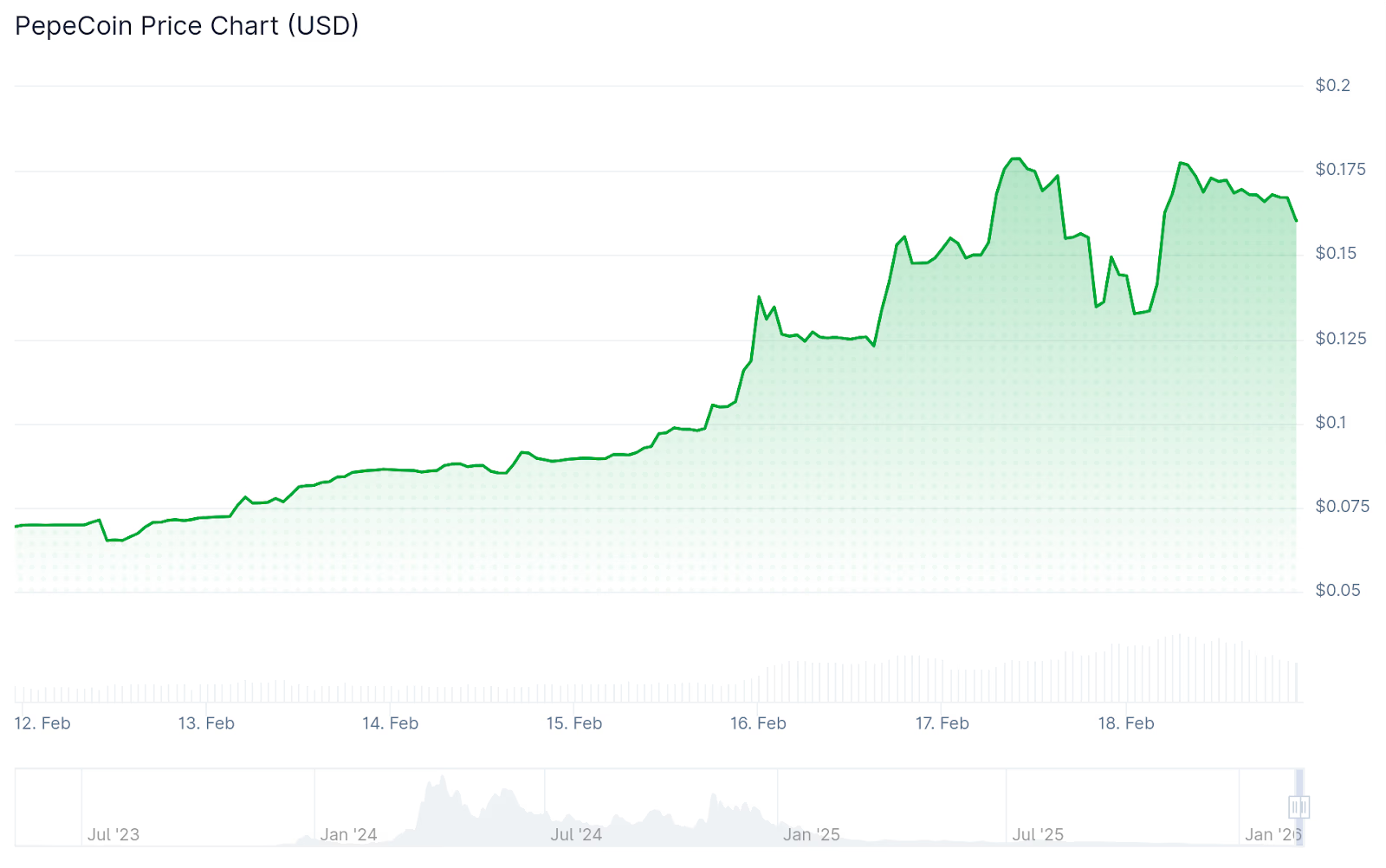
While it is unlikely there is any connection, Kraken also moved to list and promote a memecoin from 2016, PEPECOIN, yesterday, which trades at just a $15 million market capitalization, and should not be confused with PEPE, which launched in 2023 and trades at a $1.7 billion market capitalization.
PEPECOIN is only up 7.6% since the announcement, indicative of the market’s risk-off environment.

Despite the market’s lack of enthusiasm for the listing, the Magna acquisition and the listing of a micro-cap token on the same day may indicate continued aggression from Kraken in expanding asset diversity on the exchange.
Crypto World
Crypto markets feel the chill, Base, ether.fi reorganize layer-2 landscape: Crypto Daybook Americas
By Jacob Joseph (All times ET unless indicated otherwise)
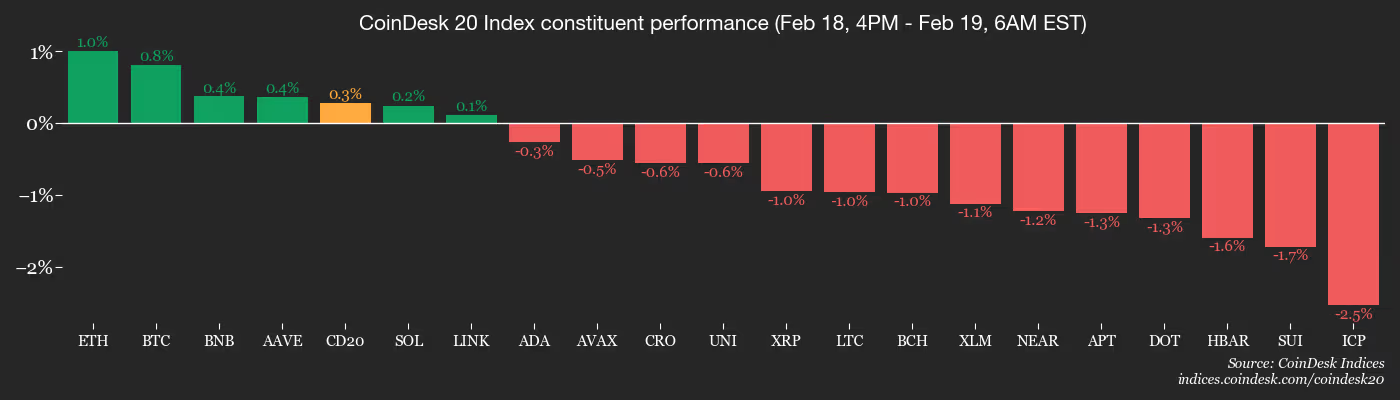
Even with the CoinDesk 20 index (CD20) little changed since midnight UTC, crypto markets remain under pressure. All but one member has dropped, and the outlier, bitcoin , is less than 0.1% in the green.
The index has lost 2% in 24 hours, and spot bitcoin exchange-traded fund flows were negative for a second consecutive session, with $133 million in net outflows on Wednesday. Spot ether (ETH) ETFs also posted net outflows. The second-largest cryptocurrency has lost another 0.2% since midnight.
The key development overnight was Coinbase’s (COIN) announcement that its layer-2 network, Base, will move away from the OP Stack, the open-source, modular rollup framework developed by Optimism that currently powers it. The OP Stack enables chains such as Base and Unichain to operate as low-cost, Ethereum-secured layer 2s, fully compatible with the Ethereum Virtual Machine (EVM) and aligned with Optimism’s broader Superchain vision.
Rather than relying on multiple external contributors for core upgrades and protocol changes, Base intends to consolidate development into a self-managed codebase, giving the team greater control over infrastructure, roadmap, and technical evolution.
The move carries meaningful implications for Optimism. Base has historically accounted for the vast majority of Superchain-generated revenue — often exceeding 90% — which accrues to the Optimism Collective. The announcement represents a significant potential headwind to Optimism’s revenue outlook, with the OP token declining 24% since Wednesday following the news.
In a more positive development, ether.fi said it will migrate its Cash product to Optimism’s OP Mainnet. The move will bring some 70,000 active cards, 300,000 accounts and millions of dollars in total value locked. The non-custodial payment card allows users to spend ETH, BTC and stablecoins at over 100 million Visa merchants, offers 3% crypto cashback and processes about $2 million in daily transaction volume.
In another notable layer-2 development, Robinhood’s testnet recorded 4 million transactions in its first week, according to CEO Vlad Tenev. The Arbitrum-based Robinhood Chain is designed to support tokenized real-world assets and a broader suite of onchain financial services, signaling the firm’s continued push into blockchain-based infrastructure.
While these ecosystem developments remain constructive, broader markets continue to trade within a wider downtrend. The latest Federal Reserve meeting minutes, released yesterday, highlight a growing divergence among policymakers on the path of interest rates.
Several officials indicated that further rate cuts should be paused for now, with the possibility of resuming easing later in the year only if inflation continues to fall. Stay alert!
Read more: For analysis of today’s activity in altcoins and derivatives, see Crypto Markets Today
What to Watch
For a more comprehensive list of events this week, see CoinDesk’s “Crypto Week Ahead“.
- Crypto
- Feb. 19, 8 a.m.: Zama to host a live presentation of its 2026 roadmap.
- Macro
- Feb. 19: U.S. Fed’s Raphael Bostic, Michelle Bowman and Neel Kashkari make speeches throughout the day.
- Feb. 19, 8:30 a.m.: U.S. initial jobless claims for Feb. 14 est. 225K (Prev. 227K)
- Earnings (Estimates based on FactSet data)
- Feb. 19: Riot Platforms (RIOT), post-market, -$0.32
Token Events
For a more comprehensive list of events this week, see CoinDesk’s “Crypto Week Ahead“.
- Governance votes & calls
- ENS DAO is voting to register the on.eth name and establish it as an onchain registry for blockchain metadata. Voting ends Feb. 19.
- Unlocks
- Token Launches
- Feb. 19: Resolv to complete rollout of updated USR/RLP yield distribution parameters
- Feb. 19: Injective to start INJ Community Buyback Round #226
Conferences
For a more comprehensive list of events this week, see CoinDesk’s “Crypto Week Ahead“.
Market Movements
- BTC is up 0.87% from 4 p.m. ET Wednesday at $66,896.68 (24hrs: -1.31%)
- ETH is up 1.29% at $1,966.13 (24hrs: -1.49%)
- CoinDesk 20 is up 0.39% at 1,932.97 (24hrs: -2.57%)
- Ether CESR Composite Staking Rate is unchanged at 2.81%
- BTC funding rate is at 0.0056% (6.1747% annualized) on Binance

- DXY is unchanged at 97.67
- Gold futures are unchanged at $5,009.90
- Silver futures are up 1.13% at $78.47
- Nikkei 225 closed up 0.57% at 57,467.83
- Hang Seng closed up 0.52% at 26,705.94
- FTSE is down 0.63% at 10,618.95
- Euro Stoxx 50 is down 0.81% at 6,054.02
- DJIA closed on Wednesday up 0.26% at 49,662.66
- S&P 500 closed up 0.56% at 6,881.31
- Nasdaq Composite closed up 0.78% at 22,753.63
- S&P/TSX Composite closed up 1.5% at 33,389.73
- S&P 40 Latin America closed up 0.37% at 3,707.85
- U.S. 10-Year Treasury rate is up 1.3 bps at 4.094%
- E-mini S&P 500 futures are down 0.3% at 6,873.25
- E-mini Nasdaq-100 futures are down 0.39% at 24,857.50
- E-mini Dow Jones Industrial Average Index futures are down 0.35% at 49,549.00
Bitcoin Stats
- BTC Dominance: 58.74% (0.26%)
- Ether-bitcoin ratio: 0.0294 (-0.09%)
- Hashrate (seven-day moving average): 1,057 EH/s
- Hashprice (spot): $33.63
- Total fees: 2.31 BTC / $155,155
- CME Futures Open Interest: 118,610 BTC
- BTC priced in gold: 13.4 oz.
- BTC vs gold market cap: 4.47%
Technical Analysis

- The ratio of altcoins (excluding the top 10) to the bitcoin price continues to rise from key weekly support and is now testing the 50-week exponential moving average.
- A break above that level would imply continued resilience of altcoins relative to bitcoin, which is most likely a result of their being extremely oversold.
Crypto Equities
- Coinbase Global (COIN): closed on Monday at $164.05 (-1.19%), +0.24% at $164.45 in pre-market
- Circle Internet (CRCL): closed at $63.15 (+2.48%), +0.19% at $63.27
- Galaxy Digital (GLXY): closed at $21.73 (+2.02%), +0.74% at $21.89
- Bullish (BLSH): closed at $31.85 (-0.47%), unchanged in pre-market
- MARA Holdings (MARA): closed at $7.50 (-0.13%), +0.40% at $7.53
- Riot Platforms (RIOT): closed at $15.49 (+5.73%), +0.19% at $15.52
- Core Scientific (CORZ): closed at $17.27 (+0.23%)
- CleanSpark (CLSK): closed at $9.27 (-0.11%), unchanged in pre-market
- CoinShares Valkyrie Bitcoin Miners ETF (WGMI): closed at $40.04 (+0.10%)
- Exodus Movement (EXOD): closed at $9.88 (-2.08%)
Crypto Treasury Companies
- Strategy (MSTR): closed at $125.20 (-2.70%), unchanged in pre-market
- Strive (ASST): closed at $8.05 (-1.59%)
- SharpLink Gaming (SBET): closed at $6.60 (-0.90%)
- Upexi (UPXI): closed at $0.69 (-4.17%)
- Lite Strategy (LITS): closed at $1.10 (+0.00%)
ETF Flows
Spot BTC ETFs
- Daily net flows: -$133.3 million
- Cumulative net flows: $54.07 billion
- Total BTC holdings ~1.26 million
Spot ETH ETFs
- Daily net flows: -$41.8 million
- Cumulative net flows: $11.68 billion
- Total ETH holdings ~5.74 million
Source: Farside Investors
While You Were Sleeping
- Bitcoin shakes off U.S. session losses as Trump says trade deficit cut by 78% (CoinDesk): Bitcoin trading remained volatile on Thursday, rising to around $67,000 after briefly dipping near $65,900, as traders digested President Trump’s claims the U.S. trade deficit was cut by 78%.
- Bitcoin, ether, xrp ETFs bleed while Solana bucks outflow trend (CoinDesk): U.S.-listed spot crypto ETFs are flashing red across the board, with one exception. SOL ETFs recorded $2.4 million in net inflows, pushing cumulative inflows to nearly $880 million.
- Gold recaptures $5,000 with focus on the Fed’s rate path (Bloomberg): Gold advanced back to around $5,000 an ounce after jumping 2% on Wednesday, with traders focused on the Fed’s next move on interest rates. Bullion climbed as much as 0.9% on Thursday, silver 3%.
- European shares dip as Airbus, Rio Tinto plunge; Nestle gains (Reuters): European shares slipped on Thursday, as investors sifted through a mixed bag of earnings from the likes of Airbus, Rio Tinto and Nestle.

Bitcoin (CRYPTO: BTC) faced renewed selling pressure after failing to clear the $71,000 threshold, slipping toward the $66,000 zone that had provided support in the prior days. The move comes as options markets reveal growing caution among professional traders who are paying a premium for downside protection while hedging risk in a mixed macro backdrop. Despite strength in equities and gold, institutional risk appetite appears to have cooled, with market participants scrutinizing potential catalysts for a deeper pullback. Data during the week showed traders defending the $66k line, but buyers did not mount a decisive comeback, leaving the door open to a retest of lower levels. The dynamic underscores a broader tension between bullish sentiment that sparked a recent rally and a risk-off mood that has crept into crypto trading.
Key takeaways
- Professional traders are paying a 13% premium for downside protection as Bitcoin struggles to maintain support above $66,000.
- While stocks and gold remain resilient, $910 million in Bitcoin ETF outflows since Feb. 11 signal rising institutional caution amid macro uncertainty.
- Put options dominated Deribit activity, with bear diagonal spreads, short straddles and short risk reversals among the most traded strategies in the last 48 hours.
- The delta skew between put and call options remained unconventionally bearish, suggesting traders are hedging against downside moves rather than betting on immediate upside.
- Stablecoin dynamics point to modest outflows, with a 0.2% discount to parity relative to USD/CNY, improving from a prior 1.4% discount.
Tickers mentioned: $BTC
Sentiment: Bearish
Price impact: Negative. A break below key support and persistent hedging pressure hint at further near-term softness for Bitcoin.
Trading idea (Not Financial Advice): Hold. The market backdrop remains tethered to macro cues and evolving ETF flows, so a cautious stance is warranted until clearer catalysts emerge.
Market context: The narrative surrounding Bitcoin is increasingly entwined with broader liquidity concerns, risk sentiment shifts, and ETF flow dynamics that continue to influence institutional exposure amid a volatile macro environment.
Why it matters
For market participants, the current configuration—soft price ceilings around $71,000 giving way to a test of the lower band near $66,000, alongside a persistent premium on downside hedges—highlights a fragile balance between optimism and risk management. The 13% delta skew in put versus call options signals that professional traders are prioritizing protection over speculative bets, which can compress upside opportunities if selling accelerates. This is not merely a Bitcoin story; it reflects how institutions are sizing risk in a backdrop of mixed signals from equities, precious metals, and cross-asset liquidity conditions.
The ETF backdrop compounds the narrative. With US-listed Bitcoin ETFs recording about $910 million in net outflows since Feb. 11, traders are re-evaluating the appetite of large funds to hold or add exposure through traditional wrappers. While broad U.S. equities and gold have shown resilience, crypto-specific demand appears tempered, underscoring the pace at which macro concerns can seep into digital-asset markets. The dislocation between crypto price action and broader risk assets underscores a broader market mood: crypto remains highly sensitive to capital allocation shifts, even as some macro indicators remain supportive for risk-taking in other sectors.
In this environment, traders are not simply playing for a bounce; they are positioning for a potential downside scenario without incurring significant upfront costs. The behavior of the Deribit order book—where bear diagonals, short straddles, and short risk reversals dominated activity in the last 48 hours—illustrates a risk-off posture that seeks to profit from limited price movement in Bitcoin while capping potential losses if liquidation accelerates. The strategy mix effectively lowers the upfront cost of a bearish bet while exposing traders to the risk of a sharp decline, a combination that speaks to growing caution rather than outright pessimism about a rapid collapse.
Beyond price action, the stablecoin channel offers another lens into market sentiment. A 0.2% discount relative to USD/CNY—versus a neutral 0.5% to 1% premium expected under normal conditions—points to moderate outflows or a cautious stance on offshore capital flows. This dynamic can reflect tighter risk appetite in the near term, even as on-chain activity and other on-ramp/off-ramp metrics present a more nuanced picture. The comparison to a prior 1.4% discount earlier in the week signals a partial stabilization, yet it remains a reminder that stablecoin markets often act as a liquid proxy for risk tolerance amid turbulent conditions.
The ETF dynamic remains central to the narrative. While the broader macro environment has not collapsed, crypto-specific inflows have cooled, suggesting that institutional demand for Bitcoin via exchange-traded vehicles is not currently robust enough to sustain a bullish tilt. In parallel, reference to industry coverage suggests that Bitcoin ETFs still sit on substantial net inflows overall—though not enough to offset the near-term outflows and price softness—highlighting a tension between longer-term demand signals and short-term sentiment shifts.
As the market digests these signals, a key question remains: will Bitcoin defend the $66,000 floor, or will sellers reassert control and push the price toward the next set of targets? The answer may hinge on a confluence of factors, including upcoming options activity, regulatory developments, and macro catalysts that can alter the risk calculus for institutions. In the near term, the balance of evidence points to a cautious posture among traders, with hedges and selective exposure dominating the narrative rather than broad-based buying appetite.
Overall, the current environment underscores the complexity of pricing risk in a market where crypto-specific headlines can swing quickly, while cross-asset indicators offer a more tempered read. The juxtaposition of a resilient stock market and a fragile crypto setup creates a dynamic in which investors may rotate away from high-beta crypto exposure until a clearer catalyst emerges. In this sense, Bitcoin’s fate in the weeks ahead will likely depend as much on external liquidity and macro cues as on internal crypto-specific developments, with options markets acting as a barometer for the evolving risk appetite among sophisticated participants.
What to watch next
- Watch Deribit option flows and delta skew in the coming days for signs of renewed hedging or a shift toward riskier bets.
- Monitor Bitcoin ETF net flows over the next two weeks to gauge institutional appetite and potential catalysts for price moves.
- Track stablecoin market dynamics (premium/discount to USD) as a proxy for offshore risk sentiment and liquidity conditions.
- Assess macro catalysts (regulatory developments, inflation data, or Fed commentary) that could reframe risk appetite for crypto assets.
SOURCES & verification
- Deribit option activity and delta skew data cited in Laevitas data (bear diagonal spreads, short straddle, short risk reversal as top strategies over the past 48 hours).
- Stablecoin premium/discount relative to USD/CNY data (OKX) as an indicator of on-chain/FX-related risk flows.
- $910 million in total outflows from US-listed Bitcoin ETFs since Feb. 11; reference to recent ETF flow coverage.
- Bitcoin ETF inflow/outflow context and comparisons to gold and the S&P 500 performance as macro backdrop.
- Bloomberg report noting that Bitcoin ETFs still sit on $53B in net inflows despite recent outflows (as a broader ETF context).
Bitcoin options reflect risk-off mood as ETF outflows weigh on price
Bitcoin (CRYPTO: BTC) is moving in a cautious mode as buyers struggle to push through the $71,000 barrier, with the asset testing the lower support near $66,000. The latest data indicates that professional traders are prioritizing downside hedges, evident in the premium paid for put options and the selective use of bearish strategies on Deribit. In a market where equities and bullion have shown resilience, crypto traders appear to be prioritizing risk management over speculative bets, a stance reinforced by notable ETF outflows and a cautious stance toward new positions.
The premium structure in the option market—specifically a 13% put premium relative to calls on a recent trading day—suggests a market not confident in a rapid revival of momentum. This condition aligns with the broader narrative of risk-off sentiment, where hedges are favored as a way to mitigate the potential for a sharper drawdown should volatility spike or macro catalysts disappoint. The existence of bearish formations such as bear diagonals, short straddles, and short risk reversals among the most active trades over the last two days further underscores a cautious posture among institutional participants who are navigating a delicate balance between preserving capital and seeking incremental exposure.
The ETF story adds another layer of nuance. With $910 million in net outflows since Feb. 11, the flow data reflects a degree of institutional hesitation that cannot be fully explained by price alone. While gold and the broader stock market have been robust, crypto-specific demand appears to be cooling, at least in the near term. The divergence between crypto price action and the appetite of large funds to deploy capital in standard wrappers is a telling indicator of how investors are reassessing risk in a landscape where cross-asset liquidity can tighten quickly, especially in times of macro uncertainty.
On stablecoins, a modest 0.2% discount to parity relative to USD/CNY signals a transitional phase in which cross-border liquidity and currency controls influence how capital moves in and out of crypto markets. That said, the improvement from a prior 1.4% discount suggests some stabilization, but it remains to be seen whether this will translate into stronger on-chain demand or simply reflect a temporary reprieve in selling pressure.
For the broader market, the “risk-off but not outright bearish” stance in Bitcoin contrasts with the relative strength seen elsewhere. A comparison of market conditions suggests that the crypto sector remains more reactive to liquidity flows and sentiment shifts than to standalone fundamental catalysts. This dynamic can produce outsized volatility within short windows, even as longer-term macro considerations remain in flux. Investors and traders alike should stay vigilant for any shifts in ETF flows, option activity, or regulatory signals that could reconfigure the risk premium embedded in BTC and related instruments.

Middle-income financial stress: Here’s what to know

Charli XCX turned Wuthering Heights into a sonic gothic masterpiece

Global Market Today | Asian stocks fall, oil climbs with Iran in focus


-

 Video3 days ago
Bitcoin: We’re Entering The Most Dangerous Phase
-

 Tech5 days ago
Luxman Enters Its Second Century with the D-100 SACD Player and L-100 Integrated Amplifier
-

 Crypto World3 days ago
Can XRP Price Successfully Register a 33% Breakout Past $2?
-

 Sports3 days ago
GB's semi-final hopes hang by thread after loss to Switzerland
-

 Video7 days ago
The Final Warning: XRP Is Entering The Chaos Zone
-
 Tech3 days ago
The Music Industry Enters Its Less-Is-More Era
-

 Business2 days ago
Infosys Limited (INFY) Discusses Tech Transitions and the Unique Aspects of the AI Era Transcript
-

 Entertainment1 day ago
Kunal Nayyar’s Secret Acts Of Kindness Sparks Online Discussion
-

 Video3 days ago
Financial Statement Analysis | Complete Chapter Revision in 10 Minutes | Class 12 Board exam 2026
-

 Tech2 days ago
Retro Rover: LT6502 Laptop Packs 8-Bit Power On The Go
-

 Crypto World6 days ago
Bhutan’s Bitcoin sales enter third straight week with $6.7M BTC offload
-
 Sports21 hours ago
Clearing the boundary, crossing into history: J&K end 67-year wait, enter maiden Ranji Trophy final | Cricket News
-

 Entertainment1 day ago
Dolores Catania Blasts Rob Rausch For Turning On ‘Housewives’ On ‘Traitors’
-

 Crypto World7 days ago
Kalshi enters $9B sports insurance market with new brokerage deal
-

 Business2 days ago
Tesla avoids California suspension after ending ‘autopilot’ marketing
-
 NewsBeat4 days ago
The strange Cambridgeshire cemetery that forbade church rectors from entering
-

 Crypto World1 day ago
WLFI Crypto Surges Toward $0.12 as Whale Buys $2.75M Before Trump-Linked Forum
-
 NewsBeat4 days ago
Man dies after entering floodwater during police pursuit
-

 NewsBeat5 days ago
UK construction company enters administration, records show
-

 Crypto World3 hours ago
83% of Altcoins Enter Bear Trend as Liquidity Crunch Tightens Grip on Crypto Market