
Crypto World
90% rent cut and the road to 200ms slots

Three feature gated upgrades began activating on Solana mainnet the week of August 17. A 90% reduction in on chain storage rent, a 3.3 fold increase in maximum transaction size, and a staged slot time reduction from 400ms toward 200ms represent Solana’s most significant infrastructure change since Firedancer reached mainnet.
Summary
- Solana’s Agave 4.2 client began mainnet feature activation the week of August 17, delivering three independent upgrades: a 90% rent reduction, 3.3 times larger transactions, and a staged slot time cut from 400ms toward 200ms.
- SIMD-0437 cuts the lamports per byte constant from 6,960 to 696, reducing the rent exempt deposit for a standard SPL token account from roughly $0.16 to approximately $0.016, lowering the cost of deploying on chain programs and creating token accounts by an order of magnitude.
- SIMD-0296 raises maximum transaction size from 1,232 bytes to 4,096 bytes through a new v1 transaction format, enabling ZK proofs, large multisigs and on chain BLS signature schemes to land as single atomic transactions.
- SIMD-0525 targets 200ms slot times in four successive 50ms decrements, with a safeguard that halts progression if block skip rates exceed a defined threshold at any stage.
- Agave 4.2 also includes the complete Alpenglow consensus codebase, though mainnet activation is withheld until Agave 4.3 in October, when Alpenglow will replace both Proof of History and TowerBFT with the Votor voting algorithm targeting roughly 150ms finality.
Solana’s infrastructure roadmap in 2026 is a sequence of bets stacked on top of each other. Firedancer reached mainnet in December 2025 and now carries approximately 14% of mainnet stake across more than 20% of active validators. Agave 4.2 changes the economics and performance characteristics of the network those validators run. Alpenglow, shipping in the next release, replaces the consensus mechanism entirely. Each layer depends on the one before it, and each one changes what developers can build on Solana.
This piece breaks down the three Agave 4.2 upgrades, measures what each one changes in practice, and examines how they position Solana against Ethereum’s Hegota roadmap and the broader competition for developer and user attention.
The rent reduction: what $0.016 accounts mean for builders
Rent on Solana is the minimum balance a user must deposit to keep an account open. The deposit scales with the amount of data stored. Under the previous rate, a standard SPL token account required roughly $0.16 in SOL as a rent exempt deposit. That amount is not a fee. It is locked in the account for as long as the account exists and returned when the account is closed.
SIMD-0437 cuts the lamports per byte constant by a factor of 10, from 6,960 to 696. The rent exempt deposit for the same token account drops to approximately $0.016. For a single account, the difference is trivial. For applications that create thousands or millions of accounts, the difference is structural.
A decentralized exchange that maintains an order book on chain creates accounts for every open order. A gaming protocol that tracks player state creates accounts for every active player. A tokenization platform that issues fractional shares creates accounts for every holder. In each case, the cost of bootstrapping the application scales linearly with the number of accounts, and SIMD-0437 reduces that cost by 90%.
The practical effect is that categories of applications that were uneconomical on Solana at the previous rent rate become viable at the new one. On chain order books with granular price levels, fully on chain games with persistent state for millions of players, and tokenization platforms with tens of thousands of holders all become significantly cheaper to operate.
The counterargument is that cheaper storage increases state bloat. Every account that exists on Solana occupies space that validators must store and process. Reducing the cost of creating accounts by 90% could produce a corresponding increase in the number of accounts, straining validator hardware requirements. Anza, the development team behind Agave, has argued that state compression and account lifecycle management features in future releases will address bloat independently of the rent rate.
Larger transactions: from workarounds to atomic execution
The 1,232 byte transaction limit has been one of Solana’s most persistent developer pain points. The constraint comes from the network’s UDP based packet size limit, which was fixed at launch and never updated. Developers working with complex operations, ZK proofs, large multisig configurations, and multi instruction DeFi transactions, have had to split work across multiple transactions or use address lookup tables to compress references.
SIMD-0296 raises the limit to 4,096 bytes through a new v1 transaction format. The format replaces ComputeBudgetProgram instructions with a configuration mask carried directly in the transaction header, freeing space for actual instruction data. v1 transactions are identified by a leading version byte of 129 and do not support address lookup tables, but at 4,096 bytes the full address list can be included directly in most cases.
The impact is felt most by three categories of developers. ZK proof verification, which requires passing proof data as transaction input, can now land as a single atomic transaction instead of being split across multiple calls. Large multisig wallets with many signers can include all signatures in one transaction. And on chain signature schemes like BLS, which require larger key material, can execute without workarounds.
Existing applications do not need to change. The v0 and legacy transaction formats continue to work exactly as before. Only applications that want the larger size need to adopt v1. Indexers and block explorers that decode raw transaction bytes will need to recognize the new layout, but the migration path is opt in rather than forced.
The 3.3 fold increase may seem modest compared to Ethereum’s effectively unlimited calldata. The difference is that Solana transactions execute in a single slot with deterministic ordering, while Ethereum transactions compete for inclusion in a block with variable gas costs. Solana’s approach trades flexibility for speed: a 4,096 byte transaction on Solana confirms in under a second, while a comparable Ethereum transaction may wait minutes depending on gas prices and block congestion.
The road to 200ms slots
SIMD-0525 is the most ambitious of the three upgrades and the one with the most visible impact on users. The current Solana slot time is 400ms, meaning a new block is produced roughly every 0.4 seconds. SIMD-0525 targets a reduction to 200ms, effectively doubling the network’s block production rate.
The reduction is not instant. It proceeds in four successive 50ms decrements: 400ms to 350ms, then 300ms, then 250ms, then 200ms. Each decrement is gated by a feature activation that validators must adopt. The protocol includes a critical safeguard: if block skip rates rise past a defined threshold at any stage, the network will not advance to the next decrement until stability is restored.
Testnet has already demonstrated 300ms slots, validating the first two decrements. The remaining steps to 250ms and 200ms will depend on mainnet validator performance under real world load, which differs from testnet conditions in traffic volume, geographic distribution and hardware diversity.
For users, faster slots mean faster confirmations. A swap on a Solana DEX currently confirms in roughly 400ms. At 200ms slots, the same swap confirms in half the time. For market makers, tighter slots mean tighter spreads, because the window during which a quoted price can become stale shrinks with each decrement. For validators, faster slots mean higher hardware requirements: the compute budget per slot remains the same, but the time available to process it halves.
The validator hardware concern is not theoretical. ETHNews reported that the Agave 4.2 upgrade “makes it cheaper to use, harder to run.” The rent reduction lowers costs for developers. The slot time reduction increases costs for validators. Whether the tradeoff is net positive depends on whether cheaper development costs attract enough new activity to justify the higher infrastructure costs that validators must absorb.
Firedancer’s role in the upgrade
Agave 4.2’s performance demands would be harder to meet without Firedancer’s presence on mainnet. Jump Crypto’s C and C++ validator client, which reached mainnet in December 2025, provides a performance baseline that the original Agave client alone could not guarantee.
Operator data from the 2025 to 2026 deployment period shows that Firedancer validators achieved an 18 to 28 basis point improvement in skip rate reduction, 15% fewer missed voting credits, vote latency of approximately 1.002 slots, and fuller blocks averaging 47 million versus 44.8 million compute units under Agave. These margins matter when slot times halve, because the tolerance for processing delays shrinks with each decrement.
Firedancer now carries approximately 14% of mainnet stake across more than 20% of active validators. The client diversity is also a resilience feature: a bug that crashes Agave will not necessarily affect Firedancer, and vice versa. For a network preparing to halve its slot time and then replace its consensus mechanism entirely, having two independent clients is not a luxury but a safety requirement.
Alpenglow: the consensus rewrite waiting in the next release
Agave 4.2 ships the complete Alpenglow codebase but does not activate it on mainnet. That activation is reserved for Agave 4.3, targeting October 2026. When it ships, Alpenglow will replace both Proof of History and TowerBFT, the two systems Solana has run since launch in 2020.
The replacement is Votor, a voting algorithm that targets roughly 150ms finality compared with TowerBFT’s current 12.8 second finality. Votor eliminates on chain vote transactions entirely. Under TowerBFT, validators submit votes as regular transactions that consume block space and compute units. Under Votor, validators exchange votes directly through a separate channel, freeing block capacity for user transactions.
The security model tolerates 20% of stake being offline and 20% of stake being adversarial simultaneously. Anza has published a 50,000 SOL bug bounty program for Alpenglow, with submissions opening August 5, indicating confidence in the codebase while acknowledging that a consensus replacement of this magnitude requires external security review.
The sequence matters. Agave 4.2 reduces rent, increases transaction size, and begins cutting slot times. Agave 4.3 replaces the consensus mechanism. Each upgrade is designed to be independently useful, but the full vision, 200ms slots with 150ms finality on a consensus protocol that does not consume block space for voting, requires all of them to ship successfully.
How this compares to Ethereum’s Hegota roadmap
Solana and Ethereum are pursuing different paths to the same destination: lower costs, higher throughput and faster finality. The contrast between Agave 4.2 and Ethereum’s Hegota upgrade plan illustrates the architectural differences.
Ethereum’s Hegota timeline calls for a preference deadline in September, with the upgrade itself targeting 2027. The scope is still being defined: 66 proposals were submitted, and the community must cut most of them before finalizing the upgrade. Key candidates include EIP-8182 for native privacy, FOCIL for censorship resistance, and blob throughput increases for rollup scalability. The Glamsterdam devnet slipped, pushing the timeline further out.
Solana’s approach is faster and more centralized in its decision making. Anza sets the feature activation schedule, validators adopt it, and the upgrade proceeds. There is no equivalent of Ethereum’s multi year EIP process with community governance over which proposals make the cut. The tradeoff is that Solana can ship three major upgrades in a single release while Ethereum takes 12 to 18 months to finalize a comparable scope of changes.
The performance gap after Agave 4.2 is stark. Solana at 200ms slots with 150ms Alpenglow finality would confirm transactions in under 400ms. Ethereum’s current finality is approximately 13 minutes, with Hegota’s improvements, if they ship, targeting single slot finality that would still be measured in seconds rather than milliseconds.
The cost gap is also widening. Solana’s rent reduction makes on chain storage an order of magnitude cheaper. Ethereum’s L1 remains expensive for storage, with rollups absorbing most of the cost reduction through blob data. For developers choosing where to build new applications, the infrastructure economics increasingly favor Solana for use cases that require high throughput, low cost and fast finality.
The counterargument is that Ethereum’s slower process produces more robust, battle tested upgrades with broader community consensus. Solana’s speed advantage comes at the cost of validator centralization pressure and a thinner safety margin during major infrastructure transitions. The market will ultimately judge both approaches by developer adoption and user activity rather than by technical specifications alone.
The developer migration signal
The infrastructure upgrades matter only if developers respond by building applications that use them. The leading indicator is not SOL price or TVL but the rate of new program deployments and the volume of v1 transaction adoption in the weeks following activation.
Solana’s developer ecosystem has grown steadily through 2026, with the Solana Foundation reporting over 2,500 active monthly developers in its most recent ecosystem report. The rent reduction is expected to accelerate development of on chain games, decentralized social protocols, and tokenization platforms that were previously constrained by account creation costs.
The competitive dynamic is also relevant. Developers who were waiting for cheaper Solana infrastructure now have it. Developers who were considering Ethereum rollups for cost reasons must weigh the added complexity of L2 bridging and fragmented liquidity against Solana’s integrated L1 experience at similar or lower costs.
The opposing case: why these upgrades carry risk
The bull case for Agave 4.2 is that it makes Solana cheaper, faster and more capable. The bear case is that it makes Solana harder to run, increasing centralization pressure on validators while introducing three simultaneous changes to a network that processes billions of dollars in daily volume.
The rent reduction creates a state growth risk. If the number of accounts on Solana increases proportionally to the cost reduction, validators will need to store and process 10 times more state data. The Solana Foundation has not published a state growth projection for the post SIMD-0437 environment.
The slot time reduction increases hardware requirements at a time when Solana validator costs are already higher than most competing networks. A validator running Solana requires high end hardware with fast NVMe storage, high bandwidth networking, and substantial RAM. Halving the slot time does not double the hardware cost, but it narrows the margin for error and may push smaller validators below the performance threshold needed to avoid skip penalties.
The transaction size increase introduces a new format that indexers, wallets and SDKs must support. While the migration is opt in, the ecosystem fragmentation between v0, legacy and v1 transaction formats creates additional complexity for developers and infrastructure providers.
The timing also introduces execution risk. Activating three major features simultaneously on a network that processes billions of dollars daily means that any interaction effects between the upgrades, a scenario that testnet may not fully replicate, could surface under production load. The staged slot time reduction mitigates the single largest risk, but the rent reduction and transaction size increase activate without equivalent safeguards.
There is also a competitive risk that is less discussed. If Agave 4.2 succeeds, it validates the thesis that a single team can ship major infrastructure changes faster than Ethereum’s decentralized governance process. That thesis attracts developers in the short term. In the long term, it creates dependency on Anza’s continued competence and alignment with the ecosystem. Ethereum’s slower process distributes that risk across a broader set of contributors. Whether speed or resilience matters more depends on the time horizon.
What would prove the bear case wrong: successful activation of all three features with no increase in skip rates, no validator departures, and measurable growth in developer activity and on chain accounts within 90 days. The 90 day window matters because infrastructure changes often show their effects gradually rather than immediately.
What to watch
- Skip rate after each slot time decrement. The safeguard in SIMD-0525 halts progression if skip rates exceed the threshold. Whether the network proceeds through all four decrements or stalls at an intermediate step will signal the real world limits of Solana’s validator infrastructure.
- Account creation rate post rent reduction. A sharp increase in new accounts validates the thesis that rent was a meaningful barrier to development. Flat account creation would suggest the constraint was elsewhere.
- v1 transaction adoption. How quickly wallet providers, DEXs and DeFi protocols adopt the larger transaction format will determine whether the size increase translates to new capabilities or remains unused.
- Alpenglow bug bounty results. The 50,000 SOL bounty program closing before the Agave 4.3 release will produce public security findings that inform whether the October consensus switch proceeds on schedule.
- Firedancer stake share trajectory. Client diversity is a prerequisite for the risk profile of these upgrades. Whether Firedancer’s 14% stake share grows toward 33%, the threshold widely considered necessary for meaningful resilience, matters for network safety during the transition.
Frequently asked questions
What is Solana Agave 4.2?
Agave 4.2 is a major client release from Anza, the development team behind Solana’s primary validator software. It delivers three feature gated upgrades: a 90% reduction in on chain storage rent, a 3.3 fold increase in maximum transaction size, and a staged slot time reduction from 400ms toward 200ms.
When did Agave 4.2 activate on mainnet?
Feature activation began the week of August 17, 2026. The three upgrades activate independently through Solana’s feature gate mechanism, meaning each one can proceed on its own timeline based on validator adoption.
How much does the rent reduction save developers?
The rent exempt deposit for a standard SPL token account drops from roughly $0.16 to approximately $0.016, a 90% reduction. For applications that create thousands or millions of on chain accounts, the cumulative savings are significant.
What does the larger transaction size enable?
The maximum transaction size increases from 1,232 bytes to 4,096 bytes through a new v1 format. This enables ZK proof verification, large multisig configurations and BLS signature schemes to execute as single atomic transactions instead of being split across multiple calls.
How does the slot time reduction work?
SIMD-0525 reduces slot time from 400ms to 200ms in four successive 50ms decrements. Each step is gated by a feature activation, and the protocol halts progression if block skip rates exceed a safety threshold at any stage.
What is Alpenglow and when does it activate?
Alpenglow is a new consensus mechanism that replaces both Proof of History and TowerBFT with the Votor voting algorithm, targeting approximately 150ms finality. The codebase ships in Agave 4.2 but mainnet activation is planned for Agave 4.3 in October 2026.
Does Agave 4.2 affect existing applications?
The rent reduction and slot time changes apply automatically to all applications. The larger transaction size is opt in through the new v1 format. Existing v0 and legacy transactions continue to work without modification.
What are the risks of these upgrades?
The primary risks are increased state bloat from cheaper storage, higher validator hardware requirements from faster slots, and ecosystem fragmentation from the new v1 transaction format. The staged rollout with skip rate safeguards is designed to mitigate the slot time risk. This is educational analysis, not investment advice.
Disclaimer: This article was published on August 17, 2026. It reflects information available at the time of writing. Feature activation timelines may change based on validator adoption and network conditions. This is educational analysis, not investment advice.

The Aussie enters this week with genuine hawkish backing. RBA Assistant Governor Christopher Kent reaffirmed that tighter policy is working as intended, with markets now pricing roughly a 70% chance of one final hike to 4.60% by early next year, even as inflation eased below forecasts last quarter. That combination of commodity strength, gold, iron ore and LNG all running above forecast, and a still-hawkish central bank has kept AUD broadly supported near multi-week highs, with all eyes now on Thursday’s July employment report.
The loonie tells an even stronger story. Canada’s economy expanded at a blistering 3.4% annualised pace in Q2, well above the Bank of Canada’s own 2.5% forecast, while July employment surged by 75,100 jobs against expectations of just 15,000, pulling unemployment down to a two-year low of 6.4%. That combination of surprising growth and labour market strength has fuelled speculation the BoC could hike if elevated energy prices persist, giving CAD real independent momentum of its own.
The result: two resource-linked currencies both riding genuinely hawkish narratives, leaving AUD/CAD’s next move to hinge on which central bank blinks first.
Technical Analysis of AUD/CAD
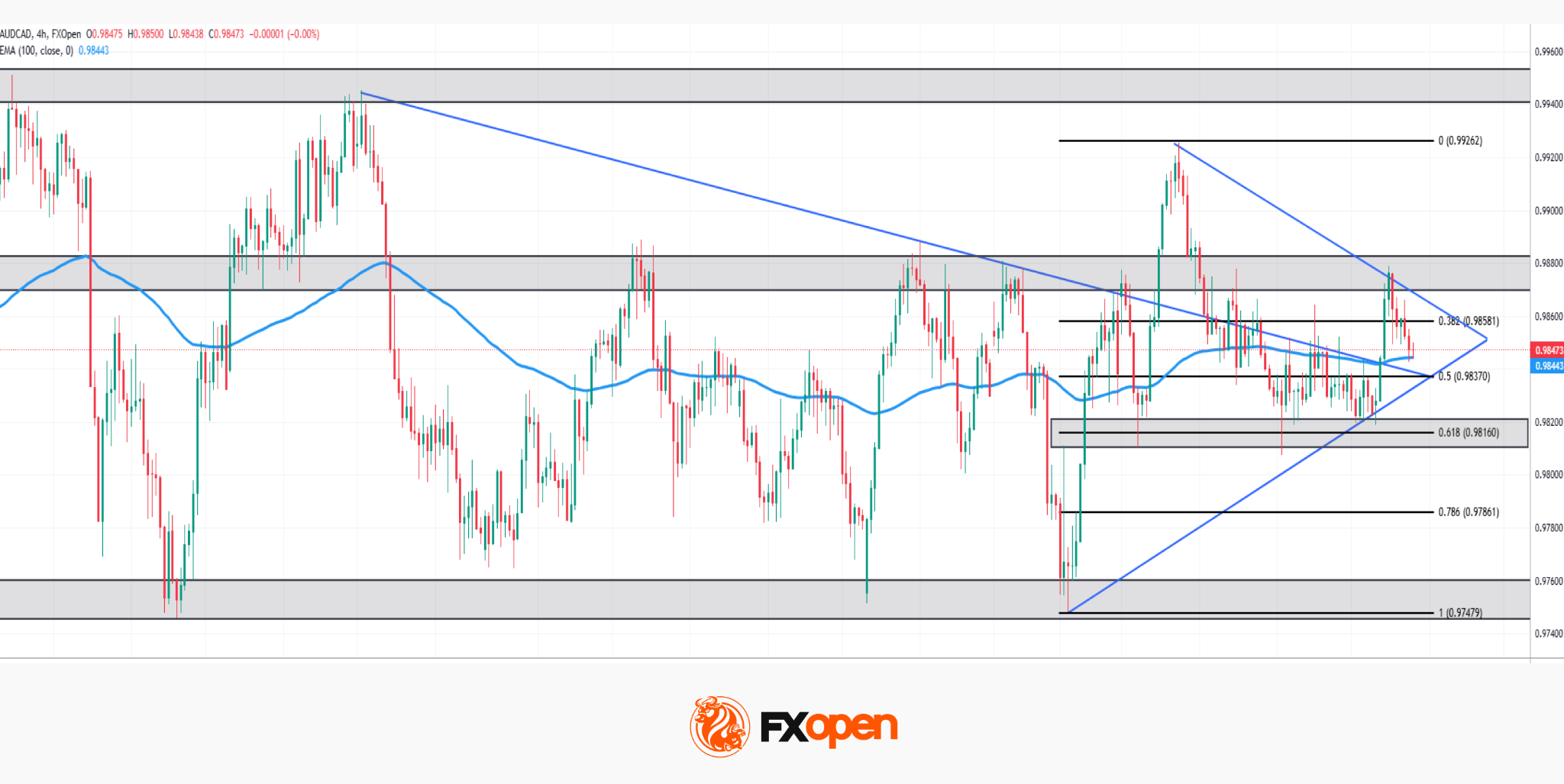
As the chart shows, AUD/CAD has been compressing into a symmetrical triangle since early August, with a descending trendline from the 0.9926 high converging with an ascending trendline off the 0.9748 low, both meeting right around current price near 0.9847, exactly where the 100-period EMA also sits.
Bullish Scenario
Should buyers break above the descending trendline and the 0.382 retracement near 0.9858, the path would open towards the 0 level at 0.9926, a confirmed breakout that would suggest genuine momentum returning to the pair.
Bearish Scenario
Conversely, a break below the ascending trendline and the 0.5 retracement near 0.9837 would expose the 0.618 level near 0.9816, with a deeper slide risking a retest of the 0.786 retracement around 0.9786, or even the 0.9748 low that anchored this entire structure.With price coiled right at the apex of this triangle, sitting exactly on the 100-period EMA, AUD/CAD looks primed for a decisive break, will the Aussie’s hawkish backing prove enough, or does the loonie’s stronger data ultimately win out?
Trade over 50 forex markets 24 hours a day with FXOpen. Take advantage of low commissions, deep liquidity, and spreads from 0.0 pips (additional fees may apply). Open your FXOpen account now or learn more about trading forex with FXOpen.
This article represents the opinion of the Companies operating under the FXOpen brand only. It is not to be construed as an offer, solicitation, or recommendation with respect to products and services provided by the Companies operating under the FXOpen brand, nor is it to be considered financial advice.


The newly authorized lenders will begin offering e-CNY services after completing operational and technical preparations.

As a writer, a university professor, artist, and designer, I worry about the risk that generative AI might destroy the delightful, human experience of carrying out acts of creation, not to mention making careers in the pursuit of that creativity unviable. Whether or not AI will improve work or destroy jobs, it already distances people from some of the moment-to-moment acts that might have felt gratifying just a few years ago. If AI can write your emails, then you don’t need to feel the click of keys under your fingertips or hear the clack they produce when you type with them. If AI can generate a gift list for the holidays or a vacation plan for Spring Break, then you don’t need to swipe through catalogs or thumb through guidebooks. In this way, AI can amplify the same dematerializing effects of technology people have encountered for years.
But that’s not the whole story. As critical of AI as I sometimes am, I have also found that AI can direct people back toward the physical world and the gratifying feelings it offers. LLMs can be quite adept at helping people figure out how to plan and carry out real-world tasks, such as fixing a plumbing leak, repairing a car, or learning a new hobby.
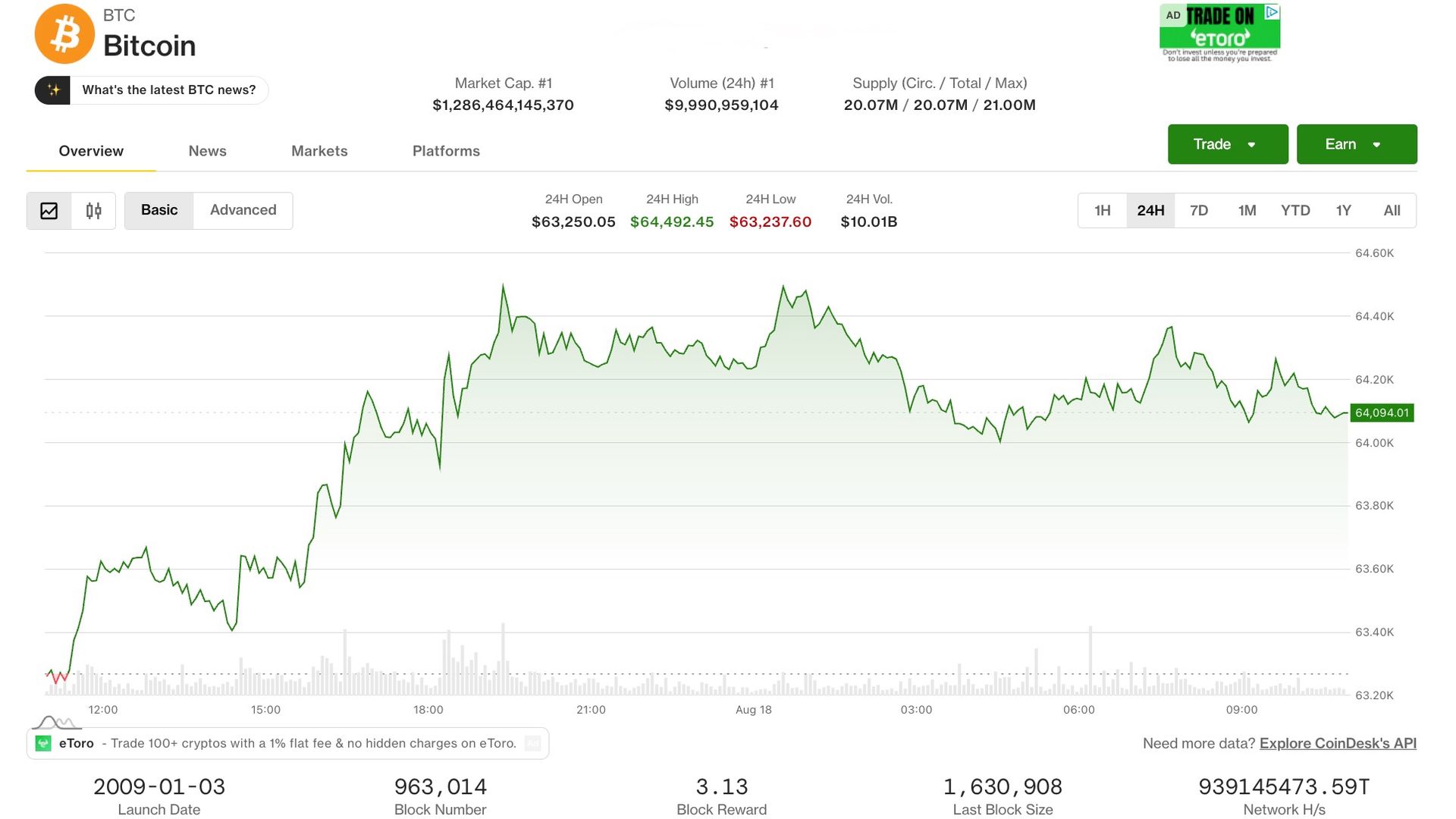
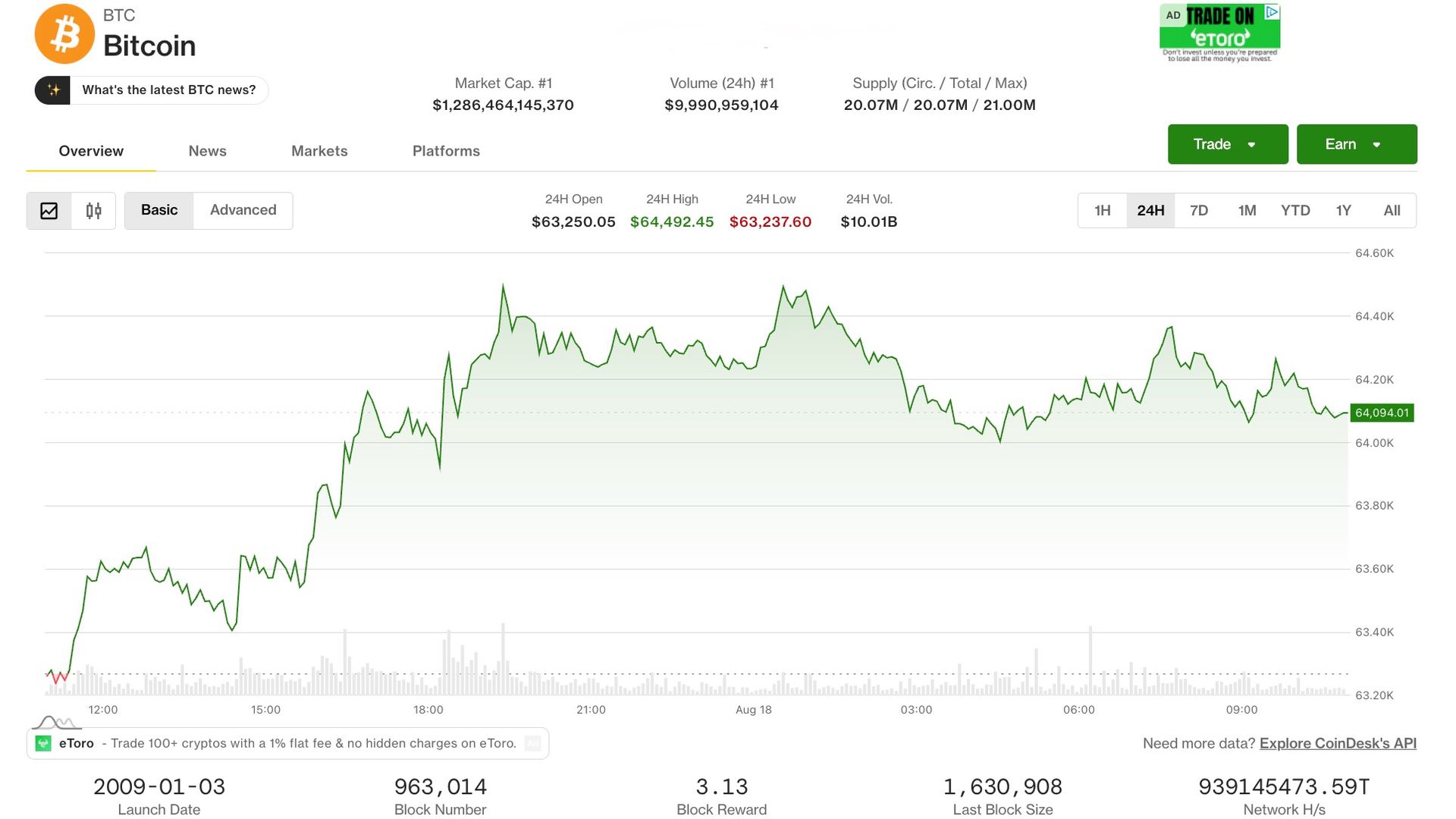
Bitcoin recently traded around $64,000, pausing after a rally that saw it rise from $62,600 on Monday. The largest cryptocurrency has dropped 0.6% since midnight UTC, trailing after Nasdaq 100 index futures, which lost 1.1% as U.S. Treasury bond yields and oil prices rose.
Ether lost around 1% since midnight and coins including SUI, XLM and TAO also dropped.
The increase in yields reflects unease ahead of the Federal Reserve minutes release due Wednesday after two consecutive softer inflation prints. Brent crude oil rose back to $94 per barrel after a 60-day US-Iran ceasefire expired Monday without a deal.
Also on Wednesday, U.S. President Donald Trump is expected to attend a meeting with crypto CEOs at the White House, with U.S. policy being a key driver of price action of late, contributing to the stop-start nature of bitcoin’s range-bound performance.
Derivatives positioning
- Taker ratio flips bullish: With BTC outperforming U.S. stocks on Monday, the long-short taker volume ratio in crypto futures flipped decisively from neutral to bullish, with longs accounting for over 51% of flow. Takers are traders who buy or sell at available prices, pulling liquidity from the order book.
- Funding rates confirm the chase for longs: BTC traders are chasing bullish bets, as evidenced by annualized perpetual funding rates surging to a 20-month high, according to data source CryptoQuant. Positive funding rates mean futures are trading at a premium to spot price, reflecting a bullish bias.
- BTC OI holds steady despite the move: Overall open interest (OI) in bitcoin futures remains near 750,000 BTC, a level it’s largely held for weeks.
- SOL sees a pickup in activity: OI in SOL futures rose to 66.88 million tokens, the most since July 10. Funding rates remain near zero.
- XLM shows a clear bearish tilt: The token has dropped nearly 3% to 15 cents since midnight, its lowest since May 27, reversing a pop to 27 cents at the end of May. Traders appear to be shorting the dip: OI in XLM futures rose 3.5% over the past 24 hours, the highest level since June 4. With annualized funding rates at -28%, that indicates a strong bearish bias. A negative 24-hour OI-adjusted cumulative volume delta (CVD) reinforces this picture, suggesting sellers are trading more aggressively via market orders rather than passive limit orders.
- Other notable OI movers: CC, DOGE and SUI are also among the notable OI gainers, though prices of all three are trading little-changed to negative. HBAR and CRO are notable OI losers.
- Bullishness looks selective, not broad-based: BTC is buoyant and showing buyer leadership, with a positive 24-hour CVD. Most of the other major cryptocurrencies, including ETH, SOL, LTC, LINK and DOGE, show negative CVD, suggesting the bullish sentiment is concentrated in BTC.
- Low volatility is inviting fresh positioning: Bitcoin and ether’s 30-day implied volatility indexes remain at the year’s lows. Trading firm TDX Strategies suggested using this low-vol environment to build tactical positioning favoring December optionality across BTC and select altcoins such as SOL and HYPE.
- Options flow leans toward upside bets: On Deribit, calls struck above BTC’s spot price continue to dominate 24-hour volume rankings. The $70,000-strike call expiring Sept. 25 is the most-traded bitcoin option of the past 24 hours. For ether, the $2,080 call expiring Aug. 28 leads.
Token talk
- PUMP rose 1.31%, holding a portion of Monday’s 7.8% surge that came alongside a 55% jump in daily trading volume to $90 million. The token has now stabilized above $0.00277.
- XMR added 0.59% since midnight to $417, taking the seven-day gain to more than 11%. The privacy coin has been one of August’s outperformers.
- SUI is the biggest laggard since midnight, sliding 4.62% to 64.36 cents, reversing a stretch of relative strength that had seen it outperform most layer-1s through late July.
- FET has shed 2.10% since midnight to 12.13 cents, extending a run of underperformance that has seen AI-adjacent tokens give back much of their late-July gains.
- LINK is down 1.45% at $9.39, retracing some of the gains that followed Standard Chartered’s prediction that called for it to rise by 2,000% by 2030. It remains up by 8% since that forecast.
Bitcoin price analysis is at a standstill, with BTC trading at $63,500 as of this writing, up around +1% on the day, a print that tells you almost nothing and everything about where this market sits right now. Rangebound is where we’re at right now, and only a significant catalyst, good or bad, can break Bitcoin out of its lull.
Jane Street’s disclosure of a $990M bitcoin ETF stake, coming on the heels of a reported $15Bn loss elsewhere in its book, has traders wondering if the near-billion-dollar BTC exposure is as bullish as it seems.
The broader tape backs that skepticism. Spot ETFs logged back-to-back outflows for the first time since late July, and BTC has slid from roughly $65,000 into the $63,000–$63,500 zone over the past week, about a 3% weekly drawdown. BTC feels trapped near $63,500 and capped below $64,000 through Monday’s session.
Layer in a 30-year Treasury yield hitting its highest level since 2007, and risk assets broadly are getting squeezed by a tightening liquidity backdrop that doesn’t discriminate between stocks and crypto.
Bitcoin Price Analysis: Can BTC USD Hit $65,000 This Week?
At $63,500 and up, just +0.8% over the past 24 hours, Bitcoin remains locked in the same range that’s defined trading since mid-August. CoinGecko data flags $62,600–$62,700 as the zone where dip-buyers keep stepping in, with $63,800 acting as near-term resistance on the way back up.
Zoom out and the wider structure holds: $62,000 as the key downside reference, $65,000 as the resistance level everyone’s watching on social feeds.
Volume hasn’t confirmed a breakout in either direction, which is the tell here. Miner selling and long liquidations have added friction on dips, while ETF outflows cap enthusiasm on bounces.
Bull case: a reclaim above $64,500, with volume follow-through, opens the door to a retest of $65,000.
Base case: continued chop between $62,800 and $64,000 while the market digests Jane Street’s position and waits on macro clarity.
Bear case: a break below $62,000 with rising Treasury yields accelerating outflows, dragging BTC toward the low-$60,000s. For a deeper technical breakdown on where support could give way next, this recent BTC forecast is worth a look.
Trade Bitcoin on Bybit and Get a Chance to Win Our $1,000 USDT Airdrop
Maxi Doge Targets Early Mover Upside as Bitcoin Tests Key Levels
The current Bitcoin price analysis highlights a market where the largest asset can’t clear $65,000, despite a near-billion-dollar institutional stake, which tells you something about the appetite for size.
Big positions moving at Jane Street’s scale don’t translate into 10x moves from here; the market cap is too large for that kind of convexity. That’s precisely the calculation driving traders toward earlier-stage plays where upside isn’t capped by nine-figure liquidity requirements.
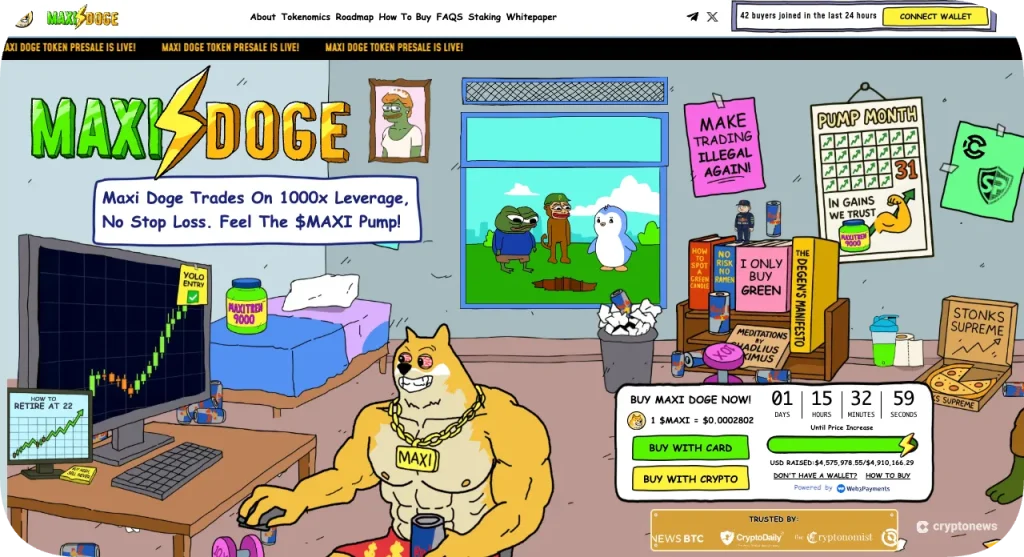
Maxi Doge ($MAXI) is leaning into that rotation with an unapologetic pitch: a 240-lb canine mascot built around 1000x leverage trading culture and holder-only trading competitions with leaderboard rewards. The presale has raised $4,844,784.51 at a current token price of $0.0002834, with dynamic APY staking live for early participants.
A Maxi Fund treasury backs liquidity and partnerships, and the meme-first marketing, gym-bro humor, “never skip leg-day, never skip a pump”, is clearly aimed at the same degenerate-trader demographic that made DOGE a household name.
Visit the Maxi Doge Presale Website Here.
Discover: The Best Crypto to Diversify Your Portfolio
The post Bitcoin Price Analysis: Can BTC Break Out of This Range and Hit $65K? appeared first on Cryptonews.


BitBox has released a firmware update fixing two severe vulnerabilities that could have exposed hardware wallet users to malicious firmware or caused Bitcoin to be locked to an unintended address.
Summary
- BitBox has patched two severe vulnerabilities affecting its BitBox02 and BitBox02 Nova hardware wallets.
- One flaw could have allowed malicious firmware installation, while another could have locked Bitcoin to an unintended address.
- BitBox said neither vulnerability had been exploited and no user funds were reported lost.
- The fixes follow a Coldcard firmware flaw linked to more than $112 million in Bitcoin thefts.
BitBox said in a security disclosure on Monday that the first vulnerability involved memory corruption affecting unconfigured Multi editions of the BitBox02 and BitBox02 Nova, while a second flaw affected the wallet maker’s Silent Payments implementation.
The company said it had found no evidence that either vulnerability had been exploited and had received no reports of users losing funds because of the flaws.
BitBox vulnerability could have allowed malicious firmware
For the first vulnerability, BitBox said a malicious host connected to an affected wallet could exploit memory corruption to execute arbitrary code before the device had been configured with a wallet.
Successful exploitation could potentially allow the host to install malicious firmware, creating a route through which funds could later be compromised, according to the company.
The exposure was limited to Multi editions of the BitBox02 and BitBox02 Nova that had not yet been set up. BitBox classified the vulnerability as severe because arbitrary code execution could undermine protections designed to prevent unauthorised software from running on the hardware wallet.
Firmware controls how a hardware wallet handles cryptographic operations, verifies transactions and communicates with a connected computer. BitBox said the vulnerability could therefore put funds at risk if an attacker managed to use the flaw to install malicious firmware on an affected device.
Similar hardware and firmware weaknesses have surfaced at other wallet makers in recent months. In June, crypto.news reported on a flaw in the TROPIC01 Secure Element used by Trezor Safe 7 devices after Ledger Donjon researchers carried out a laser fault injection attack during laboratory testing.
Trezor said its Safe 7 remained protected because the device uses three independent hardware security layers. According to the company, compromising TROPIC01 alone did not provide access to a user’s PIN, wallet or funds.
Tropic Square had provided the chip to Ledger Donjon for independent testing, with researchers notifying the company in January that they had extracted some chip secrets and bypassed firmware signature checks using the laboratory attack.
Another hardware attack disclosed in July allowed Ledger Donjon researchers to reset the password on a Tangem wallet card using a targeted laser pulse against its secure element.
Ledger Donjon said the attack required physical possession of the card, invasive preparation, specialist knowledge and laboratory equipment costing about $250,000. Tangem described the everyday risk to customers as “virtually non-existent,” while advising users to keep their wallet cards physically secure.
Silent Payments flaw could have locked Bitcoin
BitBox’s second severe vulnerability affected Silent Payments, a Bitcoin privacy feature that allows users to receive payments without publishing a new address for each transaction.
According to BitBox, a malicious host could exploit the implementation to cause Bitcoin to be locked to an unintended address.
Direct theft was not possible through the vulnerability, the company said. An attacker could instead leave the victim unable to recover the Bitcoin without cooperation and potentially demand a ransom in exchange for helping unlock the coins.
Such an attack would not automatically transfer control of the affected Bitcoin to the malicious host, but BitBox said the vulnerability could still put funds at risk by making them inaccessible to their owner.
The company addressed the problem through its latest firmware update and said it had received no reports of the Silent Payments flaw being exploited.
BitBox has dealt with other security issues through firmware updates this year. Its Oeschinen update in July included several security fixes, including one for a buffer out-of-bounds write affecting the BitBox02 firmware and bootloader.
According to the company’s disclosure at the time, a USB request accepted a length value without properly checking it against the size of the destination buffer, creating a potential route for a malicious host to trigger an out-of-bounds write.
BitBox said no working exploit had been demonstrated for that vulnerability, although an effect on control flow could not be completely ruled out.
Earlier in January, the company also patched two BitBox02 Nova vulnerabilities reported through its bug bounty programme. BitBox classified the issues as minor and moderate because exploitation required advanced physical access and applied only under specific conditions.
Coldcard firmware flaw has put wallet security under scrutiny
BitBox’s update follows the disclosure of a separate Coldcard firmware flaw linked to more than $112 million in stolen Bitcoin after the vulnerability remained undetected for more than five years.
Galaxy Research said Friday that Coldcard-related losses had exceeded $112 million, with approximately 1,778.6 BTC swept from more than 8,600 addresses.
The vulnerability was traced to a firmware change introduced in March 2021 that affected the randomness used to generate wallet seeds. Attackers could brute-force impacted seeds and derive the corresponding private keys without obtaining physical access to the hardware wallet, according to research into the incident.
A wallet seed is used to derive the private keys controlling its cryptocurrency. Weaknesses that reduce the randomness used during seed generation can therefore reduce the number of possible combinations an attacker needs to test.
For users whose wallets were created with affected Coldcard firmware, updating the device alone would not repair a seed that had already been generated with weak randomness. Moving funds to a wallet created from a newly generated secure seed would be required to remove exposure associated with the compromised seed.
The incident affected a hardware wallet line that received its first major hardware revision in several years earlier in 2026. Coinkite launched the Coldcard MK5 in March, with the device becoming the first hardware update to its flagship MK series since the MK4 arrived in 2022.
The MK5 retained the previous model’s dual secure-element architecture using chips from two different vendors and kept private keys air-gapped. Its main changes included a 1.54-inch Gorilla Glass display, redesigned physical buttons and improved NFC functions.
Coinkite said at the time that the five major MK5 upgrades focused on usability while preserving the security architecture used by the previous model.
Customer data leaks have created separate phishing risks
Hardware wallet owners have also faced security incidents outside the devices themselves, with recent breaches involving Trezor and SafePal exposing customer and order information belonging to more than 53,000 people.
Trezor attributed the exposure of information belonging to 13,689 customers to shipping provider ShipMonk. SafePal separately said an authorisation flaw in an order-tracking plug-in exposed details connected to 39,798 customers.
Neither incident compromised the companies’ hardware wallets, private keys or recovery phrases, according to the respective disclosures. Both companies warned that exposed personal and order information could instead be used for targeted phishing and impersonation attempts.
Such information can give attackers details needed to make wallet-related scams appear more credible. Earlier in February, attackers sent physical letters impersonating Trezor and Ledger and instructed recipients to complete supposed authentication or transaction checks.
The physical phishing campaign used official-looking correspondence containing QR codes that directed recipients to malicious websites. Some letters created urgency by claiming users had to complete an authentication process to avoid problems accessing their wallets.
The websites asked victims to enter 12-, 20- or 24-word recovery phrases under the pretence of verifying ownership. Once submitted, the phrases were transmitted to the attackers, allowing them to recreate the wallets and gain control over the associated funds.
Trezor and Ledger said legitimate hardware wallet providers do not ask customers to enter, scan, upload or share recovery phrases through websites or other external channels. Recovery phrases should only be entered directly on a hardware wallet when restoring a wallet, according to the companies.
Crypto exchange Kraken has launched trading in more than 7,000 U.S.-listed stocks for eligible customers across the European Economic Area, placing traditional shares alongside more than 700 tokenized xStocks and over 600 crypto assets in the same account.
Summary
- Kraken has launched trading in more than 7,000 U.S. stocks for eligible customers across the EEA.
- Customers can access traditional U.S. shares alongside more than 700 xStocks and over 600 crypto assets.
- The stock service is provided through Kraken’s MiFID II authorised Cyprus investment firm.
- xStocks have generated more than $38 billion in total transaction volume since launching in June 2025.
The Block reported on Aug. 18 that the service has become available across the EEA after Kraken quietly began introducing stock trading to customers in Germany, the Netherlands and France in recent days.
The rollout takes Kraken’s traditional equities business outside the United States, where the exchange first entered stock trading in 2025, while giving European customers two ways to gain exposure to U.S.-listed companies through the same platform.
Kraken said eligible EEA customers can buy traditional shares or use xStocks, its blockchain-based products tied to listed equities and exchange-traded funds. Both products can be accessed without transferring funds between separate platforms.
“With U.S.-listed stocks and xStocks available side-by-side in a single regulated account, customers can choose how they access the same underlying exposure — whether through traditional shares or tokenized representation — without moving capital or changing platforms,” Mark Greenberg, chief commercial officer of Kraken parent Payward and head of Payward Services, said in a statement.
Kraken U.S. stock trading reaches eligible EEA customers
Access covers more than 7,000 traditional U.S. stocks through the desktop and mobile versions of Kraken Pro as well as the main Kraken mobile app.
Kraken said stock trades will carry no trading commission, subject to its applicable terms. Eligibility will not be automatic for every existing customer, however, as users must accept additional terms and conditions before the equities feature becomes available.
The service is being provided by Payward Europe Digital Solutions (CY) Limited, a Cyprus investment firm authorised under the European Union’s Markets in Financial Instruments Directive II, or MiFID II.
Alongside the conventional securities offering, customers can access more than 700 xStocks and over 600 crypto assets through their Kraken accounts. The company said xStocks have processed more than $38 billion in total transaction volume since launching in June 2025.
Kraken describes the setup as distinct from European platforms that provide only one form of U.S. equity exposure. Bitpanda offers traditional U.S. stock trading, while platforms including Robinhood and Crypto.com have introduced tokenized U.S. equity products for European users.
Crypto.com, for example, recently launched tokenized stock derivatives tracking about 1,500 U.S. stocks and ETFs for eligible EEA customers and users in other approved markets. Its products provide synthetic price exposure and do not give buyers legal or beneficial ownership of the underlying securities.
xStocks have moved into more parts of Kraken’s trading system
Kraken has continued adding functions to xStocks since the products were introduced in June 2025, taking them beyond instruments used solely to track the price of conventional equities.
In July, crypto.news reported on Kraken allowing eligible users to post selected xStocks as collateral for futures and margin positions on Kraken Pro. Ten assets initially qualified, including tokenized versions of Apple, Nvidia, Tesla, Strategy, Robinhood, the SPDR S&P 500 ETF and the Invesco QQQ ETF.
Futures collateral was made available to qualifying clients outside the United States, including customers in the EEA. Margin collateral was offered outside the U.S. but excluded EEA clients.
Kraken had also developed dedicated onchain infrastructure for the product earlier in 2026. Its xStocks platform introduced xChange in March, an execution layer initially supporting more than 70 tokenized equities across Ethereum and Solana.
At that point, xStocks had generated about $25 billion in total trading volume, including $3.5 billion in onchain transactions, while more than 80,000 onchain holders had interacted with the products. Each token was described as fully collateralised and backed 1:1 by its corresponding underlying security.
Kraken’s current figures put total xStocks transaction volume above $38 billion, showing how quickly activity has increased since the March tally.
Payward is taking xStocks into more international markets
Payward has also been preparing to add equities from markets outside the United States to the xStocks system.
A July partnership with GTN set out plans to begin with Hong Kong-listed shares before adding securities from the United Kingdom, Europe, South Korea and other markets, subject to the necessary licences and regulatory approvals.
Under the agreement, GTN is providing execution, custody, ledgering and record-keeping infrastructure across more than 90 financial markets, while Payward continues to supply the tokenization infrastructure used to create the blockchain-based assets.
At the time of the July announcement, xStocks supported more than 500 tokenized assets and had generated over $37 billion in transaction volume. Payward also said GTN could eventually distribute xStocks to institutional customers once the required approvals are secured in individual markets.
The latest EEA rollout concerns conventional U.S.-listed securities alongside existing xStocks, while Kraken said it plans to take the combined traditional-stock and tokenized-equity service into additional markets over the coming months.
Tokenized equities have taken a larger share of RWA activity
The expansion comes as tokenized equities have become a larger part of the real-world asset market.
According to figures cited by The Block, tokenized equities now account for about 15% of the RWA market, around three times their share at the start of 2026. The segment has reached roughly $2.8 billion in total market capitalisation, with Ondo Finance, Binance’s bStocks and Kraken’s xStocks accounting for a combined 77%.
Kraken has also expanded what holders can do with the securities represented through xStocks. Earlier in August, the platform extended shareholder voting rights to more than 125,000 xStocks holders, allowing eligible investors to instruct the underlying custodian on how votes should be cast at company shareholder meetings.
The feature changed the original structure of xStocks, which did not provide voting rights when the products launched in June 2025. The arrangement relies on the custody structure operated by Backed Assets (JE) Limited, according to the report.
Kraken parent Payward, meanwhile, reported $508 million in adjusted revenue for the second quarter, up 17% from the same period a year earlier. Adjusted EBITDA reached $23 million for the three months ended June 30.
Total platform transaction volume fell 13% year over year to $310 billion during the quarter, while Payward reported that the composition of trading activity moved toward equities and tokenized equities.

The distinction between ugliness and vulgarity feels important now. Beauty often depends on proportion and on how well a building, an object, or an image relates to the world around it. Ugliness can challenge expectations and still be intelligent, deliberate, and even beautiful in its own way.
Vulgarity is different. It begins when scale, excess, or attention-seeking overwhelms context altogether.
Architecture, automobiles, and commercial environments make claims on people who have no part in choosing them. When houses squeeze into their lots, vehicles grow more imposing, and storefronts battle for attention, the problem is no longer simply whether something is beautiful or ugly. Vulgarity becomes consequential when it overwhelms the environment everyone shares.
The objects we design and consume reveal what we value, and more and more of them seem to reflect an increased appetite for more. Which leaves me wondering about one of design’s oldest and most human questions: How much is enough?
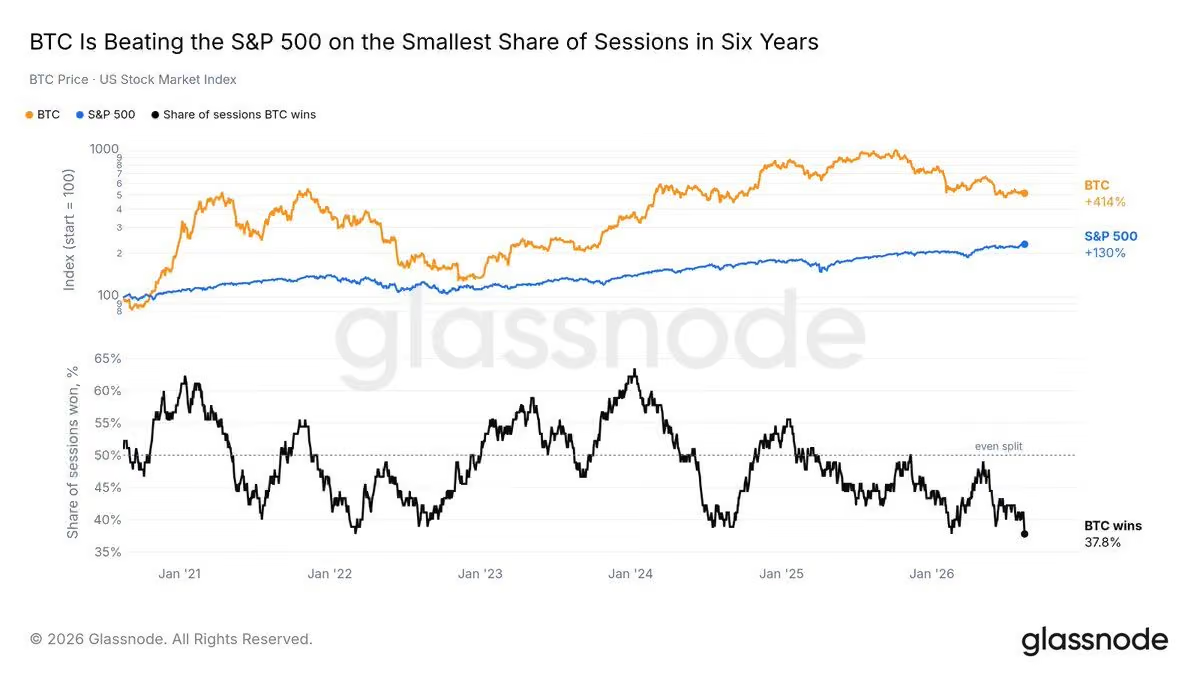
Bitcoin scored a rare achievement on Monday by outperforming the S&P 500.
The largest cryptocurrency rose 2.6% to over $64,000, registering its best daily performance in over a month, according to CoinDesk data. Wall Street’s benchmark equity index, S&P 500, fell by 0.52%.
Bitcoin, therefore, not only outpaced equities but moved in the totally opposite direction. This was once a norm. Bitcoin has spent most of its history being the higher-beta asset relative to stocks, meaning it typically moves more than stocks in both directions.
“BTC outperformed the stock market today. This has become a less common occurrence lately. 1/2 In fact, BTC only outperformed the S&P 500 on around one third of trading days over the last three months,” blockchain analytics firm Glassnode said in a Telegram chat.

Underperforming two-thirds of the time means BTC has been acting less like a higher-beta asset relative to stocks and more like a laggard. Key reasons for that include the AI stock frenzy on Wall Street that has sucked out capital from other corners of the financial market, including cryptocurrencies.
The bear market phase of bitcoin’s self-fulfilling four‑year cycle has also played a role in keeping demand for BTC subdued. BTC peaked above $126,000 in October last year and quickly entered the bear market, which is expected to bottom out by October this year.
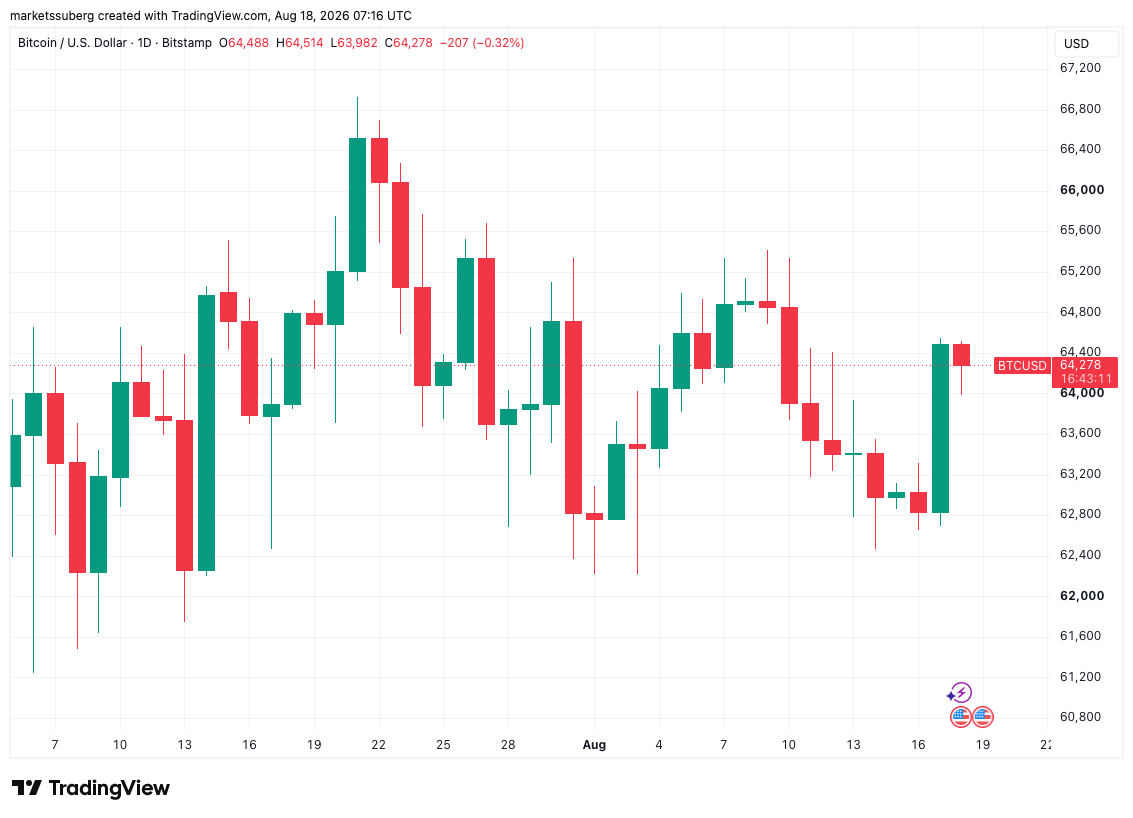
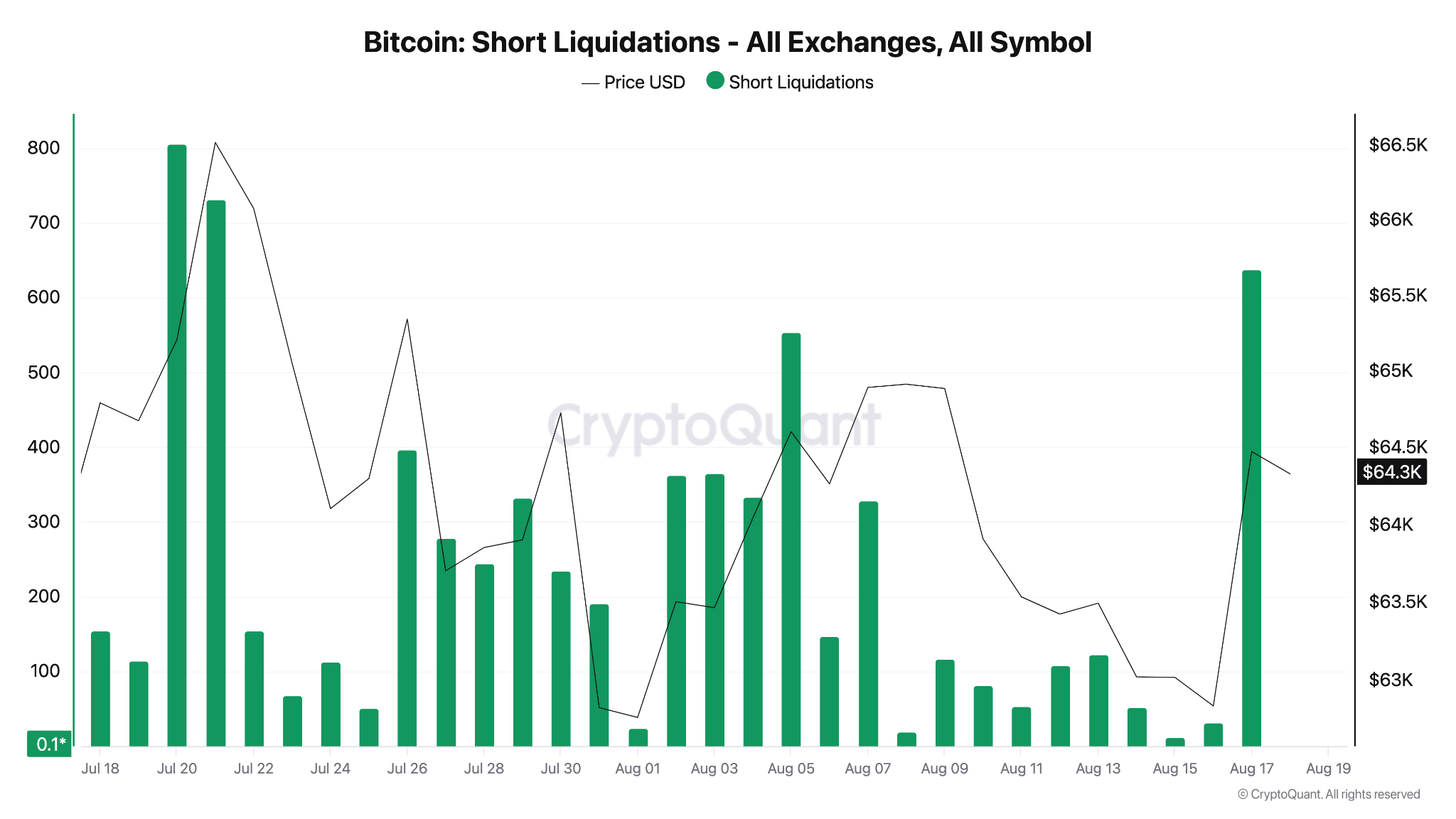
Bitcoin (BTC) short liquidations hit their highest in almost one month as it hit $64,500 on Monday, new data reveals.
Key points:
- Bitcoin passed $64,000 thanks to a short squeeze on derivatives markets, CryptoQuant says.
- An ongoing downward funding-rate reset from 0.006% to 0.003% over 24 hours could mean further short squeezes.
- The absence of spot demand raises doubts whether the upside is sustainable after a week of $267.2 million in net ETF outflows.
Bitcoin short liquidations near one-month high
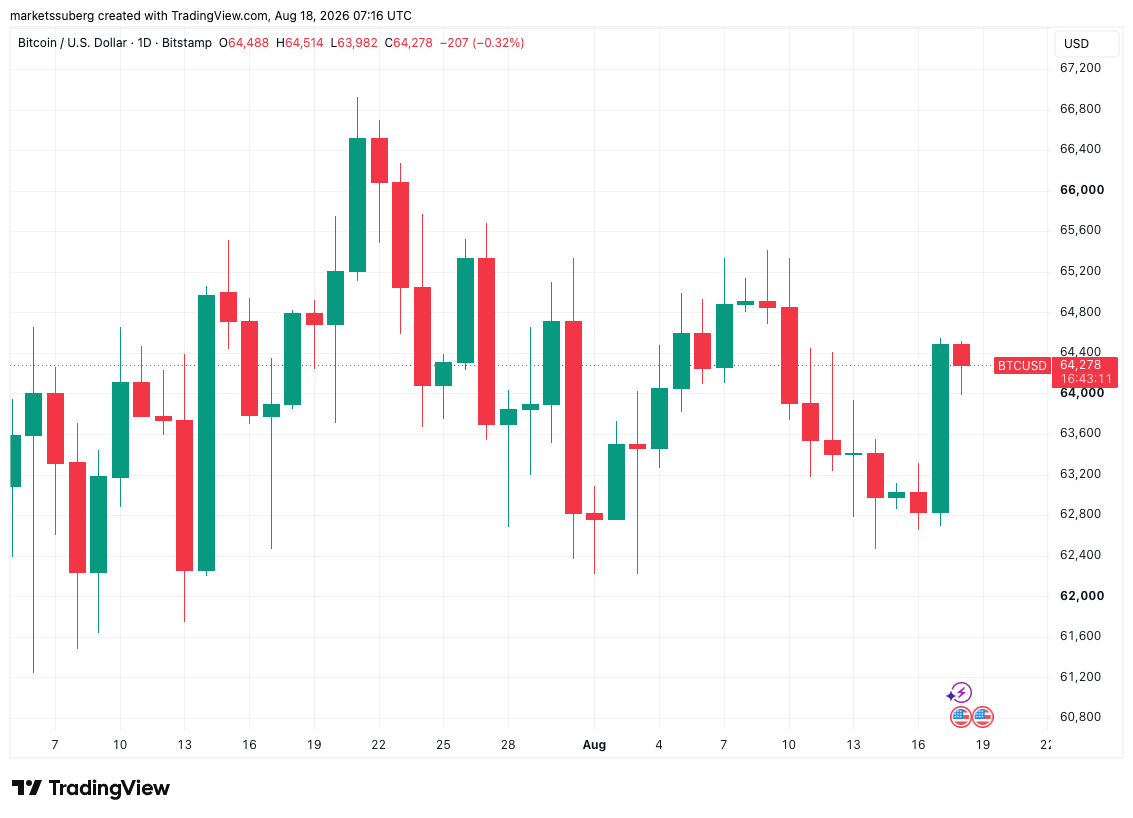
BTC/USD rallied after Sunday’s weekly close, gaining up to 3% on Monday to top out at one-week highs of $64,550 on Bitstamp.
BTC/USD one-hour chart. Source: Cointelegraph/TradingView
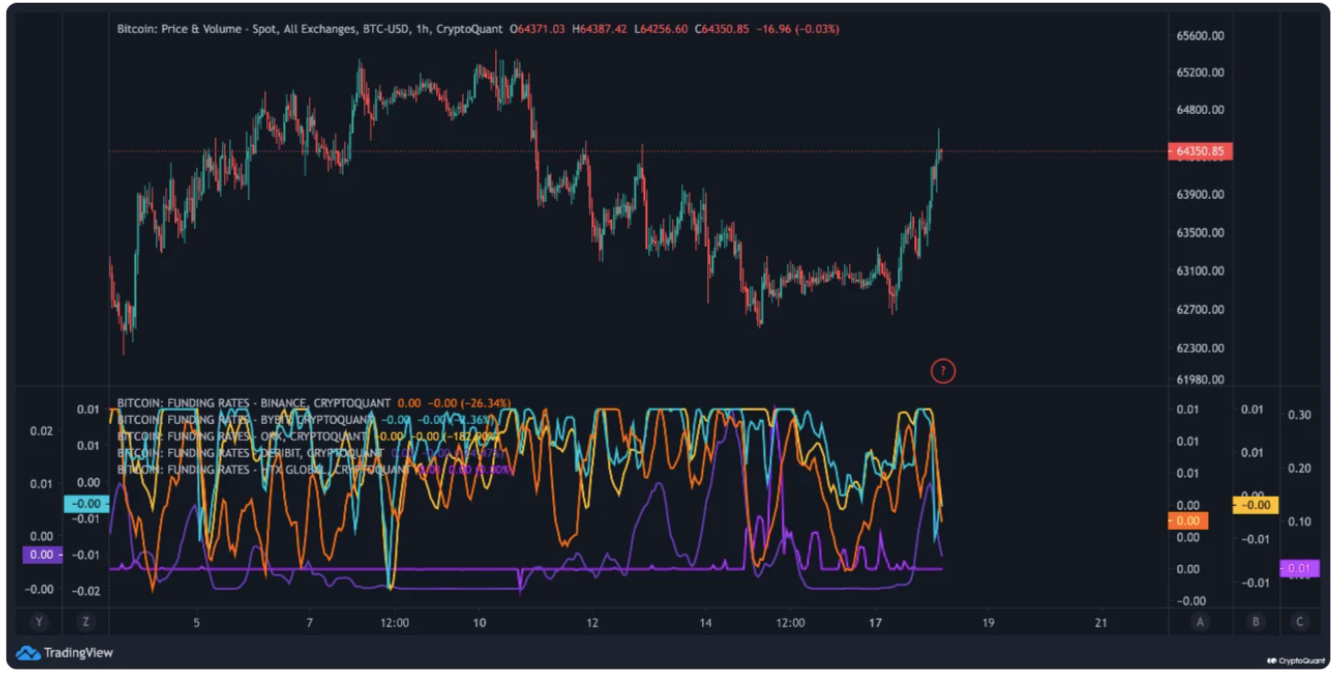
Examining the impetus behind the latest BTC price gains, onchain analytics platform CryptoQuant pointed to illiquid markets and funding-rate imbalances among exchanges.
Before rebounding on Monday, BTC circled near $62,750. Around this level, funding rates between exchanges began to diverge. Shorts were dominant on major platforms such as Binance, Bybit, OKX and Deribit, while the funding rate on HTX briefly spiked to 0.05%.
Funding rates refer to periodic payments exchanged by long and short traders on Bitcoin derivatives markets in order to maintain their positions. Positive aggregate funding rates show that long traders are actively paying shorts, with the reverse true for negative funding rates.
“This crowded short positioning served as the primary catalyst, fueling a short squeeze that drove prices higher,” CryptoQuant continued.
BTC/USD one-hour chart with exchange funding-rate data (screenshot). Source: CryptoQuant
Data puts total Bitcoin short liquidations at 637 BTC for Monday, the largest single-day tally since July 21.
Describing the event as a “low-volume liquidity trap,” CryptoQuant nonetheless suggested that the market could see more short squeezes next, with funding rates already declining again as traders increase short exposure.
Bitcoin short liquidations. Source: CryptoQuant
Crucial spot demand remains absent
Previously, Cointelegraph reported that Bitcoin futures markets accounted for the majority of trading volume in the current range, with spot traders broadly uninterested.
Related: BTC price loses 200-week trend line as 2022 repeats: Five things to know in Bitcoin this week
In further analysis on Monday, CryptoQuant called the lack of spot demand the primary hurdle to sustained upside, alongside the lack of inflows to the US spot Bitcoin exchange-traded funds (ETFs).
“A break below $60K alongside rising exchange inflows would weaken the structure and increase downside risk toward $50K. Selling pressure is cooling, but demand still needs to return,” it commented.
Recent buyers who remain underwater on their BTC allocation have helped cement the current trading range. Short-term holders — wallets holding a UTXO for less than 155 days — have their cost basis at around $68,700, reinforcing that level as resistance.

First products revealed in Sephora’s beauty advent calendar 2026

Prairie Operating: Q2 Exposed The Equity Problem (NASDAQ:PROP)

AUD/CAD: Two Hawkish Central Banks, One Triangle Left to Break


-

 Fashion4 days ago
Weekend Open Thread: Ann Taylor
-
 NewsBeat6 days ago
Communication cards help banking customers access services or report scams
-
 Sports4 days ago
This U.S. Amateur is a glimpse into golf’s future in more ways than you think
-

 Sports3 days ago
Birmingham 2026: Day 6 Timetable for Irish Athletes
-
 NewsBeat3 days ago
Myanmar says over 300,000 Rohingya refugees verified for repatriation as exodus enters ninth year
-

 Politics3 days ago
SEQ Code: The Three Letter Boarding Pass Code That Could Give You The Worst Seat
-
 Entertainment6 days ago
Keke Palmer Subtly Hints At Sean Evans Drama With Cryptic Post
-
 Tech4 days ago
11 Ways to Rank Your Videos
-

 Fashion7 days ago
Coffee Break: The Fonteyn Jane Flat
-

 Fashion7 days ago
Should you refinance your debt? Pros, cons, and real numbers
-

 Tech7 days ago
Zoom Screen-Sharing Bug Let People Fully Take Over Other Devices On A Call
-

 Fashion7 days ago
Claire Life: Kicking Off MVAAFF With the C Suite Luncheon Featuring Phylicia Rashad, Letoya Luckett, and More!
-
 Crypto World6 days ago
XRP bridge drained after software mistook fake deposits for real ones
-

 Tech5 days ago
DeepSeek Harness launches as open source rival to Claude Code, alongside V4-Pro on API with higher prices
-

 Sports6 days ago
DeQuan Jones in ‘high spirits’ after successful leg surgery
-

 Tech6 days ago
SpaceXAI’s Grok Bot turns agents into persistent digital coworkers that can operate your apps for $120-per-month
-

 Politics6 days ago
How Average Are You In The UK?
-
 Crypto World6 days ago
Perplexity AI Predicts an XRP Scenario Few Analysts Are Discussing
-

 Politics7 days ago
In the Chris Kaba case, the police watchdog capitulated to the mob
-

 NewsBeat6 days ago
‘Regret is a major theme of my work’: Matt Haig on finding acceptance
You must be logged in to post a comment Login