

Crypto World
Aave Labs Outlines Layered Security Plan for V4 After $1.5 Million Audit



Aave Labs is going all in on security ahead of its V4 launch.
The team has spent about $1.5 million on an extensive audit program, making it one of the most intensive security reviews in DeFi so far.
The review process lasted roughly 345 days and involved several security firms, as well as a large public audit contest.
The era of “move fast and break things” is fading. In today’s market, resilience and security are becoming the real competitive edge.
- Audit Scale: The $1.5 million program covered 345 days of cumulative review across four major firms and 900+ independent researchers.
- V4 Architecture: Aave has shifted to a “security-first” model where formal verification runs parallel to code writing, not after.
- TVL Implication: The zero-critical-finding result from the public contest signals institutional-grade readiness for V4 liquidity scaling.
Aave Labs $1.5M Audit Program: What the Investment Signals About V4 Risk
The V4 audit went far beyond a normal protocol upgrade.
Backed by funding from the Aave DAO, the team brought in major security firms like ChainSecurity, Trail of Bits, Blackthorn, and Certora. Instead of one audit pass, the code was tested from multiple angles.
Altogether, the protocol underwent nearly a full year of testing by internal teams, external auditors, and independent researchers. One of the biggest phases was a six-week public security contest on Sherlock between December 2025 and January 2026.
More than 900 researchers joined the contest and submitted over 950 findings. Despite that massive review, no critical or high-severity vulnerabilities were found.
That clean result strengthens confidence in Aave’s hub-and-spoke architecture, which was designed to reduce the protocol’s overall attack surface.
Aave V4’s Layered Security Model: How It Works and Why It’s Different
Aave Labs is moving away from the old “build first, audit later” approach. With V4, security teams are working alongside developers from day one.
The framework revolves around five core ideas: formal verification to mathematically test the code, layered reviews combining manual audits and automated testing, continuous checks on every code update, ongoing bug bounties, and AI tools scanning for unusual attack paths.
The AI element stands out. Automated systems can catch edge cases that human auditors might miss. Verification firm Certora helped define strict rules, called invariants, that the code must always follow before it even reaches manual review.
Early researchers who examined the code described it as unusually clean for a pre-audit project. The architecture also reduces the attack surface, helping eliminate common DeFi exploit points before launch.
Security is becoming a major competitive advantage in DeFi. Institutional capital will not touch protocols that carry unknown smart contract risk. Spending $1.5 million upfront on security is a small price to pay for the value locked in the protocol, but it sends a strong trust signal.
The next key test will come after launch. If Aave V4 runs its first months without major issues, cautious capital that has stayed away from DeFi after recent hacks could start flowing back in.
The post Aave Labs Outlines Layered Security Plan for V4 After $1.5 Million Audit appeared first on Cryptonews.


Security researchers say a bug in Solv Protocol’s smart contracts allowed an attacker to mint an outsized amount of a Bitcoin-backed token and swap it for SolvBTC, the Bitcoin-pegged asset on the Solv network. In total, the incident is estimated at $2.7 million in losses, while the attacker minted 38.05 Solv Protocol BTC (SolvBTC) tokens before converting the bulk into a position on SolvBTC. Solv said fewer than ten users were affected and that it has deployed mitigations and engaged multiple security firms to investigate the exploit. The incident underscores ongoing security challenges in DeFi vaults that rely on cross-chain assets and minting logic.
Bitcoin-based DeFi platforms continue to attract attention for the financial leverage they offer across chains, but this episode shows how a single vulnerability can ripple through a broader ecosystem. The attacker’s maneuver involved 22 separate minting events, culminating in a swap that moved most of the minted tokens into just over 38 SolvBTC, a token pegged to Bitcoin. Pseudonymous researchers described the vulnerability as a re-entrancy-like flaw, a class of attack that has repeatedly exposed weaknesses in smart contracts where external inputs can provoke unintended minting or asset creation. While the precise chain of events remains under audit, the core insight is clear: minting controls on DeFi assets tied to real-world reserves demand robust, multi-layered safeguards.
Solv Protocol has been forthright about its response. In a public post on X, the team explained that they have put measures in place to prevent a recurrence and are collaborating with security firms Hypernative Labs, SlowMist, and CertiK to conduct a comprehensive review. A 10% bounty was offered to the attacker in exchange for returning the stolen funds, a strategy designed to recover value while maintaining a channel for dialogue. So far, there has been no confirmed on-chain communication from the attacker to the bounty address, according to Etherscan data, complicating any near-term recovery plan.
Solv Protocol’s model hinges on Bitcoin deposits backing Solv Protocol BTC, enabling users to lend, borrow, or stake across interconnected blockchains. The project has stressed that it possesses a substantial on-chain Bitcoin reserve—reported at roughly 24,226 BTC, valued at more than $1.7 billion at the time of reporting. This scale underscores the potential systemic impact of the breach, even if the immediate exposure to users appears limited. The event also places a spotlight on the resilience of liquidity providers across cross-chain ecosystems, where smart contract design, reserve accounting, and user protection mechanisms must align to prevent similar exploits in the future.
Initial assessments point to a flaw within a Solv smart contract that allowed excessive minting of a token used within the protocol. Security researchers describe this as a re-entrancy vulnerability, a persistent threat in DeFi that takes advantage of unexpected inputs to force asset creation beyond intended limits. The discourse around the incident has touched on broader lessons for DeFi—namely, the importance of formal verification, rigorous contract auditing, and robust guardrails for minting functions tied to real-world assets. The Solv incident joins a growing catalog of DeFi security episodes that encourage protocols to bake in stronger checks and consensus-driven escalation paths before minting or locking value.
Solv has provided a public wallet address in its update to encourage the attacker to participate in the bounty program. Yet, as of the latest blockchain checks, no on-chain message had arrived at that address. The lack of a reply is a reminder that, even with incentives, adversaries may delay or avoid engagement, leaving affected users and the ecosystem in a state of limbo as investigators map the full scope of the breach. The situation continues to evolve as security firms parse call traces, contract states, and token movements to determine whether additional exploits are possible or if the incident has crossed a boundary into a recoverable event.
The broader crypto community is watching how Solv and its security partners respond to this breach. The cross-chain nature of Solv’s products, coupled with the size of its Bitcoin-backed reserve, makes this incident more than an isolated hack; it tests the durability of risk controls, incident response, and incentive-driven remediation in DeFi’s Bitcoin-linked layer. While the immediate loss is tangible, the longer-term implications hinge on how effectively Solv can close the vulnerability, reassure participants, and demonstrate that cross-chain lending and staking platforms can withstand sophisticated, multi-stage exploits without eroding confidence in the underlying mechanics of wrap-and-bridge systems.
The event also highlights the tension between open, incentive-aligned security practices and the risk of misaligned incentives when large sums are at stake. As Solv and its partners conduct their audits and implement additional safeguards, observers will look for a clear roadmap outlining contract upgrades, formal verification steps, and a revised risk framework for minting and reserve management across Bitcoin-backed tokens. In an ecosystem where liquidity is a prized asset, the balance between rapid response and thorough, verifiable remediation remains the defining challenge for DeFi builders and auditors alike.
Why it matters
From a technical perspective, the Solv Protocol breach underscores how minting controls in DeFi products tied to real assets require exceptionally robust safeguards. A single bug in a contract that governs token creation can unlock outsized supply, enabling attackers to siphon value before guardrails activate. For users, the incident raises questions about the reliability of Bitcoin-backed DeFi vaults and the timeline for remediation—factors that influence whether liquidity remains available and secure across connected chains.
From a market perspective, the breach occurs against a backdrop of ongoing scrutiny of DeFi security practices, audit standards, and bug-bounty programs. The involvement of established security firms signals a serious investigative effort, but the absence of a public attacker-led recovery also underscores the fragility of trust when large on-chain reserves are at stake. For builders, the episode reinforces the need to implement multi-sig governance, formal verifications, and fail-safes that prevent minting beyond predefined caps, especially in systems that bridge Bitcoin to other networks.
For investors and users, the incident serves as a reminder to assess not only the yield or liquidity benefits of cross-chain DeFi products but also the depth and rigor of their security programs. The deployment of independent audits, transparent incident timelines, and concrete upgrade roadmaps will be critical in restoring confidence as the ecosystem weighs the trade-offs between innovation and safety in complex, asset-backed DeFi architectures.
What to watch next
- Updates from Hypernative Labs, SlowMist, and CertiK on the ongoing audit findings and patch implementations.
- Any further on-chain movements of the minted tokens or the SolvBTC asset, including potential recoveries or additional seizures.
- New governance or contract upgrades that address minting guards, emergency pause mechanisms, and reserve reporting.
- Public communications from Solv Protocol about timelines for remediation and user restitution, if applicable.
Sources & verification
- Solv Protocol’s official X posts detailing the incident and bounty offer.
- On-chain data and the transaction reference 0x44e637c7d85190d376a52d89ca75f2d208089bb02b7c4708ad2aaae3a97a958d.
- Public comments from security researchers (Hypernative Labs, SlowMist, CertiK) as cited in related updates.
- The reported figure of 24,226 BTC in Solv’s Bitcoin reserve and the broader context of SolvBTC as a Bitcoin-backed token.
Solv Protocol breach exposes risk in Bitcoin-backed DeFi vaults
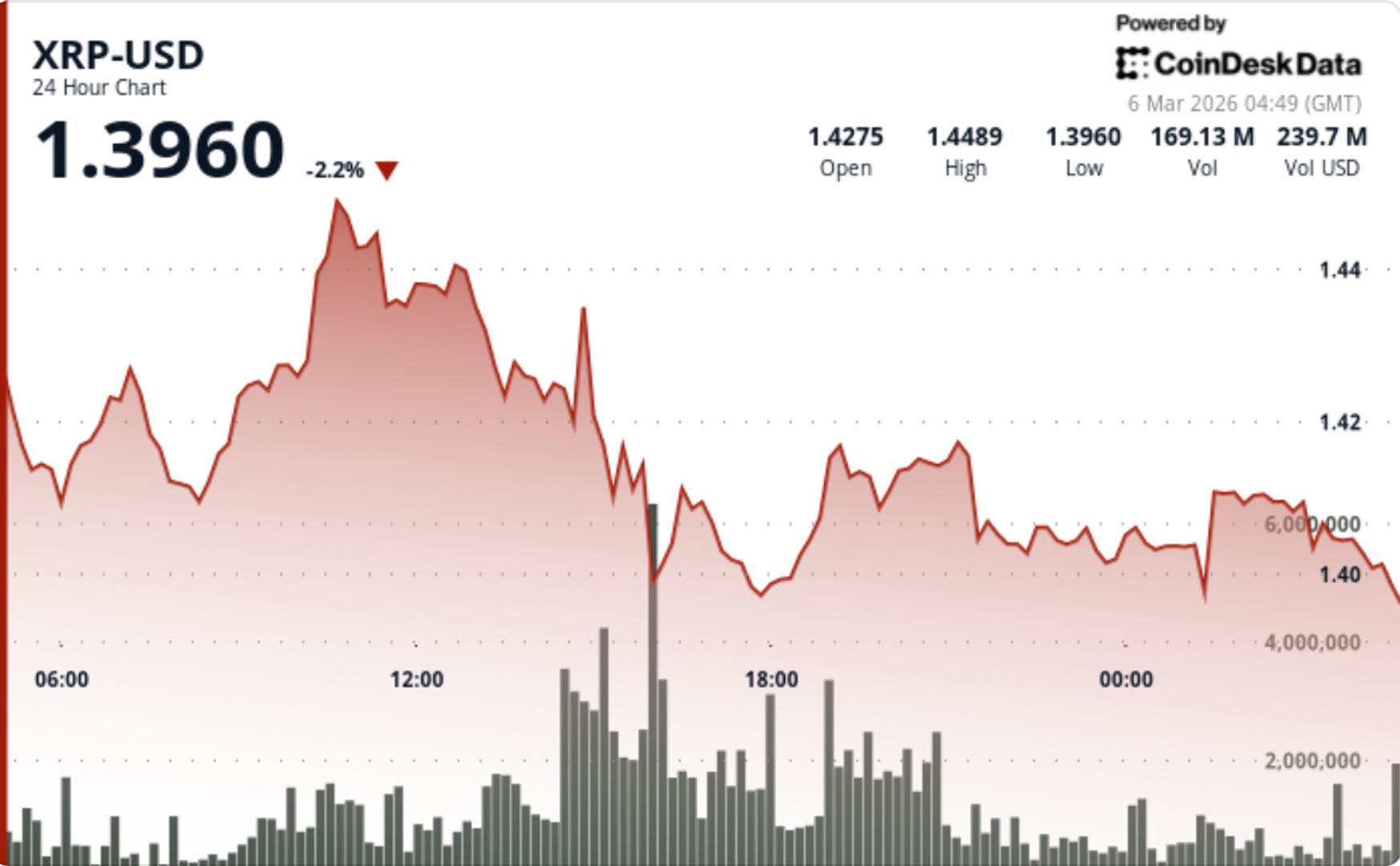
XRP moved lower after another rejection near resistance, with rising volume confirming sellers remain in control of the short-term trend.
News Background
- XRP has struggled to regain momentum since its July 2025 peak, continuing to trade within a broader corrective structure. The token remains roughly 60% below that high as market participants debate whether the current consolidation represents accumulation or continuation of the downtrend.
- Institutional positioning has offered mixed signals. Spot XRP ETFs have accumulated roughly $1.24 billion in inflows over the past four months, while on-chain data shows large wallets adding to positions during recent dips.
- At the same time, derivatives activity has cooled significantly, with open interest declining sharply since late 2025 as leverage unwinds across crypto markets.
- Ripple’s supply dynamics also remain steady. The company re-locked 700 million XRP into escrow on March 1 as part of its routine supply management cycle.
Price Action Summary
- XRP declined 3.3%, falling from $1.4588 to $1.4108
- Price repeatedly failed to hold above the $1.43–$1.45 resistance zone
- Volume surged 74% above average during the main selloff
- A late-session break below $1.411 confirmed downside momentum
Technical Analysis
- The key technical event was the rejection from the $1.43–$1.45 resistance band, which triggered a sequence of lower highs and reinforced the prevailing descending channel structure.
- Once $1.411 support gave way on elevated volume, downside momentum accelerated, pushing XRP toward the $1.40 area. Short-term structure now favors sellers while price remains below the prior support zone.
- Despite the weakness, the broader chart shows compression forming between downward resistance and rising support, with a potential triangle structure approaching its apex. This suggests the market may be nearing a larger directional move once current consolidation resolves.
- Key levels now cluster around $1.40 support and $1.43–$1.45 resistance.
What traders say is next?
- Traders are closely watching whether XRP can stabilize above $1.40.
- Holding this level could allow the token to consolidate before attempting another move toward $1.45 and eventually $1.55, which analysts view as the first level that would weaken the broader bearish structure.
- A break below $1.40, however, would likely shift focus toward deeper support around $1.33, with some analysts pointing to the $1.00 zone as a potential longer-term reset area if selling pressure accelerates.
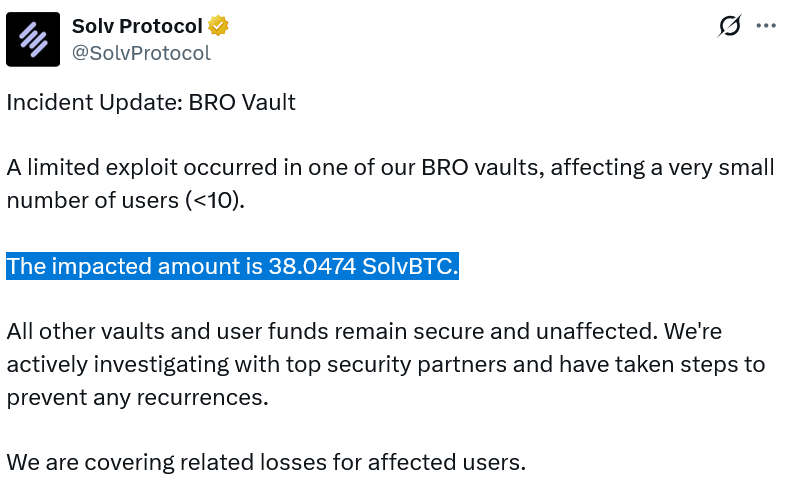
Crypto security researchers say the hacker exploited a bug allowing them to mint tokens, before swapping the freely-gained tokens for another tied to Bitcoin.
Bitcoin-based decentralized finance platform Solv Protocol says one of its token vaults was exploited for $2.7 million and has offered the attacker a 10% bounty in exchange for returning the stolen funds.
Solv said in an X post on Thursday that less than 10 of its users were impacted, but it would cover the loss of 38.05 Solv Protocol BTC (SolvBTC), a token pegged to Bitcoin (BTC).
The project added that it had implemented measures to prevent the same attack from recurring and was investigating the exploit with crypto security firms Hypernative Labs, SlowMist and CertiK.

Solv allows users to deposit Bitcoin for Solv Protocol BTC, which they can then use to lend, borrow or stake on other blockchains. The project has 24,226 Bitcoin worth over $1.7 billion and claims it is the largest on-chain Bitcoin reserve.
Solv hasn’t confirmed how the exploit happened, but two crypto security researchers attributed it to a vulnerability in one of Solv’s smart contracts that allowed the hacker to excessively mint a token used on the protocol.
Related: Mt. Gox’s former CEO floats hard fork to recover 80K hacked Bitcoin
The hacker exploited this vulnerability 22 times before swapping hundreds of millions of the tokens for a little over 38 SolvBTC, CD Security co-founder Chris Dior said.
Pseudonymous crypto researcher “Pyro” described the exploit as a re-entrancy attack, where unexpected inputs expose gaps in smart contracts, a popular attack that has plagued multiple DeFi protocols for years.
Solv shared an Ethereum wallet address in its X post to encourage the hacker into accepting a 10% bounty.
However, the hacker has not yet sent an on-chain message to the address, according to Ethereum block explorer Etherscan.
Magazine: Bitcoin may face hard fork over any attempt to freeze Satoshi’s coins


Bitcoin got to $74,000 and ran out of further buying pressure.
The largest cryptocurrency pulled back to $70,987 by Friday’s Asian session, down 2.2% over the past 24 hours after Thursday’s surge carried it to its highest level since early February. The rally from Saturday’s war-driven low near $64,000 to Thursday’s $74,000 peak amounted to roughly 15% in five days, but the retreat since has given back about a third of that move.
Chart watchers such as FxPro chief analyst Alex Kuptsikevich pointed to the rejection coincided with the 61.8% Fibonacci retracement and just below the 50-day moving average, two technical barriers that tend to attract sellers in bear market rallies.
Fibonacci retracement levels are derived from a mathematical sequence that traders use to identify where a bounce is likely to stall. The idea is that after a large move down, prices tend to retrace a predictable percentage of that drop before resuming the trend. The 61.8% level is the most closely watched because it represents the point where a recovery has retraced roughly two-thirds of its losses, far enough to feel convincing but historically where bear market rallies tend to die.
The 50-day moving average, meanwhile, is simply the average closing price over the past 50 days. It acts as a moving line of resistance during downtrends because it represents the price at which the average recent buyer breaks even, giving them an incentive to sell rather than hold. Bitcoin hitting both at the same time makes $74,000 a technically crowded level.
Kuptsikevich noted that “the bulls still have to convince the community that the bear market is over,” adding that the magnitude of the move was driven by a short squeeze from bears who “pulled their stops too close to the market price.”
Bitunix analysts flagged a similar read on the microstructure. The push to $74,000 triggered concentrated short liquidations, while long leverage liquidation clusters sit around $70,000. Secondary liquidity pools are near $64,000. That creates a defined range for the next move, with the floor and ceiling both visible on the liquidation heat map.
The weekly numbers still look strong for majors. Bitcoin is up 5.4% over seven days. Ether gained 2.7% to $2,080. BNB added 3.1% to $648. Solana rose 2.1% to $88.39. The laggards were dogecoin, down 3.7% on the week, and XRP, essentially flat with a 0.2% decline.
The macro picture heading into the weekend is messy, however.
Asia’s benchmark stock index has dropped 6.4% since the Iran war broke out, with MSCI’s regional gauge heading for its worst week since March 2020. The dollar is on pace for its best week since November 2024. Oil is posting its biggest weekly surge since 2022. Those are not the conditions that typically sustain a crypto rally.
Friday brought some tentative relief. Asian equities erased early losses as the dollar weakened and crude prices dipped on reports that the U.S. was weighing options to address the energy cost spike.
But the war isn’t over. The Senate failed to block Trump’s continued military actions against Iran, leaving conflict costs and energy disruption as open variables. Defense Secretary Hegseth has said operations could last three to eight weeks. The Strait of Hormuz remains effectively disrupted.
The $70,000 level that was resistance for a month is now the first test of support. Holding it would suggest the breakout is real. Losing it puts the $64,000 floor back in play.
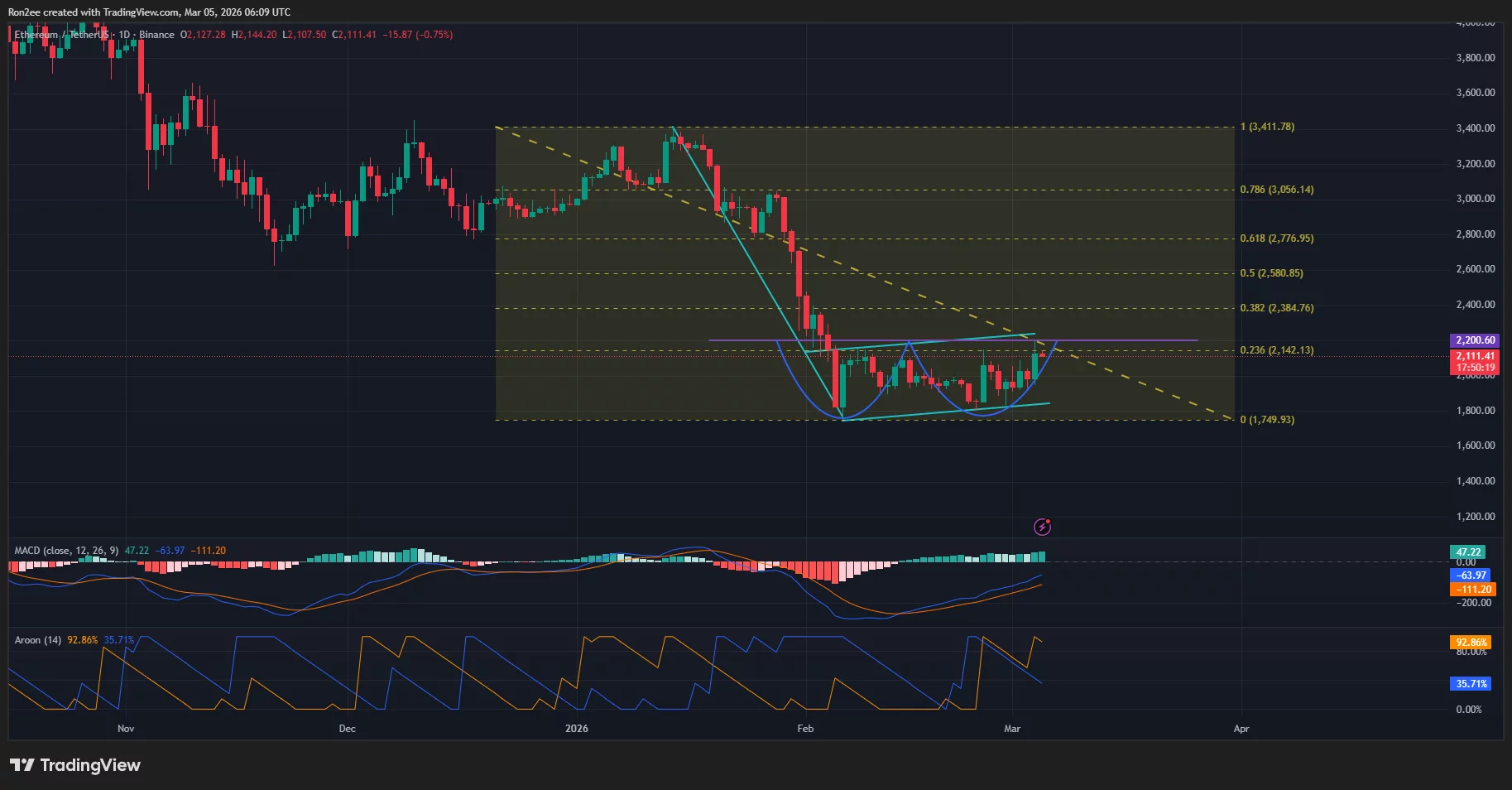
Ethereum bulls pushed its price to nearly $2,200 on Thursday amid a market-wide recovery.
Summary
- Ethereum price rebounded to a 4-week high on Friday amid increased demand from institutional traders and a surge in short liquidations.
- ETH has formed a double bottom pattern on the daily chart.
According to data from crypto.news, Ethereum (ETH) price rallied over 11% to a 4-week high of $2,192.
Ethereum price rallied amid a broader market recovery led by Bitcoin. The bellwether reclaimed the $73,000 mark for the first time since early February as reports emerged that the U.S. and Iran could be negotiating a deal to end their military confrontation.
As ETH price rose, it triggered a short squeeze of traders with highly leveraged bearish bets in the derivatives market. Data from CoinGlass show over $133 million in short positions were liquidated in the past 24 hours, compared to only $21.5 million in long positions.
A return of inflows into spot Ethereum ETFs also seems to suggest that institutional investors had played a significant part in the recovery. Per data compiled by Farside Investors, spot Ethereum ETFs drew in $169.4 million yesterday.
Simultaneously, Ethereum’s open interest shot up nearly 15%, which is a sign of increased derivatives market activity after multiple days of stagnation. While the weighted funding rate remains negative at press time, if it continues to climb, a shift toward positive funding rates could signal a return of bullish sentiment.
This surge in activity suggests that traders are once again aggressively positioning themselves, potentially setting the stage for more volatility if the price breaks key resistance levels.
On the daily chart, Ethereum price has formed a double bottom pattern, a major bullish reversal pattern formed of two consecutive troughs. The neckline of the pattern lies at the $2,200 psychological resistance level.
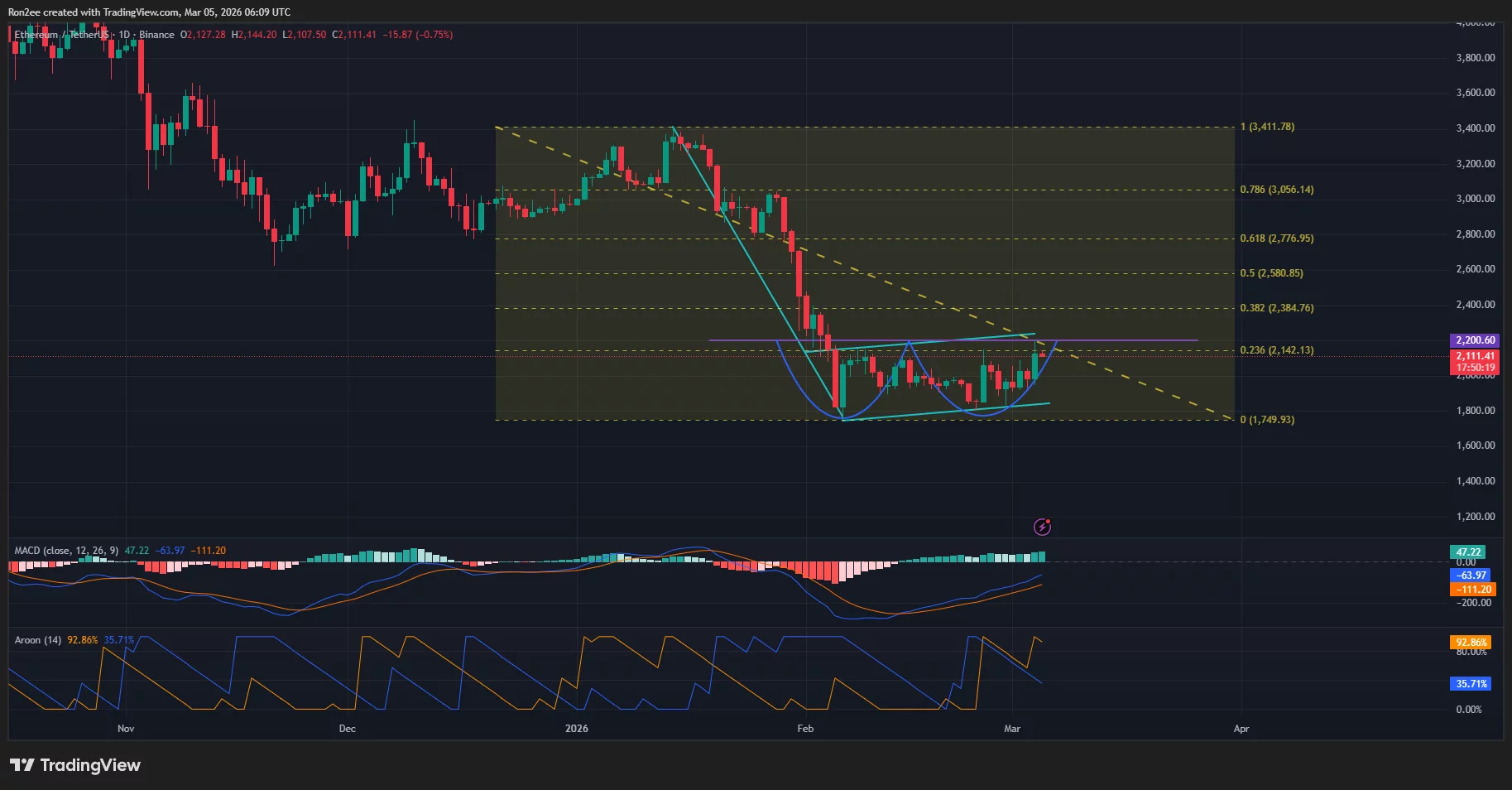
A breakout from the neckline could push Ethereum to $2,400, which aligns with the 38.2% Fibonacci retracement level that is often seen as a critical target for a trend reversal.
It should also be noted that a successful reclaiming of the $2,400 mark would invalidate a larger bearish flag pattern forming on the chart.
Key technical indicators seem to suggest that bulls are already on the move. Notably, the MACD lines have formed a bullish crossover and were pointing upwards, while the Aroon Up showed a reading of 92.86%, far above the bearish indicator at 35.71%.
For now, traders are eyeing $2,142, the 23.6% Fibonacci retracement level, as a key resistance. ETH was trading at $2,117 when writing, just 1.1% below that mark.
Disclosure: This article does not represent investment advice. The content and materials featured on this page are for educational purposes only.
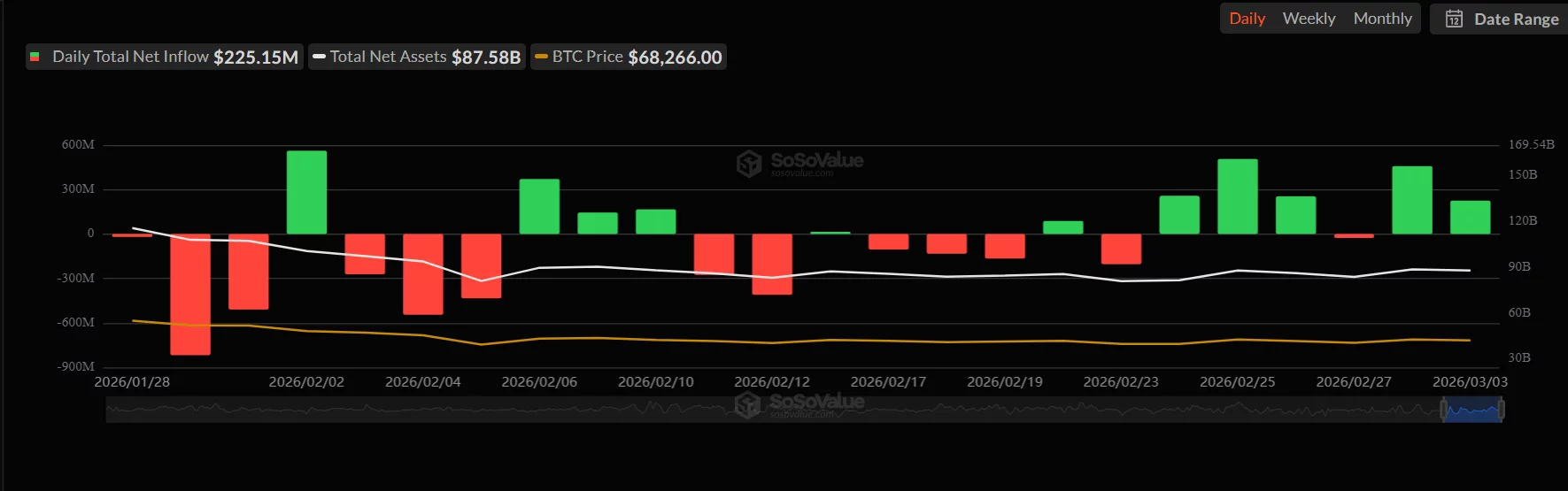
Bitcoin is regaining bullish momentum after a week of geopolitical-driven volatility, with fresh inflows into spot exchange-traded funds helping support the latest price rebound.
Summary
- Spot Bitcoin ETFs recorded roughly $155 million in net inflows, signaling renewed institutional demand.
- Bitcoin has recovered after last week’s volatility triggered by Middle East geopolitical tensions.
- Analysts say BTC could test $75,000 resistance if momentum and ETF inflows persist.
Data from SoSoValue shows that Bitcoin ETFs recorded about $155 million in daily net inflows, reversing a period of sustained outflows seen earlier in the week.
The renewed institutional demand comes as Bitcoin (BTC) stabilizes after sharp price swings triggered by rising tensions in the Middle East, which had briefly pressured risk assets across global markets.
The inflows appear to be translating into market strength. Bitcoin has climbed back above the $72,000 level, recovering from a dip near the $60,000–$65,000 zone during last week’s risk-off sentiment.
Previous market reports suggested that ETF demand and short covering were key drivers behind Bitcoin’s earlier rally toward $72,000, and the latest inflows indicate institutional buyers may be returning to the market.
Bitcoin price analysis
Beyond macro sentiment, the chart structure suggests Bitcoin is attempting to build a recovery trend.
On the daily chart, Bitcoin is currently trading around $72,500, pushing toward a key resistance band between $73,000 and $75,000. A decisive breakout above this zone could open the door for a retest of the $80,000 psychological level in the coming weeks.
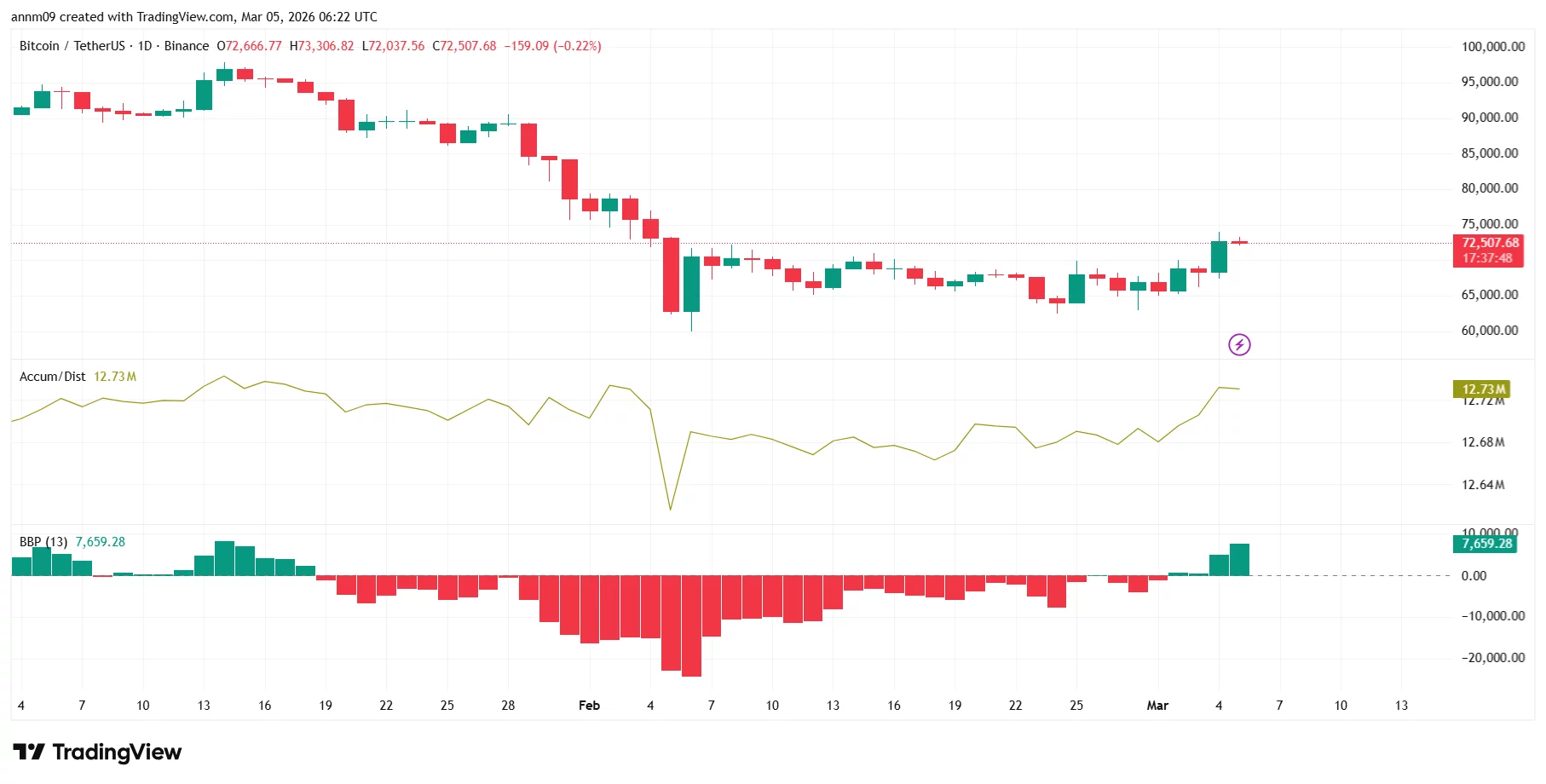
Support levels remain near $69,000, followed by stronger structural support around $65,000, where buyers previously stepped in during the February correction.
Momentum indicators are also improving. The Accumulation/Distribution line is trending higher, suggesting renewed buying pressure, while the Bull Bear Power (BBP) indicator has flipped positive, signaling that bullish momentum may be returning after several weeks of selling pressure.
If ETF inflows continue and macro risks stabilize, Bitcoin could extend its recovery. However, analysts warn that failure to hold above the $70,000 region could trigger another consolidation phase before the next major move.


Crypto exchange Coinbase teamed up with Microsoft and Europol to take down phishing-as-a-service platform Tycoon 2FA.
Summary
- Coinbase helped trace blockchain transactions linked to the Tycoon 2FA phishing network, allowing investigators to identify the platform’s alleged administrator and several users of the service.
- Tycoon 2FA offered a subscription toolkit that enabled criminals to intercept authentication sessions and bypass multi-factor protections.
- Phishing losses dropped nearly 83% in 2025.
In a Wednesday announcement, Coinbase said that it helped trace blockchain-based transactions linked to the platform, and as a result, law enforcement was able to identify the phishing operation’s alleged administrator and several of its customers.
According to Europol, Tycoon 2FA sold a subscription-based toolkit that helped bad actors intercept live authentication sessions and gain unauthorised access to online accounts, “including those protected by additional security layers.”
Using Tycoon’s phishing toolkit, cybercriminals were able to capture session cookies from authenticated users and therefore access accounts without triggering the multi-factor authentication prompts, Coinbase said.
“We’re actively working to identify Tycoon purchasers and will continue supporting law enforcement efforts focused on the people who bought and used this service to target victims,” it added.
The platform has been active since at least 2023, and by mid-2025, Tycoon 2FA accounted for nearly 62% of all phishing attacks blocked by Microsoft, Europol said.
“At scale, the platform generated tens of millions of phishing emails each month and facilitated unauthorised access to nearly 100,000 organisations globally, including schools, hospitals, and public institutions,” it added.
As previously reported by crypto.news, losses from phishing attacks dropped 83% in 2025 when compared to the previous year. Nevertheless, attackers have continued to use more advanced techniques, including exploits tied to EIP-7702, Permit and Permit2 signatures, and transfer-based attacks.
A separate report from blockchain security firm CertiK flagged that Phishing attacks remained the third most costly attack vector in 2025.


Eric Trump has accused major U.S. banks of lobbying aggressively against crypto platforms offering higher yields to consumers, escalating tensions between the traditional financial sector and the digital asset industry.
Summary
- Eric Trump accused major U.S. banks of lobbying against crypto and stablecoin yield products.
- The comments come as debate intensifies around the CLARITY Act and GENIUS Act.
- Donald Trump also criticized banks, arguing legislation is needed to keep the U.S. competitive in the crypto sector.
Eric Trump accuses big banks of lobbying against crypto yields
In a post on X, Eric Trump claimed that institutions such as JPMorgan Chase, Bank of America, and Wells Fargo are attempting to block Americans from earning higher returns through crypto-based savings products.
“Big banks are lobbying overtime to block Americans from getting higher yields on their savings,” Trump wrote, arguing that traditional lenders offer extremely low annual percentage yields, often between 0.01% and 0.05%, despite benefiting from higher interest rates paid by the Federal Reserve.
According to Trump, the banking sector is particularly concerned about crypto and stablecoin platforms that are planning to offer yields or rewards in the 4% to 5% range. He alleged that banking lobby groups are spending heavily to restrict those products through legislation and regulatory pressure.
The comments come as lawmakers debate new digital asset legislation in Washington, including the CLARITY Act, which aims to define the regulatory framework for cryptocurrencies, and the GENIUS Act.
Trump argued that banks are invoking concerns about “fairness” and financial stability while attempting to protect profit margins built on the gap between the interest they receive and the rates paid to depositors.
The criticism echoes remarks made by Donald Trump, who recently said large banks are attempting to undermine crypto legislation that could strengthen the United States’ position in the global digital asset industry.
In a statement posted on Truth Social, the president said Congress must move quickly on market structure legislation to prevent the crypto industry from shifting to other countries.
The debate highlights growing friction between the banking industry and crypto firms as policymakers weigh how to regulate digital assets while maintaining the competitiveness of the U.S. financial system.
Bitwise Asset Management has announced a $233,000 donation to Bitcoin open-source developers, marking the firm’s second annual contribution tied to the success of its spot Bitcoin exchange-traded fund.
Summary
- Bitwise Asset Management donated $233,000 to Bitcoin development groups as part of its commitment to allocate 10% of gross profits from its Bitcoin ETF.
- The donation will be distributed through Brink, OpenSats, and the Human Rights Foundation Bitcoin Development Fund.
- The contribution follows continued growth of the Bitwise Bitcoin ETF since its launch.
The funds come from profits generated by the Bitwise Bitcoin ETF, which launched with a commitment from Bitwise to allocate 10% of the ETF’s gross profits each year toward supporting the development and security of the Bitcoin network.
According to the firm, the latest contribution reflects strong growth in the ETF during the past year, allowing the company to expand its support for the developers maintaining Bitcoin’s underlying infrastructure.
The donation will be distributed among three nonprofit organizations focused on sustaining the Bitcoin ecosystem: Brink, OpenSats, and the Human Rights Foundation Bitcoin Development Fund.
These groups provide funding, fellowships, and grants to developers working on critical Bitcoin software, security research, and infrastructure upgrades. Their mission centers on supporting the open-source contributors responsible for maintaining and improving the decentralized network.
Bitwise described the developers as “unsung heroes” who help secure and evolve Bitcoin’s technology stack, noting that the contribution represents a reinvestment into the ecosystem that supports the firm’s investment products.
The asset manager also credited investors in the ETF for enabling the donation, stating that the contribution would not be possible without the support of those who chose to invest in the fund.
Bitwise added that its donations are expected to grow alongside the ETF’s expansion, reinforcing its pledge to continue directing a portion of profits toward the broader Bitcoin development community.
The initiative reflects a broader trend among crypto firms and investment products that are increasingly channeling funds toward open-source development as institutional interest in Bitcoin continues to rise.

Disclosure: This article does not represent investment advice. The content and materials featured on this page are for educational purposes only.
While market headlines focus on short-term price swings, the real signal shaping America’s crypto future in 2026 lies beneath the surface. Institutional infrastructure, regulatory developments, and a shift toward long-term investor strategy are quietly redefining how digital assets integrate into the U.S. financial system.
The conversation about digital assets in the United States is becoming increasingly complex as the market enters a new stage of development. Many readers who follow blockchain trends begin their research by exploring the coinspot website, where ongoing discussions about cryptocurrency innovation and market dynamics continue to evolve.
What makes the current situation particularly interesting is that the most important signals shaping the future of crypto in America are not always the ones dominating headlines. While price movements attract attention, deeper structural changes within technology, finance, and regulation are gradually redefining the ecosystem, mentioned on https://coinspot.io/en/

Institutional Strategy Is Quietly Expanding
Financial institutions across the United States are playing a growing role in the evolution of digital assets. What once appeared to be cautious experimentation has gradually transformed into structured long-term strategies.
Investment firms, fintech companies, and payment platforms are building services designed to support cryptocurrency adoption at scale. These initiatives include digital asset custody, blockchain settlement systems, and tokenized financial instruments that connect traditional finance with decentralized technology.
Blockchain Innovation Is Driving Long-Term Growth
Technological development remains one of the strongest forces behind the transformation of the crypto market. Developers continue to improve blockchain networks by increasing scalability, enhancing security protocols, and optimizing transaction performance.
These improvements are enabling the creation of new decentralized applications. From digital ownership systems to decentralized finance platforms, blockchain technology is expanding its role within the global digital economy.
Investor Attention Is Slowly Shifting
Another notable trend involves the changing mindset of market participants. Earlier cycles of the cryptocurrency industry were often dominated by speculation and rapid trading activity.
Today many investors appear more interested in research, technological fundamentals, and long-term strategic positioning. This shift toward a more analytical approach may contribute to a more stable phase of development for digital assets.
Regulation May Shape The Next Phase
Government policy continues to influence how cryptocurrency evolves within the United States. For several years uncertainty surrounding legal frameworks created obstacles for some blockchain initiatives.
However, policymakers are increasingly exploring ways to establish clearer rules for digital assets. A more defined regulatory environment could encourage additional investment and provide greater confidence for companies operating in the crypto sector.
The Signal Many Investors May Overlook
The future of cryptocurrency in America may not depend on a single dramatic breakthrough. Instead, it is being shaped by the gradual convergence of multiple forces including institutional adoption, technological innovation, and evolving investor behavior.
These developments may appear subtle in the short term, yet their long-term implications could be profound. As the crypto ecosystem continues to mature, the signals investors overlook today may ultimately define the direction of the market tomorrow.
Disclosure: This content is provided by a third party. Neither crypto.news nor the author of this article endorses any product mentioned on this page. Users should conduct their own research before taking any action related to the company.

Solv Protocol Offers 10% Bounty After $2.7M Hack

War, Trump and Washington’s Gridlock | Sen. Katie Britt
Brian Flores Catches Online Jab from Soon-to-Be Cut Defender


-

 Politics3 days ago
Alan Cumming Brands Baftas Ceremony A ‘Triggering S**tshow’
-

 Fashion6 days ago
Weekend Open Thread: Iris Top
-

 Tech5 days ago
Unihertz’s Titan 2 Elite Arrives Just as Physical Keyboards Refuse to Fade Away
-

 NewsBeat5 days ago
Abusive parents will now be treated like sex offenders and placed on a ‘child cruelty register’ | News UK
-
 NewsBeat5 days ago
Dubai flights cancelled as Brit told airspace closed ’10 minutes after boarding’
-
Sports6 days ago
The Vikings Need a Duck
-
 NewsBeat6 days ago
The empty pub on busy Cambridge road that has been boarded up for years
-

 NewsBeat5 days ago
‘Significant’ damage to boarded-up Horden house after fire
-

 Tech22 hours ago
Bitwarden adds support for passkey login on Windows 11
-

 Entertainment4 days ago
Baby Gear Guide: Strollers, Car Seats
-
 Sports11 hours ago
499 runs and 34 sixes later, India beat England to enter T20 World Cup final | Cricket News
-
 Tech7 days ago
NASA Reveals Identity of Astronaut Who Suffered Medical Incident Aboard ISS
-
Politics5 days ago
FIFA hypocrisy after Israel murder over 400 Palestinian footballers
-
 NewsBeat5 days ago
Emirates confirms when flights will resume amid Dubai airport chaos
-

 NewsBeat4 days ago
Is it acceptable to comment on the appearance of strangers in public? Readers discuss
-

 Tech5 days ago
Viral ad shows aged Musk, Altman, and Bezos using jobless humans to power AI
-

 Video4 days ago
How to Build Finance Dashboards With AI in Minutes
-

 Business2 days ago
Guthrie Disappearance Enters Fifth Week as Family Visits Memorial
-
 Crypto World5 days ago
US Judge Lets Binance Unregistered Token Class Action Proceed
-
 NewsBeat4 days ago
Ukraine-Russia war latest: Belgium releases video showing forces boarding Russian shadow fleet oil tanker