

Crypto World
AI just bypassed the Cloudflare protection that DeFi needs



Despite launching countless branding exercises that feature the word “decentralization,” much of the crypto industry actually uses Cloudflare to defend large chunks of its user-facing infrastructure.
Indeed, Cloudflare protects crypto websites collectively processing billions of dollars worth of trades and receiving millions of visitors daily. However, this week, crypto learned that autonomous AI agents can apparently use an open-source library to walk right through several of Cloudflare’s lines of defense.
Most heard of the vulnerability from a headline about OpenClaw, an AI agent that runs on a Mac Mini or cloud server.
OpenClaws, formerly known as ClawdBots or MoltBots, can now use a free library called Scrapling to “bypass Cloudflare natively.”
“Scrape any website without getting blocked, with zero bot detection,” the developer wrote in a brief blurb on Github before releasing the code into the wild.
It soon rocketed to a #1 trending spot among Github repositories.
The age of homespun AI agents has arrived
Boasting concurrent, multi-session crawlers with realistic start/stop actions and proxy IP addresses, the Python library allows AI agents like OpenClaw and others to bypass “all types of Cloudflare’s Turnstiles and Interstitials.”
Not only that, its own benchmarks claim over 600 times the parsing speed of BeautifulSoup, a formerly impressive web crawler.
The age of homespun AI agents is here, and the traditional armor that crypto has employed to protect its websites against crawlers, spiders, Denial of Service (DoS) attacks, and hackers of all types is starting to crack.
Through the use of human-mimicking behavior and AI adaptation, an OpenClaw agent can trick sophisticated forms of bot detection. Even more devastatingly, it can operate on commodity hardware and volley attacks for a few cents.
DeFi keeps relying on Cloudflare while losing millions
Decentralized Finance (DeFi) has already learned — repeatedly and expensively — what happens when its Cloudflare-dependent front-ends fail.
Although it doesn’t have 1:1 similarity with the capabilities of Scrapling, the most obvious example of crypto’s reliance on Cloudflare remains BadgerDAO.
In December 2021, an attacker compromised a Cloudflare Workers API key.
The attacker used that key to inject a malicious script into BadgerDAO’s front-end, tricking users into signing token approvals. It drained $130 million.
Consider another example. Curve Finance suffered Domain Name System (DNS) hijacks in August 2022 and again in May 2025.
Each time, attackers accessed its registrar and redirected traffic away from Cloudflare’s nameservers to malicious clones.
The 2022 attack cost users over $500,000. The 2025 attack forced Curve to abandon its “.fi” TLD entirely and migrate to Curve.finance.
Read more: Saga becomes latest victim in DeFi hacking spree
The pattern only accelerated. In July 2024, a single DNS attack on Squarespace put 228 DeFi protocol websites at risk, including Compound and Celer Network.
Aerodrome Finance,a decentralized exchange (DEX) on Coinbase’s Base network, lost over $1 million in a November 2025 DNS hijack. OpenEden disclosed a DNS compromise on February 16, 2026. Curvance detected and blocked a front-end attack on the same day.
Every one of these attacks exploited the gap between decentralized smart contracts and the centralized web infrastructure that users actually touch: DNS records, content delivery network (CDN) scripts, and Cloudflare configurations.
Although Scrapling is too new to boast of any crypto hacks to date, there might be victims in coming days, unfortunately. Its primary intention is to scrape and download content, not hack Defi, of course. Hopefully, developers and OpenClaw users use it for its legal and intended purposes.
Scrapling lowers the Cloudflare shield
The traditional defense model assumed that bot detection, fingerprinting, and Cloudflare’s Turnstile challenges could keep automated traffic out. Scrapling breaks some of those assumptions through AI.
Its developer describes, in language probably only developers understand, about packaging TLS fingerprint spoofing, headless detection avoidance, Canvas noise generation, and WebRTC leak mitigation into a composable library.
A third party analysis noted that the core breakthrough “wasn’t a single new trick.” Instead, it was the combination of multiple AI skills to trick cybersecurity services.
Cloudflare’s own documentation warns developers to “never trust client-side validation alone.” Unfortunately, many DeFi frontends treat Cloudflare challenge widgets as sufficient, leaving backdoors open to tools that can fake a passed challenge on the client side.
The crypto industry spent five years and hundreds of millions in user losses learning that Cloudflare is a speed bump, not a wall. Scrapling just used AI to hop over again.
Got a tip? Send us an email securely via Protos Leaks. For more informed news, follow us on X, Bluesky, and Google News, or subscribe to our YouTube channel.


Bitcoin (CRYPTO: BTC) miners faced a dual dynamic in February: cash-flow optimization through asset sales alongside aggressive capacity expansion to support AI-enabled data-center workloads. CleanSpark reported selling 553 BTC from its February production for roughly $36.6 million while mining 568 BTC during the month. By month-end, the company held 13,363 BTC in treasury and had just closed a second Texas campus that adds 300 megawatts of ERCOT-approved power capacity, broadening its footprint in a grid operated by the Electric Reliability Council of Texas. CleanSpark’s deployed fleet tallied 235,588 mining machines, delivering a peak hashrate of 50 EH/s and averaging 43.2 EH/s, underscoring the industry’s push toward scale to support denser, power-hungry operations.
Year-to-date, the miner reported 1,141 BTC produced through February, with 1,086 BTC of its holdings posted as collateral or receivable in connection with derivatives transactions, illustrating how mining revenue is increasingly hedged to manage price volatility and financing risk. The company framed this as part of a broader strategy to monetize power-dense assets beyond traditional crypto mining, aligning with a trend among miners to repurpose infrastructure for AI-friendly workloads and high-performance computing, as noted in industry analyses linked to the sector’s evolving business model.
As of the filing, CleanSpark’s stock was down about 7.5% on the day, while the sector-tracking CoinShares Bitcoin Mining ETF (EXCHANGE: WGMI) was down 6.4%, reflecting a broader risk-off tone in crypto equities on the publication date.
Miners sell off Bitcoin in 2026
CleanSpark is not alone in liquidating portions of its Bitcoin holdings to fund infrastructure expansion and AI-oriented data-center projects. Riot Platforms disclosed that it sold 1,818 BTC in December for about $161.6 million as part of a strategy to monetize energy and data-center assets while supporting AI workloads; the company reported holdings of 18,005 BTC as of Dec. 31, down from 19,368 BTC a month earlier, after producing 460 BTC during December. The move highlighted a broader shift across the sector toward leveraging hardware and data-center capacity for non-cryptocurrency applications.
In February, Bitdeer confirmed it liquidated its entire corporate Bitcoin treasury, producing 189.8 BTC during the period and selling the full amount along with an additional 943.1 BTC drawn from its existing reserves. The scale of these sales illustrates a mounting effort among miners to fund ongoing expansions and diversify revenue streams amid tight capital conditions and rising power costs.
Meanwhile, Core Scientific reported during its fourth-quarter earnings call on March 2 that it sold roughly 1,900 BTC for about $175 million in January, reducing its holdings to fewer than 1,000 BTC. In a separate move, the company announced a $500 million credit facility from Morgan Stanley to finance infrastructure capable of supporting high-density computing workloads, including AI and high-performance computing (HPC). The financing underscores how mining companies are increasingly balancing productive capacity with strategic investments in AI-ready data-center capabilities to capture new demand streams.
On the speculative front, MARA Holdings, the second-largest corporate Bitcoin treasury holder with 53,822 BTC, faced chatter about potential sales of its reserves. However, MARA’s investor-relations vice president, Robert Samuels, pushed back on X, saying the treasury strategy remained intact and unchanged. The market will be watching whether this resilience holds as macro conditions, energy prices, and the evolving regulatory landscape shape miners’ treasury management decisions in the months ahead.
Across the industry, the emphasis on powering AI and HPC workloads is driving a broader redefinition of mining infrastructure. Operators are pursuing power-dense facilities, optimized cooling, and robust electrical grids to support large-scale data processing, while balancing the volatility of Bitcoin prices with hedging strategies and longer-term capital investments. The tension between selling to fund growth and preserving Bitcoin holdings for balance-sheet resilience remains a central theme for miners navigating 2026’s mixed liquidity environment and the ongoing wave of AI-driven demand for compute power.
Why it matters
February’s disclosures paint a picture of miners simultaneously expanding physical footprints and trimming balance-sheet exposure through cash sales. The rapid deployment of additional Texas capacity, alongside continued production, demonstrates the sector’s commitment to scale despite a volatile price backdrop. For investors, the mix of reported BTC production, treasury holdings, and collateralized positions signals an industry that is increasingly integrating mining with broader data-center strategies and AI-capable operations, potentially affecting long-term profitability and cash-flow stability.
The trend toward monetizing dense data-center capacity beyond traditional mining could alter the competitive landscape. As AI and HPC workloads demand reliable, cost-efficient electricity and cooling, miners with expansive power portfolios may gain leverage in power markets and grid interactions. This could influence not just individual company valuations but also the resilience of crypto mining as a capital-intensive, infrastructure-driven business model, particularly in states like Texas where regulatory and market frameworks continue to evolve to accommodate large-scale digital infrastructure.
From a market structure perspective, the activity underscores the close relationship between crypto cycles, energy markets, and financial hedging. The fact that several operators are combining asset sales with debt facilities and non-crypto revenue streams indicates a maturing sector that is learning to weather volatility by diversifying revenue and stabilizing capital expenditure. For builders and developers, the move toward AI-ready data centers signals opportunities to repurpose existing sites or accelerate new builds in power-rich regions, while for regulators, it raises considerations about grid reliability, energy pricing, and the environmental footprint of intensive compute operations.
What to watch next
- CleanSpark’s next quarterly and monthly updates to confirm ongoing production volumes, treasury changes, and any further capacity additions in Texas.
- Public disclosures from Riot Platforms, Bitdeer, and Core Scientific on their 2026 treasury strategy, financing arrangements, and any additional asset sales or hedging activities.
- The utilization and performance of Morgan Stanley’s $500 million facility at Core Scientific, including milestones for deploying AI/HPC workloads on new infrastructure.
- Industry-wide capacity additions beyond 300 MW Texas expansions and any regulatory developments affecting energy-intensive mining and data-center operations in ERCOT and other jurisdictions.
- BTC price trajectories and macro liquidity conditions that influence mining profitability, treasury management, and investor sentiment toward mining equities and related ETFs.
Sources & verification
- CleanSpark February 2026 operational update detailing BTC production and treasury changes, including 13,363 BTC in treasury and 300 MW Texas campus expansion.
- ERCOT and Texas campus capacity information corroborating the 300 MW expansion and grid context.
- Riot Platforms’ December 2025 sale of 1,818 BTC for about $161.6 million and holdings of 18,005 BTC as of Dec 31, plus 460 BTC produced in December.
- Bitdeer’s February 2026 liquidation of its entire corporate treasury and 189.8 BTC produced, plus 943.1 BTC sold from reserves.
- Core Scientific’s January 2026 sale of approximately 1,900 BTC for $175 million and the announcement of a $500 million Morgan Stanley facility to fund AI/HPC infrastructure.
- MARA Holdings’ balance-sheet context and public comments from Robert Samuels on X addressing treasury strategy.
Bitcoin miners expand capacity as cashing out accelerates in 2026


The global fintech applied to become a federally regulated, FDIC-insured bank, while the crypto infra firm is looking to become a national bank trust.
Two crypto-adjacent firms just applied to be federally regulated banks in the United States.
Today, Revolut — a UK-headquartered, retail-focused global neobank that offers crypto trading — announced it has officially filed for a national bank charter in the U.S. as part of its strategic push to expand financial services in the United States.
Just yesterday, March 4, digital asset infrastructure company, zerohash, announced that it has applied for a national trust bank charter in the U.S.
Both firms applied to the U.S. Office of the Comptroller of the Currency (OCC), and the charters would let them operate across all U.S. states. Revolut is also applying to the Federal Deposit Insurance Corporation (FDIC), as it seeks to be full-service, federally regulated bank in the U.S.
Revolut also announced today that it has appointed a new U.S. CEO, Cetin Duransoy.
Zerohash, which specializes in settlement services for digital assets and stablecoins, is seeking an OCC National Trust Bank license, which would restrict the firm to custody and trust services. The firm’s chief legal and compliance officer said in the release:
“Applying for a National Trust Bank Charter is a natural next step in offering robust global licensing coverage and continuing to expand our product offering.”
Zerohash’s press release also notes that the trust bank charter will let the firm “expand its services offerings under a federal framework, including those activities that fall under the GENIUS Act.”
A Growing Trend
Though it’s generally known as a fintech and neobank, Revolut has rapidly expanded its offerings into digital assets, adding crypto trading as early as 2017.
The trend of crypto-native and crypto-friendly firms pursuing traditional banking licenses is driven by a dual need for regulatory compliance and the desire to expand service offerings within the traditional financial system.
Since last year, several major crypto firms — including Ripple, Paxos and Circle — applied for national bank and national trust bank charters in the U.S.
Last week, Crypto.com received conditional approval from the OCC to establish its national trust bank, as The Defiant reported.
This article was generated with the assistance of AI workflows.


Analysts say high exchange turnover often reflects traders repositioning portfolios quickly during periods of rising volatility.
Ethereum (ETH) trading activity on Binance has jumped dramatically, with around 29.6 million ETH changing hands on the exchange over the past 30 days, the highest turnover recorded since September 2025.
The spike suggests traders are cycling the same supply through the market at a faster pace as volatility returns and derivatives positioning shifts.
Binance ETH Turnover Climbs
Data shared by Arab Chain on March 5 shows the 30-day Ethereum exchange liquidity ratio on Binance has climbed to 8.47. The metric compares the amount of ETH traded during a set period with the total supply available on the exchange.
Binance currently holds around 3.5 million ETH in exchange reserves, yet trading volume during the last month reached almost 29.6 million ETH. That means the same coins have been traded multiple times within a relatively short period.
According to Arab Chain, high turnover levels often appear during periods when traders actively reposition portfolios or when price volatility increases.
“Historically, high turnover rates have often coincided with increased market liquidity and faster asset movement between wallets and exchanges, reflecting heightened risk appetite among traders,” noted Arab Chain.
The latest reading is the highest since September last year, a period that also saw strong price swings in the market.
Presently, ETH has climbed past the $2,000 level, gaining about 4.6% in the last 24 hours. On longer timeframes, the asset is up about 2% in the past week and just over 6% in the last two weeks, although it remains about 9% lower over the last 30 days.
You may also like:
Shifting Market Behavior
Alongside the spike in spot turnover, derivatives indicators point to changes in trading behavior across both Ethereum and Bitcoin. This is according to market analyst Moreno, who noted that net taker volume in derivatives markets has started to move back into positive territory after months of aggressive selling.
Net taker volume measures the difference between traders placing market buy orders and those executing market sells, which helps show who is actively pushing prices. Per the analyst, when the metric flips positive after a long stretch of negative readings, the first phase often reflects short covering and the unwinding of hedge positions rather than fresh long-term demand.
Ethereum’s derivatives activity can also appear distorted because the asset is widely used as collateral in decentralized finance strategies. Many traders hold spot ETH while at the same time shorting perpetual futures contracts to maintain delta-neutral positions, which creates persistent selling pressure in derivatives markets.
Another signal of demand came from the Coinbase premium for both Bitcoin and Ethereum. According to analyst CW, the premium is positive, suggesting buyers on the U.S. exchange are paying slightly higher prices than global markets.
Combined with rising exchange turnover and shifting derivatives flows, the data shows traders are becoming more active again as Ethereum holds above the $2,000 level.
Binance Free $600 (CryptoPotato Exclusive): Use this link to register a new account and receive $600 exclusive welcome offer on Binance (full details).
LIMITED OFFER for CryptoPotato readers at Bybit: Use this link to register and open a $500 FREE position on any coin!
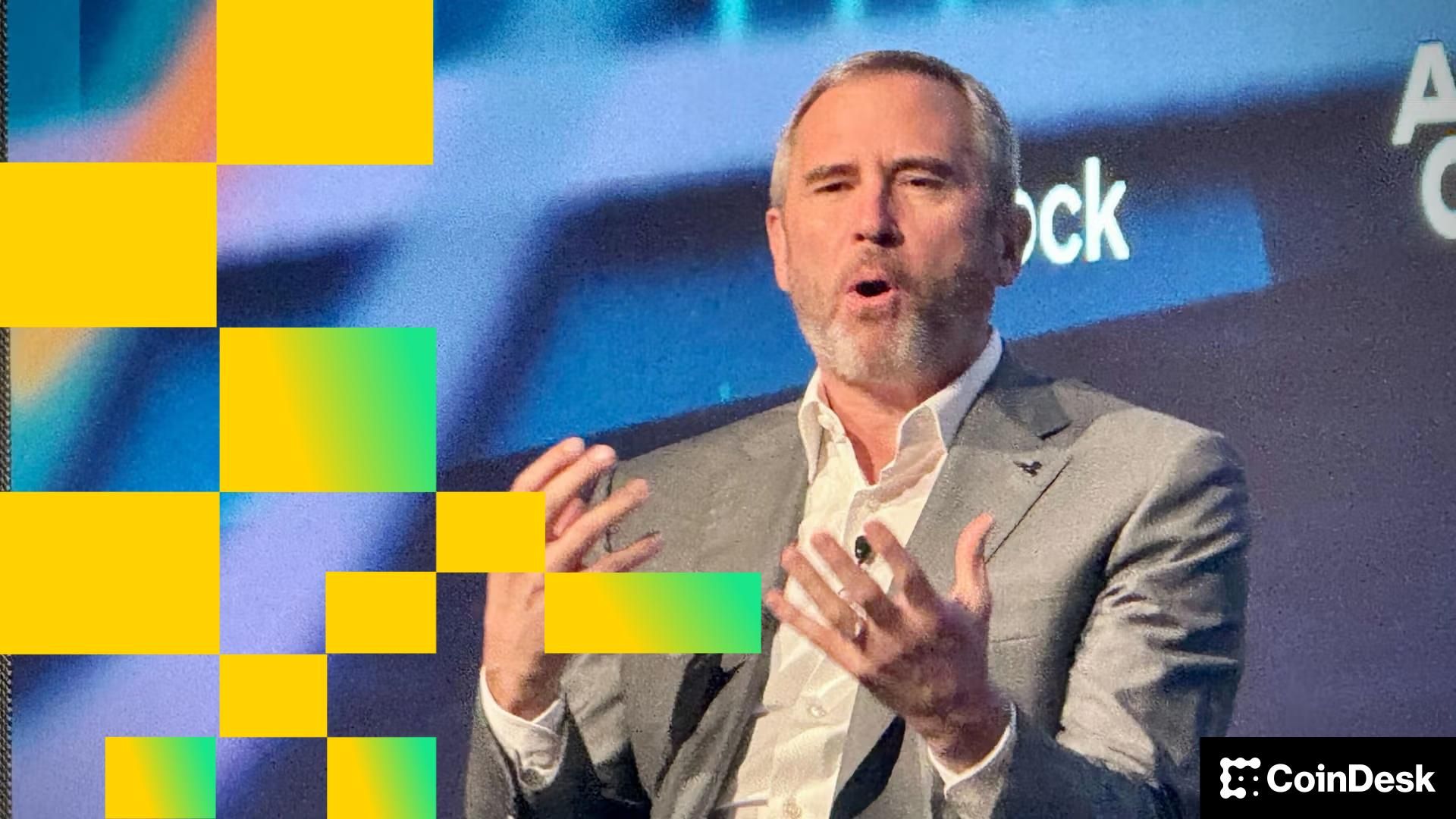
Ripple, the blockchain firm closely associated with the XRP Ledger (XRP) network, said Thursday that clients on its Ripple Prime platform can now trade the full range of crypto futures listed on Coinbase Derivatives.
The move gives institutions a new way to access regulated crypto derivatives within a market overseen by the Commodity Futures Trading Commission. Ripple said that its Prime platform cleared more than $3 trillion in trading volume in 2025.
The offering includes nano bitcoin and nano ether (ETH) futures, which are smaller contracts designed to lower the capital needed to trade. Coinbase also lists futures tied to Solana and XRP in both standard and smaller sizes. The contracts are cleared through Nodal Clear, a U.S. clearing house.
Crypto derivatives have become one of the fastest growing parts of the digital asset market. Many large trading firms prefer futures because they allow investors to gain exposure to price moves or hedge risk without holding the underlying tokens. Regulated futures markets in the U.S. have also drawn interest from institutions that need clear rules and centralized clearing.
The new service builds on Hidden Road, a futures commission merchant and prime broker Ripple acquired last year for $1.25 billion. The firm now operates as Ripple Prime and offers brokerage, clearing and financing services across several asset classes.
Ripple has been on an acquisition spree over the past year, buying a slew of companies to complement the firm’s digital assets offering for institutions and enterprises. On top of Hidden Road, the company bought stablecoin payments firm Rail for $200 million, and also acquired treasury technology provider GTreasury and crypto wallet infrastructure startup Palisade.
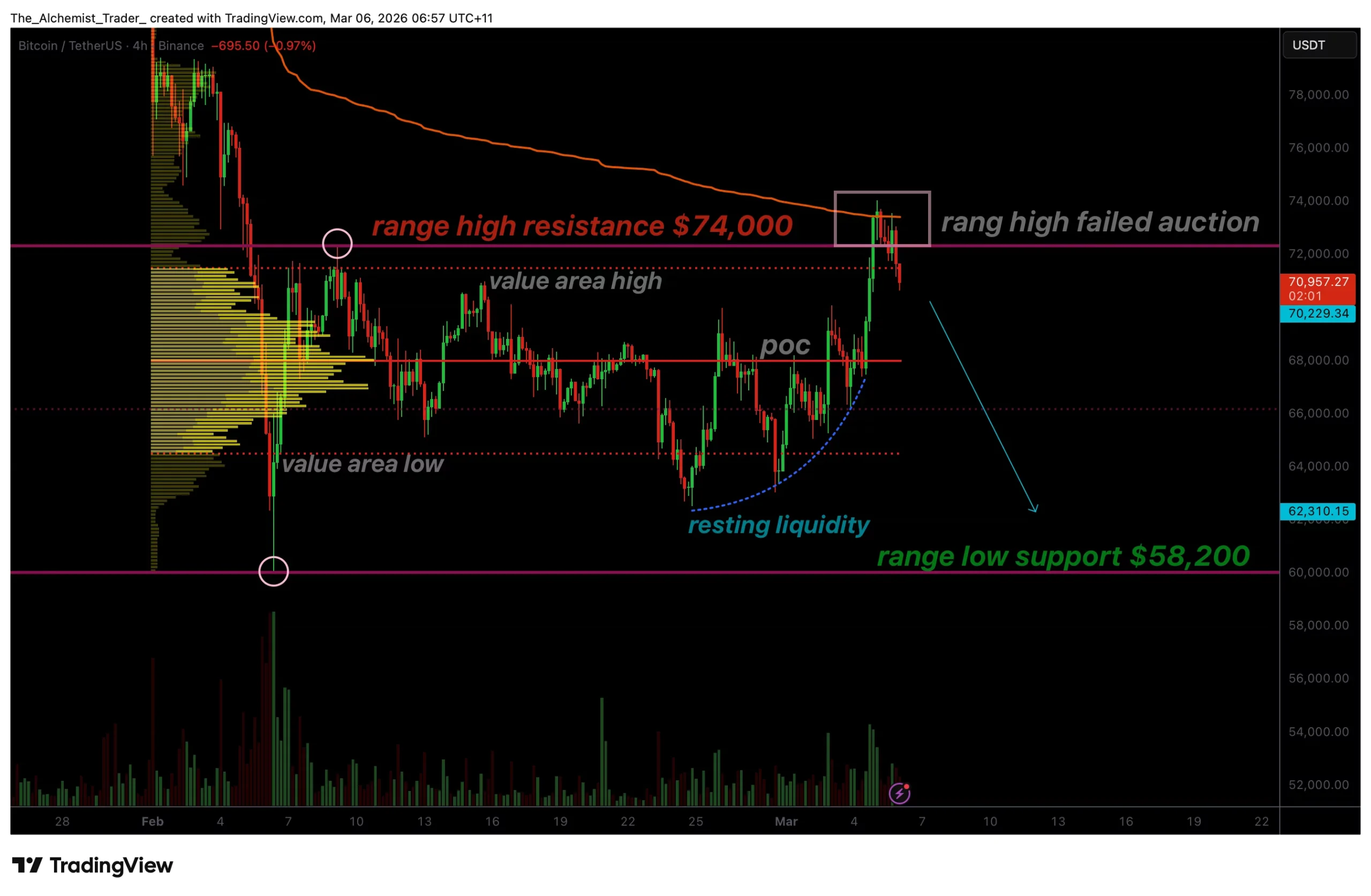
Bitcoin price has confirmed a failed auction at the $74,000 range-high resistance after a sharp rejection. With price now losing the value area high, the probability of a corrective move toward the $60,000 support is increasing.
Summary
- Failed auction at $74K: Strong rejection at range-high resistance confirms weakness.
- Value Area High lost: Signals a shift toward bearish rotational structure.
- $60K support in focus: Previous weekly low becomes the next major downside target.
Bitcoin’s (BTC) latest price action is showing clear signs of weakness after failing to sustain a breakout above the $74,000 resistance level. The rejection from this range high, combined with a confluence of technical resistance from VWAP, has created a failed auction structure.
This development suggests that bullish momentum has stalled, increasing the likelihood of a deeper corrective rotation within the current trading range.
Bitcoin price key technical points
- Range-high rejection: Bitcoin failed to hold above the $74,000 resistance level.
- VWAP confluence: Additional resistance reinforced the failed breakout attempt.
- Downside risk: Loss of value area high increases the probability of a move toward $60,000.
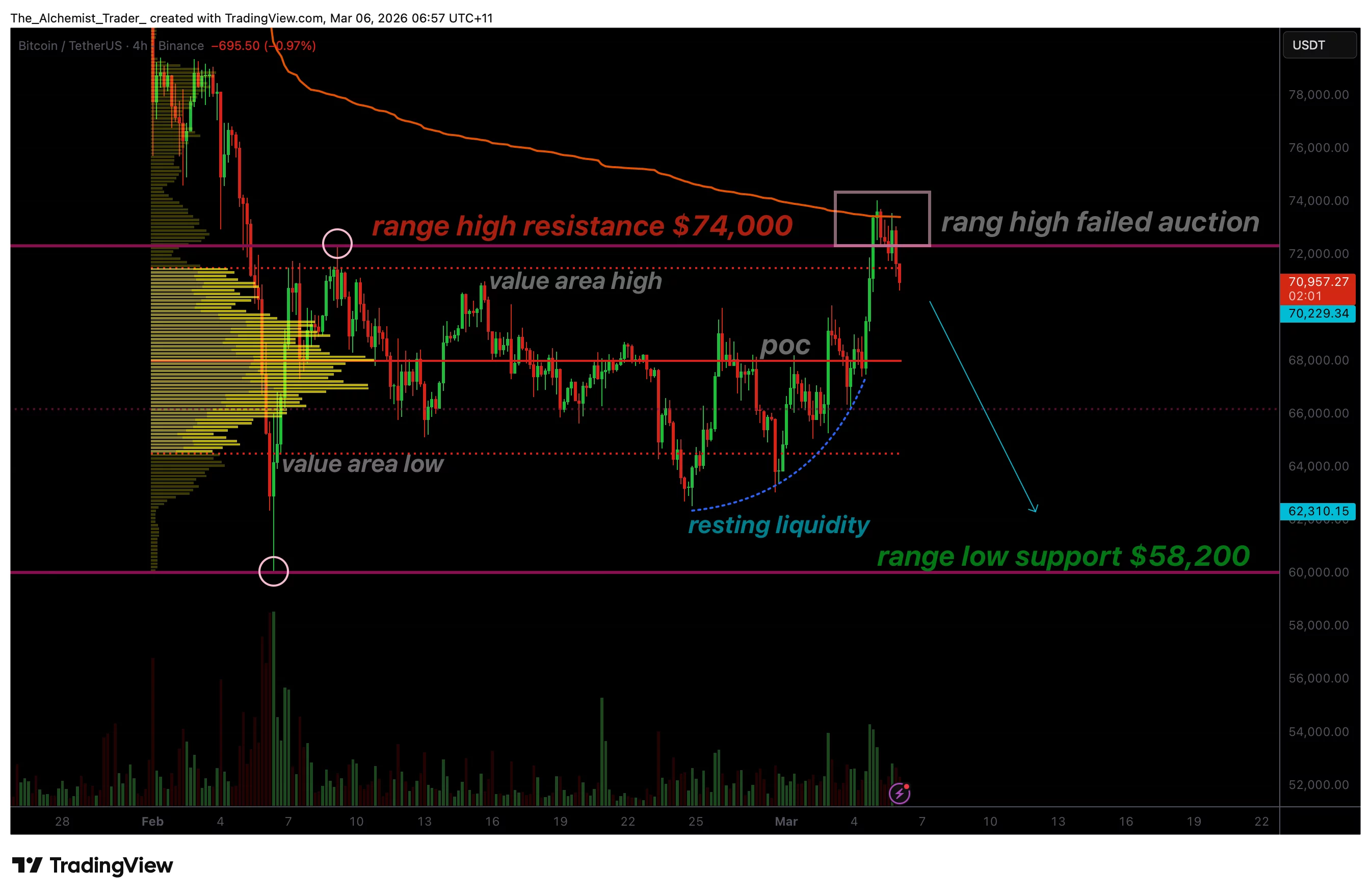
Bitcoin recently attempted to break above the key range-high resistance situated around $74,000. However, the breakout quickly failed as price was met with strong selling pressure near this level. The market briefly traded above the resistance before reversing sharply and closing back below it, forming what traders refer to as a failed auction. This type of structure typically occurs when price attempts to push into higher levels but lacks sufficient demand to sustain the move.
A critical factor contributing to this rejection was the confluence with the volume-weighted average price (VWAP), which acted as an additional resistance layer. When multiple technical resistance levels align, they often strengthen the probability of a rejection. In this case, the presence of VWAP at the range high reinforced the selling pressure and prevented Bitcoin from establishing acceptance above $74,000.
Following this rejection, Bitcoin has now lost the value area high, a key level that previously supported price within the trading range. The loss of this level is a significant technical development because it suggests that buyers are no longer in control of the short-term market structure.
When the value area high is lost, price often rotates toward the value area low as the market seeks a new balance within the range. Meanwhile, Bitwise Asset Management has also announced a $233,000 donation to Bitcoin open-source developers, marking its second annual contribution tied to the success of its spot Bitcoin ETF.
This rotation dynamic increases the probability that Bitcoin will test lower support levels. The most notable support currently sits around $60,000, which also aligns with the previous weekly low. Historically, such levels tend to attract liquidity, as traders often place orders around these key areas of interest. If bearish momentum continues to build, the market may gravitate toward this zone as it searches for demand.
Another important consideration is the internal rotation taking place within the current trading range. Markets frequently move between the value area high and value area low as liquidity is redistributed. With price now accepted below the range-high resistance and the value area high, the probability of a move toward the lower end of the range increases significantly.
In addition, resting liquidity typically accumulates around major support levels such as the value area low. As price rotates through the range, these liquidity pools often become targets for market participants. This process can accelerate downward momentum, especially if sellers remain in control and bullish attempts to reclaim higher levels continue to fail.
The broader market environment also supports the possibility of further downside. Repeated bearish candle closes near resistance often indicate sustained selling pressure and a lack of strong buying demand. In such conditions, range highs tend to act as strong rejection zones, reinforcing the probability of continued rotational movement within the market.
What to expect in the coming price action
From a technical perspective, Bitcoin remains vulnerable to further downside after confirming a failed auction at the $74,000 range high. As long as price remains below this resistance and the value area high continues to act as resistance, the probability favors a rotation toward the $60,000 support region.
A strong reclaim of the lost resistance would invalidate this bearish outlook, but until then the market structure suggests that deeper corrective movement remains likely.


AI firm Montra Finance claims that the entire team behind its recently-launched MONTRA token has been drafted to fight in the war against the US and Israel and as a result, it has been forced to abandon the project.
The firm made the announcement via X on Wednesday and the account was later deleted. The Montra Finance website now displays a 404 error page.
MONTRA’s market cap subsequently dropped 80% from $100,000 to roughly $20,000, and the project’s volume across the last six hours was just $1,200.
Montra pitched itself as “autonomous quant trading on Base” and launched its token on February 25. It reached a market cap of $700,000 by the following day, but performed poorly from then on.
All this has led many to believe that the project was nothing more than a creative rug pull or exit scam.
Read more: Zerebro founder Jeffy Yu has allegedly killed himself again
One crypto user said, “Having a hard time deciding whether this, or the dev that died and came back alive and died again was a better rug excuse 🤣.”
Another noted that the website was “vibe-coded” using the Loveable AI coding website. “What would you expect? lool,” they added.
One potential investor noted days ago that the Montra Finance site wouldn’t let them connect their wallet and that they “need further validation to invest… sketchy for now.”
The Montra team appear to be taking advantage of the ongoing US-Israel war against Iran, which has now entered its sixth day.
The conflict has led to a surge of outflows from Iran’s biggest crypto exchange, Nobitex, and caused a flurry of bets on prediction platform Polymarket that have raised insider trading red flags.
Got a tip? Send us an email securely via Protos Leaks. For more informed news and investigations, follow us on X, Bluesky, and Google News, or subscribe to our YouTube channel.
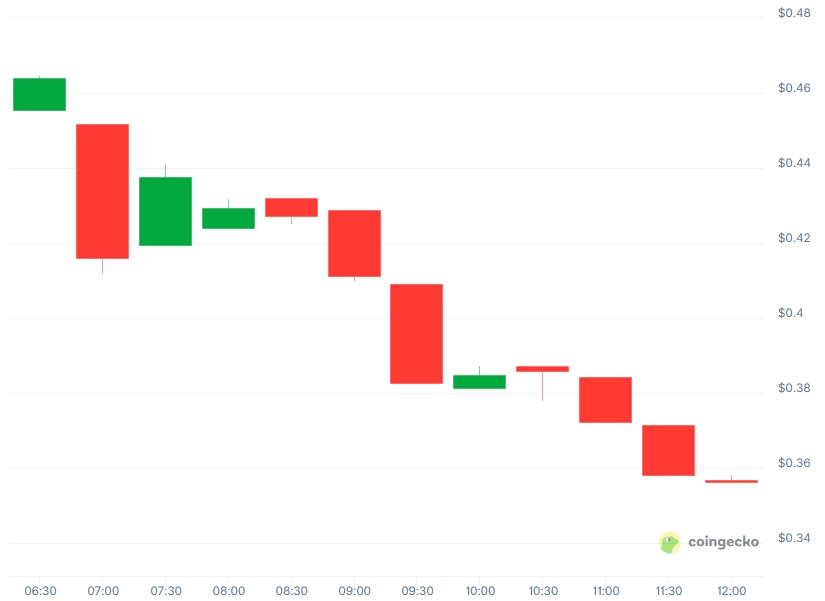
OPN debuted at a $450 million valuation but is dropping steadily amid airdrop selling pressure.
Opinion, a prediction market built on BNB Chain, launched its native OPN token earlier today with an airdrop for early users.
OPN is currently trading at a $350 million valuation, down around 20% from its launch price, according to Coingecko. The token is facing heavy selling pressure, likely from airdrop recipients, and has already generated nearly $150 million in trading volume.

Most of the activity is concentrated on Binance, which listed OPN on its spot markets with trading rewards. The token has also been listed by Bybit, MEXC and various other centralized exchanges, with Coinbase set to launch perpetuals.
Launched in October 2025, Opinion is the third-largest prediction market by volume after Kalshi and Polymarket, according to data from Artemis. However, it’s worth noting that the validity of its data has come under scrutiny after it reported a whopping $8 billion in January volume.

A month ago, Opinion raised $20 million in a pre-Series A round that included Hack VC, Jump Crypto, and Primitive Ventures.

Investigators have moved to clamp down on a high-profile crypto theft tied to government-held assets. The FBI announced the arrest of John Daghita on Saint Martin, alleging he gained unauthorized access to wallets managed under a federal asset protection program that oversees seized digital assets. The operation, conducted with assistance from the French Gendarmerie’s premier elite tactical unit, culminated in Daghita’s detention on the Caribbean island, according to an X post from FBI Director Kash Patel. Images released by the bureau show a handcuffed suspect alongside items including cash, several thumb drives, a cellphone, and three devices resembling hardware wallets. The case forms part of a broader effort to secure and trace digital assets held by government authorities, with investigators pursuing how illicit activity flowed through custody channels. Earlier reporting by ZachXBT linked a wallet to roughly $23 million in digital assets connected to a larger $90 million seizure reported by U.S. authorities in 2024–25; the FBI has not disclosed whether any funds were recovered in this particular instance.
Key takeaways
- A joint operation involving the FBI and the French Gendarmerie led to the arrest of John Daghita on Saint Martin, amid allegations of unauthorized access to wallets under the federal asset protection program.
- The case is tied to a wider seizure activity, with about $90 million reported as seized by U.S. authorities in 2024–25 and roughly $23 million traced to a wallet linked to Daghita’s activity.
- Physical traces presented by the FBI—cash, thumb drives, a phone, and hardware-wallet–style devices—underscore the tangible nature of what is often framed as digital crime.
- The FBI did not publicly state whether any portion of the stolen funds has been recovered as part of this operation.
- Ongoing cross-border cooperation signals a broader trend of international intelligence-sharing and tactical enforcement in crypto-related cases, particularly when government-held assets are implicated.
Market context: The incident arrives amid heightened scrutiny of how governments custody seized crypto assets and how authorities trace illicit flows across custody solutions. It also highlights the increasingly international reach of enforcement actions in crypto thefts, a trend observed as authorities expand on-chain analytics and cross-border cooperation to deter and punish criminal access to digital assets.
Why it matters
The arrest foregrounds a crucial ongoing narrative about security and governance in crypto custody. When government-held digital assets are at risk, the integrity of custody procedures, access controls, and key management become central to preventing unauthorized withdrawal or manipulation. The broad takeaway for custodians, exchanges, and asset-recovery teams is that physical artifacts—such as drives, devices that resemble hardware wallets, and even cash—can accompany cyber-enabled offenses, reinforcing the need for robust physical and digital safeguards around seized assets.
For law enforcement and policy makers, the Saint Martin operation illustrates how cross-border cooperation can be instrumental in pursuing suspects whose activities straddle multiple jurisdictions. The involvement of the French Gendarmerie’s tactical unit alongside U.S. authorities demonstrates a willingness to deploy coordinated, high-profile actions to disrupt alleged theft rings connected to federally held crypto assets. It also underscores the importance of transparent, timely communications from agencies to convey progress and manage public expectations in high-stakes investigations.
From a broader market and ecosystem perspective, the episode reinforces the value of meticulous asset tracing and forensic analyses. Analysts and researchers who monitor wallet movements—and the methods by which seized holdings are linked to specific individuals or entities—play a growing role in connecting on-chain activity with off-chain events and enforcement outcomes. The coverage also serves as a reminder that regulatory clarity around asset forfeiture, disclosure requirements, and custody standards may influence how institutions structure their own risk controls and reporting practices in the years ahead.
For investors and participants in crypto markets, incidents like this can shape risk sentiment and the perceived security of custody arrangements. While such enforcement actions do not directly implicate the day-to-day operations of legitimate traders, they contribute to a climate in which stakeholders expect greater transparency around how seized or controlled assets are stored, displayed, and eventually resolved through legal processes.
What to watch next
- Formal charges or court filings against John Daghita in an appropriate jurisdiction, including any details about his role and the mechanics of the access that allegedly occurred.
- Public updates from the U.S. Marshals Service or the FBI regarding whether any portion of the seized funds has been recovered or forfeited.
- Further disclosures about the specific wallets, asset types involved, and the custody framework under which they were kept.
- Additional coordinated actions or arrests related to this case or related custody breaches, especially given the cross-border nature of the operation.
- Subsequent analyses or statements from investigators that illuminate how on-chain traces were linked to off-chain assets and how artifacts recovered from the scene are being evaluated.
Sources & verification
- FBI Director Kash Patel’s X post announcing the arrest: https://x.com/FBIDirectorKash/status/2029574256959389933
- Related coverage about the US Marshals investigation into seized digital assets: https://cointelegraph.com/news/us-marshals-investigation-seized-digital-assets
- Further reading on the wallet linked to the alleged seizure and subsequent memecoin activity: https://cointelegraph.com/news/us-treasury-theft-wallet-bundled-memecoin-crashes-97
FBI arrest tied to multi‑million crypto theft from government custody
The episode centers on a perceived breach of custody protocols governing digital assets that had been seized and were intended for federal protection. The FBI’s announcement—paired with imagery supplied by the agency—provides a rare, tangible glimpse into the investigative trail: a handcuffed suspect, a suitcase of cash, and a collection of devices that practitioners in the space recognize as potential hardware-wallets. The narrative ties back to earlier reporting that traced a wallet holding tens of millions in digital assets to a broader seizure by U.S. authorities, underscoring how modern enforcement blends traditional investigative methods with on-chain analytics to establish a credible link between individuals and illicit flows.
Key elements in the report—the involvement of Saint Martin and the French Gendarmerie’s elite unit—emphasize the international scope of crypto enforcement. This is not merely a domestic matter; it reflects a governance and security dimension that cuts across borders, especially when the assets in question are held under a federal program designed to safeguard seized digital holdings. While the FBI has not disclosed recovery figures for the funds tied to this case, the scarcity of such disclosures in high-profile crypto thefts is a reminder that asset disposition in these cases can be complex, often requiring lengthy legal processes before any forfeiture or restitution is finalized.
From a narrative standpoint, the photos and the articulated sequence point to a broader truth about the crypto ecosystem: the boundary between the digital and physical world remains porous in the eyes of investigators. Hardware-wallet-like devices, thumb drives, and other offline storage components are not abstract symbols; they are practical vectors and artifacts that can illuminate how attackers choreograph access to protected funds. The public-facing portion of the case thus serves as a test case for how custody protocols, physical security measures, and cross-jurisdictional cooperation converge to deter theft and, when necessary, pursue accountability through the courts.
In the coming weeks and months, observers will watch for updates on charges, asset recovery, and the precise custody arrangements surrounding seized digital assets. The outcome could influence how other agencies calibrate their own asset-protection practices and how market participants interpret regulatory signals tied to enforcement actions. The intersection of on-chain forensics, cross-border law enforcement, and the governance of seized crypto assets remains a critical frontier for the industry as it evolves toward greater resilience and transparency.

- Cardano (ADA) is now accepted at 137 Swiss SPAR stores via direct wallet payments.
- ADA’s price remains stagnant near $0.272 despite retail adoption.
- The key levels to watch are the $0.28 resistance and the $0.26 support.
The price of Cardano’s ADA token has remained unmoved even after 137 SPAR supermarkets across Switzerland announced they now accept Cardano (ADA) as a payment method, giving the cryptocurrency a new real-world utility.
The integration, powered by a payment system that connects Cardano’s blockchain to everyday retail checkouts, allows SPAR customers to pay directly from their wallets, without converting to traditional currencies.
You can now pay with $ADA at 137 SPAR stores across Switzerland.
In partnership with @DFX_swiss and @BrickTowers, we are helping bring blockchain into everyday commerce through real-time, low-cost retail payments.
Read the full press release: https://t.co/gvYRHclp4F
— Cardano Foundation (@Cardano_CF) March 5, 2026
Cardano’s ADA token remains unmoved
This move marks a significant step toward mainstream adoption of ADA.
For many cryptocurrencies, being used in everyday retail has been a distant goal, and Cardano now joins a small group of digital assets being used at physical stores.
However, despite this positive development, ADA’s market performance has remained relatively stagnant.
At press time, the cryptocurrency was trading around $0.272, down 1.3% over the last 24 hours.
Cardano price technical analysis
From a technical standpoint, momentum indicators provide a mixed picture.
The Relative Strength Index (RSI) is recovering from oversold territory but remains below neutral, suggesting buyers have yet to assert dominance.
The Moving Average Convergence Divergence (MACD) indicator readings are flat, signalling a lack of strong bullish or bearish momentum.

Derivatives markets indicate a cautious stance, with long-to-short ratios below one and declining futures participation, hinting that traders are leaning toward a defensive approach rather than aggressive buying.
On-chain activity also shows more coins are being moved, a signal that holders may be redistributing or taking profits.
Combined with modest daily losses, this data suggests that ADA’s recent rebound is not yet convincing enough to trigger a larger market rally.
ADA price forecast
While Cardano’s integration into 137 Swiss SPAR stores is a landmark moment for adoption, the market has yet to respond.
Technical levels suggest that ADA remains range-bound, and traders should be looking for decisive moves either above the immediate resistance or below the immediate support to determine the next trend.
Notably, a descending trendline has been forming, with $0.28 currently acting as the immediate resistance point.
Therefore, a breakout above this level with sustained volume could open the path toward $0.32, where stronger resistance aligns with clustered moving averages.
On the downside, a clear break under $0.26 could bring the $0.24 level into play.
Falling below that could accelerate selling and bring prices closer to $0.21, echoing recent technical warnings about potential downside.


Analysts say past periods of deeply negative funding rates on Binance have often been followed by corrective rallies.
XRP funding rates on Binance turned negative this week, hitting levels that have historically preceded short-term price rebounds.
The setup suggests crowded short positioning may have created conditions for a corrective rally, though analysts caution this does not guarantee a lasting trend reversal without a broader market catalyst.
Derivatives Data Flashes Contrarian Signal
Data from Binance shows XRP funding rates entered a phase of extreme negativity, while the asset ranged between $1.35 and $1.50, according to CryptoQuant analyst Darkfost. This comes after the Ripple token experienced a 60% correction from its July 2025 all-time high of $3.65, with most derivatives traders positioning on the short side despite the sustained drop.
Historical data suggests that short-term rebounds or corrective rallies in XRP often follow periods of extreme negative funding rates on Binance. The analyst emphasized that such configurations act as contrarian indicators, suggesting bearish positioning may have become overcrowded relative to actual price action.
“When market consensus becomes excessively aligned in one direction, history shows that markets tend to surprise the majority,” Darkfost wrote.
Even though the configuration does not ensure long-term trend reversals, the on-chain observer pointed out that it was a favorable indicator for investors trying to find appealing entry points or looking to progressively increase their exposure to XRP.
Exchange Outflows Suggest Supply Tightening
On the technical side, analyst EGRAG CRYPTO yesterday identified $1.55 as the first critical trigger level for XRP, with a weekly close above this point weakening the current downward trajectory.
A more decisive breakout above $2.20 would invalidate the bearish descending channel structure that has defined the asset’s price action for months and open the path toward $2.70 to $3.60. At present, XRP is trading around $1.44, up about 3% in 24 hours but down nearly 10% over the past month and more than 60% below its all-time high.
You may also like:
Adding to the dynamics, exchange outflow data shows a significant increase in XRP withdrawals during February, with total outflows reaching approximately 7.03 billion XRP, the highest level since November 2025.
Binance led the withdrawal volume with outflows of 3.38 billion XRP, indicating a shift in assets from trading environments to private wallets or long-term storage. When withdrawals increase in this manner, it often indicates that a portion of the available supply is being removed from the spot market, potentially reducing liquidity on trading platforms.
With that in mind, traders will likely be focused on whether the combination of negative funding rates and large exchange withdrawals will translate into buying pressure. As Darkfost put it,
“In such uncertain conditions, it becomes essential to carefully select positions, relying on market signals that are beginning to emerge.”
Binance Free $600 (CryptoPotato Exclusive): Use this link to register a new account and receive $600 exclusive welcome offer on Binance (full details).
LIMITED OFFER for CryptoPotato readers at Bybit: Use this link to register and open a $500 FREE position on any coin!

AO VIVO: MONEY NEWS III – 05/03/2026 | CNN MONEY

Police issue update after man, 19, suffers ‘life-changing’ injuries in Rochdale shooting

Record number of Americans tap 401(k) for hardship withdrawals in 2025


-

 Politics7 days ago
ITV enters Gaza with IDF amid ongoing genocide
-

 Politics3 days ago
Alan Cumming Brands Baftas Ceremony A ‘Triggering S**tshow’
-

 Fashion6 days ago
Weekend Open Thread: Iris Top
-

 Tech5 days ago
Unihertz’s Titan 2 Elite Arrives Just as Physical Keyboards Refuse to Fade Away
-
Sports6 days ago
The Vikings Need a Duck
-
 NewsBeat5 days ago
Dubai flights cancelled as Brit told airspace closed ’10 minutes after boarding’
-

 NewsBeat5 days ago
Abusive parents will now be treated like sex offenders and placed on a ‘child cruelty register’ | News UK
-
 NewsBeat5 days ago
The empty pub on busy Cambridge road that has been boarded up for years
-

 NewsBeat4 days ago
‘Significant’ damage to boarded-up Horden house after fire
-

 Tech14 hours ago
Bitwarden adds support for passkey login on Windows 11
-

 Entertainment4 days ago
Baby Gear Guide: Strollers, Car Seats
-
 Tech6 days ago
NASA Reveals Identity of Astronaut Who Suffered Medical Incident Aboard ISS
-
 Sports3 hours ago
499 runs and 34 sixes later, India beat England to enter T20 World Cup final | Cricket News
-
Politics5 days ago
FIFA hypocrisy after Israel murder over 400 Palestinian footballers
-
 NewsBeat4 days ago
Emirates confirms when flights will resume amid Dubai airport chaos
-

 NewsBeat3 days ago
Is it acceptable to comment on the appearance of strangers in public? Readers discuss
-

 Crypto World7 days ago
From Crypto Treasury to RWA: ETHZilla Retreats and Relaunches as Forum Markets on Nasdaq
-

 Tech5 days ago
Viral ad shows aged Musk, Altman, and Bezos using jobless humans to power AI
-

 Video3 days ago
How to Build Finance Dashboards With AI in Minutes
-

 Business2 days ago
Guthrie Disappearance Enters Fifth Week as Family Visits Memorial