
Crypto World
Altcoin open interest overtakes Bitcoin after 21 months



Aggregate open interest in altcoin perpetual futures surpassed Bitcoin’s for the first time since December 2024 on Sept. 6, reflecting increased leveraged trading as Zcash and the wider altcoin market rallied.
Summary
- Coinalyze data showed altcoin perpetual futures open interest surpassing Bitcoin’s for first time since 2024.
- Bitcoin perpetual open interest remained near $23.9 billion, representing roughly 37% of aggregate tracked positions.
- Zcash open interest reached about $2.4 billion as short liquidations exceeded $34 million during breakout.
- Altcoin market capitalization outside the ten largest assets increased above $200 billion during early September.
- Open interest records outstanding contracts but does not reveal whether positioning is bullish or bearish.
Bitcoin’s aggregate open interest stood near $25 billion on Sept. 7, according to Coinalyze. Perpetual contracts accounted for approximately $23.9 billion, while dated futures represented about $1.2 billion.
Bitcoin held around 37% of the perpetual open-interest market tracked by the platform. The combined share of altcoin contracts therefore exceeded Bitcoin’s share, although the altcoin category combines positions across many different assets.
Altcoin open interest now exceeds Bitcoin’s share
Open interest measures the value of outstanding derivatives contracts that traders have not closed or settled. It rises when participants establish new positions and declines when positions are closed, expire or face liquidation.
The metric does not show whether traders are collectively bullish or bearish. Each derivatives contract has both a long and short side, making rising open interest primarily a measure of participation and leverage.
Funding rates provide additional context. Positive funding generally indicates that long positions are paying shorts, while negative funding suggests stronger demand for bearish exposure. Price movements and liquidation data can then help identify which side is under pressure.
The altcoin crossover therefore does not prove that traders expect every token to appreciate. It shows that the combined value of outstanding altcoin perpetual positions has moved above Bitcoin’s total.
Market structure also matters. Bitcoin remains the largest individual crypto derivatives market. The competing altcoin figure combines Ether, Solana, XRP, BNB, Zcash and hundreds of smaller tokens.
Bitcoin’s share could recover quickly if traders add new BTC positions or if altcoin leverage is removed through liquidations. The crossover is best treated as a snapshot of current positioning rather than a permanent change in market leadership.
Zcash drove part of the derivatives expansion
Zcash became one of the clearest examples of rising altcoin leverage. ZEC futures open interest climbed to approximately $2.3 billion to $2.4 billion as the privacy token moved above $1,000 in early September. ZEC rose about 20% on Sept. 4 and reached an intraday high near $1,023. The advance liquidated approximately $36.6 million in leveraged positions, including about $34.5 million held by short sellers.
The token continued climbing after the initial breakout. ZEC traded near $1,192 on Sept. 7, up approximately 11% during the latest session, with prices ranging between roughly $1,074 and $1,249. Crypto.news reported that the rally coincided with Zcash becoming the first privacy coin with a U.S. spot ETF. Grayscale converted its Zcash Trust into the ZCSH exchange-traded fund on NYSE Arca in August.
The fund launched with approximately $304 million under management, according to the report. Its assets later passed $414 million as ZEC prices and investor interest increased. Short liquidations also accelerated the rally. Exchanges close bearish positions by purchasing the relevant asset or contract when traders no longer hold enough collateral. This forced buying can push prices higher during an already strong move.
The same mechanism can operate in reverse. If ZEC falls, leveraged long positions may be closed through forced sales, adding pressure when market liquidity is limited.
Earlier data had already shown derivatives activity outpacing spot demand. Crypto.news reported that ZEC futures volume reached $3.55 billion against $312 million in spot volume during a snapshot before the $1,000 breakout.
Higher dollar prices can inflate open interest
An increase in dollar-denominated open interest does not always mean traders added the same amount in new positions. The value can rise because the underlying token appreciates, even when the number of contracts remains unchanged.
ZEC provides a clear example. If 2.3 million ZEC remain committed to futures positions, their dollar value rises automatically when the token moves from $800 to $1,000. New positions and price appreciation can also occur together. Distinguishing between them requires reviewing open interest in both token and dollar terms.
The relationship between price and open interest provides useful context. Rising prices accompanied by rising open interest can indicate that traders are adding exposure. Rising prices with falling open interest may indicate that short sellers are closing positions.
Falling prices and declining open interest commonly point to long liquidations or voluntary position closures. Falling prices with rising open interest may indicate new short exposure, although funding data is needed to support that interpretation.
Crypto.news previously explained that open interest and funding rates represent stored liquidation pressure. A liquidation spike accompanied by a sharp decline in open interest indicates that leverage has left the market. A small decline suggests that traders may still be heavily positioned.
Spot altcoin valuations also increased
The market capitalization of altcoins outside the ten largest crypto assets rose above $200 billion during early September, according to figures cited alongside the Coinalyze crossover.
The category gained more than 10% from the beginning of the month. That increase suggests that rising derivatives activity occurred alongside higher spot valuations rather than entirely within futures markets.
Market capitalization does not directly measure the amount of new money entering an asset. It multiplies the latest traded price by circulating supply, so relatively small purchases can increase the calculated value of all circulating tokens. Bitcoin, meanwhile, traded near $79,575 on Sept. 7, down approximately 0.4% during the latest session. Its intraday range extended from roughly $79,460 to $80,494.
The combination of stable Bitcoin prices and stronger altcoin gains is consistent with traders accepting more risk. It does not establish that investors sold Bitcoin specifically to finance altcoin purchases.
The broader altcoin market had struggled earlier in 2026. Crypto.news reported that assets excluding Bitcoin and Ether lost nearly 23% during the first half, as liquidity concentrated in larger cryptocurrencies and stablecoins.
The September recovery therefore follows a prolonged period of weaker performance rather than beginning from an established altcoin bull market.
Liquidation risk depends on market depth
Elevated open interest becomes dangerous when leveraged positions grow faster than available liquidity. A sudden price move can then force exchanges to close positions more quickly than order books can absorb them. Long liquidations add forced selling during a decline. Short liquidations create forced buying during a rally. Both can amplify the original movement and produce a cascade across multiple exchanges.
The risk depends on margin levels, collateral quality, position concentration and spot-market depth. Open interest alone cannot identify when a liquidation event will begin. The original report claimed that liquidation events tend to accelerate when aggregate open interest reaches approximately 4.42% of total market capitalization. However, it did not link to a primary study or publish the methodology used to establish that threshold.
The 4.42% figure should therefore be treated as an unverified estimate rather than a dependable market trigger. Assets with similar ratios can behave differently because their liquidity, exchange distribution and collateral requirements vary.
Recent market events show how quickly leverage can unwind. Bitcoin dropped from above $81,000 to below $78,000 in August, while long positions accounted for around $270 million of liquidations. Crypto.news reported that Bitcoin open interest fell as leveraged longs exited.
The altcoin market may be more sensitive because many tokens have thinner order books than Bitcoin. A position that appears manageable under ordinary trading conditions can become difficult to close during a rapid move.
The 2024 crossover does not guarantee another correction
The previous crossover occurred in December 2024 and was followed by corrections across several mid-cap tokens. Bitcoin remained comparatively stable during part of that period. One historical occurrence does not establish a reliable predictive relationship. Market liquidity, exchange composition, leverage limits and collateral structures have changed since 2024.
Other developments may also have contributed to the earlier corrections, including macroeconomic conditions, token-specific news and broader shifts in risk appetite. Timing alone cannot prove that altcoin open interest caused the declines.
The most useful signals now include funding rates, spot trading volume and changes in open interest. Rising leverage combined with expensive funding and weakening spot demand would indicate a less stable market.
A decline in open interest while prices remain firm would suggest that excess leverage is leaving without causing a wider sell-off. Continued growth in both spot volume and open interest could indicate that derivatives activity still has underlying demand.



The Middle East and North Africa’s annual on-chain crypto transaction volume increased from approximately $100 billion in 2022 to an estimated $350 billion during 2025–2026, according to a Bitcoin Policy Institute report published on Sept. 4.
Summary
- MENA annual on-chain transaction volume rose from about $100 billion in 2022 to estimated $350 billion.
- Turkey remains the region’s largest crypto market, with annual transaction volume approaching $200 billion, researchers estimate.
- Saudi Arabia recorded 154% year-over-year growth, while Qatar followed with a 120% increase, according to Chainalysis.
- The UAE processed approximately $150 billion in crypto transactions during 2025, the policy report estimates overall.
- Currency depreciation and conflict have increased demand for Bitcoin and dollar-backed stablecoins across vulnerable economies.
The Bitcoin Policy Institute’s report argues that MENA has become one of the fastest-growing digital asset regions. It attributes that expansion to inflation, currency depreciation, government-backed technology programs and greater institutional participation.
However, the $350 billion figure is an institute estimate covering the 2025–2026 period rather than a confirmed total for one completed calendar year. The report does not provide a single underlying dataset or detailed methodology showing how it calculated the regional increase from $100 billion.
The findings describe two distinct adoption patterns. Residents in economies affected by inflation, capital restrictions, sanctions or conflict have used Bitcoin and dollar-backed stablecoins to preserve value or transfer funds. Gulf countries, meanwhile, have attracted exchanges, institutional trading companies and tokenization platforms through regulated financial centers.
The distinction matters because transaction volume does not measure investment gains, unique users or money entering the region. On-chain estimates can include transfers between exchange-controlled wallets and repeated movements of the same assets.
Turkey remains the largest market by transaction value
Turkey received nearly $200 billion in annual crypto transaction volume, according to the institute. That makes it the largest market in the wider MENA region by the report’s measure.
Demand in Turkey has developed alongside prolonged inflation and weakness in the Turkish lira. Stablecoins can give residents digital exposure to the U.S. dollar, although they introduce issuer, platform and regulatory risks absent from physical currency.
Egypt, Lebanon and Iran show a similar but more constrained adoption pattern, according to the report. It says peer-to-peer Bitcoin trading in Egypt increased by more than 300% following successive devaluations of the Egyptian pound. The paper does not identify the complete dataset or measured period behind that percentage, so the figure should be treated as its estimate.
Conflict has also produced mixed market behavior. Bitcoin initially fell with other risk assets after the Israel–Iran confrontation escalated in June 2025. The institute said the total crypto market lost about 3.7%, while Bitcoin declined around 2.3% and Ether fell 7.5%.
Investors later shifted some capital from smaller tokens into Bitcoin, pushing Bitcoin’s market dominance to 64.8%, according to the paper. This pattern supports the claim that traders used Bitcoin defensively relative to altcoins, but it does not establish that Bitcoin consistently behaved like a traditional safe-haven asset. Crypto.news previously reported that renewed U.S.–Iran tensions pushed Bitcoin lower during a later episode, showing that geopolitical stress can still produce broad risk reduction.
Saudi Arabia and Qatar lead reported growth rates
Saudi Arabia recorded the region’s fastest growth at 154% year over year, followed by Qatar at 120%, the institute said. Those percentages originate from a Chainalysis regional study published in September 2024 rather than newly measured 2026 growth.
The dates are important. The percentages describe an earlier measurement period and should not be presented as current 2026 growth rates without newer comparable data. The Bitcoin Policy Institute reused them to explain the Gulf’s longer-term momentum.
Chainalysis connected Saudi Arabia’s growth with interest in blockchain systems, financial technology, gaming and central bank digital currency research. The country’s young population and high smartphone use also provide a large potential market for digital financial products.
Saudi Arabia has increasingly focused on blockchain applications beyond cryptocurrency trading. In related coverage, the kingdom began developing tokenization projects for energy and real estate as part of its Vision 2030 diversification program.
Qatar’s measured growth followed the introduction of a digital asset framework through the Qatar Financial Centre. The framework established rules for tokenized assets and related infrastructure. It did not legalize every form of cryptocurrency activity across the country.
The UAE builds a regulated institutional market
The Bitcoin Policy Institute estimates that the UAE processed approximately $150 billion in crypto transactions during 2025. It describes the market as institutionally oriented, with Bitcoin accounting for 38% of activity, Ether representing 22% and dollar-backed stablecoins making up 30%.
These percentages are report estimates rather than official transaction figures from a UAE regulator. Public blockchain data can identify asset movements but cannot always determine whether a user, company or controlling entity is located in the UAE.
The UAE has nevertheless established several formal regulatory routes. Dubai’s Virtual Assets Regulatory Authority oversees eligible crypto activities outside the Dubai International Financial Centre. Abu Dhabi Global Market operates a separate financial-services framework, while the Central Bank of the UAE regulates payment-token services.
Dubai expanded its institutional market during 2026. Crypto.news reported that Flowdesk secured a full broker-dealer license for services aimed at qualified and institutional investors.
Kraken also received preliminary approval covering broker-dealer and investment activities. Its proposed offering includes UAE dirham funding and institutional services, although the exchange had not announced a final launch date when its Dubai approval was disclosed.
Stablecoin infrastructure is developing alongside exchange licensing. A regulated conversion framework launched between dirham-backed AE Coin and dollar-backed USDU, creating an institutional settlement route that connects UAE dirham and dollar stablecoins.
Bahrain adds rules for regulated stablecoin issuers
Bahrain has taken a separate regulatory path. The Central Bank of Bahrain introduced its Stablecoin Issuance and Offering Module in July 2025, according to an official statement.
The module applies to regulated stablecoin offering services conducted in or from Bahrain. It sets requirements covering reserves, redemption, governance, disclosures and supervision.
Bahrain has also supported regulated digital asset infrastructure through licensed financial institutions. Singapore Gulf Bank, backed by Bahrain’s sovereign wealth fund and Whampoa Group, partnered with Fireblocks to expand crypto custody and stablecoin services.
The Bitcoin Policy Institute expects regulated Gulf markets and adoption in economically constrained countries to continue developing along separate tracks. That is a forecast, not a confirmed outcome. Future growth will depend on regulation, banking access, market conditions and whether institutions move pilot projects into commercial use.


Ethereum-compatible layer-1 network Harmony proposed sunsetting its blockchain and migrating its native ONE token to Ethereum, seven years after launching its mainnet.
On Sunday, Harmony proposed taking a final network snapshot, issuing ERC-20 ONE tokens on Ethereum and migrating exchange listings. Validators would be offered options to stop their nodes, continue as governors, or join its new AI-video initiative.
Harmony described the proposal as non-binding and did not specify when the final block would be produced or whether the shutdown would be submitted to the network’s validator-led governance process.
Under Harmony’s published governance rules, elected validators can create proposals, while unelected validators may vote, with voting power based on total stake. Passage requires 51% of total stake weight to participate and 66.7% support after a seven-day introduction and 14-day vote.
Related: Galaxy puts Coldcard hack losses at 1,789 BTC, with 87% unmoved
Under the proposal, all ONE balances would be recorded at the network’s final block and new ERC-20 tokens airdropped to the same addresses on Ethereum. The snapshot would cover wallets, staking delegations, validator rewards, smart contracts and centralized exchanges, with no claims required.
However, Harmony said multisig safes, liquidity pools and onchain applications cannot be migrated, urging users to exit all smart contracts before Sept. 10. Validators may begin shutting down that day, with a $1.372 million pool set aside to compensate those that stop on time, retain their stakes and agree to serve as governors.
Harmony proposal comes weeks after an exploit
The proposal comes less than four weeks after an exploit created forged ONE tokens and led Harmony to plan a rollback that would wipe more than 109,000 transactions, marking a potential shift from repairing the network to ending it as an independent blockchain.
On Aug. 12, Harmony said it was considering a rollback after reports that an attacker had minted nearly 4 billion unauthorized ONE, equivalent to about 26% of the supply. An outside account claimed about 2.8 billion tokens reached exchanges, but Harmony had not confirmed the figures at the time.
On Aug. 17, Harmony said it planned to revert the blockchain to an Aug. 11 checkpoint, discarding 109,126 regular transactions and 315 staking transactions. It said investigators had traced nearly all the forged tokens to wallets or service boundaries and were working with exchanges, bridges and law enforcement.
Magazine: Hugging Face hack exposes the open-weight AI cybersecurity paradox
Following last Friday’s strong US jobs report and the subsequent odd increase in expectations for an upcoming Fed rate hike, risk-on assets are entering the final week before the crucial FOMC meeting scheduled for September 15-16.
In the coming days, inflation data is likely to determine whether BTC continues its recovery or faces another major correction.
Big Week Ahead
Monday is expected to be an uneventful day since the US financial markets are closed on Labor Day. There are no major events scheduled for Tuesday, while the 10-Year US Note Auction on Wednesday is unlikely to impact crypto. The first major test comes on Thursday, with the release of the August PPI data, which measures inflation at the producer level.
Economists expect headline PPI to rise 0.4% month-over-month, compared with no actual increase in July. The core PPI is forecast at 0.3%. Annual producer inflation is likely to accelerate from 4.7% to 5.4%. A hotter reading could reinforce expectations that inflationary pressure is rebuilding, particularly as oil prices remain elevated due to the resumed conflict in the Middle East.
Friday will be an even more important day for all financial markets, especially risk-on alternatives like crypto. The CPI report goes live, which is estimated to point to inflation remaining at around 3.3%-3.4% annually, while core CPI is expected to ease from July’s 2.5%. The actual results could have a significant and immediate impact on Fed rate-hike expectations.
Once again, a higher-than-expected CPI reading would strengthen the argument for another rate increase and could pressure BTC while pushing Treasury yields higher, and vice versa.
Key Events This Week:
1. US Markets Closed, Labor Day – Monday
2. US 10Y Note Auction – Wednesday
3. August PPI Inflation data – Thursday
4. August Existing Home Sales data – Thursday
5. August CPI Inflation data – Friday
6. September MI Inflation Expectations data -…
— The Kobeissi Letter (@KobeissiLetter) September 6, 2026
Last Week Before FOMC
Given the hawkish stance taken by Fed Chair Kevin Warsh at the end of August and the strong US jobs report from last Friday, the inflation data coming in the following days will be crucial in determining the central bank’s next move. That move will come on September 16, making this week’s data even more important.
Bitcoin reacted to the hawkish speech by Warsh and the jobs report with an immediate leg down that drove it south by $2,000-$3,000 in hours. It managed to stabilize at around $80,000 even as bearish news and expectations mount, but a higher CPI reading is unlikely to help its bullish case ahead of the FOMC meeting, especially since the odds for a rate hike are well over 50%.
The post Bitcoin Faces a Crucial Week: These US Events Could Decide BTC’s Next Big Move appeared first on CryptoPotato.
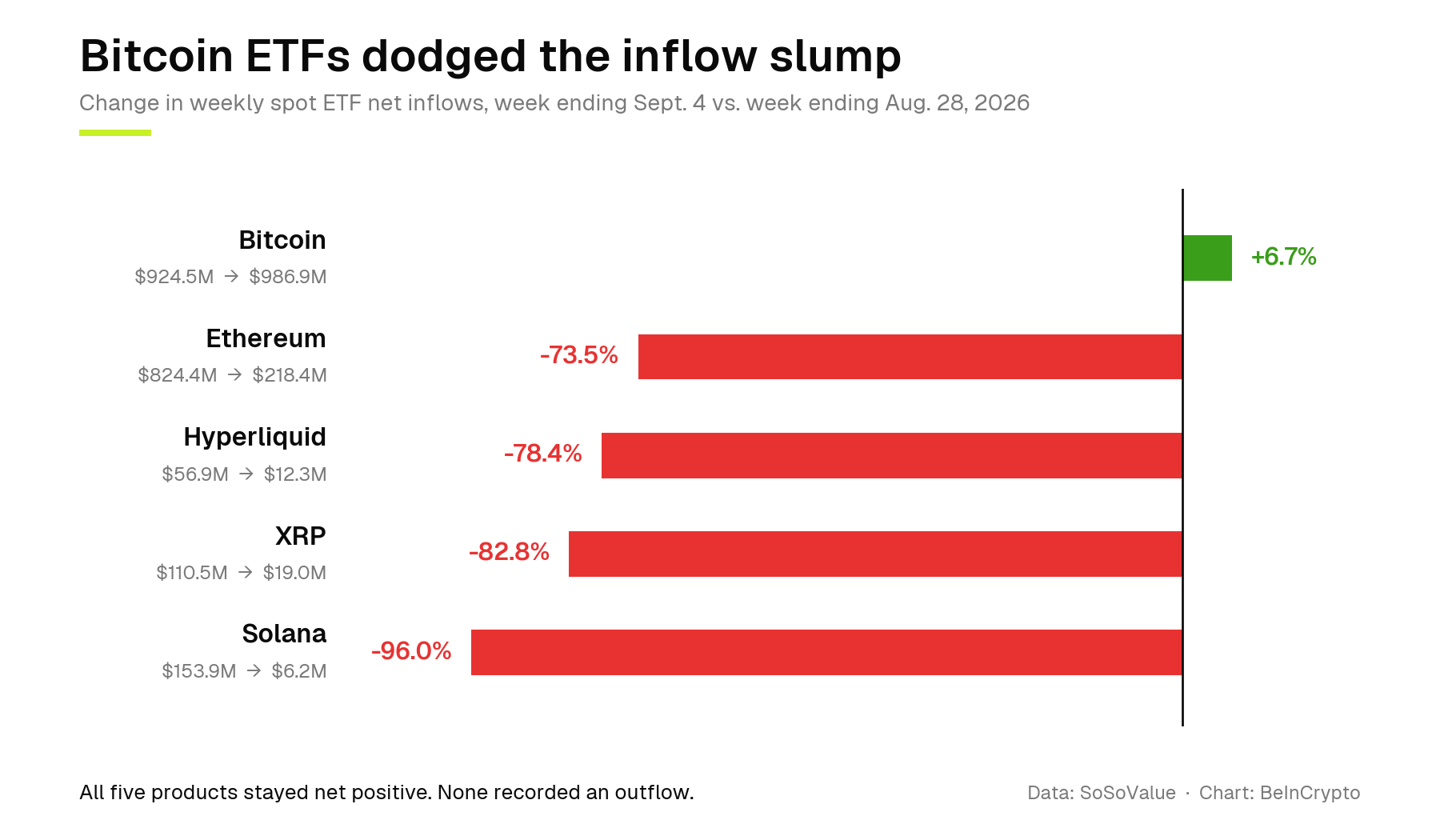
US-listed Bitcoin (BTC) exchange-traded funds (ETFs) pulled in $986.9 million during the week ending September 4, according to SoSoValue data. Inflows into Ethereum (ETH), Solana (SOL), XRP (XRP), and Hyperliquid (HYPE) products fell between 73% and 96% that week.
Bitcoin funds lifted their weekly haul by 6.7%. The four other major product groups moved in the opposite direction after a strong showing the week before.
Altcoin Funds Give Back a Week of Gains
The week ending August 28 told the reverse story. Bitcoin ETFs took in $924.5 million that week, roughly half the $1.92 billion collected a week earlier.
Solana products jumped 443% to $153.9 million during that stretch. XRP funds climbed 178% to $110.5 million, and Hyperliquid funds reached $56.9 million.
Those gains vanished within five trading days. Solana ETFs took in $6.2 million, XRP funds took in $19 million, and Hyperliquid funds took in $12.3 million.
None of the five recorded a net outflow. The shift, therefore, points to slower buying rather than investors pulling capital out.
Trading activity cooled across the board, including in Bitcoin. Turnover in the Bitcoin funds dropped to $14.5 billion from nearly $19 billion, while Ethereum turnover fell to $4.1 billion.

Follow us on X to get the latest news as it happens
Prices Refused to Follow the Money
Spot prices stayed narrow across all five assets. Bitcoin gained 2.58% over the five trading days to September 4.
Ethereum rose 1.09%. XRP added 3.02%, while Hyperliquid gained 5.76%.
Solana trailed the group with a 0.18% gain. Its fund assets slipped over the same stretch, to $1.41 billion from $1.43 billion.
Bitcoin opened Friday at its highest price since May 12. The move followed remarks from Federal Reserve Governor Christopher Waller about the coming inflation reading.
The August employment report then landed on the final day of the flow week. Payrolls rose 162,000 against a forecast near 53,000, and traders raised bets on a Fed hike this month.
That reading runs counter to the dovish signal that pulled money into Bitcoin funds on Thursday. The August inflation print, due September 11, will test how the flows hold up.
Subscribe to our YouTube channel to watch leaders and journalists provide expert insights
The post Bitcoin ETFs Dodge the Inflow Slump That Caught Ethereum, Solana, and XRP appeared first on BeInCrypto.


Bitcoin trades lower by nearly 1% as escalating U.S.-Iran hostilities push oil higher.
A large Chainlink holder transferred another 620,420 LINK to Coinbase on Sept. 7, extending a series of deposits to the U.S. exchange over the past three weeks.
Summary
- A single wallet deposited 620,420 LINK worth roughly $7.6 million into Coinbase, Onchain Lens reported.
- Over three weeks, the address transferred 2.41 million LINK valued near $26.04 million into Coinbase.
- The wallet previously accumulated the deposited LINK from Binance before routing tokens toward Coinbase addresses.
- Exchange deposits can precede sales, but blockchain records cannot confirm whether transferred tokens were sold.
- LINK traded near $13.07 on September 7 after rising approximately 7.1% during the latest session.
The latest transfer was worth approximately $7.6 million when blockchain analytics account Onchain Lens reported the movement.
The same address has now sent 2.41 million LINK, valued at about $26.04 million, to Coinbase during the period, according to the analyst’s post. Onchain Lens identified the originating wallet as 0xF5B007a6341AcC8CfEC581d8A1c5560bC19d9650.
The wallet had previously accumulated the tokens through withdrawals from Binance. Its later movement toward Coinbase represents a change from accumulation to exchange deposits, although the transfers do not confirm completed sales.
Chainlink whale moved 2.41 million LINK in three weeks
The latest 620,420 LINK deposit represented approximately 25.7% of the address’s total three-week transfers. The preceding deposits amounted to roughly 1.79 million LINK based on the cumulative figure supplied by Onchain Lens.
At the reported valuations, the newest transfer valued each LINK at about $12.25. The complete three-week figure valued the transferred tokens at an average of approximately $10.80 each. These values reflect prices around the time of each movement rather than a confirmed execution price.
The address’s earlier Binance withdrawals suggest that the wallet accumulated LINK before sending part or all of those holdings to Coinbase. However, blockchain records alone cannot identify the beneficial owner or explain the reason for each movement.
The address may belong to an individual, institution, trading firm or custody arrangement. Describing it as a whale refers to the size of the holdings and transfers, not a verified identity.
The wallet’s transaction history can be reviewed through the Ethereum block explorer Etherscan. Exchange destination labels also depend on address attribution and can change when analytics providers obtain new information.
Coinbase deposits raise selling risk but prove no sale
Transfers to centralized exchanges often receive attention because customers commonly deposit tokens before selling, converting or using them as collateral. A large deposit can therefore increase the amount of immediately tradable supply on an exchange.
Yet a Coinbase transfer does not establish that the holder sold the tokens. The wallet owner could move LINK for custody, collateral, internal account management, over-the-counter settlement or a future trade that has not occurred.
Confirmation of selling would require additional evidence. This could include movements from Coinbase hot wallets, order-book activity, changes in exchange balances or a statement from the wallet owner. None of those details accompanied the Onchain Lens report.
The transaction also should not be treated as a transfer by Chainlink itself. The address has not been identified as belonging to Chainlink Labs, the Chainlink Foundation or a known project treasury.
Large exchange transfers can still affect trader expectations before any tokens are sold. Market participants may reduce exposure when they interpret a deposit as potential supply. That reaction can create volatility even when the wallet’s actual purpose remains unknown.
Crypto.news previously documented the reverse pattern, with large holders withdrawing hundreds of millions of dollars in LINK while exchange balances declined. The latest Coinbase deposits show that individual whale behavior can differ from the broader holder trend.
LINK price retains bullish momentum near $13
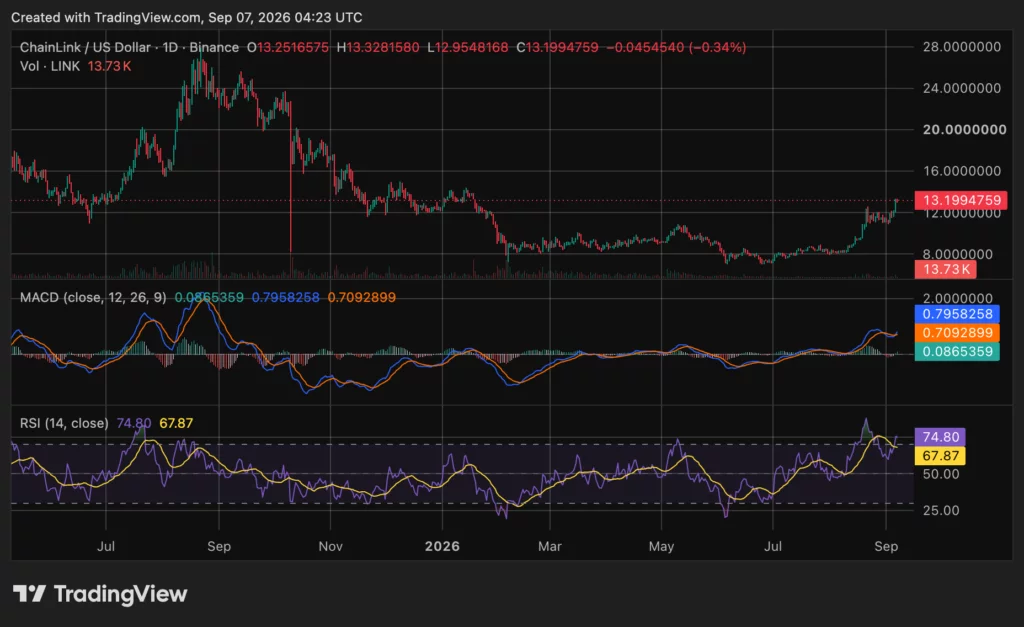
LINK traded near $13.07 on Sept. 7, up approximately 7.1% during the latest session. Its intraday range extended from about $12.12 to $13.32.
The gain means the token was trading above the approximate valuation applied to the whale’s latest transfer. Its market price had also recovered strongly from the June and July lows near $7 to $8.
On the daily chart supplied with the market data, LINK’s moving average convergence divergence remained positive. The MACD line stood near 0.7841, above the signal line at approximately 0.7069, while the histogram remained positive at about 0.0771.
Those readings indicate that upward momentum remained present. The latest red candle and narrowing distance between momentum readings, however, suggest that the rally could be entering a slower phase.
The relative strength index was approximately 72.47, above its moving average near 67.71. An RSI reading above 70 is commonly treated as overbought, although it does not independently establish that a decline will follow.
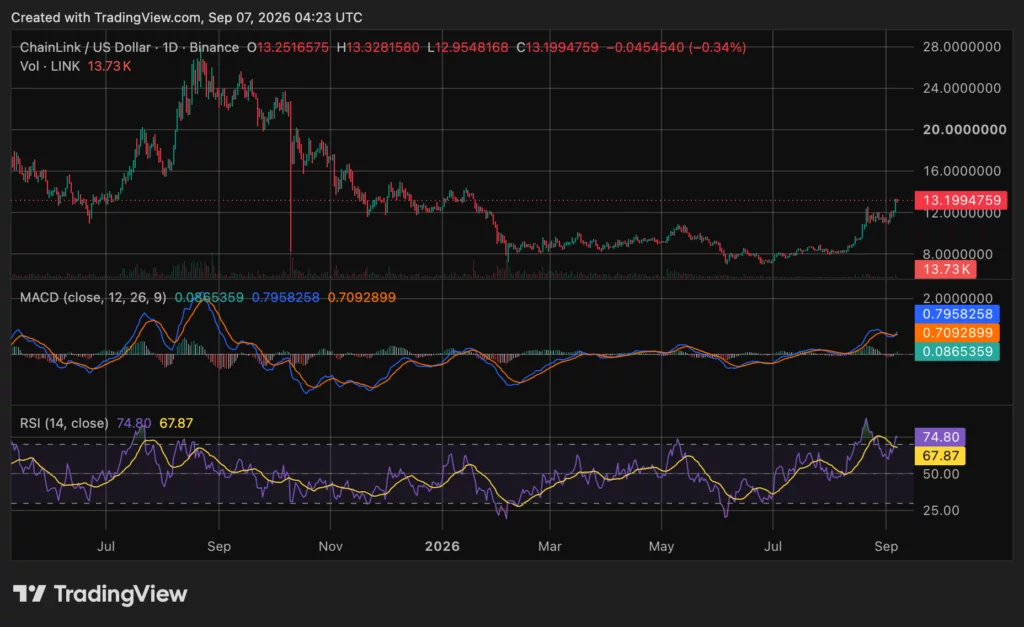
LINK would need to maintain the $12 to $13 region to preserve its recent short-term recovery structure. A sustained move below that area would weaken the rebound, while a break above recent highs would extend it.
No evidence establishes that the whale deposit caused a specific LINK price movement. The token traded within a broader crypto market and reacted to several factors beyond a single wallet transfer.
Chainlink adoption provides a separate demand narrative
The whale movement occurred as Chainlink continued expanding its oracle and cross-chain infrastructure. These developments provide a fundamental backdrop but do not determine what the unidentified holder plans to do.
Chainlink’s Cross-Chain Interoperability Protocol connects applications and assets across multiple blockchain networks. The system processed $4.9 billion in volume during the second quarter, up 353% from the corresponding period one year earlier, according to figures cited by Standard Chartered.
The bank also estimated that Chainlink secured more than $110 billion in value across oracle feeds and cross-chain services. Its long-term LINK forecasts remain estimates rather than confirmed future prices.
Several large projects expanded their use of Chainlink during 2026. Aave adopted CCIP as the default infrastructure for cross-chain deposits, withdrawals, governance and GHO transfers, extending Chainlink’s role across the Aave ecosystem.
BitGo selected CCIP as the exclusive cross-chain provider for Wrapped Bitcoin. The decision moved its $7.3 billion WBTC ecosystem away from LayerZero and brought publicly announced CCIP migrations to roughly $14.6 billion.
Chainlink has also worked with traditional financial institutions. More than 50 banks joined a stablecoin foreign-exchange settlement test designed to combine blockchain settlement with existing Swift and ISO 20022 messaging systems. The project seeks to support atomic payment-versus-payment transactions, as detailed in Chainlink’s institutional settlement trial.
Bottomline Technologies recently partnered with Chainlink to connect blockchain-based payment tools with infrastructure serving hundreds of financial institutions. The agreement expanded Chainlink access across 600 banks.
These integrations can support demand for Chainlink services, but their effect on LINK varies by product design, fee structure and token usage. They do not remove the short-term supply risk associated with large exchange deposits.
Further wallet activity will clarify the holder’s strategy
The next transactions from the whale address will help determine whether the Coinbase deposits are continuing. Additional transfers would raise the cumulative amount available within the exchange’s custody environment.
Withdrawals back to a private address would point in the opposite direction. They could indicate that the holder retained the tokens or completed an internal transfer rather than selling them.
Changes in Coinbase’s LINK balances and transaction clusters may provide further context. Even then, analysts would need to separate this wallet’s activity from unrelated customer deposits and exchange operations.
For now, the blockchain confirms that 620,420 LINK moved from the identified address toward Coinbase. The conclusion that the whale sold $7.6 million of LINK would go beyond the available evidence.


Ethereum co-founder Vitalik Buterin rejected a Sept. 7 prediction that artificial intelligence could undermine confidence in Bitcoin’s security and cause its price to fall by more than 50% within two years.
Summary
- Buterin rejected Liron Shapira’s prediction that AI-related security fears could halve Bitcoin within two years.
- Shapira assigned 50% confidence to Bitcoin crashing over 50% as AI undermines perceived network robustness.
- Buterin considers actual breaks of Bitcoin’s hashing or proof-of-work mechanisms extremely unlikely over that period.
- He said client and mining-pool upgrades could address network-layer attacks without requiring social consensus decisions.
- Bitcoin security groups have separately sought advanced AI access so defenders can identify vulnerabilities earlier.
Investor and AI-risk commentator Liron Shapira assigned a “50% confidence” level to his prediction that Bitcoin would suffer such a decline because AI could weaken what users consider the network’s security or robustness, according to his original post.
Buterin said he took “the opposite side” of that forecast. His response focused on Bitcoin’s technical adaptability rather than its market price, arguing that most AI-related threats could be addressed without changing the network’s core social agreement.
Buterin sees transition risk rather than cryptographic collapse
Buterin said he remains optimistic about cybersecurity over the long term. In his view, the main risk lies in managing the transition to a world where attackers and defenders both use increasingly capable AI systems.
He separated operational attacks from failures of Bitcoin’s underlying cryptography. Network-layer exploits, client vulnerabilities and attacks against mining infrastructure could require software updates, but they would not necessarily invalidate Bitcoin’s proof-of-work design.
Bitcoin’s network consists of several layers. Full-node software verifies transactions and blocks. Mining pools coordinate hash power, while miners provide the computing equipment that performs proof-of-work calculations. Internet infrastructure connects those participants.
AI could help attackers identify flaws in node software, wallet code, mining-pool systems or communications infrastructure. Defenders can also use AI to review code, test updates and detect suspicious behavior.
Buterin argued that client developers and mining pools could respond to those attacks through ordinary upgrades. Such changes would be less difficult than an emergency alteration of Bitcoin’s monetary rules or transaction history.
He described the probability of “actual breaks on hashes or PoW” as “tiny.” The statement is an assessment rather than a measurable guarantee, and it does not cover every cybersecurity risk affecting Bitcoin users.
Bitcoin’s proof of work is not the likeliest AI target
Bitcoin mining depends on SHA-256, the hash function used to process block headers and prove that miners performed computational work. A direct cryptographic break would require an attacker to find a practical weakness that sharply reduces the work needed to produce valid hashes.
However, Current generative AI systems have not demonstrated that capability. AI can improve software analysis and automate attack discovery, but it does not automatically defeat established cryptographic functions. An attacker also could not take control of Bitcoin simply by producing persuasive text, malicious code suggestions or automated social engineering. Compromising wallets, exchanges or individual developers would create losses, but it would not necessarily compromise Bitcoin’s consensus rules.
The more realistic near-term risks involve surrounding infrastructure. AI agents may improve phishing, credential theft, malware development and vulnerability discovery. Mining pools, exchanges, wallet providers and node operators could face more automated attacks.
A July security incident showed the distinction. Bitcoin Optech reported that a weakness in some COLDCARD-generated wallets produced insufficient entropy and exposed affected funds to theft. The problem involved wallet key generation rather than Bitcoin’s hash function or proof-of-work mechanism.
The technical report estimated losses exceeding 1,000 BTC at the time. Users of affected devices were advised to move funds to wallets created with secure external entropy.
Such incidents can damage confidence and cause major losses while leaving Bitcoin’s underlying ledger operational. They support Buterin’s argument that ecosystem software and custody remain more immediate attack surfaces than SHA-256.
AI could accelerate both attacks and defensive reviews
Shapira’s forecast appears to rest on an imbalance between attackers and defenders. Advanced AI could discover vulnerabilities faster than open-source developers can examine, patch and distribute software.
Bitcoin’s public codebase gives researchers broad access, but it also allows attackers to inspect the same software. A sufficiently capable automated system could review large repositories, identify unusual interactions and test attack paths continuously.
The Bitcoin Policy Institute and more than 40 digital-asset organizations raised that concern in August. They asked leading AI laboratories to provide vetted open-source security teams with controlled access to advanced models.
The coalition argued that defenders need early access to the same tools that sophisticated attackers may use. Its proposed program included computing resources, secure testing environments and direct communication with AI laboratory security teams.
Block, Coinbase, Strategy, MARA, Galaxy, BitGo, Brink, Trezor and several Bitcoin development groups supported the appeal. Crypto.news reported that the coalition sought frontier AI access for Bitcoin security researchers before more capable models became widely available.
A separate assessment from Bitcoin Policy Institute researcher Zack Shapiro and security specialist Efrat Fenigson’s coverage warned that the next several years could present a difficult transition. The concern was not that AI would directly solve Bitcoin’s proof of work, but that attackers could gain access to capable security tools before defenders.
As crypto.news previously reported, researchers warned that Bitcoin developers could fall behind AI-assisted attackers without comparable models, funding and computing access.
Social consensus would matter after a deeper failure
Buterin distinguished upgradeable operational problems from attacks that require social consensus. Bitcoin nodes and mining pools can adopt patched software when developers identify a conventional vulnerability.
A deeper cryptographic failure would be more difficult. If an attacker could forge digital signatures or bypass proof-of-work requirements, developers might need to introduce new cryptographic standards and coordinate a broad network migration.
Node operators, miners, exchanges, custodians and users would then need to agree on which software and transaction history to recognize. Disagreement could split the network or delay protective action.
Quantum computing is frequently discussed in this context because a sufficiently capable machine could threaten the elliptic-curve signatures protecting some Bitcoin holdings. That issue differs from Shapira’s AI claim because quantum computers use different computing methods rather than machine-learning techniques.
Crypto.news has reported that developers are exploring quantum-resistant infrastructure and migration tools before practical attacks emerge. Estimates about when such systems could threaten Bitcoin remain uncertain.
Buterin did not claim Bitcoin could respond easily to every cryptographic break. His argument was that those fundamental failures have a very low probability, while more plausible network attacks can be addressed through coordinated software changes.
Bitcoin showed no reaction tied directly to the debate
Bitcoin traded near $79,590 on Sept. 7, down approximately 0.5% during the latest session. Its intraday range was roughly $79,460 to $80,494.
There was no evidence connecting that movement to the exchange between Shapira and Buterin. Bitcoin’s price responds to liquidity, derivatives positioning, exchange-traded fund flows, macroeconomic data and broader risk sentiment.
Shapira’s prediction also does not specify a technical attack, affected software component or sequence connecting AI adoption to a 50% market decline. It is a probabilistic forecast and cannot be treated as a verified security assessment.
Buterin similarly offered no formal risk model supporting his confidence. His response provides a technical counterargument: Bitcoin can patch many operational vulnerabilities, while a direct break of its hash function or proof-of-work mechanism remains unlikely.
The dispute therefore concerns the speed and difficulty of Bitcoin’s security transition rather than evidence that AI has already compromised the network.
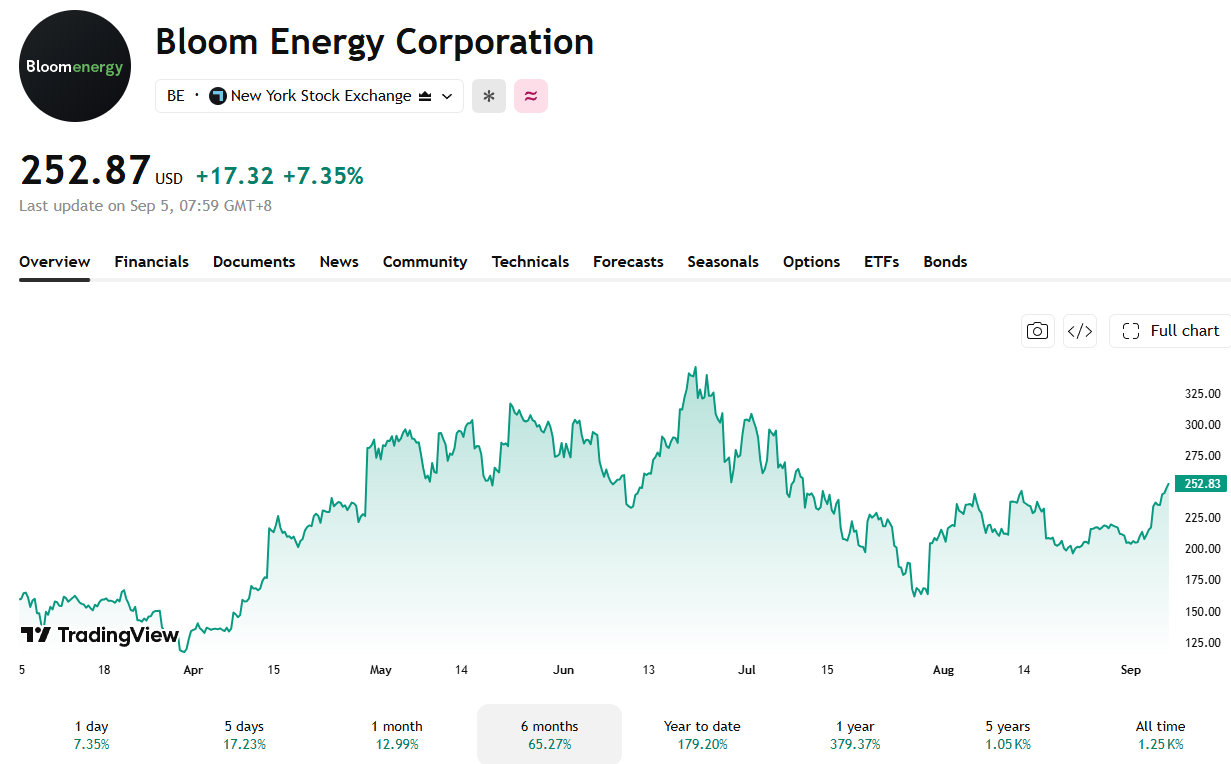
Bloom Energy (BE) shares have climbed roughly 52% since July 28. That is the day the Pelosi’s household made its second disclosed Bloom Energy purchase, a congressional filing shows.
The household bought 15,000 shares and 200 call options across two trades in July. The same filing, dated August 21, also disclosed new Intel holdings.
A Rough Patch, Then a Rebound
Bloom shares had fallen 43% in the month before Pelosi’s first purchase on July 24. A short seller report and broader AI-related volatility drove the slide.
The stock’s low was around $163 in late July. That came just before the second purchase closed at $166.84 on July 28.

The timing overlapped with Bloom’s second-quarter results. Meanwhile, revenue reached $1.065 billion, up 165.5% year over year. It was the company’s first quarter above $1 billion.
Management raised full-year guidance to a range of $3.9 billion to $4.2 billion. The company cited demand from AI data center customers.
Why the Timing Keeps Drawing Attention
The purchases have become one of 2026’s most-watched congressional trades. Still, analysts now flag nearly 40% upside in the position.
Bloom’s pitch to investors centers on the AI power bottleneck. Its fuel cells let data centers add electricity without waiting years for grid upgrades.
In contrast, company insiders sold about 144,000 shares last quarter, worth roughly $38.5 million, according to disclosed filings. Bloom’s valuation also remains rich by some measures.
Quiver Quantitative, a site that tracks congressional stock trades, estimates Pelosi’s cumulative return near 965% since 2014. Historically, that track record has drawn comparisons to other top traders.
Nonetheless, a statement from her office said she does not personally direct the household’s trades.
Bloom Energy joins the S&P 500 on September 21, a change that could pull in extra index-fund buying. Whether the rally continues will likely depend on Bloom completing its project backlog, not on any household’s trade.
The post Bloom Energy Up 52% Since Pelosi's Bottom Buy: What Does She Know? appeared first on BeInCrypto.
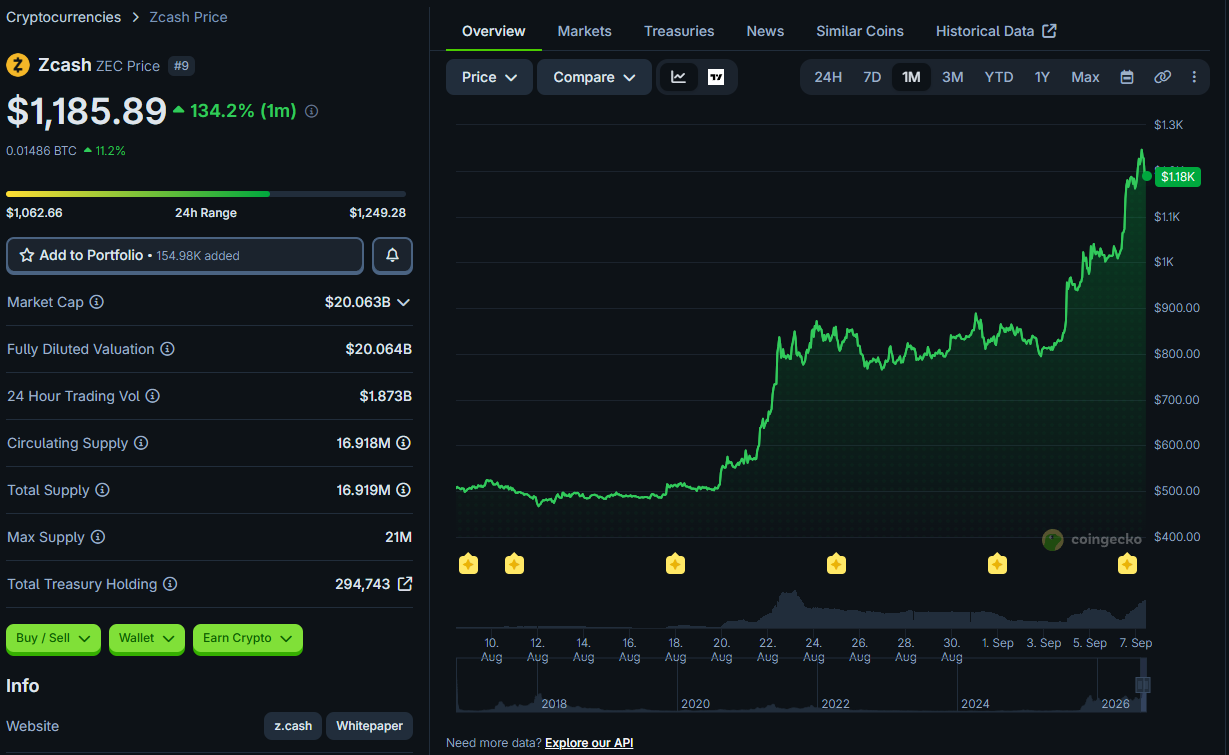
Zcash (ZEC) trades near $1,185, up 11% over the past 24 hours. Grayscale’s Zcash ETF (ZCSH) held $463.2 million in assets as of Sept. 4.
The fund converted from Grayscale’s Zcash Trust when it began trading on NYSE Arca on Aug. 25. ZEC now ranks among the ten largest cryptocurrencies by market capitalization.
ZCSH Assets Track ZEC’s Rally
ZCSH shares closed at $83.77 on Sept. 4, up 7.62% for the day. Shares slipped to $82.20 in after-hours trading that evening.
The fund’s net asset value per share stood at $83.48. That falls within a 52-week range of $3.54 to $84.23.
Daily volume reached 804,728 shares, per Grayscale’s own disclosures. The ETF’s year-to-date return reached 166.44%, per Yahoo Finance.
The fund held 444,608 ZEC tokens as of Sept. 4. Shares outstanding stood at 5.55 million, Grayscale reported.

Grayscale converted its Zcash Trust into the ZCSH exchange-traded fund on Aug. 25. The trust had operated since 2017.
Grayscale cited roughly $260 million in assets at conversion. ZCSH became the first US-listed spot ETF for a privacy-focused token.
For everyday investors, ZCSH means ZEC exposure without a crypto wallet or exchange account. That access is one reason inflows have grown so quickly since launch.
A New Demand for AI Safe Coins
Steve Vanourny, Grayscale’s head of index, linked the launch to rising demand for financial privacy.
“As AI reshapes how financial activity can be monitored, we believe demand for genuine financial privacy will only grow.”
Steve Vanourny, Grayscale’s head of index, Grayscale
ZEC’s rally began before the ETF launch, when it hit an eight-year high in August.
The rally has pushed Zcash’s market cap above $20 billion, per BeInCrypto data.
The token remains far below its 2016 all-time high of $3,191.93. That leaves room for further gains if inflows continue.
Whether ETF inflows keep pace with ZEC’s volatility remains an open question for investors.
ca
The post Zcash ETF Net Assets Reach $463 Million as ZEC Nears $1,200 appeared first on BeInCrypto.


Ledger’s Chief Technology Officer has questioned the white hat label attached to the $320 million taken from Liquid Network.
He stopped short of calling it a theft. Liquid described the parties as purported white hat hackers, and Blockstream is trying to reach them on-chain.
Liquid Network Freezes Its Bridge as Self-Proclaimed White Hats Take 4,000 BTC
For context, Liquid is a Bitcoin (BTC) layer-2 network that operates as a separate blockchain. It uses a two-way peg to connect Bitcoin with its native Liquid Bitcoin (L-BTC) asset.
Users lock Bitcoin on the main network to receive an equivalent amount of L-BTC on Liquid. They can later redeem L-BTC for Bitcoin through the network’s peg-out process.
In an X post, the team stated that roughly 4,000 Bitcoin left the Liquid Federation wallet. Liquid said the transfer used the SideSwap Peg-out Authorization Key, which it insists was not compromised.
SideSwap explained that a customer sent 4,000 LBTC to its peg-out service at 14:05 UTC, and the federation paid out 3,996 BTC 23 minutes later. Blockstream has since traced that LBTC to a bug in the Elements software, according to the company.
The funds were consolidated into the Bitcoin address bc1ql4mfu6aundtkksxklfajs2h3t9nzcd6gyqjlte. It contained an on-chain message claiming the actors were white hats.
The message also asked Liquid to contact them on-chain. Galaxy Research estimated the funds represented about 95% of all Bitcoin pegged to Liquid.
Follow us on X to get the latest news as it happens
In response, the network disabled bridge nodes, preventing new transactions from entering the chain.
Liquid also notified exchanges, which have paused or are preparing to pause L-BTC deposits and withdrawals. Other Liquid assets, including USDT, DePix, and real-world assets, remain unaffected by the incident.
“Liquid wallets will be impacted, and we’re sorry for any inconvenience. Federation members are actively working on resolving this so we can restore normal network activity,” the team said.
Ledger CTO Doubts the White Hat Label
Charles Guillemet, chief technology officer at Ledger, questioned that description. He compared the episode to the Ronin hack, in which attackers stole about $625 million after compromising validator keys. He also linked the invitation to talk to Euler.
Guillemet later softened his reading. The conduct does not look like usual white hat practice, he wrote, though criminal groups do not usually try to contact their victims either.
“There’s hope. This could be people with good intentions that intensively played with recent LLMs and are not used to responsible disclosures…,” the executive noted.
Where the Coins Stand
As of press time, the coins have not left the address that received them. Public records show it still holds about 3,998 BTC, while the federation wallet retains roughly 197 BTC.
Early Monday, the same address signed another message. It asked whether sending most of the funds back to the federation wallet would be acceptable.
Whether Guillemet’s doubts hold depends on what the address does next, not on what it writes.
Subscribe to our YouTube channel to watch leaders and journalists provide expert insights
The post Liquid's Attackers Called Themselves White Hats, Ledger's CTO Isn't Buying It appeared first on BeInCrypto.

Bruce Campbell’s 10/10 Horror Classic Is Officially Back on Streaming

Crypto Bet Big On U.S. Regulation, And Now Its Landmark Legislation Hangs In The Balance

‘Boohoo’: Jenrick mocks protester after clip of Reform UK audience pulling hair

Weekend Open Thread – Corporette.com

Weekend Open Thread: Brooks Brothers

London Mayor Sadiq Khan handed a peerage by Keir Starmer alongside 15 other Labour figures… just days before the PM leaves No10
Crypto Bet Big On U.S. Regulation, And Now Its Landmark Legislation Hangs In The Balance

Financial Festival Digelar di Lampung, Hadirkan Sesi Edukasi Keuangan, Talkshow Inspiratif & Hiburan

5 Rumus Keuangan Berdasarkan Umur
-

 Fashion2 days ago
Weekend Open Thread: Beyond Yoga
-
 Crypto World3 days ago
Bitcoin price stalls near $82K as key resistance holds
-

 Politics3 days ago
Best Gaming Laptops, CPUs, TVs, And Keyboards To Upgrade Your Set Up For GTA VI
-

 Tech3 days ago
The Birds Outside, Drawn For You Automatically
-

 Crypto World3 days ago
IMF Says El Salvador’s Post-Review Bitcoin Purchases Used No Public Funds
-
 Crypto World3 days ago
U.S. added stronger than expected 162,000 jobs in August as labor market bounced back
-

 Sports3 days ago
Alexandre Pato consortium’s Northampton Town investment approved
-

 Sports3 days ago
Commanders’ Chig Okonkwo is a top breakout fantasy football candidate
-

 Sports3 days ago
Golden Eaglets Drawn in Group B for 2026 WAFU B U17 Championship
-
 Crypto World3 days ago
XRP price breaks falling channel as bulls target $1.53
-

 Politics3 days ago
A new European chapter for Gibraltar
-

 Politics3 days ago
How To Avoid Winter Colds: 4 Everyday Habits That Spread Germs, Says Pharmacist
-

 Politics3 days ago
The House | Bin the lectures, bring gossip and be ready to banter: how the new PM should prepare for his Trump encounter
-

 Crypto World3 days ago
From warning to listing: UK’s largest retail investment platform opens access to crypto ETNs
-

 Crypto World3 days ago
FinCEN flags $12.7B tied to Southeast Asia crypto investment scams
-

 Tech3 days ago
A Worthy Android Ereader, With Some Tradeoffs
-

 Politics3 days ago
33 Cosy Autumn Home Decor Ideas: Blankets, Pumpkin Decorations, And Candles
-

 Tech3 days ago
How To Edit Claude’s Memory
-

 Crypto World3 days ago
Trezor Data Breach Impacts 67,000 More US Customers
-

 Tech3 days ago
beyerdynamic AVENTHO Y Debuts at IFA 2026 and Makes Wireless Headphones Less Disposable
You must be logged in to post a comment Login