
Crypto World
AMC CEO Criticizes Robinhood’s Tokenized Stock Plan



Adam Aron, the CEO of AMC Entertainment Holdings, criticized Robinhood’s tokenized stock offerings that provide economic exposure to AMC shares, stating the company has no affiliation and that it will have a securities counsel investigate the matter.
Robinhood’s stock tokens are not registered under US securities laws and are an “outrageous” offering with no affiliation to AMC, Aron wrote in a Friday X post, adding that the company will request an investigation from its outside securities counsel.
Aron added that these stocks may not be offered to US investors and that they are subject to restrictions in several other jurisdictions, including Canada, Switzerland and the UK.
The remarks come as the latest criticism targeting tokenized stocks, which are blockchain-based shares tracking the price of traditional company shares. Tokenized stock recently came under scrutiny when some crypto exchanges canceled their SpaceX IPO allocations earlier in June.
Platforms including Bybit, Binance, Bitget Wallet and MEXC canceled their tokenized SpaceX IPO campaigns as SpaceX went public on the Nasdaq, with several blaming Kraken-owned xStocks’ inability to deliver the underlying assets.
Related: VARA, Securitize sign MoU for tokenization innovation in Dubai
Robinhood launches tokenization initiatives
Robinhood co-founder and CEO, Vlad Tenev, responded to the criticism on X by asking Aron to share his exact concerns tied to the tokenized offering. The platform did not issue a public statement.
Cointelegraph has approached Robinhood for comment on the remarks and the regulatory status of its tokenized stock offerings.
The first generation of Robinhood stock tokens launched in July 2026 as tokenized debt securities issued by Jersey-based Robinhood Assets as ERC-20 tokens, providing economic exposure to underlying assets such as US stocks and exchange-traded funds.
In February, Robinhood launched a public testnet for Robinhood Chain, its Ethereum layer‑2 network built using Arbitrum technology to host tokenized assets.
In October 2025, Robinhood shared plans to tokenize nearly 500 US stocks and ETFs on Arbitrum, as part of its push into tokenized assets.
In July 2026, Bernstein analysts raised their price target on Robinhood Markets, predicting that the platform’s next phase of growth will be driven by tokenized equities and prediction markets, rather than traditional crypto trading.
Magazine: How Hong Kong is turning tokenized bonds into real market infrastructure

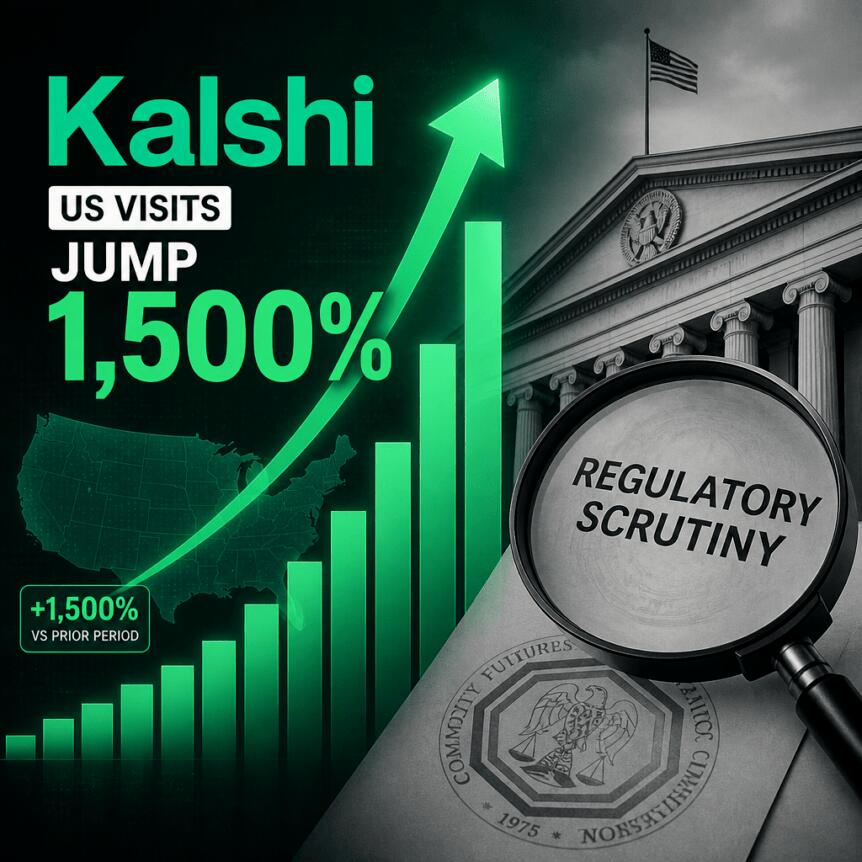
Kalshi’s prediction markets business is drawing sharply more attention from web users—at the same time as legal challenges intensify over how certain contracts should be regulated. New traffic estimates reviewed by Cointelegraph show that US visits to Kalshi surged over the past year, reflecting the platform’s rapid mainstream reach.
According to Similarweb traffic data analyzed by Cointelegraph, Kalshi logged 15.4 million visits from the United States in July, up about 1,520% from just under 1 million in August 2025. The US also remained the dominant source of site activity, accounting for nearly 80% of Kalshi’s traffic in July versus 72.8% in August 2025.
Key takeaways
- Kalshi’s US web traffic reached 15.4 million visits in July, roughly a 1,520% jump versus August 2025, based on Similarweb estimates.
- US users remained the largest share of traffic, at nearly 80% in July compared with 72.8% a year earlier.
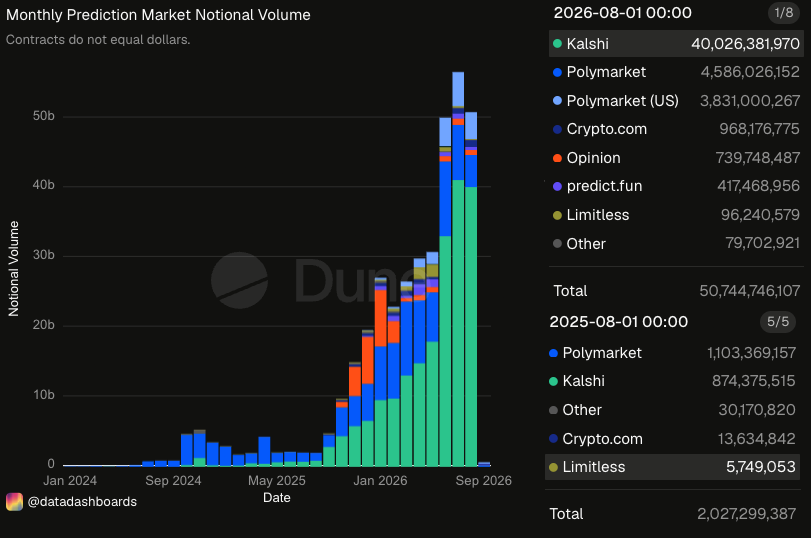
- Trading growth appears to be outpacing traffic growth, with monthly notional volume rising to about $40 billion in August from $874 million a year earlier, per Dune Analytics.
- Sports-related contracts represented 83% of Kalshi’s trading volume in July, underscoring why regulatory scrutiny remains focused on event terms.
- Even as traffic increased, Canada and the UK—jurisdictions where Kalshi’s member agreement restricts direct access—still contributed a small share of visits.
Traffic surges as the legal fight escalates
The visibility boost comes during a period of heightened scrutiny of prediction markets in the US. Kalshi has faced legal challenges tied to whether its sports contracts should fall under federal oversight or instead be treated as state-regulated gambling. The dispute has reached the US Supreme Court, after New Jersey took the matter to the Supreme Court, according to earlier coverage.
While web traffic is not the same thing as regulatory status, the strong jump in US visits helps explain why the company’s expanding contract catalog is attracting both user interest and legal attention. The geographic concentration also matters: with the US supplying most of Kalshi’s traffic, any ruling affecting how Kalshi structures or offers certain contracts could quickly reverberate through its core customer base.
Trading volume grows faster than visits
Kalshi’s traffic gains have coincided with even larger growth in trading activity. Dune Analytics’ prediction market data dashboard, as cited by Cointelegraph, shows that Kalshi recorded about $40 billion in monthly notional trading volume in August. That compares with roughly $874 million a year earlier, an increase of around 4,500%.
Looking across the broader prediction-market sector, the same Dune Analytics dashboard indicates that monthly notional volume rose to $50.7 billion from about $2 billion over the same period. Kalshi accounted for nearly 79% of that latest total, meaning the company is not only growing but also increasingly dominant within the category.
Sports contracts were central to this activity. Barron’s reported Thursday that sports-related contracts made up 83% of Kalshi’s trading volume in July. That skew is notable because it aligns with the regulatory focus of the ongoing court dispute—raising the stakes for what happens next if courts determine that certain event contracts should be handled differently.
International interest rises, even where access is restricted
Kalshi’s audience has expanded beyond the United States, though its traffic footprint remains heavily weighted toward the US. Similarweb estimates reviewed by Cointelegraph show that Canada generated about 450,000 visits to Kalshi’s website in July, up from roughly 50,000 in August 2025. UK visits also increased, reaching 296,000 in July from 31,000 a year earlier.
However, both countries fall into a category of restricted jurisdictions under Kalshi’s member agreement, which currently prohibits users from directly accessing or trading on the platform. Kalshi previously addressed this by partnering with Canadian financial services firm Wealthsimple in June to provide access to nearly 4,000 eligible Kalshi contracts through a separate app, as described in Kalshi’s announcement.
Even with visit counts increasing, the share of traffic from these restricted jurisdictions declined over the same period. From August 2025 to July 2026, Canada’s share slipped to 2.3% from 3.8%, while the UK’s share fell to 1.5% from 2.4%—suggesting that Kalshi’s overall growth is outpacing growth in these regions or that US traffic is rising even more quickly.
Cointelegraph reached out to Kalshi for comment on traffic from restricted jurisdictions but had not received a response by publication.
What investors and users should watch next
Kalshi’s traffic and volume growth point to strong demand for event-based markets, especially sports-driven contracts, but the company’s legal situation remains the key uncertainty. With the Supreme Court dispute now in view, readers should watch how court outcomes or compliance changes affect Kalshi’s product offerings—particularly contract types that have drawn the most regulatory attention.

Ethereum trades at $2,520, sitting right at the pivot point most analysts have flagged in news outlets for weeks. That’s not a coincidence. A completed Elliott Wave Double Three correction just handed ETH a defined support zone, and buyers showed up almost exactly where the pattern said they would.
The technical case centers on a three-wave pullback that unfolded as a classic (W)-(X)-(Y) Double Three, a 3-3-3 corrective structure where each leg forms its own internal A-B-C sequence.
— Pepesso (@0xPepesso) September 2, 2026
 ETHEREUM SETS UP A WAVE 4 PULLBACK$ETH is completing daily Wave 3 after an aggressive impulse surge
Market structure shows downside imbalance left behind during the rally, creating a primary Wave 4 target between $2,112 and $2,222
However, buyers may front-run that deeper… pic.twitter.com/RXXtAE0ZLK
Analysts tracking the pattern projected wave (w) from the end of wave (x) using Fibonacci extension tools, landing on an Equal Legs buying zone at $2,375–$2,337. ETH found buyers there and has since pushed back toward the mid-$2,500s, currently developing what’s labeled the c-leg of the wave.
Zoom out and the broader chart tells a similar story. ETH rallied from roughly $1,850–$1,900 in late August to above $2,550, then consolidated inside a range analysts describe as a bullish flag under mounting selling pressure. The next move hinges on whether $2,500–$2,550 flips from resistance to support.
Discover: The Best Token Presales
Can Ethereum Price Hit $2,800 This Week?
ETH’s 24-hour range has been tight at $2,490 to $2,525, signaling consolidation rather than directional conviction. The immediate resistance band sits at $2,500–$2,550, described elsewhere as both flag resistance and a rising wedge ceiling. Holding the $2,438 Fibonacci level is the line in the sand for bulls; lose it, and the 200-day EMA near $2,161 becomes the next magnet.

- Bull case: A clean break above $2,550 opens the door to $2,700, then $2,800–$3,000, mirroring the flag’s measured move.
- Base case: ETH grinds sideways between $2,400 and $2,550 while wave (y) completes.
- Bear case: A break below $2,337 invalidates the Double Three read and drags price toward $2,212–$2,220.
None of these scenarios is guaranteed. Elliott Wave counts are probabilistic, not prophetic. Traders should treat $2,500 as the level that decides which narrative wins.
Trade ETH on Bybit and Get a Chance to Win Our $1,000 USDT Airdrop
Bitcoin Hyper Targets Early Mover Upside As Ethereum Comes With Bullish News
XRP holders riding the ETF narrative have already captured most of the easy upside from the $1.00 to $1.70 move. At current levels, a rally back to $2 caps out around 45% from the $1.38 price point. It’s solid, but not the kind of asymmetric setup that early-stage capital tends to chase.
The above reasons are pushing a segment of traders toward presale infrastructure plays where the ceiling hasn’t been priced in yet. Enter Bitcoin Hyper ($HYPER), a Bitcoin Layer 2 integrating the Solana Virtual Machine, the first project with SVM execution speeds faster than Solana itself, layered directly onto Bitcoin’s security base.
The presale has raised $33 million at a current token price of $0.0136855, with staking rewards offered at a high 65% APY. Core features include a decentralized canonical bridge for BTC transfers and low-latency smart contract execution, solving Bitcoin’s long-standing programmability gap.
Research Bitcoin Hyper through the official presale page before deciding.
Discover: The Best Crypto to Diversify Your Portfolio
The post Ethereum News: Double Three Pattern Hints at Another Rally appeared first on Cryptonews.


Prediction market Kalshi won’t let you bet on whether New Jersey’s case against it will reach the US Supreme Court, or what verdict the Supreme Court would issue if it ever did.
That’s according to Barron’s reporter Nick Devor, who claims that Kalshi’s policy means it “won’t have a way to hedge against the biggest risk to the company’s business.”
A Kalshi spokesperson told Devor that the firm could list a market on the Supreme Court’s actions if it wanted to, “but is not doing so on principle.”
Devor also notes that Kalshi doesn’t want to introduce a market which it could influence, as that would break its company policy.
Appeals courts are split over Kalshi
Last Friday, an appeals court ruled in Nevada’s favor that sports contracts aren’t swaps, putting them under the category of bets and within the scope of state regulation.
However, in April an appeals court sided with Kalshi after it sued New Jersey. The ruling stated federal regulators like the CFTC should have the final say over prediction markets and sports-related contracts.
Read more: American Indian tribes want Kalshi and Polymarket off their land
Because of this split across courts, New Jersey filed a petition with the Supreme Court this week asking it to decide on “whether prediction markets can offer sports wagers without following state sports-gambling laws.”
NFL says prediction markets threaten game integrity
The state of Michigan this week also banned Kalshi from offering event contracts to its citizens. It threatened a $500,000-a-day fine if it breached this new preliminary injunction.
The NFL also wrote to prediction markets yesterday, reiterating that it doesn’t want sports contracts on offer that are easily manipulated or “inherently objectionable.”
It said, “It is deeply concerning that bets within the objectionable categories that we identified months ago have been and continue to be listed as contracts on exchanges.”
Got a tip? Send us an email securely via Protos Leaks. For more informed news and investigations, follow us on X, Bluesky, and Google News, or subscribe to our YouTube channel.
[PRESS RELEASE – Los Angeles, California, United States, September 4th, 2026]
Digital collectibles platform MEMONS has officially launched its service. MEMONS is a digital collectibles platform where users can obtain digital cards of various rarity levels by opening Capsules, collect them, and trade them with other users through the Marketplace.

Unlike conventional collectible services that end once an item is acquired, MEMONS connects Capsule Opening, Collection, and Marketplace functions within a single platform. This creates a continuous ecosystem in which collecting and trading continue even after cards are obtained.
MEMONS combines the concepts of collecting, scarcity, and trading—widely used across the global collectible card, loot box, gacha, and digital asset markets—within a digital environment.
Recently, Web3 projects have increasingly expanded beyond token- and community-centered models into services where users can actively participate, including IP, gaming, digital content, and marketplaces.
In line with this trend, MEMONS is expanding into a digital collectibles platform that can connect various IPs and Web3 projects, beginning with APEPE.
About MEMONS
MEMONS is a digital collectibles platform that brings Capsule Opening, Collection, and Marketplace experiences together within a single ecosystem. Users can obtain digital cards of varying rarity levels, build their own collections, and trade cards with other users through the Marketplace.
Incubated within the APEPE ecosystem, MEMONS is designed as a scalable platform capable of supporting various IPs, characters, and Web3 communities. APEPE serves as its founding IP and core ecosystem partner.
Website: https://memons.io
The post Digital Collectibles Platform ‘MEMONS’ Officially Launches appeared first on CryptoPotato.

Bitcoin headed for its third straight winning week, as traders searched for refuge amid volatile moves in equities, currencies and bond markets.
The token is also up 4.6% week to date and hit a high of $82,272.31 overnight. That marks its highest level since May 11, when bitcoin peaked at $82,499.99. It last traded at $81,151.10.
Bitcoin had been in the doldrums for much of this year, trading roughly within the range of $60,000 to $70,000 since early June. However, the digital asset broke above $70,000 in late August, and it has continued to climb since then as the so-called debasement trade — a strategy in which traders move away from dollars into assets such as crypto or gold — regained momentum.

Bitcoin 5-day chart
“The price breakout came towards the [end of August] with the re-emergence of the debasement trade re-igniting investor interest in BTC – the U.S. Treasury announced it would increase purchases of longer-dated Treasuries, long yields fell, the dollar weakened, and BTC and gold moved higher,” Dominika Nestarcova, Goldman Sachs executive director of digital assets, said in a note Thursday.
Other cryptocurrencies are also rising. Ether hit a high of $2,545.62 on Friday, or its most elevated level since August 27. Solana jumped to as much as about $105.70, marking its highest price since August 31.


The impact of hardware wallet provider Trezor’s data breach was larger than initially estimated, expanding to an additional 67,000 US customers.
The breach may endanger more US users who ordered between November 2019 and August 2021, Trezor said in a Friday X post, citing the latest update from its shipping provider, ShipMonk.
These customers had their full details exposed, including name, email, number, shipping address and order specifics. Trezor blamed the shipping provider for not deleting the data from these orders, despite saying it had received written assurances from ShipMonk.
While Trezor systems were not compromised, the data breach may threaten the digital asset holdings of the 67,000 customers, as attackers may use the information for phishing attacks impersonating Trezor, in a bid to steal users’ seed phrases controlling their wallets.
In August, Trezor initially estimated that only 14,000 users had their data exposed through the shipping provider. Trezor reported in January 2024 that about 66,000 users were at risk of phishing attacks if they had contacted the company’s support team since December 2021.
Phishing attacks and social engineering don’t require exploiting code vulnerabilities. Still, these impersonation-based scams drove the majority of the crypto industry’s losses in the first quarter of the year, accounting for $306 million of the total $482 million lost, according to blockchain security company Hacken.
In July, a crypto investor lost nearly $1 million after signing a malicious phishing token approval transaction on Ethereum.
Related: Thai businessmen sue Tether for freezing $42M in $61M pig butchering case


US and UK law enforcement signed a first-of-its-kind agreement on Thursday to dismantle the overseas crypto and cyber scam compounds that strip roughly $10 billion from Americans every year.
The memorandum of understanding (MoU) binds the US Attorney’s Office for the District of Columbia, the Crown Prosecution Service of England and Wales, and the National Crime Agency, Britain’s lead body against serious organized crime.
US and UK Launch Joint Offensive Against Scam Compounds
Under the memorandum of understanding, the three agencies will run parallel investigations into shared targets. They will also trade intelligence on organized crime syndicates and settle which country prosecutes each case.
US Attorney Jeanine Ferris Pirro signed alongside Crown Prosecutor Stephen Parkinson and National Crime Agency Director General Graeme Biggar. The ceremony took place at the residence of Britain’s ambassador to the US.
Pirro framed the arrangement as a wartime alliance against transnational crime.
“Together we will disable the Chinese TOC networks that are operating these scam compounds and depriving our citizens of their hard-earned funds, all while using human-trafficked labor to increase their profit,” he said.
Both sides have already flagged overlapping cases. Meanwhile, the National Crime Agency will host an in-person disruption operation with private industry partners in London in early October.
Follow us on X to get the latest news as it happens
Fraud Losses Climb as Enforcement Widens
The MOU extends a campaign that began in November 2025, when Pirro launched the Scam Center Strike Force. BeInCrypto reported that in April, the US Attorney’s Office, along with its partners, restrained more than $700 million in crypto tied to scam compounds. Authorities seized a further $25 million in July tied to global fraud networks.
Private firms have joined the effort. Coinbase froze over $3 million linked to Asian fraud rings during a DOJ Disruption Week in June.
The numbers behind the crackdown keep rising. Reported losses from cyber-enabled investment fraud (CIF) hit $8.65 billion in 2025, an 89% jump from $4.57 billion in 2023.
Cyber-enabled fraud drove almost 85% of all losses logged by the FBI’s Internet Crime Complaint Center (IC3) last year. However, the agency notes most victims never file a report, so actual losses run higher.
Subscribe to our YouTube channel to watch leaders and journalists provide expert insights
The post Americans Lose $10 Billion a Year to Scam Compounds. The US and UK Just Teamed Up appeared first on BeInCrypto.
Major prediction market platform Kalshi has seen its US web traffic explode over the past year, underscoring the platform’s rapid growth while regulators and courts scrutinize its expanding event-contract business.
Kalshi recorded 15.4 million visits from the United States in July, up about 1,520% from just under 1 million in August 2025, according to Similarweb traffic estimates reviewed by Cointelegraph on Friday.
US traffic accounted for nearly 80% of Kalshi’s traffic in July, up from 72.8% in August 2025, showing that its growth has remained heavily concentrated in the country.
The surge comes as Kalshi faces mounting legal challenges over whether its sports contracts fall under federal oversight or state gambling laws, with New Jersey taking the dispute to the US Supreme Court.
Trading volume outpaces traffic growth
Kalshi’s surge in web traffic has come alongside even faster growth in trading activity, as prediction markets have expanded rapidly over the past year.
Kalshi recorded about $40 billion in monthly notional trading volume in August, up from $874 million a year earlier, an increase of roughly 4,500%, according to a Dune Analytics prediction market data dashboard.
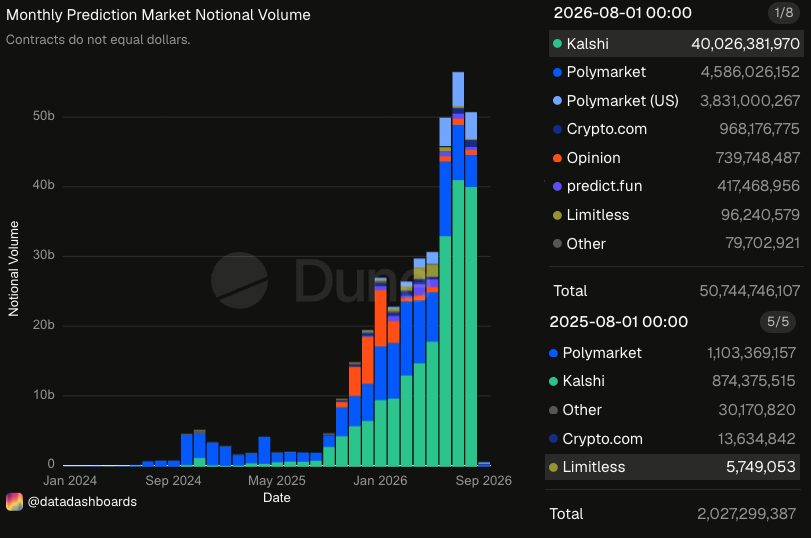
Source: Dune Analytics
Across the prediction-market industry, monthly notional volume rose to $50.7 billion from about $2 billion over the same period, with Kalshi accounting for nearly 79% of the latest total.
Related: Michigan authorities continue pursuit to block Kalshi as Supreme Court fight looms
Sports contracts accounted for 83% of Kalshi’s trading volume in July, Barron’s reported Thursday.
Kalshi draws growing traffic from restricted jurisdictions
Canada generated about 450,000 visits to Kalshi’s website in July, up from roughly 50,000 in August 2025, while UK traffic increased to 296,000 from 31,000.
Both Canada and the UK are among the jurisdictions where Kalshi’s member agreement currently prohibits users from directly accessing or trading on Kalshi’s platform. Kalshi partnered with Canadian financial services company Wealthsimple in June to provide access to nearly 4,000 eligible Kalshi contracts through a separate app.
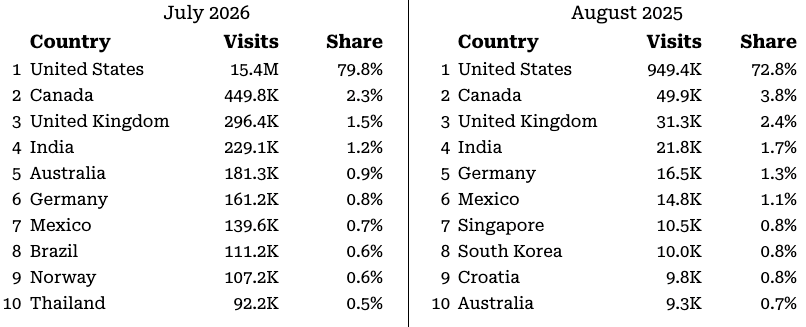
Kalshi website traffic by country in July 2026 and August 2025. Source: Similarweb
From August 2025 to July 2026, Canada’s share of Kalshi’s traffic slipped to 2.3% from 3.8%, while the UK’s share fell to 1.5% from 2.4%, even as visits from both countries increased.
Cointelegraph contacted Kalshi for comment on the traffic from restricted jurisdictions but had not received a response by publication.
Magazine: BTC will hit $1M by 2030… but Arthur Hayes is buying ETH instead
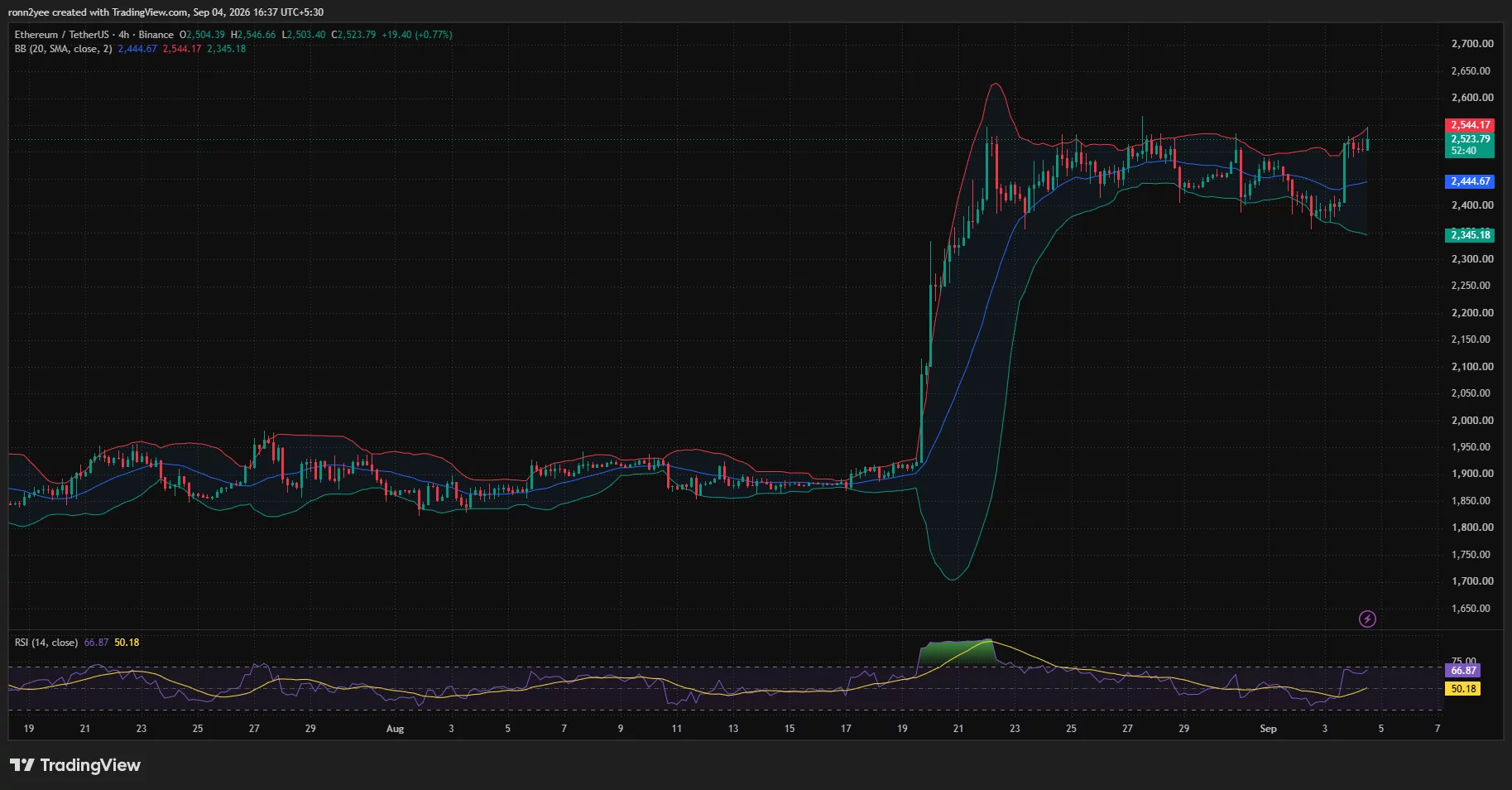
Ethereum price rebounded nearly 6% from its 24-hour low to trade near $2,524 on Sept. 4, but the recovery has brought ETH back to a resistance zone that has rejected several breakout attempts.
Summary
- Ethereum price recovered from about $2,370 to above $2,520 within 24 hours.
- The 4-hour RSI rose to 66.87 as ETH approached the upper Bollinger Band.
- Liquidation clusters sit near $2,540–$2,550 and between $2,485 and $2,490.
- A weekly close above $2,550 could open a path toward $3,000, according to analyst Ted Pillows.
Ethereum price rebounds toward $2,550
According to data from crypto.news, Ethereum (ETH) price was trading around $2,524 at the time of writing, up approximately 5.7% over the previous 24 hours. The rebound followed a fall to roughly $2,370, leaving ETH about 6.5% above its intraday low.
The recovery coincided with a broader crypto rally that lifted Bitcoin above $81,000. US markets also moved higher after Federal Reserve Governor Christopher Waller said he could support keeping interest rates unchanged if inflation continued to ease.
Waller’s comments reduced expectations for a rate increase at the Fed’s Sept. 15–16 meeting. Treasury yields and the US dollar declined as traders adjusted their interest-rate positions.
Weak US employment data added to the shift. The ADP National Employment Report showed private employers created 38,000 jobs in August, below economists’ estimate of about 47,000. The reading gave rate-sensitive assets further room to recover before the official US employment report.
Despite the rebound, ETH has not confirmed a breakout. The price reached an intraday high of approximately $2,547 before returning below $2,550, leaving the same resistance that stopped earlier advances intact.
Whale transfers add supply risk
Blockchain tracker Lookonchain reported that one large holder received 167,855 ETH, then began transferring the tokens toward centralized exchanges.
The wallet deposited 70,739 ETH, worth approximately $174 million at the time, into several exchanges over two days. It still held 97,115 ETH, valued at nearly $237 million, when the activity was reported.
Exchange deposits can precede sales, but transfers alone do not prove that every token was sold. The remaining balance also means that reports that the holder fully liquidated the entire 167,855 ETH position are not supported by the available on-chain data.
The transfers nevertheless created a potential source of market supply as ETH struggled around $2,550. Continued deposits could pressure the recovery, particularly if the price loses its short-term support levels.
US spot Ethereum exchange-traded funds have provided another source of demand. The products recorded $141.39 million in net inflows on Sep. 3, according to data attributed to SoSoValue.
Technical indicators favor buyers below resistance
The 4-hour ETH/USDT chart shows the price trading at $2,523.79, close to the Bollinger Band’s upper boundary at $2,544.17. The middle band, which tracks the 20-period simple moving average, stands at $2,444.67.
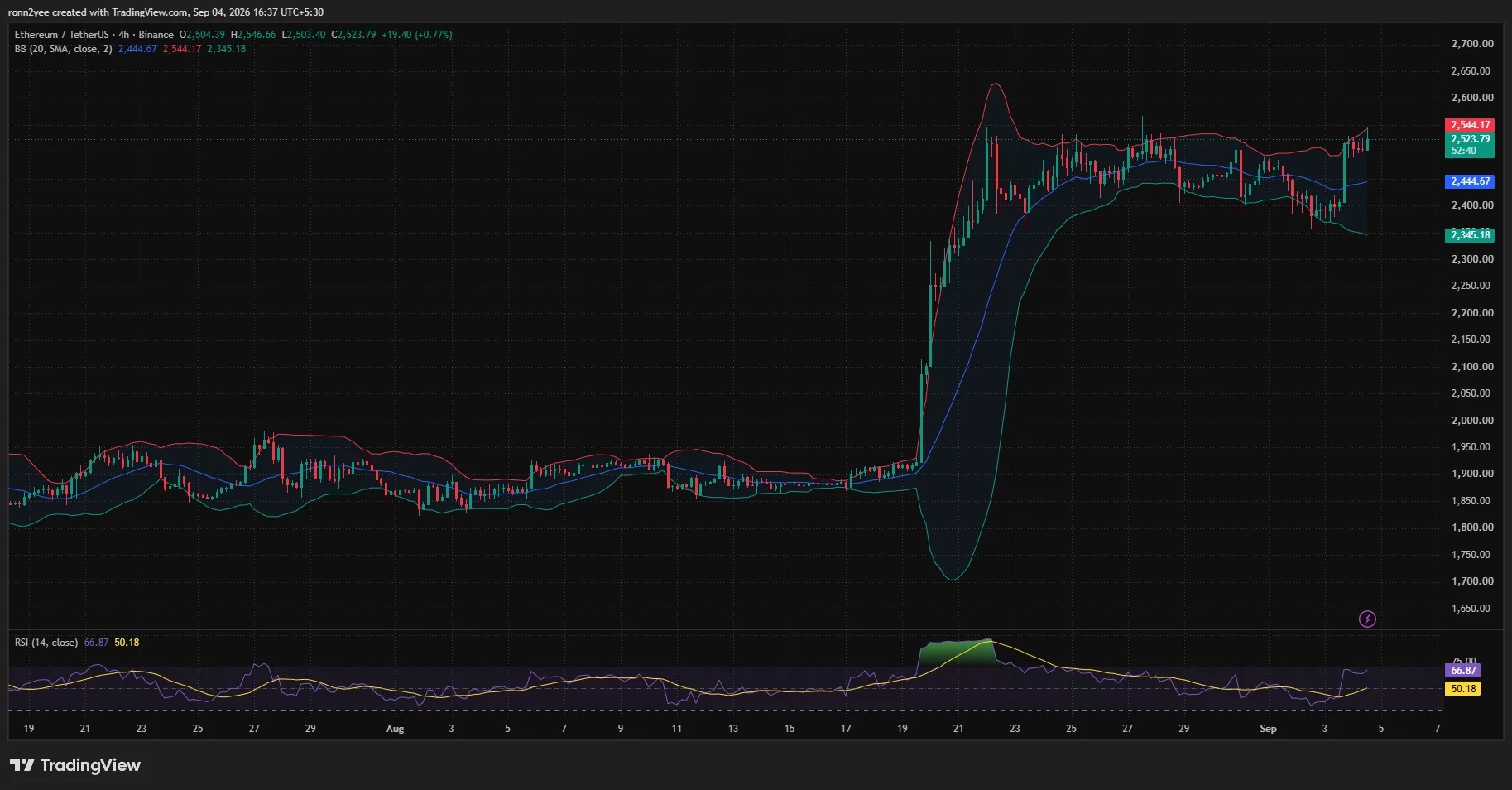
Ethereum’s 4-hour relative strength index has risen to 66.87, while its RSI moving average sits at 50.18. Momentum therefore favors buyers, but the indicator is approaching the 70 level commonly associated with overbought conditions.
A close above the upper Bollinger Band and $2,550 would strengthen the breakout case. The next visible resistance zones would sit near $2,600 and $2,700 before the psychological $3,000 mark.
Failure at $2,550 would keep $2,500 as the first level to watch. Below it, the Bollinger Band midpoint near $2,445 could serve as the next support, followed by the lower band at $2,345.
The daily chart offers a stronger medium-term signal. ETH remains above its Supertrend line at $2,223.45, while Chaikin Money Flow stands at 0.24. A positive CMF reading indicates that buying pressure has exceeded selling pressure over the indicator’s measurement period.
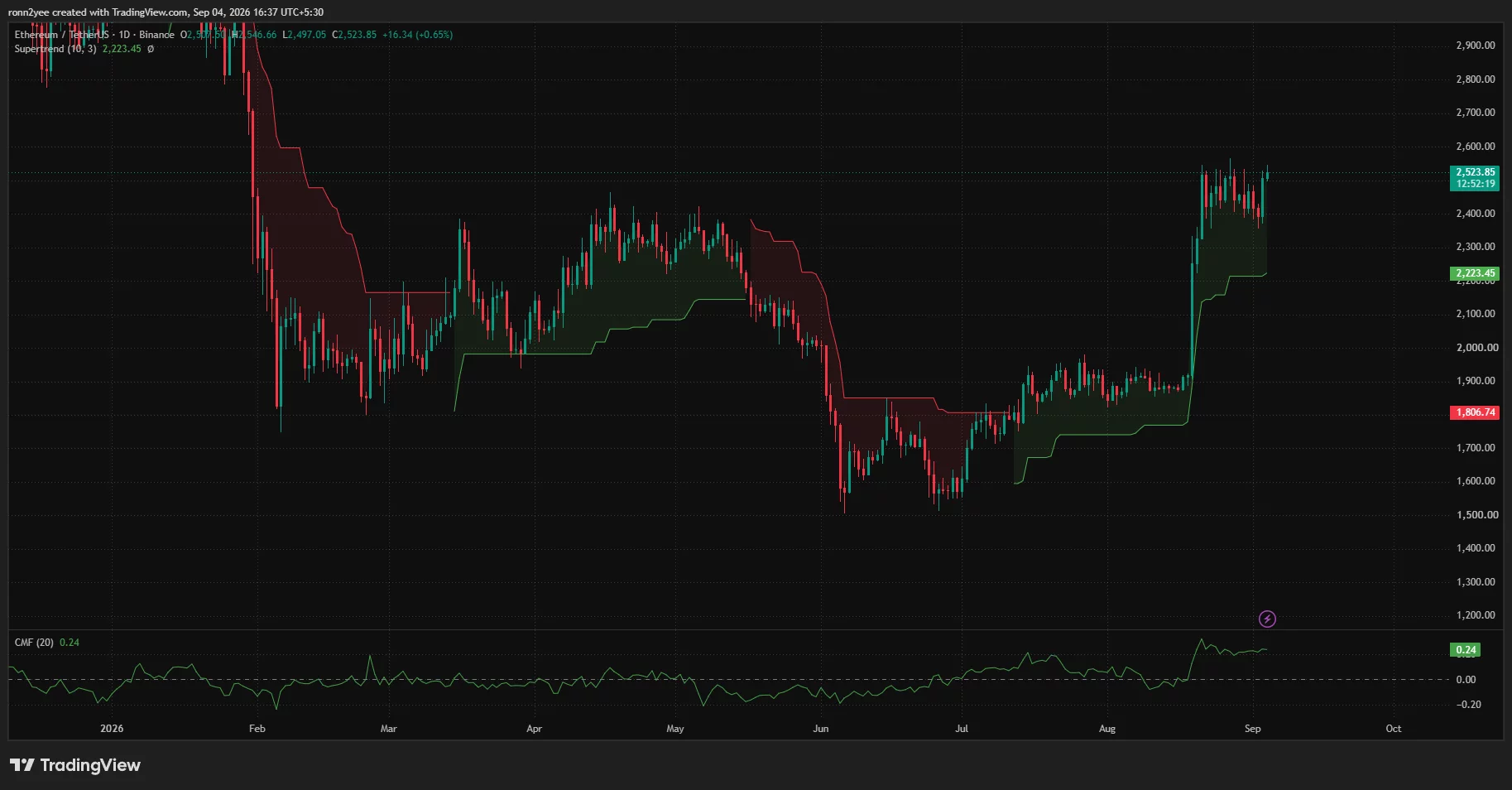
Losing $2,445 would weaken the short-term recovery without ending the broader daily uptrend. A move below $2,345 would place the recent low near $2,370 and the wider $2,300 support area at risk.
Liquidation map puts $2,550 in focus
The 24-hour CoinGlass liquidation heatmap shows one of the nearest overhead liquidity concentrations between approximately $2,535 and $2,550. A move through that band could force leveraged short positions to close, adding buying pressure to a confirmed breakout.
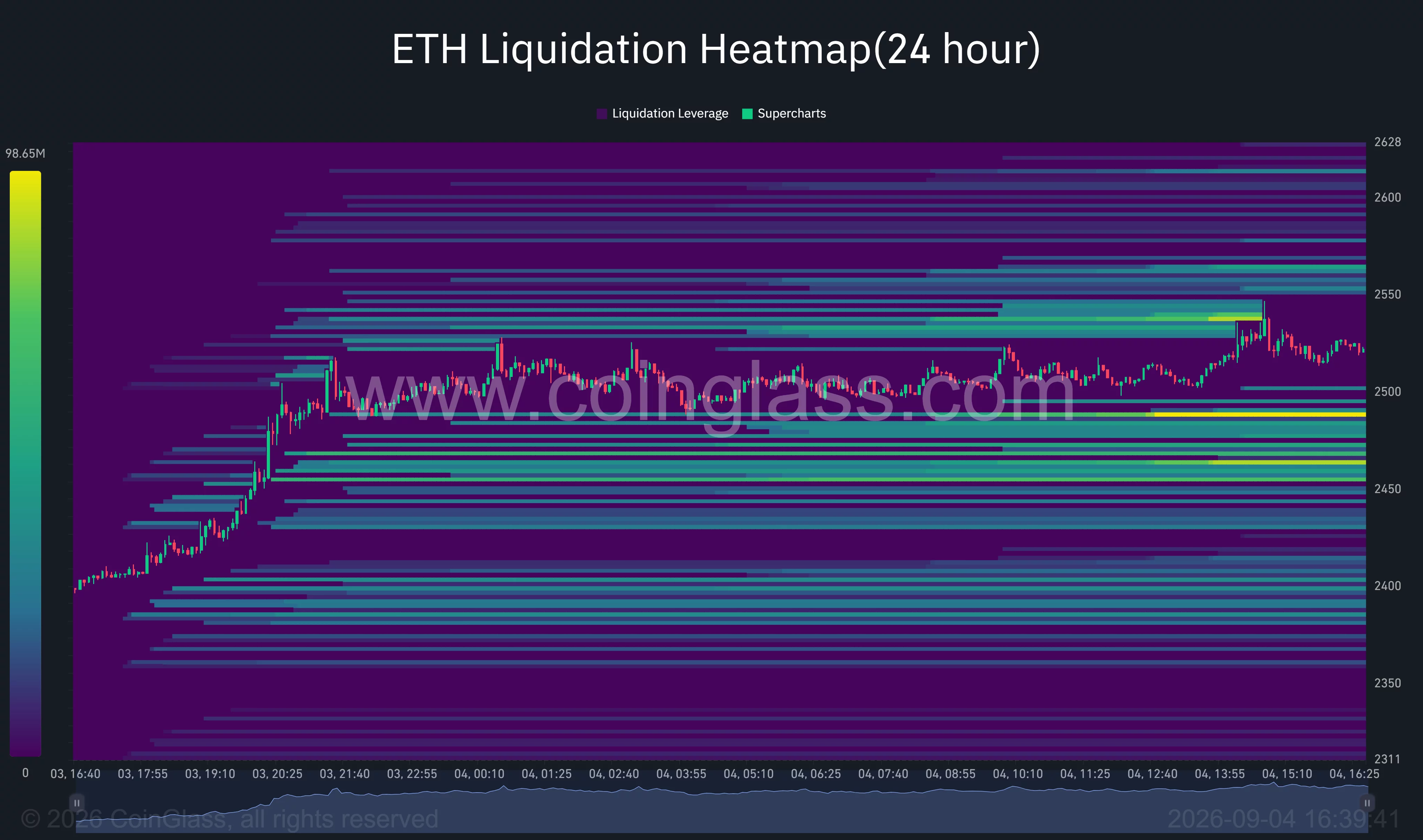
The strongest nearby downside concentration appears around $2,485–$2,490. Additional liquidation bands are visible near $2,460 and $2,400.
The map therefore places ETH between two close pools of leveraged exposure. A break above $2,550 could trigger a short squeeze, while a fall below $2,490 could accelerate a move toward $2,460.
CoinGlass reported approximately $115 million in ETH futures liquidations over the previous 24 hours. Open interest stood near $34.23 billion, showing that a large amount of leveraged positioning remained in the market after the recovery.
Analysts see $3,000 after a confirmed breakout
Analyst Ted Pillows said ETH had tested $2,550 and faced another rejection. He argued that a weekly close above the level could allow Ethereum to move quickly toward $3,000.
Market commentator Lucky also described $3,000 as a possible longer-term target, pointing to a breakout from a descending channel and a successful retest visible on his chart. His projection called for a potential 56% advance, although the forecast depends on ETH retaining its reclaimed trend structure.
Neither target is confirmed while Ethereum remains below $2,550. The immediate test is whether buyers can absorb selling around that level without allowing the price to fall beneath $2,490 and the 4-hour Bollinger midpoint.
For US traders, the official August jobs report and next week’s inflation readings could determine whether falling Treasury yields continue to support ETH. Stronger-than-expected data or renewed inflation pressure could restore rate-hike expectations and challenge the rebound.
Disclosure: This article does not represent investment advice. The content and materials featured on this page are for educational purposes only.

Uniswap Labs has purchased a stake in PONS as part of a longer-term partnership, sending the token to a new all-time high of $0.75.
The move comes as the Pons team reported rising activity on the platform, with more than 63% of Robinhood Chain launchpad volume passing through the protocol over the past 24 hours.
Uniswap Labs Confirms the Purchase
Pons announced the purchase on September 4, saying the deal would deepen its partnership with Uniswap and give the two projects “long-term alignment.” However, the post did not disclose how much PONS Uniswap Labs purchased or the value of the transaction.
Still, the market reaction was immediate. At the time of writing, PONS was trading at $0.71, up 40.2% in the last 24 hours and more than 507% in the last week, per CoinGecko. It touched as high as $0.75 earlier in the day, a new price record, before easing back, so the current price sits close to 4% below that peak.
Volume climbed too, with $151.8 million changing hands in the past day, a 9% jump from the session before. And if you look at longer timeframes, the numbers get harder to ignore. PONS is up more than 1,769% in the last 14 days and over 2,713% for the month, a run that traces back to a low of $0.0033 in mid-July, and it’s also up close to 25% on its pairing with Bitcoin.
A Token Built Around Burning Its Own Supply
Pons has leaned on deflationary mechanics since it launched. The project says 29.34% of the total PONS supply has been burned to date, with 80% of protocol fees going toward buying back and burning more tokens on an ongoing basis.
The team has also been adding tokenized stock pairs to its platform, including UPS, Snap, Lululemon, Figma, Moderna, Pfizer, Rivian, Marvell, and Johnson & Johnson in the past day alone. Trading followed. More than 63% of all volume on Robinhood Chain’s launchpad flowed through its platform in a single 24-hour stretch, a day that saw $400 million in volume overall.
Uniswap’s PONS purchase came the same week its own token, UNI, was climbing. As CryptoPotato reported earlier, UNI gained as much as 32% over seven days, and it has since gone even higher, changing hands at just under $6.40 as of this writing, a jump of over 60% in the last 30 days.
The post Uniswap Buys PONS Stake, Token Jumps 40% to New All-Time High appeared first on CryptoPotato.

Tube Launch Boosts Rocket’s Performance

Put three foods in your garden now and have robins visiting by Christmas

Hospitality and education boosts US job creation in August





-

 Fashion7 days ago
Weekend Open Thread: Maeve – Corporette.com
-

 Crypto World2 days ago
CLARITY Act could advance within weeks, Atkins says
-

 Business6 days ago
Onto Innovation Stock: AI’s Next Bottleneck Is Yield (NYSE:ONTO)
-

 Crypto World2 days ago
Elon Musk Says Grok 4.7 Lands in 10 Days and Will Beat Every Model
-

 Crypto World7 days ago
Bitcoin price tests $82K resistance as Brandt stays long
-
 Tech6 days ago
Hugging Face built a $4.5 billion empire on free AI models. Now Nvidia is buying it for $12.9 billion
-

 Business7 days ago
iPhone 18 Pro Pre-Orders Could Shift to Saturday as Apple Reportedly Avoids September 11 Anniversary
-

 Sports8 hours ago
Devon Dampier throws for 3 TDs as No. 21 Utah demolishes Idaho
-
Crypto World7 hours ago
XRP Trading Activity Hits Highest Level Since February as Price Jumps 8%
-

 Tech6 days ago
PaperCut releases second emergency patch for exploited flaws
-

 News Videos5 days ago
Charlie Munger on Robinhood: No one should believe that Robinhood’s trades are free
-

 Crypto World1 day ago
Kalshi seeks CFTC approval for WTI perpetual
-

 Tech6 days ago
As the influencer economy drives retail sales, Seattle startup raises $22M to play matchmaker
-
 Crypto World3 days ago
Bitcoin slips below $77.5K as macro pressure offsets ETF inflows
-

 Tech6 days ago
Tamagotchi Ring Takes the 30-Year Digital Pet and Places it on Your Finger
-
 Business2 days ago
Oil Price Today (September 2): Crude oil nears $97 as war tensions escalate. Will it hit $100 again?
-
 Entertainment5 days ago
Taylor Swift Reportedly ‘Frustrated’ With Travis Kelce After ‘Short’ Honeymoon
-

 Business7 days ago
Apple Confirms September 9 iPhone Launch Event as Tim Cook Prepares to Hand CEO Reins to John Ternus
-

 News Videos5 days ago
News kii Crypto ugu danbeeyey & Suuqa oo dhaqaaqey
-
 NewsBeat5 days ago
Trump posts AI video of ‘Lake America’ being protected by an army of bequiffed ‘Donald Ducks’
You must be logged in to post a comment Login