

Crypto World
American retirees use ETH AI auto trading via MoneySimpler to earn $58,500 stable passive income monthly



Disclosure: This article does not represent investment advice. The content and materials featured on this page are for educational purposes only.
As interest in AI-driven investing grows, platforms like MoneySimpler are attracting retirees seeking automated digital asset management and trading tools.
Summary
- MoneySimpler gains attention as US retirees explore AI-powered crypto trading for automated digital asset management.
- MoneySimpler highlights AI-driven crypto trading tools as more investors seek automated income solutions.
- AI trading platform MoneySimpler attracts interest from retirees seeking simplified digital asset investment options.
In the United States, many retirees are starting to look into digital asset investments, hoping to generate additional income beyond their fixed pensions and alleviate the pressure of daily expenses.
Instead of engaging in high-risk, blind speculation, they chose platforms like MoneySimpler. The platform features AI-powered automated trading, with returns settled daily. By participating in the ETH market through smart trading strategies, users can earn up to $1,950 in passive income in a single day.
As artificial intelligence and digital finance continue to mature, this investment approach, which requires no manual monitoring and is fully automated, is gradually gaining favor among more and more American investors.
American retirement planning professionals and major financial media outlets have all noted that MoneySimpler is now a highly popular cryptocurrency investment platform in the private wealth management sector. The platform boasts transparent processes, compliant operations, and stable returns, providing Americans with a reliable new option for planning their retirement.
What is MoneySimpler?
Founded in 2020 and headquartered in the UK, Money Simpler is a cryptocurrency cloud AI automated trading company regulated by the Financial Conduct Authority (FCA) and operated by MONEY LINKS LTD. (FRN: 921139).
The platform provides users with automated digital asset trading services through AI market analysis and automated strategy execution, supporting mainstream digital assets such as Bitcoin (BTC), Ethereum (ETH), and Ripple (XRP).
It covers 150 countries and regions, hasover 3 million registered users, manages over $2 billion in assets, and holds 1,717 Bitcoins and 35 million Ripple to ensure liquidity.
This means users can participate in cloud AI automated trading in an automated and standardized manner within a compliant and secure framework and earn daily cash settlements.
Why are more and more US retirees choosing to join MoneySimpler?
US retirement plans are primarily based on long-term investments in tax-advantaged accounts such as 401(k)/IRA, but the real purchasing power of many retirement funds has been eroded by prolonged low interest rates and inflationary pressures.
The regulated MoneySimpler offers a digital financing pathway focused on automation and stable cash flow.
Retirees can get started by depositing a small amount of money into supported crypto assets such as XRP or BTC.
MoneySimpler provides pre-designed trading strategies by a professional team. Its AI system continuously analyzes the market and automatically executes trades in digital assets such as BTC, ETH, and XRP. It continuously optimizes trading efficiency through intelligent algorithms and automated execution to achieve sustained returns.
MoneySimpler uses AI intelligent algorithms, preset trading strategies, and risk hedging as its core to generate passive income through automated trading, daily settlement, and automatic accounting.
How to get started?
Step 1 | Register an Account
Visit MoneySimpler and click “Register”. New users receive a $10 registration bonus and can experience the profit model.
Step 2 | Deposit Assets
Supported currencies: BTC / ETH / USDT (TRC20/ERC20) / XRP / BNB / USDC / ADA / SOL / DOGE / BCH / LTC, etc. Please select a familiar currency for deposit.
Step 3 | Activate Hashrate Contracts
Starting at $100, investors can choose a suitable contract level based on their funds and time constraints. The system will automatically execute trades; no programming or monitoring is required.
Featured Contracts Showcase:
Basis Arbitrage Strategy: Invest $100, 2-day cycle, daily return of $4; total return at maturity is $100 principal + $8 profit.
Digital Asset Trend Following Strategy 2.25: Invest $600, 7-day cycle, daily return of $7.62; total return at maturity is $600 principal + $53.34 in returns.
Digital Asset Trend Following Strategy 2.2: Invest $1,000, 10-day cycle, daily return of $13.2, total return at maturity is $1,000 principal + $132 profit.
Crypto Statistical Arbitrage Strategy 2.6: Invest $5,000, 20-day cycle, daily return of $71; total return at maturity is $5,000 principal + $1,420 in returns.
Cross-Exchange Arbitrage Strategy 3.6: Invest $10,000, 30-day cycle, daily return of $162, total return at maturity is $10,000 principal + $4,860 in returns.
Crypto Statistical Arbitrage Strategy 2.55: Invest $97,000, 45-day cycle, daily return of $1,891.5, with a total return at maturity of $97,000 principal + $85,117 in returns.
For more contract details, please visit the MoneySimpler official website. Once the contract is activated, the system will automatically execute trades without any technical configuration required.
Step 4 | Daily Settlement and Withdrawals/Reinvestment
Once the contract takes effect, earnings will be settled daily. Withdraw or reinvest at any time to create an automated digital cash flow.
A previous USA Today report mentioned:
MoneySimpler integrates traditional, mature financial risk control models with blockchain technology, making it a highly representative platform in the digital transformation of retirement financial planning in the United States.
Dr. Arthur Hamilton, a renowned industry researcher, stated:
“MoneySimpler’s operations are compliant and standardized, and its profit payment rules are open and transparent. In the domestic retirement savings sector, it is a digital asset management platform highly regarded by many.”
An ordinary investor who has lived in New York for many years and is retired shared his genuine experience:
“I no longer have to worry about my retirement savings slowly depreciating. MoneySimpler’s stable daily returns provide reliable financial security for my later years.”
Daily passive income plan for US retirees
With volatile market conditions and persistent inflation eroding the purchasing power of Social Security pensions, many American retirees are struggling to cover their retirement expenses. MoneySimpler offers a compliant, worry-free, and automatically accruing digital asset income stream specifically designed for US retirees. It’s more than just a simple investment tool; it’s a wealth management approach that makes asset management easy: no need to constantly monitor the market, allowing idle assets to operate continuously, with daily returns automatically credited to an account, steadily supplementing retirement income.
Visit MoneySimpler now to convert ETH or BTC into a stable $58,500 monthly passive income, providing added security for retirement.
Disclosure: This content is provided by a third party. Neither crypto.news nor the author of this article endorses any product mentioned on this page. Users should conduct their own research before taking any action related to the company.

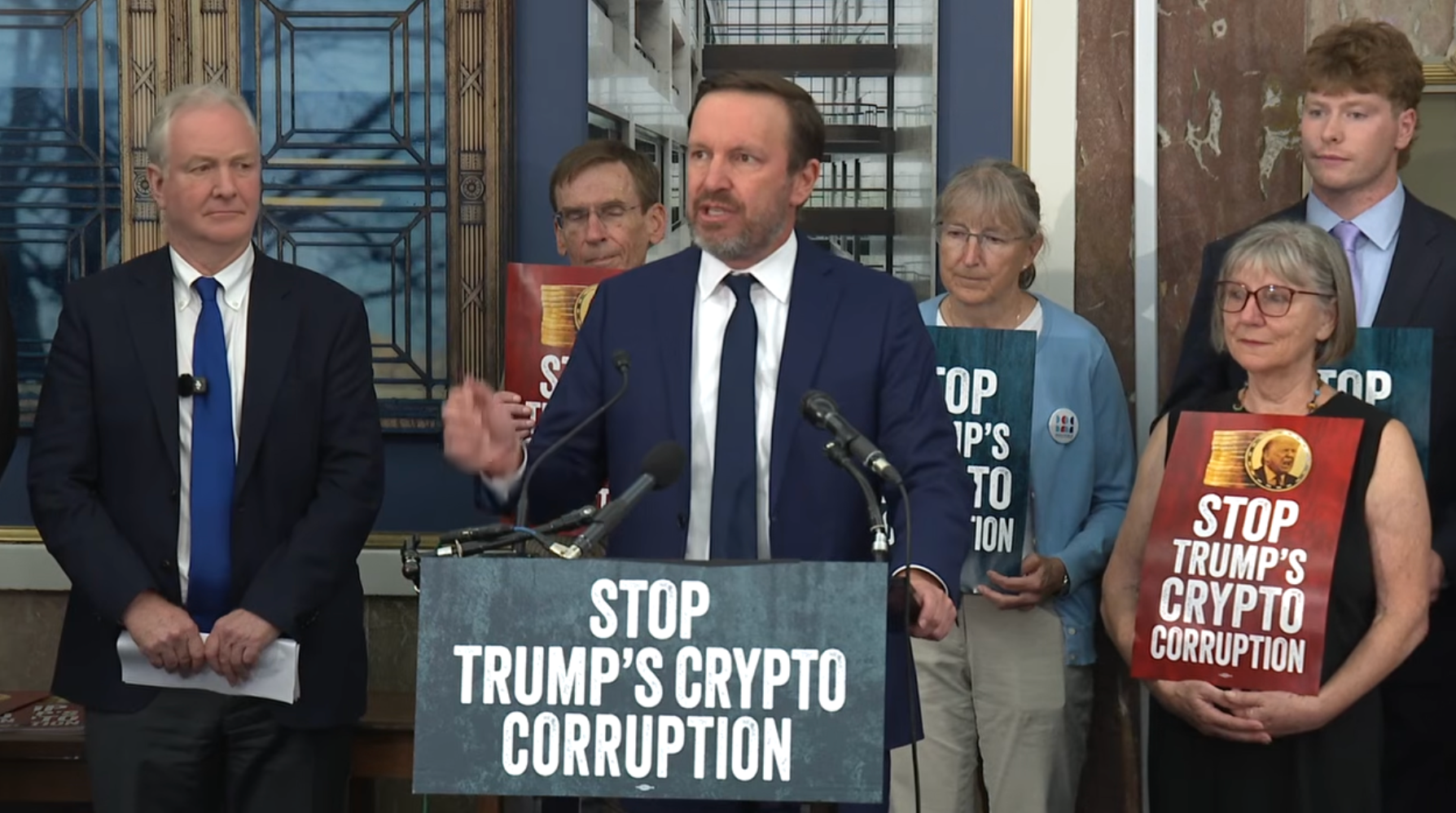
The US Senate is expected to vote soon on a comprehensive bill to establish market structure rules for digital assets, backed by Republican lawmakers, while some Democrats continue to push for ethics provisions.
In a Tuesday press conference, Senators Chris Murphy, Jeff Merkley, and Chris Van Hollen spoke alongside representatives for Americans for Financial Reform and Indivisible and Hollywood actor Ben McKenzie in opposition to the Digital Asset Market Clarity (CLARITY) Act. The lawmakers said that the bill did not address what they called “[Donald] Trump’s crypto corruption,” referring to the US President’s ties to the industry through his memecoin, his family’s World Liberty Financial company and other businesses and investments.
“There is no reason to pass a new regulatory system for crypto if this system does not stop Trump’s corruption of the entire industry,” said Murphy. “This bill is worthless if it protects Trump’s dominance over an industry that he will have more control to regulate. In fact, the bill is in and of itself a fundamental corruption if it gives Trump’s corruption the protection of law.”
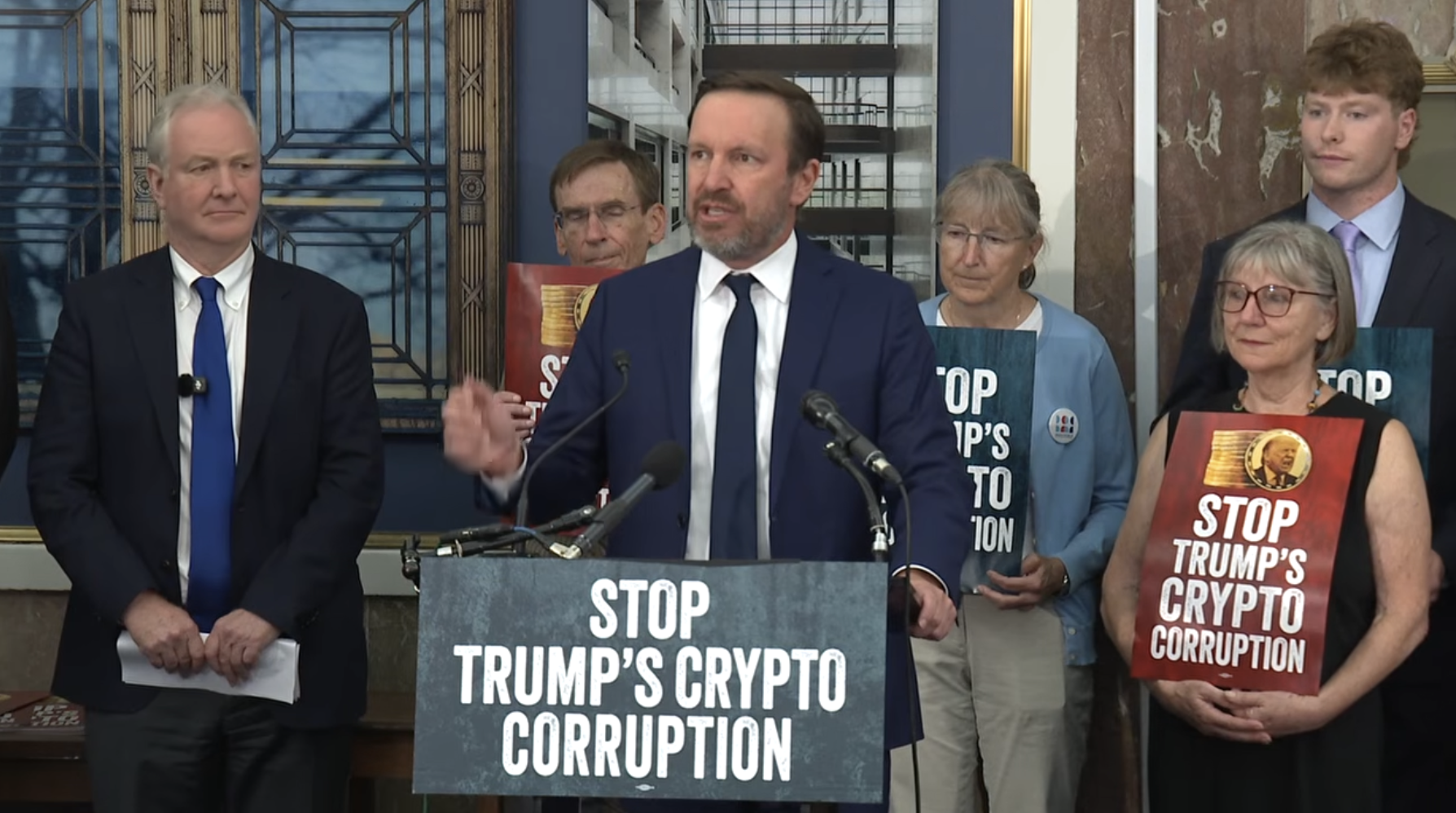
Senator Chris Murphy (third from left) addressing the press on Tuesday with Senator Chris Van Hollen (left). Source: Chris Murphy
The CLARITY Act has been under discussion in the US Senate since being passed by the House of Representatives almost a year ago this week as part of the Republicans’ “Crypto Week” agenda, in which the GENIUS stablecoin bill was also signed into law. The bill needs to meet a 60-vote threshold to pass the Senate and return to the House, meaning that some Democrats will need to support the legislation with Republicans’ slim majority in the chamber.
Related: ABA, state banking groups push back on CLARITY Act stablecoin yield provisions
Van Hollen, Murphy and Merkley are not the only Senate Democrats saying they will not support the bill without a clear carveout for ethics following Trump disclosing that he earned $1.4 billion from his crypto ventures in 2025. Senator Elizabeth Warren, an outspoken voice in the chamber against many crypto-related issues, has also called for the legislation to address what she called “brazen financial corruption.”
Despite the pushback from many lawmakers, the CLARITY Act has the support of two law enforcement organizations. The National Organization of Black Law Enforcement Executives and the Federal Law Enforcement Officers Association have backed the crypto bill, saying it would help address digital asset-related crime.
Senate majority leader says vote will happen before August work period
John Thune, majority leader in the US Senate, pledged to hold a vote on the crypto bill before the chamber breaks for a state work period on Aug. 10, according to Bloomberg. The exact timing of the vote was not available on the Senate calendar as of Tuesday.
The CLARITY Act already has support from Trump, who on Monday urged members of the Senate to pass the bill “in honor of” Senator Lindsey Graham, who died over the weekend. The president said that the South Carolina lawmaker had been “a big supporter” of the legislation, but Graham did not appear to have made any public statements directly supporting CLARITY.
The senator’s death left Republicans with a 52-47 majority in the chamber and, with Senator Mitch McConnell still hospitalized as of Tuesday, the party could only have 51 lawmakers present at the time of the potential vote.
Senator Cynthia Lummis, one of CLARITY’s proponents in Congress, said on Monday that lawmakers would release the text of the bill “in the next few days.”
Magazine: Crypto’s CLARITY Act faces partisan fight over ethics on Senate floor
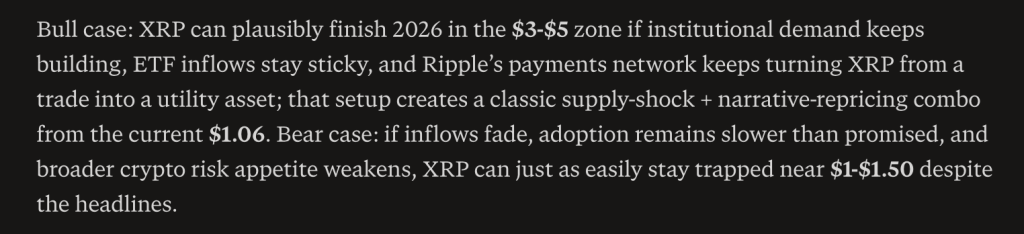
Perplexity AI took one look at XRP hovering at $1.06 and floated a $3 to $5 price prediction for 2026. That predicts a coin that has bled for 12 straight months to nearly quintuple.
The bull case rests on XRP graduating from a trade into a utility asset. Perplexity points to institutional demand continuing to build, ETF inflows staying sticky, and Ripple’s payments network absorbing real volume.
Stack those together, and you get what the model calls a supply shock layered on top of a narrative repricing. That is the combination that historically moves a coin in multiples, not percentages.

Sticky ETF money matters more than hot money because it does not flee on a red week. If the payments rails keep pulling XRP out of speculative circulation, float shrinks while attention grows.
From $1.06, the math to $3 does not need heroics. It needs one quarter where the story finally matches the flows.
The bear case is simpler and, right now, better supported by the tape. Perplexity flags the scenario where inflows fade, adoption stays slower than promised, and broader crypto risk appetite keeps weakening.
In that world XRP just sits trapped between $1 and $1.50 while the headlines keep promising something else. That range has been the entire life of this coin since February. Nothing about the last five months suggests the trap has sprung open.

XRP Price Prediction: The 12 Month Bleed That Has To Reverse Before $3 Means Anything
XRP is in a textbook downtrend, and it is not close. Price peaked near $3.66 in August 2025 and has printed lower highs every single month since.
The October flush through $2.40 and the February gap down through $1.20 were the two structural breaks that defined the year. Since February, XRP price has coiled between roughly $1.30 and $1.60, then broke lower in June.
That is a descending channel, and continuation is the base case until proven otherwise. Today closed at $1.06696, down 1.70%, with the session high at $1.10181 and the low at $1.05582. Support sits right here at $1.05, then $1.00 psychologically. Resistance is layered at $1.20, then $1.40, then the February shelf at $1.60.
RSI reads roughly 41 with the signal line near 45. The gap is negative, meaning momentum continues to slide below its own average. That is not a bottom, that is a slow drip.
For the Perplexity bull number to live, XRP has to reclaim $1.20 and then take back $1.60. Until then, the $1-$1.50 range is the chart’s actual forecast.
Don’t Miss Out on Our $1,000 USDT Airdrop on ByBit
Discover: The best crypto to diversify your portfolio with
Here is What Perplexity AI Predicts For LiquidChain Near Future, Very Bullish
Sitting at resistance waiting for a breakout is not positioning. It is standing in line.
Bitcoin, Ethereum, and XRP have been pressing against the same ceilings for weeks. The catalyst that unlocks the next leg is perpetually one data print away.
The institutional inflows are perpetually next quarter. Every large-cap trader waiting for a breakout is waiting on a decision that belongs to someone else’s balance sheet.
Early-stage infrastructure plays by completely different rules, Copilot AI predicts. Capital that would vanish as statistical noise at Bitcoin’s scale moves a small undiscovered project by multiples.
The asymmetric return lives in one place only: the gap between what something is genuinely worth and what the market currently thinks it is worth. That gap exists because the project has not been found yet. The moment it gets found, the gap is gone.
Cross-chain fragmentation has been extracting value from DeFi participants since the first bridge went live and nobody has eliminated it. Bitcoin, Ethereum, and Solana were engineered as independent systems with no shared architecture and no intent to interoperate.
Every transaction that crosses those boundaries pays the price of that design in fees, slippage, and execution failures. Bridges were supposed to be the solution. They became the mechanism through which the problem collects its fee.
LiquidChain eliminates the fee entirely. Three networks inside a single execution layer. One deployment reaches all of them. No cross-chain tax on any interaction anywhere.
Perplexity AI flagged it as worth watching. The presale is at $0.01454 with just over $860,000 raised.
Execution is unproven. Adoption is unknown. Established assets offer a predictable ride toward a ceiling that is already fully visible. LiquidChain is an entry point that disappears once the market finds it.
The post Perplexity AI Predicts XRP Will Hit This XRP Price by End of 2026 appeared first on Cryptonews.


President Donald Trump has strengthened support for a new UK-US stablecoin framework as the Senate races to advance the CLARITY Act despite growing opposition from banking groups over its stablecoin provisions.
Summary
- UK and US have endorsed common stablecoin standards for cross-border finance and customer protection.
- Trump has continued pushing the Senate to pass the CLARITY Act before the August recess.
- Banking groups warn unclear stablecoin rules could accelerate deposit outflows from smaller banks.
According to a joint statement released through the Transatlantic Taskforce for Markets of the Future, the United Kingdom and the United States have agreed that properly regulated stablecoins can improve cross-border payments, financial market infrastructure, and competition while providing businesses with more consistent regulatory treatment across both jurisdictions.
UK and US have aligned on core stablecoin standards
Created in September 2025, the Transatlantic Taskforce for Markets of the Future said both governments consider stablecoins “an important vehicle for innovation in digital money.”
The statement said the two countries intend to support their use in cross-border payments, settlement, and capital market transactions while coordinating their domestic regulatory frameworks to reduce unnecessary differences between the two markets.
The joint position also sets out common expectations for stablecoins intended for use as money. According to the statement, regulated stablecoins should be backed one-to-one with clearly defined, high-quality liquid reserve assets under each country’s legal framework.
Reserve and liquidity rules, the statement added, should reduce financial risks without creating unnecessary barriers for new entrants or limiting cross-border competition. It also calls for regulated issuers to maintain clear custody arrangements, separate reserve assets from company funds, and provide timely redemption for token holders.
During insolvency or restructuring proceedings, the UK and US governments said stablecoin holders should have legally protected claims over reserve assets ahead of other creditors, subject to each country’s domestic insolvency laws. The statement further said issuers should clearly disclose customer rights so holders understand how their assets are protected.
Senate faces pressure as banks challenge CLARITY Act
The transatlantic agreement arrives as Trump continues urging the Senate to approve the CLARITY Act before lawmakers begin their August recess. The president has repeatedly linked crypto legislation to his goal of making the United States the “crypto capital of the world.”
The bill remains one of the most closely watched crypto measures in Washington, with senators still negotiating provisions covering market structure, stablecoin oversight and ethics rules affecting elected officials. The compressed legislative timetable has increased pressure on lawmakers to finalize the text before Congress leaves for its summer break.
At the same time, major banking organizations have intensified criticism of the legislation’s stablecoin language. Banking groups have argued that several provisions remain too unclear and could encourage consumers and businesses to move money from traditional bank accounts into stablecoins.
Those organizations have warned that sustained deposit outflows could place additional pressure on community and regional banks that depend heavily on customer deposits for lending. They have called on lawmakers to tighten the bill’s wording and introduce stronger safeguards before the legislation moves forward.
The joint UK-US position does not address those banking concerns directly, but it places significant emphasis on fully backed reserves, customer protections and clear legal treatment of stablecoin assets. As both governments continue developing their domestic rulebooks, the coordinated framework signals a common regulatory direction even as debate over the final shape of the CLARITY Act continues in Washington.
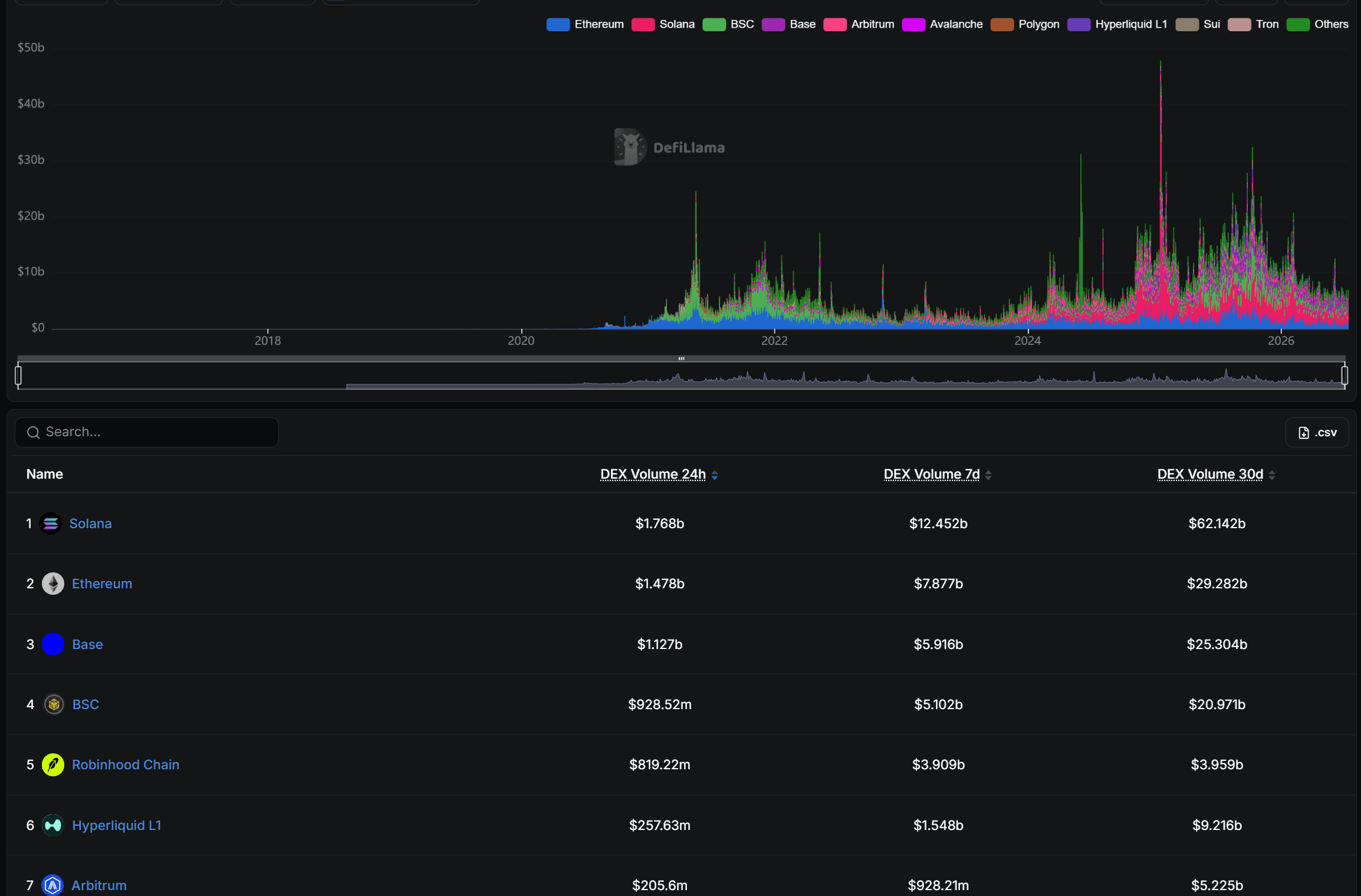
Robinhood Chain is clearing more than $800 million in daily decentralized exchange (DEX) volume two weeks after launch, with meme coins doing most of the lifting. Artemis CEO Jon Ma warns that the network’s biggest strength could become its biggest liability.
The layer-2 network runs on Arbitrum, handling trades faster and cheaper than Ethereum itself. It launched July 1 to host tokenized stocks and real-world assets (RWA), yet speculative tokens have dominated early trading.
Meme Coins Drive Robinhood Chain’s Early DEX Volume
DefiLlama recorded roughly $819 million in 24-hour DEX volume on Tuesday and $3.9 billion for the week. That figure measures the value of tokens changing hands on the chain each day. The network briefly passed Ethereum in volume on Monday before slipping back behind it.

Cash Cat (CASHCAT), a token built on Robinhood’s pre-launch internal name, holds a $156 million market cap, per CoinGecko. Thinner plays like Robin Hood (FOX) doubled in a day on a market cap near $2 million.
Ma runs Artemis, an on-chain analytics firm, and invested in Robinhood pre-IPO in 2019. In an open letter to CEO Vlad Tenev, he acknowledged the strong start.
He counted 300,000-plus daily active addresses, $40 million in annualized fees, and $300 million in total value locked (TVL).
Still, he argued memes account for most trading. He pointed to the 2024 meme coin class on Coinbase’s Base network, down 99% from peak by his count. He also recalled 2021, when GameStop mania forced Tenev to testify before Congress.

“But meme coins lose people money and destroy trust…PLEASE Robinhood DO NOT build a meme coin chain,” Ma cautioned.
Follow us on X to get the latest news as it happens
Supporters Bet on Liquidity First, Utility Later
Not everyone agrees. Analyst Miles Deutscher called Robinhood Chain one of the year’s most compelling crypto narratives.
Trader Bark argued the meme wave previews what happens when Robinhood’s retail base arrives onchain. Ma’s own letter puts that base at 27 million funded accounts.
“Tens of millions of people are one app update away from participating in memes for the first time.”
Arbitrum said the network earned over $800,000 in revenue in seven days, annualizing near $42 million. Its expansion program routes 10% of that to the Arbitrum (ARB) ecosystem, and ARB price gained 16% this week.
Ethereum, by contrast, captures almost none of that value, a split analysts already debate.
Coinbase CEO Brian Armstrong backed positive-sum use cases in the debate, calling users and liquidity the strongest moat. Grayscale research similarly found the market now rewards fundamentals over meme speculation.
Whether meme coins prove a gateway or a distraction may become clearer once Robinhood connects its main app to the chain. Until then, the network’s loudest critics and its biggest fans are pointing at the same numbers.
The post Artemis Warns Robinhood Chain’s Biggest Success May Also Be Its Greatest Risk appeared first on BeInCrypto.

Cardano’s largest holders have been increasing their exposure even as smaller investors reduce theirs, according to Santiment’s latest supply distribution data.
Wallets holding between 100,000 and 100 million ADA now collectively own more than 25.6 billion coins. The figure is the highest balance since February 2023. On the other hand, wallets holding fewer than 100 ADA have reduced their holdings by about 0.7% over the past four months.
Whales See Opportunity
Santiment said this trend comes as ADA faces intense FUD. The crypto asset’s price performance in 2026 fell short of expectations, and it recently traded near multi-year lows. Last week’s upside push toward $0.2 proved futile after ADA quickly pulled back. It slid to $0.15 and was down more than 11% over the past week. Despite that backdrop, major holders have continued accumulating.
The analytics firm pointed to several ongoing developments within the Cardano ecosystem, including work on the Leios testnet, continued Hydra scaling upgrades, progress on Mithril, integration of Pyth oracles, and new ecosystem funding initiatives.
These combined factors – whale and shark accumulation, declining retail participation, and persistently weak sentiment – represent one of the healthier market setups ADA has shown so far this year, although it does not necessarily signal an immediate price reversal.
String of Setbacks
2026 has been challenging for Cardano as the ecosystem has witnessed a series of setbacks. This month, EMURGO announced it was stepping down from the Cardano Pentad, the network’s governance group, to focus its resources on helping users recover from the SecondFi exploit. One community member described the exit as worrying and speculated that the organization may have run out of funds following the SecondFi exploit.
Earlier in the year, analytics platform TapTools shut down, while the planned 2026 Singapore Summit was called off. During the same period, Charles Hoskinson also warned that a “wave of failures” could hit DeFi projects built on the network. The developments came even as the ecosystem continued pushing ahead with technical upgrades behind the scenes.
The post Whales Keep Loading Up on Cardano While Retail Dumps ADA appeared first on CryptoPotato.

Binance has marked its ninth anniversary by highlighting strong user growth and expanding beyond digital assets into traditional financial products. The exchange now reports 323 million registered users across more than 100 countries, reflecting its growing global presence.
The scale of that user base becomes clearer when placed in the context of global cryptocurrency adoption. According to the firm’s report, its users represent about 43% of the estimated 741 million people worldwide who currently own cryptocurrency. Notably, this compares with a global crypto user population of fewer than six million when Binance launched in July 2017.
User Growth and Trading Activity
Registered users on Binance grew by another 7% during the first half of 2026 despite mixed market conditions. The company also reported a 9% rise in institutional users over the same period, pointing to continued participation from larger market players.
This growth in user activity was accompanied by higher trading volumes. Binance’s cumulative trading volume reached $156 trillion after adding $11.4 trillion during the first six months of the year. That pushed total trading activity 7.8% above the level recorded at the end of 2025.
Expansion Into Traditional Financial Products
The exchange also reported steady activity outside its crypto business through newer financial products. Monthly trading volume for its traditional finance offerings has remained above $80 billion since March, according to the company.
One of the latest additions to that business is direct stock trading, which Binance introduced in June as part of its broader financial services strategy. The product reached $1 billion in assets under management within 30 days and generated more than $3 billion in cumulative trading volume.
The company’s tokenized U.S. equities, known as bStocks, also recorded early growth after launch. Binance said the offering reached $100 million in assets under management within two weeks, while 47% of trading activity occurred outside regular U.S. market hours.
Co-CEOs Yi He and Richard Teng said the company aims to serve both retail users and institutional participants through a wider range of financial products. They added that recent launches, including stocks and tokenized assets, support Binance’s goal of improving access to global markets.
To celebrate the milestone, Binance launched a community campaign called “Built by You,” featuring up to $4.5 million in rewards and an interactive virtual experience. The anniversary comes as regulatory frameworks continue to evolve in major markets and institutional participation in digital assets remains a key industry trend.
The post Binance Marks Ninth Anniversary With 323 Million Users and Expansion Beyond Crypto appeared first on CryptoPotato.
Crypto World
Retail traders are hyping up XRP and ether during a dip, but history says a crash could be next

Retail traders are piling into XRP and ether while both tokens slip, the kind of crowd behavior that more often precedes further downside than a bounce.
XRP drew 3.02 bullish social media comments for every bearish one on Monday, its most positive reading in five weeks, according to Santiment. Ether ran at 2.31 and bitcoin at 1.40, which the firm classified as neutral. Bitcoin and ether both opened higher and faded through the day, so the loudest enthusiasm is landing on the assets that are falling.

Sentiment readings like these are used as contrarian signals, because crowd excitement usually peaks near local tops.
“Crypto typically moves opposite to what the crowd is loudly expecting,” Santiment wrote, adding that heavy bullishness on XRP or ether while prices dip can add short-term downside risk or slow any rebound.
Bitcoin’s flat reading is the healthier one, meanwhile. Retail chasing the smaller tokens while staying neutral on bitcoin is narrow speculation, not broad greed, and rallies have more room when the crowd hasn’t already crowded into the higher-prices trade. XRP traded near $1.09 on Monday, down on the week.
Crypto World
Prediction markets saw over $50 billion in volume as World Cup kicked off, crushing traditional sportsbooks


But the regulated U.S. app and the global platform are fundamentally different products. The U.S. version requires full KYC identity verification, is funded through registered futures commission merchants rather than crypto wallets and settles in U.S. dollars. The global platform, still geoblocked for U.S. IP addresses, has no identity checks, settles in USDC and carries a far wider range of markets.
The $571 million figure refers to Americans trading on that global platform through VPNs and existing crypto wallets. Allium tracked wallet behavior rather than IP addresses, which is how a VPN that defeats geoblocking still leaves U.S. fingerprints in the data.
Kalshi’s breakout moment
Named FIFA’s official prediction market partner part-way through the tournament, Kalshi had branding rights, in-venue presence and a media distribution deal with Fox Sports.Though notably, the user growth was already well underway when Kalshi signed its co-branding deal with ADI Predictstreet, the FIFA World Cup’s official prediction market partner, on June 26, just four days before Apptopia data was recorded. Both Kalshi and Polymarket have advertised heavily during games, with ads airing during the halftime break, as well as the so-called hydration breaks during the American broadcasts.
App data from Apptopia found that by June 30, Kalshi’s daily active users were 36% above their June 15 level. Over the same period, DraftKings fell 36% from its tournament peak, FanDuel dropped 41% and BetMGM and Caesars each declined 32%. Traditional sportsbook apps spiked early and faded, while prediction markets built steadily throughout.
The European Central Bank (ECB) has enlisted 36 payment firms to test the digital euro, its answer to the dollar stablecoins spreading through European payments. The central bank named the pilot group on Tuesday, July 14.
Deutsche Bank, UniCredit, and Revolut lead a roster that also includes US-based Stripe and European processors Adyen, SumUp, and Worldline.
A Digital Euro Pilot Built to Counter Dollar Stablecoins
Brussels frames the project as monetary sovereignty. ECB President Christine Lagarde has rejected euro stablecoin proposals, arguing a public digital currency should fill the role instead. The central bank has also warned about deposit risks from expanding private euro tokens.
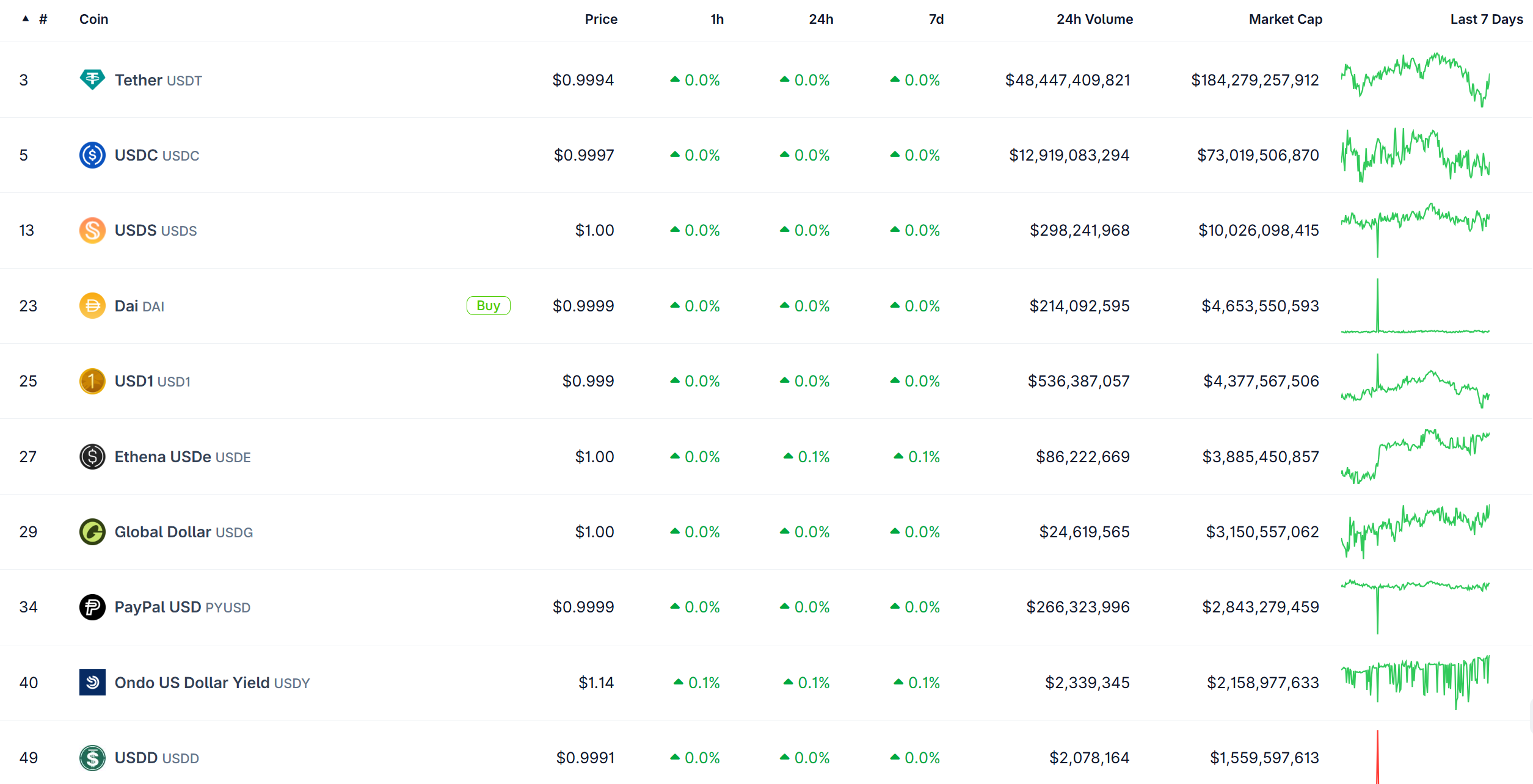
The mismatch is stark. Dollar-pegged tokens account for nearly all of the $306 billion stablecoin market, per CoinGecko data. Tether (USDT) and USD Coin (USDC) alone hold a combined 84%. Circle’s EURC, the largest euro-pegged token, circulates about $424 million, over 400 times smaller than USDT.

Notably, Tuesday’s announcement avoids naming stablecoins, framing the pilot around testing and user experience. The confrontation reading comes from Lagarde and other officials, who cast the project as protection for Europe’s monetary autonomy. The roster itself carries some irony, with US-based Stripe testing Europe’s independence project.
MiCA has already redrawn the field. Revolut, one of the 36, recently moved to delist USDT in Europe after Tether skipped authorization. The MiCA transition period ended this month, closing the EU market to unlicensed platforms.
What the 36 Firms Will Test From 2027
The pilot begins in the second half of 2027 and runs for 12 months. More than 50 firms applied for the 36 slots. According to the pilot framework, participants will test a beta digital euro in person-to-person, in-store, and e-commerce payments.
The exercise spans the ECB and 19 euro-area central banks. The beta currency will mirror the final product technically but will carry no legal tender status.

“Staff at participating central banks will have the opportunity to make beta digital euro payments from person to person (both online and offline) and from person to business (both at the physical point of sale, including Software Point of Sale, and via e-commerce, including mobile payments),” The ECB confirmed this in its Tuesday statement.
Follow us on X to get the latest news as it happens
The politics moved first. Parliament approved final negotiations in a 416-169 vote on July 9, and talks with member states and the Commission opened Monday.
Negotiators led by Spanish MEP Fernando Navarrete aim to finish the law this year. That would keep potential issuance on track for 2029.
For consumers, nothing changes before 2027. If the project reaches issuance, Europeans would hold central bank money in digital form, spendable in shops and online like cash.
After five years of study, the pilot will show whether public digital money can match the convenience that made dollar stablecoins the default.
Critics still argue the EU’s digital euro plan could hand advantages to US firms. The 169 votes against suggest the fight is not over.
Subscribe to our YouTube channel to watch leaders and journalists provide expert insights.
The post ECB Picks Revolut, Stripe, and 34 Others to Test the Digital Euro appeared first on BeInCrypto.


Bitcoin’s consensus rules have historically treated valid transactions equally regardless of purpose. BIP-110 prompted concerns that rules aimed at discouraging one category of transaction risked opening the door to future restrictions on others.
BIP-110 rejected
The means by which the proposal sought approval was equally contentious. Bitcoin upgrades typically only proceed after overwhelming support has emerged across miners, businesses, wallet providers and the wider ecosystem. BIP-110, instead, revived discussion around a user-led activation approach, with upgraded nodes enforcing the new rules if predefined conditions were met.
Supporters viewed that as a necessary safeguard if miners refused to act against what they considered abuse of block space. Opponents warned that attempting to introduce new consensus rules without broad agreement risked creating incompatible versions of Bitcoin, a scenario that many veterans still associate with the divisive block-size wars of 2017.
This was where BIP-110 fell short in winning support. Mining companies had little inventive to reject transactions that paid competitive fees, while institutional investors had no appetite for governance battles.
Michael Saylor, founder of Strategy, the largest corporate holder of bitcoin , said BIP-110 “turns a spam dispute into a consensus change that would invalidate some currently valid, fee-paying transactions.”
“That precedent is the danger,” he wrote on X on July 11. “We shoul save our energy for threats that really matter.”

Clacton by-election circus loses its fox

Spain into World Cup final after victory over France
Klipsch The Sevens II Review: Wireless Speakers for Music, Movies and TV


-

 Fashion5 days ago
Loro Piana Fall 2026 Enters Houston’s Art Scene
-

 Fashion4 days ago
Weekend Open Thread: Nutriplenish Leave-In Conditioner
-
 Sports5 days ago
2026 Genesis Scottish Open Thursday TV coverage: Round 1
-

 Tech7 days ago
Anthropic brings Claude Cowork to mobile and web as usage data shows most users aren’t coding
-

 Sports5 days ago
Super Eagles star Moses Simon opens up on Liverpool transfer regret
-

 Tech5 days ago
Character.AI enters the microdrama arena with its own productions, but there’s a twist
-

 Tech17 hours ago
Get Your ESP32 Sunny Side Up With This Solar Dev Board
-

 News Videos2 hours ago
XRP BOMBSHELL… XRP OMBOARDED FOR TRANSACTIONS!!!
-

 News Videos6 days ago
Crypto Just Entered Its Most Important 6-Month Candle (Could Decide Everything!)
-

 Tech2 hours ago
Dark Secrets Emerge When Jailbreaking LLMs
-

 Tech7 days ago
Keychron is stepping outside keyboards with a $349 Thunderbolt 5 dock aimed at power users
-
 Business7 days ago
ASX 200 Slides Over 0.6% as Rare Earths and Lithium Stocks Tumble Amid Global Semiconductor Sell-Off Today
-
 NewsBeat5 days ago
Major update after Huntingdon train attack as man enters plea
-
 Business7 days ago
Will Trent shares rebound after Q1 update triggers 13% crash? Here’s what technical charts indicate
-

 Business7 days ago
SpaceX Shares Slide Nearly 6% Amid Post-IPO Volatility and Starship Test Focus
-

 Sports6 days ago
39-year-old Djokovic wins five-hour thriller to enter Wimbledon semis | Other Sports News
-

 Tech6 days ago
Entra passkey enrollment vishing targets Microsoft 365 users
-

 News Videos1 day ago
how to make coin bank box with cardboard #scienceproject #money #diy #shorts
-
 Tech1 day ago
Cloudflare Precursor Watches Your Mouse and Keyboard To Decide If You Are Human
-

 Tech5 days ago
Level Infinite Launches Gangstar Mirage City in India with Pre-Registrations
You must be logged in to post a comment Login