

Crypto World
Americans traded $571 million on Polymarket politic bets despite U.S. ban

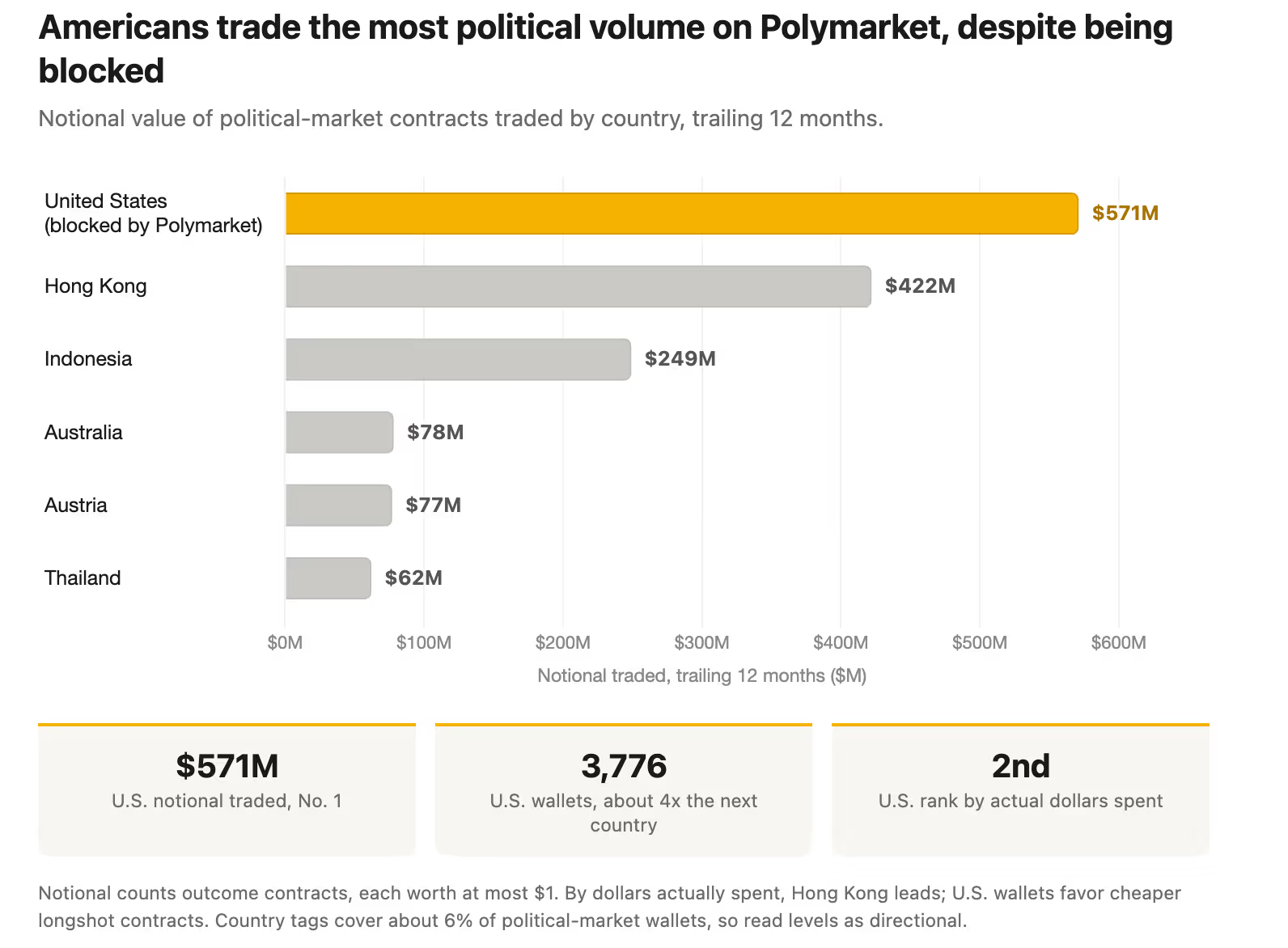
As such, Allium can tie only about 6% of Polymarket’s political-market wallets to a country – so the firm says the figures should be read as directional rather than exact.

Polymarket did not immediately respond to request for comments ahead of U.S. market hours.
Meanwhile, a further interesting bit is what Americans bet on. Geopolitics made up 46% of U.S. notional against 36% for the platform as a whole, while elections drew 16% from U.S. wallets against 32% platform-wide, meaning the American crowd trades foreign wars at nearly three times the rate it trades the elections everyone else favors.
Of U.S. cohort’s twelve biggest markets, five were bets on the Iran war. Its single largest, at $20.8 million, was a novelty market on whether Ukrainian President Volodymyr Zelenskyy would wear a suit.
Those are largely the markets regulated U.S. venues do not carry. Kalshi and Polymarket’s compliant U.S. arm stick mostly to economic data, rate decisions and elections, so the demand flows to the offshore version that lists regime change and ceasefires.

The pattern regulators might fear is the one the data does not show.
On markets that have resolved, U.S. wallets backed the winner 81.9% of the time against 80.3% for everyone else, effectively no edge, and returns if held were nearly identical.

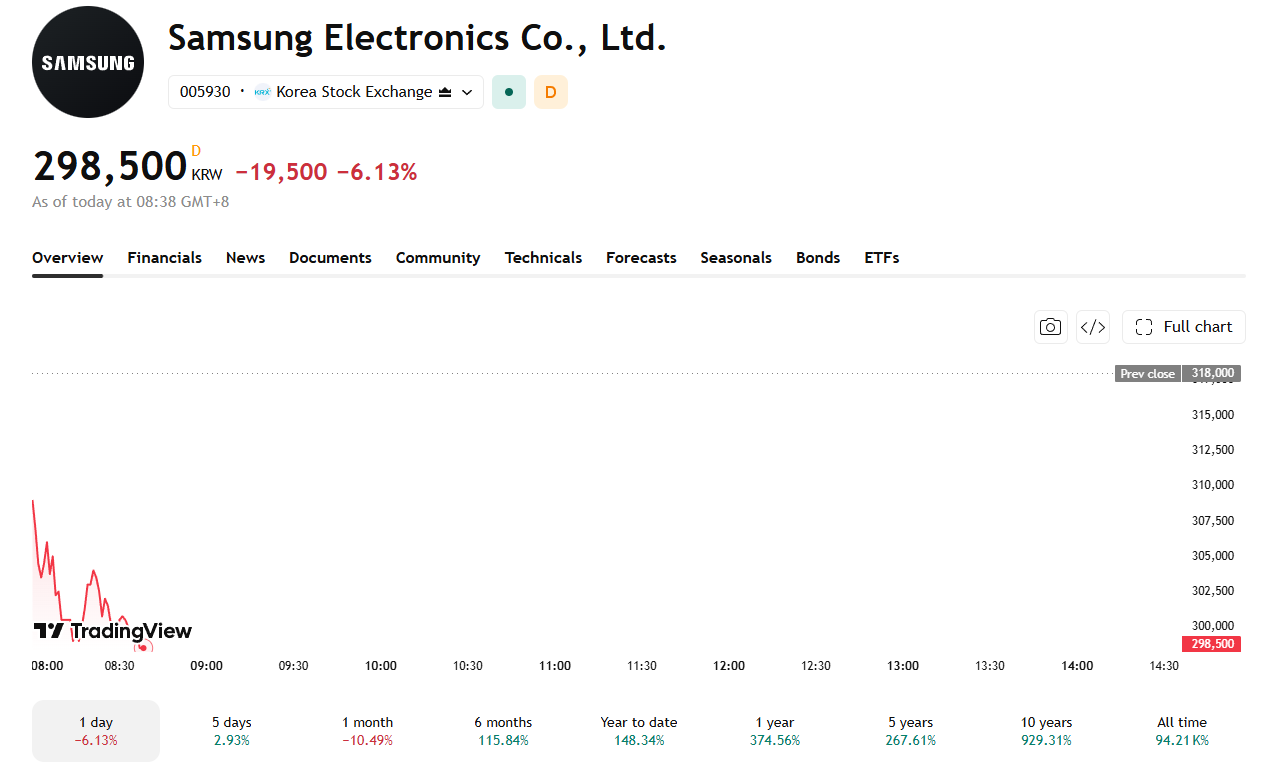
Samsung Electronics forecast a 19-fold jump in second-quarter operating profit to 89.4 trillion won ($58.4 billion) today, July 7. The estimate beat analyst forecasts and marked Samsung’s third straight record quarter.
However, Shares still fell over 6% in early trading, extending a pullback from the stock’s fivefold rally over the past year.
AI Demand Fuels Record Profit
Samsung’s guidance topped the 87.3 trillion won LSEG SmartEstimate. It also beat the 84.4 trillion won FnGuide consensus, according to Reuters.
Samsung expects revenue to climb 129% year over year to 171 trillion won. However, that figure actually fell short of analyst forecasts of 173.3 trillion won, according to Korea JoongAng Daily.
Citi Research found DRAM prices climbing 44% quarter over quarter, while NAND flash prices rose 53% in the same stretch. Analysts tied the increase to AI spending pushing beyond high-bandwidth memory into conventional chips for phones, PCs and servers.
Booming HBM production has increasingly squeezed the supply of standard memory chips, keeping prices elevated. Customers have also started seeking longer-term supply contracts, a shift analysts say could keep prices high well into next year.

Additionally, Samsung agreed to a wage deal with workers in May. The deal ties semiconductor worker bonuses to operating profit, and Samsung set aside funds for those bonuses this quarter.
Analysts estimate operating profit would have only topped 100 trillion won without those bonus provisions.
Why Are Shares Falling Anyway?
Samsung stock climbed fivefold over the past year, but Tuesday’s drop looks like profit-taking after that run, as some investors sold into the earnings beat rather than chase the stock higher.
Analysts expect widening losses at Samsung’s foundry and logic chip units, since bonus costs spread across the whole semiconductor division.
The pullback also fits a broader pattern across chip stocks, where sentiment has split sharply by company. Memory glut fears have hit some suppliers in recent weeks, even as Micron’s AI-driven surge pushed others higher over the same stretch. That divide has fed recent warnings about an AI bubble, with some investors growing wary of how far the rally can run.
Samsung will release a full divisional breakdown on July 30. It also pledged 2,100 trillion won for domestic investment through 2040, though it will adjust that spending to market conditions.
Some analysts argue the memory boom looks increasingly structural, since new fabrication plants take years to build and limit supply growth. A slowdown in AI data center spending remains the clearest risk to that outlook.
The post Samsung Forecast a 19-Fold Profit Jump Today: So Why is Stock Down 6%? appeared first on BeInCrypto.
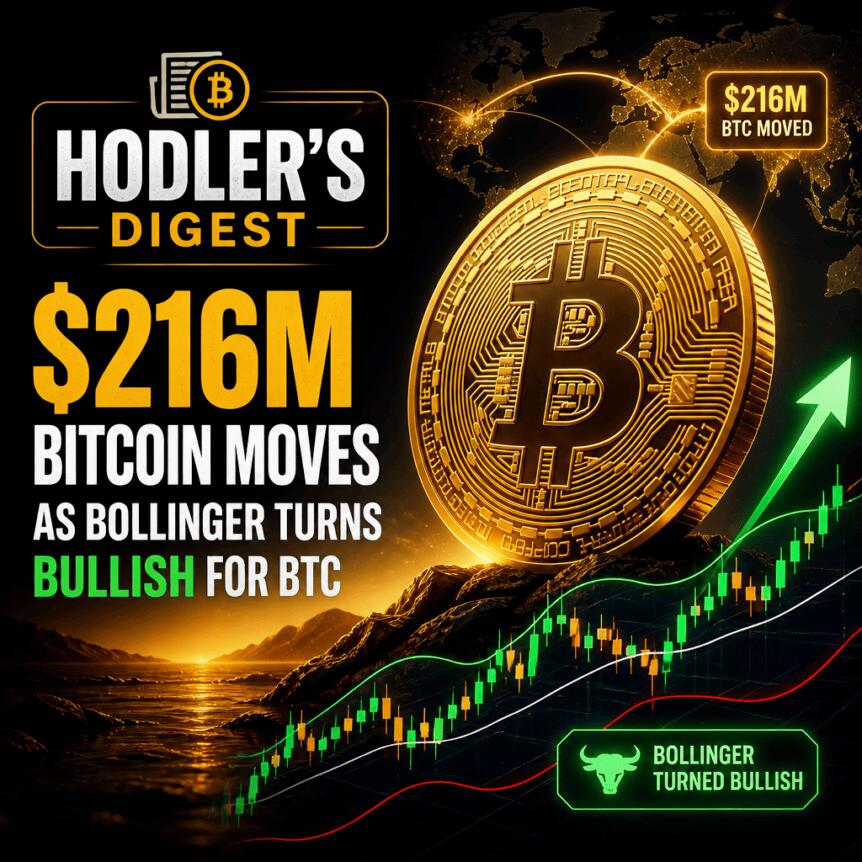
MicroStrategy peer Strategy has continued its capital reshuffle, selling 3,588 Bitcoin for $216 million to support preferred stock dividend payments and replenish cash reserves, according to a Monday SEC filing. The move reduces the company’s total Bitcoin holdings to 843,775, as Strategy seeks to balance shareholder payouts with ongoing exposure to the asset class.
The transaction also adds a new datapoint to the debate over whether major Bitcoin buyers will eventually be forced to liquidate holdings. Earlier this year, Strategy disclosed its first reported Bitcoin sale since a 2022 tax-loss transaction—raising scrutiny about what, if anything, could trigger further sales.
Key takeaways
- Strategy sold 3,588 BTC for $216 million, cutting its holdings to 843,775, per an 8-K filed with the SEC.
- The sales were executed in two price windows: 1,363 BTC at an average $59,256 and 2,225 BTC at an average $60,773.
- Strategy says the purpose was to fund preferred stock dividends and restore cash reserves, keeping payout obligations covered.
- Analyst coverage from Bernstein previously argued the company was unlikely to be compelled to sell due to its liquidity position.
Strategy’s latest Bitcoin liquidation and what it funds
In its 8-K, Strategy states that it sold 3,588 Bitcoin for proceeds totaling $216 million. After the sale, the company reported remaining holdings of 843,775 BTC. The filing frames the sell-down as part of a broader effort to manage near-term corporate obligations while maintaining a large Bitcoin position.
Strategy also broke out portions of the sales by timing and average execution price. It sold 1,363 BTC at an average price of $59,256 between last Monday and Tuesday, then sold 2,225 BTC at an average price of $60,773 between Wednesday and Sunday. Those details matter for investors assessing whether the company is selling opportunistically across specific windows or responding to cash needs that require market timing.
Why the sale matters for investors watching “forced selling” risk
Bitcoin sales by large holders can move sentiment—even when they are not tied to distress. The key question for the market has been whether Strategy’s capital plan could eventually lead to compelled liquidation, or whether the company has enough liquidity to prevent that outcome.
That question has been addressed in prior research cited by the article, including a report from Bernstein. Bernstein argued that Strategy was unlikely to be forced to sell its holdings, pointing to the company’s liquidity position and cash reserves. The report also estimated that Strategy had 17 months of cash coverage for dividend obligations and interest payments and described Strategy as a “balancing force” in a market where other major Bitcoin-related players have been net sellers.
From an investor’s perspective, this framing reduces the immediacy of “death spiral” style fears—though the latest sale shows Strategy is willing to convert some Bitcoin exposure into cash when the corporate calendar requires it. What remains uncertain is whether future dividend cycles or funding needs would lead to additional sell-offs, or whether this was a contained adjustment.
From Strategy’s first sale to a broader read-through
Earlier coverage noted that Strategy disclosed the sale of 32 Bitcoin in early June, described as its first reported Bitcoin sale since a 2022 tax-loss transaction. The updated 8-K expands the story from a small exception into a far larger cash-generating action.
The market implication is not automatically bearish. Large holders can sell for operational reasons without changing their long-term thesis, especially when they hold substantial Bitcoin inventories and manage liquidity through a mix of cash and structured funding. Still, the direction and size of future transactions will likely influence how traders interpret Strategy’s role in the broader Bitcoin flow picture.
What to watch next
Going forward, investors should track whether Strategy repeats similar sell-downs in subsequent dividend periods and whether additional SEC disclosures clarify the cadence of its cash-management plan. The most important signal will be how Strategy’s reported liquidity coverage and dividend funding needs evolve relative to the timing and scale of future Bitcoin sales.
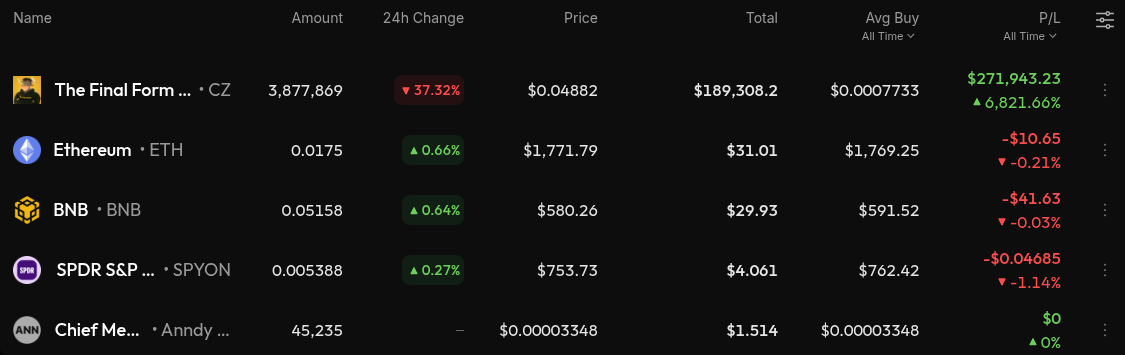
An anonymous trader turned a $754 bet into roughly $271,000 in under 48 hours, scoring a 357x return. The windfall came from CZ, a BNB Chain meme coin tied to Binance founder Changpeng Zhao.
Here is how the trade unfolded, what powers the token, and why the story is both inspiring and risky.
How the Trader Scored a Staggering 357x Return With a CZ Meme Coin
A meme coin is a cryptocurrency built around an internet joke, personality, or cultural reference rather than a specific technical use case. The CZ token, known as “The Final Form Bull,” leans entirely on that formula across the BNB Smart Chain.
On-chain platform Lookonchain reported the details. The wallet acquired roughly 5.1 million CZ tokens across three transactions totaling $754.49. Furthermore, the average entry price sat near $0.000147 per token during the early accumulation phase.
Follow us on X to get the latest news as it happens.
The payoff was explosive at its peak. As the token surged, the position’s value skyrocketed to around $271,100. However, the meme coin has since pulled back from 0.0592 to $0.0418, according to GeckoTerminal.
As a result, the holder’s unrealized gains have eased to roughly $246,000, though the trader still holds 100% of the position without selling a single token.
The token itself draws direct inspiration from a viral CZ tweet. On January 17, 2021, Zhao wrote, “Everyone knows I’m a bull. You haven’t even seen my final form yet,” alongside a muscular bull image. As a result, that phrase became legendary crypto folklore.
Launched recently via the Four.Meme platform, CZ meme coin now holds a market capitalization of around $41 million. Furthermore, its 24-hour trading volume briefly topped $80 million during the rally’s peak, reflecting intense speculative interest.
Why This 357x Win Comes With Real Warnings
The trade looks glamorous, but the trader’s history reveals the harsh reality of meme coins. Over the past two months, the wallet made roughly 260 trades with just a 31.88% win rate. Most positions ended in losses.
That context matters enormously. This single outlier dramatically offset a long string of failures. As a result, a single successful bet can mask the fact that most speculative meme coin trades do not pay off in the long run.
Subscribe to our YouTube channel to watch leaders and journalists provide expert insights.

The CZ phenomenon also reflects the ongoing popularity of Binance-themed meme coins. Low fees and fast transactions on BNB Chain continue to attract retail traders seeking high-volatility opportunities amid an increasingly crowded speculative market.
However, experts caution that such extreme returns remain rare. Meme coins can pump violently and then correct just as sharply. Sustainable success requires discipline, risk management, and the understanding that most participants never achieve life-changing results.
The post Trader Makes 357x Gains With CZ Meme Coin Born From a Viral Post appeared first on BeInCrypto.
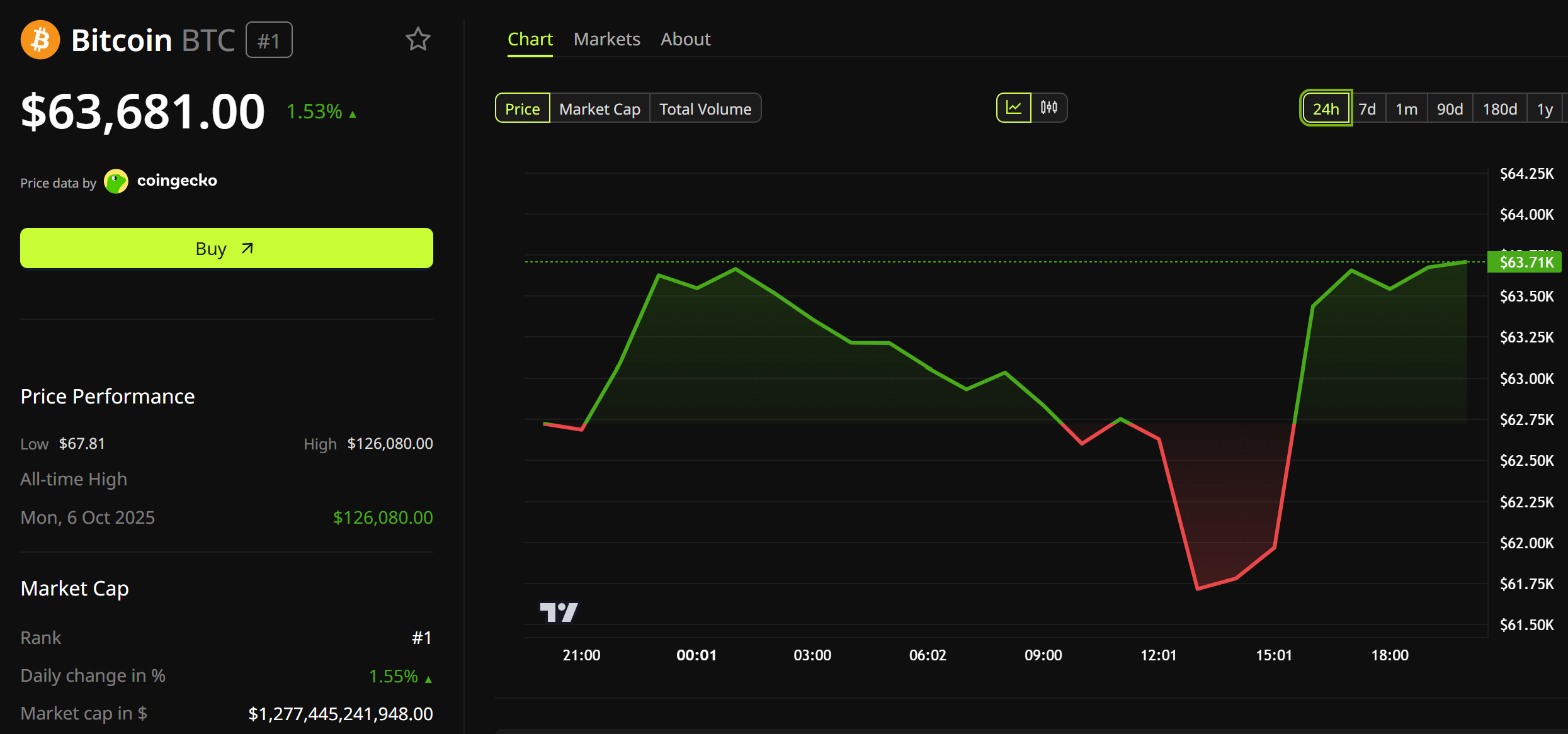
Blockstream CEO Adam Back says crypto keeps repeating the custody failures that destroyed FTX and Mt. Gox. His Bitcoin advice cuts against the noise. Separate trading from custody, skip leverage, and HODL through every downturn.
Back speaks from experience. By his own account, he lost coins in the Mt. Gox bankruptcy after redepositing funds to chase a 10% arbitrage spread that proved to be a risk premium in disguise.
The Custody Mistake Crypto Refuses to Fix
In a Blockstream interview at BTC Prague 2026, Back argued that both collapses shared a common flaw. Exchanges held customer funds while trading against them.
The cost of that flaw compounds for years. Mt. Gox lost about 850,000 BTC in 2014, and its Japanese bankruptcy trapped creditors for nearly a decade. Its estate still moves markets, and a $739 million transfer in June helped push Bitcoin below $70,000.
FTX repeated the pattern in 2022. Its creditors received a $2.2 billion fourth round of repayments in March 2026, more than three years after the exchange failed.
Back sees progress, though. Institutional traders increasingly demand trilateral agreements, which park assets with independent custodians while exchanges extend trading credit. If a platform fails, he noted, possession is nine-tenths of the law.
Adam Back’s Bitcoin Advice for a Volatile Market
For individuals, the prescription is blunt. Keep long-term holdings in self-custody, and never borrow against bitcoin to buy more. That trade, Back warned, carries a surprising liquidation risk because the collateral and the asset fall together.
Successfully timing markets is difficult for a similar reason. Back estimates that roughly 12 trading days deliver each year’s gains, so sitting out is costlier than it looks.
“The problem is it’s very very hard to time these markets or to second guess them… being out of market is like palpably dangerous.”
Back said this while defending the HODL strategy, which began as a drunken misspelling on a 2013 forum. By his count, he has held through three 85% drawdowns, earning the nickname “cucumber” for staying cool.
Bitcoin’s current price near $63,681, up 1.5% in 24 hours, sits just above the 200-week moving average. Back placed that average near $61,000 and treats it as the asset’s dependable value floor.

Back is betting his own capital on that conviction through his pending BSTR bid. The open question is whether exchanges adopt custody separation before the next stress test, or whether the old playbook runs again.
The post Adam Back Says One Bitcoin Mistake Could Cost Traders Again appeared first on BeInCrypto.
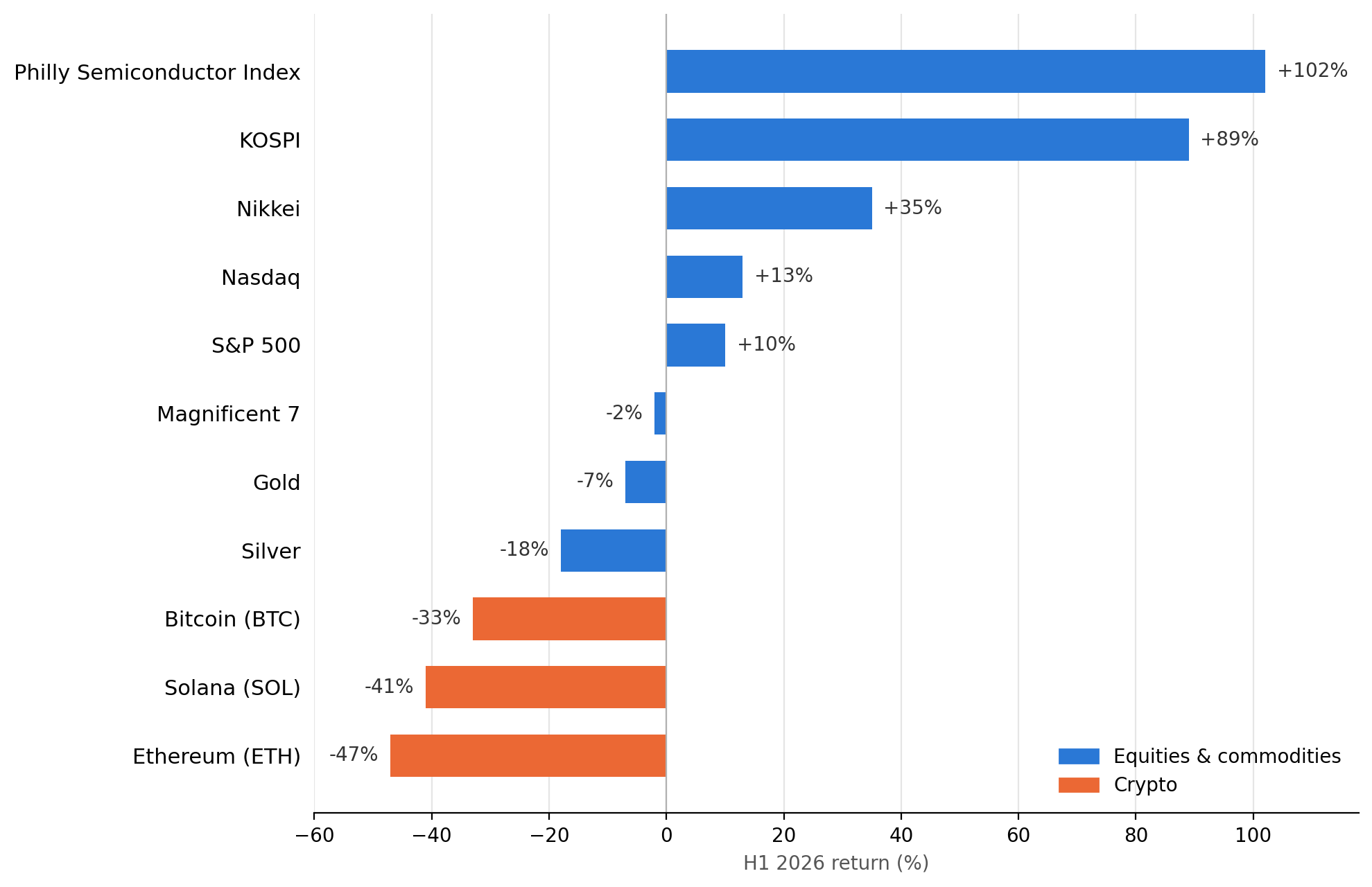
Semiconductor stocks beat both Big Tech and crypto in the first half of 2026. The Philadelphia Semiconductor Index gained 102%, while the Magnificent Seven fell 2% and Bitcoin (BTC) lost 33%, according to Deutsche Bank and CoinGecko data.
Wall Street banks now disagree about the second half. Goldman Sachs expects investors to keep backing chipmakers, while Morgan Stanley argues the trade has already started to unwind.
How Semiconductors Beat Big Tech and Crypto in H1 2026
Deutsche Bank’s half-year scoreboard ranked the Philadelphia Semiconductor Index as the best-performing major asset in the world. The benchmark gained 102% between January and June, according to a chart shared by Schaeffer’s Investment Research.
Korea’s chip-heavy KOSPI followed with an 89% gain, while Japan’s Nikkei added 35%. In contrast, the Nasdaq rose just 13% and the S&P 500 slightly under 10%.
The Magnificent Seven, the group that carried US markets for two years, ended the half 2% lower.

Crypto fared even worse. Bitcoin slid 33% in the first half, falling from roughly $87,500 to below $59,000, CoinGecko data shows. Ether (ETH) dropped 47%, and Solana (SOL) fell 41%. Traditional hedges offered no shelter either, as gold slipped 7% and silver lost 18%.
ETF flows tell the same story. The VanEck Semiconductor ETF climbed 72%, and the iShares Semiconductor ETF gained 99%, while the Roundhill Magnificent Seven ETF declined slightly.
Meanwhile, a shortage of memory and storage has led chipmakers to raise prices as the industry approaches $1 trillion in annual revenue.

Goldman Backs the Earners While Crypto Trades Like a Spender
Goldman Sachs derivatives specialist Brian Garrett explained the divergence in a client note last week, as reported by Stocktwits.
“One of the reasons for the decrease in Mag7 exposure seems almost too simple as it’s been hiding in plain sight for months. The market is rightly rewarding the names that earn (capex beneficiaries, semiconductors, etc) while at the same time questioning the names that spend (hyperscalers).”
Hyperscalers such as Microsoft, Amazon, Meta, and Google pour hundreds of billions of dollars into data centers. Markets increasingly treat that spending as a cost without a proven payoff.
Meanwhile, companies that sell chips, memory, and equipment recognize revenue today.
That logic hits crypto hardest. Bitcoin earns nothing from the AI buildout, so it traded alongside the spenders rather than the earners. The pressure intensified after Michael Burry’s bubble warning sent memory stocks sliding this month.
The same split appeared inside the crypto market. Render (RNDR) gained 17%, and NEAR Protocol (NEAR) added 18% in the first half, while most majors fell over 30%, per CoinGecko. Both tokens sell exposure to computing power, the scarcest resource of this cycle. However, the pattern is not universal, as Bittensor (TAO) and Fetch.ai (FET) still declined.

Bitcoin miners occupy the middle ground. Riot Platforms keeps selling BTC while funding its AI pivot, and rival miners chase similar data center deals.
Morgan Stanley Sees the Chip Trade Turning
Morgan Stanley strategist Michael Wilson argued on Monday that chip momentum is fading as investors rotate toward hyperscalers, Bloomberg reported. The Philadelphia index has dropped almost 14% from its June record, though it remains 123% higher since September.
Cracks appeared before July. A blowout Micron forecast failed to sustain the rally, and the KOSPI triggered circuit breakers in June. Wilson, therefore, favors hyperscalers in the near term and expects them to soften spending plans.
JPMorgan strategist Mislav Matejka believes the rally will broaden beyond technology in the second half.
“AI is unlikely to be the only story in town.”
For crypto, this debate matters more than it appears. If capital exits the crowded chip trade and hunts laggards, Bitcoin ranks among the largest liquid laggards available. The token trades near $61,626 after a weekend short squeeze briefly lifted it toward $64,000.
Still, no major bank has named digital assets as the next rotation target. The coming weeks will show whether hyperscaler earnings confirm the turn, and whether any freed capital finds its way back to crypto.
The post Semiconductors Beat Big Tech and Crypto in H1: Is the Trade Turning? appeared first on BeInCrypto.

Richard Heathcote, the former chief investment officer of Tether, is reportedly looking to sell part of his stake in the stablecoin issuer, according to a Bloomberg report citing people familiar with the matter. Heathcote holds 1.26% of Tether, and the planned transaction would involve only a portion of that ownership.
Tether, which issues USDt (USDT), remains privately held despite operating as one of crypto’s most profitable businesses. The reported partial sale is notable not only because of Heathcote’s senior role, but also because it would be among the few glimpses into ownership at a company that underpins a large share of the stablecoin market.
Key takeaways
- Bloomberg reports that former Tether CIO Richard Heathcote plans to sell part of his 1.26% stake, offering rare insight into Tether ownership.
- USDT remains the dominant stablecoin by market capitalization, with DefiLlama data placing its circulating supply around $184 billion (about 59% market share).
- The potential sale comes as Tether faces increased regulatory pressure in Europe, including platform delistings after Tether did not align with the EU’s MiCA framework.
- Broader IPO chatter continues in crypto, even as exchanges weigh listing paths amid regulatory and operational constraints.
Why Heathcote’s stake sale matters
Bloomberg’s report focuses on the planned sale by Richard Heathcote, who stepped away from the role of Tether’s chief investment officer in March. The report says he moved into an advisory capacity after overseeing the company’s investment portfolio.
For markets, transactions involving insiders in key stablecoin issuers are often watched closely—even when only partial. Tether’s scale means its ownership structure and governance are relevant to traders and institutions that rely on USDT’s liquidity. While the report does not specify deal size beyond the portion of the stake, it underscores that influential executives at stablecoin issuers are not necessarily bound to long-term illiquidity, despite the asset’s centrality to crypto settlement and exchange activity.
Heathcote’s stake also highlights the challenge of assessing control and incentives in privately held crypto firms. With Tether not publicly listed, investors and observers have fewer direct market signals about internal changes. A reported sale, even a partial one, can become a data point for how senior stakeholders view holding periods, risk, and governance in a fast-changing regulatory environment.
USDT’s market position remains central
Any ownership move at Tether inevitably ties back to USDT’s dominance. According to DefiLlama data, USDT has a circulating supply of roughly $184 billion and accounts for approximately 59% of the stablecoin market by market capitalization.
This matters because USDT is not just a retail token—it is deeply embedded in the infrastructure of exchanges, trading pairs, and on-chain activity. When large portions of market liquidity are concentrated in a single issuer, stakeholders tend to pay particular attention to credible updates on that issuer’s financial posture, governance, and regulatory standing.
At the same time, the reported sale is not automatically a signal about USDT’s strength or weakness. Stablecoins can remain widely used even as regulatory constraints limit where they are permitted. The more meaningful question for investors is whether Tether’s regulatory path and distribution access continue to affect demand for USDT in key jurisdictions.
Regulatory pressure in Europe intersects with business uncertainty
The Heathcote sale report arrives as Tether faces heightened scrutiny in Europe. Earlier coverage from Cointelegraph noted that USDT has been delisted by an increasing number of platforms operating under MiCA authorizations after Tether chose not to comply with the EU’s crypto framework.
That tension has been visible in operator decisions. Cointelegraph previously reported that Revolut would remove USDT from its platform, reflecting how regulatory alignment—or lack of it—can translate into immediate distribution losses for a stablecoin issuer.
For market participants, this creates a split reality: USDT may remain dominant by market size, but issuer exposure to regulation can change the on-ramps and availability that sustain that market share in Europe. In that context, insider ownership moves may be read less as a market bet on USDT itself and more as an adjustment to the broader uncertainty around compliance, platform access, and long-term growth channels.
IPO speculation continues elsewhere in crypto
While Tether’s executives have publicly indicated the company does not need to go public, crypto’s IPO debate appears to be broadening beyond stablecoins. Several other firms have reportedly explored listing routes.
Cointelegraph previously highlighted that Kraken has taken steps that could lead toward an IPO. Fortune reported in September 2025 that Kraken raised $500 million at a $15 billion valuation, fueling expectations that the exchange was positioning for a public listing. Kraken also announced it had confidentially filed a draft registration statement with the US Securities and Exchange Commission in November 2025 for a proposed initial public offering.
However, Bloomberg later reported that Kraken’s IPO timeline could slip into 2027 after layoffs tied to the company’s increasing use of artificial intelligence. The implication for readers is that even when a path to liquidity exists, operational restructuring and market conditions can delay capital-market milestones.
In South Korea, Cointelegraph reported that Bithumb delayed its IPO until after 2028. The exchange said it was working to strengthen accounting policies and internal controls after earlier regulatory setbacks, underscoring how compliance process—not only investor demand—can shape public-market timing for crypto firms.
Separately, Cointelegraph has also published coverage focusing on anonymity-related risks and how AI may be used to identify hidden identities in crypto activity, reflecting the broader environment in which regulators, exchanges, and compliance teams are operating.
What to watch next
For Tether, the next signals likely won’t come from ownership headlines alone. Investors should track whether additional European platforms follow through on delistings under MiCA and how Tether responds operationally and commercially in regions tightening stablecoin rules. Meanwhile, Bloomberg’s reported stake sale may prompt renewed attention to how insiders manage liquidity in privately held firms as crypto firms weigh—or postpone—public listings.


Alex Van de Sande, a co-founder of the Ethereum Name Service (ENS), proposed Monday that the ENS DAO delegate 5 million ENS tokens from its dormant community treasury to individual participants, a step he said would end the DAO's reliance on what he called “just a 1-of-1 multisig.” “Currently, one… Read the full story at The Defiant


BonkDAO, the decentralized autonomous organization tied to the Solana-based memecoin BONK, said Monday it was the target of a malicious governance proposal that drained an estimated $20 million worth of BONK tokens from its treasury, according to a post on its official X account. The DAO said the… Read the full story at The Defiant


EMURGO, the Cardano-founding entity behind SecondFi, said Monday the hacked wallet service will not resume normal operations even after ongoing security audits conclude, telling all users to migrate away using its official recovery process. "Although we believe unaffected users remain safe,… Read the full story at The Defiant

Strategy sells 3,588 Bitcoin for $216M to fund dividends
Michael Saylor’s Strategy sold 3,588 Bitcoin (BTC) to fund preferred stock dividend payments and replenish its cash reserves.
Strategy sold the Bitcoin for $216 million, reducing its total holdings to 843,775 Bitcoin, according to a Monday 8-K filing with the US Securities and Exchange Commission.
This included 1,363 Bitcoin sold at an average price of $59,256 between last Monday and Tuesday, and 2,225 Bitcoin sold at an average price of $60,773 between Wednesday and Sunday.
Strategy disclosed the sale of 32 Bitcoin in early June, as its first reported Bitcoin sale since the 2022 tax-loss transaction.
Before Strategy disclosed its latest Bitcoin sale, Bernstein said the company was unlikely to be forced to sell its holdings, citing its liquidity position and cash reserve coverage.
Bernstein’s report said Strategy had 17 months of cash to cover dividend obligations and interest payments. It added that the company remained a net buyer of Bitcoin and served as a strong “balancing force” in a market where leading US Bitcoin miners are net sellers due to their pivot to AI.
Donald Trump says ‘nothing wrong’ with $1.4B crypto windfall while in office
US President Donald Trump has responded to criticism of his 2025 financial disclosures, showing that he earned $1.4 billion in income from crypto-related ventures while in office.
In a Thursday interview with CNBC’s Joe Kernen, Trump said that there was “nothing illegal” and “nothing wrong” with profiting from his crypto investments as president. He claimed that other people were responsible for his investments and he didn’t “even know who they are,” not directly answering questions about perceived conflicts of interest as president.
Trump’s comments followed the release of his 2025 financial disclosure report by the US Office of Government Ethics, showing that he took in more than $2 billion from his businesses and investments, about $1.4 billion of which was connected to crypto projects like his memecoin and family’s platform World Liberty Financial. Many advocacy organizations have characterized the investments as a “grift” allowing the president to influence related legislation like the Digital Asset Market Clarity (CLARITY) Act.
Trump disclosed that his memecoin generated about $636 million, World Liberty sales about $588 million and $197 million from equity in a stablecoin venture.

US senator calls for ban on elected officials issuing memecoins
Senator Kirsten Gillibrand, one of the US lawmakers behind negotiations for a digital asset market structure bill in Congress, has proposed barring elected officials and the president from issuing or sponsoring their own tokens, citing President Donald Trump’s and First Lady Melania Trump’s memecoins.
In a Friday notice, Gillibrand said that Congress should support measures barring elected officials and their spouses from “issuing or sponsoring their own digital assets.” The New York lawmaker said that the proposed restriction would include any US president and their spouse, but did not specifically mention extending the provision to the office of the vice president or other members of their families.
“This is a commonsense requirement that should get broad bipartisan support – public officials and their spouses should not be issuing memecoins,” said Gillibrand. “We cannot let self-dealing destroy an opportunity to strengthen consumer protections, crack down on illicit finance, and expand economic opportunity for the millions of Americans our financial system has left behind.”

Vitalik Buterin shares top priorities for new ‘Lean Ethereum’ strawmap
Ethereum co-founder Vitalik Buterin has named quantum resistance, scalability and privacy as three of Ethereum’s top priorities under a new “Lean Ethereum” strawmap, which lays out the network’s technical direction for the remainder of the decade.
In a post to X on Saturday, Buterin said the collection of upgrades will roll out over the next three to four years, touching nearly every layer of Ethereum in a transformation he compared in scale to the September 2022 Merge, which shifted the network away from energy-intensive mining.
“Quantum safety has shifted up a LOT in priority,” he said, adding that finalizing a quantum-safe solution for blobs has “become urgent.” Enhancing privacy is another priority, Buterin said, stating that it has become a “first class goal.”
Dankrad Feist, a former Ethereum Foundation researcher behind the payments-focused layer-1 Tempo blockchain, praised the new plan but argued the 3-4 year timeline is too slow, stating that AI could help developers ship the upgrades within a year.
Financial companies join forces for US dollar stablecoin, keeping reserve earnings
More than 140 companies have reportedly signed onto a US dollar-pegged stablecoin project that allows them to “receive all of the earnings” from its reserves.
In a Tuesday notice, Open Standard said it was launching the Open USD (OUSD) stablecoin, a US dollar-pegged coin supported by financial companies including Visa and Mastercard, as well as crypto companies Coinbase, Ripple, OKX and Bybit. The project will allow businesses to mint OUSD “at no cost and with no artificial limits on volume,” and keep earnings from the coin’s reserves.
“When Visa, Stripe, Mastercard, Coinbase and Google coordinate on a new stablecoin, the signal is unmistakable,” said Rhino.fi co-founder and CEO Will Harborne. “Open USD is the first launch with a real chance to win share from USDT and USDC, because reserve revenue flows back to everyone who holds it. But that same incentive is what drives fragmentation at scale.”
As the week continued, some of the signatories denied making any firm commitments to the consortium.

Winners and losers
At the end of the week, Bitcoin (BTC) is at $64,039, Ether (ETH) at $1798, and XRP (XRP) is at $1.14. The total market cap is at $2.12 trillion, according to CoinMarketCap.
Among the biggest 100 cryptocurrencies, the top three altcoin winners of the week are MemeCore (M) at 105%, Lighter (LIT) at 39%, and ether.fi (ETHFI) at 29%.
The top three altcoin losers of the week are Venice Token (VVV) at -13%, Stable (STABLE) at -10% and Audiera (BEAT) at -5%.
Top Prediction of the Week
Bollinger Bands creator eyes Bitcoin bear-market end, ‘W’-shaped reversal
John Bollinger, creator of the Bollinger Bands volatility indicator, believes he has spied a “W”-shaped double bottom on BTC/USD on the charts.
“$BTC has seen a series of bullish patterns broken, evidence of the power of the downtrend,” he commented in X posts on Friday.
“Will this ‘W’ be the one that breaks the trend?”
“W”-shaped reversals involve two swing lows with a rejected rebound in between, with price ultimately breaking through that rejection level to form a new uptrend.
Bollinger has been bullish on BTC for some time. In early May, he revealed a new long position via his Bitcoin investment vehicle.
As Cointelegraph reported, an increasing number of price indicators are flashing signals not seen since the last bear market in 2022. Despite this, market participants broadly believe that the next macro bottom is still to come and is due in Q3 or later.
Top FUD of the week
Tim Draper says Arkham got Bitcoin wallet attribution ‘wrong’
Billionaire investor and longtime Bitcoin bull Tim Draper said blockchain analytics company Arkham incorrectly linked him to a wallet involved in a large Bitcoin transfer to Coinbase Prime.
“It just wasn’t me. I haven’t touched it. Arkham has it wrong,” Draper told Cointelegraph, adding that he still expects Bitcoin to reach $250,000 within one year.
The statement came after blockchain analytics platform Lookonchain reported Friday that a wallet “possibly linked” to Draper had transferred 1,000 Bitcoin worth about $62 million to Coinbase Prime, citing data from Arkham.
Draper is best known in the crypto community as one of Bitcoin’s earliest high-profile investors, having won a US Marshals Service auction for nearly 30,000 Bitcoin seized by US authorities from Silk Road-related holdings in 2014. The holdings are now worth $1.9 billion, meaning Draper selling could have a big impact on Bitcoin’s.
Bitcoin profit and loss ratio falls to 43-month low
Bitcoin’s realized profit and loss ratio has fallen to a 43-month low of -0.35, a figure that signals extreme market-wide loss conditions but has historically coincided with market bottoms, blockchain analytics platform CryptoQuant said.
The Bitcoin realized P&L ratio — which measures the net percentage of Bitcoin (BTC) in profit or loss relative to total supply — hasn’t fallen this low since December 2022, shortly after FTX shockingly collapsed and sent Bitcoin below $16,000.
“Historically the indicator has marked BTC bottoms with extreme precision,” CryptoQuant said on Thursday. In 2015 and 2019, the Bitcoin realized P&L ratio also fell below -0.35 before price rallies followed.
The data could lift market sentiment, which has repeatedly fallen to near-record lows during the course of Bitcoin’s latest 50% drawdown from $126,080, set in October. Market sentiment has risen cautiously over the last 10 days, with Bitcoin up more than 7% since tanking to a near two-year low of $58,190 on June 25.
Upbit says it only expressed interest in future OUSD participation
South Korean crypto exchange Upbit said it is not participating in the issuance of Open USD, after its operator Dunamu was named among more than 140 businesses involved in the new stablecoin initiative.
“Upbit has only indicated our potential willingness to consider taking part in the future expansion of the OpenStandard ecosystem,” an Upbit spokesperson told Cointelegraph.
The clarification follows similar pushback from Samsung Electronics and other South Korean companies listed by Open Standard.
According to a Friday report by ChosunBiz, Samsung said it had not held formal discussions with the project and did not know what role it was expected to perform. Meanwhile, Shinhan Financial Group and KBank reportedly said they had only indicated that they would consider the initiative.
Cointelegraph reached out to Open Standard for comments but did not receive a response before publication.
Top Cointelegraph Features of the Week
The biggest blockchain upgrades still to come in 2026
From Ethereum’s Glamsterdam and Solana’s Alpenglow, to proposed post quantum security changes for Bitcoin, 2026’s key crypto upgrades are some of the most significant in years.
Has Strategy’s capital overhaul put an end to ‘death spiral’ fears?
Has Strategy’s new capital overhaul defused the fears swirling around STRC, or has it simply bought more time before the next bout of stress?
From Bitcoin critics to blockchain believers: The 5 biggest crypto backflips
From crypto hater Nouriel Roubini launching the Technodollar to Bitcoin critic Peter Schiff putting out tokenized gold, meet the skeptics who are now cashing in on crypto.

Samsung Forecast a 19-Fold Profit Jump Today: So Why is Stock Down 6%?
Taylor Swift and Travis Kelce reportedly walked down the aisle to this song

York- wrestling and boxing plan for Acomb Working Men’s Club


-

 Fashion3 days ago
Weekend Open Thread: High Hopes
-

 Politics4 days ago
The House | “Reframing the debate from a binary discussion of winners and losers”: Yuan Yang reviews ‘We Are Not Machines’
-

 Fashion8 hours ago
Open Thread: What Great Books Have You Read Recently?
-

 Crypto World7 days ago
Strategy authorizes up to $1.25B in Bitcoin sales under new capital plan
-

 News Videos7 days ago
How to Build INSANE Live Financial Dashboards With Claude
-
 NewsBeat2 days ago
Taylor Swift and Travis Kelce wedding staffer hilariously struggles to keep her cool while checking in megastars
-

 Tech7 days ago
Anonymous researcher drops 0-day ‘exploitarium’ repo
-

 Business7 days ago
Australia treasurer says alleged access of prime minister’s bank data ’incredibly concerning’
-
 Crypto World6 days ago
Airdrop Registration Becomes Key Focus For Remittix As RTX Launch Updates Approach
-

 Sports6 days ago
Broncos roster: OL Ben Powers (No. 74) entering final year of contract
-

 Crypto World5 days ago
Binance stock trading tops $1B in first month after launch
-

 NewsBeat6 days ago
Presenter Caroline Flack’s brother Paul Flack dies aged 55
-

 Crypto World5 days ago
Alibaba-affiliate Ant Group enters the humanoid robot market with 12 deals
-

 Crypto World3 days ago
Standard Chartered Secures MiCA License as ESMA Adds 37 New Crypto Firms
-

 Crypto World1 day ago
South Africa proposes crypto tax guidance under existing rules
-

 News Videos9 hours ago
Best Time to Enter Small Caps Right Now? Another Bull Run? | Financially Free
-
 NewsBeat5 days ago
New exhibition reflects five decades of movement between island of Ireland and GB
-

 Business5 days ago
Meta Platforms Stock Jumps 7% Today as Bloomberg Reports Company Plans to Enter the Cloud Business
-

 Tech2 days ago
Lenovo laptops are now shipping with YMTC SSDs, a sign of Chinese NAND entering the mainstream
-

 Business4 days ago
What a 10 Percent Drop Means for Buyers, Sellers and Renters
You must be logged in to post a comment Login