
Crypto World
Analytical Gold Price Predictions for 2026, 2027, and Beyond

Gold continues to attract attention as investors search for a so-called safe haven in an increasingly uncertain global environment. Rising geopolitical tensions, currency volatility, central bank reserve shifts, and questions about long-term economic resilience have all pushed gold back into focus.
With prices reaching repeated record highs in 2025, many are now looking beyond the immediate rally and asking what comes next. This article breaks down the factors shaping gold’s trajectory and examines analytical gold price forecasts for 2026 to 2030.
Forecast Summary
2026
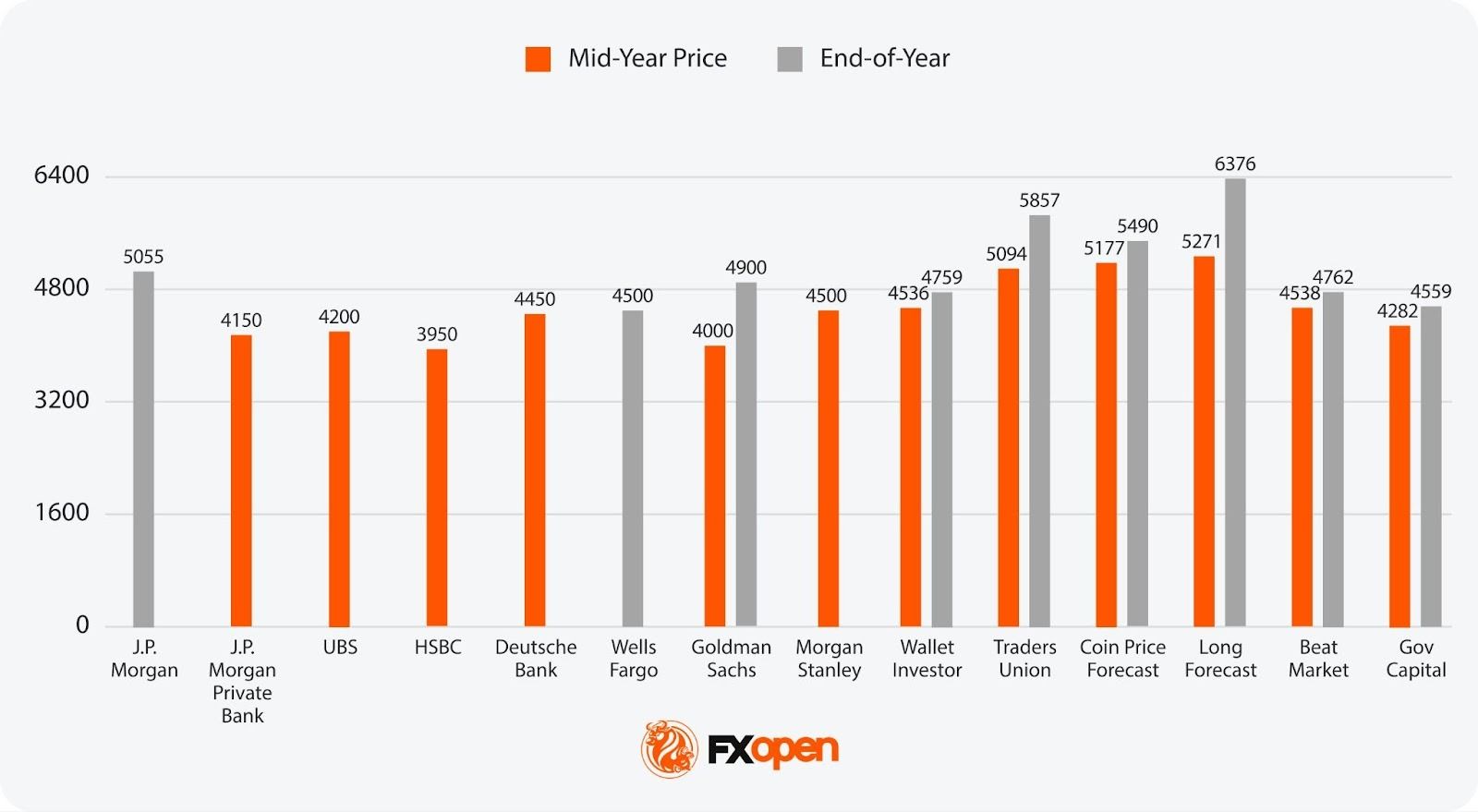
Predictions range from around $3,950 to $6,376, suggesting a broad possible outcome. The midpoint sits near the $4,500 level, with sentiment driven by interest rate cuts, slowing growth, and ongoing de-dollarisation.
2027
Outlooks extend between $4,579 and roughly $7,819. Many forecasters see gold pushing meaningfully higher as structural demand from institutions and emerging markets remains strong while supply growth stays limited.
2028
Estimates fall between $5,133 and $8,619. The gap reflects uncertainty around inflation persistence and global financial stability. Long-term projections lean bullish as miners struggle to increase production.
2029
Most projections fall between $5,710 and $8,504. Sources note that if geopolitical fragmentation or currency debasement accelerates, gold could outperform these expectations.
2030
Long-range forecasts suggest $5,900 to over $9,300, indicating a continued upward structural trend. Much of this depends on whether monetary policy remains loose and global reserve diversification continues.
Gold Price History
Gold has been a cornerstone of economic systems and wealth preservation for millennia. Revered for its scarcity and intrinsic value, the precious metal has been used as a form of currency, a symbol of wealth, and a reserve asset across different civilisations. Its unique qualities, such as durability and resistance to corrosion, have made it a preferred choice for monetary systems until the modern era introduced fiat currencies.
In the 20th century, gold retained its prominence through the establishment of the gold standard, where currencies were directly linked to gold reserves. Although this system was eventually abandoned, gold has continued to play a significant role as a store of value and a hedge against economic uncertainties, maintaining its relevance in global markets.
The journey of gold’s value over time is marked by significant fluctuations influenced by economic policies, global crises, and shifts in demand. Traders can observe how these various factors influenced the spot gold price (XAU/USD) CFDs on FXOpen’s TickTrader platform.
Post Bretton Woods and 1970s Inflation
The collapse of the Bretton Woods system in 1971 initiated a free float of currency values against gold, leading to a decade of volatility. The 1970s experienced a dramatic increase in the price of gold, fueled by inflation, geopolitical tensions, and energy crises, peaking at around $843 in 1980.
1990s Stabilisation and a Dip
The 1990s saw gold stabilising, then dipping to a low of approximately $253 per ounce in 1999 amidst a robust US economy and strong US dollar, diminishing gold’s attractiveness as an alternative investment. However, in the second half of 1999, the gold price recovered and fluctuated between $275 and $325 in late 1999 and early 2000.
2000s to Great Recession (2008-2010)
The early 2000s witnessed a gradual rise in prices, surging sharply during the Great Recession of 2008. Its appeal as a so-called safe-haven investment drove it from about $730 in October 2008 to ~$1,300 by October 2010.
European Debt Crisis (2010-2012)
Gold soared to new heights, reaching around $1,825 in August 2011, as concerns over the eurozone’s stability and global economic health spurred investor demand for the precious metal.
Post-2013 Economic Recovery
The period following 2013 saw gold decline by 29%, from around $1,695 in January 2013 to around $1,200 in December 2014, influenced by the Federal Reserve’s tapering of quantitative easing and a strengthening US dollar.
COVID-19 Pandemic (2020-2023)
The most notable event in the gold price over the last 5 years was the unprecedented global disruption caused by the COVID-19 pandemic. The pandemic led to a significant rise in the price of gold, which soared 27% from around $1,500 in January 2020 to over $2,000 by the summer of 2020. Prices consolidated between $1,700 and $1,900 before reaching new highs above $2,000 in late 2023.
Strong Performance 2024-2025 and Early 2026
Gold experienced a remarkable surge in 2024, driven by a combination of geopolitical tensions, economic uncertainty surrounding the US presidential election, and strong demand from emerging market central banks. By mid-December 2024, gold prices had climbed more than 30%.
Gold hit fresh records in early 2025 as markets reacted to escalating tariff announcements and renewed instability in Ukraine and the Middle East. March marked a turning point, with gold breaking above $3,000 for the first time after a series of selloffs in equities and bonds. So-called safe-haven positioning accelerated through April, and gold briefly touched $3,500 following an aggressive US trade action that triggered further volatility.
While the price ranged between April and September, momentum returned as the Federal Reserve signalled its first rate cut of the cycle, weakening the dollar and boosting gold demand from global investors as yields fell. By mid-October, gold peaked at $4,381, before surging to $4,550 by year-end.
The metal delivered one of its strongest annual performances on record, gaining roughly 65% amid dovish monetary policy expectations, heightened geopolitical tensions, and sustained central bank buying.
By 21 January 2026, XAU/USD had climbed further to $4,888, driven by escalating geopolitical risks, including US military action against Venezuela, unrest in Iran with the prospect of US involvement, and renewed rhetoric from Donald Trump regarding the takeover of Greenland.
Let’s now examine the factors that could influence gold prices in 2026 and the years ahead.
Analytical Gold Price Forecasts for 2026-2030
Is gold going up or down between 2026 and 2030? In this section, we’ll examine gold price predictions for the next 5 years from various algorithm-driven analytical resources.
The period from 2026 to 2030 is poised to be transformative for gold markets, influenced by a confluence of factors that could significantly impact gold prices. They collectively reflect a supportive environment for gold, potentially leading to elevated prices as the decade progresses.
Central Bank Diversification Away from the US Dollar
Central banks continued to play a major role in supporting gold demand through 2025, with reserve managers increasingly positioning gold as an alternative to the US dollar. Official sector buying exceeded 1,000 tonnes for the third year in a row in 2024, led by emerging markets such as China, Turkey, India, and Poland. Many of the institutions cited geopolitical risk, sanctions exposure, and concerns about US fiscal sustainability as major reasons for diversifying.
Surveys from the World Gold Council show this behaviour isn’t a short-term trend. By mid-2025, more than 70% of central bank respondents expected the share of gold in global reserves to continue rising over the next five years, while a similar proportion anticipated a gradual decline in the dollar’s dominance. Some reserve managers also highlighted the appeal of owning an asset with no counterparty risk, particularly as global debt levels increased and geopolitical blocs became more defined.
This shift contributes to the creation of a structural floor under gold prices in 2026 and beyond. With few signs of reversal, continued official-sector buying remains a supportive factor for analytical gold price forecasts in 2026 to 2030, especially if geopolitical fragmentation deepens and confidence in traditional reserve currencies weakens further.
Dollar Devaluation
The weakening of the US dollar’s purchasing power has become an increasingly influential factor in gold demand. While headline inflation cooled from its post-pandemic peak, the cumulative effect has been significant. Between 2021 and 2025, the dollar lost roughly 15–20% of its real spending value, depending on the inflation measure tracked. Everyday benchmarks such as housing, energy, and food costs rose sharply, highlighting the dollar’s deterioration as a store of value.
This erosion was echoed in gold-relative terms. In 2022, one ounce of gold cost around $1,700; by late 2025, it traded above $4,000. Put differently, the dollar now buys less than half the gold it did three years earlier. That decline reflects not only inflation but also reduced confidence in long-term dollar strength as government debt surpassed $38 trillion (Trading Economics) and global demand for US Treasury assets softened.
As purchasing power weakens, investors increasingly view gold as a more durable alternative to holding cash.
Geopolitical Tensions
Persistent geopolitical tensions are expected to sustain gold’s appeal as a so-called safe-haven asset. Conflicts such as those in Ukraine and the Middle East have already driven investors toward gold. The question of Greenland became one of the most critical geopolitical issues in early 2026. Additionally, potential new flashpoints, like heightened tensions between China and Taiwan, could further escalate global instability.
Analysts note that during periods of significant geopolitical upheaval, gold demand tends to rise as investors seek protection against economic and financial fallout. This pattern is expected to continue through 2030, supporting higher gold prices.
Monetary Policy and Interest Rates
Monetary policy remains one of the most important forward-looking drivers for gold. After an extended tightening cycle, major central banks, including the Federal Reserve and the ECB, entered 2025 signalling a transition toward easing. Markets now expect rate cuts to continue into 2026 as growth slows and labour market data softens. This shift matters for analytical gold price predictions in 2026 and beyond because lower interest rates reduce the relative appeal of yield-bearing assets, encouraging capital to move into non-yielding stores of value.
Real rates will be especially important. If inflation proves sticky while nominal rates fall, real yields could turn negative again, historically a strong tailwind for gold accumulation. Investors are already positioning for this scenario, particularly as government borrowing remains elevated and fiscal policy stays expansionary.
If the easing cycle accelerates or recession risks rise, gold demand may strengthen further. Conversely, a pause or reversal in rate cuts could temper upside momentum but is not currently the base case.
Economic Indicators
Economic indicators such as inflation, currency fluctuations, and global economic growth significantly influence gold prices. A potential slowdown in the US economy, coupled with a weaker dollar, may bolster gold prices. As the dollar depreciates, gold becomes more affordable for holders of other currencies, increasing its demand.
Additionally, high global debt levels and potential devaluation of currencies like the US dollar are prompting a shift to gold. These economic factors are expected to play a pivotal role in shaping gold prices through 2030.
Supply Constraints
Global mine supply is modest but demand is high. High operating costs continue to pressure producers, with average All-In Sustaining Costs climbing above $1,500 per ounce in 2025 due to fuel, labour, and equipment inflation.
New large discoveries are rare, and most new output comes from expansions of existing sites rather than fresh deposits. Several projects in West Africa and Latin America also faced delays linked to permitting, power shortages, and security risks.
With limited new supply and declining ore grades, analysts expect output growth to flatten and potentially contract late in the decade.
Gold Price Predictions for 2026
As we move into 2026, the expectations show a continuation of the upward trend, albeit with differences in the extent of growth anticipated by various sources.
- Most Optimistic Projection for Mid-Year 2026: 5,271 (Long Forecast)
- Most Pessimistic Projection for Mid-Year 2026: 3,950 (HSBC)
- Most Optimistic Projection for End-of-Year 2026: 6,376 (Long Forecast)
- Most Pessimistic Projection for End-of-Year 2026: 4,500 (Wells Fargo)
J.P. Morgan Private Bank forecasts gold at $4,050–4,150 by mid-2026, supported by the Federal Reserve’s looser policy. At the same time, J.P. Morgan projects that the metal could average $5,055 per ounce by Q4 2026, citing robust investor interest and steady central bank purchases, which could reach about 566 tons per quarter. “Gold remains our highest conviction long for the year, and we see further upside as the market enters a Fed rate-cutting cycle,” stated Natasha Kaneva, Head of Global Commodities Strategy at J.P. Morgan.
Goldman Sachs projects gold to reach about $4,000 per ounce by mid-2026 and $4,900 by year-end, driven primarily by strong central bank demand and a more dovish Fed. Continued central bank buying will be the main driver of the uptrend. Daan Struyven, head of oil research at Goldman Sachs, stated, “We look for nearly 20% of additional price upside by the end of 2026, with our forecast at $4,900 per troy ounce by the end of ’26.” He noted that higher central bank purchases and the dovish Fed’s monetary policy will contribute to the rise.
Morgan Stanley offers the most bullish mid-year prediction from any bank here, forecasting that gold could reach around $4,500 per ounce by mid-2026, supported by strong demand from ETFs and ongoing central bank accumulation as uncertainty persists. While the outlook remains broadly positive, Morgan Stanley cautions that volatility, shifting investor allocation, or reduced central bank buying could limit upside.
Gold Price Predictions for 2027
The projections for 2027 illustrate a continued rising trend, with certain forecasters predicting substantial gains.
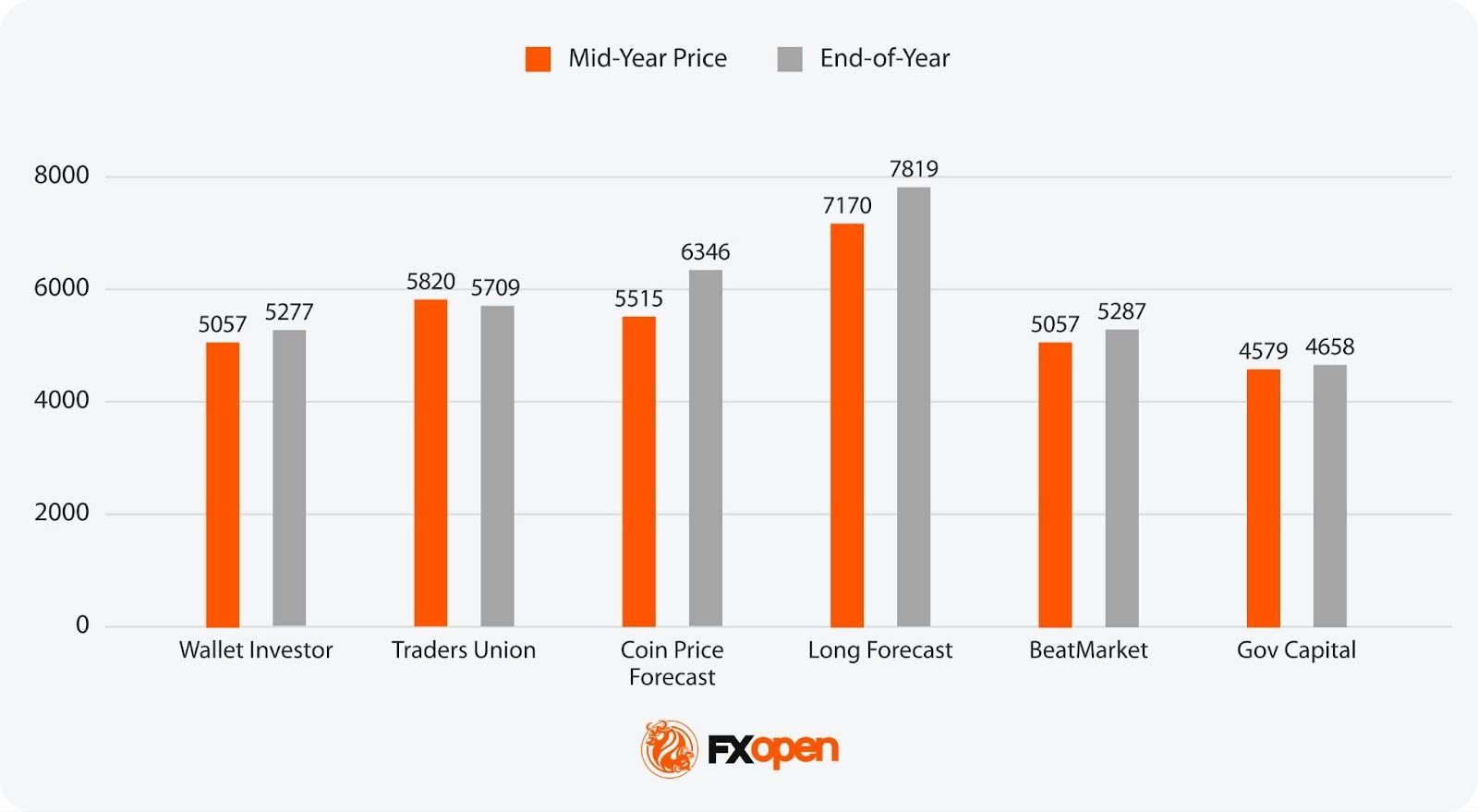
- Most Optimistic Projection for Mid-Year 2027: 7,170 (Long Forecast)
- Most Pessimistic Projection for Mid-Year 2027: 4,579 (Gov Capital)
- Most Optimistic Projection for End-of-Year 2027: 7,819 (Long Forecast)
- Most Pessimistic Projection for End-of-Year 2027: 4,658 (Gov Capital)
Gold Price Predictions for 2028
Looking towards 2028, the range of predictions indicates both caution and enthusiasm about gold’s value in the market.
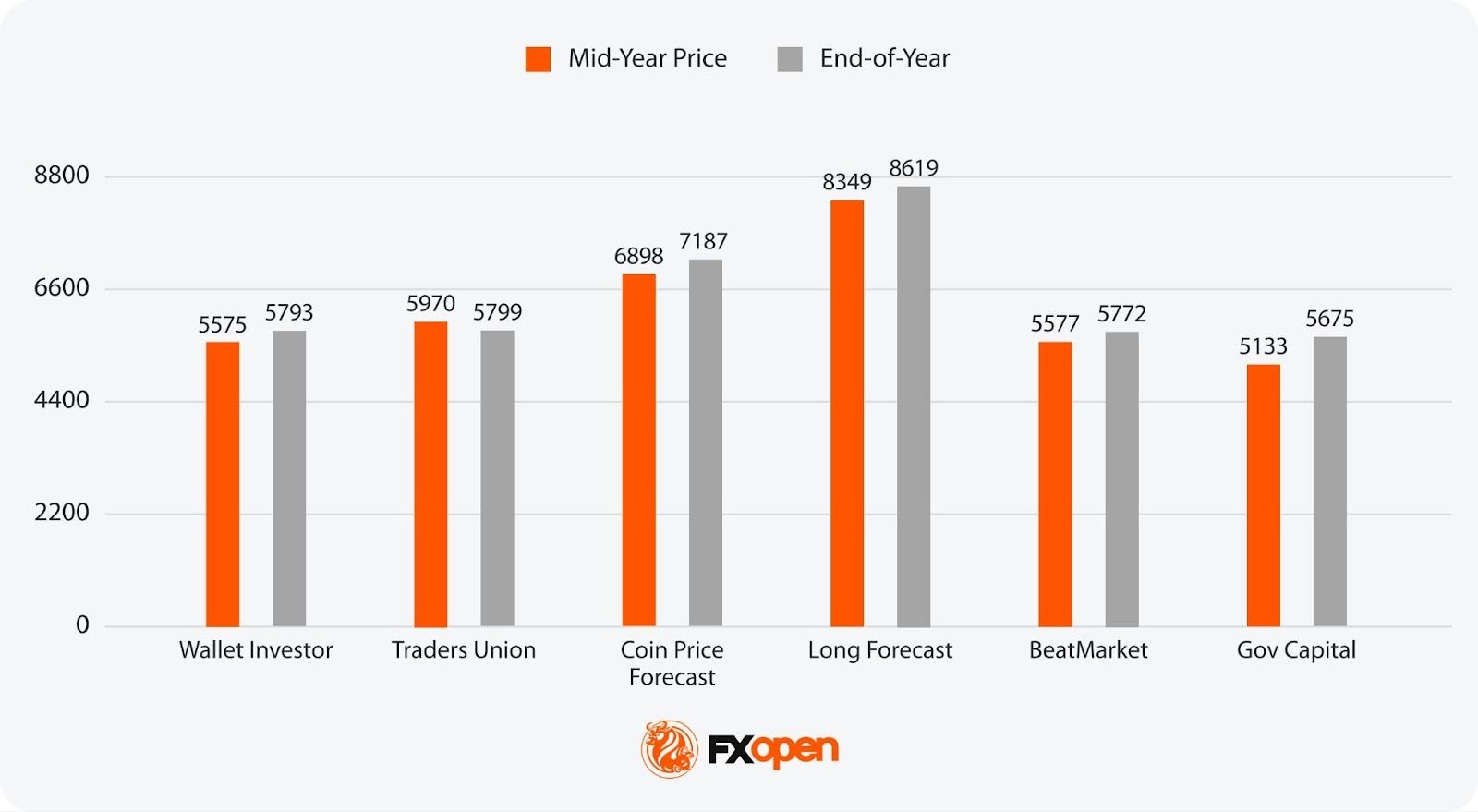
- Most Optimistic Projection for Mid-Year 2028: 8,349 (Long Forecast)
- Most Pessimistic Projection for Mid-Year 2028: 5,133 (Gov Capital)
- Most Optimistic Projection for End-of-Year 2028: 8,619 (Long Forecast)
- Most Pessimistic Projection for End-of-Year 2028: 5,675 (Gov Capital)
Gold Price Predictions for 2029
As we approach the end of the decade, forecasters remain optimistic about the yellow metal’s enduring value.
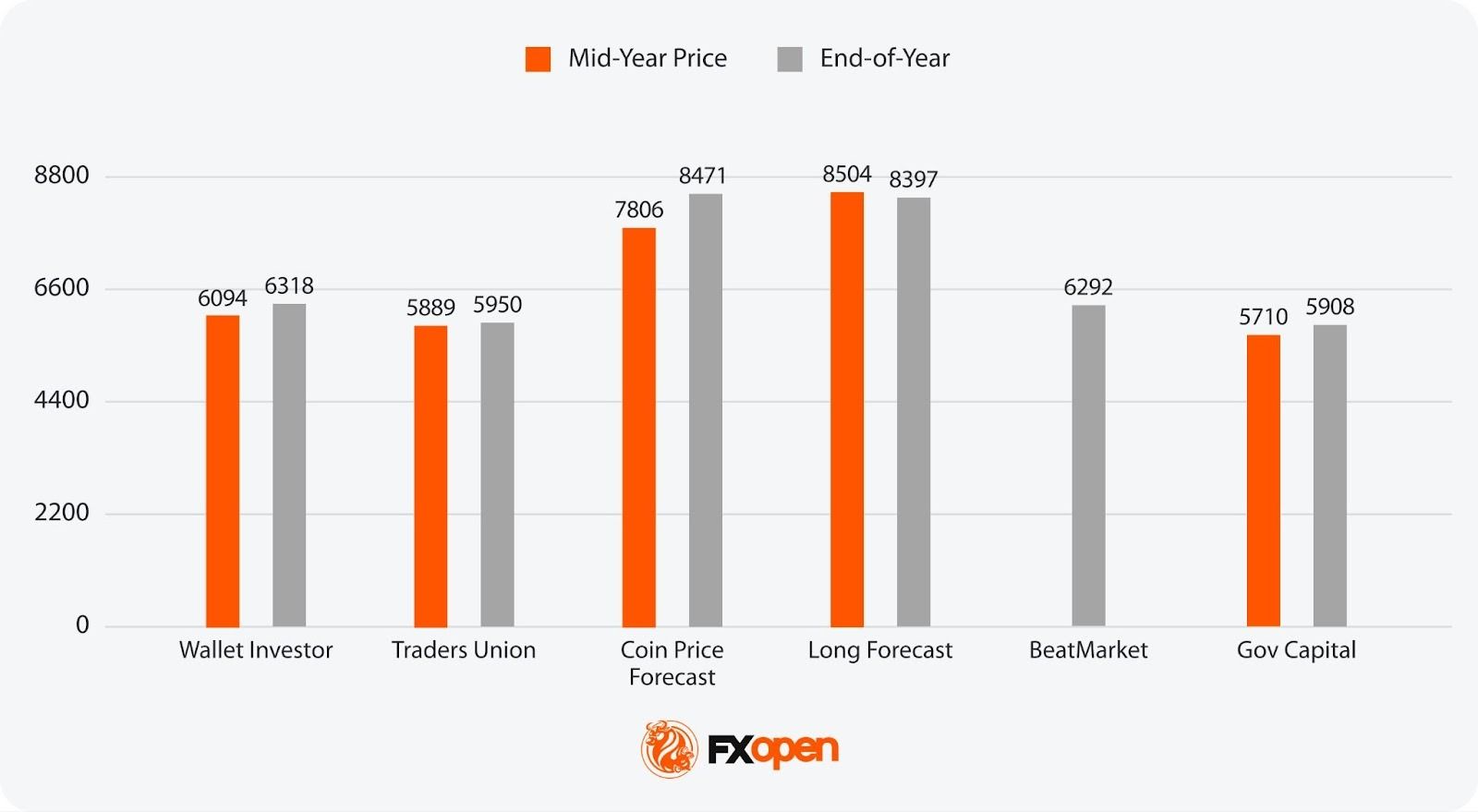
- Most Optimistic Projection for Mid-Year 2029: 8,504 (Long Forecast)
- Most Pessimistic Projection for Mid-Year 2029: 5,710 (Gov Capital)
- Most Optimistic Projection for End-of-Year 2029: 8,471 (Coin Price Forecast)
- Most Pessimistic Projection for End-of-Year 2029: 5,908 (Gov Capital)
Gold Price Predictions for 2030
Gold projections remain strongly bullish for the end of the decade, with only one source expecting a price below $6,000 by the end of the decade.
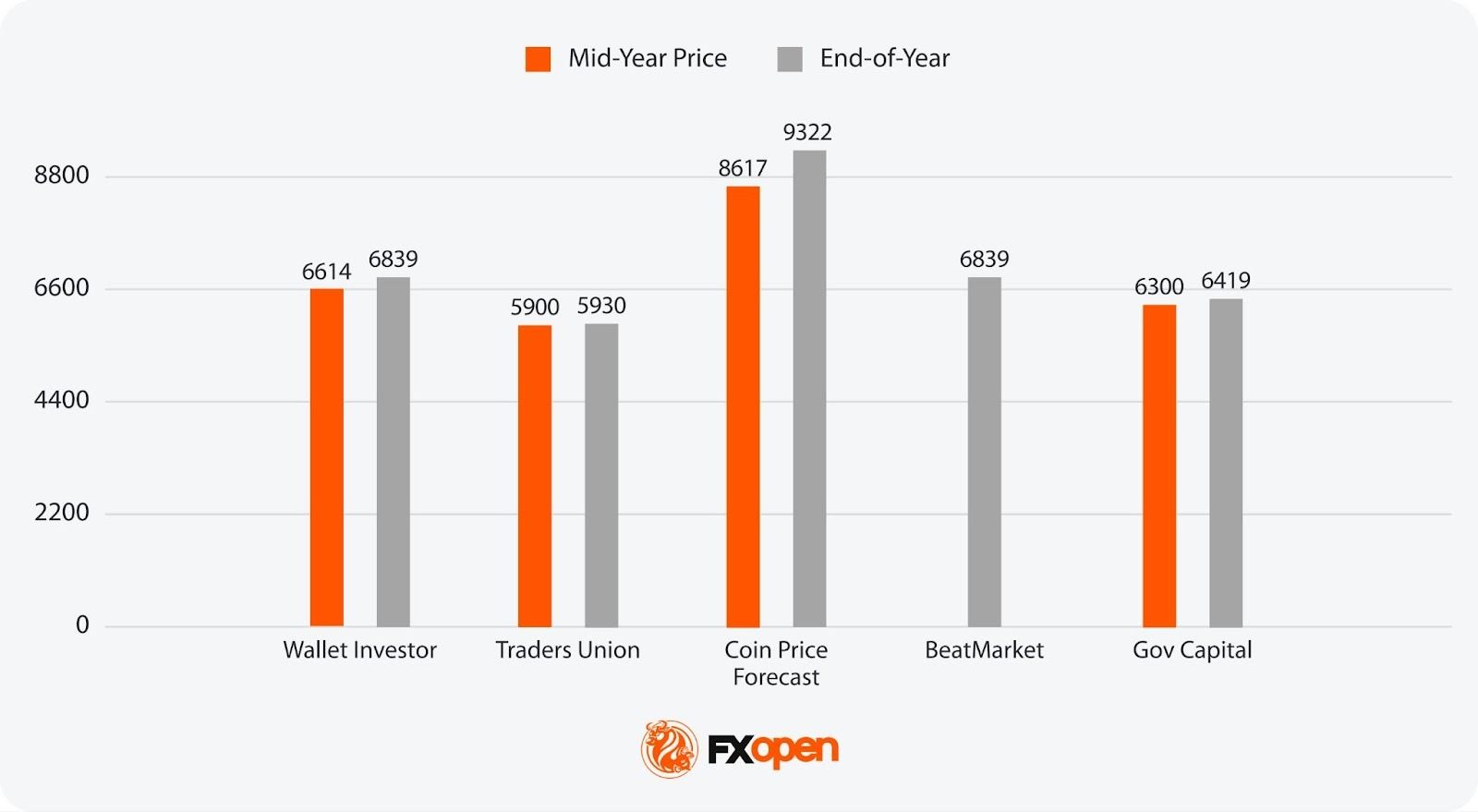
- Most Optimistic Projection for Mid-Year 2030: 8,617 (Coin Price Forecast)
- Most Pessimistic Projection for Mid-Year 2030: 5,900 (Traders Union)
- Most Optimistic Projection for End-of-Year 2030: 9,322 (Coin Price Forecast)
- Most Pessimistic Projection for End-of-Year 2030: 5,930 (Traders Union)
Factors That May Affect the Gold Price Over 10 Years
As we look towards gold prices 10 years from now, several macroeconomic factors could shape the gold projections over the next 10 years.
- Inflation: While many assume a direct correlation between inflation and gold, the relationship is complex and not as straightforward. Inflation can impact the metal, but other factors often mitigate its effects.
- Currency Fluctuations: Gold and the US dollar share an inverse relationship. As the dollar weakens, gold often rises, becoming more attractive to investors holding other currencies.
- Geopolitical Tensions: Conflicts and political instability historically drive investors towards gold as a so-called safe haven, potentially boosting its price during periods of heightened uncertainty.
- Interest Rates: Gold’s appeal can diminish with the expectation of rising interest rates, as higher yields on bonds and savings accounts compete with the non-yielding metal.
- Supply and Demand: The actions of large market players, including central banks and investment funds, significantly impact demand. Additionally, economic growth in countries like China and India may bolster demand for gold as an investment and reserve asset.
Advantages and Risks for Traders
Although analytical projections are optimistic, traders and investors should be cautious as the gold price movements are shaped by geopolitical, economic, and supply dynamics.
Advantages
- Safe-Haven Demand: Ongoing geopolitical risk remains one of the key drivers, with conflicts in Eastern Europe and the Middle East, plus rising US–China strategic tension, keeping demand elevated as investors seek protection during periods of market stress.
- Diversification: Central banks’ shift away from the US dollar suggests continued demand for gold, providing portfolio diversification in volatile currency markets.
- Inflation Hedge: With global debt levels climbing, gold’s historical role as a so-called safeguard against inflation remains relevant.
Risks
- Volatile Demand: Declining consumer demand in major markets like India and China due to economic shifts could impact gold prices.
- Regulatory Risks: Changes in taxation or import restrictions on gold in major markets could affect investment flows.
- Economic Recovery: A stronger-than-anticipated recovery in global economies or currencies, particularly the US dollar, may dampen gold demand.
The Bottom Line
Gold remains a vital asset in the global financial landscape, often viewed as a potential hedge against inflation, currency fluctuations, and economic uncertainty. Based on the analytical predictions for 2026-2030, evolving geopolitical events, central bank policies, and demand from investors will be the key factors, determining the gold market direction.
If you are looking to trade gold via CFDs, you can consider opening an FXOpen account and gain access to tight spreads and low commissions.
FAQ
What Will the Price of Gold Be in 2026?
Gold price future predictions vary, with estimates ranging from roughly $3,950 to above $6,000 depending on economic conditions, interest rates, and global stability. Many analysts view a price near $4,500 as a reasonable midpoint based on current momentum.
Will the Gold Price Go Down in 2026?
Short-term pullbacks are possible, especially if risk sentiment improves or monetary easing slows. However, most analytical outlooks still lean bullish, with geopolitical tension, high debt levels, and currency weakness providing support rather than downside pressure.
Will Gold Go Up in 2026?
Many analysts expect further upside if central banks continue cutting rates and inflation remains above target. Ongoing reserve diversification, a softer dollar, and continued geopolitical risk may extend gold’s multi-year upward trend.
What Drives the Price of Gold?
Major drivers include currency movements, real interest rates, inflation expectations, supply limitations, and investor sentiment. Central bank buying and geopolitical stress also play a significant role in shaping demand and long-term price direction.
This article represents the opinion of the Companies operating under the FXOpen brand only. It is not to be construed as an offer, solicitation, or recommendation with respect to products and services provided by the Companies operating under the FXOpen brand, nor is it to be considered financial advice.



The CLARITY Act has stalled ahead of a Sept. 15 procedural vote requiring 60 senators, as Senate Banking Committee Chairman Tim Scott accused Elizabeth Warren’s team of trying to drive crypto activity from the United States.
Summary
- The Senate will hold a Sept. 15 cloture vote on whether to begin considering H.R. 3633.
- Scott accused Warren’s team of repeatedly changing its demands during negotiations.
- Republicans need Democratic support because advancing the bill requires at least 60 Senate votes.
- Ethics rules, stablecoin rewards and financial-crime provisions remain unresolved.
SALT Conference footage from the Wyoming Blockchain Symposium showed Scott blaming Warren and her allies for holding up the Digital Asset Market Clarity Act during his Aug. 18 appearance.
“Elizabeth Warren’s team wants to run Bitcoin and crypto out of the country,” Scott said.
Addressing the remaining negotiations, the South Carolina Republican also accused Democrats of repeatedly moving the “goalposts” for political reasons. Scott argued that the bill would not advance unless Republican lawmakers applied direct pressure and forced a Senate vote.
His remarks place Warren, the Banking Committee’s ranking Democrat, at the center of the dispute over the most extensive digital asset market structure proposal considered by Congress. Warren and other Democrats have sought stronger investor safeguards, financial-crime controls and restrictions covering crypto businesses tied to elected officials.
Scott’s criticism came one day before Democratic Sen. Ruben Gallego warned that taking the bill to the floor too quickly could damage bipartisan negotiations. Gallego, one of two Democrats who supported the Banking Committee’s version, said lawmakers still needed to resolve several parts of the proposal before a vote.
CLARITY Act faces a 60-vote Senate test
Senate Majority Leader John Thune filed cloture on the motion to proceed to H.R. 3633 before the Senate began its August recess, according to the Senate Daily Press.
The cloture motion will ripen at 2:15 p.m. on Sept. 15, one day after senators return to regular business. Approval would allow the chamber to begin formally considering the legislation, but it would not constitute final passage.
Senators could still debate the proposal, offer amendments, and vote on the resulting text. Any Senate version that differs from the measure approved by the House would also require further action from the lower chamber before reaching President Donald Trump.
Supporters need at least 60 votes to overcome the Senate’s cloture threshold. Republicans cannot reach that number alone, leaving Scott dependent on Democrats and independents even as he criticizes Warren’s role in the negotiations.
The House passed its version in July 2025 by 294 votes to 134, with 78 Democrats joining Republicans. In May, the Senate Banking Committee advanced its section of the legislation by 15 votes to nine.
Democratic Sens. Gallego and Angela Alsobrooks supported the committee measure. Their votes gave Scott a bipartisan result but fell well short of the Democratic support needed on the Senate floor.
The Sept. 15 proceeding would therefore measure whether negotiators have secured enough support to open debate. As crypto.news previously reported, Solana Policy Institute CEO Miller Whitehouse-Levine placed the bill’s chance of passing before the November midterms at 10%, while prediction markets remained somewhat more optimistic.
Polymarket traders assigned about a 20% probability to the bill becoming law during 2026 as of Aug. 19. Whitehouse-Levine’s estimate covered passage before the midterms, while the Polymarket contract allows lawmakers until Dec. 31.
What the CLARITY Act would change
H.R. 3633 would divide authority over digital assets between the Securities and Exchange Commission and the Commodity Futures Trading Commission.
Under the proposal, the CFTC would receive primary authority over spot markets for qualifying digital commodities. The SEC would continue regulating securities and certain investment contracts, while both agencies would receive responsibilities tied to registration, disclosure, and market conduct.
Crypto exchanges, brokers, and dealers covered by the legislation would have to register under new federal rules. The bill also contains provisions addressing customer asset protection, anti-money laundering requirements, and disclosures for digital asset businesses.
Developers of certain non-custodial software could receive protection from being treated as money transmitters solely because they publish or maintain software. Law enforcement groups previously objected to parts of the language, arguing that it could limit investigations involving decentralized finance.
Several organizations later changed their positions after lawmakers revised the relevant provisions. The National Fraternal Order of Police, which represents more than 382,000 members, endorsed the updated language in July after concluding that it preserved authorities used in digital asset investigations.
A separate coalition of police chiefs also backed the revised proposal, while other prosecutors and enforcement organizations continued seeking changes. The disagreement has made the developer provisions one of several issues that senators must manage before securing enough floor votes.
Lawmakers released a 616-page merged draft in late July, combining work completed by the Banking and Agriculture committees. Each committee oversees different parts of the proposed regulatory structure because the SEC falls under Banking jurisdiction and the CFTC falls under Agriculture jurisdiction.
Ethics and stablecoin rewards divide negotiators
Restrictions involving elected officials and their crypto interests remain among the hardest issues for senators to settle.
Democrats have sought rules addressing digital asset ventures connected to the president, senior officials, and their families. Their concerns include Trump-linked crypto businesses and whether a sitting president should be allowed to issue, promote, or profit from digital assets while influencing federal policy.
Republican Sen. Thom Tillis has worked on a bipartisan ethics proposal intended to address some of the objections. Industry executives have also pointed to negotiations with the White House as a possible route to an agreement, but lawmakers had not released a final compromise as of Aug. 20.
Stablecoin rewards have created another divide. Banks have pushed for restrictions preventing crypto platforms from paying yield or rewards on payment stablecoins, warning that such products could draw deposits away from regulated financial institutions.
Crypto companies argue that a sweeping restriction could limit competition and extend beyond the rules Congress adopted for stablecoin issuers. Negotiators have not publicly confirmed final language that satisfies both groups.
Financial-crime controls and the treatment of decentralized protocols also remain under discussion. Warren and aligned Democrats have pressed for stronger measures covering illicit finance and national security, while crypto advocates have warned against applying obligations designed for financial intermediaries to software developers who do not control customer funds.
A July report on the Senate’s delayed vote found that disputes over ethics, DeFi protections and stablecoin rewards persisted even after major law enforcement groups supported revised provisions.
Scott’s criticism meets Democratic resistance
Scott presented the dispute in Wyoming as a choice between passing federal rules and allowing crypto businesses to leave the country. His accusation against Warren’s team went further than earlier Republican appeals for bipartisan cooperation.
Warren has argued that digital asset legislation must contain sufficient consumer protections and prevent public officials from using their positions for personal financial gain. Democrats aligned with her have also questioned whether the current enforcement provisions would adequately cover money laundering and national security risks.
Not every Democrat opposing an immediate vote has rejected market structure legislation. Gallego said on Aug. 19 that rushing the process could weaken the chance of reaching a bipartisan deal, according to a recent report.
Gallego also said the White House had not supplied detailed feedback on bipartisan ethics language sent by Senate negotiators. Along with the ethics dispute, he identified stablecoin rewards and unresolved Agriculture Committee provisions as matters requiring further work before the legislation advances.

A Wall Street analyst initiated coverage of SiTime (SITM) stock with a buy rating, calling the timing-chip specialist a “technology disruptor.” Benchmark analyst Gary Mobley gave SiTime stock a positive report Thursday and set a price target of 850. In late morning trades on the stock market today, SiTime stock slid more than 3% to 598.29. Semiconductor stocks in general…
Copyright ©2026 Investor’s Business Daily, LLC. All rights reserved. 87990cbe856818d5eddac44c7b1cdeb8

Since bottoming out in April 2025, Relay Therapeutics (RLAY) shares have skyrocketed by as much as 1,074%. Now the biotech firm has a fresh breakout in its sights. With its 10-week moving average continuing its long ascent, the Cambridge, Mass.-based company earns a coveted blue dot in MarketSurge, a clear indication of stock market leadership. Biotech Taps AI And Machine…
Copyright ©2026 Investor’s Business Daily, LLC. All rights reserved. 87990cbe856818d5eddac44c7b1cdeb8


Cointelegraph is committed to providing independent, high-quality journalism across the crypto, blockchain, AI, and fintech industries.
All news, reviews, and analyses are produced with full journalistic independence and integrity. For more details on our standards and processes, please read our Editorial Policy.
The Commodity Futures Trading Commission has prepared digital asset market structure proposals that could move forward even if Congress does not pass the CLARITY Act.
Summary
- CFTC Chair Michael Selig said crypto market structure would proceed regardless of the bill’s outcome.
- The CLARITY Act faces a Senate procedural vote on Sept. 15 and needs 60 votes to advance.
- CFTC advisers are discussing digital assets, artificial intelligence and prediction markets on Aug. 20.
- The agency has separately requested public input on derivatives tied to artificial intelligence computing capacity.
Whale Insider reported on Aug. 20 that Selig said the CFTC already had regulatory proposals prepared, giving the agency a route to continue its crypto agenda if lawmakers fail to complete the legislation.
“Crypto will get market structure regardless of bill,” Selig said, according to the report.
Selig’s statement did not identify which proposals the agency has finished drafting, when it could publish them, or how much of the planned framework could be created under the CFTC’s current legal powers. Congress would still need to act before the regulator could receive the full spot-market authority contemplated by the CLARITY Act.
CFTC crypto rules could proceed under existing powers
The CFTC currently oversees derivatives markets, including futures, options, and swaps tied to digital assets. Its enforcement authority also covers fraud and manipulation in spot commodity transactions, but the agency does not have the same routine supervisory power over crypto spot exchanges that it exercises over registered derivatives platforms.
Without legislation, any CFTC proposals would have to remain within the authority already provided by the Commodity Exchange Act. Rules covering registered derivatives venues, intermediaries, disclosure requirements, or crypto futures could therefore move independently, while a complete federal framework for spot digital commodity trading would require action from Congress.
For U.S. investors, the distinction affects which regulator supervises the platforms where they trade. The CLARITY Act would create a registration framework for certain digital commodity exchanges and divide responsibility for digital assets between the CFTC and the Securities and Exchange Commission.
The bill would generally place qualifying digital commodities under CFTC oversight while preserving the SEC’s authority over crypto assets treated as securities. Lawmakers have continued negotiating the treatment of decentralized finance, ethics restrictions, and rewards offered on stablecoin balances.
As previously reported, an expansion of the CFTC’s duties would also raise questions about staffing and resources. The commission is designed to have five members but currently has one confirmed commissioner, Selig, while its workforce has fallen from its fiscal 2025 level.
Staffing constraints would become more important if the agency had to supervise spot crypto trading alongside its existing work in derivatives, prediction markets, and enforcement. The CLARITY Act could assign the CFTC primary oversight of a large part of the U.S. digital asset market, requiring the regulator to review registrations and monitor companies that are not presently under its routine supervision.
CLARITY Act faces a 60-vote Senate test
Senate Majority Leader John Thune filed cloture on the motion to proceed to the CLARITY Act before lawmakers left Washington for their August recess. Under the Senate schedule, the procedural vote is set to ripen on Sept. 15 after senators return.
Cloture requires 60 votes, meaning Republican support alone may not be enough to move the bill forward. Even if the Senate invokes cloture, the vote would only allow the chamber to begin considering the measure. Senators could still debate or amend the text before voting on final passage.
The House approved its version of the CLARITY Act in July 2025, while the Senate Banking Committee advanced its text in May 2026. Any Senate version that differs from the House bill would require additional congressional action before the legislation could reach the president.
Negotiations have remained difficult as lawmakers debate ethics requirements for public officials and restrictions involving stablecoin rewards. The bill’s chances of passage have also weakened in prediction markets, with Polymarket pricing its probability of becoming law in 2026 below 20% by mid-August after showing odds of 82% in February.
President Donald Trump urged lawmakers during an Aug. 19 White House event to pass what he called a “fair version” of the legislation. Trump described the proposal as bipartisan and said federal law was needed to preserve the administration’s digital asset policies beyond his presidency.
Representatives from Coinbase, Gemini, Ripple, Kraken, Chainlink Labs, Anchorage Digital, Grayscale and OKX attended the event, along with executives from prediction-market and artificial intelligence companies. The White House meeting took place one day before the CFTC’s first Innovation Advisory Committee session.
CFTC committee is examining unresolved crypto questions
The CFTC scheduled the inaugural Innovation Advisory Committee meeting for Aug. 20 from 1 p.m. to 4 p.m. EDT in Washington. Its agenda covers digital assets, artificial intelligence in financial markets, and prediction markets.
During the crypto session, committee members are expected to examine customer protection, market integrity and the CFTC’s ability to use its present statutory authority. The discussion also covers how agency action could complement legislation passed by Congress rather than replace the additional powers contained in the CLARITY Act.
Committee members include executives and specialists from crypto companies, traditional financial institutions, market infrastructure providers, and technology businesses. The advisory body can make recommendations but cannot adopt binding regulations or expand the CFTC’s legal jurisdiction.
Members of the public can submit written statements related to the meeting through Aug. 27. The commission will publish accepted materials as part of the committee record, although the meeting itself does not include a vote on a crypto market structure proposal.
At the same time, the SEC has been developing separate rules for crypto offerings and tokenized securities. Securitize President Brett Redfearn said the securities regulator pulled back a planned innovation exemption because of concerns surrounding the Sept. 15 CLARITY Act vote.
Redfearn expects the innovation exemption to return after the Senate vote, possibly in early October. The proposal would provide a tailored regulatory route for companies seeking to issue and trade tokenized securities while keeping the products within the SEC’s jurisdiction.
The SEC also canceled an Aug. 14 open meeting at which commissioners had been scheduled to consider a separate offering framework for certain investment contracts involving crypto assets. The agency cited an unforeseen scheduling issue and did not publicly connect the cancellation to the CLARITY Act.
CFTC seeks rules for artificial intelligence compute markets
Outside digital assets, the CFTC requested public comments on Aug. 19 about derivatives linked to artificial intelligence computing capacity. The 19-page consultation covers liquidity, reference prices, manipulation risks, customer safeguards, and the possible listing of perpetual compute futures.
“America cannot win the AI race without a robust derivatives market for compute,” Selig said in the agency’s announcement. He described the consultation as the first step toward setting rules for U.S. compute markets.
A compute contract could track the cost of renting a particular graphics processor, such as Nvidia’s H100 or Blackwell B200, or reference access to a specified amount of AI inference capacity. The request does not approve any contract, create a final rule, or authorize an exchange to start trading the products.
Public comments will remain open for 60 days after the consultation appears in the Federal Register. As of Aug. 20, the document had not been published in the register, leaving the final submission deadline unset.
CME Group has targeted Oct. 5 for two futures contracts based on daily GPU rental benchmarks supplied by Silicon Data. Both planned products remain subject to regulatory review, and the proposed launch date does not guarantee that the CFTC’s review will be completed by then.


Wall Street did not wake up one morning and decide it liked Bitcoin. It woke up and realized the custody fees were too large to leave on someone else’s balance sheet.
Summary
- Citigroup announced Custody+ on Aug. 18, folding Bitcoin into the same rails that hold $34.5 trillion in traditional assets, with a live launch expected before year end 2026.
- BNY Mellon, the world’s largest custodian at $59.4 trillion in assets under custody, already holds crypto for ETF issuers and expanded Bitcoin and Ethereum custody to Abu Dhabi in May 2026.
- Coinbase Custody manages $376 billion in institutional crypto assets and serves as custodian for more than 80% of U.S. spot Bitcoin and Ethereum ETFs, making it the single largest target if banks bundle custody with prime brokerage.
- The regulatory runway cleared in 2025 when the SEC rescinded SAB 121 and the OCC confirmed that national banks may custody crypto without prior approval, removing the two largest barriers to bank entry.
- Only roughly 1% of all cryptocurrency by market value carries insurance coverage, creating a protection gap that neither banks nor crypto natives have solved and that could define the next wave of competition.
For most of the past decade, holding digital assets for institutions was a job only crypto-native firms would touch. Coinbase built a custody arm. BitGo pioneered multi-signature wallets for institutional clients. Anchorage Digital became the first federally chartered crypto bank. They earned the business because traditional banks either could not or would not hold the keys.
That era is ending. In the span of 18 months, BNY Mellon, State Street, Standard Chartered, U.S. Bank, and now Citigroup have either launched or committed to launching direct crypto custody services. The question is no longer whether banks will hold Bitcoin. It is what happens to the companies that held it first.
The regulatory gates that opened everything
Two regulatory changes made the bank custody wave possible, and both arrived within weeks of each other. Understanding the sequence matters because it explains why the bank entry wave happened in 2025 and 2026 and not before: the barriers were legal and accounting constraints, not technological ones.
In January 2025, the SEC rescinded Staff Accounting Bulletin 121 through SAB 122, removing the rule that had forced any company holding crypto on behalf of clients to record a corresponding liability on its own balance sheet. SAB 121 had been the single most effective barrier to bank participation in crypto custody since its introduction in March 2022. The math was simple and punishing: a bank holding $10 billion in client Bitcoin had to treat that $10 billion as its own liability, which meant setting aside capital against it. For institutions already managing trillions in traditional custody without any such requirement, the asymmetry made crypto custody economically irrational. No amount of client demand could overcome a rule that turned a fee business into a capital drain.
The OCC followed months later with Interpretive Letters 1183 and 1184, which confirmed that national banks and federal savings associations may custody crypto assets, execute buy and sell orders on behalf of custodial clients, and use sub-custodians for digital asset services. Critically, Letter 1183 also rescinded the requirement for banks to obtain supervisory nonobjection before engaging in crypto custody. Under the prior regime, a bank wanting to hold Bitcoin had to apply to its regulator and wait for written permission, a process that could take months and carried no guaranteed timeline. Removing that requirement turned crypto custody from a special privilege into a standard banking power.
Then came the GENIUS Act, signed into law in July 2025. While written primarily for stablecoins, the Act created new national trust bank charter pathways that Circle, Paxos, BitGo, Fidelity Digital Assets, and Ripple have all used to secure preliminary OCC approval. The OCC conditionally granted national trust bank charters to all five firms by the end of 2025. The legislation codified for the first time that digital asset custody is a permissible banking activity under federal law, not merely an interpretive stretch of existing authority. The Financial Stability Oversight Council simultaneously dropped its classification of crypto as a systemic “vulnerability,” signaling that the broader regulatory posture had shifted from containment to integration.
The combined effect was immediate. Within months of SAB 121’s repeal, BNY Mellon expanded its crypto ETF custody operations. State Street launched its Digital Asset Platform. Morgan Stanley applied for a bank charter specifically to custody crypto. Nomura’s Laser Digital applied for a U.S. national trust bank charter dedicated to crypto custody. Even Charles Schwab began exploring direct crypto services for its advisory clients. The regulatory question shifted from “may banks hold crypto?” to “how quickly can they staff up?”
Who is already live
The landscape of bank crypto custody in mid-2026 is more developed than most market participants realize.
BNY Mellon is the furthest along. The world’s largest custodian, with $59.4 trillion in assets under custody, began holding Bitcoin and Ethereum for ETF issuers in 2022 and has since expanded the service. In May 2026, BNY announced a collaboration with Finstreet Limited and ADI Foundation to offer crypto custody in Abu Dhabi Global Market, marking its first expansion of direct crypto custody outside the United States. BNY serves as custodian for Morgan Stanley’s MSBT Bitcoin ETF and as primary reserve custodian for Ripple’s RLUSD stablecoin.
State Street, the world’s second-largest custody bank at $51.7 trillion in assets under custody, launched its Digital Asset Platform in January 2026 in partnership with Taurus, a Swiss digital asset infrastructure provider. The platform supports wallet management, custody, and settlement for tokenized money market funds, ETFs, tokenized deposits, and stablecoins across both public and permissioned blockchains.
Standard Chartered took a different path. Rather than building from scratch, the bank is absorbing Zodia Custody, the subsidiary it co-founded with Northern Trust in 2020. The acquisition, expected to close by end of August 2026, merges Zodia’s seven global offices and custody support for more than 75 cryptocurrencies into Standard Chartered’s corporate and investment banking division. Standard Chartered also holds a $1 billion-plus investment in crypto market maker GSR, giving it adjacency across custody, trading, and market making.
U.S. Bank was among the earliest traditional banks to move into the space, offering cryptocurrency custody services to fund administrators and providing reserve custody for Anchorage Digital Bank’s payment stablecoins. U.S. Bank brings more than 150 years of securities custody experience and has described its strategy as evolving the crypto offering in step with market demand, a measured approach that prioritizes regulatory alignment over speed. Its focus has been on the plumbing of the stablecoin ecosystem, reserve management, and fund administration support, areas where reliability matters more than headlines.
The Citi catalyst
When Citi unveiled Custody+ on Aug. 18, the announcement carried weight not because of novelty but because of scale. Citi holds $34.5 trillion in assets under custody and administration as of June 2026, making it the third-largest custodian in the world.
Custody+ is not a standalone crypto product bolted onto existing infrastructure. Citi described it as a modular suite covering eight capabilities across three categories: speed and certainty, intelligence, and control. Digital asset custody sits alongside real-time asset servicing, instant settlement, liquidity management, foreign exchange, and AI-powered market data. An asset manager holding Bitcoin and conventional securities would use one Citi environment for all custody services rather than running parallel operating stacks.
Bitcoin will be the first cryptocurrency supported. Citi will handle key management, wallet infrastructure, and safekeeping, meaning institutional clients will not touch private keys or manage wallets directly. The timeline targets a live launch before the end of 2026.
The strategic logic is straightforward. Citi already serves as custodian for the world’s largest asset managers, sovereign wealth funds, and pension systems. If those clients want Bitcoin exposure, and a growing number of them do, Citi would prefer to custody the Bitcoin itself rather than watch the fees flow to Coinbase or BitGo.
What the crypto natives stand to lose
The competitive threat to crypto-native custodians is not theoretical. It is structural.
Coinbase Custody manages approximately $376 billion in institutional crypto assets and custodies more than 80% of U.S. spot Bitcoin and Ethereum ETF assets. BitGo’s assets under custody crossed $90 billion in mid-2025, and it expanded its regulatory footprint with MiCA-compliant licenses in Germany and broker-dealer approval in Dubai. Together with Gemini, Ledger Enterprise, and Fireblocks, the top five crypto-native custodians hold roughly 46% of the global market.
That dominance was built on a simple fact: banks could not compete. SAB 121, regulatory ambiguity, and institutional caution kept traditional finance on the sideline. Every one of those barriers has now fallen.
The specific danger is the bundle. Charles Schwab, which manages over $5 trillion in client assets, illustrates the dynamic. If a registered investment adviser can get custody, trading, compliance reporting, and client portal access for both traditional securities and crypto in one place, and that place already manages the rest of the client’s portfolio, the crypto-native custodian needs to offer something meaningfully better to keep the relationship. Schwab can afford to compress margins on crypto custody if it retains the broader advisory business. Coinbase and BitGo cannot subsidize the same way.
Coinbase has responded by building what it describes as the only full-service prime brokerage in crypto: trading, custody, a $1 billion lending book, derivatives through its Deribit integration, and staking across 10 to 20 tokens. BitGo runs adjacent prime brokerage, staking, and lending intermediation businesses under separate entities. Both are betting that depth of crypto-specific services will matter more than breadth of traditional financial infrastructure.
Whether that bet holds depends largely on a question neither side has answered well: insurance.
The numbers illustrate the stakes. A 2026 survey found that roughly three in four institutional investors plan to increase their digital asset allocations this year, with 66% naming regulatory uncertainty as a top concern. Even as ETF flows normalize and the initial rush of passive inflows slows, active institutional demand for direct Bitcoin exposure continues to grow. As that uncertainty fades and allocations grow, custody becomes the bottleneck. Every new dollar of institutional Bitcoin exposure needs a custodian, and the winner of that race captures not just the custody fee but the relationship that unlocks lending, trading, settlement, and advisory revenue downstream.
The custody tech stack no one talks about
This is where the bank versus crypto-native comparison gets technical, and where the differences matter most for the institutions writing the checks.
Crypto custody technology falls into three broad categories, and every custodian uses some combination of all three.
Cold storage keeps private keys entirely offline in air-gapped environments. Keys never touch a network-connected device. Withdrawals require physical intervention and typically take hours or days to process. Cold storage is the most secure option against remote attacks and remains the standard for strategic reserves. Most institutional custodians hold 90% or more of client assets in cold storage.
Hardware Security Modules are tamper-resistant physical devices purpose-built to generate, store, and manage cryptographic keys. HSMs provide auditable logs of every key operation and meet FIPS 140-2 Level 3 or Level 4 certification standards, the same standards used by central banks and military organizations. Banks like BNY Mellon and State Street default to HSM-based architectures because they map directly onto the security infrastructure banks already operate for traditional securities.
Multi-Party Computation splits a private key into multiple shares distributed across independent parties. Transaction signing happens through a cryptographic protocol that produces a valid signature without ever reconstructing the full key. MPC eliminates the single point of failure inherent in traditional key management and enables faster transaction processing than pure cold storage. Coinbase, BitGo, and Fireblocks all built their custody platforms around MPC architectures.
The industry trend in 2026 is toward hybrid models. Leading custodians use HSMs as hardware roots of trust providing secure randomness and tamper-evident storage, while layering MPC protocols on top for the actual signing workflows. Tiered storage has become standard: cold storage for long-term holdings, HSM-protected warm storage for operational liquidity, and MPC-based hot wallets for active trading, with automated rebalancing based on velocity and exposure limits.
Banks enter with a structural advantage in HSM deployment because they already operate these devices at scale for traditional markets. Crypto natives hold the advantage in MPC innovation, where they have years of production experience banks cannot replicate overnight. The competitive question is whether hybrid convergence favors the party that starts with better hardware infrastructure or the party that starts with better cryptographic software.
The insurance arithmetic that should worry everyone
The protection gap in crypto custody is the industry’s open secret and its most dangerous unresolved problem.
Only approximately 1% of the cryptocurrency market by value carries insurance coverage. The crypto insurance market totaled roughly $1.9 billion in premiums in 2024 against a total crypto market then valued at approximately $2.5 trillion. That ratio has not materially improved as the market has grown.
Leading custody insurance programs offer between $75 million and $320 million in coverage limits, with some providers reaching $1 billion in aggregate. But if a custodian holds $5 billion in client assets and carries $200 million in coverage, the policy functions as partial risk transfer, not protection. For an institution accustomed to SIPC coverage on brokerage accounts or FDIC insurance on deposits, that gap is difficult to explain to a compliance committee.
The FDIC proposed its first custody and reserve standards for FDIC-supervised institutions providing crypto safekeeping in April 2026, but the proposal explicitly states that digital assets will not receive deposit insurance. This means bank custody of Bitcoin operates under a fundamentally different protection framework than bank custody of dollars. A client whose Bitcoin is stolen from bank custody has no federal insurance backstop.
Banks bring balance sheet strength that theoretically provides a different kind of protection. If Citi loses client Bitcoin through a custody failure, the bank’s $2.4 trillion balance sheet stands behind any claim. If Coinbase suffers the same failure, its balance sheet, while substantial for a crypto company, is orders of magnitude smaller. But “the bank will make you whole” is an assumption, not a contractual guarantee, and it has never been tested in the context of a large-scale digital asset loss.
The insurance gap creates an unexpected competitive dynamic. Crypto-native custodians have spent years building specialized insurance programs, negotiating with Lloyd’s syndicates, and structuring coverage specifically for digital asset risks. Banks are entering the market with reputational credibility but without existing crypto-specific insurance relationships. Neither side has solved the fundamental problem: the insurance market does not have the capacity to fully cover the assets being custodied.
The tokenization bridge
Custody is not the end of the story. It is the beginning.
The banks entering crypto custody are simultaneously building tokenized deposit networks and settlement infrastructure. JPMorgan, Citigroup, Bank of America, and Wells Fargo are constructing a shared tokenized deposit network through The Clearing House, targeting the first half of 2027. JPMorgan already lets institutional clients pledge Bitcoin and Ethereum as collateral for U.S. dollar loans, placing crypto on the same ledger as Treasuries and blue-chip equities.
The tokenized real-world asset market has expanded more than 420% since the start of 2025, reaching $31.6 billion. State Street’s Digital Asset Platform was designed from the start to handle tokenized money market funds and ETFs alongside native crypto. Standard Chartered’s absorption of Zodia Custody positions it to offer custody for more than 75 cryptocurrencies and tokenized assets under a single institutional brand.
This is where the bank custody play reveals its full scope. Custody is the entry point. Once a bank holds an institution’s Bitcoin, it can offer lending against that Bitcoin, settlement of tokenized assets alongside that Bitcoin, and eventually a fully integrated platform where the distinction between traditional and digital assets disappears from the client’s perspective.
For crypto-native custodians, the tokenization wave presents both threat and opportunity. Coinbase and BitGo do not have the balance sheet capacity to compete on collateral lending at the scale JPMorgan or Citi can offer. But they do have the technological infrastructure to custody tokenized assets that banks are only beginning to issue, creating potential for a custody relationship that flows in the reverse direction. A bank might issue a tokenized Treasury product and then need a crypto-native custodian to safeguard it on a public blockchain, a scenario that would turn today’s competitor into tomorrow’s sub-custodian.
The digital asset custody market is projected to grow from roughly $953 billion in 2026 to more than $4.3 trillion by 2030, according to industry estimates. That growth trajectory means the market is large enough for both bank custodians and crypto natives to expand, at least in aggregate. The question is whether the most valuable slice of the market, the largest institutional accounts with the highest fee revenue, will consolidate around banks that offer one-stop access to traditional and digital assets, or whether those accounts will continue to split their custody across specialists who offer superior technology and deeper asset coverage.
What to watch
- ETF custody rotation: whether any major ETF issuer moves custody from Coinbase to a bank custodian in the next 12 months, which would signal that the bundle is winning over specialization.
- Insurance capacity growth: whether Lloyd’s syndicates or new entrants expand crypto custody insurance capacity above $5 billion in aggregate, which would begin to close the protection gap that currently defines the market.
- OCC charter applications: the number of new national trust bank charter applications filed for digital asset custody, which indicates whether crypto-native firms believe they must become banks to survive.
- Citi Custody+ live date: whether Citi meets its year-end 2026 target and which institutional clients move first, setting the pace for other banks still building.
- Coinbase Prime retention: whether Coinbase’s prime brokerage bundle, including its $1 billion lending book and Deribit derivatives integration, holds institutional clients who could consolidate with a bank.
What is bank crypto custody?
Bank crypto custody refers to regulated depository institutions holding digital assets like Bitcoin on behalf of institutional clients, using the same legal and operational frameworks they apply to traditional securities such as equities and bonds. The bank manages private keys, wallet infrastructure, and safekeeping so clients do not handle cryptographic material directly.
Which banks currently offer crypto custody in the United States?
BNY Mellon has been live with crypto custody since 2022 and serves as custodian for multiple Bitcoin and Ethereum ETFs. State Street launched its Digital Asset Platform in January 2026. U.S. Bank offers cryptocurrency custody for fund administrators. Citigroup announced Custody+ in August 2026, with a launch expected before year end.
What happened to SAB 121 and why did it matter?
Staff Accounting Bulletin 121 was an SEC rule introduced in March 2022 that required companies holding crypto assets for clients to record a corresponding liability on their own balance sheets. This capital charge made crypto custody economically unviable for banks. The SEC rescinded SAB 121 in January 2025 through SAB 122, removing the primary accounting barrier to bank participation.
How does bank custody differ from Coinbase or BitGo custody?
Banks typically build custody around Hardware Security Modules and infrastructure they already operate for traditional securities. Crypto-native custodians like Coinbase and BitGo built their platforms around Multi-Party Computation, which splits private keys across multiple parties to eliminate single points of failure. Banks offer the advantage of bundling crypto custody with existing services. Crypto natives offer deeper specialization in digital asset security.
Is Bitcoin held in bank custody insured by the FDIC?
No. The FDIC proposed custody and reserve standards for FDIC-supervised institutions in April 2026 but explicitly stated that digital assets will not receive deposit insurance. Bitcoin held in bank custody does not carry the same federal insurance protection as dollar deposits.
What is Citi Custody+ and when does it launch?
Custody+ is a modular custody suite announced by Citigroup on Aug. 18, 2026. It covers eight capabilities across three categories: speed and certainty, intelligence, and control. Bitcoin custody is one component alongside real-time settlement, liquidity management, and AI-powered market intelligence. Citi targets a live launch before the end of 2026.
What does the GENIUS Act mean for crypto custody?
The GENIUS Act, signed into law in July 2025, created the first federal framework for payment stablecoins and opened new national trust bank charter pathways. Circle, Paxos, BitGo, Fidelity Digital Assets, and Ripple have all used these pathways to secure preliminary OCC approval. The Act codified digital asset custody as a permissible banking activity under federal law.
Will crypto-native custodians survive the bank custody wave?
Crypto-native custodians hold structural advantages in MPC technology, specialized insurance programs, and depth of digital asset support. Coinbase manages $376 billion in institutional crypto assets and has built a full prime brokerage suite. BitGo operates across multiple jurisdictions with integrated custody, brokerage, and lending. The competitive outcome likely depends on whether institutional clients prioritize the convenience of bundled traditional and crypto services at a bank or the specialized depth of a crypto-native platform.
Disclaimer: This article is for informational purposes only and does not constitute financial, investment, or legal advice. Cryptocurrency investments carry significant risk. Always conduct your own research and consult qualified professionals before making investment decisions. Published Aug. 20, 2026.

Cybersecurity firm Rapid7 has disclosed a large-scale cryptocurrency phishing and vishing campaign dubbed “Operation Asterix,” designed to compromise crypto investors by impersonating popular wallet brands and luring victims to fraudulent applications.
In its report released this week, Rapid7 says attackers obtained data tied to roughly 885,000 phone numbers across multiple countries, then used exchange-account matching to identify targets—ultimately queuing thousands of victim accounts associated with Binance for follow-on attacks.
Key takeaways
- Rapid7 estimates the campaign worked from a dataset of about 885,000 phone numbers, with a largest file containing 316,002 German mobile numbers.
- Rapid7 found evidence of matching 5,576 accounts associated with Binance users, “queued for attack.”
- Among validated exchange-linked targets, Rapid7 calculates an approximate 13.6% “hit rate” from the larger German dataset.
- The scheme used impersonation tactics aimed at seed phrase theft, including fake prompts and support-style outreach.
- Rapid7’s recovered artifacts indicate automated tooling, including use of AI, to support aspects of the campaign.
How Operation Asterix targets crypto users
Rapid7’s analysis, authored by Anna Sirokova and Jan Recinsky, describes how the attackers moved from acquisition of contact data to attempts at credential and seed phrase theft. The core technique involved directing victims to fake applications designed to impersonate wallets and wallet ecosystems.
According to the report, the fraudulent lures specifically referenced well-known self-custody brands including Ledger, Trezor, and Exodus. The attackers attempted to extract seed phrases by pushing victims toward the counterfeit software and accompanying “support” interactions.
Rapid7 also reports that outreach included both fake emails and phone-based inquiries, consistent with a phishing plus vishing workflow. In other words, the campaign wasn’t limited to a single lure method; it used layered contact channels to increase the odds of a victim engaging with the scam.
Target filtering and exchange-account matching
A major component of Rapid7’s findings is the apparent use of target filtering. The report indicates that the attackers matched 43,066 accounts connected to cryptocurrency users with exchange accounts, which were then validated against the larger set of over 316,000 German phone numbers. On that basis, Rapid7 calculates a “hit rate” of approximately 13.6% for the German dataset.
Rapid7’s findings go further by highlighting that the campaign included a checker for Kraken—used to bulk-validate phone numbers against accounts from that exchange. That implies the adversaries were not simply blasting contact lists; they were trying to confirm that particular numbers corresponded to exchange-registered identities before escalating.
For Binance specifically, Rapid7 says the campaign identified and queued 5,576 accounts for attack. The report frames this as a direct outcome of matching efforts tied to the wider phone-number dataset.
Seed-phrase theft via wallet spoofing
Rapid7’s recovered artifacts point to a strategy aimed squarely at self-custody weaknesses: the combination of wallet brand impersonation and human trust in “official” support channels. Rapid7 says victims were driven to fake apps that mimicked Ledger, Trezor, and Exodus, with the goal of stealing seed phrases.
This matters because seed phrases remain the highest-value target in many crypto theft attempts. Once a seed phrase is obtained, the attacker can often access the associated wallets without needing to bypass complex cryptography—making social engineering a uniquely effective attack surface in practice.
Rapid7’s report also notes that the campaign used AI tools as a significant part of operations. While the disclosure does not provide step-by-step details of how AI was applied, it supports the broader pattern that attackers increasingly rely on automation to scale personalization, message creation, and workflow management.
Why this fits the wider pattern of crypto fraud
Operation Asterix arrives amid a continued run of phishing and social engineering losses across the sector. Hacken, a blockchain security company, reported that phishing and social engineering scams accounted for $306 million of the $482 million lost in the first quarter of the year—according to Rapid7’s reference to Hacken’s figures.
That concentration underscores an ongoing asymmetry in crypto security: many of the most costly incidents still involve attackers exploiting user behavior rather than breaking protocol rules. In that environment, phone-number datasets and exchange-account matching can become especially dangerous, as they help scammers reach likely victims through direct, targeted contact.
The tactics described in Rapid7’s report also echo prior industry incidents: Cointelegraph previously reported on a Trezor customer data breach involving about 14,000 users via its shipping provider, ShipMonk, earlier in August; a nearly $1 million loss for an investor after signing a malicious phishing token approval transaction on Ethereum in July; and a fake Ledger Live app incident on the Microsoft Store in November 2023 that resulted in theft of $588,000 across 38 transactions.
Earlier onchain reporting has similarly highlighted how scammers can use mainstream platforms to distribute fake prompts; Cointelegraph has noted cases where malicious ads impersonating Uniswap appeared via Google, leading to losses reportedly exceeding $400,000.
What to watch next
Rapid7’s disclosure is likely to raise renewed attention on how attackers blend contact-data targeting with wallet brand impersonation and automated tooling. Investors and builders should watch for follow-on indicators such as new fake wallet app deployments and continued exchange-linked targeting methods, while the industry works toward reducing the human friction that scammers rely on.


Bitdeer expects revenue from the five-year agreement to begin in early 2027 as it builds toward 350 megawatts of AI cloud capacity by 2028.
Crypto World
Bitcoin breaks out of six-week range, tops $71,000 as $3 billion in shorts get wiped out
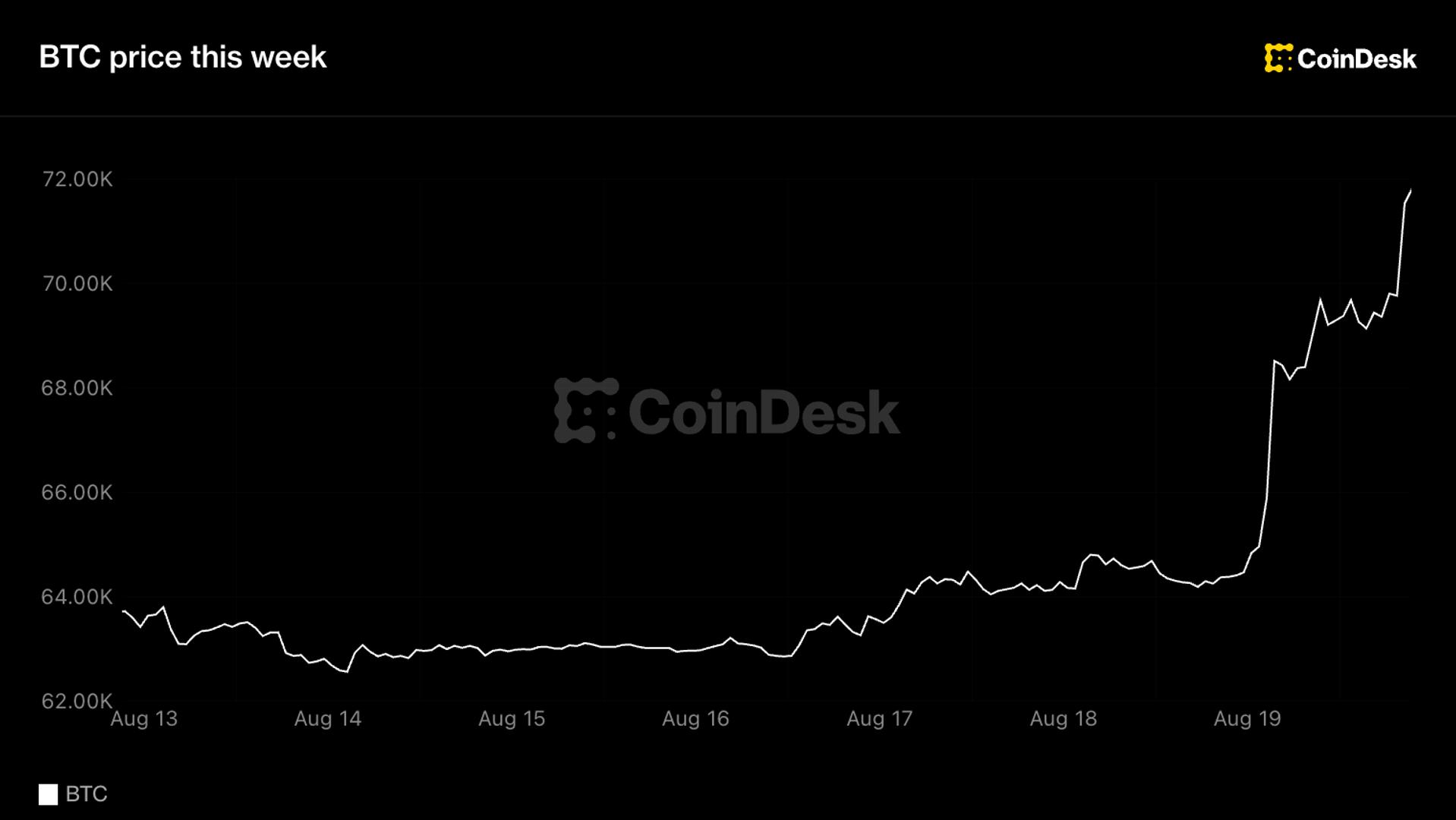
Six weeks of compression ended in the largest short liquidation since at least 2021, with $3 billion of bearish bets forced to buy back into thin supply.
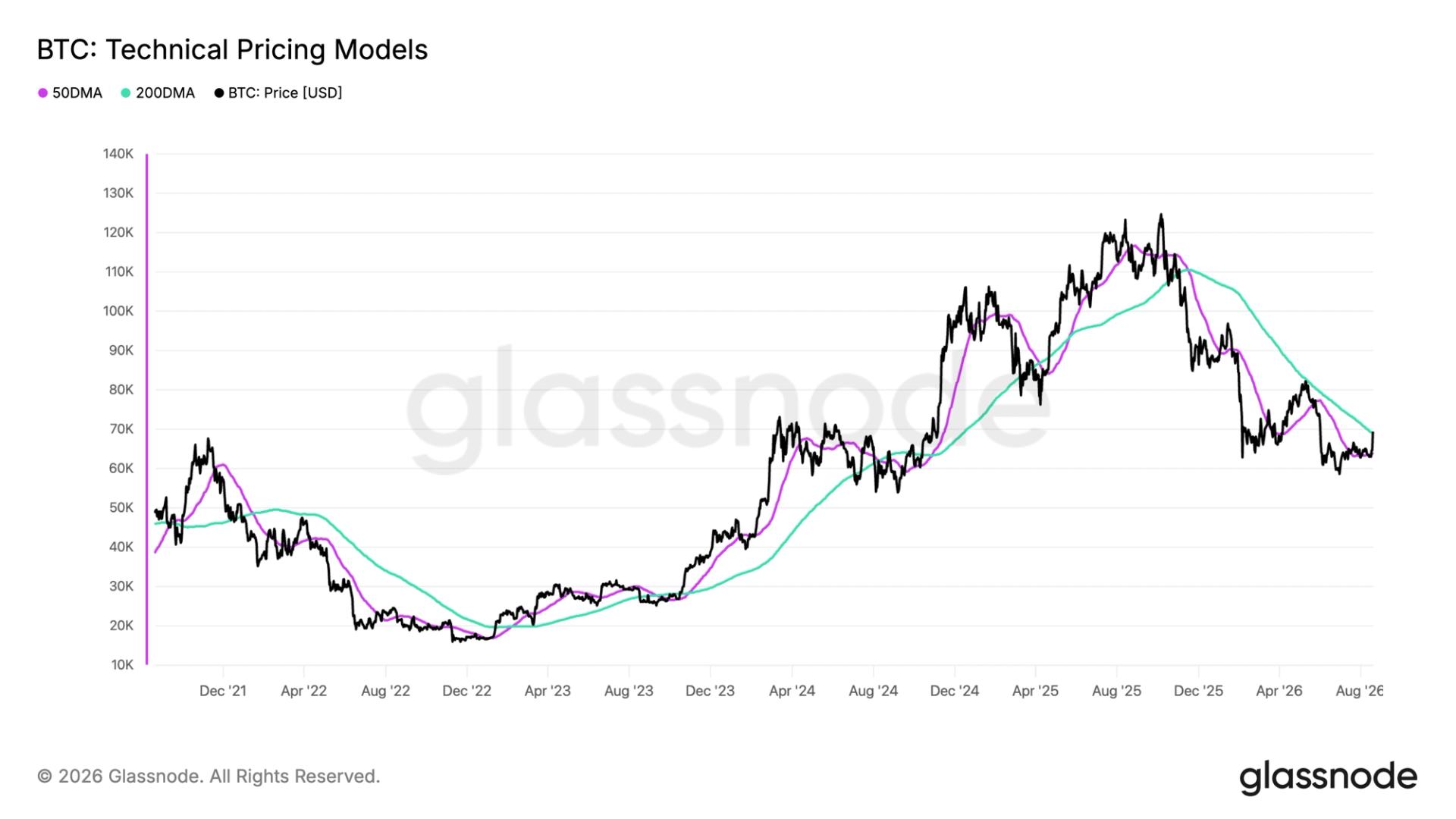
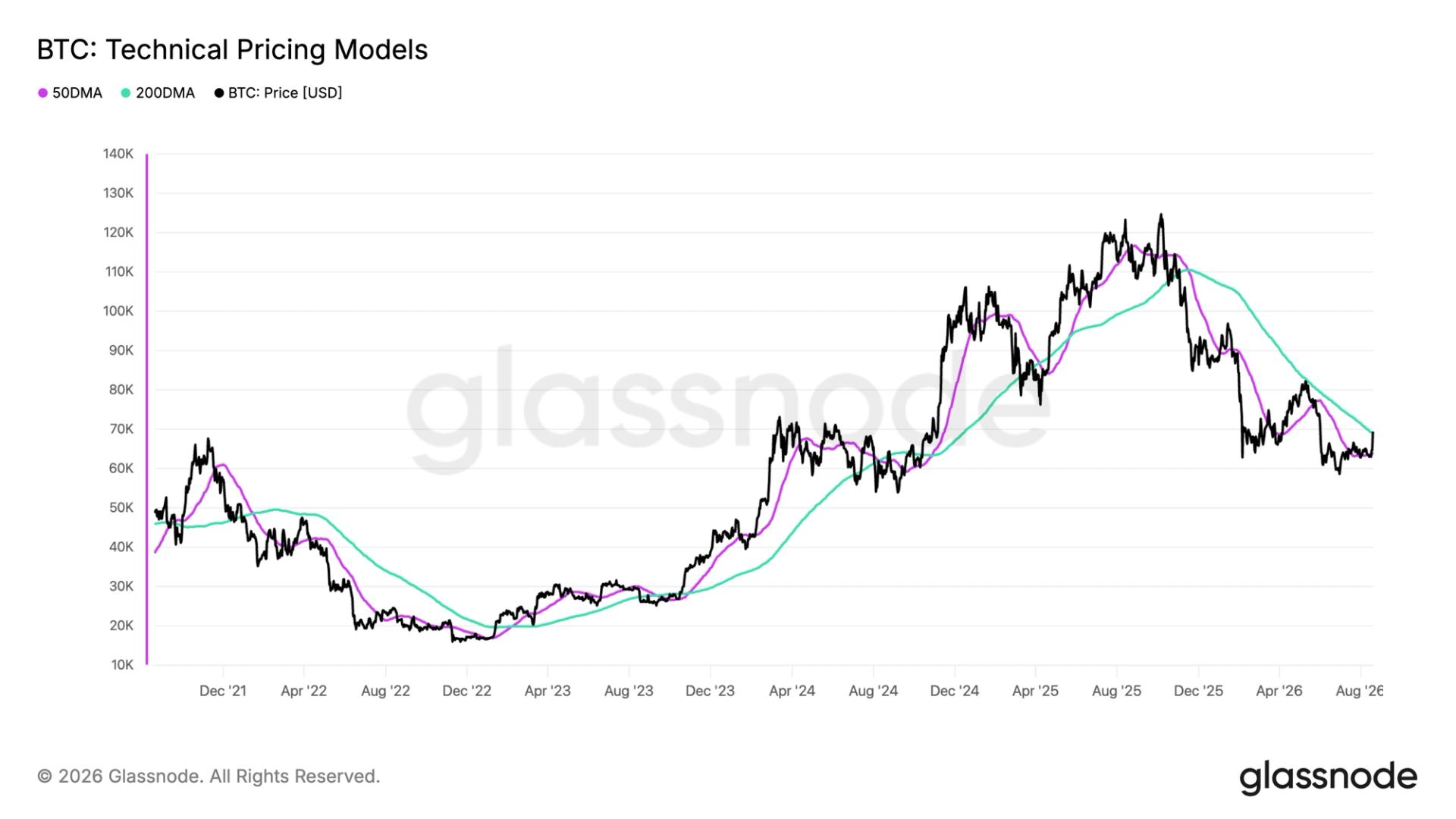
Bitcoin’s improving momentum could produce a golden cross, but the rally still faces an important test.

Meta glasses banned by ‘many’ cinemas amid piracy concerns

Caulipower introduces high-protein pizza innovation

CLARITY Act stalls as Scott criticizes Warren’s team





-

 Fashion6 days ago
Weekend Open Thread: Ann Taylor
-
 Sports7 days ago
This U.S. Amateur is a glimpse into golf’s future in more ways than you think
-

 Tech6 days ago
11 Ways to Rank Your Videos
-

 Sports6 days ago
Birmingham 2026: Day 6 Timetable for Irish Athletes
-
 NewsBeat5 days ago
Myanmar says over 300,000 Rohingya refugees verified for repatriation as exodus enters ninth year
-

 Politics5 days ago
SEQ Code: The Three Letter Boarding Pass Code That Could Give You The Worst Seat
-

 Tech7 days ago
DeepSeek Harness launches as open source rival to Claude Code, alongside V4-Pro on API with higher prices
-

 Tech3 days ago
Qwen3.8-27B runs frontier-class coding agents and reasoning locally, no cloud API required
-

 Crypto World6 days ago
Pi Network Protocol 27 endgame: last upgrade before what?
-

 Business2 days ago
SMA Solar Technology AG (SMTGY) Q2 2026 Earnings Call Transcript
-

 Crypto World3 days ago
OCC Greenlights Trump Family Crypto Firm for Trust Charter
-
 Tech5 days ago
Every fusion startup that has raised over $100M
-
 Entertainment6 days ago
10 Netflix Shows That Quietly Became Modern Classics
-

 Fashion6 days ago
Weekly News Update, 8.14.26 – Corporette.com
-
 Entertainment5 days ago
Marvel Studios Reveals New X-Men Cast Including Adam Driver and Sadie Sink
-

 Business6 days ago
15 Ways to Make Money From Your Phone (2026 Guide)
-

 Business5 days ago
Facebook Down Now? Users Report Login And Loading Problems As Outage Trackers Monitor Ongoing Issues
-

 News Videos12 hours ago
Don’t Leave Your Financial Future To Chance | August 19, 2026
-

 Fashion6 days ago
Silver bangles for women – Newbridge Silverware
-
 Business5 days ago
Monarch Mutual Fund set to enter MF space with maiden overnight fund; files draft with Sebi
You must be logged in to post a comment Login