
Crypto World
Apple, Google hire for stablecoin-related roles


Apple and Google have opened senior roles seeking stablecoin, blockchain and tokenized-finance expertise as both companies build teams around payments and digital-asset infrastructure.
Summary
- Apple’s Apple Pay strategy role explicitly lists stablecoins, tokenized deposits and blockchain as preferred qualifications.
- Google’s Hong Kong Web3 architect role requires at least four years of production-grade blockchain experience.
- Google explicitly lists stablecoin rails, tokenized deposits, RWA tokenization and custody architectures for regulated institutions.
- Neither company has announced plans to issue a stablecoin or launch a related consumer service.
- Google Cloud has built AP2, Pay.sh and Universal Ledger products supporting digital-asset payment infrastructure development.
Apple’s official careers posting, dated Aug. 26, shows the company recruiting an Apple Pay Financial Product Strategy Lead in the U.S., with understanding of stablecoins, tokenized deposits and blockchain technology listed among its preferred qualifications.
The position sits within the Apple Card and Apple Cash group, which handles consumer credit cards, peer-to-peer transfers, stored value and other financial products linked to Apple Pay. Apple says the employee will assess new product structures, commercial models and potential partnerships while helping shape long-term financial product strategy.
Google, meanwhile, is recruiting an Industry Principal Architect for Web3 in Hong Kong. Its official job posting lists real-world asset tokenization, stablecoin rails, tokenized deposits and custody architectures among the institutional Web3 use cases candidates should understand.
The reviewed postings do not state that either company intends to issue a stablecoin. They describe strategy, infrastructure, architecture and customer-facing work tied to existing payments and digital-asset businesses, leaving any future product decisions unannounced.
Apple’s stablecoin role sits inside Apple Pay strategy
Apple is seeking a payments professional with at least six years of experience in consulting, investment banking, corporate strategy, strategic finance or a similar planning function. The company lists experience with consumer payment models, international payment systems and financial modeling among the role’s main requirements.
Stablecoin knowledge appears under preferred qualifications alongside tokenized deposits and blockchain technology. Apple describes the job as one that will identify new growth opportunities, build business cases and help guide product decisions for Apple Card and Apple Cash. The U.S. base-pay range runs from $149,700 to $280,000, depending on qualifications, experience and location.
Apple says the employee will work with product, business development and data science teams to evaluate potential products and partnerships. Its description refers to projects across Wallets, Payments and Commerce, though it does not identify a planned blockchain product or stablecoin integration.
Existing Apple financial services remain centered on conventional payment infrastructure. Apple announced in January that Chase will become the new issuer of Apple Card, with the transition expected to take approximately 24 months. Mastercard will remain the card’s payment network during the change.
Apple’s public Apple Pay materials currently describe card, merchant, peer-to-peer and digital wallet payment services. No company release reviewed for this report announces an Apple-issued stablecoin.
Google stablecoin hiring targets institutional Web3 systems
Google’s Hong Kong opening has a more technical focus. The company requires 10 years of experience in system architecture, distributed systems or cloud infrastructure, along with at least four years working with production-grade Web3 systems, blockchain protocols or smart-contract ecosystems.
Preferred qualifications cover multi-party computation, hardware security modules, transaction-signing systems and confidential computing. Google specifically names RWA tokenization, stablecoin rails, tokenized deposits and digital-asset custody within regulated financial environments.
The role will support Google Cloud engagements across Asia-Pacific with blockchain foundations, institutional exchanges, custodians, financial institutions and decentralized applications. Google says the architect will help customers design systems involving validator operations, blockchain indexing, key management and enterprise security.
Compliance forms part of the job. Google says the employee will guide customers on virtual-asset risk, security and compliance architectures aligned with regional rules, including requirements from the Hong Kong Monetary Authority and Securities and Futures Commission.
Google describes the position as a bridge between customers and its product and engineering teams. Its posting says the employee can influence Google’s Web3 product roadmap by identifying recurring infrastructure needs among institutional clients.
Google already operates digital-asset payment infrastructure
Google’s recruitment comes after the company introduced several products involving blockchain-based payments.
Google Cloud’s Universal Ledger documentation describes a managed distributed-ledger service for financial institutions. The API lets organizations create payment services, tokenize assets and manage digital representations of commercial bank money.
The documentation, updated in 2026, says operators can mint, transfer and burn tokenized forms of value under defined permissions. Google describes the service as a platform for banks and intermediaries building payment and financial-market products, not as a Google-issued stablecoin.
Google has separately developed crypto-payment infrastructure for software agents. Its Agent Payments Protocol, or AP2, supports extensions for stablecoins and cryptocurrencies. Google Cloud said the A2A x402 extension was developed with Coinbase, the Ethereum Foundation, MetaMask and other participants to support agent-based crypto payments.
As crypto.news reported, Google launched AP2 with an extension designed to support stablecoin and digital-asset payments between AI agents. The protocol uses cryptographically signed mandates to record user authorization and payment instructions.
In another project, crypto.news reported in May that Google Cloud and the Solana Foundation launched Pay.sh, which allows AI agents to pay for APIs and cloud resources using stablecoins on Solana.
Google Cloud executive Richard Widmann later discussed crypto payment rails for AI agents at Consensus Miami. In related coverage, crypto.news reported that Widmann described crypto as a machine-readable payment interface because autonomous agents cannot open conventional bank accounts under existing technological and regulatory systems.
Hong Kong regulation shapes Google’s hiring environment
Google’s choice of Hong Kong for the Web3 architect role places the position inside a jurisdiction that already regulates fiat-referenced stablecoin issuers.
The Hong Kong Monetary Authority says the Stablecoins Ordinance took effect on Aug. 1, 2025, creating a licensing system for companies issuing fiat-referenced stablecoins in Hong Kong. The regulator said in February 2026 that it was processing applications and expected to grant only a small number of licenses initially.
HKMA rules cover issuers operating inside Hong Kong, overseas issuers marketing Hong Kong dollar-pegged stablecoins and firms actively marketing regulated issuance services to the local public. Supervisory requirements cover reserve management, governance, risk controls and anti-money-laundering obligations.
The regulator’s 2026 priorities include processing stablecoin applications, supervising licensed issuers and monitoring the local market. HKMA is simultaneously running EnsembleTx through 2026 to test real-value transactions involving tokenized assets and tokenized deposits.
Consumer technology companies are approaching stablecoin payments in different ways. Crypto.news reported in July that Samsung plans to add stablecoin support to Samsung Wallet, although Samsung had not disclosed supported assets, technology partners or a launch timetable.
Apple’s current job posting provides no comparable product announcement. Google’s listing centers on institutional architecture and Google Cloud clients, while its existing AP2, Pay.sh and Universal Ledger products already involve blockchain or tokenized-payment systems.
Hong Kong’s monetary authority plans to publish a register of licensed stablecoin issuers in December 2026 and update the dataset when licensing information changes.

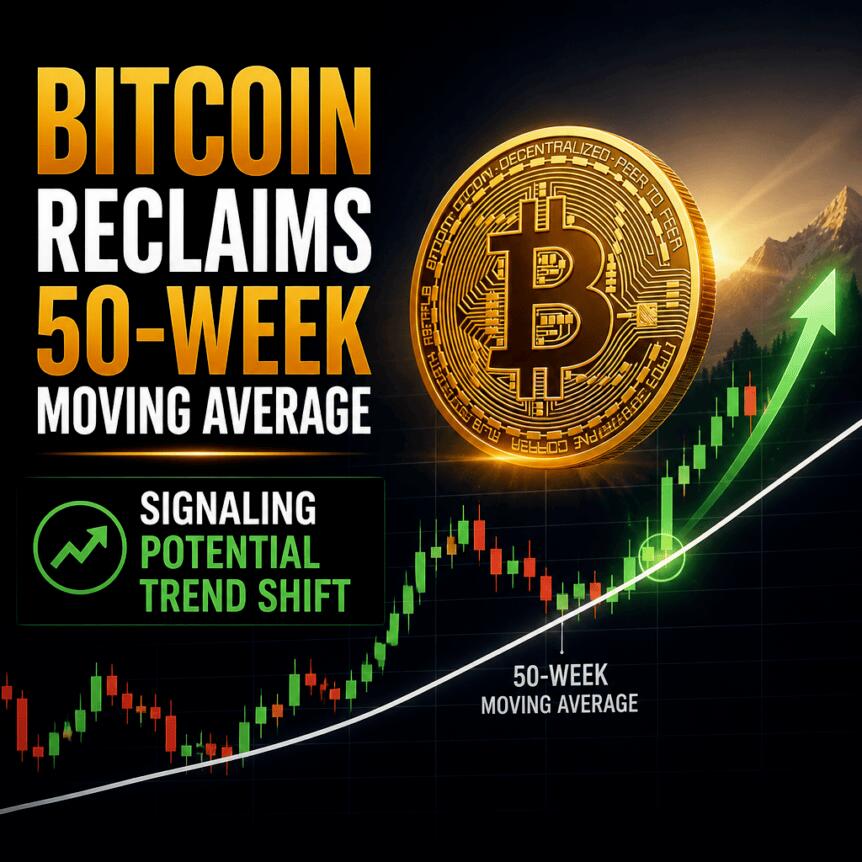
Bitcoin ended the week above a level that many market watchers associate with cycle turning points: its 50-week moving average. The move marks the first time in more than 10 months that the benchmark has been reclaimed on a weekly closing basis—an outcome analysts say often aligns with the end phase of bear markets, though they caution that one close alone cannot confirm a new bull cycle.
According to TradingView, Bitcoin closed Sunday’s session at $81,159 on Coinbase, holding above its 50-week moving average of $78,788. The previous weekly close above the 50-week average occurred on Nov. 9, 2025. The latest result also represents Bitcoin’s highest weekly close in about four months, per the same TradingView data.
Key takeaways
- Bitcoin’s weekly close at $81,159 is the first above its 50-week moving average in over 10 months, based on TradingView.
- Galaxy Research’s Alex Thorn has previously framed the 50-week moving average as a “bear market ceiling,” with historical follow-through after reclaiming it.
- Analysts including Bitget’s Ryan Lee stress that confirmation now depends on whether Bitcoin can stay above the average and build higher lows.
- Galaxy Research has also highlighted that reclaim signals can fail—especially in past cycles when the broader macro environment remained strained.
- Not all traders view the 50-week level as decisive; some are instead watching higher thresholds on the monthly and quarterly charts.
Why reclaiming the 50-week moving average matters
The 50-week moving average has become a commonly cited technical line because of how price tends to behave around it during downtrends. In August, Galaxy Research head of firmwide research Alex Thorn described the metric as functioning like a “ceiling” during bear markets—an area that price struggles to regain until the market’s momentum shifts.
In a research note cited in this week’s discussion, Thorn pointed out that in four of the five completed bear markets, once the 50-week moving average was first broken upward, the bear-market bottom was later confirmed. He added that retaking the 50-week moving average has previously served as a practical confirmation of bear-market completion.
That context helps explain why this week’s close is drawing attention: it doesn’t just represent short-term strength; it reconnects Bitcoin with a longer-duration trend gauge that has historically been more meaningful than many shorter moving averages.
A milestone, but traders want follow-through
Even with the technical milestone, several analysts are careful not to treat a single weekly close as the full verdict on the cycle. Bitget chief analyst Ryan Lee, speaking to Cointelegraph, said the latest close increases the odds that Bitcoin’s recovery is underway—but emphasized what comes next.
Lee noted that in prior cycles, reclaiming the 50-week moving average has often occurred after the major low was already established and longer-term momentum began to repair. However, he argued that buyers still need evidence that the market can hold the level and develop a healthier structure.
“What matters now is whether Bitcoin can stay above the 50-week average and continue forming higher lows,” Lee said. He also warned that failures can happen when macro conditions remain difficult, pointing to instances of “failed reclaims” in earlier cycles.
This concern aligns with Galaxy Research’s own caution. While Thorn’s framework suggests the 50-week moving average tends to confirm bear-market resolution, the research also indicates the indicator isn’t perfect. Galaxy’s warning, as referenced here, notes that among 13 weekly crossings back above the 50-week moving average, two were followed by a lower low—both within the 2021–2022 bear market. The implication is straightforward for investors: the reclaim is meaningful, but it must be validated by continued trend behavior.
What’s driving the stronger backdrop
Beyond the chart, analysts referenced improvements in the broader market environment since earlier in the year. Lee said the backdrop is stronger than earlier in 2025, highlighting that Bitcoin has rebounded significantly from July lows around $57,000. He also pointed to the possibility that repeated liquidations may have reduced leverage that had accumulated in the market, potentially improving the ability of price to sustain upward moves.
Lee further mentioned signs of renewed institutional interest, framing institutional demand as an element that could help support follow-through if the technical level holds.
For traders, this mix—improving structure on the weekly chart alongside evidence of de-leveraging and participation—helps explain why the 50-week reclaim is being treated as more than a one-week anomaly.
Other levels still in focus
Not everyone agrees that the 50-week moving average is the decisive checkpoint for a bull market call. Crypto trader Craig Cobb told Cointelegraph that he does not use the 50-week level as his primary trigger. Instead, he emphasized $83,000 as a key threshold.
According to Cobb, breaking above $83,000 would imply there is no lower high on the monthly chart—meaning the longer-term trend would no longer be down. His second condition is tied to Bitcoin’s quarterly chart pattern: he is watching for a sequence where red quarterly candles are followed by a shift into a green candle, and then a later candle breaks above the green candle’s high.
Cobb said this red-to-green transition has occurred 15 times in Bitcoin’s history. He stated that in 11 instances, the high of the first green candle was later broken, and each of those outcomes eventually produced a new all-time high. On that basis, he argued that investors should be attentive to specific technical confirmations rather than relying on a single moving average.
His framework ties cycle interpretation more directly to higher-timeframe trend structure—useful as a reminder that different traders often treat the 50-week metric as a supporting signal, not the entire thesis.
Going forward, the most important question is whether Bitcoin can hold above the 50-week moving average and continue the process of forming higher lows, as Lee suggested. Investors and traders will likely watch for additional weekly closes around the $78,788 area, while others may shift attention to higher breakout levels such as $83,000 and quarterly chart confirmation.

Kalshi has faced fresh wash-trading allegations after trader Beni cited roughly $538.6 million in 24-hour ETH-PERP volume against approximately $3.1 million in open interest, while the exchange’s crypto lead disputed the claims and pointed to differences between prediction markets and perpetual futures.
Summary
- Kalshi’s September filing sets crypto perpetual takers at 0.3 basis points after applicable rebate adjustments.
- The same program rebates makers so eligible participants net 0.3 basis points on crypto perps.
- Kalshi excludes suspected wash trades, self-matching, and pre-arranged trades from receiving rebates under the program.
- Beni cited $538.6 million ETH perpetual volume against roughly $3.1 million open interest during questioning.
- Kalshi’s crypto lead denied fake-volume claims and said prediction markets have no crypto-specific rebate program.
Beni’s Sept. 20 thread on X argued that the reported ETH perpetual turnover appeared unusually large compared with open interest. He calculated the ratio at roughly 174 times and cited a Kalshi position leaderboard that he said showed its largest position at $17,598 at the time of his screenshots.
The figures in Beni’s screenshots could not be independently reconstructed from Kalshi’s current public pages because trading data changes continuously. No CFTC enforcement action reviewed as of Sept. 21 has accused Kalshi of wash trading in its crypto perpetual markets. The regulator’s current Kalshi-related release index contains no public case matching the ETH-PERP allegations.
Beni wrote, “Kalshi fakes their crypto volume and I can prove it.” His posts present that statement as an allegation. They do not establish through an enforcement finding, exchange audit or identified trading accounts that wash trades occurred.
Kalshi rebate filing puts crypto perps under scrutiny
A separate part of Beni’s argument focused on Kalshi’s temporary perpetual fee rebate program, which can be checked against the exchange’s official regulatory filing.
Kalshi submitted its latest program update to the Commodity Futures Trading Commission on Sept. 2. The filing was certified on Sept. 16, according to the CFTC filing database. Kalshi said the program applies to all of its perpetual markets, including cryptocurrency and metals contracts, and remains scheduled to run through Dec. 31 unless amended or ended sooner.
For cryptocurrency perpetuals, eligible taker fees are rebated down to 0.3 basis points, or 0.003%. Eligible makers receive rebates that leave them with a net 0.3-basis-point payment. The terms define eligible participants as all Kalshi Self-Clearing Members.
Beni cited the positive maker rebate and reduced taker charge to argue that matched trading could face little or no combined fee cost. Kalshi’s filing addresses that structure directly: payments must be reduced when overlapping incentive programs would produce net-negative combined maker and taker fees on an individual trade.
More importantly for the wash-trading allegation, the same document states that fees from transactions resulting from, or being investigated for, self-matching, wash trading, pre-arranged trading or other abusive practices are excluded from rebate eligibility. Kalshi says its Chief Regulatory Officer can revoke a participant’s program status and pursue disciplinary proceedings when warranted.
The filing therefore confirms the rebate rates Beni discussed, but it does not establish that rebates were paid on wash trades.
Kalshi says prediction volume and perps were conflated
Kalshi crypto lead IcoBeast disputed Beni’s argument in a Sept. 20 response on X, saying two separate products had been mixed together.
IcoBeast said the Artemis chart that prompted the initial exchange concerned prediction-market share, not perpetual futures. He said Kalshi does not operate the cited rebate program for its crypto prediction markets and described the perpetual incentives as a separate program.
Kalshi’s own documentation confirms the product distinction. Its current trading glossary defines prediction-market volume as the number of contracts traded during a period. The same glossary states that perpetual futures are separate products involving margin, leverage, funding payments and no fixed expiry.
Beni separately alleged that Kalshi’s interface displays prediction-market contract volume beside a dollar sign, which he argued could make contract counts appear to represent dollars traded. The reviewed Kalshi glossary confirms that its stated prediction-market definition is contract count, but the historical interface presentation described in Beni’s screenshots was not independently verified.
IcoBeast maintained that Kalshi uses a convention common among prediction platforms. “I know it’s all real,” he wrote in an earlier exchange after Beni questioned the reported activity.
Kalshi’s ETH perpetual market has operated since June. As crypto.news reported when ETH-PERP launched, the exchange introduced Ethereum perpetual futures shortly after its regulated Bitcoin perpetual contract began trading in the U.S. Kalshi has since expanded to Bitcoin and 17 altcoin perpetual products.
In related coverage, crypto.news reported in June that Kalshi said perpetual volume exceeded $5.5 billion within the first two weeks of the product rollout. That figure came from Kalshi through Bloomberg and predates the present dispute.
CFTC guidance specifically addresses wash-trading risks
The CFTC had issued detailed guidance on exchange incentive programs more than a month before the current dispute.
In its Aug. 12 staff advisory, the Division of Market Oversight said properly structured incentive programs can support liquidity and price discovery, while some designs can encourage improper activity if controls are inadequate. The advisory mainly discusses prediction-market programs, though it states that the cited core-principle requirements apply to other derivatives traded on designated contract markets.
CFTC staff specifically warned that steep volume thresholds can increase the risk of wash trading and pre-arranged transactions. It said market-maker arrangements that guarantee net profits or cover losses through rebates may encourage artificial strategies.
The advisory did not accuse Kalshi of either practice. It directed exchanges to conduct real-time surveillance, build program-specific controls and use monitoring capable of finding suspicious wash or fictitious trading patterns.
Kalshi’s Sept. 2 rebate filing addresses several of those areas. The company told the CFTC that it had reviewed potential manipulation risks, would monitor participating Self-Clearing Members with heightened attention and would exclude suspicious transactions from rebates. The exchange said its program is public and offered to eligible members on nondiscriminatory terms.
IcoBeast pushed back on Beni’s suggestion that Kalshi picks the Self-Clearing Members benefiting from the program. CFTC guidance states that designated contract markets must provide impartial, transparent and nondiscriminatory access, while participants still have to satisfy applicable financial and operational requirements.
The regulator separately reminded exchanges in February that wash sales, pre-arranged transactions and noncompetitive trading can violate the Commodity Exchange Act. It said designated contract markets have an independent duty to maintain audit trails, conduct surveillance and enforce their trading rules.
Market-maker rebates exist beyond Kalshi
IcoBeast compared Kalshi’s incentives with programs used elsewhere in derivatives trading. Public documentation confirms that maker rebates are not unique to the company.
Hyperliquid’s current fee schedule provides maker rebates for traders meeting specified volume-share thresholds. Its documentation lists rebates reaching negative 0.003% at the highest displayed maker tier, though Hyperliquid separately states that it does not operate a designated market-maker program with privately negotiated special fees.
Binance’s Liquidity Hub similarly publishes maker programs for spot and futures markets. Its U.S.-dollar-margined futures program lists negative maker fees for qualifying tiers, meaning eligible liquidity providers receive rebates.
Kalshi has separately announced a multi-year agreement with Nasdaq Market Surveillance. In its Aug. 10 company release, Kalshi said the system would cover both event contracts and perpetual futures and provide cross-market monitoring intended to identify manipulation, insider trading and other abusive activity. The description represents Kalshi’s stated surveillance setup, not an independent audit of the ETH-PERP trading questioned by Beni.
Jump relationship does not establish wash trading
Beni brought Jump Trading into his argument, pointing to a previously reported commercial relationship between the trading firm and Kalshi.
Bloomberg reported in February, citing people familiar with the matter, that Jump was set to receive a small Kalshi equity stake in exchange for providing liquidity. Bloomberg described the Kalshi arrangement as involving a set amount of equity. Kalshi and Jump were not quoted in that report confirming the terms.
A separate trading relationship is publicly documented. As crypto.news previously reported, Jump supplied liquidity for Kalshi’s first bespoke prediction-market block trade, involving a carbon allowance contract.
No official filing or enforcement record reviewed for this report identifies Jump as responsible for the ETH-PERP volume Beni questioned, and the reported commercial relationship by itself does not establish wash trading.
Late in the dispute, Beni said he had received new non-public information and was delaying another Kalshi thread for roughly 24 to 48 hours while consulting lawyers. He said he planned to provide an update after determining what information he could publish; no regulator filing or independently verifiable evidence supporting that new claim had appeared publicly at the time of writing.
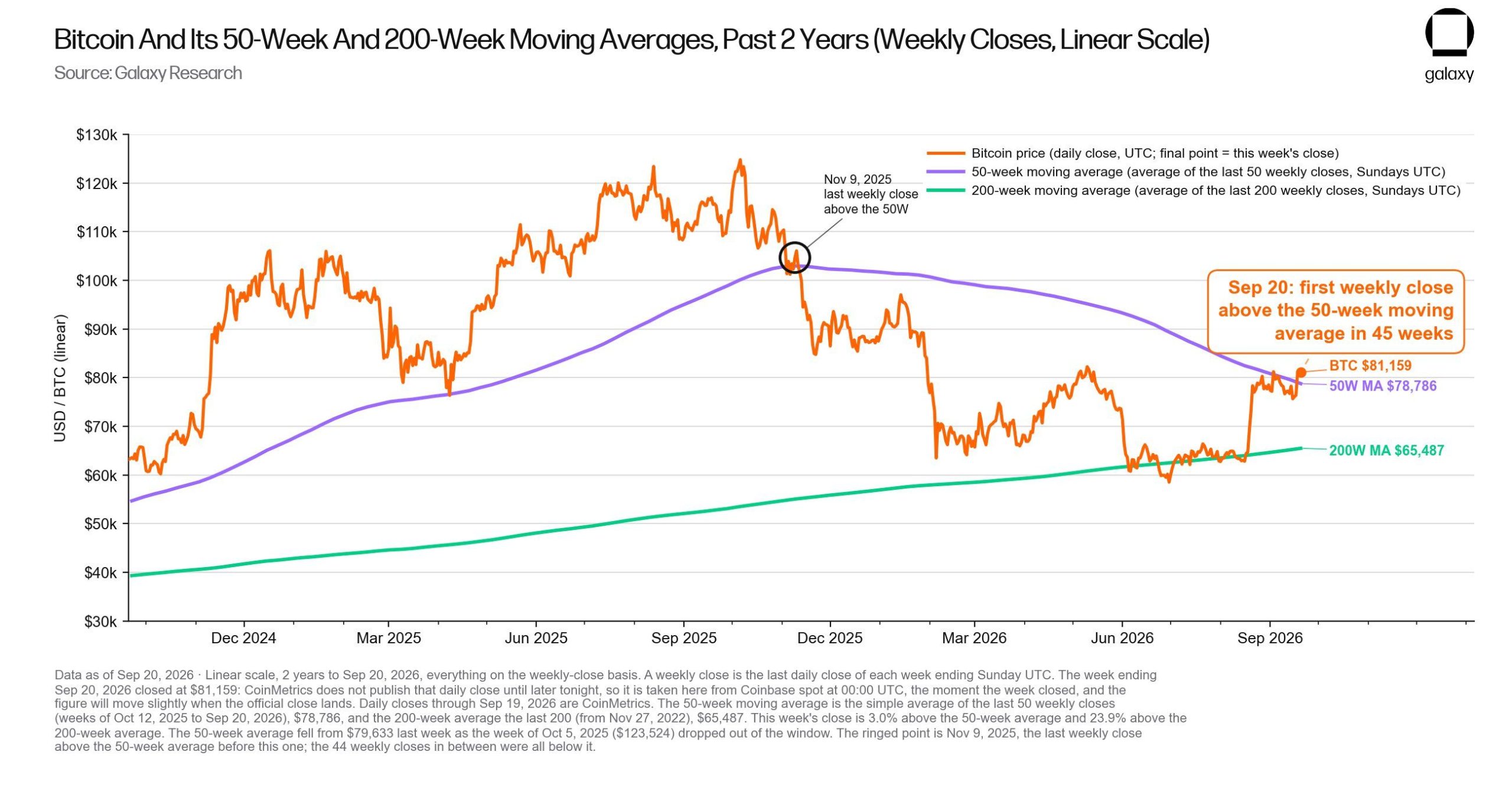
Bitcoin (BTC) has appreciated roughly 30% since August, and despite a volatile September, the largest cryptocurrency has stayed in the green for the month with gains of 3.33%.
Beyond those gains, Bitcoin has also flashed a key signal, suggesting the bear market lows for this cycle may be in.
Alex Thorn Says this Bitcoin Signal Has Confirmed Past Bottoms
That signal arrived on Sunday. Bitcoin posted its first weekly close above its 50-week moving average since November 2025. No weekly close had finished above that average in the 45 weeks since.
Alex Thorn, head of firmwide research at Galaxy, flagged the close and pointed to what it has meant in earlier cycles.
“Regaining the 50w MA has historically served as strong confirmation that bear market lows are in,” he said.
Follow us on X to get the latest news as it happens

Historical data provides some context for Thorn’s view. In a research note, the executive identified 13 instances in completed bear markets when Bitcoin crossed back above its 50-week moving average.
Only two of those instances were followed by another lower low, with both occurring during the 2021–2022 decline. More broadly, four of the five bear markets that lost the moving average saw the first reclaim after the cycle low hold as the eventual recovery signal.
This history helps explain why the latest weekly close has drawn attention. However, the 50-week average is only one part of the broader cycle structure.
Why the 50-Week and 200-Week Averages Matter For Bitcoin
Bitcoin’s 50-week and 200-week moving averages have historically provided important reference points during major market cycles. The 200-week moving average has acted as a floor, with only 56 of 642 weekly closes printing below it since its existence.
The 50-week average has served as the ceiling, capping rallies until a drawdown ends. According to Thorn, this cycle has “so far behaved similarly to the 2015 and 2018 bear markets at the floor.”
Bitcoin lost the 50-week moving average during the week of November 16, 2025. It then reached a bear market low of $58,525 on June 30, 2026, marking a 53.1% decline from its October 2025 record of $124,824.
Since then, Bitcoin has gained 39%. Sunday’s weekly close came 3.0% above the 50-week moving average at $78,786 and 23.9% above the 200-week average at $65,487. Bitcoin traded at $81,341 at press time.

The recovery above both levels strengthens the case that the low could be in. Still, the latest move has not eliminated the possibility of another decline.
Several analysts expect Bitcoin to bottom in October. The coming weeks will therefore test whether June’s low holds as the cycle floor or whether the calendar call proves right.
Subscribe to our YouTube channel to watch leaders and journalists provide expert insights
The post Is Bitcoin's Bear Market Low In? A Signal Absent for 45 Weeks Returns appeared first on BeInCrypto.

Uniswap founder Hayden Adams has said Sam Bankman-Fried paid seven figures for Uniswap.com before Uniswap Labs secured the domain through a 2021 legal proceeding that found it had been used in bad faith.
Summary
- Hayden Adams says SBF paid seven figures for Uniswap.com after Uniswap rejected the seller’s price.
- WIPO ordered Uniswap.com transferred to Uniswap Labs in September 2021 after finding bad-faith domain use.
- The 2021 WIPO ruling confirmed Uniswap.com redirected visitors to SushiSwap, a competing decentralized exchange platform.
- WIPO records identify Future XXX as respondent but do not name Sam Bankman-Fried as purchaser.
- Uniswap.com currently redirects visitors to Uniswap’s official app, confirming the domain remains under project control.
In a Sept. 21 post on X, Adams said the original owners wanted a seven-figure payment for the domain, which his team declined. He claimed Bankman-Fried later paid that amount and redirected Uniswap.com toward a fork of the Uniswap protocol. Adams did not disclose the purchase price, transaction documents or identity of the seller in his post.
“I guess to flex / mess with us,” Adams wrote while discussing Bankman-Fried’s possible motive. The phrasing was speculation by Adams, not a documented finding from the later domain proceeding.
A review of the official WIPO case record confirms several other parts of the account. Uniswap Labs filed a complaint over Uniswap.com in May 2021, and a three-member World Intellectual Property Organization panel ordered the domain transferred to the company on Sept. 3, 2021.
Uniswap.com redirected users to SushiSwap in 2021
The dispute began after Uniswap.com appeared to send visitors to SushiSwap, the decentralized exchange created as a fork of Uniswap. Contemporary reporting from The Block documented the redirect in May 2021, when the identity of the domain owner was not publicly known. SushiSwap contributor 0xMaki said at the time that the SushiSwap team had not bought the domain.
WIPO later examined the redirect directly. Its panel reviewed a screenshot dated May 18, 2021 and checked archived versions of Uniswap.com through the Wayback Machine. The records showed pages from May resolving to a SushiSwap webpage. The panel described SushiSwap as operating in the same financial market as Uniswap Labs.
The respondent contested parts of Uniswap Labs’ case. According to the WIPO decision, it argued that SushiSwap was an open-source derivative of the Uniswap protocol and disputed whether the redirect had initially been established. The panel rejected those arguments after reviewing the additional evidence.
WIPO found that using the Uniswap name for a domain did not become permissible simply because the underlying software was open source. Uniswap Labs held registered rights to the UNISWAP trademark, and the panel found the domain identical to that mark.
The panel determined that redirecting users to SushiSwap did not qualify as a bona fide use of the domain and created a high risk of implied affiliation with Uniswap Labs.
WIPO found Uniswap.com had been used in bad faith
Registration records cited by WIPO show that Uniswap.com itself was first registered on July 30, 2000, years before Hayden Adams created the Uniswap protocol. The respondent in the 2021 proceeding acquired the domain on April 7, 2021, according to a declaration from its legal representative.
The official proceeding identified the respondent as Registration Private, Domains By Proxy, LLC / Future XXX of Hong Kong. The published decision does not identify Bankman-Fried as Future XXX, name him as the domain purchaser or disclose a seven-figure transaction.
WIPO found credible evidence showing that the respondent knew about Uniswap Labs before acquiring the domain and regarded the company as a competitor. The panel said the respondent failed to address evidence contradicting its earlier claim that it lacked prior awareness of Uniswap Labs.
On the domain’s use, the panel found that the SushiSwap redirect intentionally created confusion over whether Uniswap Labs was connected to, sponsored or endorsed the destination. WIPO consequently determined that the domain had been registered and used in bad faith.
Its Sept. 3, 2021 decision ordered Uniswap.com transferred to Universal Navigation Inc., which operates as Uniswap Labs. The decision came under the Uniform Domain Name Dispute Resolution Policy and did not require Uniswap Labs to purchase the domain from the respondent.
Adams described that result more simply in his Sept. 21 post, saying the “malicious use” gave Uniswap’s legal team enough grounds to obtain the domain “for free.” The WIPO record supports the court-like transfer mechanism, though it does not use Adams’ wording or state what legal expenses Uniswap Labs incurred.
SBF had an earlier connection to SushiSwap
Bankman-Fried had a documented role in SushiSwap months before the Uniswap.com dispute. As crypto.news reported in September 2020, SushiSwap creator Chef Nomi handed control of the project to Bankman-Fried during a governance crisis after withdrawing tokens from its developer fund.
Bankman-Fried helped oversee SushiSwap’s migration before control moved toward a multisignature structure. SushiSwap itself had launched as a fork of Uniswap during the 2020 decentralized-finance boom.
The historical relationship provides context for Adams’ new statement but does not independently establish Bankman-Fried’s ownership of Uniswap.com. Reporting in May 2021 said the person controlling the domain remained unknown, while 0xMaki denied that the SushiSwap team itself had purchased it.
The WIPO record similarly stops short of naming Bankman-Fried. Its respondent was Future XXX, represented in the proceeding by Australian law firm Cornwalls, and WIPO based its ruling on trademark rights, the SushiSwap redirect and evidence of bad-faith use.
Uniswap.com now redirects to Uniswap’s official app
More than five years after the dispute, Uniswap.com now redirects directly to the official Uniswap application at app.uniswap.org. A live check of the domain on Sept. 21 confirmed the redirect.
Uniswap Labs’ current trademark guidelines state that third parties should not use UNISWAP, UNI or UNISWAP LABS trademarks in domain names or create names that could falsely suggest affiliation. The company says it enforces its trademark rights to protect users.
Its current support directory still identifies Uniswap.org as the company’s official website and app.uniswap.org as its trading interface, while Uniswap.com functions as a redirect.
Bankman-Fried remains involved in separate criminal proceedings stemming from FTX’s collapse. In related crypto.news coverage, the U.S. Court of Appeals for the Second Circuit formally affirmed his fraud conviction, 25-year prison sentence and approximately $11 billion forfeiture order in 2026.
The official Second Circuit opinion was issued June 12, 2026. It concerned Bankman-Fried’s FTX criminal case and made no findings about the 2021 Uniswap.com domain transaction.
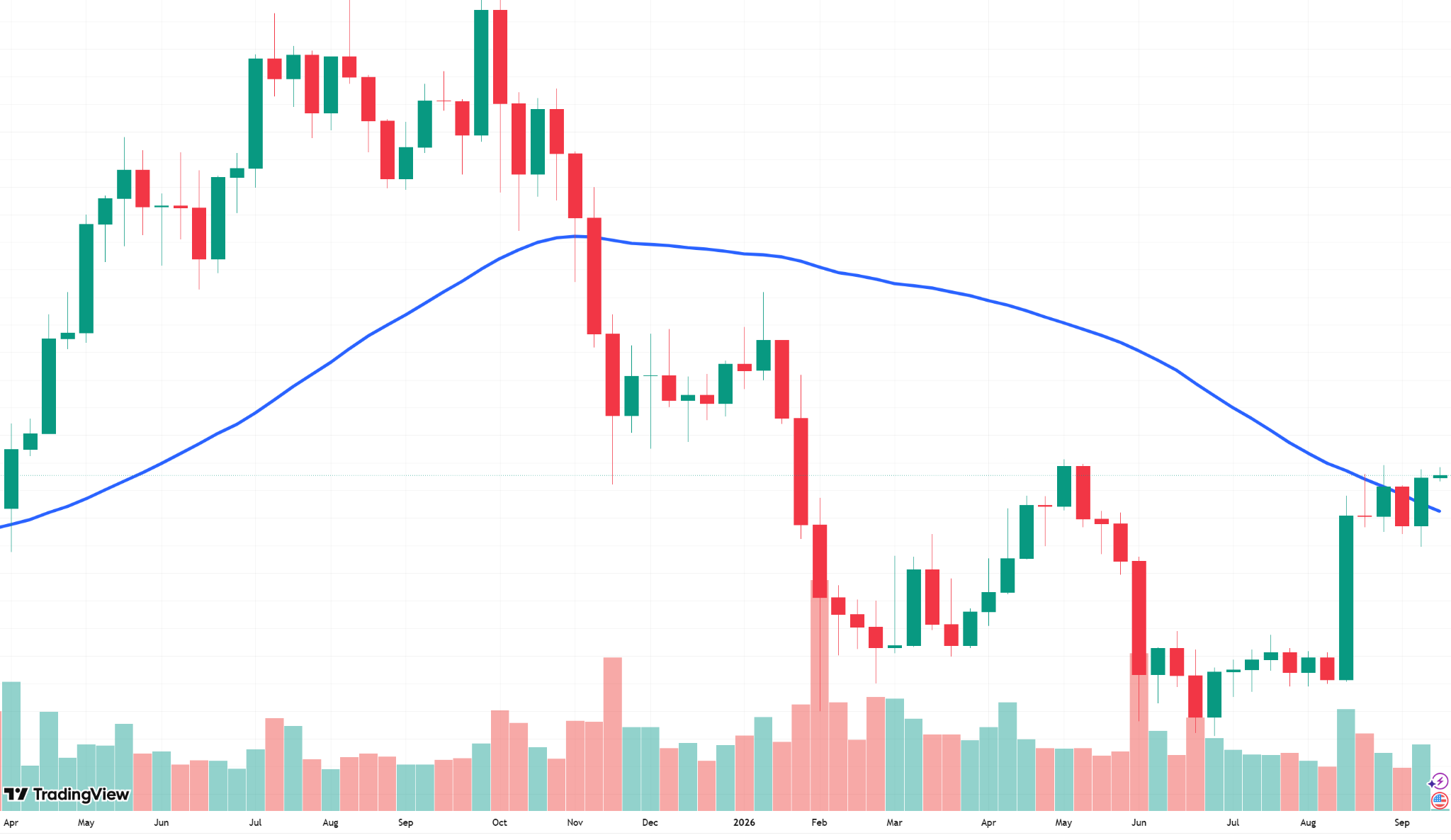
Bitcoin has closed above its 50-week moving average for the first time in more than 10 months, a development some analysts said could signal the end of Bitcoin’s bear market.
Bitcoin closed the week at $81,159 on Coinbase on Sunday, above its 50-week moving average of $78,788, according to TradingView. The last weekly close above the moving average was on Nov. 9, 2025.
In August, Galaxy Research’s head of firmwide research Alex Thorn described the 50-week moving average as serving as a ceiling during bear markets.
“In four of the five completed bear markets, once the 50-week moving average was first broken to the upside, the bear market bottom was definitively ‘in,’” he said in a research note.
“Essentially, retaking the 50w MA has previously confirmed the end of a bear market,” Thorn added.
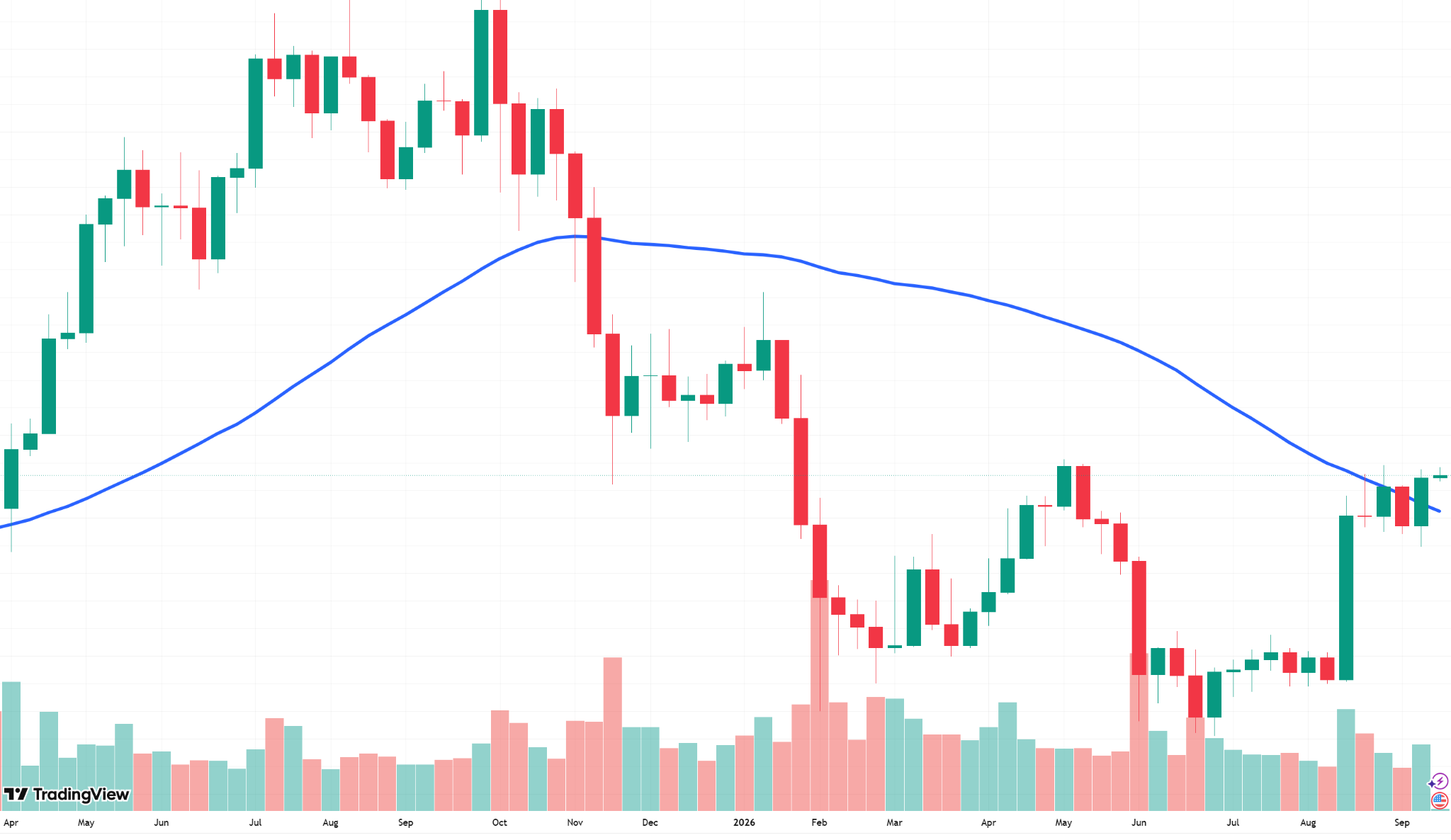
The latest close is also Bitcoin’s highest weekly close in four months, according to data from TradingView.
On Tuesday, ahead of the weekly close, crypto research company Collective Shift founder Ben Simpson said Bitcoin closing above its 50-week moving average would be “the last thing I need to see before I call this a bull market.” He said Bitcoin gained between 700% and 900% after breaking above the level in 2017, 2020 and 2023.
Bitget chief analyst Ryan Lee told Cointelegraph that the latest close added weight to the case that Bitcoin’s recovery was underway.
“In previous cycles, reclaiming this level has tended to happen after the major low was established and longer-term momentum had started to recover.”
However, Lee said one weekly close was not enough to confirm that Bitcoin had reached its cycle bottom.
“What matters now is whether Bitcoin can stay above the 50-week average and continue forming higher lows,” he said. “We have seen failed reclaims in previous cycles, particularly when the macro environment remained difficult.”
Galaxy similarly cautioned in August that while the 50-week moving average is a historically strong indicator that a bear market is over, the signal isn’t infallible.
Of 13 weekly crossings back above the 50-week moving average, two of them were followed by a lower low, both occurring in the 2021-2022 bear market.
Lee said the market backdrop was nevertheless stronger than it was earlier in the year, with Bitcoin recovering significantly from its July lows of $57,000. Lee said repeated liquidations have also cleared out leverage that had built up in the market, and there are signs of a return of institutional demand.
Related: Bitcoin hits $81K as US bond yields rebound on global oil woes
Meanwhile, crypto trader Craig Cobb told Cointelegraph that the 50-week moving average was not the indicator he was watching to determine whether a bull market had begun.
Cobb said he was instead looking at $83,000 as a key level for Bitcoin, “which will mean there is no lower high on the monthly chart and therefore the trend is no longer down.”
His second test involves Bitcoin’s three-month chart. Under that setup, Cobb said he is looking for a succession of red quarterly candles that must end with a green candle, followed by a subsequent candle breaking above the green candle’s high.
Cobb said the red-to-green transition had occurred 15 times in Bitcoin’s history. In 11 instances, the high of the first green candle was subsequently broken, and all 11 moves eventually produced a new all-time high.
“So combine $83,000 being broken and the close of the September three-month candle, then a break of the high and I will say the bull market has begun,” said Cobb.

Cointelegraph is committed to providing independent, high-quality journalism across the crypto, blockchain, AI, and fintech industries.
All news, reviews, and analyses are produced with full journalistic independence and integrity. For more details on our standards and processes, please read our Editorial Policy.
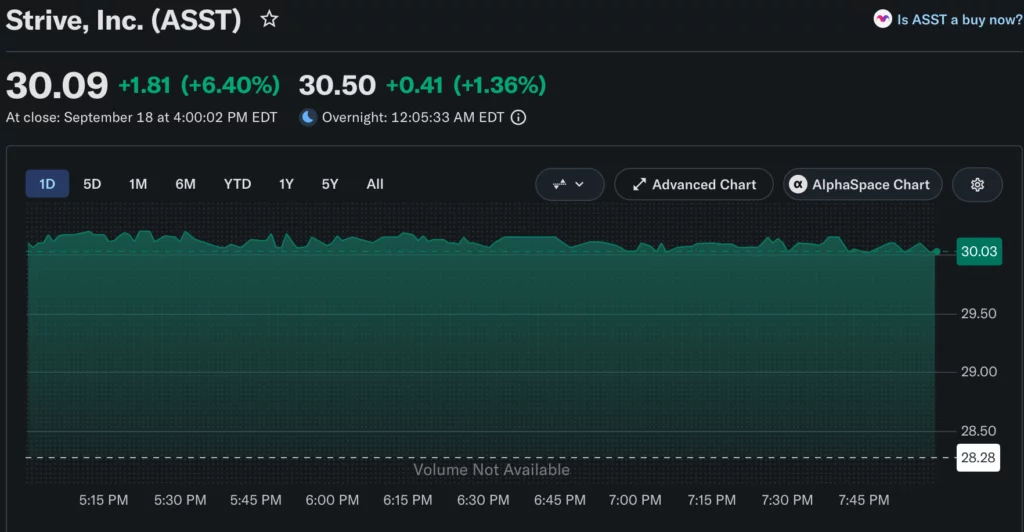
REX Shares and Tuttle Capital Management have launched ASSX, a Cboe-listed exchange-traded fund that began trading Sept. 18 and seeks 200% of Strive Inc.’s daily share performance before fees and expenses.
Summary
- ASSX targets 200% of Strive’s daily share performance and resets its leverage after each session.
- Cboe listed ASSX on September 18 after certifying the fund for registration three days earlier.
- Strive held 25,000 Bitcoin after purchasing 469 BTC at a $77,954 average price per coin.
- Strive shares closed Friday at $30.09, rising 6.4% during ASSX’s first trading session on Cboe.
- REX warns longer holding periods can diverge sharply from twice Strive’s stock return over time.
REX Shares said the T-REX 2X Long ASST Daily Target ETF gives traders leveraged exposure to Strive’s Nasdaq-listed ASST shares for a single trading day. The issuer described ASSX as “the first ETF in the U.S. offering 2x daily long exposure to ASST.” Cboe lists the fund under ticker ASSX, while Strive continues trading on Nasdaq under ASST.
A Cboe certification filed with the U.S. Securities and Exchange Commission on Sept. 15 recorded the exchange’s approval for listing and registration. Three days later, Cboe’s product page recorded Sept. 18 as the listing date. The fund’s official page lists a 1.5% total expense ratio and identifies Tuttle Capital Management as adviser, with REX Shares as sponsor.
Strive ETF ASSX targets 200% of ASST’s daily move
The fund seeks twice ASST’s daily performance before fees and expenses, not twice Strive’s return over a week, month or other multi-day period. REX says leverage resets after each session, so compounding can cause results over longer periods to differ from 200% of the stock’s cumulative return.
ASSX does not hold Bitcoin and does not seek twice Bitcoin’s daily price change. Its reference asset is Strive common stock. REX’s risk disclosure says investing in the fund is not the same as buying ASST, and fund shareholders do not receive voting rights or distributions attached to Strive shares.
The issuer says the fund can use derivatives, including swap agreements, to obtain leveraged exposure. Its disclosure warns that derivatives, counterparty conditions, liquidity and daily rebalancing can prevent the fund from reaching its stated 2x objective. REX says a 1% daily decline in ASST would translate into an approximately 2% decline in the fund before financing costs and other operating expenses.
REX places a clear limit on the intended holding period. The company says ASSX is designed for knowledgeable investors who monitor positions frequently, and it warns that multi-day compounding can produce losses even when ASST finishes a longer period higher. Its disclosure states that an adverse ASST move of more than 50% in one trading day could wipe out an investor’s principal.
Strive’s 25,000 BTC treasury backs the stock story
Strive’s latest Bitcoin holdings filing showed 25,000 BTC as of Sept. 11. In a Sept. 14 Form 8-K, the company said it bought 469 BTC between Sept. 8 and Sept. 11 at an average price of $77,954 per coin, including fees and expenses. The purchase lifted holdings from 24,531 BTC one week earlier.
The same filing put cash and cash equivalents at $204.2 million and the fair value of Strive’s 505,000 Strategy STRC preferred shares at $49.813 million. SATA preferred shares outstanding rose by 402,541 during the period to 10,397,966, while effective common shares increased by 34,206 to 94,968,764.
Chairman and CEO Matt Cole said in a public statement that “100% of the capital raised came from SATA,” adding that the preferred stock had passed $1 billion in notional value outstanding. The SEC filing itself records the increase in SATA shares but does not state in narrative form that the full Bitcoin purchase was financed by SATA.
As crypto.news reported on Sept. 14, the 469-BTC acquisition followed a 1,375-BTC purchase for roughly $109 million during the prior reporting week. In related coverage, crypto.news reported that Strive had bought 1,800 BTC for approximately $143 million in late August, taking holdings to 23,156 BTC and moving the company into fifth place among public corporate Bitcoin holders at the time.
BitcoinTreasuries.net currently lists Strive as the fifth-largest public company by reported Bitcoin holdings, with 25,000 BTC. The ranking service places Strive behind Strategy, Twenty One Capital, Metaplanet and MARA Holdings in its public-company table.
ASST rose 6.4% as ASSX opened its first session
Strive shares closed Sept. 18 at $30.09, up 6.4% for the session after trading between $29.33 and $30.38. Market data showed roughly 16.1 million ASST shares changed hands during the day. The move followed a 3.17% gain on Sept. 17, when ASST closed at $28.28.
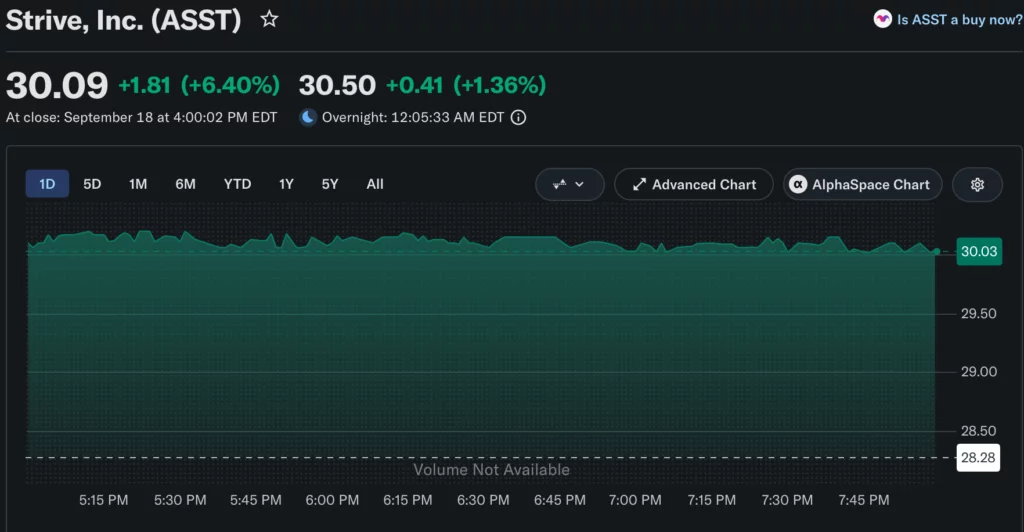
ASSX finished its first trading session at $28.27 after opening at $27.78 and trading between $27.22 and $28.70, according to market data sourced from Cboe and S&P Global Market Intelligence. Reported volume reached 123,946 shares. After-hours data later showed ASSX at $28.71.
REX and Tuttle have placed ASSX alongside leveraged products tied to other crypto-sensitive securities. The T-REX lineup includes 2x long funds linked to Strategy, BitMine, Cipher Mining, Circle and SharpLink, plus BTCL, a separate 2x daily product tied to spot Bitcoin. ASSX differs because its target is Strive’s common stock, which carries both corporate and Bitcoin-treasury exposure.
Tuttle CEO Matt Tuttle said “ASST moves, and it moves with bitcoin,” while describing the product’s intended use for one-day positions. The statement is the sponsor’s characterization of ASST’s trading behavior; ASSX’s formal objective remains tied to ASST’s daily share performance, not Bitcoin.
Strive’s next filings can update the treasury figure
The 25,000-BTC total remains the latest Strive Bitcoin balance disclosed in the SEC filings reviewed for this report. BitcoinTreasuries.net has estimated further SATA-funded purchasing capacity from subsequent trading, but such estimates do not establish that Strive acquired more Bitcoin because only company disclosures can confirm a completed purchase.
Separate from the Bitcoin filing, Strive filed another Form 8-K concerning SATA’s dividend policy. The board maintained the regular annual dividend rate at 13%, effective for periods beginning on or after Oct. 1, 2026.
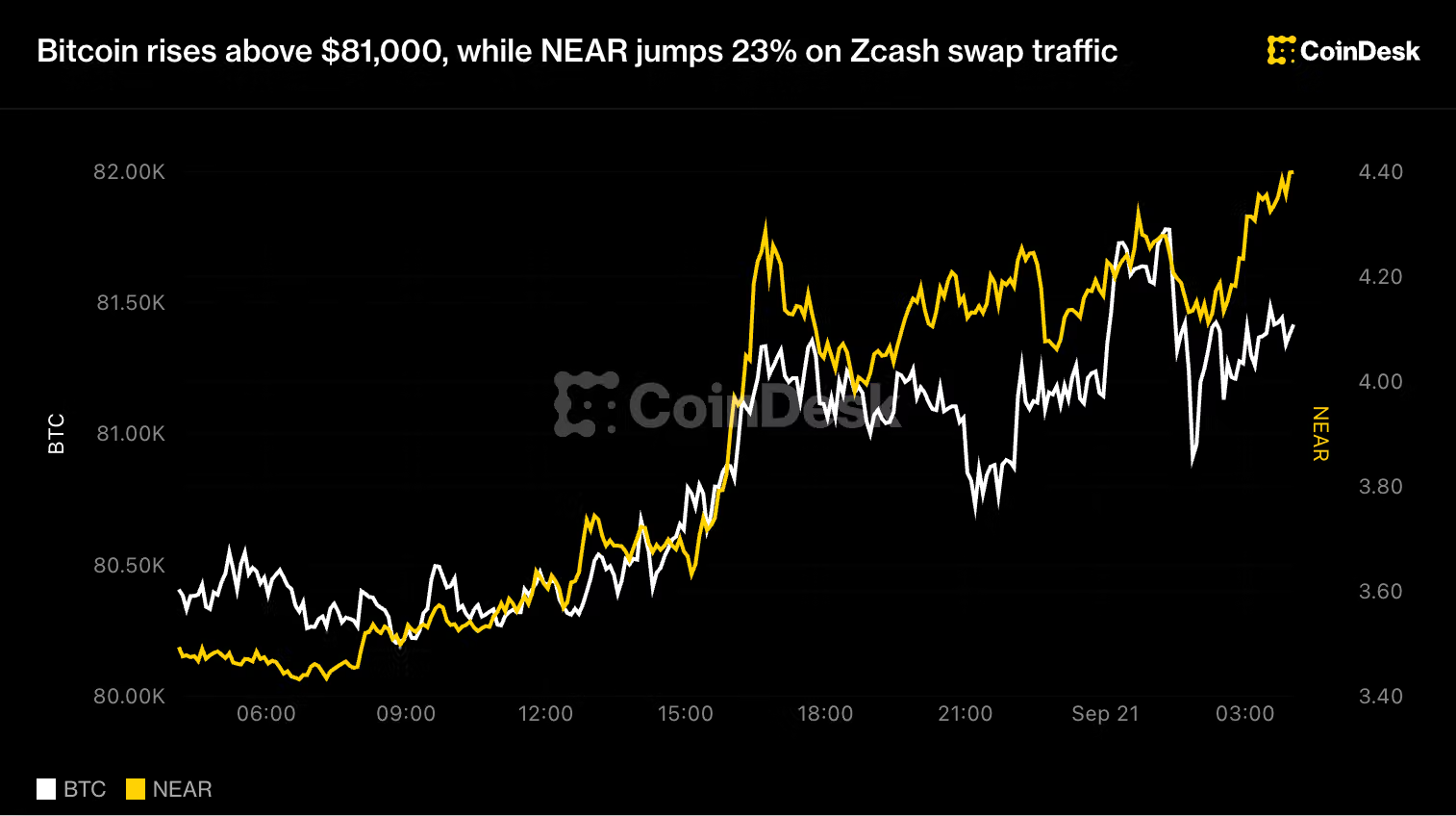
Bitcoin traded just above $81,000 as of Monday Asian morning hours, up less than 1% over 24 hours and adding to the ground it has taken since the U.S. Securities and Exchange Commission cleared a path for onchain trading of tokenized U.S. stocks on Thursday, CoinDesk data show.
NEAR was the standout among the major tokens, up roughly 23% to just above $4. The move traces to NEAR Intents, a swap service built on the NEAR blockchain that lets a wallet trade one token for another across different chains without the user having to move funds between them first.
Major consumer wallets, such as ZODL and Vizor, have plugged it in to offer ZEC swaps, and daily ZEC volume routed through the service jumped sixfold in a single in the past week. NEAR has become the routing layer for one of the most heavily traded tokens on the market, and its own token has followed the traffic.
Elsewhere, ZEC gained 3% to just above $1,500 and BNB 2% to nearly $777. Ether and HYPE each picked up about 2%, while XRP, DOGE, SOL and TRX rose 1% or less.
Crypto World
Bitcoin’s price has cleared a key hurdle that has historically preceded major bull runs

These multiples are approximate, given that early BTC price data is inconsistent. So they’re meant to illustrate the scale of subsequent rallies, do not necessarily imply that the moving-average crossover alone caused them.
History, however, is not a guarantee
Past performance does not guarantee future results, and the 50-week average has had its share of misses.
Two of the 13 instances failed. Both occurred during the volatile period spanning late 2021 and early 2022, when bitcoin briefly moved above the average before rolling over and eventually falling toward $16,000. Galaxy identifies those failed reclaims as the Dec. 26, 2021, and March 27, 2022, crossovers.
As of this writing, bitcoin is trading near $81,450, with the 50-week average at $78,115, according to data source CoinDesk.
If history is a guide, the latest reclaim suggests the bear-market low may have been established near $60,000 in recent months. It also raises the possibility that bitcoin could continue advancing toward new highs.
That outcome, however, will depend on whether bitcoin can hold above the moving average in the weeks ahead.

North Korea-linked hacking group WaterPlum—also tracked as “Contagious Interview”—has stolen at least $10.7 million by tricking job seekers into installing malware under the guise of recruitment for legitimate crypto and AI companies, according to a joint cyber advisory issued by authorities in Japan, Germany, Australia, and the United States.
The campaign, which has targeted software developers and IT professionals across multiple countries, combines fake hiring workflows with malicious files that grant attackers remote access to victims’ systems, enabling the theft of cryptocurrency and other sensitive information.
Key takeaways
- WaterPlum used fake recruiter identities and recruitment services to impersonate real crypto, blockchain, AI, and Web3 companies.
- Victims were commonly directed to download and run malware disguised as coding tasks or fixes for video-conferencing problems.
- Authorities link the group to a broader North Korean strategy of placing IT workers inside foreign organizations.
- Reported impact includes at least 30,000 infected devices in more than 100 countries and theft from over 7,000 crypto wallets between December 2025 and July 2026.
- Beyond financial theft, stolen documents and personal data can be leveraged for impersonation, extortion, or follow-on access to employers.
Fake recruitment as the entry point
In the advisory, the involved authorities describe WaterPlum’s targeting of web designers, engineers, and specialists working in cryptocurrency, blockchain, and Web3-related technologies.
According to the report, attackers reached out through social media, online job platforms, gig work services, and freelance marketplaces. Once a candidate engaged, the impostors allegedly instructed the victim to download and execute malicious files, framing them as either coding assignments or troubleshooting steps for video-conferencing errors.
While recruitment scams are not new, this campaign’s focus on technical roles and blockchain-specific expertise increases the odds of victims being persuaded by the “work assignment” narrative—especially when malicious files are disguised as development deliverables.
From malware to wallet theft and data exfiltration
The advisory says the scheme went beyond deception and culminated in compromise. After gaining backdoor access to a victim’s computer, WaterPlum operators reportedly used remote-access tools and infostealing malware to exfiltrate sensitive data and cryptocurrency.
The attackers also created a pathway for further infiltration: successful infections can allow WaterPlum to compromise organizations that employ the recruited developers, particularly if the victim is granted access to internal systems, source code, or related accounts.
Authorities estimate that WaterPlum infected at least 30,000 devices across more than 100 countries. During the period from December 2025 through July 2026, the advisory attributes extraction of funds or credentials from over 7,000 cryptocurrency wallets.
For users and employers, the key risk is that credential or wallet compromise may not be confined to a single endpoint. If logins, signing keys, or operational details are harvested, attackers can potentially move from theft to sustained access or further fraud.
Why the threat extends beyond crypto theft
The joint advisory emphasizes that the harm can be broader than stolen cryptocurrency. It warns that identity documents taken from victims can enable North Korean IT workers to impersonate those individuals and generate income, while other harvested information could be used for extortion.
The advisory also links WaterPlum’s activity to North Korea’s longer-running effort of embedding IT workers inside foreign organizations. Japanese and US authorities, according to the report, assess that WaterPlum actors—and some North Korean IT workers—operate under North Korea’s Munitions Industry Department.
In that context, a recruitment-driven malware campaign can serve a dual function: stealing funds in the short term and supporting infiltration or fraud in the longer term—particularly when victims’ identities are compromised.
Real-world cases highlight operational tradecraft
The advisory describes a suspected North Korean IT worker applying for an engineering role at a Japanese crypto exchange using a forged resume. Authorities say the exchange rejected the applicant after discrepancies emerged during the interview, including the candidate’s inability to explain skills listed on the document in detail.
More recently, earlier reporting from Cointelegraph documented an incident involving Consensys, which unknowingly engaged a North Korea-linked developer as a consultant. Cointelegraph reported that Consensys terminated access after discovering the threat, and that an investigation found no theft of assets or data, no deployment of malicious code, and no impact on user safety.
Together, these cases underline a common pattern: recruitment-related infiltration attempts may be caught before they result in damage, but they still create enough risk to require stronger screening, particularly for roles tied to crypto operations and sensitive technical work.
Part of a wider North Korea funding and infiltration playbook
The WaterPlum campaign is presented as another example of North Korea’s persistent use of cryptocurrency-related theft to raise funds, even amid years of warnings and enforcement efforts.
Cointelegraph notes that the FBI previously blamed North Korea for a $1.5 billion Bybit theft reported in February 2025. US authorities, meanwhile, have warned about North Korea’s undercover IT workers since at least 2018, according to the same coverage.
What makes the WaterPlum advisory particularly significant is the blend of financial criminality and human infrastructure infiltration. The malware delivery method—tied to job hunting—shows how attackers attempt to exploit legitimate hiring processes in a sector where technical trust and remote work are common.
Going forward, the most important open question for organizations is how quickly and consistently recruitment-related compromises are detected—especially when malware is introduced through “normal” workflows like coding assignments and conferencing fixes. Readers should watch for additional advisories detailing mitigation steps, and employers should treat suspicious recruitment paths as a cyber incident risk, not just a fraud concern.

Nikki Glaser Calls Out Taylor Swift Haters in ‘SNF’ Video

She was struggling at Pebble Beach. Then came a pro’s lesson—and a miraculous twist | News

O BITCOIN EXPLODIU, MAS ESSA ALTA VAI DURAR ?




-

 Fashion2 days ago
Weekend Open Thread: Talbots – Corporette.com
-

 Crypto World2 days ago
Circle launches Arc Studio AI agent for building onchain apps
-

 Crypto World6 days ago
Revolut Attackers Warn of Ongoing Daily Customer Data Leaks
-
 NewsBeat2 days ago
Trump says US has reached an agreement to take permanent control of Greenland’s security
-

 Crypto World6 days ago
Kraken Lets xStocks Holders Earn Yield Through DeFi
-

 Tech7 hours ago
Researchers escape OpenAI Codex sandbox to run commands on host
-

 Crypto World5 days ago
Robinhood engineers charged over $50K crypto scheme
-

 Crypto World5 days ago
What Is the Status of the U.S.-Iran Peace Talks? Here's What Both Sides Are Saying
-

 Crypto World2 days ago
Bitcoin price breaks channel as RSI climbs to 63
-

 Crypto World4 days ago
US Charges Robinhood Engineers Over Crypto Listing Trades
-

 Crypto World7 days ago
Elon Musk Drops a Bombshell: Grok 5 Could Be the AGI Breakthrough
-
 NewsBeat7 days ago
‘Sick conspiracy’: Trump says only guardrails AI needs is ‘a strong and smart (High IQ!) president’ in all-caps rant
-
Business7 days ago
SK Hynix ADRs Fall More Than 6% as Memory Rally Breaks on Fears of Slower AI Spending
-

 Crypto World6 days ago
NVIDIA Analysis: Attempted Rising Wedge Breakout Amid Pressure on the AI Sector
-

 Tech5 days ago
Webb’s IC 348 Mosaic Includes Two-Jupiter Dwarfs, Twin Jets, and a Nursery Still Making Worlds
-
Crypto World6 days ago
Can Circle’s Arc Repeat Robinhood Chain’s Meme Coin Boom?
-

 Crypto World6 days ago
DOJ Seeks to Seize $61M in Iran Oil Funds From Binance Accounts It Vouched For
-

 Crypto World3 days ago
Silver prices recover quickly, hitting weekly high today
-

 Crypto World2 days ago
World Money launches in 150+ countries with Stripe
-

 Crypto World3 days ago
Mortgage and refinance interest rates today, Thursday, September 17, 2026
You must be logged in to post a comment Login